
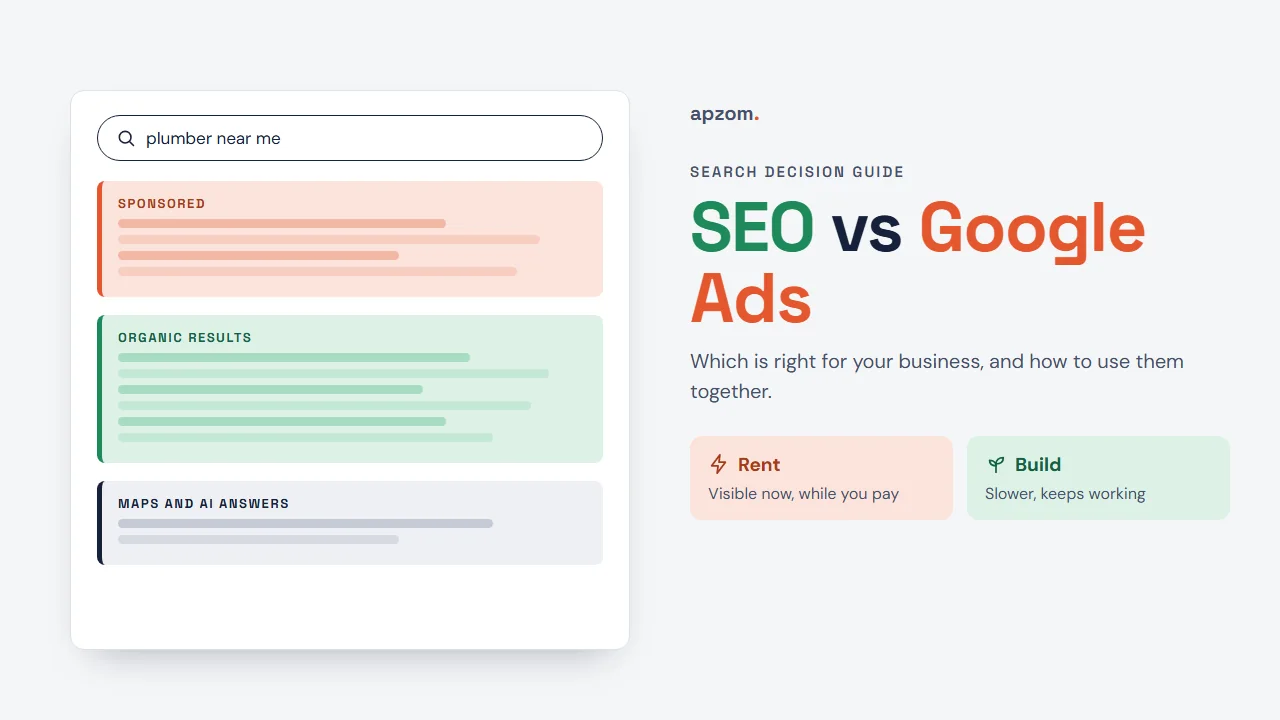
The short answer: Google Ads buys you a place in search results today, for as long as you keep paying. SEO earns a place in the unpaid results over months, and keeps working when you stop spending on it. Neither is better in general. The right choice depends on how urgently you need enquiries, how much people already search for what you sell, what a customer is worth to you, and how long you can wait.
This guide is for business owners and marketing managers deciding where to put their search budget. It explains how each channel actually works, the six questions that usually decide the choice, which mix suits which kind of business, how to use each channel to make the other better, and how to measure both fairly so you are not comparing a sprint with a marathon.
How each channel works, in plain terms
Google Ads is an auction. You choose the searches you want to appear for, write ads and set a budget. When someone searches, Google runs an auction among advertisers. Where your ad appears depends on your Ad Rank, which Google bases on six factors: your bid, the quality of your ads and landing page, Ad Rank thresholds, how competitive the auction is, the context of the search, and the expected impact of your ad assets. You usually pay when someone clicks. Google labels ads as sponsored in the results.
SEO (search engine optimisation) means making your website the best, clearest answer for the searches your customers make, so Google shows it in the unpaid results. You cannot pay Google to rank higher there. Google says it only sells ad space, so no one can buy better placement in organic results, and advertisers get no ranking boost. SEO work includes building the right pages, writing useful content, fixing technical problems, earning links and mentions, and for local businesses, managing your Google Business Profile.
The core difference: renting versus building
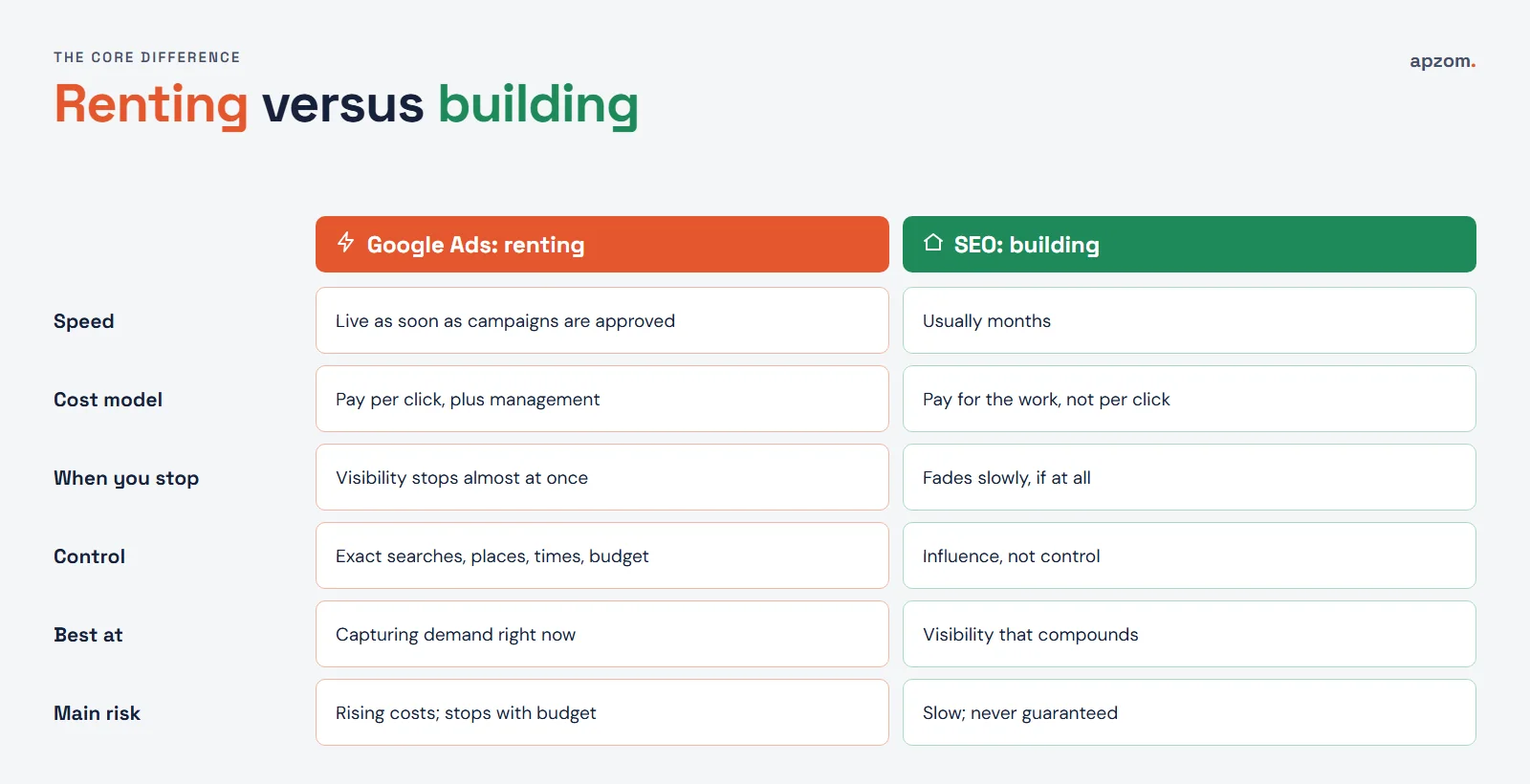
| Factor | Google Ads | SEO |
|---|---|---|
| Speed | Ads can show as soon as a campaign is approved and live | Usually months before meaningful results |
| Cost model | Pay for each click, plus management | Pay for the work (people, content, technical fixes), not per click |
| When you stop | Visibility stops almost immediately | Visibility fades slowly, if at all |
| Control | Choose exact searches, locations, times, budget | Influence, not control; Google decides rankings |
| Where you appear | Ad positions, labelled “Sponsored” | Organic results, maps, and AI and answer features |
| Best at | Capturing demand that exists right now | Building visibility that compounds over time |
| Main risk | Costs rise with competition; stops when budget stops | Slow; results not guaranteed; can lose ground to competitors |
Think of Google Ads as renting a shop on the high street and SEO as building your own. Renting gets you open this week. Building takes time, but you are not paying rent forever.
Six questions that decide it
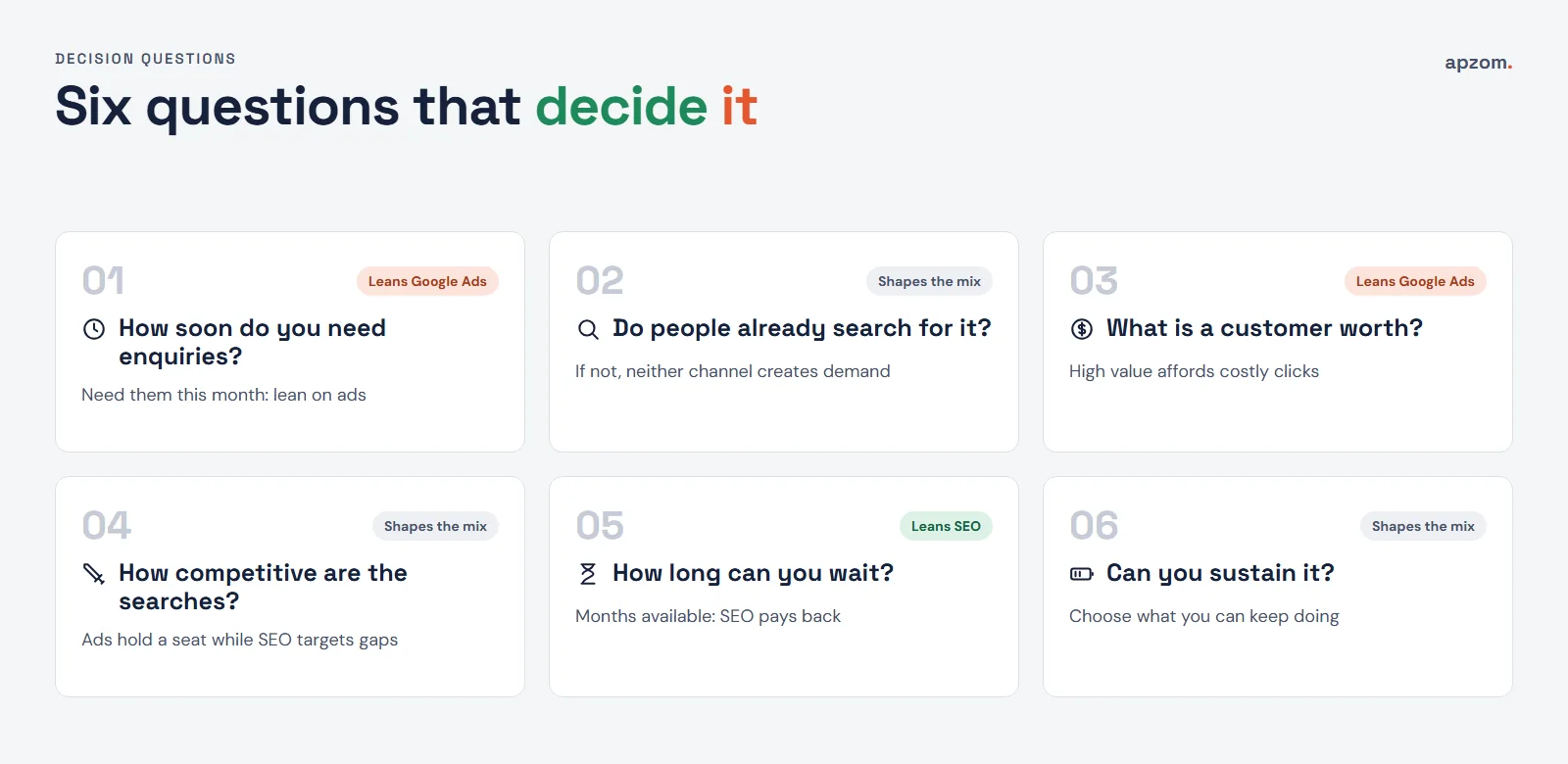
1. How soon do you need enquiries?
If you need leads this month, for a launch, a new location, a seasonal peak or cash flow, Google Ads is the only one of the two that can deliver that quickly. SEO is a poor choice for urgent demand.
2. Do people already search for what you sell?
Both channels capture existing searches. If people do not search for your product or service because they do not yet know it exists, neither channel will create that demand on its own. You may need social media, content or partnerships first.
3. What is a customer worth to you?
When a single customer is worth a lot, such as a legal matter, a dental implant, a construction project or a B2B contract, you can afford expensive clicks, and both channels are usually worth it. When each sale is small, expensive clicks can wipe out the margin, and SEO often matters more.
4. How competitive are the searches?
In crowded markets, clicks can be expensive and organic rankings slow to win. Google Ads gives you a guaranteed seat at the table while SEO works on more specific searches that competitors ignore.
5. How long can you wait?
SEO usually takes months. Google’s own starter guide says some changes take effect in a few hours and others can take several months, and that you should wait a few weeks before judging whether a change helped. Google also says no one can guarantee a number one ranking. If the business cannot wait, start with ads.
6. Can you sustain it?
Google Ads needs a budget every month, forever, and someone managing it properly. SEO needs consistent work and patience. Choose what you can actually keep doing; half-done SEO and under-funded ads both waste money.
Which mix suits which business?
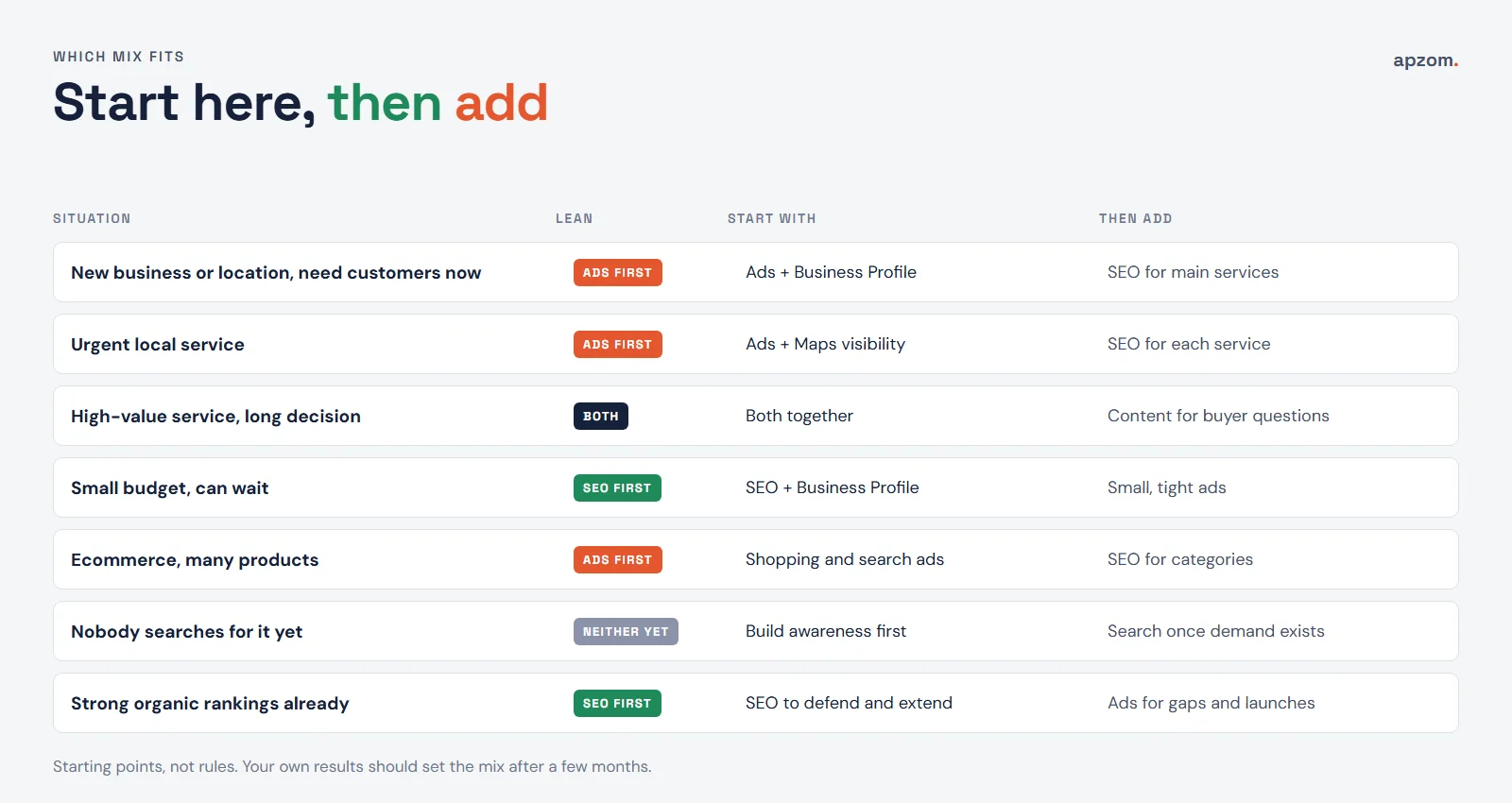
| Situation | Usually start with | Then add |
|---|---|---|
| New business or new location, need customers now | Google Ads plus a complete Google Business Profile | SEO for your main services and area |
| Urgent local services (emergency repairs, locksmiths) | Google Ads and Maps visibility | SEO for each service |
| High-value services with long decisions (legal, B2B, construction) | Both: ads for urgent searches, SEO for research searches | Content that answers buyer questions |
| Small budget, can wait | SEO and Google Business Profile | Small, tightly targeted ads for your best service |
| Ecommerce with many products | Shopping and search ads for top sellers | SEO for categories and products |
| Product or idea people do not search for yet | Neither alone; build awareness first | Search once people start looking |
| Established site with good organic rankings | SEO to defend and extend | Ads for gaps, launches and competitor-heavy searches |
These are starting points. Your own results should decide the mix after a few months.
Use each channel to make the other better
The strongest search strategies treat ads and SEO as one system.
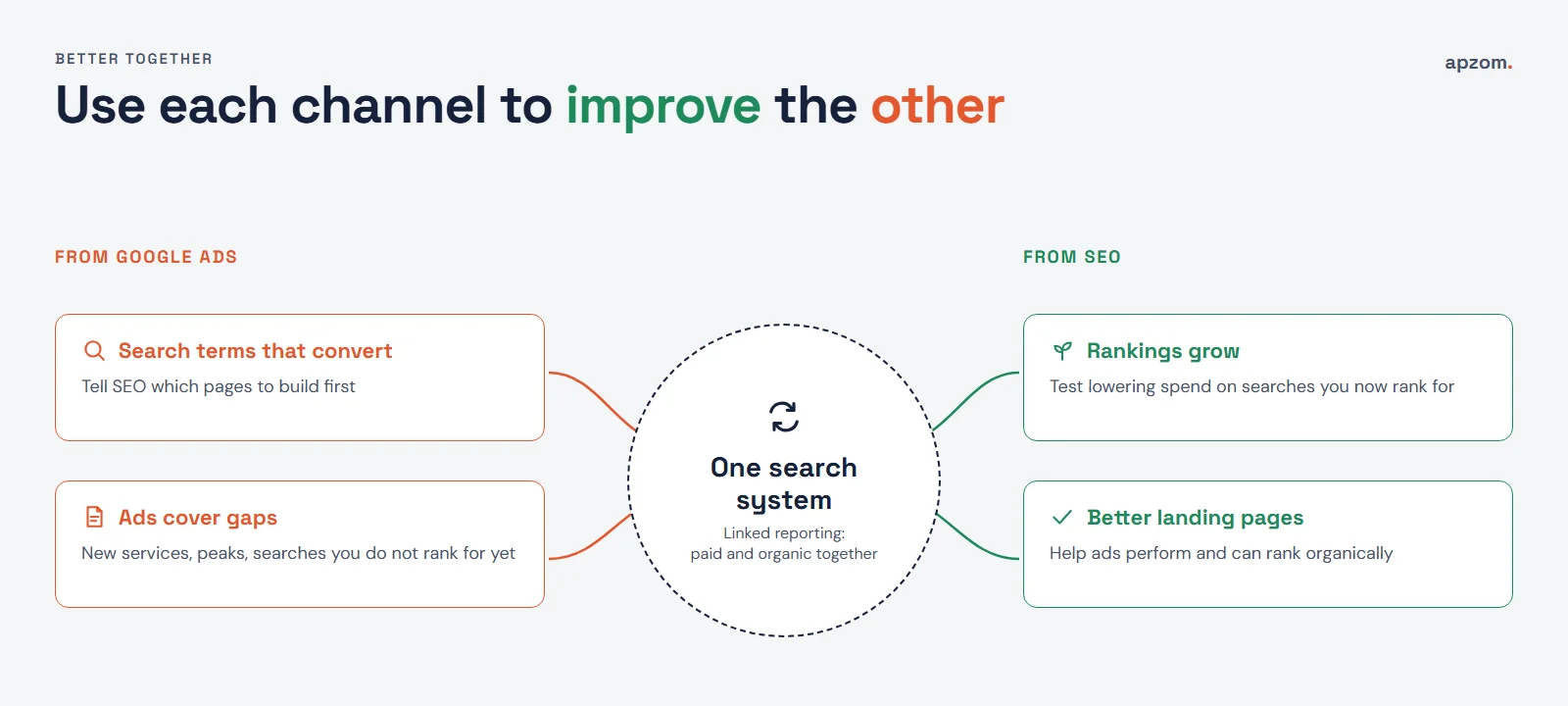
- Ads show you what converts. The search terms report in Google Ads shows the exact searches that led to enquiries. Use those to decide which SEO pages to build first.
- SEO lowers what you need to spend. As organic rankings grow for a search, you can test reducing ad spend on it and measure whether total enquiries hold.
- Landing pages serve both. A strong service page helps your ads perform and can rank organically.
- Ads cover the gaps. Use ads for searches you do not rank for yet, new services and seasonal peaks.
- Brand searches deserve a decision. Whether to bid on your own brand name depends on whether competitors bid on it. Test it rather than assuming.
Google Ads and Search Console can be linked, which lets you compare paid and organic performance for the same searches in one report.
Not sure where your search budget should go? A Search Strategy Review looks at your search demand, competition, customer value and current results, and recommends a mix of SEO and Google Ads you can measure.
What each one really costs
There is no honest “average cost” for either channel that applies to your business. Costs vary hugely by industry, location, competition and how well the work is done.
Google Ads costs are the clicks you pay for plus the cost of managing the account. You set a budget, and Google may spend more than your average daily budget on some days, but it limits your monthly charges based on that average. Clicks in competitive industries can be expensive. The real measure is cost per qualified enquiry and per customer, not cost per click.
SEO costs are the work: strategy, writing, technical fixes, page building and earning authority, whether done in-house or by an agency. There is no per-click charge, but the investment comes before the results.
To compare them fairly, look at the cost per customer over 12 months or more, not over the first month. In the first month, ads will almost always look better, because SEO has not started working yet.
How to measure both fairly
| Measure | Google Ads | SEO |
|---|---|---|
| Visibility | Impressions, impression share | Impressions and positions in Search Console |
| Traffic | Clicks, cost per click | Organic clicks |
| Enquiries | Conversions from tracked calls and forms | Organic calls and forms, tracked by source |
| Quality | Qualified leads, sent back to Google Ads from your CRM | Qualified leads by landing page |
| Revenue | Customers and value by campaign | Customers and value by page or topic |
| Time frame | Weekly and monthly | Quarterly and yearly |
Two things make the comparison honest. First, record the source of every enquiry, so you know which channel produced customers, not just clicks. Second, send real outcomes back into Google Ads, such as qualified leads or sales from your CRM, so the campaigns learn to find more of them. Google Ads supports this through offline conversion imports and enhanced conversions for leads.
Common mistakes
- Choosing by month-one results. Ads always win month one. Judge over a year.
- Running ads to the homepage. Send each ad to the page that matches the search.
- Doing SEO with no plan. Random blog posts rarely bring customers. Build the pages that match buying searches first.
- Ignoring the Google Business Profile. For local businesses, it often matters as much as the website. Our Google Business Profile checklist covers it, and our local SEO checklist covers the rest.
- Measuring clicks, not customers. Track enquiries and sales by source.
- Believing guarantees. Nobody can guarantee a number one ranking, and no one controls the ad auction.
What about AI search?
Google’s search results now include AI-generated answers. Ads can appear within AI Overviews in a set of English-language markets, including the US and India, and Google has been testing ads in AI Mode in the US. Organic content can also be shown and linked in AI answers. The same principle applies: Google says there are no special requirements to appear in its AI features beyond good SEO. Ads and SEO both still matter; the layout of the results page keeps changing, which is another reason to measure customers rather than positions.
Industry guides
How the choice plays out differs by industry. Our guides cover it in more depth for small businesses, dental practices, law firms, construction companies and manufacturers.
How Apzom can help
Apzom Digital runs both SEO and Google Ads management, so we have no reason to push you towards one. We start by looking at your search demand, your competition, what a customer is worth and how quickly you need results, then recommend a mix and a way to measure it. If you are comparing agencies, our guide on how to choose a digital marketing agency lists the questions worth asking.
Request a Search Strategy Review. We look at what your customers search for, what competitors do in both paid and organic results, your website’s current visibility, your ad account if you have one, and how enquiries are tracked. You get a recommended mix, priorities and a way to measure them.
The review is free, with no obligation and no guaranteed rankings. Prefer to talk it through? Contact us or see all our services.
Frequently asked questions
Is SEO or Google Ads better?
Neither is better in general. Google Ads brings visibility quickly for as long as you pay; SEO builds visibility slowly that keeps working. Most businesses with real search demand benefit from both, weighted by urgency, budget and customer value.
Does paying for Google Ads help my SEO rankings?
No. Google says it only sells ad space and advertisers get no ranking boost in organic results. Ads can, however, show you which searches convert, which helps you decide what SEO work to do first.
How long does SEO take compared with Google Ads?
Google Ads can show your ads as soon as campaigns are live and approved. SEO usually takes months to show meaningful results, depending on competition and the state of your website.
Can I do SEO and Google Ads at the same time?
Yes, and they often work better together. Ads capture demand now and show which searches convert; SEO builds lasting visibility for those searches.
Which is cheaper, SEO or Google Ads?
It depends on your market. Ads cost money for every click; SEO costs money for the work. Over a year or more, SEO often costs less per customer for searches you rank well for, but it needs investment before it pays back.
Should a new business start with SEO or Google Ads?
Usually with Google Ads and a complete Google Business Profile for quick enquiries, while starting SEO for its main services. Shift the balance as organic visibility grows.
What if no one searches for my product?
Then neither channel can capture demand that does not exist yet. Build awareness through social media, content, partnerships or PR first, and use search once people start looking.
Can an agency guarantee first-page rankings?
No. Google’s own guidance says no one can guarantee a top ranking. Treat any such promise as a red flag.