
The short answer: Good digital marketing for a car dealership does three jobs. It makes sure buyers can find your stock online with real photos and honest prices. It turns their enquiries into booked test drives quickly. And it keeps customers coming back for service and their next car. A good agency will start with your vehicle pages, inventory feed and Business Profile before spending on ads, follow the price and finance advertising rules in your country, and judge results in cars sold and service bookings, not clicks.
This guide is for franchised new-car dealers, independent used-car dealers, dealer groups, and dealers in motorcycles, commercial vehicles and electric vehicles, in any country. It covers how buyers shop for a car now, why your stock is your best content, which channels suit which kind of dealer, how to handle leads, how to market your service department, the advertising rules on prices and finance, and what to measure. Where rules differ by country, we say which country.
How people shop for a car now
Car buyers do most of their homework online. Cox Automotive’s 2025 Car Buyer Journey study of US buyers, published in January 2026, found that people spent about 14 hours buying a car, and around 7 of those hours researching and shopping online. 59% visited a dealership website along the way, and 75% used third-party listing sites. Habits differ by country, but the pattern is the same in most markets: most of the shopping now happens on a screen before anyone walks into a showroom. By the time a buyer calls or visits, they have often picked a model, compared prices and looked at a few specific cars in stock. The visit is for checking the car, the deal and the people.
The first framework we use with dealers is the five buyer questions. Every buyer needs answers to all five before they visit, and your marketing should answer each one online.
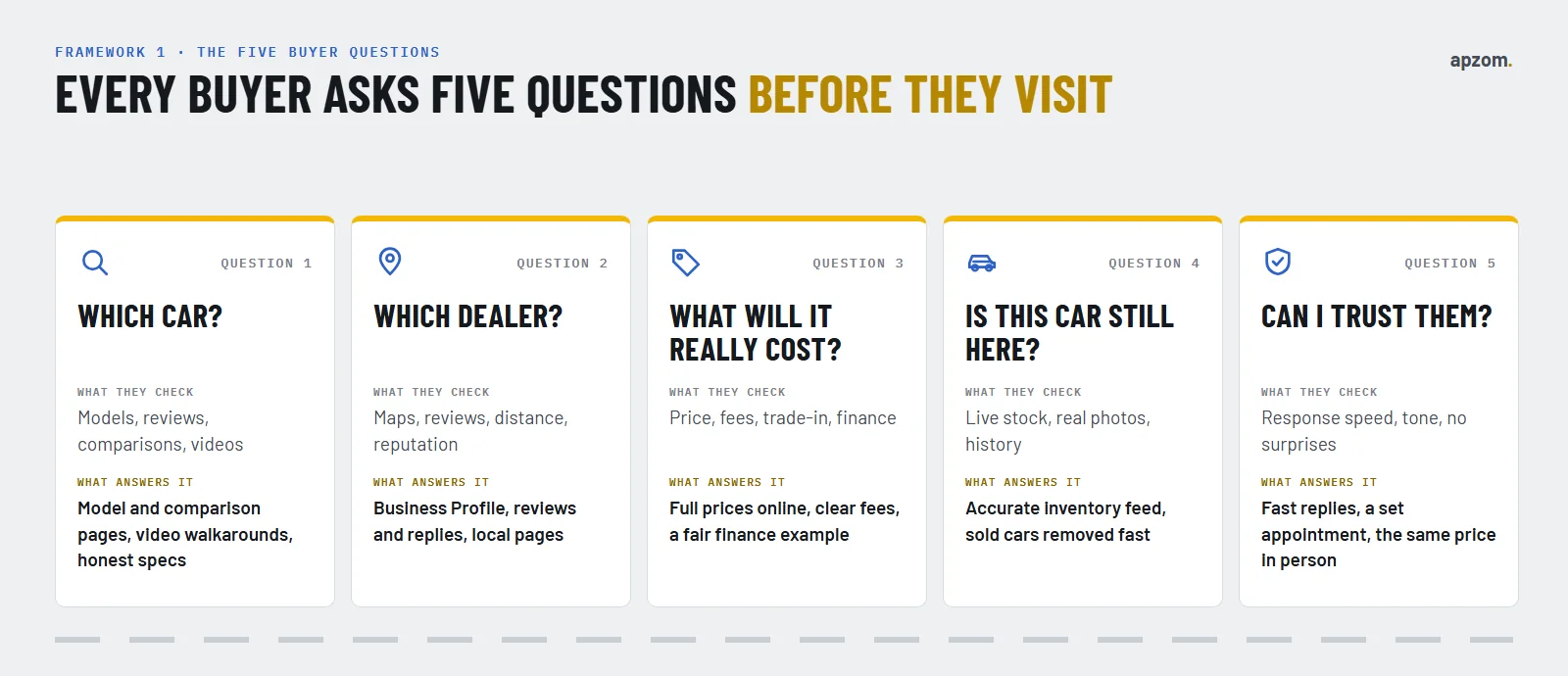
| Buyer question | What they check | What answers it |
|---|---|---|
| 1. Which car? | Models, reviews, comparisons, videos | Model and comparison pages, video walkarounds, honest specs |
| 2. Which dealer? | Maps, reviews, distance, reputation | A complete Business Profile, reviews and replies, local pages |
| 3. What will it really cost? | Price, fees, trade-in value, finance | Full prices online, clear fees, a fair finance example |
| 4. Is this car still here? | Live stock, real photos, history | An accurate inventory feed; sold cars removed quickly |
| 5. Can I trust them? | Response speed, tone, no surprises | Fast replies, a set appointment, the same price in person |
Many dealers spend most of their budget on question 1, through brand-style ads, and leave questions 3, 4 and 5 to chance. The buyer then finds a dealer that answers them better.
Your stock is your best content
For most businesses, content means articles. For a dealer, your best content is the vehicle detail page: the page for one specific car (often called a VDP in the trade), along with the search results pages that list your stock. These pages are what shoppers compare, what ads link to and what search engines can show for model searches in your area.
The second framework is the vehicle page test: six things every vehicle page needs before you spend money sending people to it.
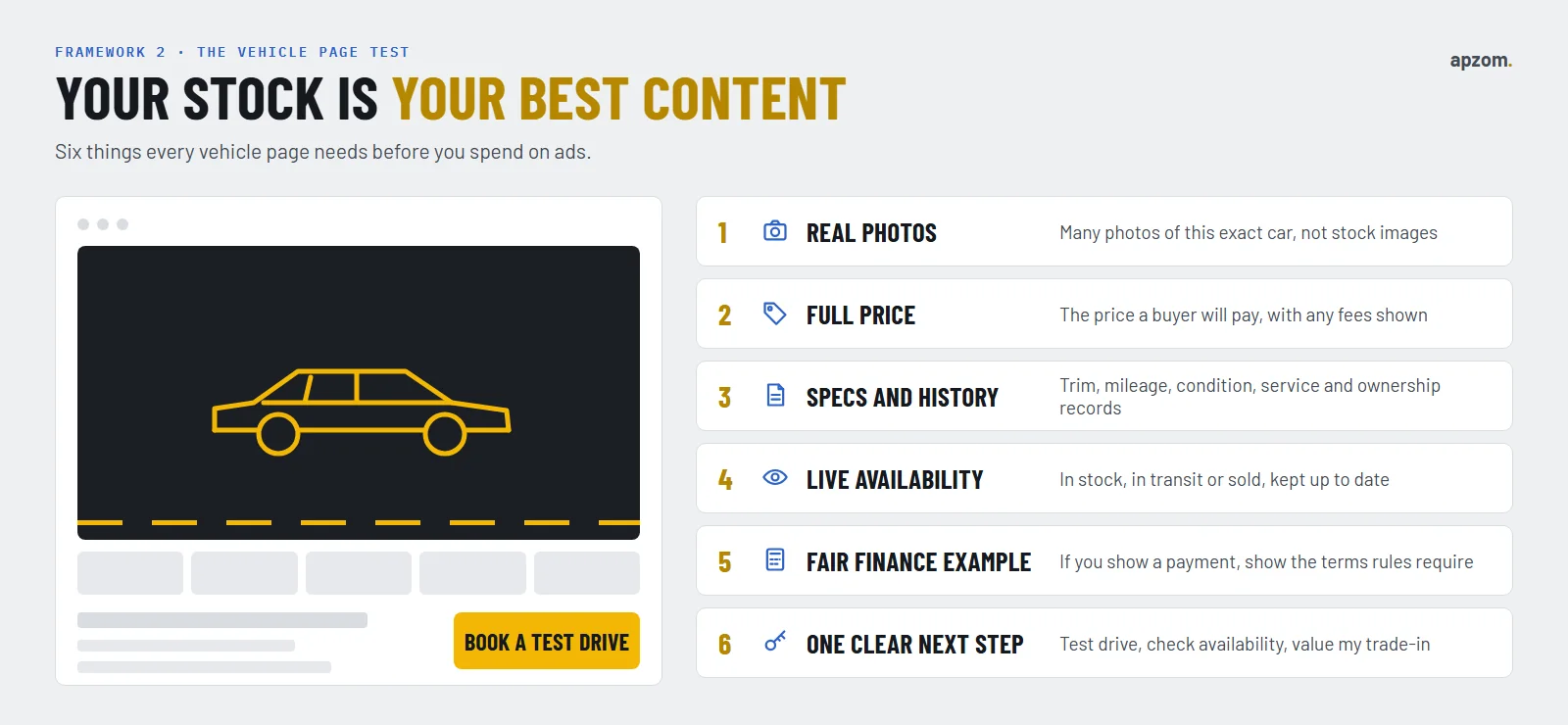
- Real photos. Many photos of this exact car, inside and out, including any marks. Stock images make a used car look like a bait offer.
- The full price. The price a buyer will actually pay, with any fees shown. In several countries, this is a legal requirement, not just good practice (see the rules section below).
- Specs and history. Trim, mileage, condition, service history and ownership records, plus any vehicle history report you offer.
- Live availability. In stock, in transit, reserved or sold, kept up to date. Nothing frustrates a buyer more than driving to see a car that sold last week.
- A fair finance example. If you show a monthly payment, show the terms that the law in your country requires alongside it.
- One clear next step. Book a test drive, check availability or value my trade-in. Not five competing buttons.
Pages that pass this test do better in search, convert better from ads and cause fewer arguments in the showroom. Your website platform or inventory system should handle most of this automatically. If it cannot, that is the first thing to fix.
Which kind of dealer are you?
The third thing to decide is the channel mix, and it depends on what you sell. A franchised dealer, a used-car lot and a motorcycle dealer have different buyers.
| Type of dealer | What buyers care about | Channels to start with |
|---|---|---|
| Franchised new-car dealers | Model choice, offers, finance, service | Vehicle ads, search ads on model and local terms, Business Profiles for each department, service marketing |
| Independent used-car dealers | Price, condition, history, trust | Vehicle pages, used-car marketplaces, reviews, vehicle ads, Meta ads with stock |
| Luxury and specialist dealers | Rarity, provenance, the experience | Video walkarounds, Instagram and YouTube, a strong vehicle page, email to past buyers |
| Commercial vehicles and fleets | Uptime, running costs, finance, servicing | Search ads, LinkedIn, case-style pages, account management |
| Motorcycle and scooter dealers | Models, test rides, accessories, finance | Instagram and YouTube, local search, test ride events, Meta ads |
| Electric vehicle specialists | Range, charging, incentives, running costs | Explainer content, comparison pages, search ads, local search |
Local search and your Business Profile
Car buying is local. Even buyers who shop online want a dealer they can drive to. Google Maps and the local results are often the first place a buyer meets you.
Google’s Business Profile guidelines for dealerships allow separate profiles for the dealership’s sales, service and parts departments, each with its own name and its own main category (for example “Car dealer”, “Car service” or “Auto parts business”). New-car dealers can also have one profile for each brand they sell; used-car dealers cannot. Check the current guidelines before you add profiles, because duplicate or rule-breaking profiles can be suspended.
- Choose the most accurate primary category, and keep hours, phone numbers and website links correct for each department.
- Add real photos of the showroom, the service area and the forecourt. Update them when the site changes.
- Ask every buyer and service customer for a review, and reply to all of them, including the bad ones, calmly and specifically.
- Make sure your name, address and phone number match on your website, Business Profile and the main listing sites in your country.
Our Google Business Profile checklist and local SEO checklist cover the details step by step.
SEO for dealerships
Search engine optimisation for a dealer is mostly about structure, not blog posts.
- Model and location pages. A page for each model you sell, and pages for the areas you serve, with real information, not the same text with the town name swapped.
- Clean inventory pages. Search engines need to crawl your stock. Make sure vehicle pages have their own URLs, unique titles and descriptions, and that sold cars are handled sensibly (shown as sold or redirected to similar stock, not left as broken pages).
- Structured data. Google used to show special vehicle listing results from structured data, but it retired that feature in 2025. Clean Car or Vehicle markup on your vehicle pages is still good practice because it helps search engines and AI tools read your stock correctly. Just do not expect it to create special search results on its own.
- Service and parts pages. “Car service near me” and “[brand] service” searches bring steady, high-value visits. Many dealer sites hide service behind one generic page.
- Helpful buyer content. Honest comparisons, ownership costs, EV charging explained, trade-in guides. Write for the questions your sales team hears every day.
Our SEO services and local SEO services pages explain how we approach this.
Paid search and vehicle ads
Search ads catch buyers who are ready: people searching for a model, a used car in their city, or a dealer by name.
Google’s vehicle ads show your actual cars, with a photo, price and mileage, directly in Google Search. They run through a Performance Max campaign that uses a vehicle feed from Google Merchant Center. According to Google’s Merchant Center help pages, they are fully available in the US, Canada, Australia and Japan, are opening up across Europe (including France, the Netherlands, Germany, Italy and Spain) and are still in beta in the UK. Google’s pages do not always agree on the European list, so check Google’s vehicle ads page for your country before you plan around them.
Google also used to show dealer stock for free in Search and on Business Profiles. It has switched that feature off, so today the main ways to put individual cars in front of Google searchers are paid vehicle ads and strong vehicle pages on your own website.
A few rules of thumb for dealer search campaigns:
- Split campaigns by intent: your own brand, model searches, used-car searches, service and parts. They have very different values.
- Keep the feed accurate. Ads that show a sold car or a wrong price waste money and annoy buyers.
- Send traffic to the matching vehicle or model page, not your home page.
- Track calls, forms and chats as conversions, and bring in which of those leads became a sale if your CRM allows it.
Our Google Ads management page covers how we set up and run campaigns.
Social media, video and Meta ads
Cars are visual and emotional, which suits video. Short walkarounds, delivery-day content (with the customer’s permission), service tips and new-arrival posts work well on Instagram, Facebook, YouTube and TikTok.
Meta’s automotive inventory ads use your vehicle feed to show the right cars to people who have shown interest in them on Facebook and Instagram. Check in Meta Ads Manager that the format is available in your country before you plan a campaign around it.
If an ad promotes car finance, such as monthly payments or loan rates, Meta treats it as a financial products and services ad. That special ad category replaced the older “Credit” category in January 2025. It is required for ads in the US, and Meta’s credit rules also cover Canada and parts of Europe. It limits targeting: no age or gender targeting, no postcode targeting, and a wider minimum location radius. Plan finance campaigns with those limits in mind.
Our guide to Facebook and Instagram ads for local businesses explains how to set up campaigns, lead forms and tracking.
Plenty of clicks, not enough test drives? A Dealership Marketing Audit follows a buyer from the first search to the showroom and shows where your leads leak.
The lead lane: from enquiry to test drive
Ads buy enquiries. The lead lane sells cars. This is our fourth framework: six steps every enquiry should move through, and the points where leads usually leak.
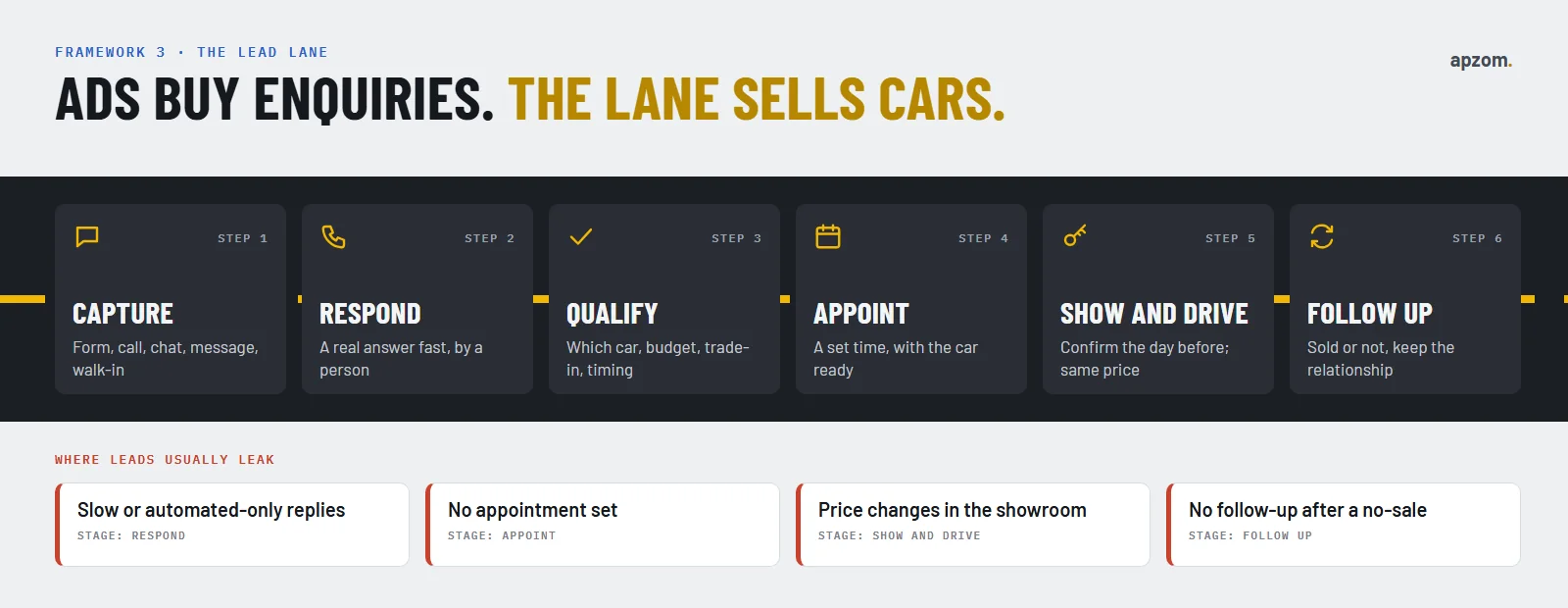
| Step | What should happen | Where it usually leaks |
|---|---|---|
| 1. Capture | Forms, calls, chat, messages and walk-ins are logged in one place | Leads sit in separate inboxes and some are never seen |
| 2. Respond | A real person replies quickly, with a useful answer about the car | Slow replies, or only an automated email |
| 3. Qualify | Which car, budget, trade-in and timing | Sales staff push for a visit without listening |
| 4. Appoint | A set time, with the car cleaned and ready | “Come in any time” with no booking |
| 5. Show and drive | A reminder the day before; the same price as online | The price or availability changes in the showroom |
| 6. Follow up | Sold or not, keep in touch with useful messages | No follow-up after a buyer says “not yet” |
Speed matters, but so does the quality of the first reply. A buyer who asks “Is this car still available?” wants a clear yes or no, a photo of the car today and a time to see it. A link to your home page and a request to “call us” does not help.
If you want marketing to improve, give your agency access to what happens after the lead: appointments, shows and sales by source. Without that, everyone is optimising for form fills.
Service, parts and the next car
For many dealers, the service department brings in steady income and the customers who will buy their next car from you. Marketing often forgets it.
- Make online service booking simple, on mobile, with real time slots.
- Remind customers when their service or roadworthiness test (such as the MOT in the UK) is due (where the customer has agreed to hear from you).
- Market seasonal checks, tyres and EV servicing in plain language.
- Ask for reviews after service visits as well as sales. Many buyers read service reviews before choosing a dealer.
- Use service visits to start the next sale: a fair trade-in valuation and an offer on a newer car, never a hard sell.
Advertising rules to know: prices, finance and driving
Car advertising is more regulated than most retail, and the rules differ by country. These are the ones that most often affect online ads and vehicle pages.
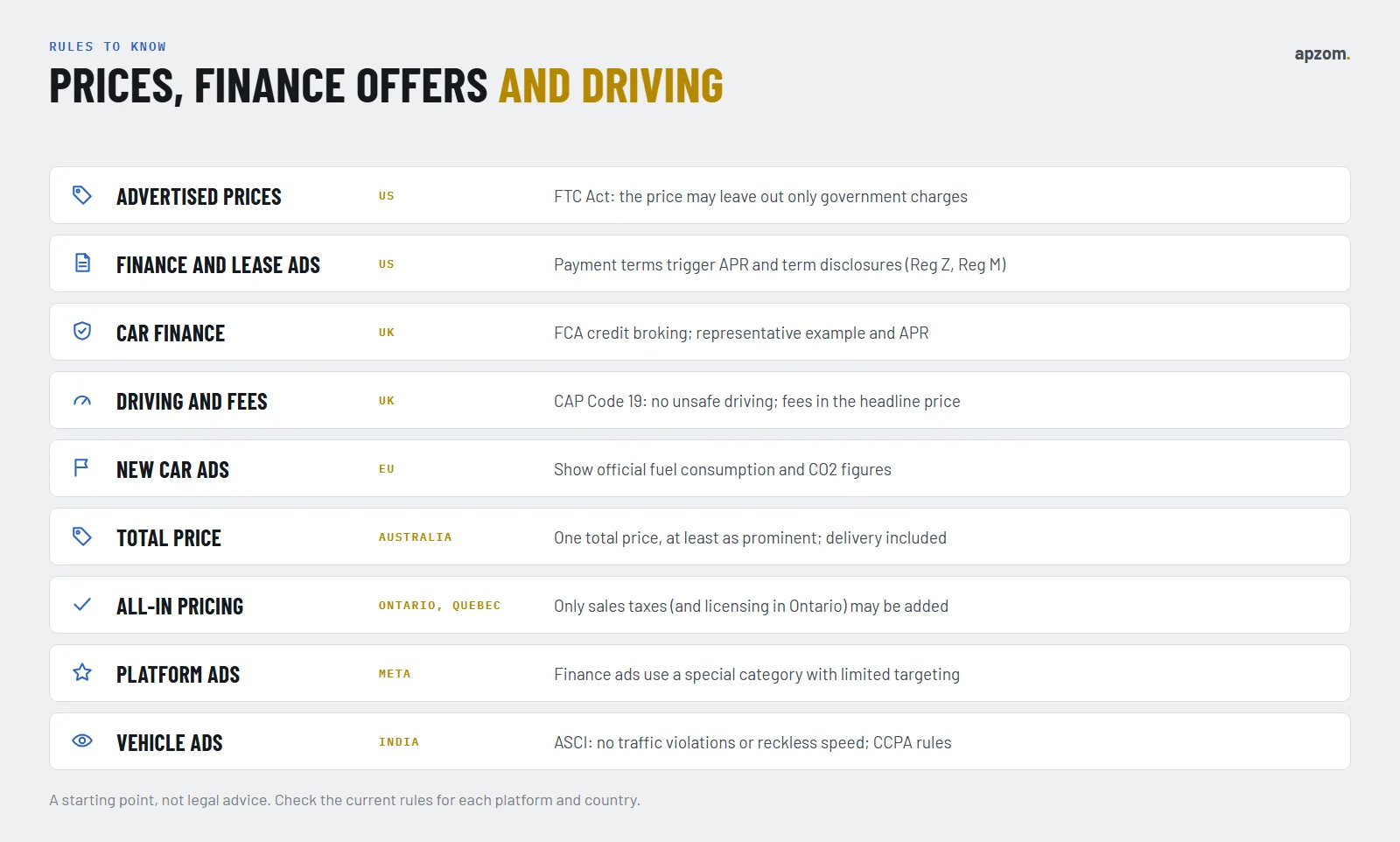
| Market | What to know |
|---|---|
| US: prices | The FTC’s CARS Rule was struck down by a federal appeals court in January 2025 and formally withdrawn in 2026. The FTC still acts against dealers under the FTC Act: in 2026 it sent warning letters to 97 dealer groups and settled cases over advertised prices that left out fees. Its 2026 guidance says the advertised price may leave out only government charges, such as taxes and registration |
| US: finance and leases | Under the Truth in Lending Act (Regulation Z), stating a down payment, a number of payments, a repayment period, a payment amount or a finance charge in a credit ad triggers more disclosures: the down payment, the repayment terms and the APR. Lease ads have similar trigger rules under Regulation M |
| UK: finance | A dealer that arranges finance needs FCA authorisation for credit broking. Under the FCA’s CONC rules, a finance ad that shows an interest rate or any cost of credit must include a representative example with the representative APR. The FCA’s motor finance compensation scheme, confirmed in March 2026, has been partly paused since July 2026 by a legal challenge |
| UK: driving and prices | The CAP Code’s motoring section (Section 19) bans ads that encourage unsafe or irresponsible driving, or speed in a way that might encourage breaking the law. Since 6 April 2025, the DMCC Act requires fees that every buyer must pay, such as an admin fee, to be in the headline price |
| EU | Under the Car Labelling Directive (1999/94/EC), promotional material for new cars must show official fuel consumption and CO2 figures. The European Commission proposed a replacement in December 2025; until it is adopted, the current rules apply |
| Australia | If a car ad shows part of the price, it must also show the single total price at least as prominently. The ACCC treats dealer delivery as part of that price, which is why “drive away, no more to pay” pricing is common |
| Canada | In Ontario, OMVIC requires all-in advertised prices: only HST and licensing may be added. Quebec has a similar rule, with only GST and QST excluded |
| UAE | The federal Consumer Protection Law (Federal Law No. 15 of 2020) requires clear and accurate information for consumers. Check current pricing rules with the Ministry of Economy or your emirate’s economic department |
| India | ASCI’s self-regulation guidelines for ads depicting automotive vehicles ban showing traffic violations, or speed that encourages unsafe or reckless driving. The CCPA’s 2022 guidelines on misleading advertisements, under the Consumer Protection Act 2019, apply to car ads and to the influencers who endorse them |
This is a starting point, not legal advice. Ask your compliance adviser or trade association about the rules for your market and your finance products.
Measure what matters
The fifth framework is the dealership scorecard. It moves reporting away from clicks and impressions towards cars sold and customers kept.
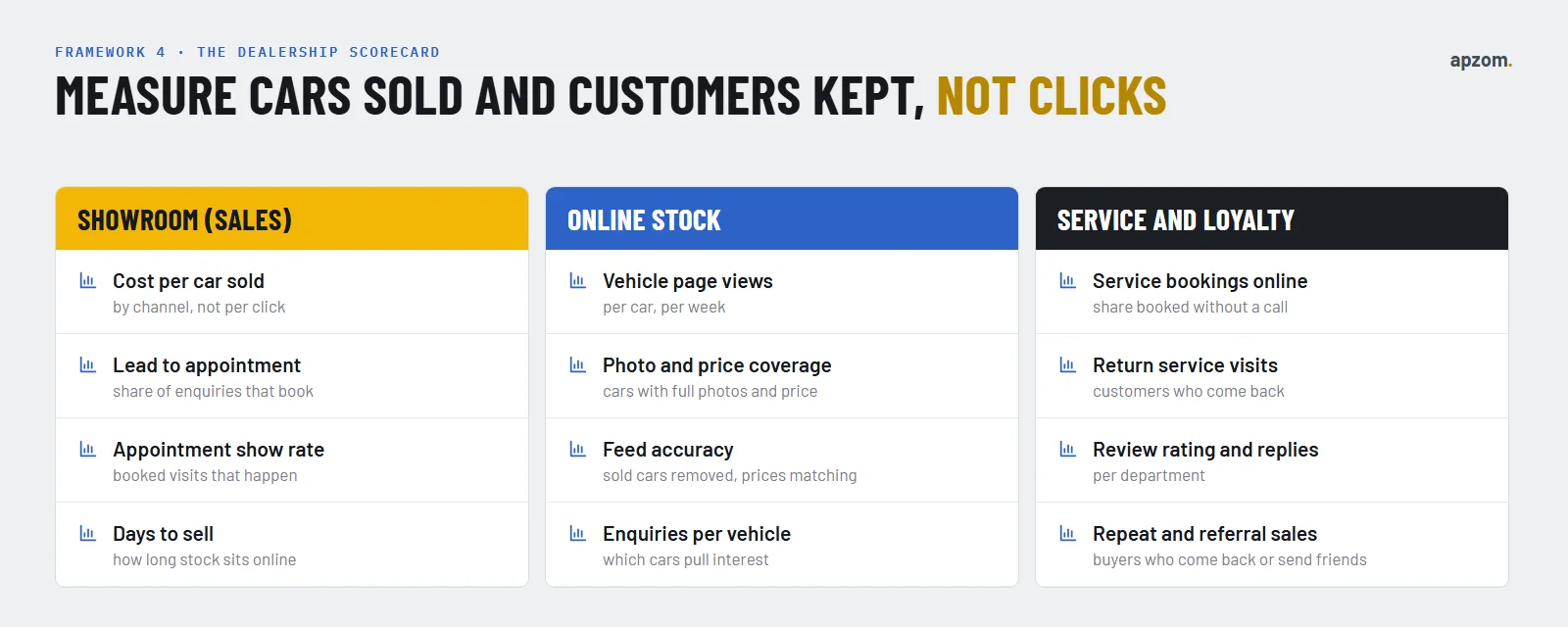
| Area | What to measure | Why it matters |
|---|---|---|
| Showroom | Cost per car sold by channel; lead-to-appointment rate; appointment show rate; days to sell | Shows which channels sell cars, not just which ones get clicks |
| Online stock | Vehicle page views per car; share of cars with full photos and price; feed accuracy; enquiries per vehicle | Shows whether your stock is presented well enough to sell |
| Service and loyalty | Online service bookings; return service visits; review rating and replies by department; repeat and referral sales | Shows whether customers stay with you after the sale |
You do not need every number on day one. Start with cost per car sold and lead-to-appointment rate, because they connect marketing to the showroom.
What to ask a dealership marketing agency
- Will we own our ad accounts, website, feed and data?
- How will you connect leads to appointments and sales in our CRM?
- How do you check our price and finance ads against the rules in our country?
- What will you fix on our vehicle pages before you spend on ads?
- What do you report every month, and how do you define a lead?
For a full list of questions and red flags, read our guide on how to choose a digital marketing agency. If you are deciding where to start, SEO vs Google Ads compares the two.
How Apzom can help
We help dealers fix the basics first: vehicle pages, inventory feeds, Business Profiles and lead handling, then add search, vehicle and social ads on top. We set up tracking from the first click to the booked test drive, and we check price and finance messages against the rules in your market. We work with clients worldwide, remotely, from our base in Ahmedabad, India.
We have not published a car dealership case study yet. In the automotive space, our AutoHunt case study describes a WordPress website we built from scratch for an automotive publication, together with its technical SEO. For lead generation with Meta ads, our Kingston Flats case study shows real lead numbers from a property client.
You can see how we work in our process, and the full list of what we do in our services, including website development, Meta ads management and conversion rate optimization.
Request a Dealership Marketing Audit. We review your Business Profiles, vehicle pages and inventory feed, ads, social channels, lead handling and service marketing, and check your price and finance messages against the rules in your country. You get a prioritised list of what to fix first.
No obligation and no guaranteed sales numbers. Prefer to talk first? Contact us or see all our services.
Frequently asked questions
What does a digital marketing agency for car dealerships do?
It helps buyers find your stock online, turns their enquiries into test drives and sales, and keeps customers coming back for service. In practice that means improving vehicle pages and inventory feeds, managing your Business Profiles and reviews, running search, vehicle and social ads, setting up lead tracking, and marketing your service department.
How can a car dealership get more leads?
Start with what buyers see before they enquire: real photos, full prices, accurate availability and a clear next step on every vehicle page. Then make sure your Business Profile is complete and reviews are answered. Only then add more ad spend. More traffic to weak vehicle pages usually means more wasted budget.
What is the best advertising for car dealerships?
There is no single best channel. Search and vehicle ads catch buyers who are ready to buy. Local search and reviews win buyers choosing between nearby dealers. Social video builds interest and works well for used and specialist stock. The right mix depends on your type of dealership, your stock and your market.
Do car dealers have to show the full price in online ads?
In many countries, yes, or close to it. Australia requires a single total price, Ontario requires all-in pricing, the UK’s DMCC Act bans leaving unavoidable fees out of the headline price, and the US FTC says an advertised price may leave out only government charges. Check the rules in your market before you publish prices.
Can a dealer advertise monthly payments?
Yes, but in most countries a monthly payment or other finance detail triggers extra disclosures, such as the interest rate and the full terms. In the US, Regulation Z sets these “trigger terms”. In the UK, a finance ad that shows a rate or cost of credit needs a representative example with the representative APR, and the dealer needs FCA authorisation to arrange finance. On Meta, finance ads also fall under a special ad category with limited targeting.
Is SEO worth it for car dealerships?
Yes, for most dealers. Model, used-car and service searches in your area bring buyers who are already looking. SEO for a dealer is mostly about clean vehicle and model pages, local search and service pages, rather than blogging. It takes longer than ads to build, but the traffic does not stop when the budget does.
How do you measure car dealership marketing?
Measure cost per car sold by channel, the share of leads that book an appointment, how many appointments show up, and service bookings. Clicks and impressions matter only as early signals. To measure properly, your agency needs to see what happens to leads after they arrive.
Can Apzom work with car dealers outside India?
Yes. We work with clients worldwide, remotely, from our base in Ahmedabad, India. We follow the advertising rules of each market, such as price and finance disclosure rules, and we use the platforms and listing sites that buyers in your country actually use.