
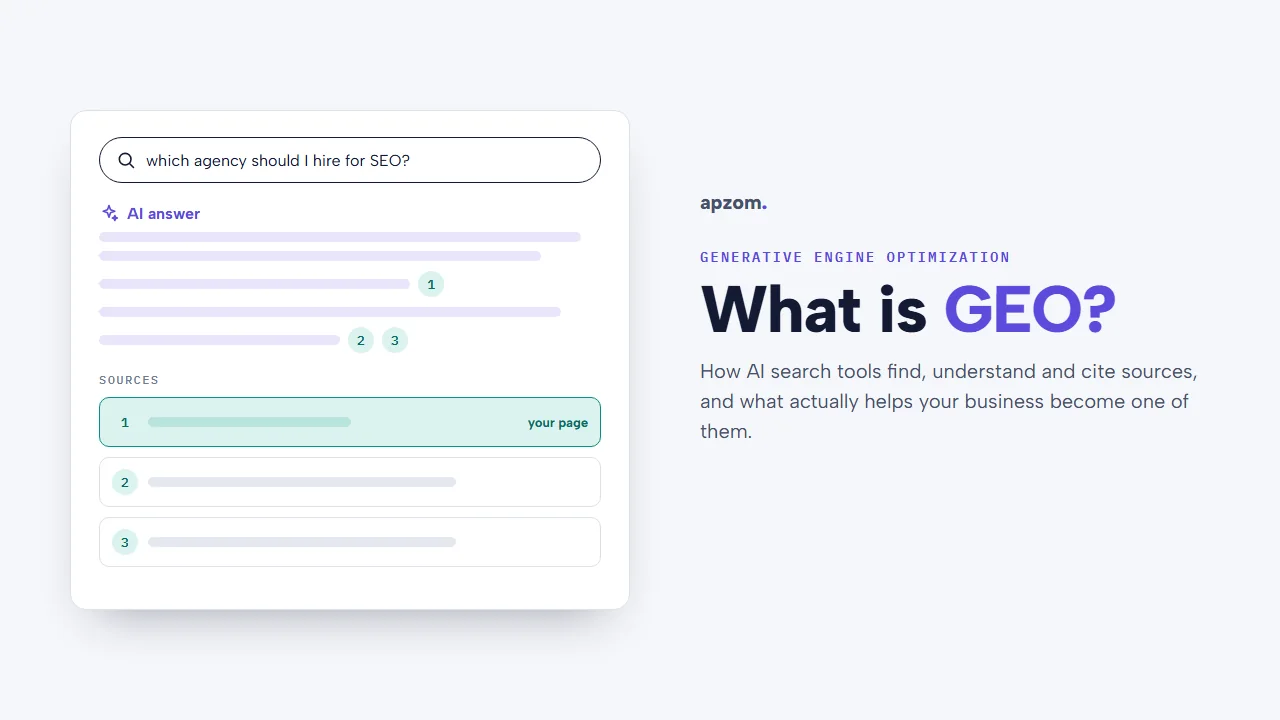
The short answer: GEO, or generative engine optimization, is the work of making your business and your content easy for AI search tools to find, understand and cite when they write an answer. Those tools include Google’s AI Overviews and AI Mode, ChatGPT search, Microsoft Copilot and Perplexity. GEO is not a replacement for SEO. It is built on the same foundations, with extra attention to clear facts, quotable passages and a consistent picture of your business across the web.
This guide is for business owners and marketers who keep hearing about GEO and want a straight answer. It explains where the term came from, how AI search tools pick their sources, what actually helps and what is hype, how to control which AI crawlers can use your content, and how to measure results without fooling yourself.
Where the term GEO comes from
The term comes from a research paper, “GEO: Generative Engine Optimization”, by Pranjal Aggarwal and colleagues. The original preprint, posted in November 2023, lists authors from Princeton University, Georgia Tech, the Allen Institute for AI and IIT Delhi. The paper was presented at the KDD 2024 conference in Barcelona. The researchers built a test set of queries, called GEO-bench, and measured how changes to web pages affected how visible those pages were in AI-generated answers.
They reported that adding citations to sources, quotations and statistics made content noticeably more visible, by up to 40% in their test setup. They also found that results varied by topic, and that old-style keyword stuffing did worse than making no changes at all. That finding is useful as a direction, but treat it with care: the main tests ran on a simulated AI search engine built by the researchers, not on Google or any live product, and the systems have changed a great deal since.
GEO, AEO and SEO: how they differ
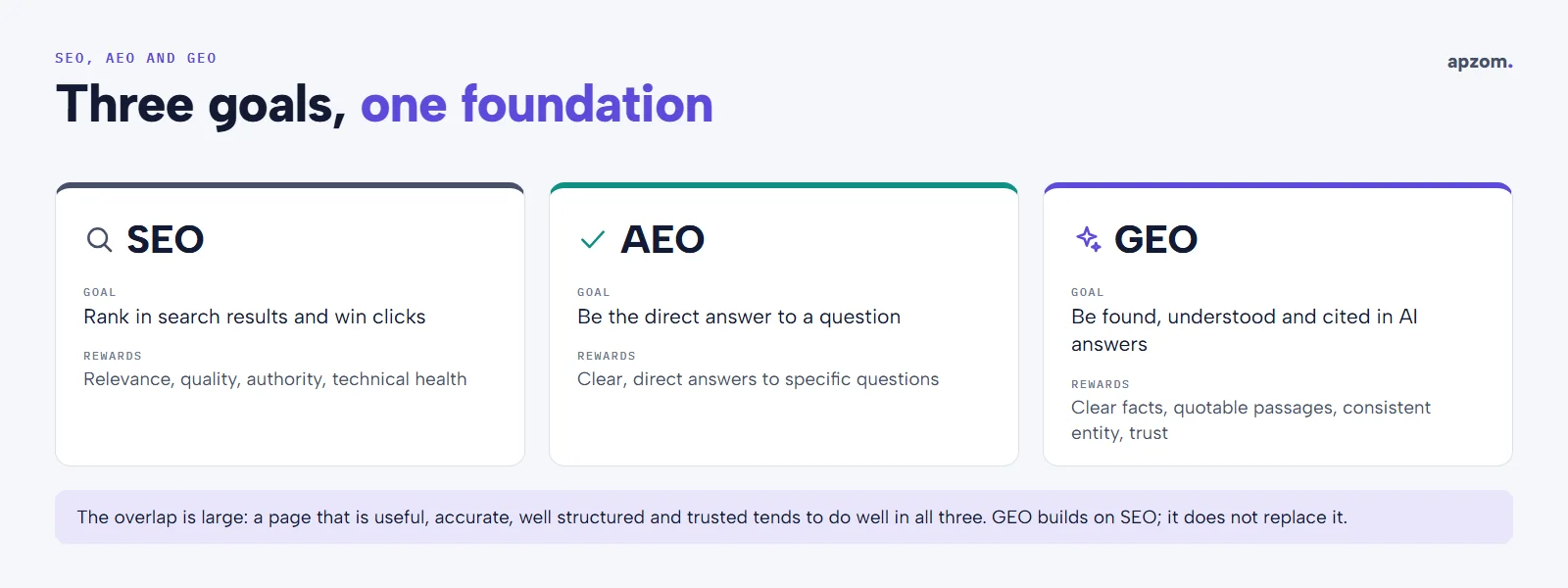
| Factor | SEO | AEO | GEO |
|---|---|---|---|
| Goal | Rank in search results and win clicks | Be the direct answer to a question | Be found, understood and cited in AI-generated answers |
| Where it shows | Traditional search results | Featured answers, voice assistants, answer boxes | AI Overviews, AI Mode, ChatGPT search, Copilot, Perplexity |
| What it rewards | Relevance, quality, authority, technical health | Clear, direct answers to specific questions | Clear facts, quotable passages, consistent entity information, trust |
| How you measure it | Rankings, clicks, conversions | Answer appearances, clicks | AI feature impressions, AI referral visits, mentions, enquiries |
The overlap is large. A page that is useful, accurate, well structured and trusted tends to do well in all three. GEO adds a sharper focus on whether an AI system can lift a correct fact from your page and attribute it to you.
How AI search tools choose their sources
Most AI search tools do not answer only from memory. They search an index of the web, pick relevant pages, and then write an answer based on them, often with links to the sources.
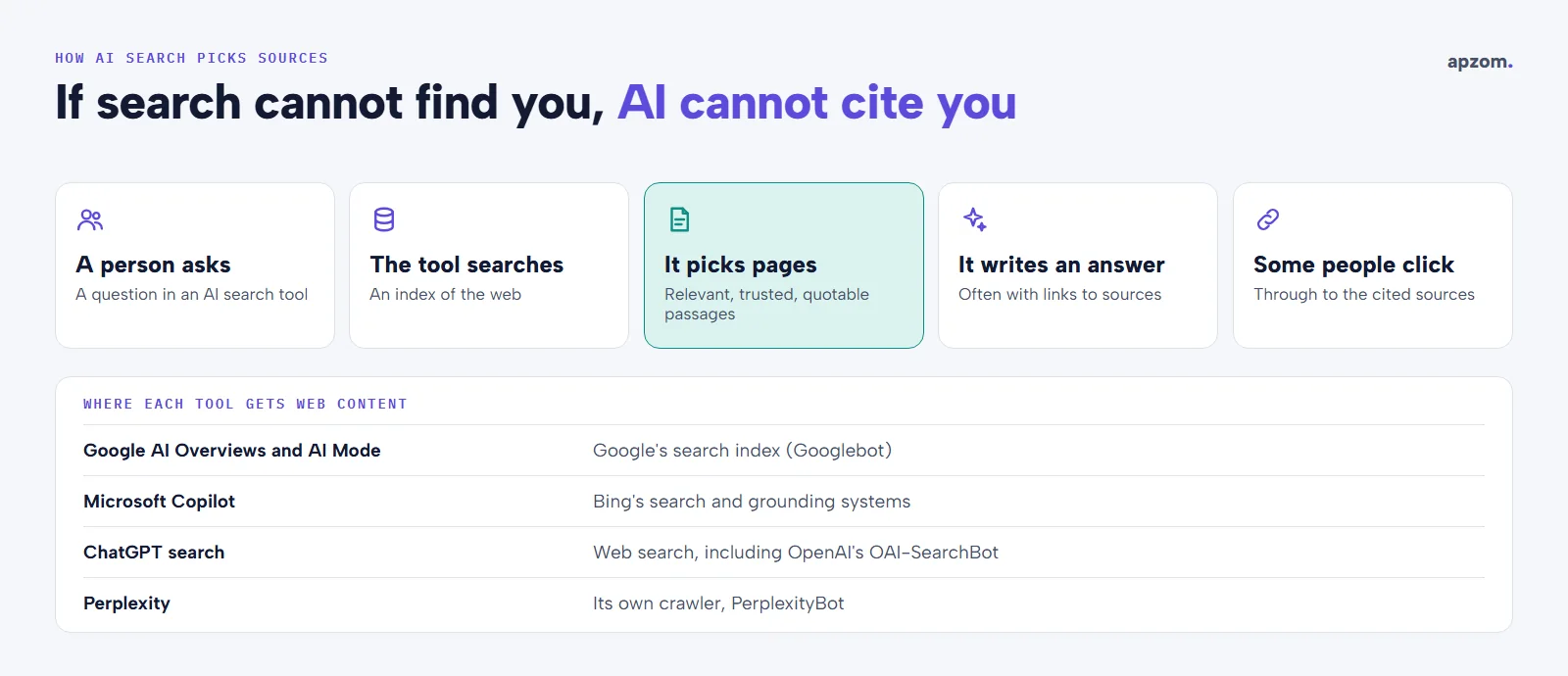
| AI search tool | Where it gets web content |
|---|---|
| Google AI Overviews and AI Mode | Google’s own search index, crawled by Googlebot |
| Microsoft Copilot | Bing’s search and grounding systems |
| ChatGPT search | Web search, including OpenAI’s own crawler, OAI-SearchBot |
| Perplexity | Its own crawler, PerplexityBot, and search systems |
This matters because it means the basics of being crawlable and indexable still come first. If a search engine cannot crawl, index and understand your page, the AI answer built on that engine cannot use it.
Google’s guidance is direct: there are no additional requirements to appear in AI Overviews or AI Mode, and no special optimisation is necessary. A page has to be indexed and eligible to be shown with a snippet in Google Search. Google also says its generative AI features are rooted in its core Search ranking and quality systems. Normal SEO best practice applies.
The four layers of GEO
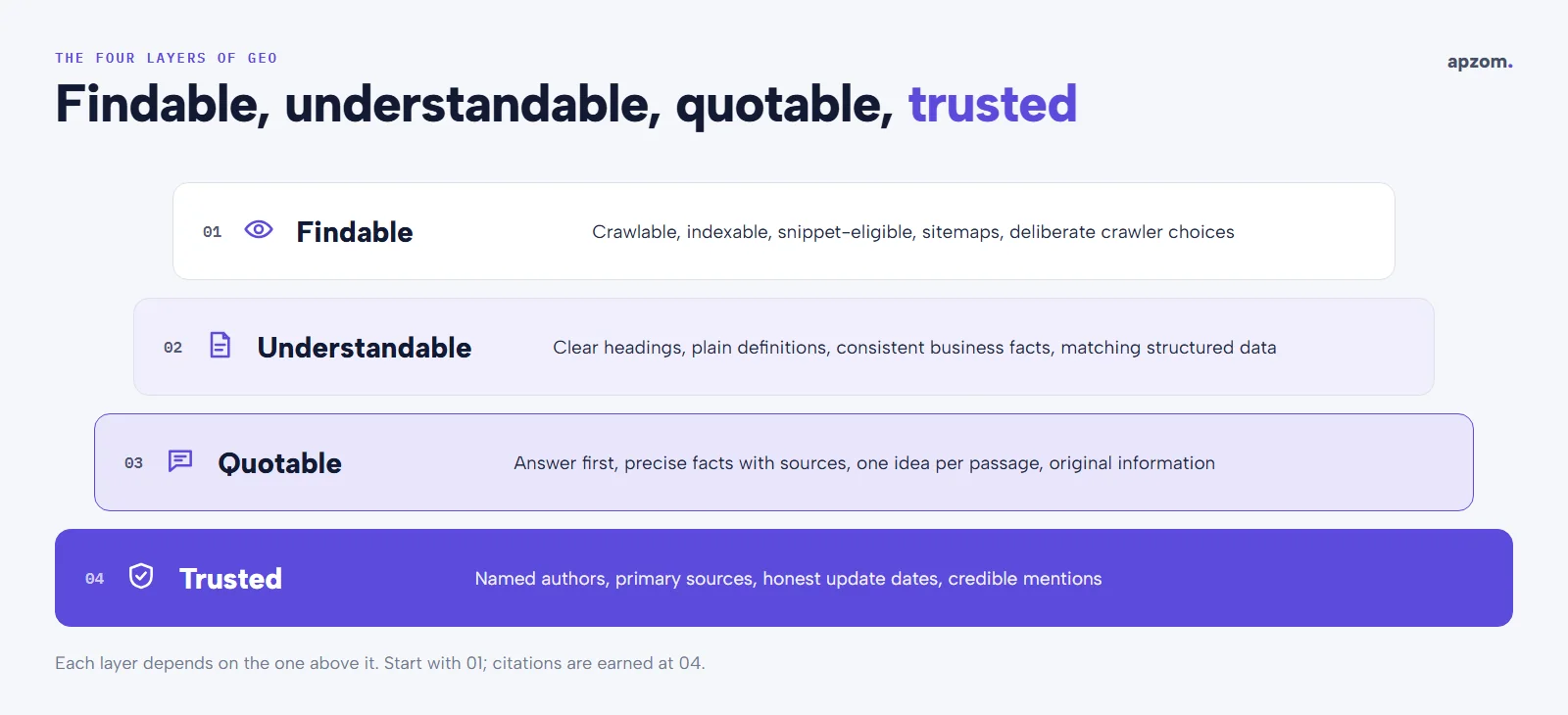
We use a simple framework to plan GEO work. Each layer depends on the one before it.
1. Findable
AI search tools can only use what their crawlers can reach.
- Make sure your important pages are crawlable, indexable and not blocked by mistake in robots.txt.
- Check that your pages can be shown with a snippet. Google’s controls, such as nosnippet, data-nosnippet, max-snippet and noindex, also limit what its AI features can show.
- Submit sitemaps to Google and Bing. IndexNow can also tell Bing and several other search engines about new and updated pages quickly, though Google does not use it.
- Decide deliberately which AI crawlers you allow (see the crawler table below).
2. Understandable
AI systems need to know what your page is about and who it comes from.
- Use clear, descriptive headings that match the questions people ask.
- Define terms plainly the first time you use them.
- Keep your business facts consistent everywhere: name, services, locations, founding year, people. Inconsistent facts confuse people and machines.
- Use structured data that matches the visible page, such as Organization, LocalBusiness, Person, Article and FAQ where they fit. Google says structured data is not required for its generative AI features, and that it should match the visible text on the page. Its main proven benefit is eligibility for rich results.
3. Quotable
AI answers are built from passages. Write passages that stand on their own.
- Put the direct answer first, then the explanation, then the evidence or example, then the caveat.
- State facts precisely, with numbers, names and dates where you have them, and say where they come from.
- Keep each passage about one idea, so it can be lifted without losing meaning.
- Add original information other sites do not have: your own data, examples, frameworks and experience.
4. Trusted
AI systems lean on sources that look reliable.
- Show who wrote and reviewed the content, with real author pages.
- Cite primary sources for important claims.
- Keep pages current and date updates honestly.
- Earn mentions and links from credible, relevant sources: industry publications, partners, local press and professional bodies.
Curious what AI tools say about your business? An AI Visibility Review checks how AI search describes your category and your brand, whether your key pages are findable and quotable, and what to fix first.
GEO myths to ignore
| Myth | Reality |
|---|---|
| You need an llms.txt file to appear in AI search | Google says you do not need new machine-readable files, AI text files or markup to appear in Google Search, because Search does not use them. llms.txt is a voluntary proposal from Jeremy Howard, co-founder of Answer.AI, published in September 2024. Adding one for other tools is fine, but it will not help in Google. |
| There is special “AI schema” | Google says structured data is not required for its generative AI features. Use normal structured data that matches the visible page. |
| AI-written content at scale will win citations | Google’s guidance says generating many pages without adding value for users may break its spam policy on scaled content abuse. |
| Hidden text or instructions aimed at AI will help | Hiding content from users is a long-standing spam risk, and it damages trust if found. |
| GEO replaces SEO | AI search tools mostly build answers from search indexes, so SEO foundations still come first. |
| Someone can guarantee you will be cited by ChatGPT or Google | Nobody controls what AI systems say. Treat guarantees as a red flag. |
AI crawlers: what they do and how to control them
You can allow or block many AI crawlers in robots.txt. Blocking one has consequences, so decide on purpose.
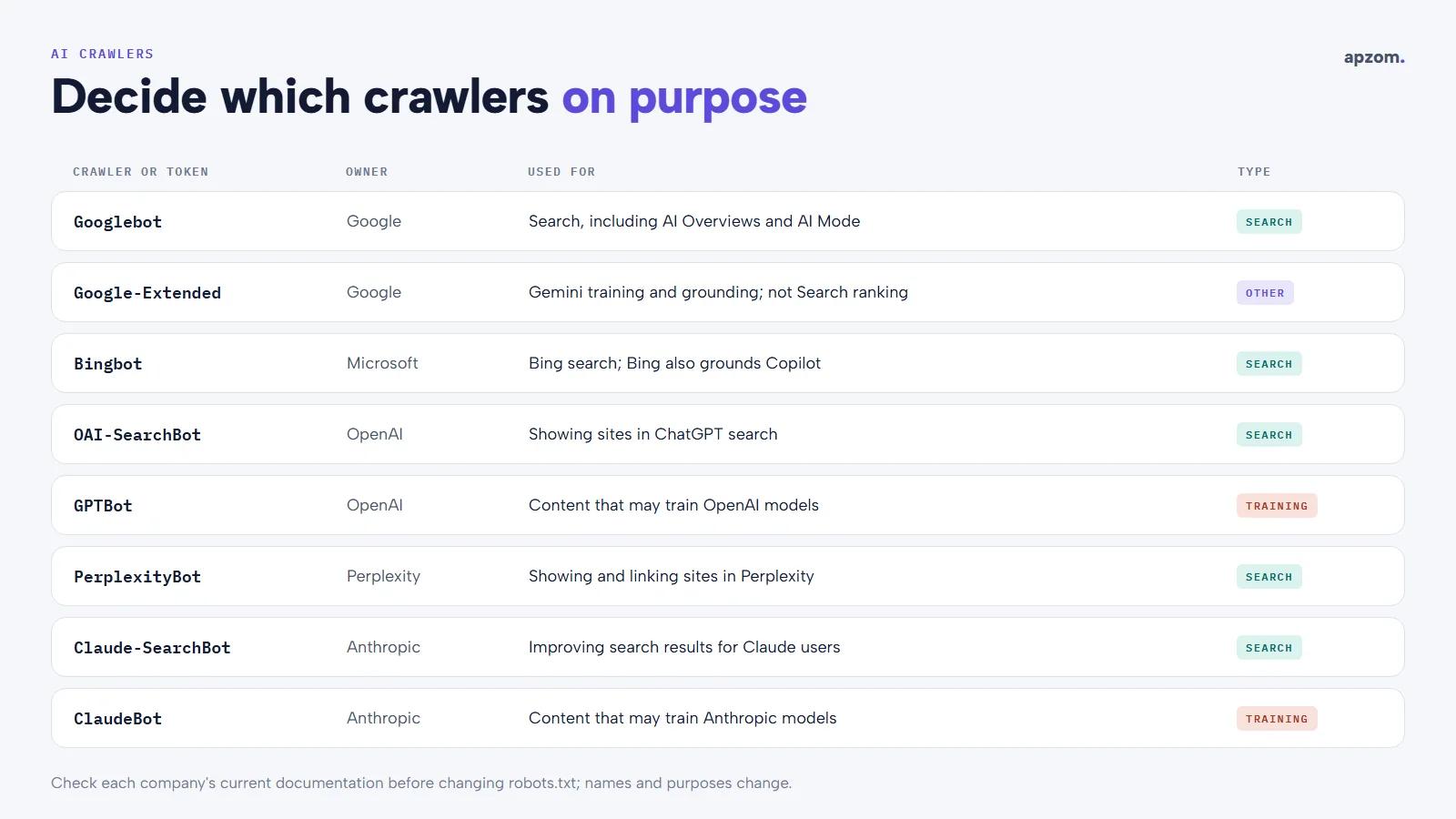
| Crawler or token | Owner | What it is used for |
|---|---|---|
| Googlebot | Search, including AI Overviews and AI Mode | |
| Google-Extended | Controls whether your content is used to train future Gemini models and to ground answers in Gemini Apps and Vertex AI; Google says it does not affect inclusion or ranking in Search | |
| Bingbot | Microsoft | Bing search; Bing’s systems also ground Copilot answers |
| OAI-SearchBot | OpenAI | Showing your site in ChatGPT search results |
| GPTBot | OpenAI | Collecting content that may be used to train OpenAI’s models |
| PerplexityBot | Perplexity | Showing and linking your site in Perplexity’s results; Perplexity says it is not used to train AI foundation models |
| Claude-SearchBot | Anthropic | Improving search results for Claude users |
| ClaudeBot | Anthropic | Collecting content that may be used to train Anthropic’s models |
Some fetchers work differently. Perplexity says its Perplexity-User agent generally ignores robots.txt, because a person asked for the page. And blocking Google-Extended does not remove you from AI Overviews, because those rely on Googlebot.
A common, balanced choice is to allow the search crawlers, so you can be found and cited, and make a separate decision about crawlers used mainly for model training. Check each company’s current documentation before changing robots.txt, because names and purposes change.
How to measure GEO honestly
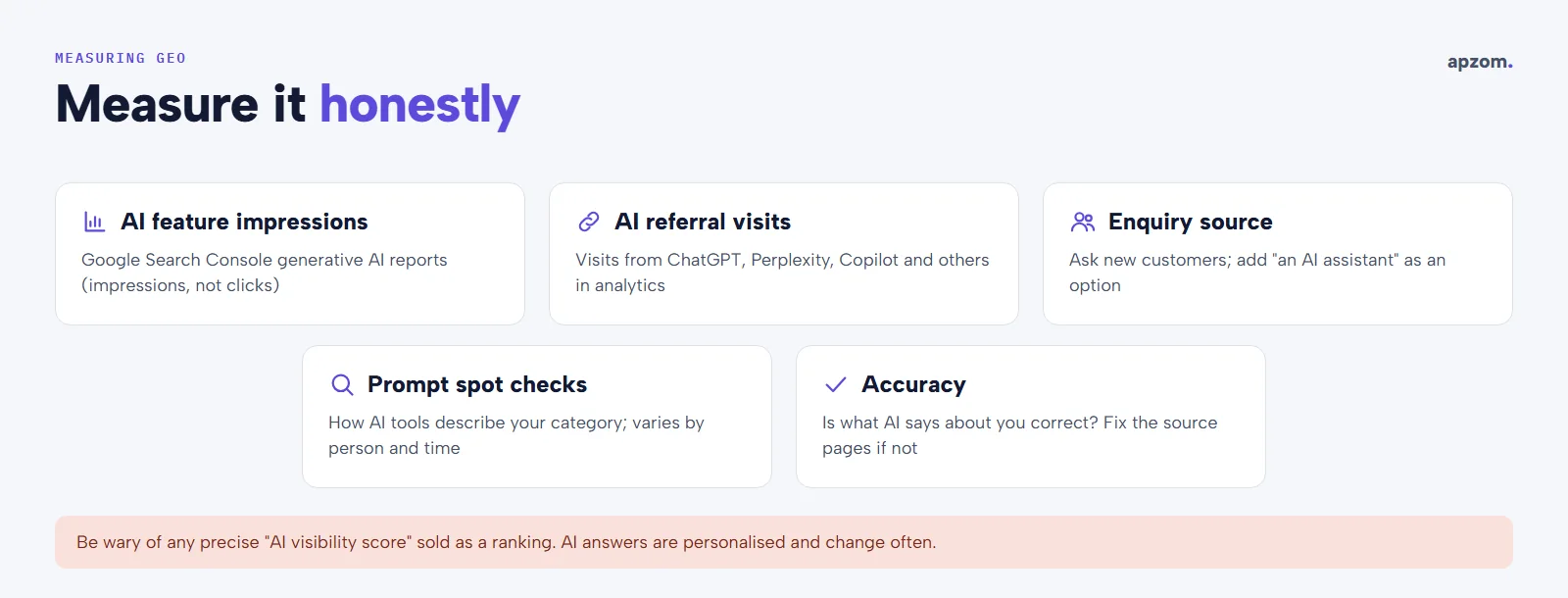
- Google Search Console now reports how often your site appears in Google’s generative AI features. Google announced these reports on 3 June 2026 and said they reached all websites by 31 August 2026. They cover AI Overviews and AI Mode in Search and generative AI in Discover, and they show impressions, not clicks or enquiries.
- Bing Webmaster Tools has an AI Performance report, launched in February 2026, that tracks citations of your site in Copilot and in Bing’s AI-generated summaries.
- Analytics referrals: look for visits from AI tools that link to sources, such as ChatGPT, Perplexity and Copilot, in your referral reports.
- Enquiry source: ask new customers how they found you, and add “an AI assistant” as an option.
- Prompt checks: asking AI tools about your category can show how you are described, but answers vary by person, place and time. Treat them as spot checks, not rankings.
- Accuracy: check that what AI tools say about your business is correct, and fix the source pages if it is not.
Be wary of tools or agencies that report a precise “AI visibility score” as if it were a ranking. AI answers are personalised and change often.
GEO by type of business
| Business type | Where to focus first |
|---|---|
| Local service business | Accurate Business Profile and local listings, clear service pages, reviews |
| Professional services (legal, accounting, medical) | Named expert authors, jurisdiction-specific answers, primary sources |
| B2B and manufacturers | Precise capability and product facts, specifications in HTML, case examples |
| Ecommerce | Clear product information, consistent details across feeds and pages, genuine reviews |
| Publishers and content sites | Original reporting and data, clear authorship, quotable summaries |
A 90-day GEO plan
Days 1 to 30: be findable and consistent
- Check crawling, indexing and snippet settings for your key pages.
- Decide your AI crawler policy and update robots.txt deliberately.
- Make your business facts consistent across your website, profiles and directories.
Days 31 to 60: be understandable and quotable
- Rewrite your most important pages answer-first, with clear headings and precise facts.
- Add author and reviewer information, and cite primary sources.
- Add structured data that matches the visible content.
Days 61 to 90: be trusted and measured
- Publish one or two pieces of genuinely original information, such as your own data or a detailed guide.
- Start earning credible mentions from relevant sources.
- Set up measurement: Search Console AI reports, AI referrals in analytics, and enquiry source tracking.
How Apzom can help
Apzom Digital’s GEO services and AEO services build on strong SEO foundations: crawlable, well-structured pages, consistent entity information, answer-first content and honest measurement. We will not promise citations in ChatGPT, Google or any other AI tool, because nobody can. We will show you what AI tools currently say about your category, where the gaps are and what to fix first. If you are still deciding between channels, our guide to SEO vs Google Ads may help too. We work with clients worldwide, remotely, from our base in Ahmedabad, India.
Request an AI Visibility Review. We check crawling and indexing, your AI crawler settings, how consistently your business is described across the web, whether your key pages are answer-first and quotable, your authorship and sources, and how AI-driven visits are measured. You get a prioritised list of what to fix first.
The review is free, with no obligation and no guaranteed citations. Prefer to talk it through? Contact us or see all our services.
Frequently asked questions
What is GEO in digital marketing?
GEO, or generative engine optimization, is the work of making your business and content easy for AI search tools such as Google AI Overviews, ChatGPT search, Copilot and Perplexity to find, understand and cite in their answers.
Is GEO different from SEO?
GEO builds on SEO rather than replacing it. AI search tools mostly draw on search indexes, so crawlable, useful, trusted pages remain the foundation. GEO adds extra focus on quotable passages, precise facts and consistent business information.
What is the difference between GEO and AEO?
AEO focuses on being the direct answer to a specific question, for example in featured answers or voice search. GEO is broader: it covers how AI systems find, understand and cite your content when they write longer answers.
Do I need an llms.txt file for GEO?
Not for Google. Google says Search does not use llms.txt or other AI text files, and that adding one will neither harm nor help your Search visibility. Other tools may read it, but it does not replace well-built pages.
How do I get cited by ChatGPT?
Make sure your site can be crawled by the search crawlers that ChatGPT search relies on, publish clear and accurate pages that answer real questions, keep your business facts consistent across the web and earn credible mentions. Nobody can guarantee a citation.
Should I block AI crawlers?
It depends on your goals. Blocking search-related crawlers can stop AI search tools from showing and linking your site. Crawlers used mainly for model training are a separate decision. Check each company’s documentation before changing robots.txt.
How do I measure GEO?
Use Google Search Console’s generative AI reports for impressions, Bing Webmaster Tools’ AI Performance report for Copilot citations, analytics for referral visits from AI tools, enquiry source tracking, and occasional spot checks of what AI tools say about your business.
Can an agency guarantee AI visibility?
No. AI answers are generated differently for different people and change often. Treat guarantees of citations or a fixed “AI ranking” as a red flag.