The short answer: Good digital marketing for a veterinary clinic brings in new clients who stay for the life of their pet. It does that with a website that answers the questions pet owners have at each moment (routine care, a worried evening, an emergency, a planned procedure, long-term care), clear prices or price guides, a strong local search presence, honest reviews, and reminders that bring clients back. A good agency will follow the rules on veterinary advertising and medicines in your country, and measure results in new clients who return, not clicks.
This guide is for independent practices, corporate groups, emergency and out-of-hours clinics, referral and specialist hospitals, mobile vets, and exotic, equine and farm practices, in any country. It covers how pet owners choose a vet, how to plan your website and local search, health content, paid ads, keeping clients for life, price transparency, the advertising rules by country, and what to measure.
Pet care is a large market, and owners have more clinics to choose from than ever. The American Pet Products Association (APPA, 2025 figures) puts total US pet industry spending at $158 billion, including $41.0 billion on vet care and product sales, and the American Veterinary Medical Association counts 133,475 vets in the US at the end of 2025. In the UK, the PDSA Animal Wellbeing (PAW) Report 2025 says 30% of adults own a dog and 24% own a cat. Animal Medicines Australia’s 2025 survey found pets in 73% of Australian households, and the European pet food industry body FEDIAF counts 139 million European households (49%) with a pet.
Why veterinary marketing is different
Marketing a vet clinic is not like marketing most local businesses. Six things make it different:
- Two “clients” in every visit. The pet is the patient, but the owner makes every decision and pays the bill. Your marketing speaks to the owner about the animal they love.
- Emotion runs high. Owners search when they are worried, sometimes at night, sometimes in tears. Tone matters as much as content.
- Emergencies need a different answer. When an owner searches for an emergency vet, they need a phone number, an address and a clear “call first” message, not a blog post.
- The relationship lasts years. A puppy registered today may come back for vaccines, check-ups, dental work, senior care and end-of-life care over many years. Most of the value of a new client comes after the first visit.
- It is a regulated profession. Vets work under professional conduct rules on advertising, and in many countries, including the UK and every EU country, prescription-only medicines cannot be advertised to pet owners.
- Prices are under scrutiny. In the UK, the Competition and Markets Authority (CMA) has ordered practices to publish prices and say who owns them, and owners everywhere are asking more questions about costs before they book.
Framework 1: the pet owner moments map
The first framework maps the five moments when pet owners search, and what your marketing should show at each one.
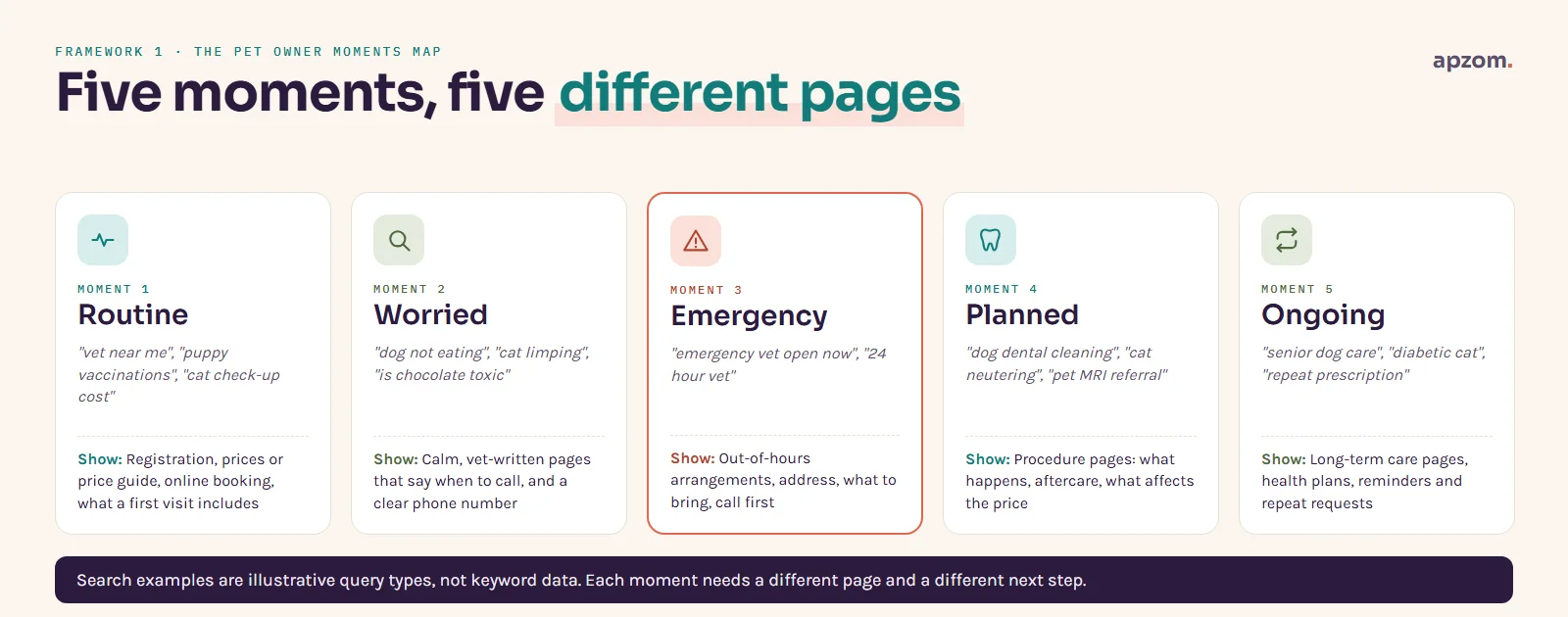
| Moment | What the owner is thinking | What to show them |
|---|---|---|
| 1. Routine | “We need a vet for our new puppy.” “The cat is due a check-up.” | How to register, what a first visit includes, prices or a price guide, online booking |
| 2. Worried | “My dog has stopped eating. Is it serious?” | Calm, vet-written pages that explain the signs, say when to call and give a clear phone number |
| 3. Emergency | “Is there a vet open now?” | Who answers out of hours, where to go, what to bring and the instruction to call first |
| 4. Planned | “How much is a dental clean? What happens during neutering?” | Procedure pages: what happens, how to prepare, aftercare, what affects the price |
| 5. Ongoing | “My dog is getting older.” “My cat has diabetes.” | Long-term care pages, health plans, repeat prescription requests and reminders |
Most clinic websites cover moment 1 on the home page and little else. The other four moments are where trust is built and where new clients find you.
Build a website that books appointments
Your website should make the next step easy for every moment above. The core pages:
- Services, one page for each service you want more of: vaccinations, neutering, dentistry, surgery, diagnostic imaging, nutrition and weight care, senior care, and any species you treat beyond cats and dogs. Say what happens, who it is for and what affects the price.
- Emergency and out-of-hours. Who answers at night and at weekends, where they are, and how to reach them. If another provider covers your out-of-hours care, name them and give their address.
- Prices or a price guide for common services, or at least what affects the cost and how to get a written estimate. In the UK this is becoming a legal duty: under the CMA’s Order on vet services, practices must put a standard price list online, with larger groups starting in December 2026 and smaller practices in March 2027.
- Meet the team, with real names, roles and qualifications. Only use titles such as “specialist” in the way your country’s rules allow (see the rules section below).
- New client registration with a short form, and online booking if your practice software supports it.
- About the practice: when it opened, who owns it, the facilities you have and any accreditation you really hold.
- A pet health library written or checked by your vets (see the next section).
Use structured data to describe the clinic. schema.org has a VeterinaryCare type for veterinary practices. Add your real name, address, phone number, opening hours and, if you run one, your emergency service hours, and make sure everything in the markup is visible on the page.
Be found: local search and Google Business Profile
Most new clients start with a local search, and many choose from the map results. Our Google Business Profile checklist covers every field. The points that matter most for vets:
- Choose the category that best describes the clinic, then add secondary categories only for services you really provide.
- Keep opening hours exact, including any emergency hours, and use special hours for public holidays. Wrong hours on an emergency search cause real harm, not just a lost booking.
- Individual vet listings. Google’s guidelines let public-facing professionals, such as vets, have their own Business Profile separate from the clinic’s. If a clinic has only one vet who sees clients, Google suggests one shared profile instead. Keep these listings accurate when a vet joins or leaves.
- Add real photos of the reception, consulting rooms and equipment, and of patients only with their owners’ permission.
- List your services with short, plain descriptions.
If you run several clinics, give each real clinic its own profile and its own location page, with its own team, hours and services. Our local SEO checklist covers multi-location set-ups in more detail.
Health content that owners trust
Pet owners search for symptoms all the time: “dog vomiting yellow”, “cat not using the litter tray”, “can dogs eat grapes”. Clear, honest answers bring owners to your site at the moment they are deciding whether to call.
Good pet health pages follow a simple pattern:
- Answer first, in plain words.
- Say clearly when it is an emergency and when to call, with your phone number on the page.
- Do not diagnose online. Explain possible causes and what a vet will check, and invite the owner to book.
- Show who wrote or checked it, with their name and qualification, and the date it was last reviewed.
- Write about what you see in your area: local parasites, seasonal hazards, common breeds, climate.
These pages are also the kind of clear, sourced passages that AI search features and assistants quote. Our guide to what GEO is explains how that works. Google’s guidance is to write helpful, reliable content for people, not for search engines.
Paid ads: emergency, new clients and planned care
Paid ads work best for vets in three places:
- Search ads for emergency and urgent searches, shown only during the hours you can really answer, with call-focused ads and the address clearly shown.
- Search ads for new client searches, such as “vet near me” or “puppy vaccinations”, sent to a page that explains registration and the first visit.
- Social media ads for planned care, such as a dental check month, puppy classes or a new service, shown to people within a short drive of the clinic.
Medicines are where vet advertising needs the most care. Across the EU, since 28 January 2022, prescription-only animal medicines can only be advertised to vets and others allowed to supply them, not to pet owners (Regulation (EU) 2019/6, Article 120). The UK has the same ban under the Veterinary Medicines Regulations 2013. So advertise the consultation, not the drug. If you sell prescription pet medicines online, Google requires certification before you can target prescription drug terms in the US and Canada, and online pharmacies usually need third-party accreditation such as LegitScript. Ads for the clinic’s own services usually run normally.
Our guides to Google Ads for small businesses and Facebook and Instagram ads for local businesses cover set-up in more detail.
New clients booking once and never coming back? A Vet Clinic Marketing Audit follows owners from the first search to the second visit and shows where they drop off.
Framework 2: the lifetime care calendar
The second framework is the lifetime care calendar. Instead of marketing only to new clients, plan the messages each client should get over the whole life of their pet.
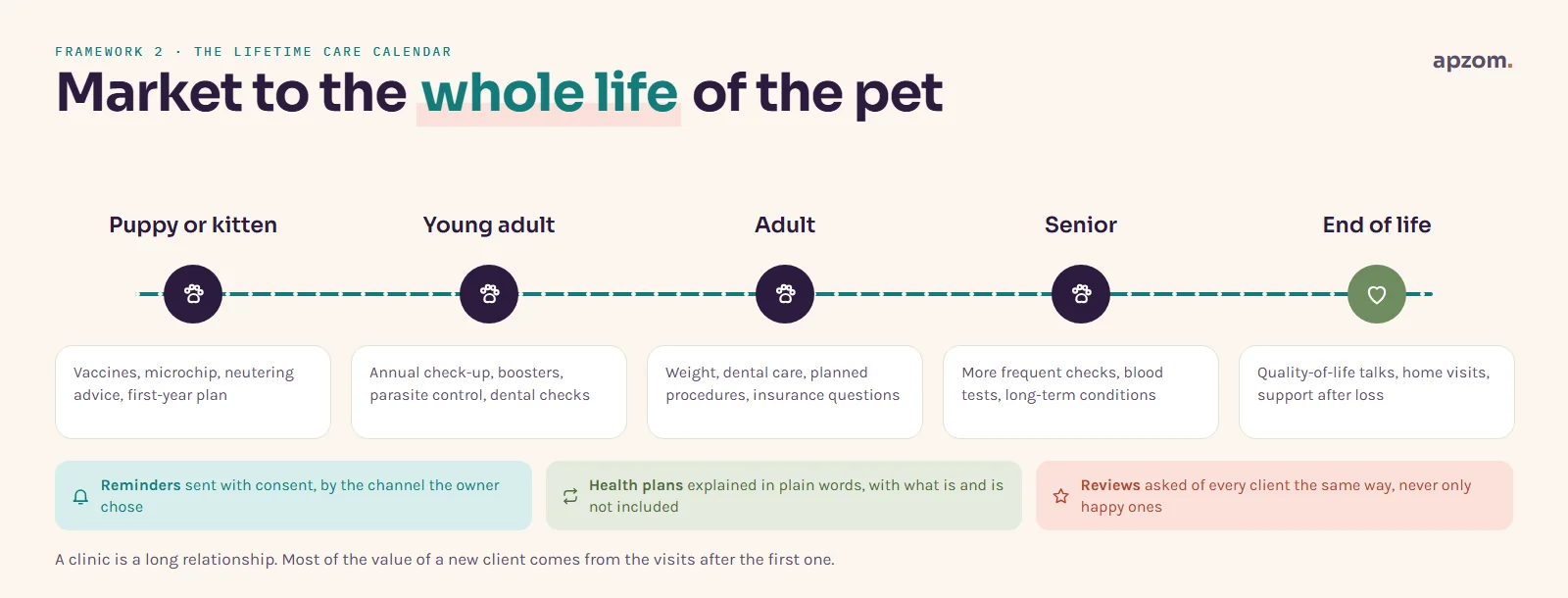
| Life stage | What the owner needs | What to send or show |
|---|---|---|
| Puppy or kitten | Vaccines, microchipping, neutering advice, training and diet | A first-year guide, vaccine reminders, an introduction to health plans |
| Young adult | Annual check-ups, boosters, parasite control | Reminders, dental checks, seasonal parasite advice |
| Adult | Weight, dental care, planned procedures, insurance questions | Procedure pages, weight and dental clinics, honest price guides |
| Senior | More frequent check-ups, blood tests, long-term conditions | Senior check reminders, long-term care pages, repeat prescription requests |
| End of life | Quality-of-life decisions, home visits, support after loss | Calm, clear information, and no marketing messages at this time |
Three things make this work:
- Reminders with consent. Vaccination and check-up reminders are some of the most useful messages a clinic sends. In the UK, the PECR “soft opt-in” lets you send marketing to existing clients about similar services, as long as you offered an easy opt-out when you collected their details and include one in every message. In the US, marketing texts sent by automated systems need the client’s prior express written consent under the Telephone Consumer Protection Act. Keep vaccine reminders factual and free of sales offers, and let owners choose how they hear from you.
- Health plans explained plainly, with exactly what is and is not included, how payment works and how to cancel.
- Respect for the end of life. Stop routine marketing messages when a pet dies, and make sure your systems record it. A reminder for a pet that has died is one of the most upsetting messages an owner can receive.
Framework 3: the clinic trust test
The third framework is a six-point test for every page, ad and social post your clinic publishes.
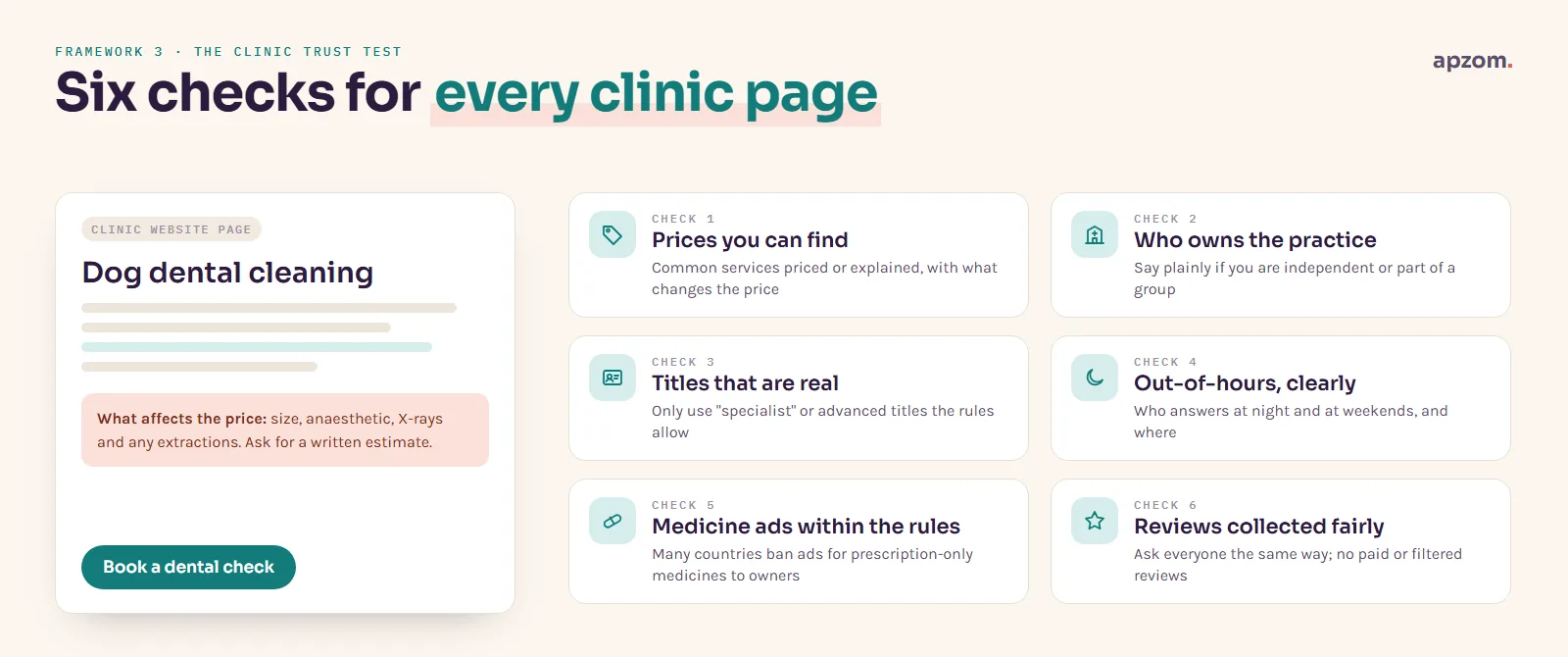
- Prices you can find. Common services priced, or at least explained, with what changes the cost.
- Who owns the practice. Say plainly whether you are independent or part of a group.
- Titles that are real. Only use “specialist” and other advanced titles in the way your regulator allows.
- Out-of-hours, clearly. Who answers at night and at weekends, and where.
- Medicines handled properly. Advertise consultations and services, not prescription-only medicines, wherever the rules forbid it, as they do in the UK and the EU.
- Reviews collected fairly. Ask every client the same way, never only the happy ones, and never pay for reviews. Our guide on how to get more Google reviews covers the rules.
Price transparency: what the UK changes mean for every clinic
In March 2026 the UK’s Competition and Markets Authority published its final decision on its investigation into vet services. Its Order, made in September 2026, turns that decision into legal duties that start in stages:
| What changes | Larger groups (15 or more practices) | Smaller practices |
|---|---|---|
| A standard price list online | From December 2026 | From March 2027 |
| Showing clearly if the practice belongs to a larger group | From March 2027 | From March 2027 |
| A cap on written prescription fees (£21 for the first medicine, £12.50 for each extra one, including VAT, adjusted each year for inflation) | From March 2027 | From September 2027 |
| Written prescription rules | From June 2027 | From September 2027 |
For UK practices, this is now a compliance job as well as a marketing one: the price list, the ownership statement and the prescription information all need a clear, easy-to-find place on the website. Outside the UK it is still a useful guide. Owners everywhere want to know roughly what a visit will cost before they book, and a clinic that explains its prices plainly stands out from one that says “call for a quote”.
The rules on veterinary marketing by country
Veterinary advertising is covered by professional conduct rules, medicines law and general consumer law. This is a starting point, not legal advice; check the current rules with your regulator or professional body.
| Market | What to know |
|---|---|
| UK | The RCVS Code of Professional Conduct (Chapter 23, on titles and advertising) says advertising must be accurate and truthful and follow the UK advertising code (the CAP Code). Only vets on the RCVS lists can call themselves “specialist” or “Advanced Practitioner”, and a practice should only call itself a “Veterinary Hospital” if it is accredited as one. Prescription-only medicines cannot be advertised to the public. The CMA’s price, ownership and prescription duties start from December 2026 (see above). |
| EU | Regulation (EU) 2019/6, Article 120, bans advertising prescription-only veterinary medicines to pet owners (since 28 January 2022). Each country’s veterinary body sets its own conduct rules. |
| US | The AVMA Principles of Veterinary Medical Ethics say advertising must not be false, deceptive or misleading, and testimonials and reviews count as advertising. Only board-certified vets (diplomates of an AVMA recognized specialty organization) should call themselves specialists. Each state board has its own rules. Since 21 October 2024, the FTC rule on consumer reviews (16 CFR Part 465) bans fake reviews, buying positive reviews and hiding bad ones. |
| Australia and Canada | Each state or province’s vet board sets its own advertising rules. Victoria and Western Australia, for example, limit the word “specialist” to registered specialists, and Ontario’s college bans comparative or superlative claims such as “best in town”. |
| UAE | Vet clinics are licensed at emirate level (in Dubai, by Dubai Municipality). People who post paid or promotional content on social media need a UAE Media Council Advertiser Permit. Avoid any unproven health claims. |
| India | The Veterinary Council of India Regulations 1992 (Regulation 7) treat self-promotion that claims superiority as unethical and ban publishing cases, operations or clients’ letters of thanks in non-professional newspapers. Formal announcements, such as an opening or a change of address, are allowed. Keep marketing factual. |
Telehealth rules also differ. In the UK, since 1 September 2023, vets can sometimes prescribe without seeing the animal in person, though some medicines, such as antibiotics and parasite treatments, normally still need a physical examination. In California, since 1 January 2024, a vet can set up a vet-client-patient relationship through a live video exam. If you market online consultations, say clearly what can and cannot be done remotely where you work.
Social media for vet clinics
Social media is where clinics show what they are like inside. What works:
- Real behind-the-scenes posts: the team, the equipment, a day in the clinic, with every patient photo used only with the owner’s permission.
- Seasonal health advice that fits your area, such as heat, fireworks, festivals, parasites and toxic plants.
- Clear service news: new services, opening hours changes, holiday cover.
- Care with graphic content. Surgery and injury images can upset people. If you share them for education, warn people first and keep them respectful.
Do not post prices that may change without a date, and do not respond to complaints with details of the pet’s treatment in public. Move the conversation to a private channel.
Referral, emergency and specialist hospitals
Referral and specialist hospitals market to two audiences: pet owners and the vets who refer cases to them. For referring vets, what matters is easy referral forms, clear case updates, continuing education events and published information on your services and team. For owners, what matters is what to expect, how to get there, how billing works and who to call after hours.
Emergency clinics need fast, simple pages for the emergency moment, with location, parking, what to bring and the instruction to call ahead. Their reviews often reflect stressful nights, so reply to every review calmly and without sharing clinical details.
Framework 4: from search to lifelong client
The fourth framework follows each channel from the first search to a client who comes back. Judge marketing by the clients it brings who return, not by clicks or calls alone.
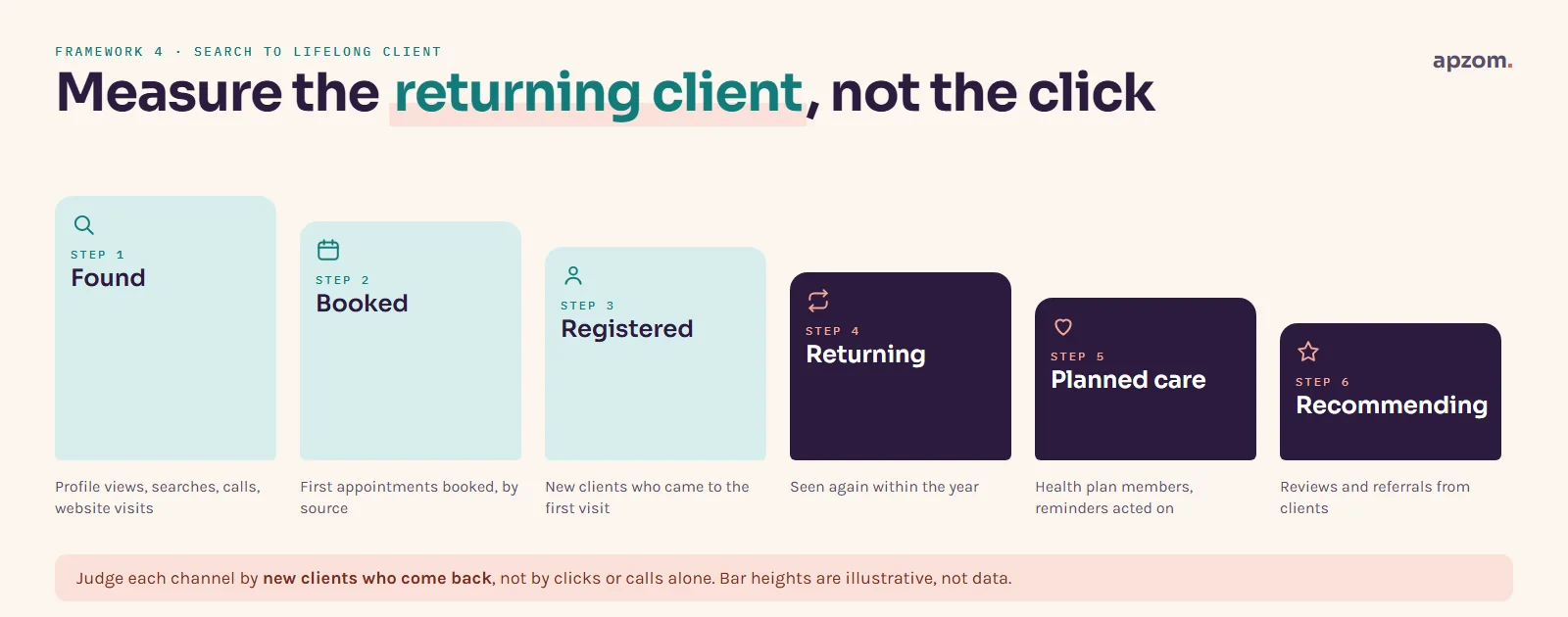
Track these every month, by channel:
- Found: Business Profile views, searches, calls and website visits.
- Booked: first appointments booked, by source. Ask “how did you hear about us?” at registration, and use tracking links in ads.
- Registered: new clients who came to the first visit.
- Returning: new clients seen again within the year.
- Planned care: health plan sign-ups and reminders that led to a booking.
- Recommending: reviews and referrals from clients.
Our guide on how to measure marketing ROI explains how to turn these into cost per new client and return on spend.
What a vet marketing agency should do
Questions to ask
- Have you worked within veterinary advertising and medicines rules in our country? How do you check claims?
- How will you report new clients, returning clients and cost per new client, not just clicks?
- Who writes and checks pet health content? Will our vets approve it before it goes live?
- How do you handle patient photos and owner permission?
- Who owns the website, ad accounts, Business Profiles and data if we stop working together?
Red flags
- Promises of a set number of new clients or a guaranteed top ranking.
- Plans to buy reviews, filter out unhappy clients or post fake reviews.
- Ads for prescription medicines to pet owners, where your rules do not allow it.
- Health content written without any vet checking it.
- Reports that show only clicks, likes and impressions.
How Apzom can help
Apzom Digital helps local businesses win the right customers and measure what matters. For veterinary clinics, that means SEO and local SEO for service and clinic pages, website development with clear booking, emergency and price pages, content marketing for vet-checked pet health pages, Google Ads and Meta ads that follow the medicines rules in your country, email marketing for reminders and health plans, and reputation management. We work with clients worldwide, remotely, from our base in Ahmedabad, India.
We have not published a veterinary case study yet, so we will not show you one. Our case studies page shows the local search and lead generation work we have done for other businesses. We will not promise a number of new clients. We will show you where owners drop off between the first search and the first visit, and what to fix first. If you are comparing agencies, our guide on how to choose a digital marketing agency has the questions to ask.
Request a Vet Clinic Marketing Audit. We review your service, emergency and price pages, pet health content, Google Business Profiles and reviews, Google and Meta ads, booking and registration, reminders and tracking, against the advertising and medicines rules in your country. You get a prioritised list of what to fix first.
No obligation and no guaranteed client numbers. Prefer to talk first? Contact us or see all our services.
Frequently asked questions
What is the best marketing for a veterinary clinic?
A website that answers owners’ questions at each moment, a complete Google Business Profile with exact hours, real reviews collected fairly, vet-checked health content, search ads for urgent and new client searches, and reminders that bring clients back. Then measure new clients who return, by channel.
How do vet clinics get new clients?
Mostly from local search and the map results, recommendations from existing clients, reviews, social media in the local area, and search ads. New pet owners (puppies and kittens) and people moving to the area are the main groups looking for a new vet.
Should a vet clinic show prices on its website?
Usually, yes. Owners want to know what to expect, and a price guide or a list of what affects the cost builds trust. In the UK, the CMA’s Order requires practices to publish a standard price list online, starting with larger groups in December 2026 and smaller practices in March 2027.
Can vets advertise prescription medicines?
In the UK and the EU, no. Prescription-only animal medicines cannot be advertised to pet owners, so advertise your consultations and services instead. Other countries have their own rules, and selling prescription pet medicines online brings extra checks: in the US and Canada, Google requires certification before you can target prescription drug terms. Check the rules where you practise.
Can a vet clinic use client reviews and testimonials?
Yes, if they are real and collected fairly. Ask every client the same way, never pay for reviews or only ask happy clients, and check your professional body’s rules on testimonials. Some, such as the Veterinary Council of India, restrict publishing clients’ letters of thanks.
Do vet clinics need SEO?
Yes. Most owners search before they choose a vet, and many search when their pet is unwell. Service, emergency, price and health pages bring owners who are already looking, and the results last longer than ads.
How should an emergency vet clinic market itself?
Make the emergency moment simple: exact opening hours everywhere, call-focused ads only when you are open, a page with location, parking and what to bring, and calm replies to every review. Tell referring practices clearly how and when to send cases.
Can Apzom work with veterinary clinics outside India?
Yes. We work with clients worldwide, remotely, from our base in Ahmedabad, India, and plan marketing around the countries you work in, their veterinary advertising and medicines rules, and the platforms your clients use.