
The short answer: SEO for a car dealership is mostly about inventory pages, not blog posts. Search engines need to find, understand and trust thousands of vehicle pages that appear and disappear every week, plus the model, location and service pages that bring steady local traffic. Most dealer sites lose rankings to the same few problems: filter pages that create endless near-duplicate URLs, sold cars that leave broken or misleading pages, inventory that only loads with JavaScript, and the same vehicle listed on marketplaces with better rankings than your own page. This guide shows how to fix each one.
This guide is for dealers, dealer groups and their marketing teams in any country, and for the agencies and website providers that work with them. It goes deeper than the SEO section of our guide to digital marketing for car dealerships, which covers the wider picture of ads, social media, leads and advertising rules. Here we focus on site structure, crawling and indexing, sold vehicles, filters, duplicate listings, structured data, speed and local pages.
Plan the site structure first
The first framework is a simple dealer site architecture. Every page should have a clear job and a clear place.
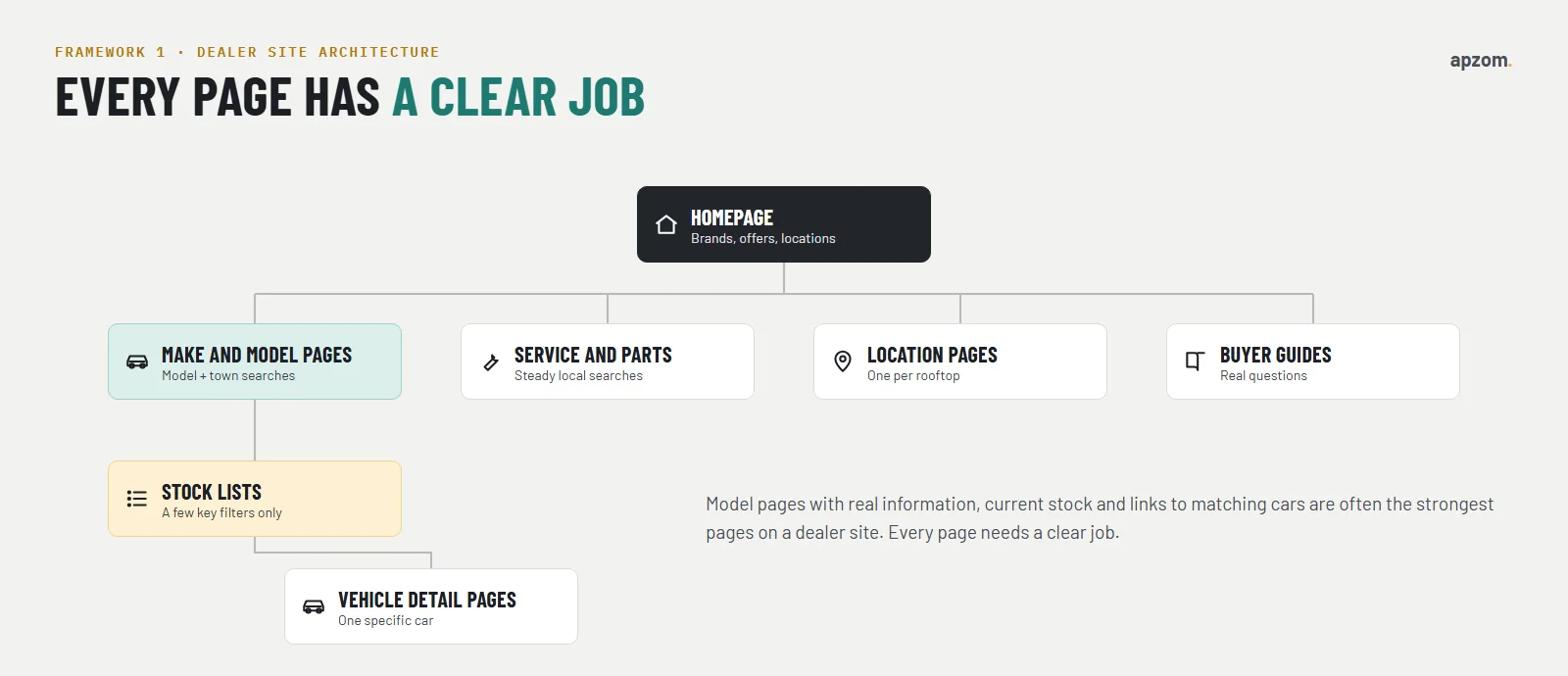
| Page type | Its job | What it should target |
|---|---|---|
| Make and model pages | Rank for model searches in your area and explain what you sell | “[model] for sale [town]”, “new [model] [town]”, “used [make] [town]” |
| Search results pages (stock lists) | Let people browse and filter stock | A few important combinations, such as a make, model or body type, not every filter |
| Vehicle detail pages | Sell one specific car | The exact vehicle; often found through internal links and model pages |
| Service, parts and finance pages | Win steady, high-value local searches | “[brand] service [town]”, “MOT”, “tyres”, “car servicing near me” |
| Location pages | Show each rooftop’s details | Each site’s address, hours, departments and stock |
| Buyer guides | Answer real questions | Comparisons, ownership costs, EV charging, trade-in guides |
A model page with real information, current stock and links to matching vehicles is often the strongest page on a dealer site. Do not let it become a thin template with the same text on every model.
Control which filter pages search engines crawl
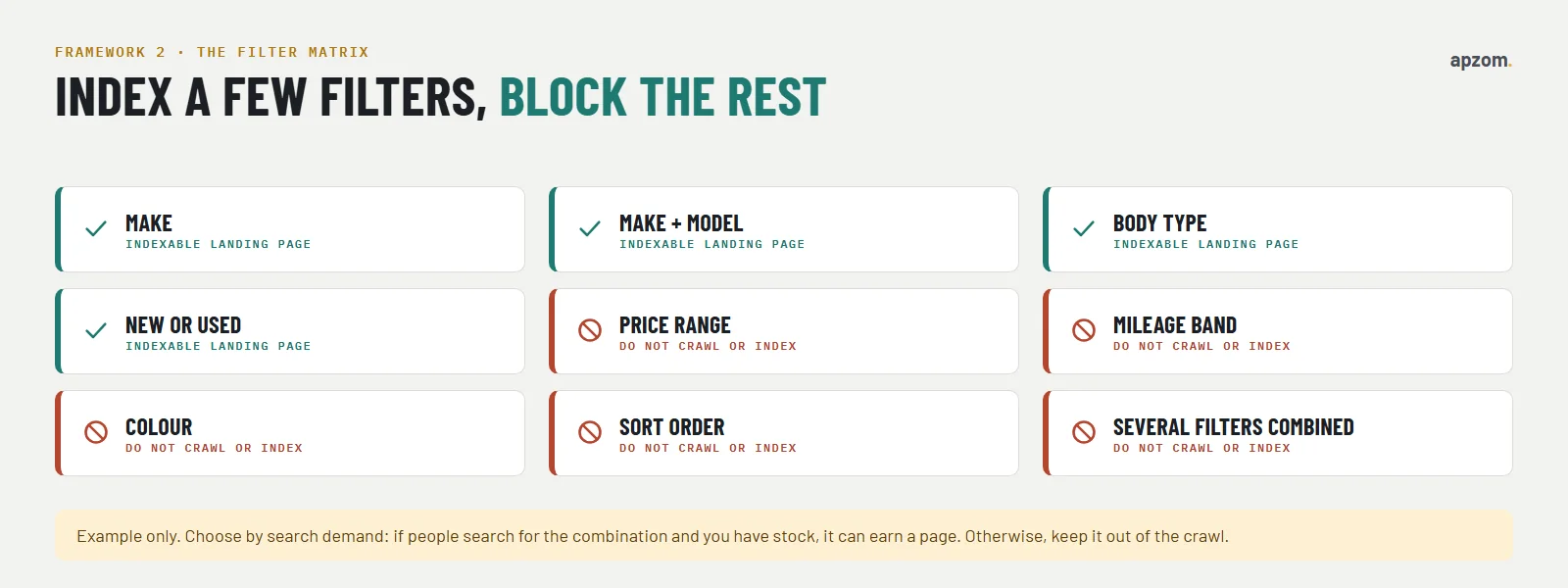
Stock search pages usually come with filters: make, model, price, mileage, colour, fuel type, transmission, sort order. Each combination can create a new URL. A few hundred cars can turn into tens of thousands of near-identical filter URLs, which waste search engines’ time and dilute your important pages.
The second framework is the filter matrix: decide, filter by filter, which combinations deserve to be indexable pages and which should not be crawled.
Google’s guidance on managing crawling of faceted navigation URLs (last updated December 2025) gives clear options:
- If you do not need filter URLs in search results, stop them being crawled with a robots.txt disallow rule, or put filters in URL fragments (the part after #), which Google says have no impact on crawling.
- If you do need some filter pages crawled, keep the order of filters in the URL consistent, so the same filters always make the same URL.
- When a filter combination has no results, return a 404 status code rather than an empty page.
For the few combinations you do want as landing pages, such as a make, a model or a body type, give them their own clean URL, a unique title and a short introduction, and link to them from your navigation and model pages.
Google’s guide to managing crawl budget is written for very large sites: roughly 1 million or more unique pages that change weekly, or 10,000 or more unique pages that change daily, which Google calls a rough estimate. Most single dealerships are smaller than that, but large dealer groups with big feeds may not be. Either way, thousands of filter URLs still slow the discovery of new stock and spread attention away from the pages that matter.
Handle sold vehicles properly
Cars sell every day, so vehicle pages come and go constantly. How you handle a sold car affects both shoppers and search engines. The third framework is the sold-car decision.
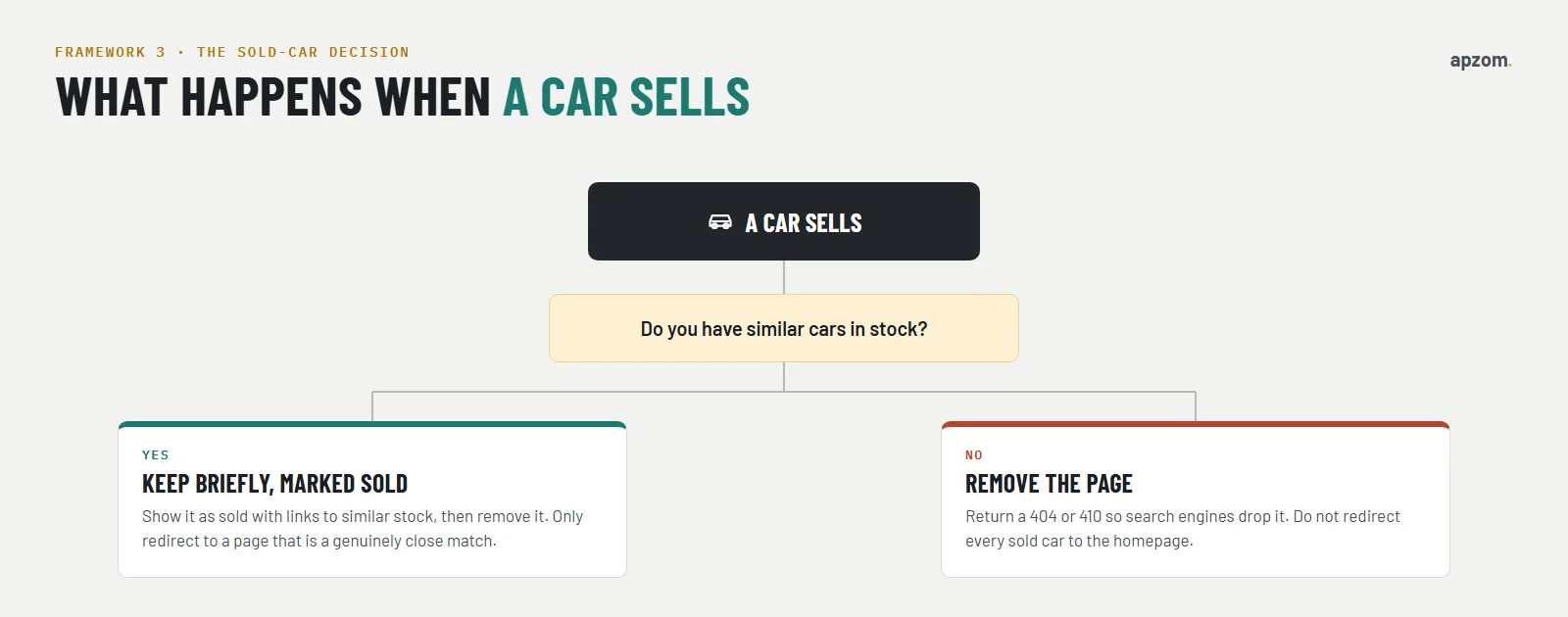
Google’s guidance is straightforward. For pages that are permanently removed, return a 404 or 410 status code; Google treats the two the same. Redirecting removed pages to an unrelated page can be treated as a soft 404, and Google specifically says not to redirect many old URLs to one irrelevant destination such as the homepage. Use a 301 redirect only when a genuinely equivalent page exists, such as the same model’s page when you still have that model in stock.
A practical approach many dealers use:
- When a car sells, keep the page live for a short time, clearly marked as sold, with links to similar vehicles. Update its structured data so it no longer shows the car as available.
- After that, remove the page and return a 404 or 410, unless there is a genuinely equivalent page to redirect to.
- Update your sitemap so it lists only live vehicles, and remove sold cars from internal links and stock lists.
- Tell search engines that use IndexNow, such as Bing, about removed and new URLs. Google does not use IndexNow, so it relies on recrawling and your sitemap.
Your listings on marketplaces: duplicate content
Most dealers syndicate their stock to marketplaces and classified sites. That brings leads, but it means the same car, photos and description appear on several sites, and the marketplace often outranks your own page.
Google’s guidance on syndicated content is written for publishers: it says a canonical link is not the recommended fix, and that the most effective solution is for syndication partners to block indexing of your content. In practice, a dealer cannot ask the big marketplaces to do that. So the realistic approach is to make your own vehicle page the richer, more useful version of the listing.
Practical steps:
- Write your own description for your website rather than using the same text everywhere. Add the details only you can give: who traded it in, what work you did, why it is a good buy.
- Use your own photos first on your site, and publish the vehicle page on your site before or at the same time as the feed goes out.
- Make your pages better than the listing: full history, finance options, reviews, test drive booking and a clear price.
- Strengthen model and location pages, where marketplaces cannot compete with your local detail.
Structured data: what it does and does not do now
Google used to show special vehicle listing results from structured data. It announced the phase-out on 12 June 2025 and removed the documentation in September 2025, saying these structured data types are no longer shown in Google Search results.
Structured data is still worth getting right, for three reasons:
- Schema.org’s Car type (a kind of Vehicle, which is a kind of Product) lets you describe a car precisely, with properties such as the vehicle identification number and the mileage. Its availability values include sold out and reserved, which suit sold or held cars.
- It helps search engines and AI tools read your stock correctly, even without a special result.
- Google’s rule still applies: your structured data must be a true representation of the page content. Do not mark up a price, mileage or availability that the page does not show.
If you sell cars online and want to explore Google’s merchant listing results, note that Google says these are for pages where a shopper can buy the product, and that a Car is not automatically treated as a Product, so both types need declaring. Most enquiry-only vehicle pages are unlikely to qualify.
Inventory that only loads with JavaScript
Many dealer platforms load stock with JavaScript after the page opens. If links and vehicle details are not in the page in a form search engines can read, your stock may not be crawled properly.
Google’s JavaScript SEO guidance says Google can only follow links that are HTML `<a>` elements with an `href` attribute, and that server-side rendering or pre-rendering is still a great idea. Check a few stock and vehicle pages with the URL inspection tool in Google Search Console and look at the rendered HTML: you should see real links to each vehicle and the key details such as make, model, price and mileage.
Stock lists often run across several pages. Google’s pagination guidance is to give each page its own URL, link the pages in sequence, and not to use the first page as the canonical for the whole series. Infinite scroll is fine for shoppers, as long as each set of results also has a normal URL that search engines can reach.
Not sure what search engines see on your dealer site? A Dealer SEO Audit checks indexing, filter crawl, sold-car handling, duplicate listings, JavaScript rendering, speed and local pages.
Photos and speed
Vehicle pages are photo-heavy, which makes them slow. Slow pages lose shoppers and can hold back rankings.
Google’s Core Web Vitals give clear targets for a good experience: Largest Contentful Paint (how fast the main content appears) within 2.5 seconds, Interaction to Next Paint (how quickly the page responds) under 200 milliseconds, and Cumulative Layout Shift (how much the page jumps around) under 0.1. Vehicle pages with big photo galleries often fail the first and third.
- Compress photos and serve modern formats such as WebP or AVIF.
- Load the first photo fast and lazy-load the rest of the gallery.
- Give photos short, descriptive file names and alt text, such as “2022 hatchback in blue, front three-quarter view”, not “IMG_4412”. Google calls alt text the most important attribute for image search, and it does not index images set as CSS backgrounds.
- Keep third-party chat, finance and tracking scripts to the ones you really use.
Local SEO for dealerships and dealer groups
Google’s Business Profile guidelines allow dealerships to have separate profiles for departments such as sales, parts and service. New-car dealerships can also have a profile for each brand of new car they sell, but used-car dealerships cannot have profiles per brand. Separate profiles let each department show its own hours, phone number and reviews.
- Give each rooftop its own location page with address, opening hours by department, directions, staff and stock at that site.
- Keep names, addresses and phone numbers identical across your website, Business Profiles and directories.
- Ask for reviews for sales and service separately, so each profile builds its own reputation.
Our local SEO checklist and Google Business Profile optimization checklist go through this step by step.
Service and parts pages
Service, repairs, tyres, inspections and parts bring steady, high-value local searches all year, and those customers often buy their next car from the same dealer. Give each main service its own page with what is included, prices or “from” prices, booking and the brands you cover. Link to them from your homepage and vehicle pages.
A dealer SEO audit checklist
The fourth framework is a quarterly audit. Check these every three months, and after any website or platform change.
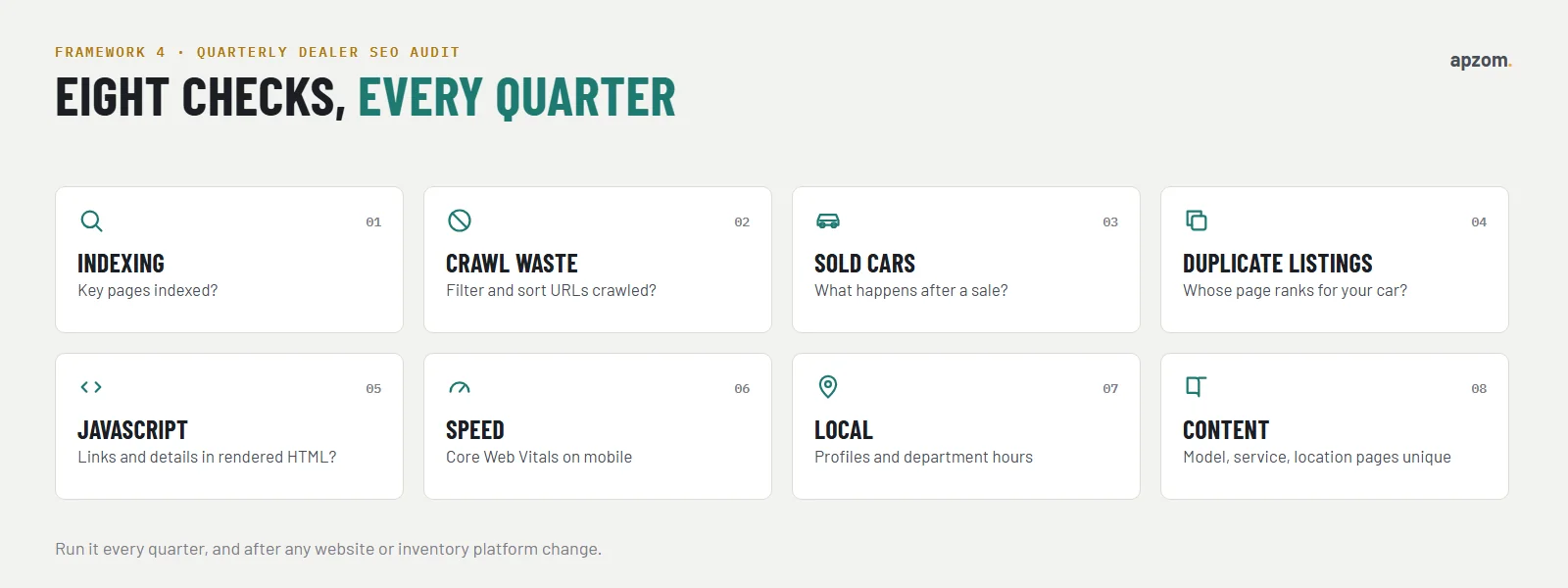
- Indexing: are your model, location, service and vehicle pages indexed? Check the page indexing report in Google Search Console.
- Crawl waste: are filter, sort or tracking URLs being crawled or indexed?
- Sold vehicles: what happens to a car’s page when it sells? Check a few recent ones.
- Duplicate listings: for a few cars, search for the vehicle and see whose page ranks.
- JavaScript: can you see vehicle links and details in the rendered HTML in Search Console’s URL inspection tool?
- Speed: check Core Web Vitals for vehicle and search pages on mobile.
- Local: are all Business Profiles accurate, with correct hours for each department?
- Content: are model, service and location pages unique and up to date?
If you are moving to a new website or inventory platform, use our website redesign SEO checklist so you do not lose rankings in the move.
How Apzom can help
We have not worked with a car dealership yet, so we will not show you a dealer case study. The closest work on our case studies page is AutoHunt, a car and bike review site we built from scratch on WordPress and grow with SEO, including structured data, sitemaps and real 404 pages. That case study does not quote traffic or ranking figures.
We work with clients worldwide, remotely, from our base in Ahmedabad, India. Our SEO services and local SEO services cover technical audits, site structure, crawl control, content for model and service pages, and local search for dealer groups. We will not promise rankings. If you also run paid search, our guide to Google Ads for small businesses explains how to set it up so it supports your SEO rather than competing with it.
Request a Dealer SEO Audit. We crawl your site the way search engines do, check how vehicle, model, service and location pages are indexed, how filters and sold cars are handled, whether marketplaces outrank your own pages, and how fast vehicle pages load on phones. You get a prioritised list of fixes, in plain language your website provider can act on.
No obligation and no guaranteed rankings. Prefer to talk first? Contact us or see all our services.
Frequently asked questions
Is SEO worth it for car dealerships?
Yes, for most dealers. Model, used-car and service searches in your area bring buyers who are already looking. Most of the work is technical: clean inventory pages, controlled filters, sensible handling of sold cars, and strong model, location and service pages.
What should I do with a car’s page after it sells?
It depends on whether you have similar stock. Many dealers keep the page live for a short time marked as sold with links to similar vehicles, then return a 404 or 410. Google says not to redirect many old URLs to one irrelevant page such as the homepage, which can be treated as a soft 404. Redirect only when a genuinely equivalent page exists.
Should filter pages be indexed?
Only a few. Pages for important combinations, such as a make, model or body type, can be useful landing pages. Most other filter and sort combinations should not be crawled or indexed, because they create near-duplicate pages.
Why do marketplaces outrank my own vehicle pages?
They have more authority and the same content. Write your own descriptions, publish on your site first, add details and features the marketplace cannot, and invest in model and location pages where your local knowledge wins.
Does vehicle schema still help SEO?
It can help search engines understand your pages, but Google no longer shows special vehicle listing results from it. Use accurate markup that matches what is on the page, and do not expect it to create rich results on its own.
How long does dealer SEO take?
Technical fixes such as crawl control and sold-car handling can show results within weeks of being crawled again. Building rankings for competitive model searches usually takes months.
Do I need a separate Google Business Profile for my service department?
Many dealers can have separate profiles for sales, service and parts if they meet Google’s guidelines, which helps each department show the right hours and reviews. Check Google’s current rules for your situation.
Can Apzom do SEO for dealerships outside India?
Yes. We work with clients worldwide, remotely, from our base in Ahmedabad, India, and set up SEO for your market, language and the search engines your buyers use.