
The short answer: a digital marketing agency for hotels should help you earn more of your revenue from guests who book directly, without pretending you can switch off online travel agencies (OTAs) such as Booking.com or Expedia. That means being visible where travellers actually plan trips, giving them a reason and an easy way to book on your own website, and building a guest relationship that brings people back.
This guide is for owners, general managers and sales and marketing teams at independent hotels, resorts, boutique and heritage properties, business hotels and small hotel groups. It explains how travellers choose and book, why so many guests who find you end up booking elsewhere, which channels suit which kind of property, the pricing and review rules that now apply in several markets, and how to measure marketing in net room revenue rather than clicks.
Why hotel marketing is different
Hotels share a few features that most marketing advice ignores.
- Every room-night is perishable. An empty room tonight cannot be sold tomorrow. Marketing has to respond to occupancy, season and events, not run at the same level all year.
- Intermediaries are part of the business. OTAs, metasearch sites, travel agents and corporate booking tools bring real guests, and they charge for it. Good hotel marketing manages that mix; it does not wage war on it.
- Guests compare everything. The same room can appear on your website, several OTAs and metasearch at once. Travellers notice price differences, review scores and how easy each one is to book.
- Trust is built by strangers. Reviews from previous guests often carry more weight than anything you say about yourself.
- The stay is the product. Marketing can fill a room once. Only the experience fills it again.
First, which kind of property are you?
Different properties win guests in very different ways. Be clear about your type, because it decides where to spend.
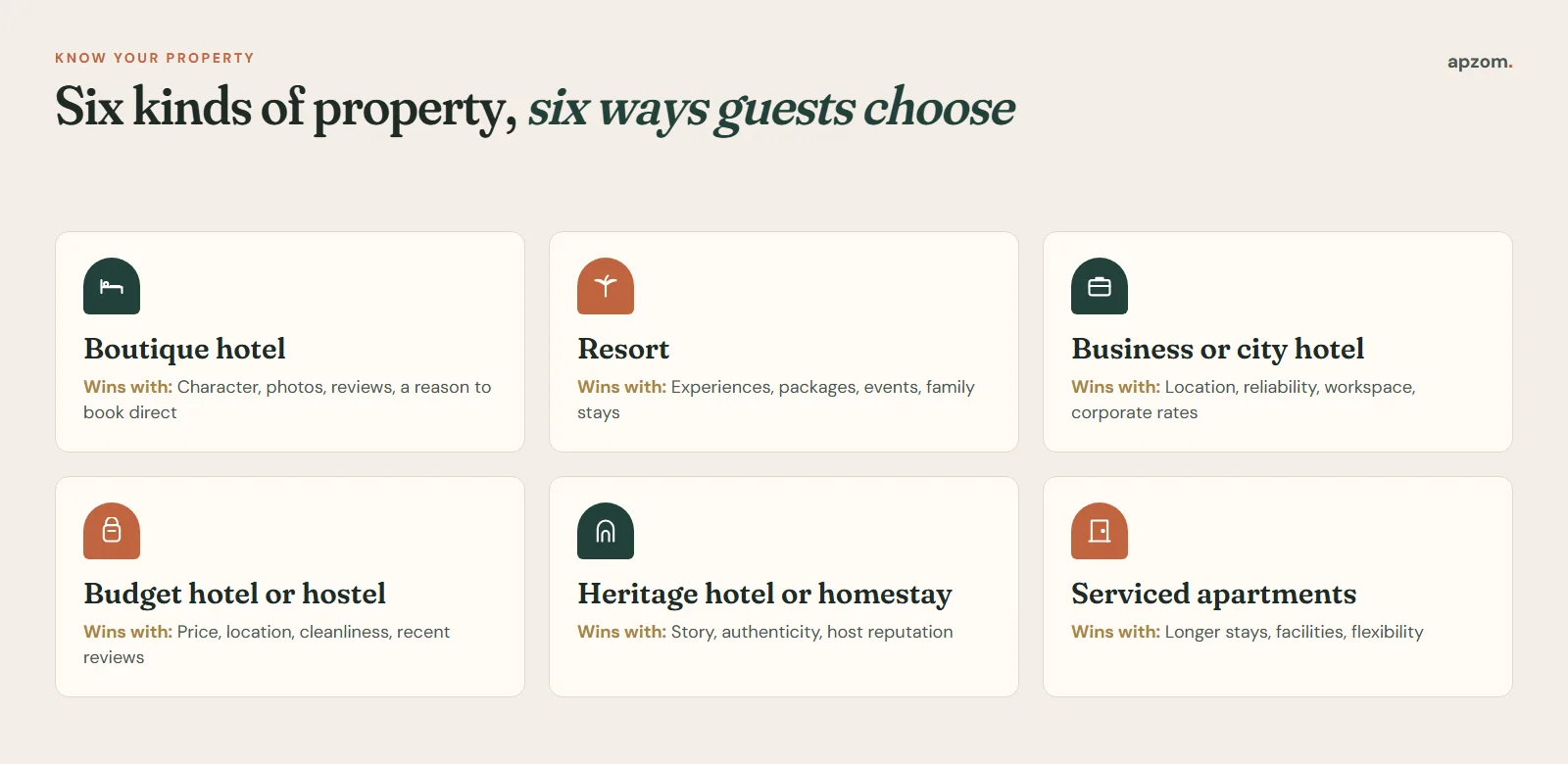
| Property type | Who books | Where they find you | What wins the booking |
|---|---|---|---|
| Independent boutique hotel | Leisure couples, short-break travellers | Google, Instagram, OTAs, word of mouth | Character, photos, reviews, a clear reason to book direct |
| Resort or destination property | Families, couples, groups, wedding parties | Google, OTAs, travel agents, social media | Experiences, packages, photos, reviews, events |
| Business or city hotel | Corporate travellers, conference guests | Google Maps, corporate tools, OTAs | Location, reliability, Wi-Fi and workspace, corporate rates |
| Budget hotel or hostel | Price-led travellers, students, backpackers | OTAs, metasearch, Google Maps | Price, location, cleanliness, recent reviews |
| Heritage hotel or homestay | Experience seekers, international travellers | Google, social media, specialist platforms | Story, authenticity, photos, host reputation |
| Serviced apartments | Longer stays, relocations, project teams | Google, corporate referrals, OTAs | Monthly rates, facilities, flexibility, location |
The booking mix: OTAs are a channel, not the enemy
Most hotels get bookings from several channels: their own website, OTAs, metasearch, phone and email, travel agents, corporate accounts, groups and events, and walk-ins. Each has a different cost and a different kind of guest.
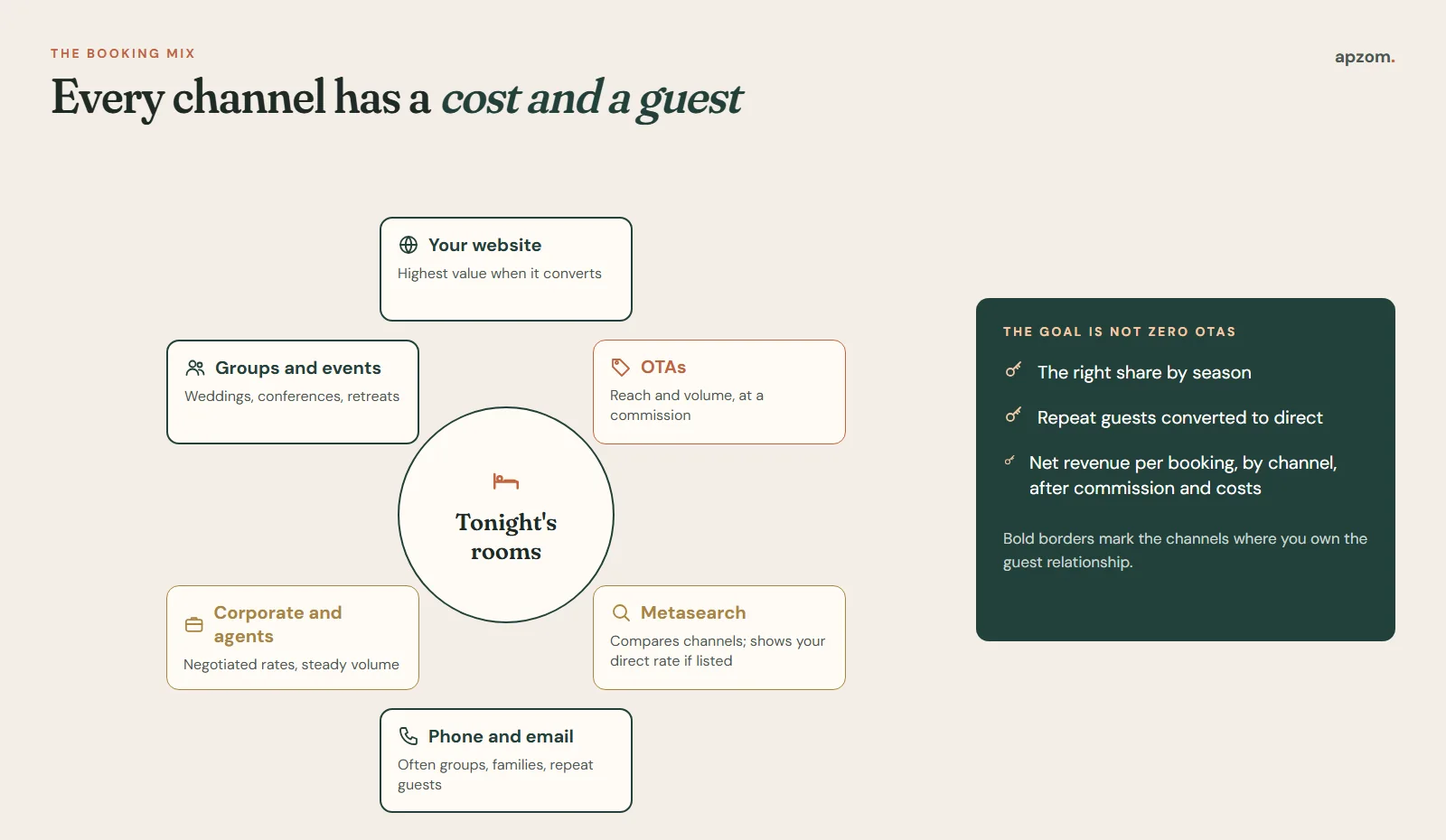
OTAs reach travellers you could never reach alone, especially for new properties, international guests and quiet periods. But they charge commission on each booking, and the guest relationship often stays with them. The practical goal is not zero OTA bookings. It is:
- The right share by season. Use OTAs more when you need to fill rooms, and lean on direct bookings when demand is strong.
- Converting repeat guests to direct. A guest who found you on an OTA the first time should have every reason to book direct the second time.
- Knowing your net revenue by channel. Compare what each booking is worth after commission, payment fees and marketing costs, not just the room rate.
Every hotel’s commission rates and contracts differ, so work this out with your own numbers rather than industry averages.
The direct booking gap
Many travellers find a hotel through search or social media, check its website, and then book on an OTA anyway. That is the direct booking gap, and closing it is often the most profitable thing a hotel’s marketing can do.
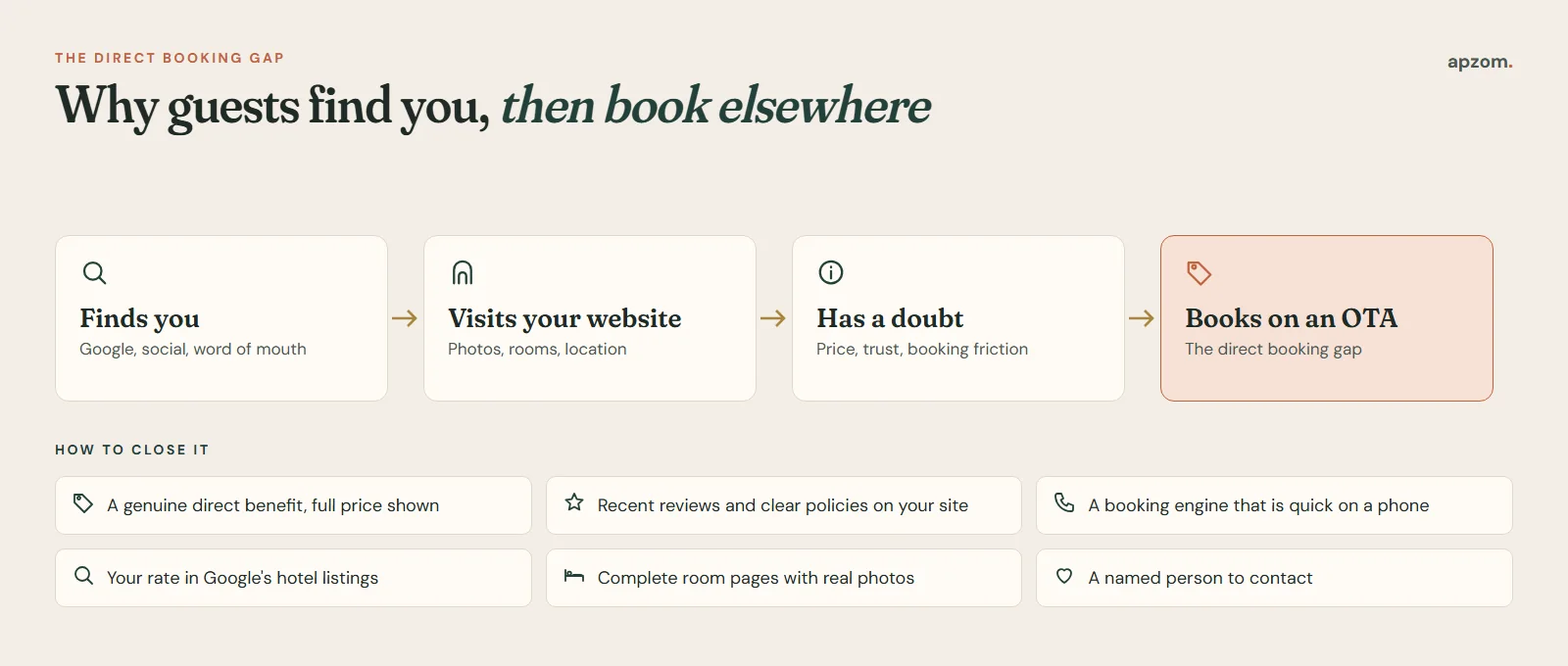
Why guests leave your website to book elsewhere:
| What they think | What causes it | How to fix it |
|---|---|---|
| “It’s cheaper on the OTA” | Your direct rate is no better, or looks worse once fees are added | Offer a genuine direct benefit and show the full price clearly |
| “I trust the OTA more” | Reviews and secure payment are visible on the OTA, not on your site | Show recent reviews, clear policies and secure payment on your site |
| “The booking engine is painful” | Slow, clunky or confusing on a phone | Test your booking flow on a phone yourself, monthly |
| “I already have an account there” | Loyalty points and saved details | Offer your own reasons: perks, flexibility, a direct contact |
| “I couldn’t find what I needed” | Missing room details, photos, policies, location information | Complete room pages with real photos and answers |
Direct booking benefits that guests value
A direct benefit does not have to be a lower price. Depending on your property and your contracts, it can be a better cancellation policy, breakfast included, a room upgrade when available, early check-in or late check-out, parking, a welcome drink, or simply a named person to talk to. Say it plainly on your website: “Book direct and get…”
Check your OTA contracts before advertising lower direct prices. Price parity clauses have historically limited this in some markets, and the rules are changing. In the European Economic Area, Booking.com was designated a gatekeeper under the Digital Markets Act in May 2024, and since November 2024 it must let hotels offer better prices and conditions on other channels, including their own websites.
Where travellers find hotels
Google: search, Maps and hotel listings
For many travellers, Google is where hotel research starts: a search for the destination, a Maps view of the area, and Google’s hotel listings that compare prices across booking sites.
- Google Business Profile: keep your hotel’s profile complete and accurate, with real photos, amenities, contact details and policies. Reply to reviews. Google decides some details itself, such as the hotel class, so focus on what you can control.
- Free booking links: through Google Hotel Center and a connectivity partner (often your booking engine or channel manager), your own website’s rate can appear alongside OTA prices in Google’s hotel results. There is no cost for clicks on free booking links, and no one can pay to rank higher in them.
- Paid hotel ads: Google also offers paid placements for hotel prices, and since 30 September 2026 these need your own direct price feed. Under Google’s price accuracy policy, the total price on your booking page must match what Google shows, for both ads and free booking links.
If your website rate is not appearing in Google’s hotel listings, you are leaving the direct option off the comparison that many travellers use.
SEO for hotels
Hotel SEO is less about blog posts and more about pages that answer what travellers search for:
- Room and suite pages with real photos, sizes described in words or your own figures, bed types, views, accessibility details and what is included.
- Location pages that explain how to get to you, what is nearby and why your location suits certain trips. Write about the area as someone who lives there, not as a copy of a travel guide.
- Experience and package pages: weddings, conferences, spa breaks, family stays, festivals and seasonal events, where you genuinely offer them.
- Policies that are easy to find: check-in and check-out, cancellation, children, pets, parking, accessibility.
Use structured data that matches what is on the page. Schema.org has Hotel and LodgingBusiness types with properties for amenities and check-in and check-out times. Apzom’s SEO services and local SEO work start from these pages.
Social media and visual discovery
Hotels are visual. Instagram, YouTube and short video help travellers imagine the stay: the view from the room, breakfast, the pool at sunset, the street outside. Use real, recent photos and videos of your property, not stock images. Show the people who work there if they are happy to be shown. Respond to messages quickly, because many travellers ask questions by direct message before booking.
Paid social and retargeting
Meta’s ad platforms can show your property to people who have visited your website, looked at specific dates or engaged with your content, and Meta offers catalogue-based ads for travel that can show the specific hotel a person looked at. Paid social works best for direct bookings when it sends people to a fast booking page with a clear direct-booking benefit. Our Meta Ads management covers this.
Metasearch
Metasearch sites compare prices across booking channels. If your direct rate appears there, a traveller can choose to book with you. Whether paid metasearch is worth it depends on your booking engine, your rates and how you track bookings, so test it carefully and measure net revenue.
Email and the guest relationship
Your past guests are your cheapest source of future bookings. Collect contact details with consent at booking and check-in, then stay in touch with useful, occasional messages: seasonal offers, events, a note before their anniversary of staying. Follow the email rules in each market you send to. Apzom’s email marketing service is built around this kind of lifecycle.
Groups, weddings, conferences and corporate
For many properties the most valuable business is not individual rooms but groups, events and corporate accounts. These buyers behave like B2B buyers: they compare spaces, capacities, menus and packages, and they want a fast, specific reply. Give them dedicated pages with floor plans or capacities you can confirm, real photos of events, downloadable information and an enquiry form that asks for dates, guest numbers and type of event.
Losing direct bookings to OTAs? A Hotel Direct Booking Audit checks your Google listings, website and booking engine on a phone, direct-booking offer, reviews and tracking, and shows where guests are slipping away. Free, with no obligation.
Reviews and reputation
Reviews influence where travellers book and how platforms rank you. A good review system is simple:
- Ask every guest at checkout or in a follow-up message, in the same way.
- Make it easy with a direct link.
- Reply to reviews, positive and negative, briefly and professionally.
- Fix the issues guests keep mentioning. Marketing cannot outrun a recurring complaint.
Do not offer incentives for reviews, do not ask only happy guests, and never post or buy fake reviews. Google’s policies prohibit incentivised reviews and selectively asking for positive ones, and consumer laws in the US and the UK ban fake reviews. Apzom’s online reputation management work follows these rules.
Show the full price: pricing rules for hotels
Several markets now require hotels to be upfront about total prices, and marketing pages and ads are part of that.
- United States: the Federal Trade Commission’s rule on unfair or deceptive fees covers short-term lodging, including hotels. It requires the total price, including mandatory fees, to be shown prominently.
- United Kingdom: the Digital Markets, Competition and Consumers Act 2024 bans drip pricing, so unavoidable fees must be included in the headline price.
- India: the Central Consumer Protection Authority’s guidelines on dark patterns list drip pricing as a prohibited practice.
Check the rules in each market you sell to, and make sure your website, booking engine, ads and price feeds all show the same full price.
The guest lifecycle: from first search to repeat stay
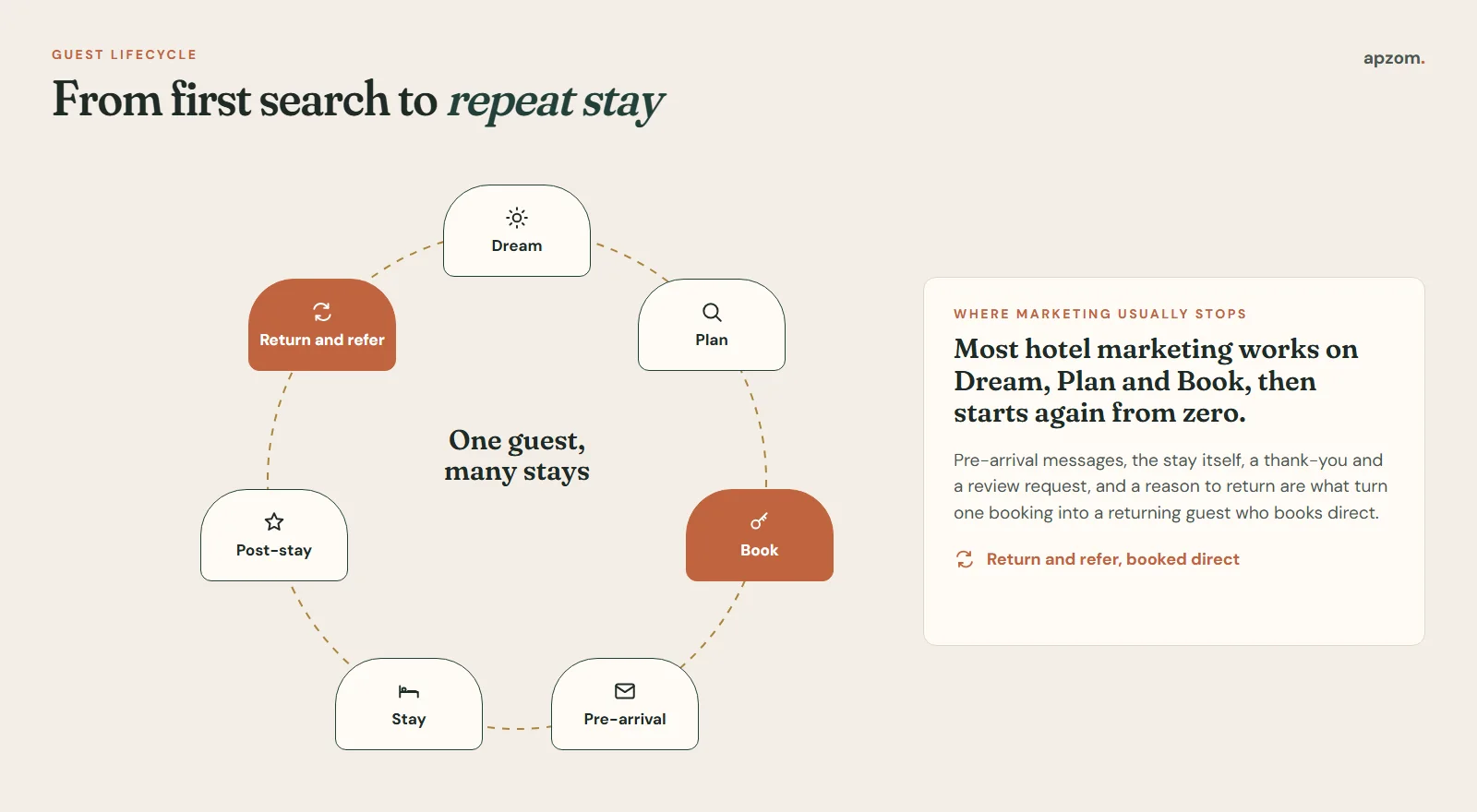
- Dream: the traveller is inspired by social media, a friend or a search for a destination.
- Plan: they compare areas, properties, reviews and prices.
- Book: they choose a channel. Your job is to make direct the easiest and best option.
- Pre-arrival: confirmation, useful information, upgrades and add-ons.
- Stay: the experience. Collect consent for future contact here.
- Post-stay: thank-you message, review request.
- Return and refer: a reason to come back and to tell others, booked direct.
Marketing that only works on stages one to three keeps paying to find new guests. Marketing that works on all seven builds a base of returning guests who book direct.
Measure net revenue, not clicks
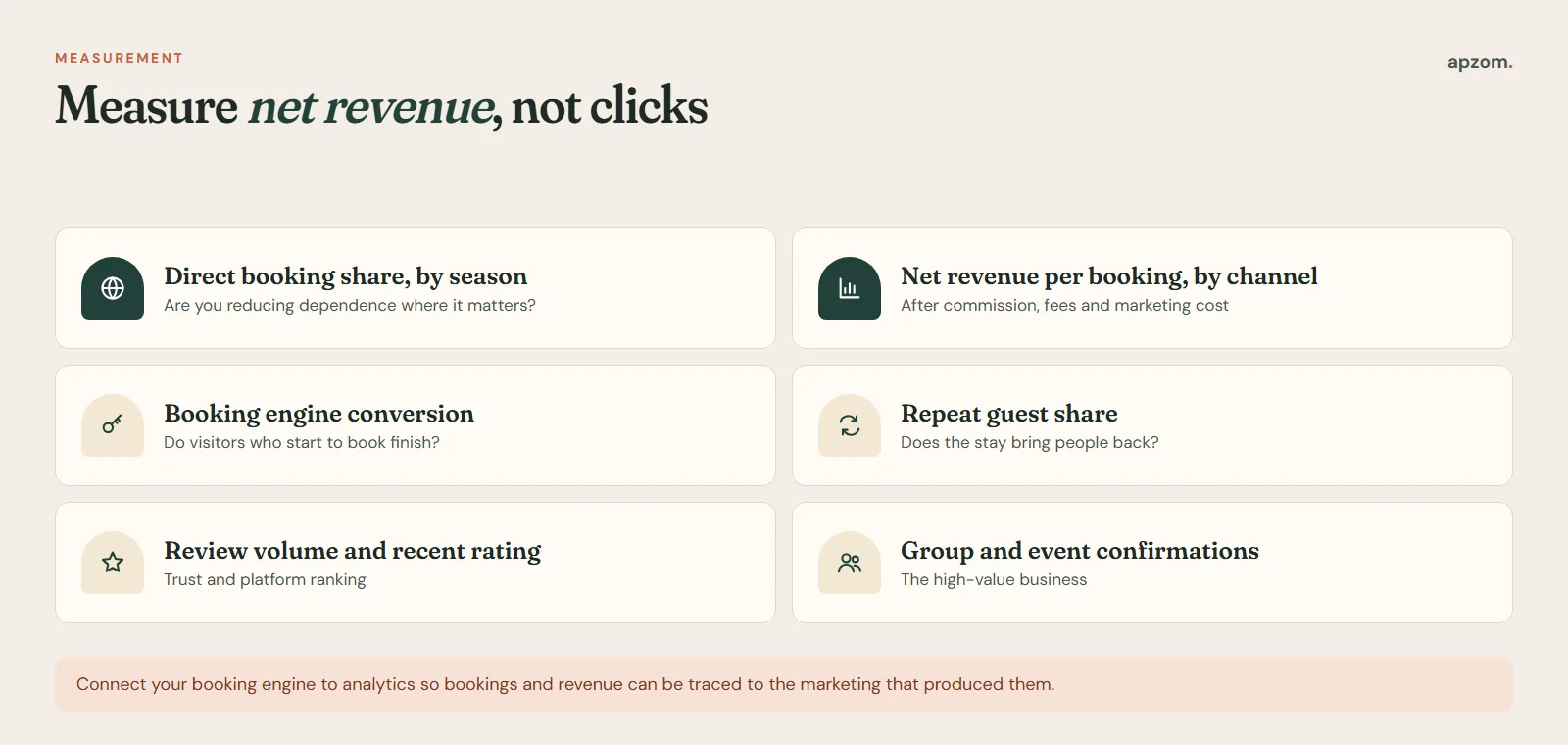
| Measure | Why it matters |
|---|---|
| Direct booking share, by season | Shows whether you are reducing dependence where it matters |
| Net revenue per booking, by channel | Compares channels after commission, fees and marketing cost |
| Booking engine conversion | Shows whether visitors who try to book actually finish |
| Repeat guest share | Shows whether the stay and the follow-up bring people back |
| Review volume and recent rating | Drives trust and ranking on platforms |
| Group and event enquiries, and how many are confirmed | Tracks the high-value business |
Connect your booking engine to analytics so you can see which marketing produced which bookings and revenue. Without that link, hotel marketing is guesswork. Be wary of anyone quoting typical OTA commission, conversion or return-on-ad-spend figures as if they apply to you; they vary widely by market, property and season.
AI search and travel planning
Travellers increasingly ask AI tools to suggest hotels or plan trips. Nobody can guarantee your property will be recommended. Google says there are no special requirements to appear in its AI features; the same foundations apply. What helps: complete, consistent information about your property everywhere, clear room and policy details, recent reviews, and pages that describe what makes your property different in plain language.
What a hotel marketing agency should actually do
Questions to ask
- How will you increase direct bookings without damaging our OTA relationships?
- Can you connect our booking engine to analytics so we see revenue by channel?
- Will our direct rate appear in Google’s hotel listings?
- How will you handle reviews?
- Will marketing respond to our occupancy and seasons?
Red flags
- Promises to “replace OTAs” or guaranteed occupancy.
- Reporting only clicks, followers and impressions.
- Stock photos of rooms that are not yours.
- No interest in your booking engine, rates or channel manager.
- Advice to post fake or incentivised reviews.
How Apzom can help
Apzom Digital helps businesses earn trust before the first conversation, and for hotels that means direct-booking focused SEO, local SEO, Google Ads, paid social, website development with fast booking paths, conversion rate optimisation and guest email. We do not have a hotel case study to show yet, and we will not invent results or occupancy figures. You can see the work we can show on our case studies page, and our guide on how to choose a digital marketing agency explains what to ask any agency, including us.
Request a Hotel Direct Booking Audit. We review your Google Business Profile and hotel listings, room and location pages, booking engine on mobile, direct-booking benefits and price display, reviews, paid search and social, guest email, and whether bookings can be traced to marketing. You get a prioritised list of what to fix first.
The audit is free, with no obligation and no guaranteed occupancy. Prefer to talk it through? Contact us or see all our services.
Frequently asked questions
What does a digital marketing agency for hotels do?
It helps hotels attract the right guests and earn more of their bookings directly: visibility on Google and social media, a website and booking path that convert, review and reputation management, and guest email that brings people back. A good one also measures net revenue by channel, not just clicks.
How can a hotel get more direct bookings?
Make sure your direct rate appears in Google’s hotel listings, offer a clear direct-booking benefit, show the full price, make the booking engine fast on a phone, show recent reviews on your site, and stay in touch with past guests so they book direct next time.
Should hotels stop using OTAs?
Usually not. OTAs reach travellers you cannot reach alone, especially for new properties and quiet periods. The aim is the right mix by season and converting repeat guests to direct bookings, judged on net revenue per booking.
Is SEO worth it for hotels?
Yes, especially for room, location, experience and event pages that answer what travellers search for. It works best alongside a complete Google Business Profile and visibility in Google’s hotel listings.
Do hotels need to show the full price including fees?
In several markets, yes. US federal rules on junk fees cover short-term lodging, UK law bans drip pricing, and Indian guidelines list drip pricing as a dark pattern. Show the total price, including mandatory fees, everywhere you advertise.
How should a hotel get more Google reviews?
Ask every guest in the same way at checkout or in a follow-up message, make it easy with a direct link and reply to reviews. Do not offer rewards for reviews or ask only happy guests.
Does social media bring hotel bookings?
It can, especially for boutique, resort and heritage properties where the experience sells the stay. Use real photos and video, answer messages fast and send interested people to a quick direct booking page.
How do we measure hotel marketing?
Track direct booking share by season, net revenue per booking by channel, booking engine conversion, repeat guest share, reviews and group or event conversions. Connect your booking engine to analytics so bookings can be traced to marketing.