The short answer: SEO usually takes months, not weeks, and nobody can tell you the exact date it will pay off. Google says some changes take effect in a few hours and others take several months, and suggests waiting a few weeks before judging whether a change helped. In our judgement, a business with an established website can often see early movement within two to three months and meaningful commercial results in four to six. Competitive markets and new websites take longer. The real answer depends on four separate clocks, explained below, and on what you count as a result.
This guide is for business owners and marketers deciding whether to invest in SEO, or wondering why the work they paid for has not shown results yet. It uses Google Search Central documentation as checked in November 2026. Apzom Digital sells SEO, so read this knowing we have an interest. We would rather you start with realistic expectations than be disappointed in month two.
What to take from this guide
- There is no single SEO timeline. Being found, being indexed, ranking and winning customers each run on a different clock.
- Some results are fast, most are not. Fixing a page that cannot be indexed can help quickly. Earning rankings against established competitors takes longer.
- Judge by leading indicators first. Indexing and impressions move before clicks, and clicks move before enquiries.
- No one can guarantee a ranking. Google says so directly, so treat a guaranteed timeline as a warning sign.
What Google says about timing
Google’s SEO Starter Guide says every change takes some time to be reflected, with some taking effect in a few hours and others taking several months, and that you will likely want to wait a few weeks to assess whether your work helped. It also notes that not every change will make a noticeable difference.
On discovery, Google says it can take a few weeks for it to notice a new site or changes to an existing one. When you ask it to recrawl a page, Google says crawling can take anywhere from a few days to a few weeks, and that requesting indexing does not guarantee the page will be included in results at all. Requesting a recrawl of the same URL several times will not make it happen faster.
Google is just as clear on promises. Its guidance on hiring an SEO says no one can guarantee a number one ranking, and warns against anyone claiming a special relationship with Google or offering priority submission.
The four clocks of SEO
Most confusion about SEO timelines comes from treating it as one process. It is easier to plan, and to judge an agency, once you separate it into four.
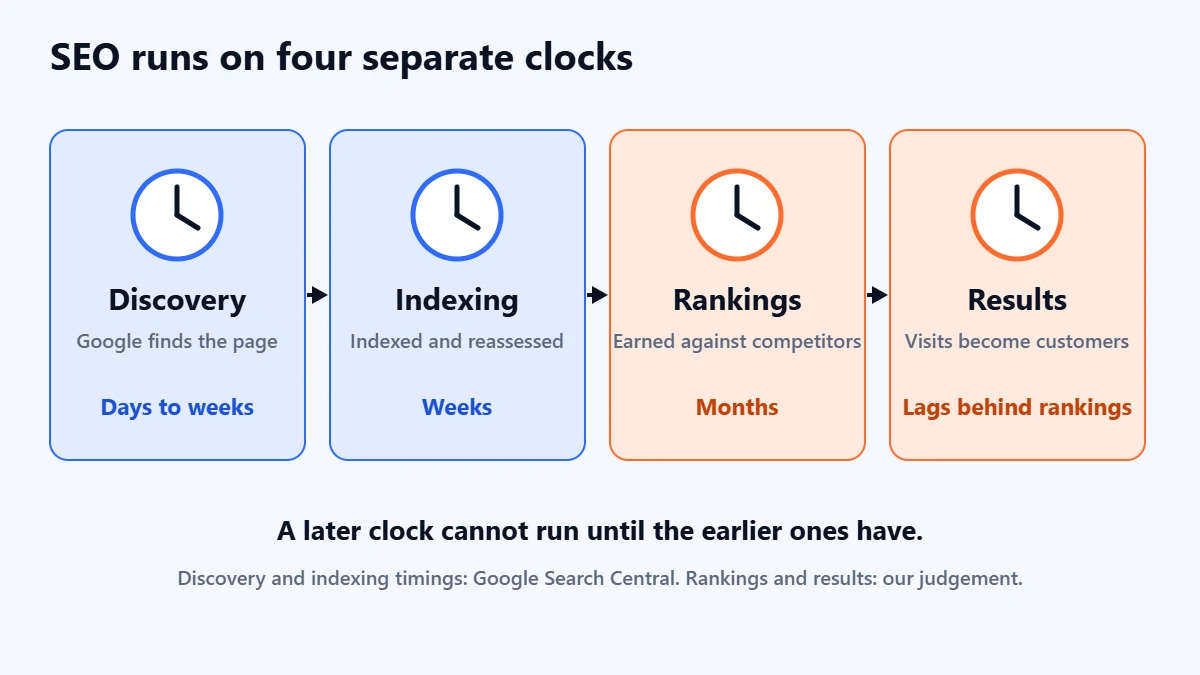
- Discovery and crawling. Google has to find the page. For a known site with a sitemap and good internal links, this is usually the fastest part, measured in days to weeks.
- Indexing and reprocessing. Google has to decide to index the page and reassess it after changes. Technical problems can stop the clock here entirely.
- Rankings. Your page has to earn a position against everyone else’s. This is the slow, competitive part, and it varies most between markets.
- Commercial results. Rankings have to become visits, visits become enquiries, and enquiries become customers. If your sales cycle is three months, revenue from SEO arrives at least three months after the traffic does.
A realistic timeline, stage by stage
The stages below are our judgement for a business with an existing website in a moderately competitive market. They are a planning guide, not a promise, and your own timeline could be faster or slower for the reasons in the next section.
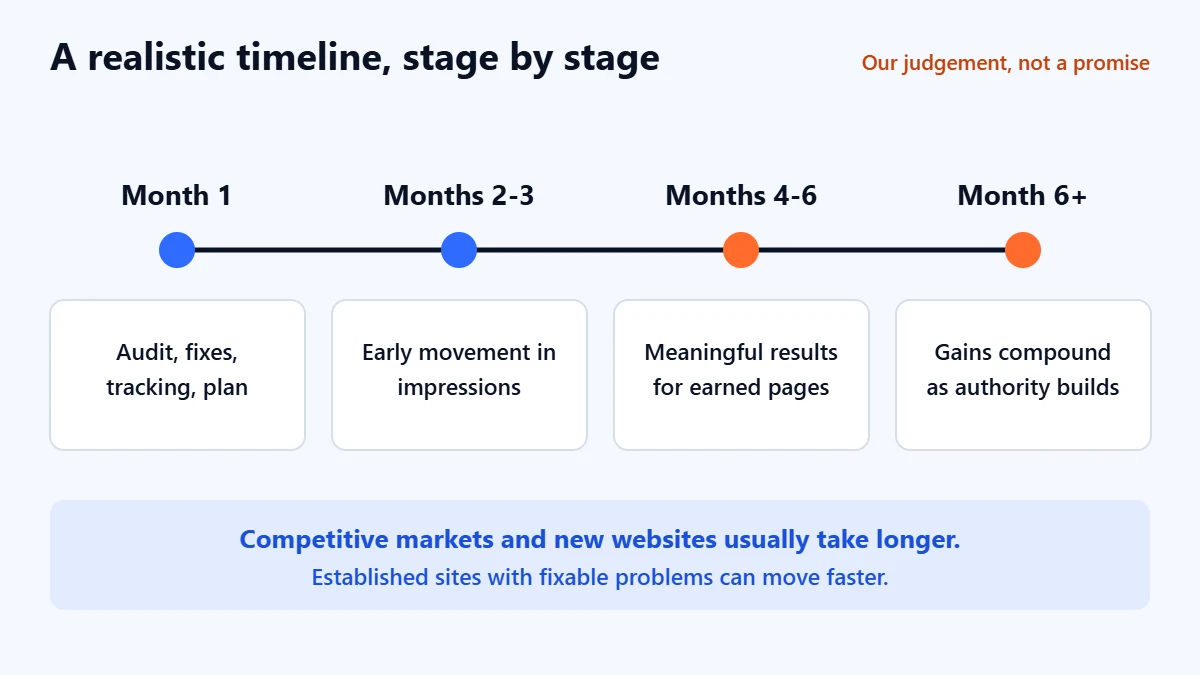
| Period | What usually happens | What to look at |
|---|---|---|
| Month 1 | Audit, technical fixes, tracking, and a plan for which pages matter most | Pages indexed, errors fixed, key events recording |
| Months 2 to 3 | Improved and new pages are crawled and reassessed. Early movement for less competitive searches | Impressions and average position for priority pages |
| Months 4 to 6 | Rankings settle for the pages that earn them. Clicks and enquiries start to follow | Clicks, visits to service pages, enquiries from organic search |
| Month 6 onwards | Gains compound as content, links and reputation build, and weaker pages are improved | Qualified leads and cost per lead compared with paid channels |
What makes SEO faster or slower
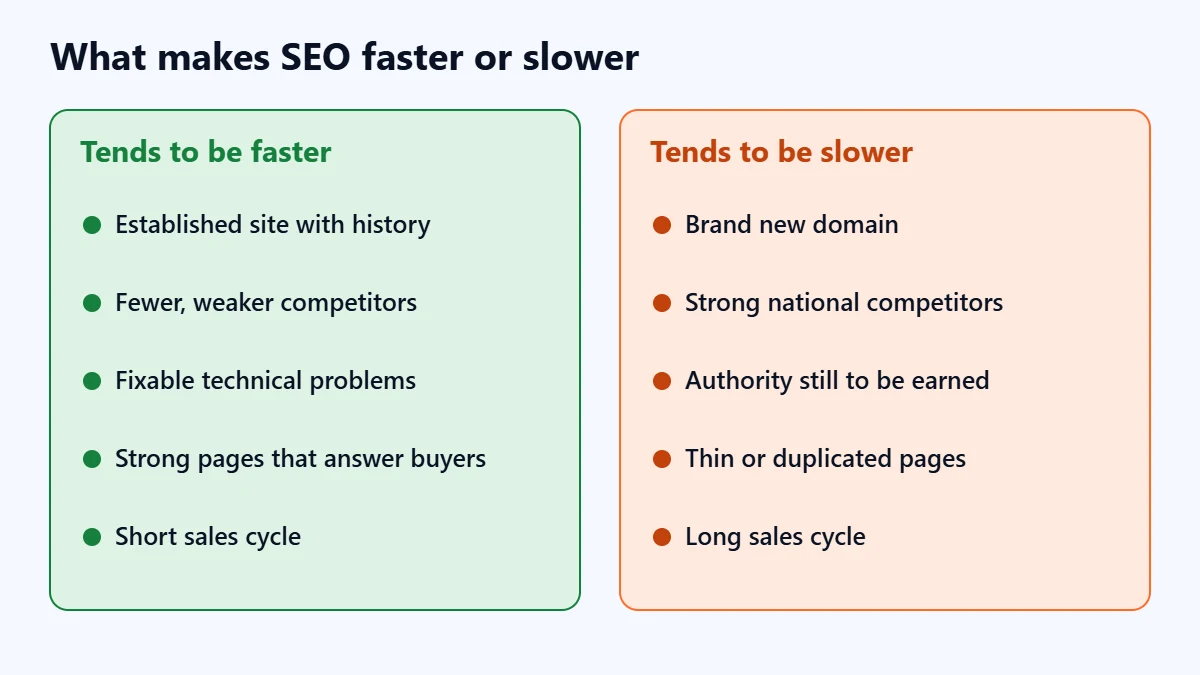
- Your starting point. A site with years of history and existing rankings usually moves faster than a new domain, which Google first has to discover and learn to trust.
- Competition. A local plumber in a small town is not competing with the same strength of pages as a national insurance comparison site.
- The problem you are fixing. If pages were blocked from indexing, removing the block can help quickly. Building authority in a crowded topic cannot be rushed.
- How much changes, and how well. A few thin pages will move less than a properly built set of service pages that answer real buying questions.
- Local or national. Local searches often depend heavily on your Google Business Profile, which our local SEO checklist covers.
- Your sales cycle. The longer customers take to decide, the longer the gap between traffic and revenue.
Want a realistic estimate for your website? Ask for a Free Growth Audit. We look at your current visibility, technical health and competition, and tell you what we think is achievable and how long it is likely to take.
What to check each month while you wait
Because SEO is slow, the danger is judging it only by enquiries in month two and giving up just before it works. Watch the leading indicators in order instead. If an earlier one is stuck, the later ones will not move.
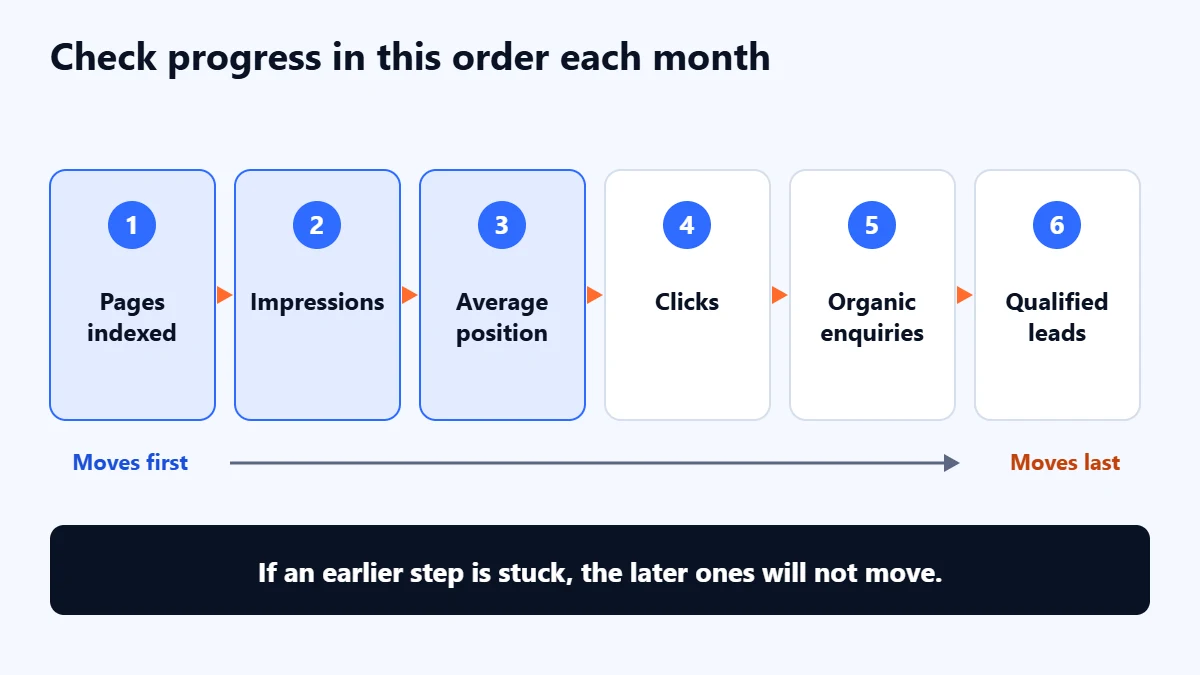
- Are the priority pages indexed? Check in Search Console’s page indexing report or with the URL Inspection tool. Our guide to using Google Search Console explains both.
- Are impressions rising for those pages? This usually moves first.
- Is average position improving for the searches you care about? Look at trends for groups of queries, not one keyword.
- Are clicks following? If impressions rise but clicks do not, look at titles and descriptions.
- Are organic visitors enquiring? Check key events in Google Analytics by landing page.
- Are those enquiries any good? Count qualified leads, not only form fills.
Things that do not speed it up
- Requesting indexing again and again. Google says repeated requests for the same URL will not get it crawled any faster, and there is a quota.
- Paying for priority submission. Google warns against anyone offering it.
- Buying links. Google’s spam policies treat links bought for ranking as link spam, which can harm the site.
- Publishing large numbers of thin pages. Volume without usefulness rarely helps and can make the site harder to assess.
- Changing everything every month. Google suggests waiting a few weeks to assess a change. Constant rewrites make it impossible to tell what worked.
When to worry
Patience is not the same as ignoring problems. In our judgement, it is worth asking hard questions if any of these are true:
- Priority pages are still not indexed after several weeks, and nobody can explain why.
- After three months there is no movement at all in impressions for the pages being worked on.
- Your reports show activity, such as hours or tasks, but no measures of visibility or enquiries. Our guide to what a marketing report should include covers what to ask for.
- Someone guaranteed a ranking or a date.
- Traffic is falling rather than growing slowly. Our guide to why organic traffic drops explains how to find the cause.
If you need results sooner
If you need enquiries this month, SEO alone is the wrong tool. Paid search can show your ads as soon as campaigns are approved, and many businesses run it while SEO builds. It also shows you which searches convert, which helps decide where SEO should focus first. Our comparison of SEO and Google Ads explains how to split budget between them, and our guide to what SEO costs covers pricing models.
A 90-day plan
- Weeks 1 to 2: audit the site, fix indexing and technical problems, and set up Search Console and key events. Our technical SEO audit guide lists the checks.
- Weeks 3 to 6: improve the service pages most likely to bring enquiries, and strengthen internal links to them.
- Weeks 7 to 10: add new pages only where real searches have no good page yet, and work on your Business Profile if you serve a local area.
- Weeks 11 to 13: review indexing, impressions and positions for the priority pages, and decide what to do next based on what moved.
Frequently asked questions
Can SEO work in a month?
Some fixes can show an effect quickly, especially when pages were blocked from indexing or had serious technical problems. Building rankings against established competitors usually takes longer. Google itself says some changes take effect in hours and others take several months.
How long does SEO take for a new website?
Usually longer than for an established one. Google says it can take a few weeks just to notice a new site, and a new domain has no history or existing rankings to build on. Plan for a longer runway, and consider paid search for enquiries in the meantime.
Why are my rankings going up and down?
Positions change constantly as Google updates its systems and competitors change their pages. Judge trends over several weeks for groups of searches, rather than reacting to daily movement for a single keyword.
When should I stop if SEO is not working?
Not before the leading indicators have had a fair chance. In our judgement, three months is reasonable to expect movement in indexing and impressions for the pages being worked on. If those have not moved and nobody can explain why, that is the time to review the approach, rather than simply spending more.
Get your Free Growth Audit and Quote. We review your website, search visibility and competition, then send a plain-English plan with what we would fix first and a realistic view of timing and cost.
No obligation and no guaranteed rankings. Prefer to talk first? Contact us or see our SEO services.