
Most small businesses that struggle with marketing are not doing too little. They are doing too much of the wrong thing. A few Instagram posts a week, a Google Ads campaign someone set up two years ago, a website that has not been touched since launch, a directory listing that charges every month, and no clear idea which of it brings in customers.
This playbook takes the opposite approach. A small business does not need every marketing channel. It needs the smallest marketing system that reliably turns the right people into paying customers, and the discipline to grow it only when it works.
It is written for owners and managers of small businesses of every kind: a plumber, a salon, an online shop, a two-person B2B consultancy, an accountancy practice, a gift shop. The advice changes depending on which of those you are, and this guide says so.
The short answer
What does a digital marketing agency for small businesses do? A good one starts by learning how the business makes money: who buys, what a customer is worth, where those buyers already look, and how much work the business can take on. Then it builds the smallest set of marketing activity that gets the business found, trusted and chosen, sets up tracking that shows which activity produces customers, and grows only what proves profitable. That might be local search and reviews for a plumber, product pages and email for an online shop, or case studies and search for a consultancy.
What this playbook helps you decide
- What to fix before spending money on more traffic.
- Which one or two channels suit your kind of business, and which you can ignore for now.
- Whether you need SEO, ads, social media or a new website.
- How to tell whether marketing is making money, not just activity.
- When to do it yourself, when to hire help, and what to ask before you do.
The Minimum Viable Marketing Stack
Every small business needs just enough marketing to do five jobs. Nothing more until those work.
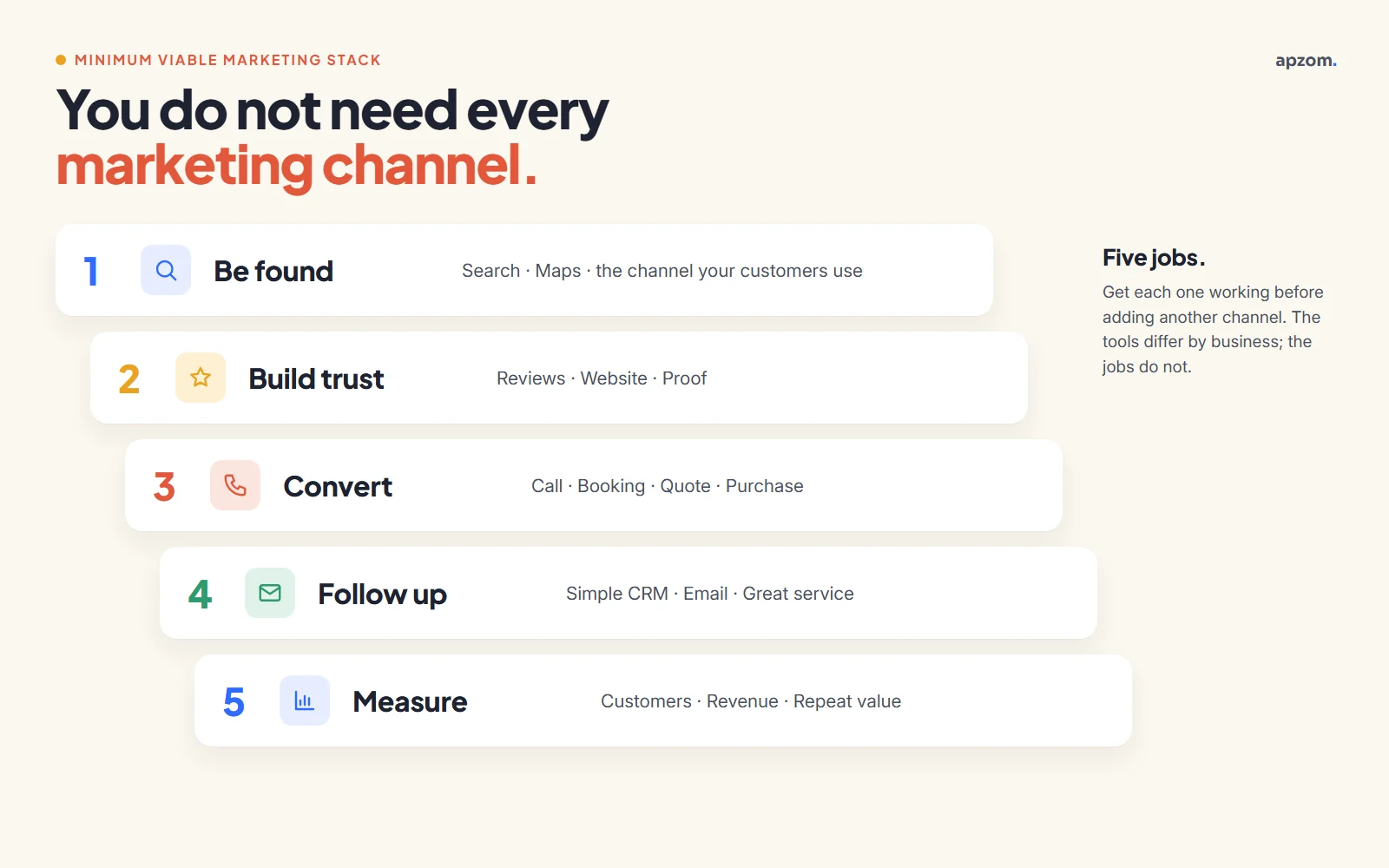
- Be found. By people who already need what you sell, in the place they look.
- Look trustworthy. Reviews, a clear website, real photos, proof that you deliver.
- Make it easy to buy or enquire. One obvious next step: call, book, buy, request a quote.
- Follow up. Answer quickly, confirm, deliver well, and stay in touch.
- Measure the result. Know which activity produces customers, revenue and repeat business.
The tools that do these jobs differ by business. For a local electrician, “be found” means Google Maps and a few strong service pages. For an online candle shop it means product pages, Google Shopping and perhaps Instagram. For a software consultancy it means search visibility for specific problems and a few case studies. The jobs are the same; the tools are not.
More channels do not automatically mean more growth. A small budget split across Google, Meta, TikTok, LinkedIn, SEO, YouTube, email and influencers usually means none of them gets enough money, attention or time to work. Two channels that match where your customers already look, done properly, will almost always beat eight done half-heartedly.
First, know which kind of business you are
Marketing advice goes wrong when it treats every small business the same. Start with your model.
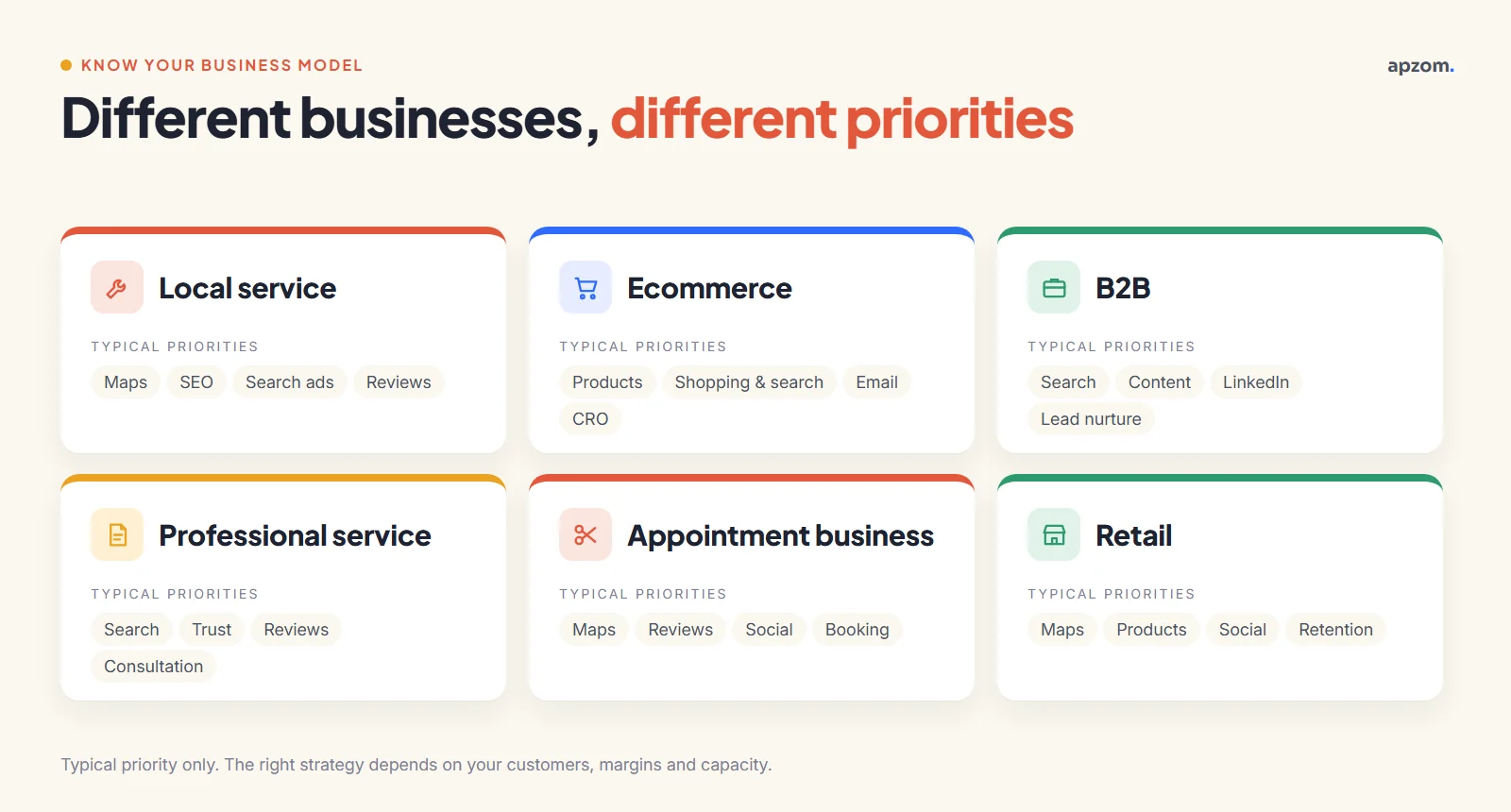
| Business model | Examples | Where customers usually look | Usual first priorities | Usually lower priority at first |
|---|---|---|---|---|
| Local service | Plumber, electrician, cleaner, roofer, locksmith, auto repair | Google Search and Maps, often urgently | Business Profile, reviews, service pages, search ads, answering the phone | Daily social posting, broad brand campaigns |
| Appointment-based | Salon, spa, fitness studio, photographer, consultant | Maps, Instagram, recommendations | Reviews, easy online booking, social proof, reminders | Long-form blogging |
| Small ecommerce | Online shop, maker, specialist retailer | Google, Shopping results, marketplaces, social | Product pages, product feed, shopping and search ads, email, checkout | Local SEO, unless you also have a shop |
| Small B2B | IT provider, agency, manufacturer, software or service firm | Google for specific problems, LinkedIn, referrals | Commercial pages, case studies, search, email follow-up, lead qualification | Short-form consumer social |
| Professional service | Accountant, architect, adviser, consultant | Search, referrals, reviews | Expertise pages, reviews, credentials, easy consultation booking | Heavy paid social |
| Brick-and-mortar retail | Shop, café, boutique | Maps, social, walking past | Business Profile, photos, reviews, social, email or loyalty | Wide-area paid search |
This is a starting point, not a rule. A highly visual local service, such as a landscaper, may find Instagram more useful than the table suggests. A B2B firm whose buyers live on LinkedIn should prioritise it. Use the table to question your assumptions, not to replace your judgement.
The Growth Control Panel: five decisions
Instead of starting with channels, work through five decisions in order. Each one narrows what you should spend on.
Decision 1: Where does customer demand already exist?
Before choosing a channel, find where buying intent already is.
Customer demand → channel → offer → conversion
If people already search Google for “emergency electrician near me”, the demand exists and your job is to show up when it happens. If nobody searches for your product because they do not know it exists, search cannot capture demand that is not there, and you need channels that create it, such as social, video or partnerships.
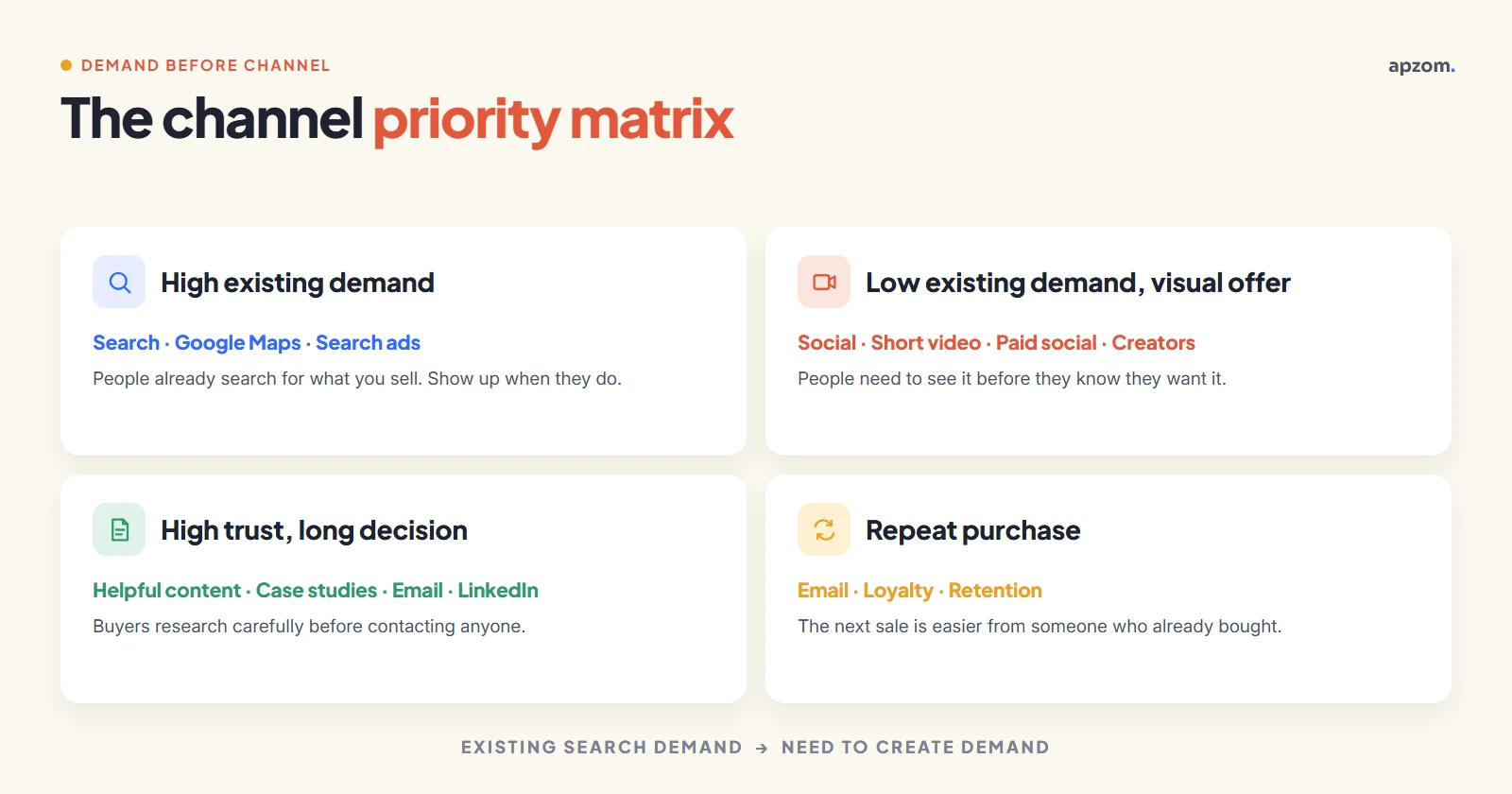
A simple way to think about it:
- High existing demand, clear intent. People search for what you sell. Prioritise Google Search, Google Maps and search ads.
- Low existing demand, visual offer. People do not know they want it until they see it. Consider social media, short video, creators and paid social.
- High trust, long decision. Buyers research carefully before contacting anyone. Prioritise helpful content, case studies, email and, for B2B, LinkedIn.
- Repeat purchase. Customers buy again and again. Prioritise email, loyalty and retention before buying more new traffic.
Local search: often the first channel for local businesses
If you serve customers in a local area, your Google Business Profile may be the most valuable marketing asset you have, and the centre of any local SEO work. Google says local results are based mainly on three things: relevance (how well your profile matches the search), distance (how far you are from the person searching), and prominence (how well known the business is, which includes reviews). It also says there is no way to request or pay for a better local ranking.
What helps, according to Google’s own guidance:
- A verified profile with complete, accurate details: name, address or service area, phone, website, hours and categories.
- The right primary category and only the categories that truly describe you.
- Real photos of the premises, team and work.
- Reviews, and replies to them.
What to avoid: keywords stuffed into the business name, fake addresses or virtual offices, duplicate profiles, and fake reviews. These break Google’s guidelines and can get a profile suspended, which for a local business can be worse than having no marketing at all.
If you serve several towns, a page for each is useful only if it says something genuinely local: the work you do there, real projects, how you get there, local details. Ten copies of the same page with the town name swapped are doorway pages that help nobody.
SEO: show up where people are already searching
For a small business, SEO is simpler than it is often made to sound. It means making sure that when someone searches for what you sell, your site is a strong, helpful answer.
- Commercial pages. One clear page for each main service or product line, explaining what it is, who it is for, what it costs or how pricing works, and how to buy or enquire.
- Local pages. Only for real locations or markets you serve.
- Helpful content. Answers to the questions buyers ask before they buy: pricing explained, comparisons, what to expect, how long it takes.
- Technical basics. Google can find and index your pages, the site works well on a phone and loads quickly, and pages link to each other sensibly.
- Authority. Genuine reviews, mentions in local or industry publications, partners and associations.
Publishing thirty AI-written blog posts a month is not an SEO strategy. Google’s guidance asks for helpful, reliable content written for people, and its 2026 guide to AI search warns against simply recycling what is already online. A few strong pages that answer real buyer questions are worth more than a hundred generic ones.
Google Ads: buying a place in the search results
Search ads make sense when people already search for what you sell and you want to appear immediately. They work when they are tight:
- Bid on searches with clear buying intent, not broad phrases.
- Add negative keywords for searches you do not want, such as jobs, free, DIY or services you do not offer.
- Target only the area you can actually serve.
- Send people to a page that matches the ad.
- Track what matters: calls, booked appointments, quote requests and sales.
Not every conversion is worth the same. A quote request for a full kitchen refit is worth far more than a newsletter sign-up. Google’s own guidance recommends setting conversion values that reflect what each action is really worth, so the system can prioritise the valuable ones.
Performance Max, Google’s automated campaign type across its networks, can work well, but it relies on reliable conversion tracking, good images and text, and clear goals. For many small businesses, a tightly controlled search campaign is the better place to start, with automation added once tracking proves trustworthy.
Meta ads and social media: create demand, build familiarity
Facebook and Instagram ads are good at showing your business to people who were not looking for it: a new product, an offer, a local opening, a visual service. They are less reliable at capturing someone who needs a plumber in the next hour, because that person is searching, not scrolling.
Organic social media is similar. For some businesses it is central: restaurants, cafés, beauty, fashion, fitness, lifestyle products and visual services win customers through what they show. For others, such as a plumber, an accountant or an industrial supplier, it is a supporting channel that shows you are active and real. It does not have to be daily. Not every small business needs to become a media company.
Comparing the main channels
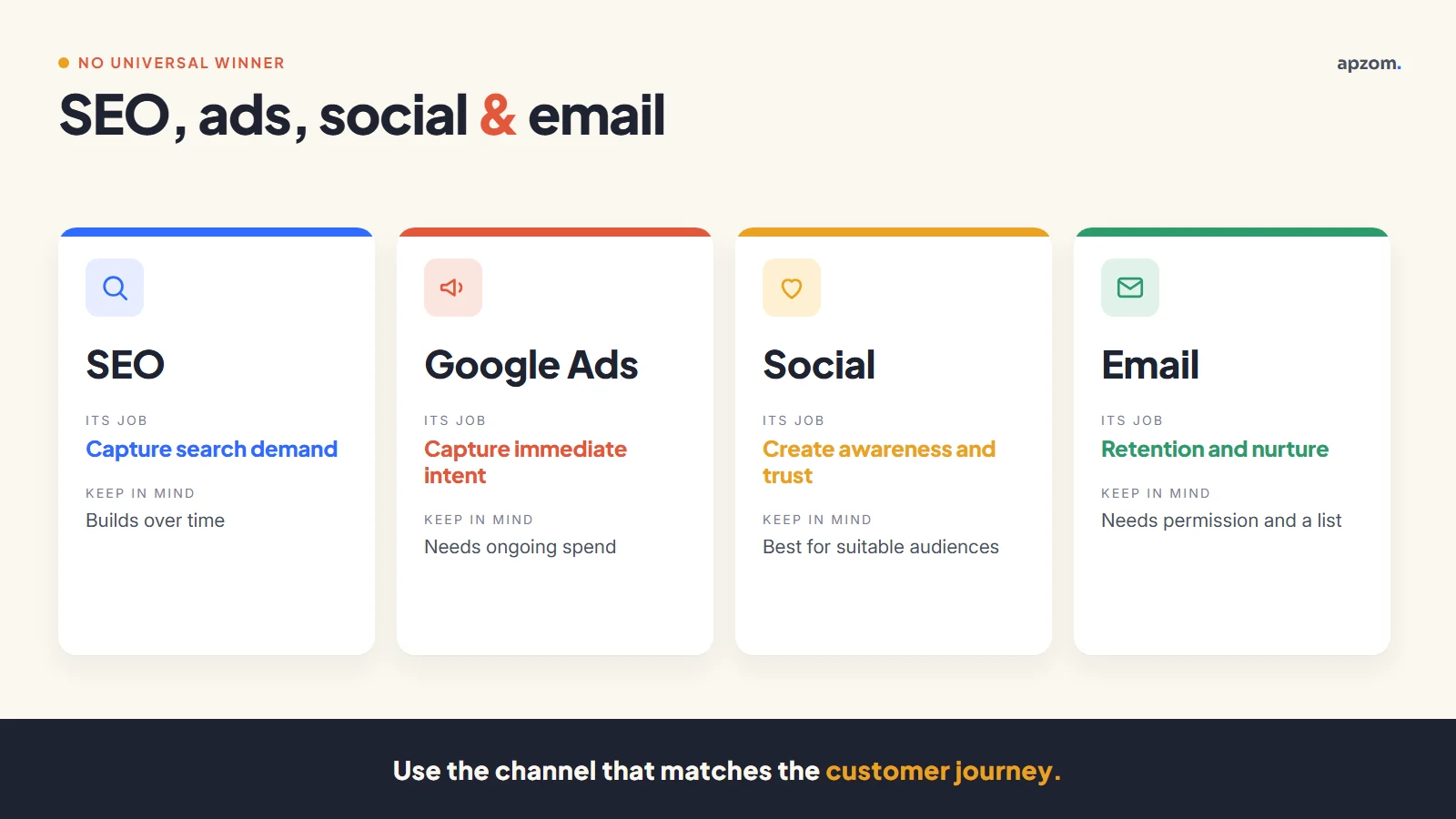
| Channel | Best for | Speed | Builds over time? | Buyer intent | Main risk |
|---|---|---|---|---|---|
| SEO | Capturing existing search demand | Slower | Yes | Medium to high | Slow or weak execution |
| Local SEO | Nearby customers | Medium | Yes | High | Ineligible locations or fake tactics |
| Google Ads | Immediate demand | Fast | No, stops when spend stops | High | Wasted spend on the wrong searches |
| Meta ads | Creating demand, offers, retargeting | Fast | Partly | Mixed | Low-quality enquiries |
| Repeat sales, nurturing, retention | Medium | Yes, your list grows | Existing relationship | Spam and unsubscribes | |
| Organic social | Trust, awareness, community | Continuous | Partly | Mixed | Time spent without return |
Decision 2: What must people see before they trust you?
Traffic without trust converts poorly. Before someone calls, books or buys, they want reassurance.
Depending on the business, that might be reviews, real photos of your work or premises, prices or a price range, examples or case studies, credentials, the team, clear policies on returns or guarantees (only if they are genuine), and easy-to-find contact details.
Your website is where most of this comes together. It does not need to be complicated, but it should answer six questions within seconds:
- What do you do?
- Who do you help?
- Where do you operate?
- Why should I trust you?
- How much does it cost, or how do I get a price?
- What should I do next?
If your site cannot answer those on a phone in ten seconds, fixing it will usually do more than buying more traffic.
Reviews: the trust you cannot fake
Reviews follow a simple cycle: experience → review → response → trust. A good experience leads some customers to review you; a thoughtful reply shows future customers how you treat people; together they build the trust that brings the next customer.
The rules are clear. Google prohibits paying or offering discounts for reviews, discouraging negative reviews, and asking only happy customers. In the United States, the FTC’s rule on consumer reviews, in force since October 2024, bans fake reviews, reviews bought on condition that they are positive, undisclosed reviews by staff, and tactics to suppress negative ones. Other countries have their own consumer protection rules. Ask every customer the same way, make it easy, and accept what they write.
Decision 3: What is the easiest conversion?
Every business has one action that matters most. Marketing should be built around it.
| Business | Main conversion |
|---|---|
| Emergency plumber | Phone call |
| Salon or physio | Booked appointment |
| Online shop | Purchase |
| Kitchen fitter or builder | Quote request |
| B2B software or service | Demo or consultation |
| Café or shop | Store visit |
Once you know the action, make it effortless: a tap-to-call button on mobile, online booking that works in a few taps, a short quote form, a smooth checkout, clear directions.
This is also where many businesses find their quickest win. Conversion rate optimisation, or CRO, simply means getting more customers from the visitors you already have. Common fixes include a clearer offer, a more obvious call to action, a faster mobile site, a shorter form, reviews next to the button, clear pricing or a clear quote process, and landing pages that match the ad that brought people there. Fake countdown timers and invented scarcity might lift a number briefly, but they damage trust.
Decision 4: What happens after the lead or sale?
Most marketing plans stop at the enquiry. That is where many small businesses lose money they have already spent.
A quick, friendly reply often matters as much as the ad that produced the enquiry. Missed calls, slow quotes, forgotten follow-ups and confirmations that never arrive quietly undo good marketing.
You do not need expensive software. You need a simple way to record every enquiry and what happened to it: new, contacted, quoted, booked, won or lost, and where it came from. For some businesses that is a spreadsheet; for others a simple CRM, or customer relationship management tool. Choose the simplest system your team will actually use.
Automation helps with repetitive, low-risk tasks: form confirmations, routing enquiries to the right person, appointment reminders, abandoned-cart emails, follow-up reminders and review requests. It should not replace human judgement in real conversations, and it should never be used for spam, fake engagement or fake reviews.
Before buying more traffic, ask whether existing customers come back
This is the question most marketing plans skip. For many small businesses, the cheapest growth comes from customers they already have: repeat purchases, maintenance plans, renewals, subscriptions, referrals and a second product or service.
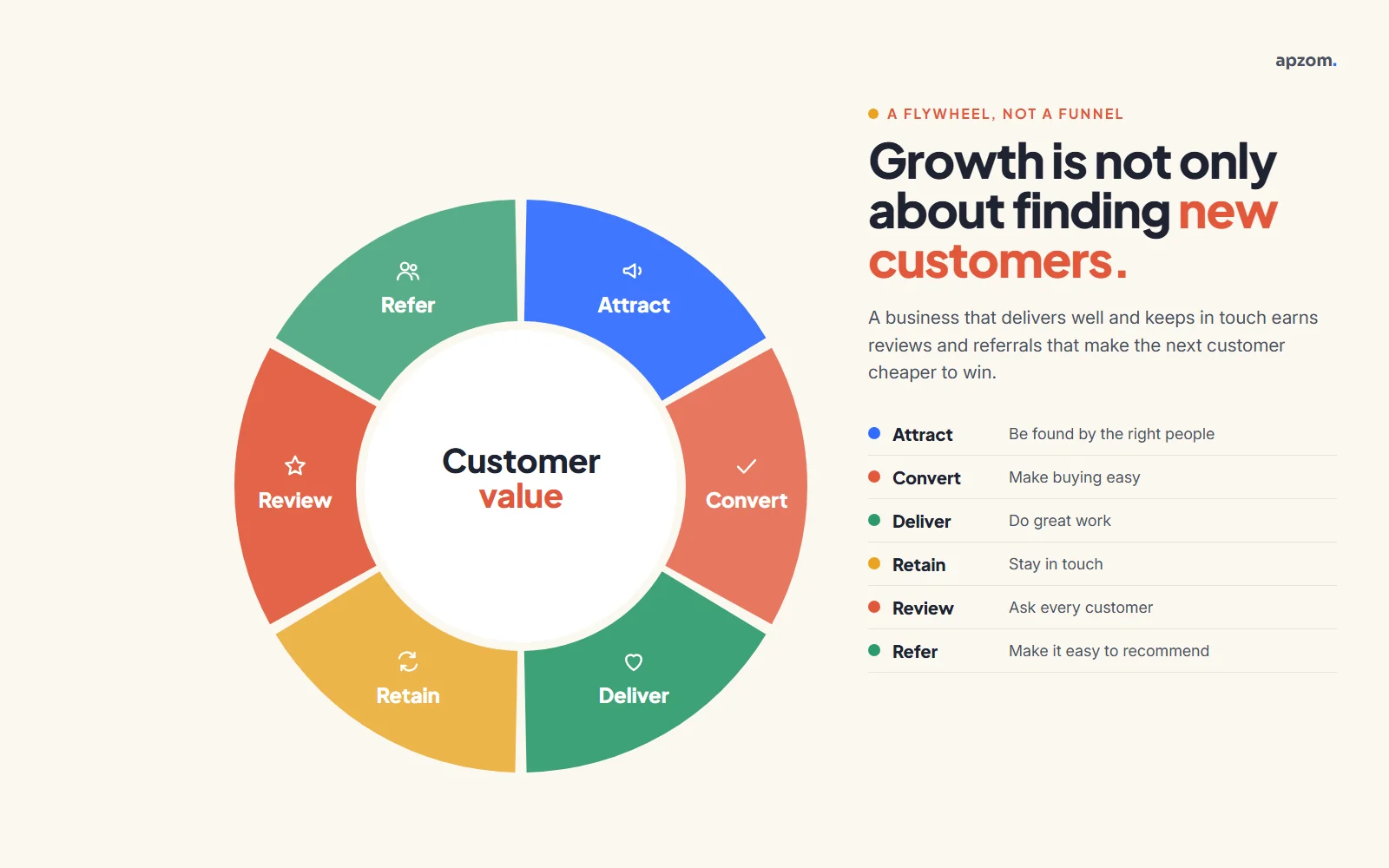
Think of it as a flywheel, not a funnel: attract → convert → deliver → retain → review → refer, and back to attract. A business that delivers well and keeps in touch gets reviews and referrals that make the next customer cheaper to win. A business that only chases new customers has to pay for every single one.
Email is usually the main tool here, and SMS can suit some businesses. Both rely on permission. Collect contact details honestly, make unsubscribing easy, and follow the consent and messaging rules where you operate, which vary by country. Never buy lists or scrape contacts.
The information customers choose to give you directly, such as their email address, purchases, appointments and enquiries, is called first-party data. It is one of the most valuable things a small business owns, and it should be used responsibly and with care for privacy.
Decision 5: Did marketing make money?
Most marketing reports stop too early: impressions, clicks, followers. A small business needs to follow the money.
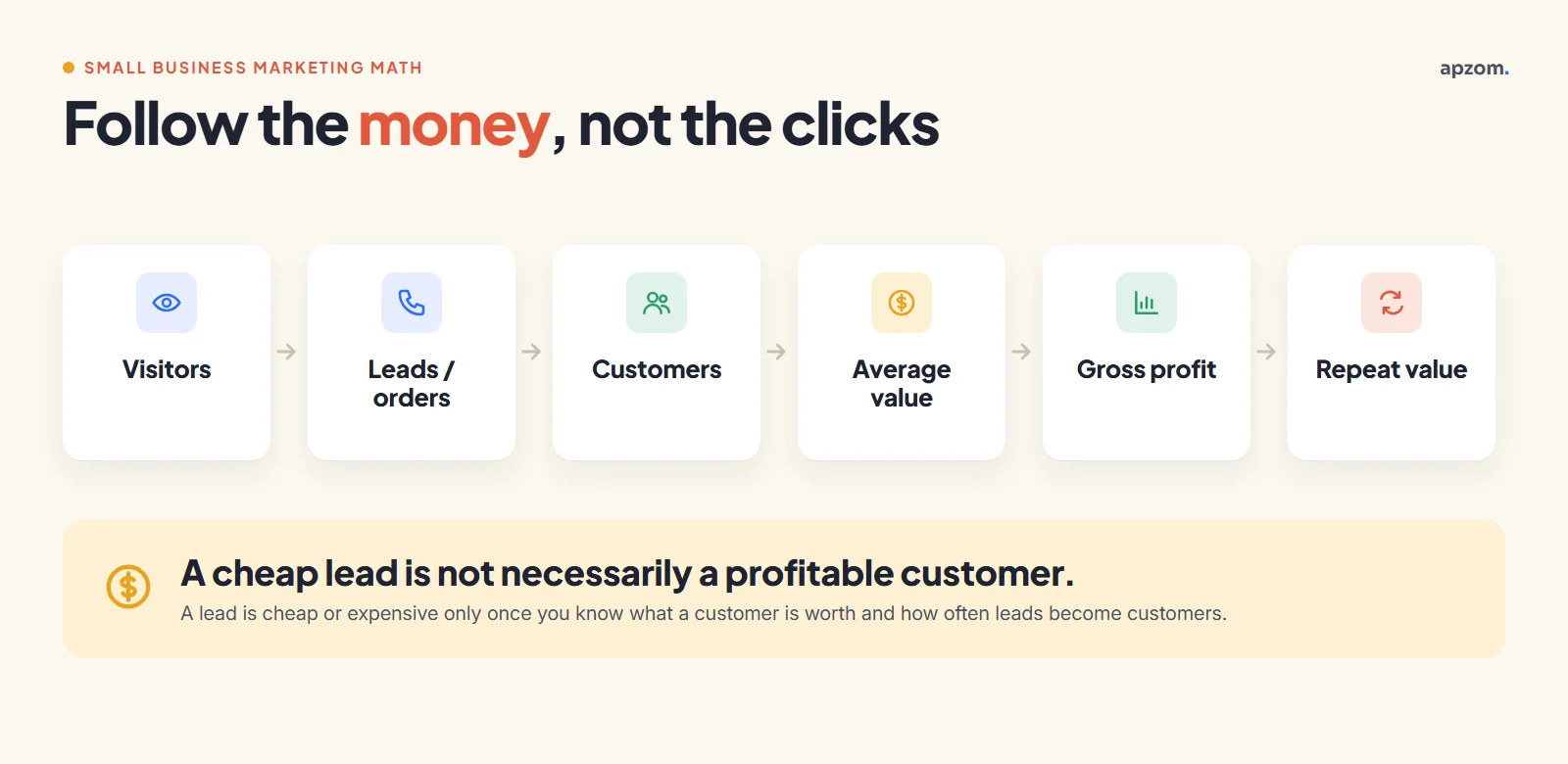
Visitors → leads or orders → customers → average value → gross profit → repeat value
A few simple ideas make this work:
- Customer acquisition cost (CAC): what you spent on marketing to win one new customer.
- Average transaction value: what a typical customer spends per job or order.
- Gross margin: what is left from that sale after the direct cost of delivering it.
- Customer lifetime value: what a customer is worth over the whole relationship, including repeat purchases.
The key point: a £50, $50 or ₹5,000 lead is neither cheap nor expensive until you know what a customer is worth and how often leads become customers. A “cheap” lead that never buys is expensive. An “expensive” lead that becomes a customer for ten years can be a bargain.
How much should a small business spend on marketing?
There is no correct universal percentage. Build your budget from your own numbers instead:
- What is one new customer worth, after the cost of delivering the work?
- How many new customers can you actually handle each month?
- How quickly can you respond to enquiries?
- Which channel already has demand for what you sell?
- How much can you spend testing without hurting cash flow?
Start with an amount you can afford to learn from, measure what it produces in customers and profit, and increase it only when the numbers support it.
Knowing where customers came from
A customer might see your Instagram post, search Google for your name a week later, read your reviews, visit your website and then call. No single channel deserves all the credit, and platform reports tend to claim as much as they can.
You do not need an enterprise analytics setup. Simple habits go a long way: tag links in emails and social posts so analytics can see where visits came from, track calls, record the source of every enquiry, ask new customers how they found you, and connect ecommerce sales to your analytics. Then look at trends rather than single numbers.
Before adding any tracking tool, pixel, chat widget or recording script, ask a simple question: what data is this collecting, why, and who receives it? Consent and privacy rules differ by country, so check what applies where you trade. Installing every script available slows your site and creates risks you do not need.
The one-page scorecard
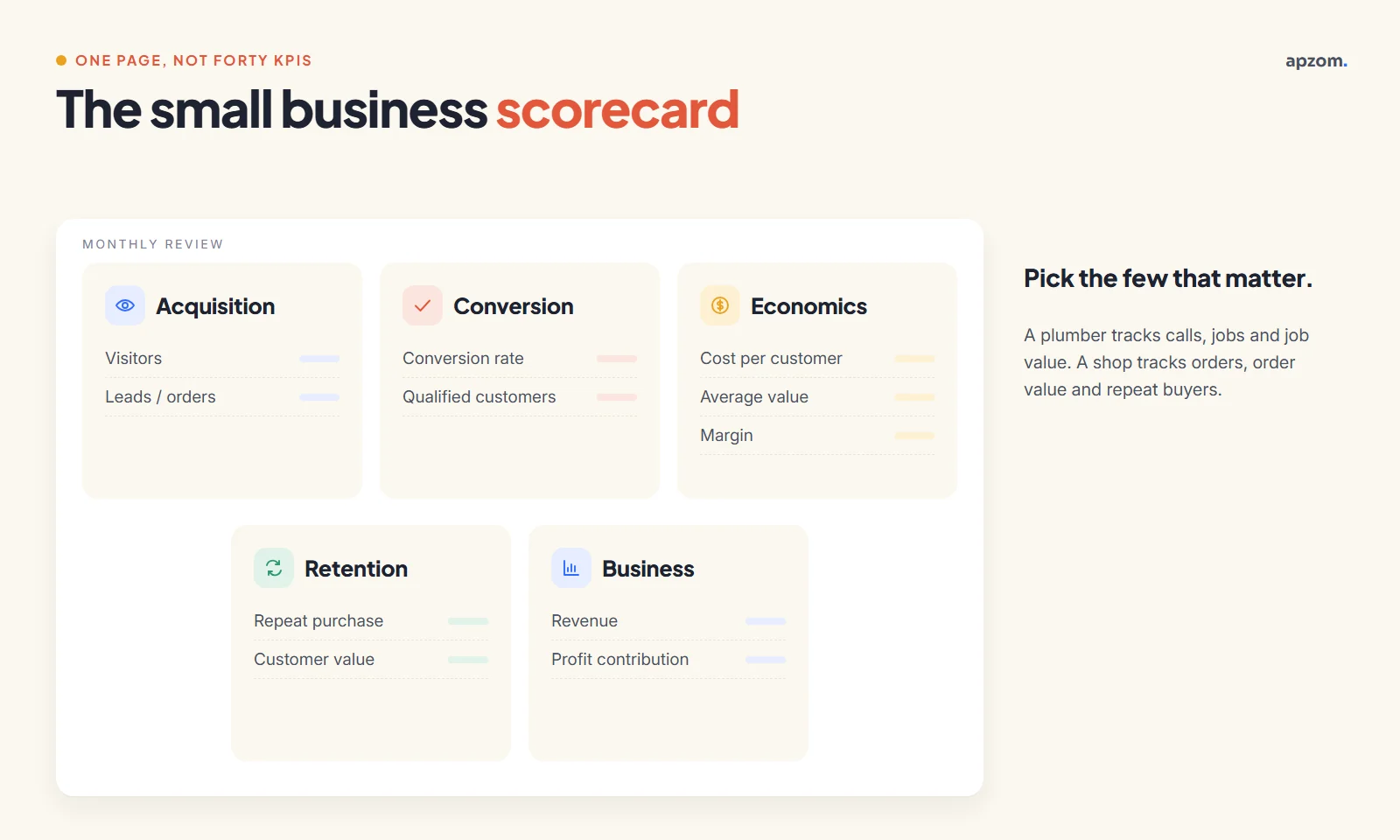
| Area | What to track |
|---|---|
| Acquisition | Visitors, leads or orders |
| Conversion | Conversion rate, qualified leads |
| Economics | Customer acquisition cost, average order or job value, gross profit |
| Retention | Repeat purchase rate, customer value |
| Business result | Revenue and profit contribution from marketing |
Not every business needs every line. A local service business may care most about calls, jobs won and average job value; an online shop about orders, average order value and repeat purchases. Pick the few numbers that match how your business makes money.
Fix, prove, then scale
The most common and expensive small-business mistake is scaling a leaky system: paying for more traffic while the website, the follow-up or the offer is losing the customers you already attract.
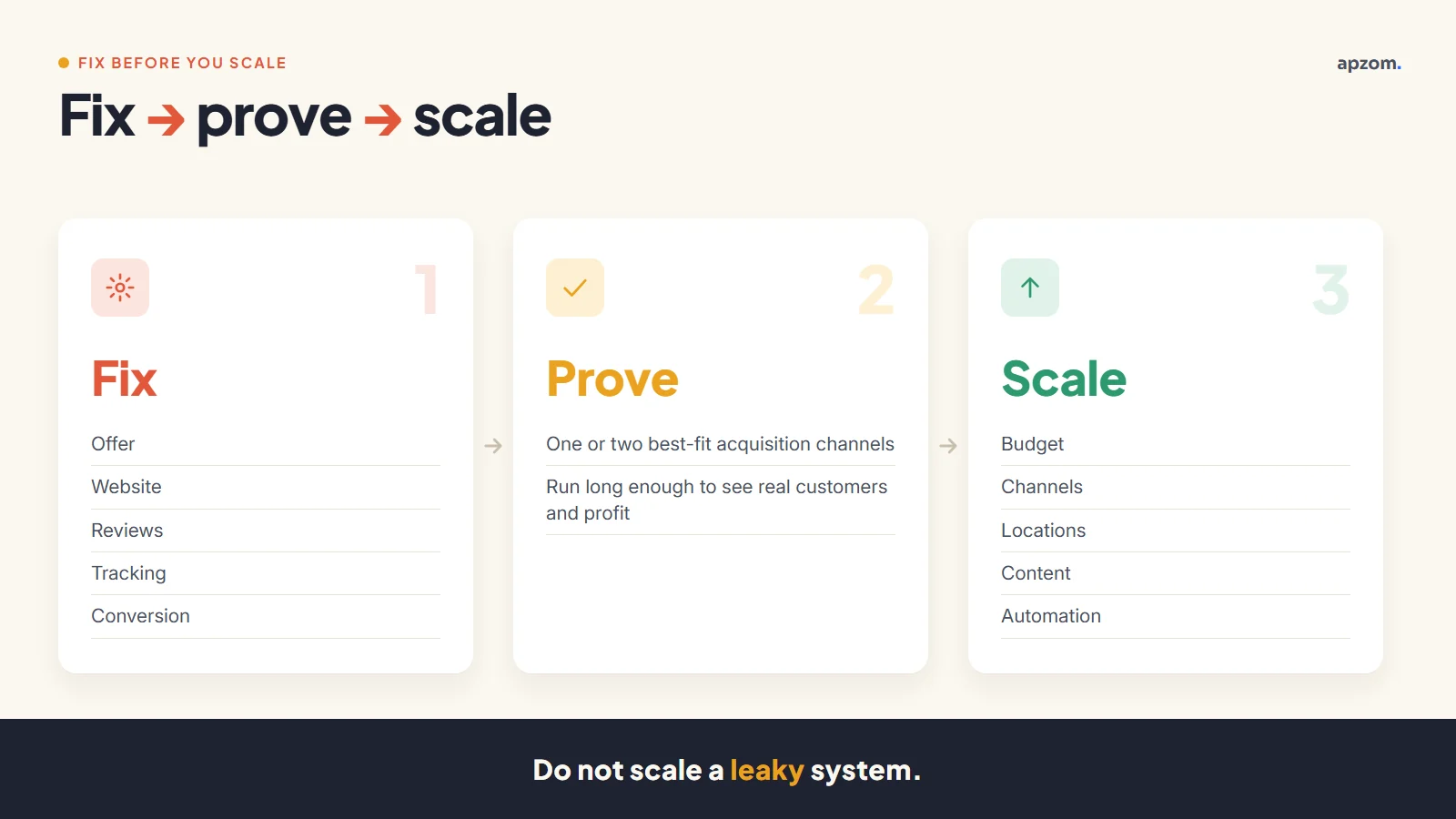
- Fix. Make sure the offer is clear, the website converts, reviews are visible, tracking works, and enquiries are answered.
- Prove. Choose one or two channels that match where your customers already look, and run them long enough to see real customers and profit.
- Scale. Only then increase budget, add channels, open new locations, expand content or automate more.
Do this before adding another channel
If you are unsure what to do next, work up this ladder and do not skip levels.
- Business basics. A clear offer, a defined customer, sensible pricing, and capacity to deliver.
- Conversion basics. A website that answers the six questions, an easy way to contact you, working tracking, and reviews.
- Demand capture. SEO, Google Maps and search ads, where people already look for what you sell.
- Demand creation. Social media, content and video, where you need people to discover you.
- Retention and scale. Email, a simple CRM, automation and ongoing conversion improvements.
How growth actually happens: foundation, traction, efficiency, scale
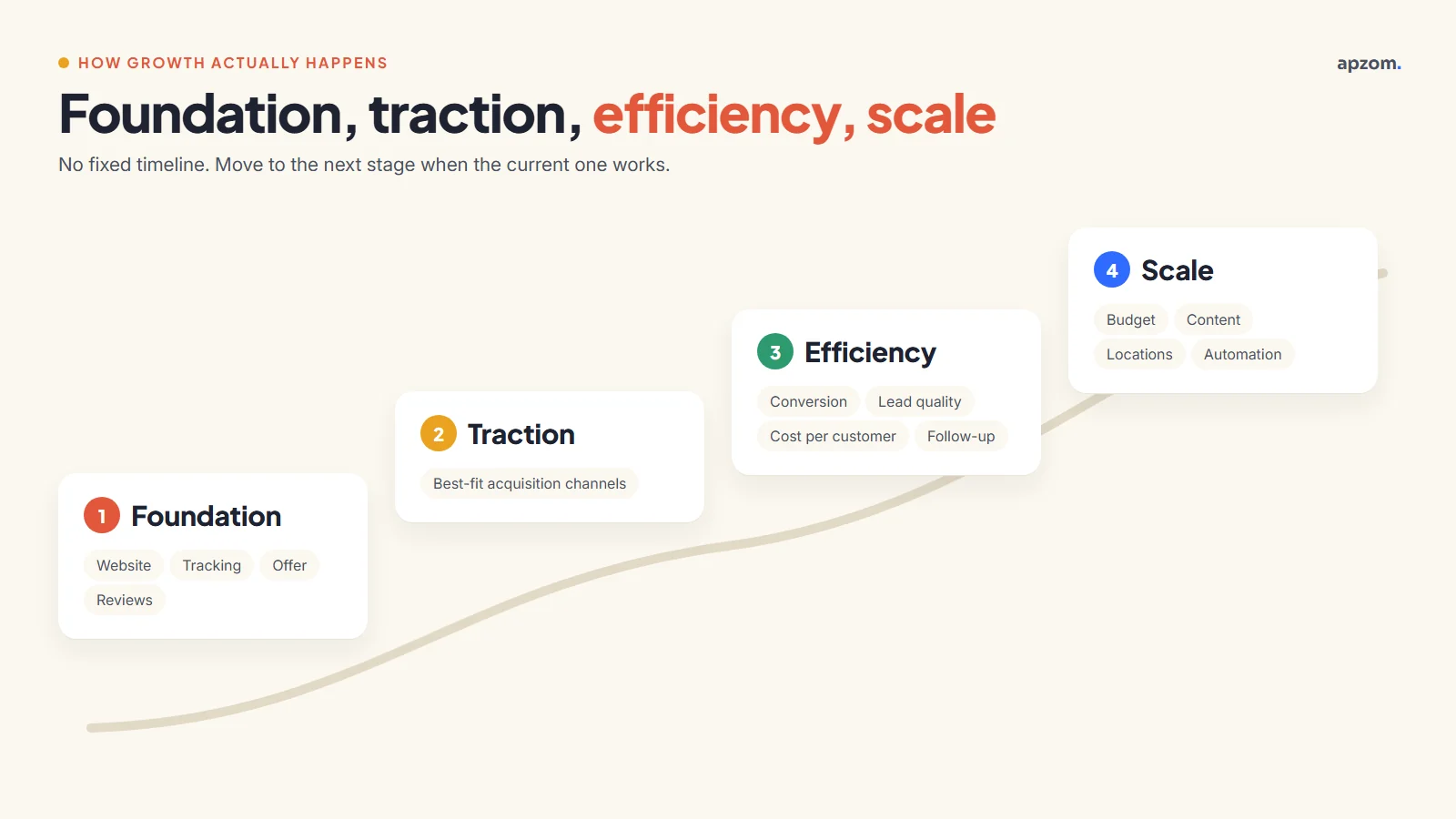
Growth tends to come in four stages, each with its own focus. They take different amounts of time for different businesses, so there is no fixed timeline.
- Foundation. The offer, website, tracking, reviews, Business Profile and conversion path all work.
- Traction. One or two channels with existing demand start producing customers.
- Efficiency. You improve conversion, lead quality, follow-up and the cost of winning each customer.
- Scale. You expand spend, locations, channels, content and automation, because the numbers say it is worth it.
Three examples
These are illustrative examples, not client results.
A local plumbing company. It will probably get more from a complete Google Business Profile, a page for each main service, a tightly targeted search campaign, steady reviews and reliable call answering than from five Instagram posts a day. Its key numbers are calls answered, jobs booked and average job value.
A small online shop. It will probably get more from strong product pages, an accurate product feed for Google Shopping, search ads on product terms, an easy checkout and email to past customers than from local SEO. Its key numbers are orders, average order value and repeat purchase rate.
A two-person B2B consultancy. It will probably get more from clear pages about the problems it solves, two or three detailed case studies, search visibility for those problems, a LinkedIn presence where its buyers are, and email follow-up than from TikTok. Its key numbers are qualified enquiries, proposals and won contracts.
The same budget, spent on the same channels, would produce very different results for each of these businesses. That is why business model comes first.
AI, answer engines and visual search
What AEO and GEO mean for a small business
AEO, answer engine optimisation, means making useful answers clear enough that search engines and answer systems can understand and use them. GEO, generative engine optimisation, applies the same idea to AI assistants and AI-generated answers in search.
For a small business, both come down to being clear and accurate. Answer the questions customers ask, on the right page, in plain language: what you do, where you work, what it costs or how pricing works, what is included, how long it takes, how to book. Keep your business details consistent everywhere, earn genuine reviews and mentions, and publish things only you can say: your process, your prices, your projects, your expertise.
Google’s guidance says there are no special files, markup or tricks needed to appear in its AI features; the same SEO fundamentals apply, and content should be useful and genuinely original rather than a rewrite of what is already online. Nobody can guarantee your business will be mentioned in AI Overviews, ChatGPT or Gemini.
Measuring AI and visual search
In 2026, Google added reports to Search Console, its free site-owner tool, that show how often a site’s pages appear in generative AI features such as AI Overviews and AI Mode, and a filter for multimodal searches made with images, through Lens, Circle to Search, image uploads and Chrome’s “Search this image”. Both are worth watching. Remember that the AI reports show impressions, not customers or revenue.
Visual search matters most for businesses where people search with a camera: products, fashion, beauty, food, home improvement and retail. For these, original, high-quality photos with descriptive file names and useful alt text help. Hundreds of generic AI images do not.
Video is similar: useful where it helps people decide, such as product demos, behind-the-scenes, a tour of a café or gym, or a short explanation of a service. It is not something every accountant or industrial supplier needs every day.
Using AI in your own marketing
AI tools can help a small team draft text, brainstorm ideas, summarise customer feedback, write ad variations and analyse data. Everything they produce needs a human check for accuracy, brand voice and privacy, and they should never be used to invent reviews, testimonials, customer results, statistics or product claims.
What a good small business marketing agency should do
A good strategy does not start with “we sell SEO packages”. It starts with “how does this business make money?”
Before recommending anything, an agency should understand your business model, what a customer is worth, who your customers are, where demand already exists, how many customers you can handle, how you convert and follow up, whether customers come back, what tracking you have, and your budget.
Questions to ask before hiring anyone
- How will you learn our business, and what will you need from us?
- What should we do first, and what should we not do yet?
- How will you define a conversion, and how will you tell qualified customers from leads?
- Who owns our website, ad accounts, Business Profile and data?
- What exactly is included, and how is ad spend kept separate from your fee?
- What happens if a campaign does not perform?
- What reports will we get, and how often?
- How will you use AI, and how will you protect our customers’ data?
Red flags
- Guaranteed first-page rankings or guaranteed revenue.
- The same package for every client, regardless of business model.
- Refusing to give you ownership of or access to your accounts and domain.
- Reports that show only traffic, impressions or followers.
- Buying links, publishing mass AI content, or offering reviews.
- Case studies or results that cannot be verified.
- Never asking about your margins, prices or capacity.
- Ignoring your website and follow-up while selling more traffic.
Do it yourself, freelancer, agency or in-house?
| Option | Best for | Advantages | Limitations |
|---|---|---|---|
| Do it yourself | Very early or simple businesses | Low cash cost, you learn the market | Your time, and gaps in expertise |
| Freelancer | One specific need, such as ads or a website | Flexible, often affordable | Limited capacity and range |
| Agency | Several channels that need to work as one system | Broader team and skills | Higher investment |
| In-house hire | Larger, ongoing marketing needs | Deep knowledge of the business | Salary, management and hiring risk |
An agency is not always the right answer. Many small businesses do the basics themselves, bring in a specialist for one channel, and hire an agency once they need several pieces working together.
How Apzom can help
Apzom Digital is a digital marketing agency covering SEO, local SEO, Google Ads, Meta ads, social media, content, email marketing, website development, ecommerce, conversion rate optimisation, and answer engine and generative engine optimisation. We start with how your business makes money, and we will tell you when a channel is not worth your budget yet.
Request a small business digital growth audit
A free growth audit from Apzom looks at:
- Your website: whether it answers the six questions and converts on a phone.
- Your search visibility, Google Business Profile and reviews.
- Your Google Ads or other paid campaigns, if you run them.
- Your social channels, and whether they fit your kind of business.
- How you handle enquiries and follow-up.
- Your tracking, and whether you can see which marketing produces customers.
- Retention: whether existing customers come back.
- Your readiness for AI and answer engines.
You get a short, prioritised list: what to fix first, what to test next, and what to ignore for now. Request your free growth audit, or see all our services.
Frequently asked questions
What does a digital marketing agency for small businesses do?
It helps a small business get found, look trustworthy and turn interest into customers, then measures which activity makes money. A good one starts with your business model and customer value, and recommends only the channels that fit.
Is digital marketing worth it for a small business?
Usually, if it is focused. Most customers look online before they buy, call or visit. It is worth it when spend goes to channels where your customers already look and you track what turns into customers and profit.
Which marketing channel should a small business use first?
The one where your customers already look. For local services that is usually Google Maps and search; for online shops, product search and shopping; for B2B, search for the problems you solve. Fix your website and tracking first.
Should a small business use SEO or Google Ads?
Often both, for different jobs. Ads show up immediately and stop when spending stops. SEO takes longer but keeps working. Many businesses start with tightly targeted ads while building SEO, then rebalance as organic visibility grows.
Does every small business need social media?
No. It can be central for restaurants, beauty, fashion, fitness and visual products. For a plumber, accountant or industrial supplier it is usually a supporting channel, not the main source of customers.
How can a small business rank higher on Google Maps?
Google says local results depend on relevance, distance and prominence. Keep a complete, accurate and verified Business Profile, choose the right categories, add real photos, and earn and reply to genuine reviews. You cannot pay for a better local ranking.
How much should a small business spend on marketing?
There is no universal figure. Work it out from what a customer is worth, your margins, how many customers you can handle and how much you can test without hurting cash flow. Increase spend only when results justify it.
What are AEO and GEO for small businesses?
AEO means making useful answers clear enough for search engines and answer systems to use. GEO applies the same idea to AI assistants and AI search results. Both mean accurate, consistent business information and genuinely useful content. Nobody can guarantee AI mentions.
How should a small business measure marketing ROI?
Follow the path from visitors to leads or orders, customers, average value, gross profit and repeat value. Record where each customer came from and compare it with what you spent. Clicks and followers alone do not show ROI.
Sources
These are the primary sources behind the platform and policy statements in this guide, checked in October 2026.
- Google Business Profile Help: Tips to improve your local ranking on Google (relevance, distance and prominence).
- Google Business Profile Help: Guidelines for representing your business on Google.
- Google Maps user-contributed content policy: Fake engagement.
- Google Search Central: Creating helpful, reliable, people-first content; AI features and your website; Google’s guide to optimising for generative AI features on Google Search (updated July 2026).
- Google Search Central Blog: Introducing Search Generative AI performance reports in Search Console (3 June 2026); Announcing web multimodal Search performance reporting in Search Console (24 September 2026).
- Google Ads Help: Conversion values best practices; About Performance Max campaigns.
- US Federal Trade Commission: Consumer Reviews and Testimonials Rule, 16 CFR Part 465, effective 21 October 2024.