The short answer: A coworking space sells several different products, and each one is bought differently. A day pass is a quick, local, often mobile decision. A dedicated desk is a monthly comparison. A private office for a team is a business purchase with a tour and a contract. A meeting room is booked by people who may never become members, and a virtual office is bought for an address and mail handling, with legal rules attached. Digital marketing for a coworking space works when each product gets its own page, its own search terms, its own conversion and its own number in your reports, and when you measure occupancy and member retention rather than clicks.
This guide is for coworking operators, flexible workspace managers and business centre owners anywhere in the world who want more tours, more members and fewer empty desks and rooms. We set out the buyer journey for each product, the website pages and local listings that win local searches, where Google and Meta ads fit, the rules that apply to virtual offices and pricing in the US, UK, EU, Australia, the UAE and India, and how to measure what matters.
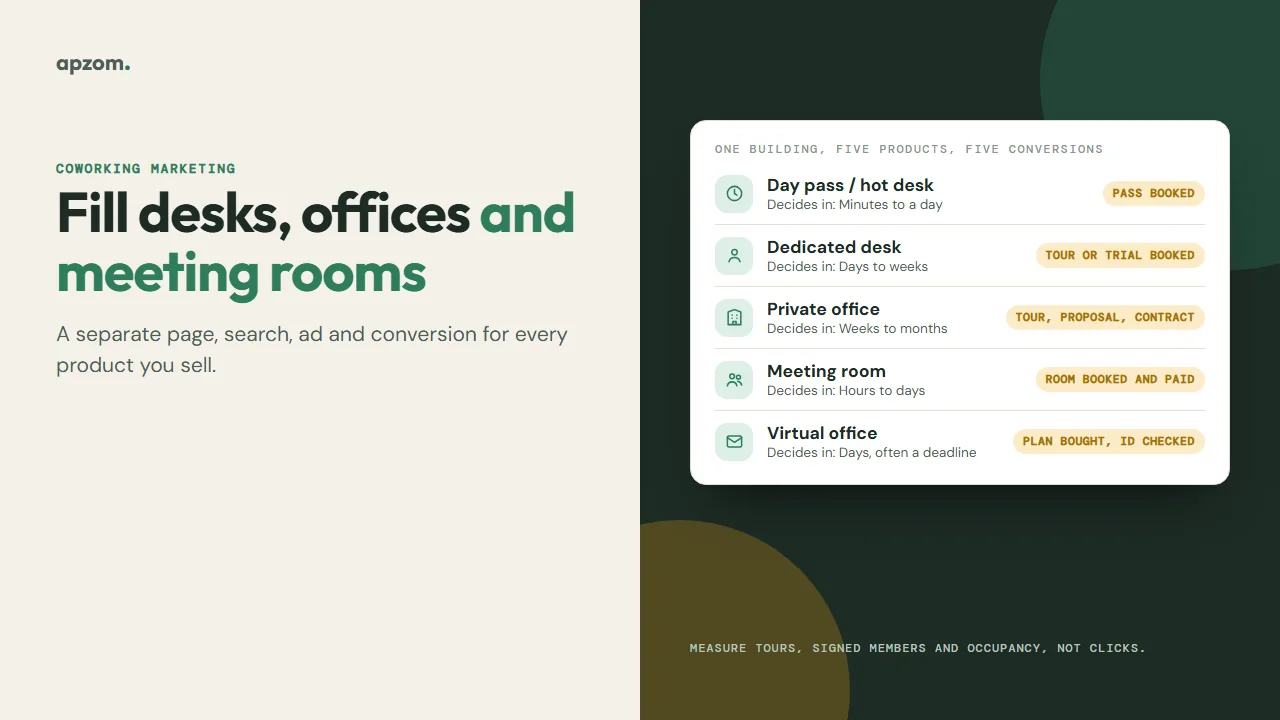
One building, five products
Most coworking websites have one “Membership” page and one “Contact us” form. That hides the fact that the people buying a day pass, a private office and a virtual address have almost nothing in common. They search differently, they decide on different timescales and they are worth very different amounts to you over a year.
| Product | Typical buyer | How they search | How long they take to decide | The conversion to track |
|---|---|---|---|---|
| Day pass or hot desk | Freelancers, remote workers, visitors to the city | “coworking near me”, “day pass [area]”, maps on a phone | Minutes to a day | Pass bought or booked |
| Dedicated desk or monthly membership | Freelancers and remote employees who want a routine | “coworking space [area]”, comparisons, reviews | Days to weeks, often after a trial day | Tour or trial booked, then member signed |
| Private office or team suite | Founders, office managers, regional teams | “private office [city]”, “serviced office for 10 people” | Weeks to months, with a tour and a contract | Tour booked, proposal sent, contract signed |
| Meeting or event room | Anyone who needs a room for a few hours, often non-members | “meeting room hire [city]”, “conference room by the hour” | Hours to days | Room booked and paid |
| Virtual office | New companies, overseas firms, home-based businesses | “virtual office [city]”, “registered office address” | Days, often driven by a registration deadline | Plan bought and ID checks completed |
Two things follow from this. First, your marketing needs a separate path for each row, because a page that tries to sell all five sells none of them well. Second, you should decide which products you most need to fill. A building with empty private offices needs a different plan from one with a full office floor and a quiet hot-desk area.
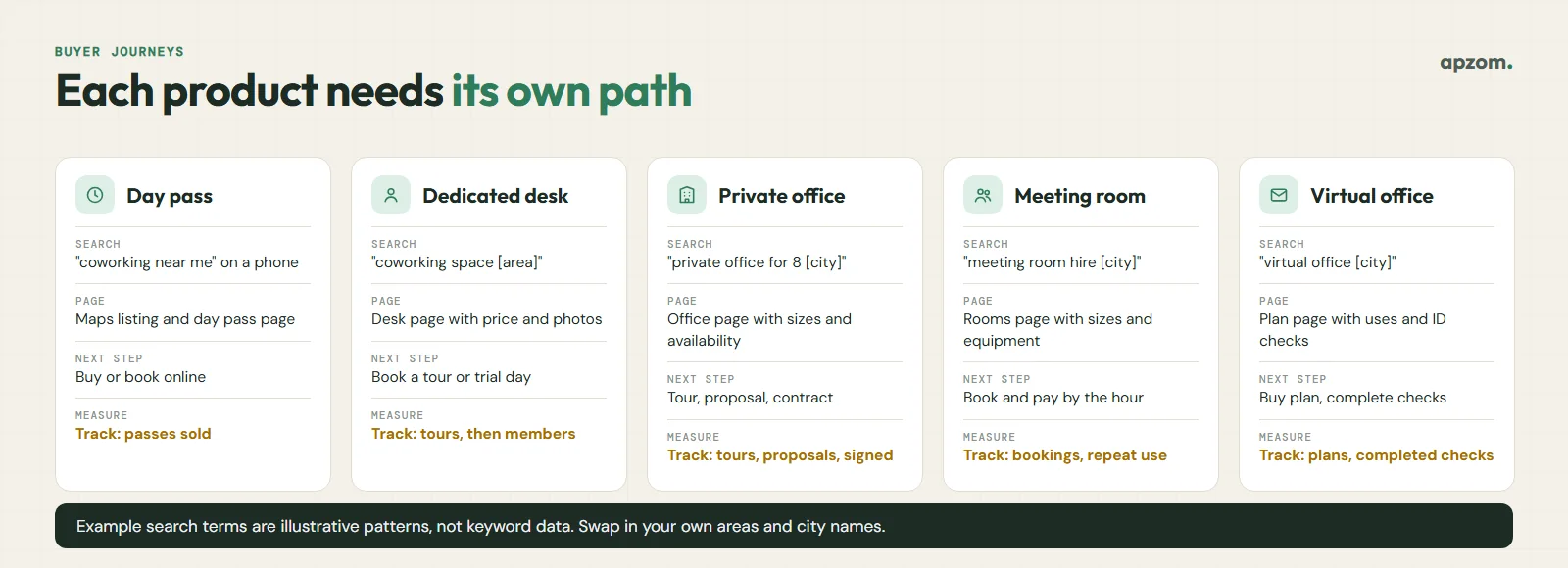
Give every product its own page
Your website does much of the selling, because many buyers check it before they book a tour or a room. Build one page for each product (and one page for each location if you have more than one), and give each page the same core parts:
- What is included, in plain terms: hours of access, desks, Wi-Fi, printing, meeting room credits, phone booths, kitchen, parking, mail handling.
- The price, or a real starting price. Buyers comparing spaces may move on from a page that says “contact us for pricing”. If prices vary, show a starting price and what changes it.
- Real photos of the actual space, taken in daylight, including the desks and rooms people will use. Stock photos of other offices create a gap that the tour will expose.
- Availability: whether private offices of a given size are free now, or the date they become free.
- One clear next step for that product: buy a pass, book a room, book a tour, or start a virtual office application.
Price honestly, by country
Consumer pricing rules protect people buying mainly for personal purposes, so they matter most for passes and memberships sold to individuals; memberships bought by companies are generally outside them. Clear, all-in prices are good practice for every buyer anyway. As checked on 17 November 2026:
- United Kingdom: under the Digital Markets, Competition and Consumers Act 2024, from 6 April 2025 the headline price shown to consumers should normally include mandatory charges, including VAT (the CMA’s price transparency guidance explains this “drip pricing” ban). The Act protects individuals acting wholly or mainly outside their business. If a set-up fee or a compulsory service charge applies to every member, put it in the headline price.
- Australia: the ACCC says that if you advertise part of a price, such as a monthly fee, you must also show the total price, including taxes and unavoidable fees, at least as prominently. Under the Australian Consumer Law this rule covers goods and services ordinarily bought for personal, domestic or household use.
- European Union: the EU rule on showing the lowest price of the previous 30 days in a price reduction covers goods, but some countries apply similar rules to services, so check local law before you run “was/now” membership offers.
- United States: there is no single federal all-in pricing rule for workspace; the FTC’s fees rule covers live-event tickets and short-term lodging only. The FTC Act’s general ban on deceptive practices still applies to every price you advertise, and some states have their own fee rules, so check the state you sell in.
None of this is legal advice. The practical rule is simple anyway: the price on the page should be the price people pay.
Get found on maps and local search
People looking for a day pass or a meeting room often search on their phone, and the map results decide who they see first. Local search for a coworking space comes down to four things.
A complete Google Business Profile for each location. Choose the most accurate primary category (“Coworking space”, where it is available in your market), add your real opening hours (and separate hours for staffed reception if they differ from 24/7 member access), photos of the space, a booking link where Google offers the option, and your services. Use one profile per location, not one per product: Google does not allow separate profiles for your day passes, offices and meeting rooms unless one genuinely operates as a separate department or brand. Our Google Business Profile optimization checklist covers every field, and our guide to verifying a Google Business Profile helps if your listing is new. Add the same details to Bing Places and Apple Maps.
Honest advice to your own members about their listings. Google’s Business Profile guidelines say a virtual office, meaning a rented mailing address the business does not work from, is not eligible for a profile. An office inside a coworking space can be listed only if it has clear signage, receives customers during its business hours and is staffed by the business’s own staff during those hours. Your own profile for the space qualifies; most members and virtual office customers do not, and listings that break the rules clutter your location and can be removed. Tell them the rule when they join. If duplicate or member listings appear at your address, our guide to removing a duplicate Google Business Profile listing explains the options.
Reviews, asked for at the right moment. Ask after a good first month, after a well-run event or when a member renews. Google’s policies do not allow you to offer incentives for reviews, to ask only the members you expect to be happy, or to pressure people into reviewing while they are on your premises, so a front-desk review drive needs care. In the UK and the US, the law also bans fake reviews (the UK Act above bans reviews that hide an incentive, and the FTC’s rule on fake reviews and testimonials, in force since 21 October 2024, bans incentives tied to positive reviews). Our guide to getting more Google reviews covers how to ask.
Consistent details everywhere. Your name, address, phone number and hours should match on your website, your profiles and any workspace marketplaces you list on. Our local SEO checklist covers the rest.
SEO: match the way people search for each product
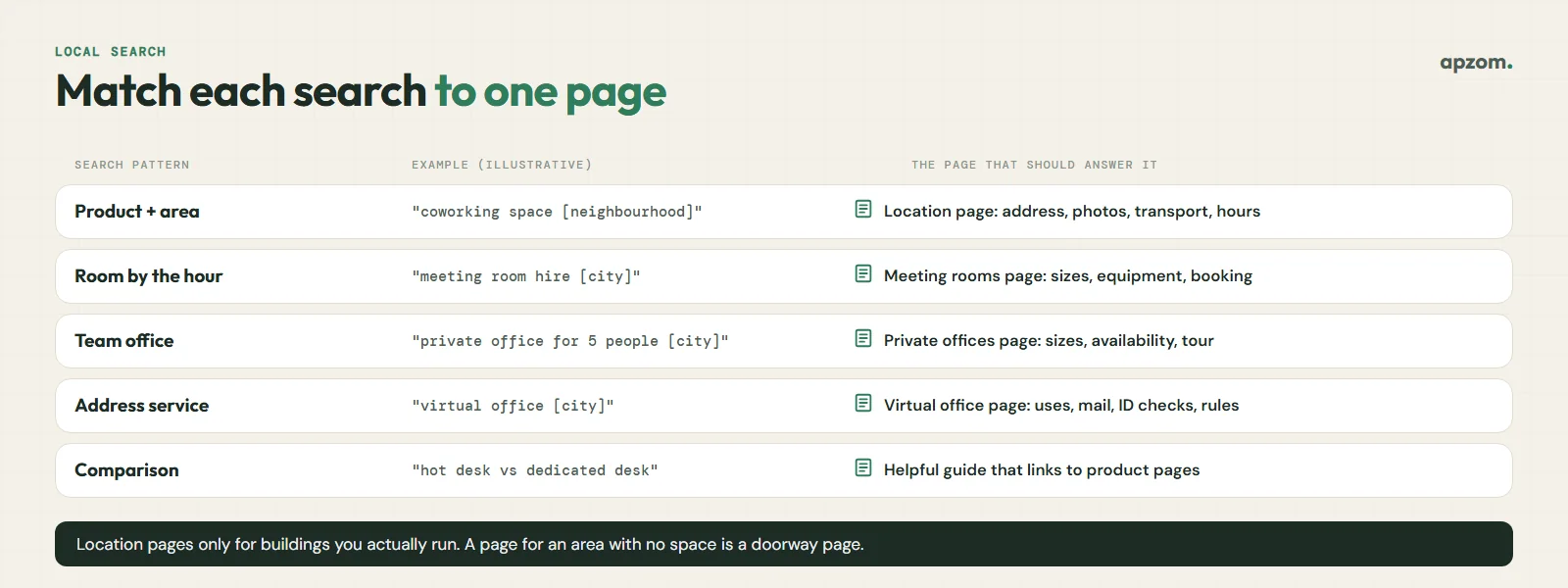
Beyond the map, people search for coworking in fairly predictable patterns, and each pattern maps to a page. This is where one page per product pays off.
| Search pattern | Example | Page that should answer it |
|---|---|---|
| Product + area | “coworking space [neighbourhood]” | Location page, with that area’s details and directions |
| Room by the hour | “meeting room hire [city]”, “conference room for 12 people” | Meeting rooms page, with sizes, equipment and a booking link |
| Team office | “private office for 5 people [city]”, “serviced office [city]” | Private offices page, with sizes, availability and a tour link |
| Address service | “virtual office [city]”, “registered office address [city]” | Virtual office page, with what is included, ID checks and the rules |
| Comparison | “coworking vs office lease”, “hot desk vs dedicated desk” | A helpful guide that links to your product pages |
A few points matter more for coworking than for most local businesses:
- Location pages must be real. If you run three buildings, each needs a page with its own address, photos, transport, hours and availability. A page for a neighbourhood where you have no building is what Google’s spam policies call doorway abuse, which includes “pages targeted at specific regions or cities that funnel users to one page”.
- Mark up what is true. schema.org has no specific “coworking space” type, so use LocalBusiness (or a close type) with your real address, hours and contact details for each location. List memberships as Offer items and use the MeetingRoom type for bookable rooms, marking up only what the page shows. Our guide to schema markup for small businesses explains how.
- Write pages that answer questions directly. AI search answers, like featured snippets, tend to quote pages that state prices, hours, sizes and what is included in plain sentences. Our guide to what GEO is explains how AI search picks sources.
- Workspace marketplaces help, but do not replace your site. Listing on marketplaces can bring bookings, especially for meeting rooms and day passes, but you rent that visibility. Your own pages are the asset you keep.
If you want to check that your pages and listings are set up correctly, our local SEO services and SEO services cover this work.
Paid ads: where Google and Meta each fit
Paid ads work best for coworking when each campaign sells one product to the people who want it now.
Google Search ads suit high-intent searches: “meeting room hire [city]”, “day pass [area]”, “private office for 10 people”. Send each ad group to the matching product page, not the home page. Check your location targeting. Google’s default is “Presence or interest”, which also reaches people who have only shown interest in your area, and Google calls this broader setting a best practice on Search. For day passes and local memberships, consider switching to “Presence”, which targets people in or regularly in your area; for visitors planning a trip, the default can suit. Test which works for each product. Our guides to Google Ads for small businesses and Google Ads match types cover the set-up.
Meta ads (Facebook and Instagram) are better for reaching people who do not yet know they want coworking: remote workers and freelancers near your building, people who visited your site but did not book a tour, and audiences for your events. Video or photo walkthroughs of the real space work well because the space is the product. Our guide to Facebook and Instagram ads for local businesses explains the basics, and Google Ads vs Facebook Ads helps you choose where to start. If you also rent rooms people live in, such as co-living, check whether Meta’s Housing special ad category and Google’s housing ad rules apply, because both limit targeting for housing ads in the US and Canada (Meta also in parts of Europe).
LinkedIn and partnerships can reach the people who buy private offices for teams: office managers, founders and companies moving into your city. Partnerships with local accountants, company formation agents and relocation services can also bring team leads, often with more context than an ad click.
Whatever you run, track each product separately. A campaign that brings cheap day pass sales and no office tours may look good in the ad platform and do little for your occupancy.
Not sure which of your products your marketing is really filling? Ask for a Free Growth Audit. We review your product pages, Google Business Profile, ads and enquiry tracking, and tell you which products are under-marketed and what to fix first.
Virtual offices: marketing a product with rules attached
A virtual office can earn well for the space it uses, because it needs almost no floor area. It is also the product where marketing claims run into law. People buying one usually want an address they can register a company at, put on a website or use for mail. Say clearly what your plan can and cannot be used for, and what checks you run.
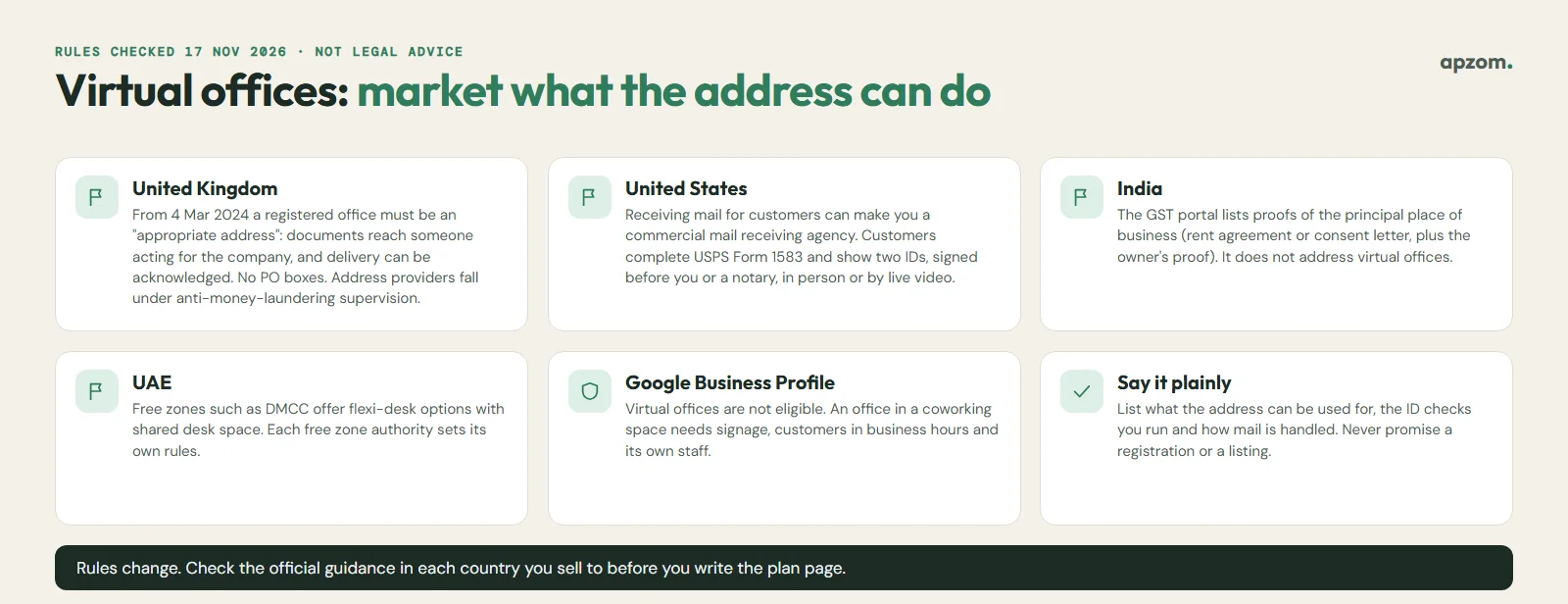
As checked on 17 November 2026 (not legal advice):
- United Kingdom: since 4 March 2024, a company’s registered office must be an “appropriate address” under the Economic Crime and Corporate Transparency Act 2023: documents sent there should come to the attention of someone acting for the company, and delivery can be recorded. A PO box is not enough. Businesses that provide registered offices, business or correspondence addresses, or mail forwarding are trust or company service providers under the UK’s anti-money-laundering rules: they must register with HMRC (unless the FCA or a professional body supervises them) and must not trade until HMRC confirms registration.
- United States: if you receive mail for customers, you may be a commercial mail receiving agency (CMRA) under USPS rules. Customers then complete USPS Form 1583 and show two current forms of identification, signing in front of you or a US notary, in person or over a live video call.
- India: the GST portal lists the documents accepted as proof of the principal place of business: for rented premises, a rent or lease agreement with the owner’s proof of ownership; otherwise, a consent letter with the owner’s proof. It says the same documents may be uploaded for shared premises, but it does not address virtual offices, so do not promise that a registration will be approved.
- UAE: free zones such as DMCC offer flexi desks, which DMCC describes as a part-time workspace solution with a full-time physical address; each free zone authority publishes its own rules on what they include.
Marketing a virtual office honestly means saying which uses your address supports, which ID checks you run and what happens to mail, rather than implying it is the same as a staffed office. It also means telling customers that an address alone will not get them a Google Business Profile.
Make the tour your main conversion
For memberships and private offices, the tour (or a trial day) is where many decisions are made. Treat it as the main conversion and build your marketing around getting people to it.
- Let people book a tour online, with real time slots, from every product page. A form that says “we’ll call you to arrange a visit” adds a step and a delay.
- Reply fast to tour requests and calls. Someone comparing three spaces may book with the one that answers first. Our speed to lead guide sets out response targets and routing.
- Confirm and remind. Send a confirmation with the address, parking or transport details and who to ask for, and a reminder the day before.
- Run the tour around their needs. Ask how many people, which days they come in and what they need, and show those things first: the desk area for a freelancer, the office size and meeting rooms for a team.
- Follow up within a day, with a written summary of what they saw and the price for what they need, and an offer of a trial day if they are undecided.
- Record the outcome in a simple CRM or spreadsheet: tour booked, tour attended, proposal sent, signed or lost, and why.
Keep members: retention is marketing too
An empty desk costs the same whether it was empty because nobody joined or because someone left. Keeping a member often costs less than winning a new one, and it is part of marketing:
- Onboard well. A clear first-week email, introductions to other members and an easy way to book rooms make the first month go well.
- Run events that fit your members, and use them as a reason for prospective members to visit. An event page also gives Meta and Google ads something to promote that is not a sales message.
- Email members and past enquirers with useful updates, not just offers. Check the consent rules for marketing email where your contacts are. In the UK, the “soft opt-in” lets you email individuals whose details you collected during a sale or negotiations for a sale, such as an enquiry or a tour, about similar products, if you offered an opt-out when you collected their details and include one in every message; company email addresses do not need consent but still need your identity and an opt-out. In the US, CAN-SPAM applies to business email too. Our guide to email marketing for small businesses explains the basics.
- Ask members for referrals when they renew or upgrade, and make the referral offer simple and honest.
- Offer upgrades. A dedicated desk member whose team grows is your best private office lead.
What to measure: occupancy, tours and retention
The numbers that matter for a coworking space are about filled space and members who stay. Ad platform numbers are useful only when you can connect them to these.
| What to measure | Why it matters | Where it comes from |
|---|---|---|
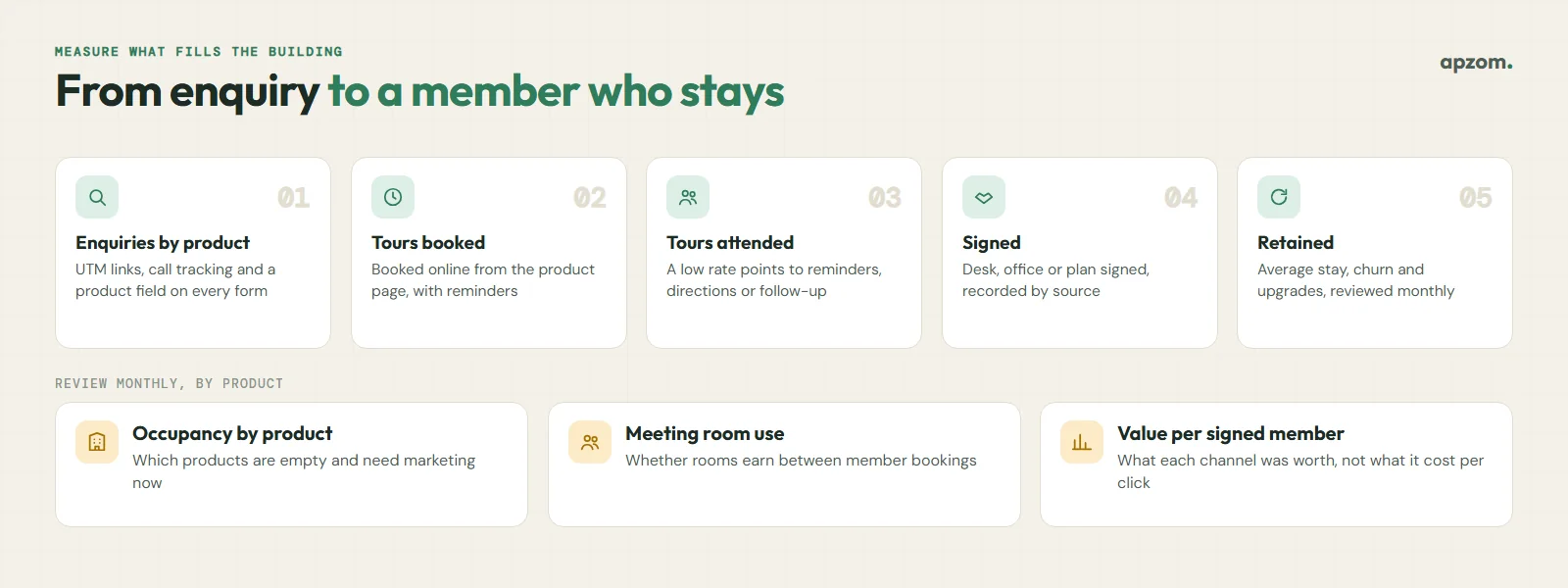
| Enquiries and bookings by product and source | Shows which channels bring which products | UTM links, call tracking, form fields, booking system |
| Tour booked to tour attended | Shows whether reminders and directions work | Booking system or CRM |
| Tour attended to signed | Shows whether the space, price and follow-up convince | CRM or spreadsheet |
| Occupancy by product | Shows which products need marketing now | Your management software or a monthly count |
| Meeting room use | Shows whether rooms are earning between member bookings | Room booking system |
| Member churn and average stay | Shows whether you are filling a leaky bucket | Member records |
Tag every campaign link with UTM parameters so you can see sources in Google Analytics 4, and track phone calls from Google Ads if many people call. Then review monthly: which products are empty, which channels fill them and what each signed member was worth. Our guide to measuring marketing ROI shows how to put those together.
Common mistakes
- One page for everything. A single “Membership” page cannot rank for meeting rooms, private offices and virtual offices at once, and it gives ads nowhere specific to send people.
- Hiding prices. Comparison buyers move on. Show at least a real starting price for each product.
- Stock photos. If the tour does not match the photos, you lose trust at the point of sale.
- Ignoring meeting room buyers. People who book rooms by the hour can be local businesses that later need desks or offices. Capture their details and keep in touch, with consent.
- Letting members create Business Profiles at your address. It breaks Google’s guidelines unless they meet the signage, customer and staffing conditions, and messy listings can hurt your own.
- Promising what a virtual office cannot do. Do not imply guaranteed company registration, a Google listing or a staffed office if you do not provide one.
- Measuring clicks instead of desks. A cheap lead that never tours is not a win.
How Apzom can help
We can help workspace operators build the parts this guide describes: product and location pages on your website through our website development work, local search set-up through our local SEO services, and Google and Meta campaigns through our Google Ads management and Meta ads management, with tracking that shows enquiries and tours by product. Our digital marketing services page lists everything we offer.
We have not published a coworking case study yet, so we won’t quote results we can’t show you. Our published lead-generation results are for two property businesses: HillTown Group, with 600+ leads every month from Meta ads, for 12 months running, and Kingston Flats, with 560+ Meta leads every month since June 2025.
We work with clients worldwide, remotely, from our base in Ahmedabad, India.
Get your Free Growth Audit and Quote. We look at how each of your products is found and booked: day passes, desks, private offices, meeting rooms and virtual offices. That covers your pages, local listings, ads, tour booking and how enquiries are tracked by product. You get a prioritised list of fixes, and a quote if you want us to do the work.
No obligation and no guaranteed results. Prefer to talk first? Contact us or see our digital marketing services.
Frequently asked questions
What is the best way to market a coworking space?
Start with the product you most need to fill, give it its own page with real prices and photos, complete your Google Business Profile, and make booking a tour or a room easy. Then add Google Search ads for high-intent searches and Meta ads for awareness and retargeting, and measure tours and signed members by source.
How do coworking spaces get members?
Members usually come through a mix of local search and maps, word of mouth and referrals, workspace marketplaces, events and paid ads, with the tour or trial day as the deciding step. The mix varies by city and building, so track where your own signed members came from rather than relying on general averages.
Should a coworking space list prices on its website?
Yes, at least a real starting price for each product. Buyers compare several spaces, and in some countries, such as the UK and Australia, consumer pricing rules generally require mandatory charges to be included in the price you show to people buying for personal use.
Can members use our address for their Google Business Profile?
Usually not. Google’s guidelines say a virtual office is not eligible, and an office in a coworking space qualifies only if it has clear signage, receives customers during its business hours and is staffed by its own staff during those hours. Tell members and virtual office customers this when they sign up.
Is a virtual office address enough to register a company?
It depends on the country and the service. In the UK, a registered office must be an “appropriate address” where documents come to the attention of someone acting for the company, and a PO box is not enough. Check the rules where the company is registered, and do not promise more than your service provides.
Are Facebook ads or Google ads better for coworking?
They do different jobs. Google Search ads catch people already searching for a meeting room, day pass or office. Meta ads reach remote workers and freelancers nearby who are not searching yet, and people who visited your site but did not book a tour. Many operators use both, with separate campaigns per product.