
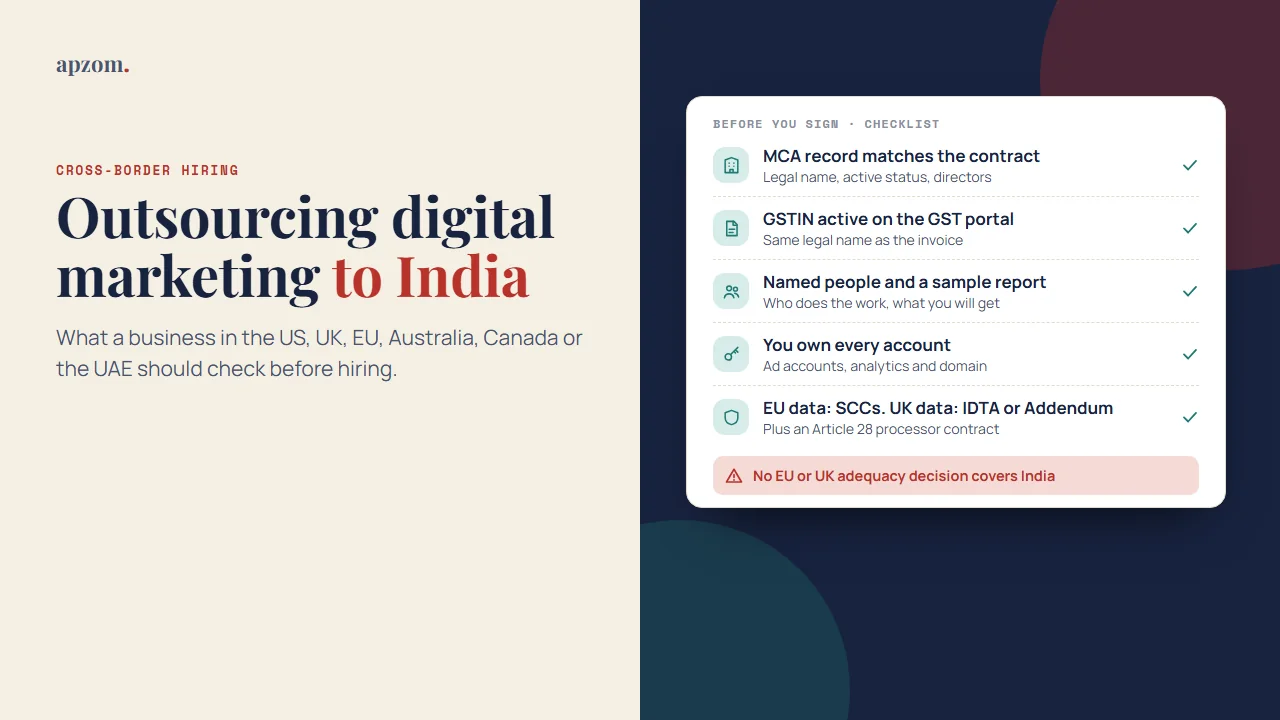
The short answer: Outsourcing digital marketing to India can work well for a business in the US, UK, EU, Australia, Canada or the UAE, but only if you check things you would take for granted at home. Look up the company on India’s Ministry of Corporate Affairs records and its GSTIN on the GST portal, and make sure both match the name on the contract and the invoice. Ask who will actually do the work, and ask for a sample report. Sign a contract that names the governing law, assigns the work to you and confirms that your business owns the ad accounts, analytics and domain. If personal data from the EU or UK is involved, put a processor agreement and a transfer mechanism (EU standard contractual clauses, or the UK IDTA or Addendum) in place, because India has no EU or UK adequacy decision. Then run a paid 30-day trial before you commit to a long retainer.
This guide is for owners, founders and marketing managers outside India who are considering an India-based agency or freelancer for SEO, paid ads, content, social media or web work. It covers what to outsource, engagement models, verifying a provider, cross-border contract and data terms, invoicing and tax, working-hour overlap by region, red flags and a 30-day trial. Apzom Digital is itself an agency based in India, so we have written this to be just as useful if you hire someone else. We checked the data-protection, company-registry and GST facts against official sources on 25 November 2026. None of it is legal or tax advice.
What this guide adds to a normal agency checklist
The general checks are the same anywhere. Our guide on how to choose a digital marketing agency covers questions, pricing models and red flags; our digital marketing audit records your starting point; our guide to writing a marketing brief gives you a template to send to every shortlisted provider; and, for paid search, see how to choose a Google Ads agency. This guide covers only what changes when the provider is in India: public records, governing law, data transfers, invoicing and tax, and working across a time difference of up to thirteen and a half hours.
What to outsource and what to keep in-house
Outsourcing works best for work that can be specified, checked and reported on, and worst for decisions that need deep customer knowledge or authority to commit your business.
| Usually fine to outsource | Keep in-house |
|---|---|
| Campaign builds and day-to-day ad management, within a budget you set | Your budget, your targets and the decision to raise spend |
| Technical SEO fixes, on-page work and reporting | Ownership of the domain, hosting, ad accounts and analytics |
| Content drafts, design, video editing and social scheduling | Final approval of claims, prices, offers and anything regulated in your country |
| Landing page builds and tracking set-up | Customer data exports and who receives them |
| Research, audits and competitor reviews | Replies to complaints, reviews and press enquiries in your name |
Two rules make the split work: someone inside your business owns the strategy and the numbers, and anything that makes a promise to your customers (a price, a guarantee, a health or financial claim) is signed off by someone who knows your local rules.
Engagement models: project, retainer, dedicated resource or white-label
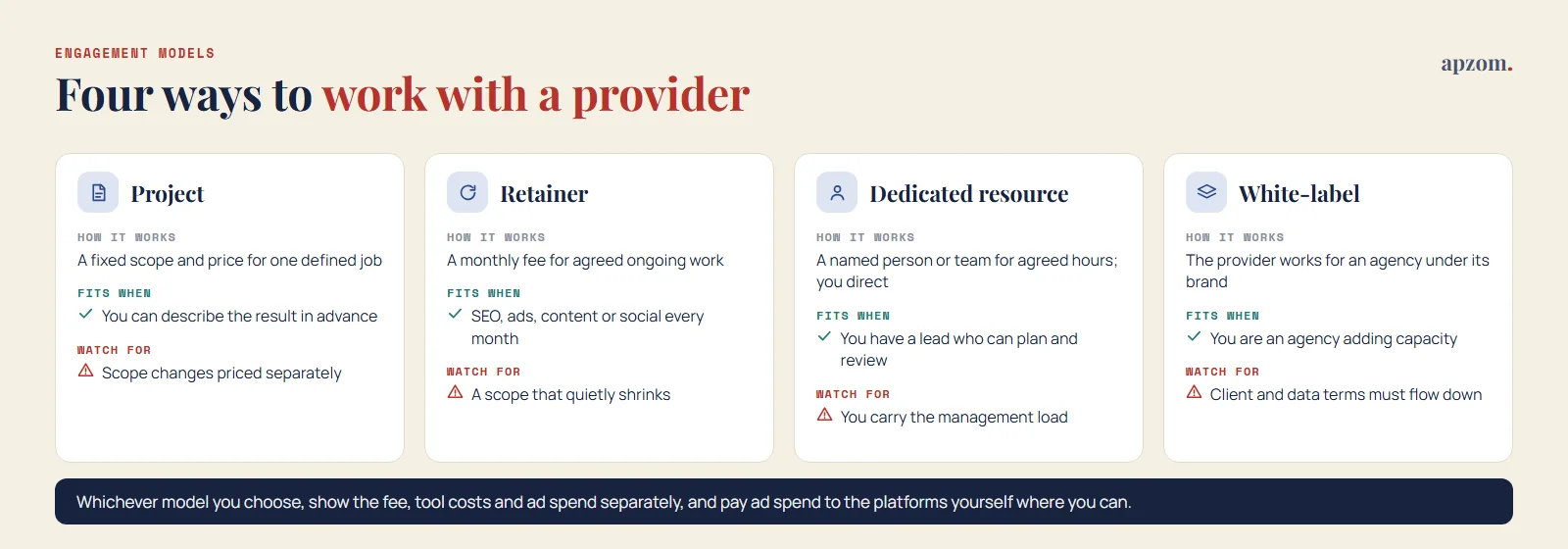
Most India-based providers offer some mix of four models, each suited to a different situation.
| Model | How it works | Fits when | Watch for |
|---|---|---|---|
| Project | A fixed scope and price for a defined job, such as an audit, a website or a campaign launch | You can describe the result in advance | Changes outside the scope priced separately; agree what “done” means |
| Retainer | A monthly fee for an agreed scope of ongoing work | SEO, ad management, content or social that runs every month | A scope that quietly shrinks; ask for a monthly list of what was delivered |
| Dedicated resource | A named person or small team works for agreed hours, and you direct the work | You have a marketing lead who can plan and review | You carry the management load; check who covers holidays and sick days |
| White-label | The provider works for an agency, which sells the work under its own brand | You are an agency adding capacity | Your client contracts and data terms must flow down to the provider |
Whichever model you choose, ask for the fee, any tool costs and your advertising spend to be shown separately, and pay ad spend directly from your business to Google, Meta or LinkedIn where you can.
If you are an agency buying white-label work, your clients still hold you to their contract. Check that your client agreements allow subcontracting, and that the provider’s contract repeats what you promised them on confidentiality, security and return of data. Article 28 of the GDPR says a processor needs the controller’s written authorisation before engaging another processor, and must bind that sub-processor to the same data protection obligations.
How to check a provider
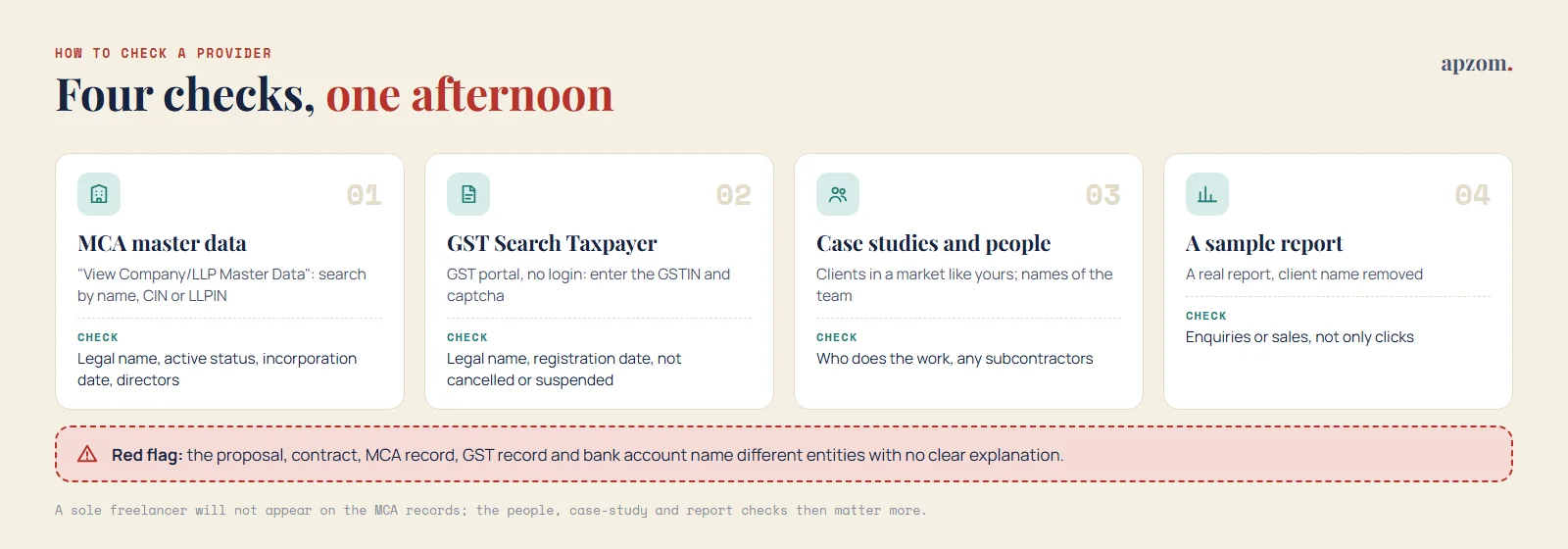
These four checks use public records and evidence you can ask for, and take about an afternoon.
1. Company registration on India’s MCA records
India’s Ministry of Corporate Affairs (MCA) runs a public “View Company/LLP Master Data” service. You search by the company’s name, its Corporate Identification Number (CIN) or, for a limited liability partnership, its LLPIN, and the service shows the registry’s basic record. Check that the legal name matches the proposal, contract and invoices; that the company is shown as active and its incorporation date fits the history you were told; and that the registered address and the directors or partners listed make sense for the people you are dealing with.
The MCA site blocked our automated checks, so check the live page yourself. A sole freelancer will not appear there at all, because the service covers companies and LLPs. That is not a reason to reject one, but the next checks then matter more.
2. GSTIN on the GST portal
Indian businesses registered for Goods and Services Tax (GST) have a GST Identification Number (GSTIN), which should be printed on their invoices. The official GST portal’s “Search Taxpayer” menu works without logging in: enter the GSTIN and the captcha, then click Search. The portal’s user manual says the result shows the legal name of the business, the trade name, the effective date of registration and the constitution of business, along with the principal place of business, any cancellation date and return filing details. Names of directors or proprietors appear only after logging in.
Check that the legal name matches the MCA record and your contract, and that the registration has not been cancelled or suspended. If a provider is not registered for GST, ask why in writing.
3. Real case studies, and who actually does the work
Ask for two or three case studies from clients in your country or a similar market, and whether you can speak to one of them. A credible case study names the client (or explains why not), states the period and the source of the numbers; our guide on how to write a case study works as a checklist for reading someone else’s.
Then ask the question buyers often forget: who will do the work? Some agencies, in India and elsewhere, pass work to freelancers or partner firms. That is not wrong, but you should know. Ask for the names and roles of the people on your account, whether any are subcontractors, and whether your data will be shared outside the company, and write the answers into the contract. Before you sign, have one video call with the person who will lead your account, not only the salesperson.
4. A sample report
Ask for a real report, client name removed, from an account like yours. It should connect the work to enquiries or sales, not just clicks, and say what happens next month. Compare it with our guide to what a marketing report should include. If a provider cannot show you any report, expect the same when you are paying.
The contract: four terms that matter across borders
Governing law and jurisdiction
A cross-border contract should say which country’s law applies (governing law) and where disputes are decided (jurisdiction): named courts, or arbitration under named rules. Ask your lawyer which suits the size of the contract.
IP assignment
Who owns the copyright in a contractor’s work depends on the law and the contract, and default rules differ by country, so do not rely on a vague “work for hire” phrase. The contract should assign to your business the rights in everything made for you (ad copy, designs, videos, landing pages, code, reports) once the related invoice is paid, and list any exceptions, such as the provider’s own templates or licensed stock images, with the licence you receive.
Account ownership
Your business should own every account, and the provider should be a guest in each one: the domain registered to your business, hosting in your account, Google Ads and analytics under Google accounts your business controls, and your Meta business portfolio owning your Page, ad account and pixel. Write it into the contract and set it up before work starts. Our guides show how to give an agency access to your Google accounts and to your Meta business portfolio without handing over ownership.
Exit and handover
Write the exit down before you need it: the notice period, what the provider hands over (files, campaign notes, report templates, data exports), how quickly, and written confirmation that it has removed its access and deleted or returned your data.
Comparing India-based agencies or freelancers? Ask for a Free Growth Audit. We review the proposals you have, list the registry, contract, account-ownership and data-transfer checks each one still needs, and tell you honestly if another provider fits your brief better than we do.
Data protection: what changes when the provider is in India
If the provider will handle personal data, such as leads, email lists or CRM records, the rules depend on where your business and customers are, not only where the provider sits.
EU and UK: a processor contract plus a transfer mechanism
An agency that handles personal data on your behalf is usually your processor. Article 28 of the GDPR (kept in the UK GDPR) says processing by a processor “shall be governed by a contract” that covers, among other things, processing only “on documented instructions from the controller”, confidentiality, security, the rules for sub-processors, and that at the end the processor “deletes or returns all the personal data”. This applies wherever the processor is.
Giving a provider in India access to personal data from the EU or UK is a restricted transfer, and it needs a legal basis of its own:
- No adequacy decision for India. The European Commission’s list of adequacy decisions, which let data flow “without any further safeguard being necessary”, does not include India. Neither does the ICO’s list of current UK adequacy regulations.
- EU: standard contractual clauses. Article 46 of the GDPR allows transfers with appropriate safeguards, including “standard data protection clauses adopted by the Commission”. The Commission’s current SCCs date from 4 June 2021 and are designed for importers outside the EU that are not themselves subject to the GDPR. If your provider is directly subject to the GDPR, for example because it targets people in the EU itself, ask your lawyer which tool applies.
- UK: the IDTA or the Addendum. The ICO says the EU SCCs “are not valid on their own” for UK transfers. UK businesses use the ICO’s International Data Transfer Agreement (IDTA), or the Addendum that adds UK terms to the EU SCCs, and must complete a transfer risk assessment. The ICO says it plans to update both documents in the course of 2026 and that, until then, the current versions should be used, so check its page before you sign.
The cheapest protection is to share only the personal data the work needs: a content writer or technical SEO rarely needs your customer list.
India’s DPDP Act, briefly
India’s Digital Personal Data Protection Act was enacted on 11 August 2023. The government notified the DPDP Rules in November 2025 with an eighteen-month period for phased compliance, according to India’s Press Information Bureau, so most duties for businesses, and the exemptions in section 17, apply from around mid-2027. For an overseas client, section 17(1)(d) matters most: most of the Act’s duties do not apply where personal data of people outside India is processed by someone in India under a contract with someone outside India, although the duty to protect the data with reasonable security safeguards, and the responsible business’s overall duty to comply, still apply. So the DPDP Act will not protect your overseas customers’ data for you; your contract and your own law have to.
The US, Australia, Canada and the UAE each have their own privacy laws, which in places vary by state, province or free zone. Ask your lawyer which apply to the data you plan to share.
Payments, invoicing and tax
Invoicing in USD or your currency
Agree the invoice currency (your own, or US dollars) and who bears exchange-rate costs. India’s GST law defines an export of services partly by how the supplier is paid: in “convertible foreign exchange” or, where the Reserve Bank of India permits, in Indian rupees, so providers are usually clear about the currencies they accept. Confirm the bank details on the first invoice by video call with someone you have met, and treat any later email asking you to change them as suspicious until confirmed the same way.
GST on exports of services
Under India’s Integrated GST (IGST) Act, an export of services is a “zero rated supply”. Section 16 lets a registered supplier make zero-rated supplies “under bond or Letter of Undertaking, without payment of integrated tax”. The supplier files the Letter of Undertaking (LUT) on the GST portal in form GST RFD-11 before the supply, and it is valid for one financial year. The Act also sets conditions for a service to count as an export, including that the supplier is in India, the customer is outside India and the place of supply is outside India.
So an invoice from a GST-registered Indian provider for exported services will often show no Indian GST; whether a job meets every condition is for the provider’s accountant to settle. If an invoice does include Indian GST, ask why before you pay.
Your side: withholding and local tax
Tax on your side depends on your country and business, so ask your own accountant before the first payment: whether you account for VAT or GST yourself on services bought from abroad (HMRC’s guidance says that for a business customer, the place of supply is generally where the customer belongs), whether any withholding applies, and which forms to collect. In the US, your accountant may ask the provider for IRS Form W-8BEN-E, which the IRS describes as the form foreign entities use to document their status (an individual freelancer uses Form W-8BEN instead).
We have not included typical agency rates: no reliable official source publishes them, and quotes vary widely. Compare written proposals on the same brief, and see our guide to Google Ads management costs for how the common fee models compare.
Time zones and communication
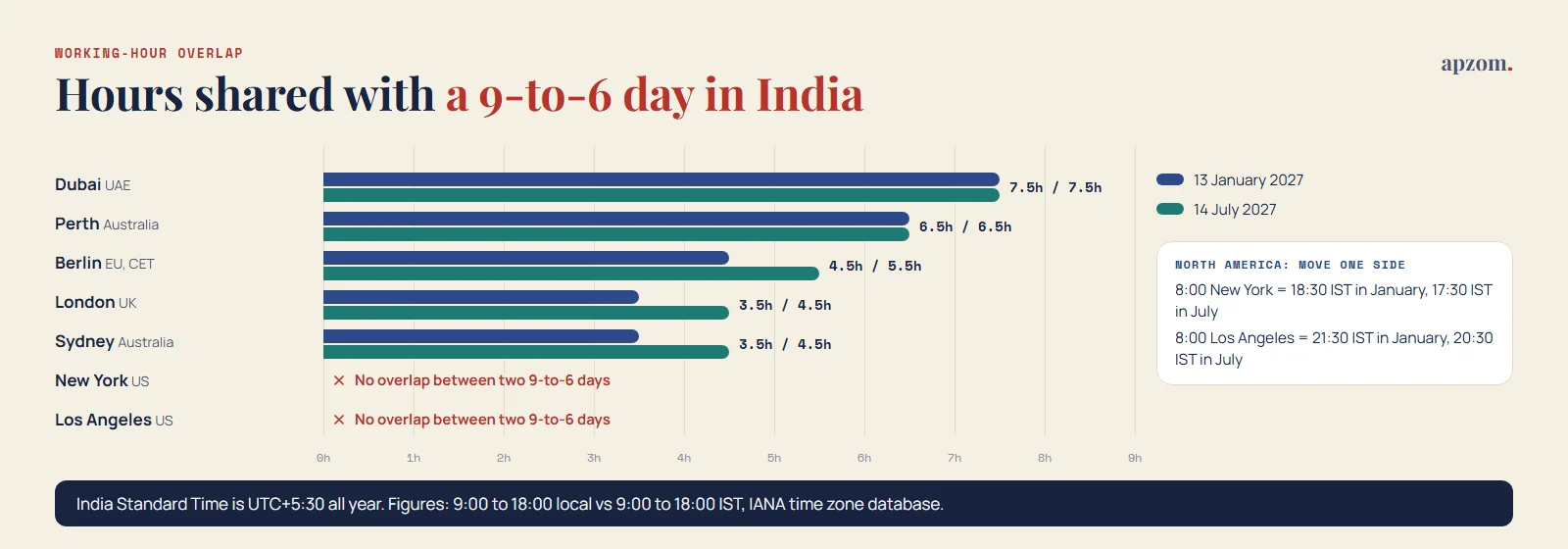
India Standard Time is UTC+5:30 all year, because India does not change its clocks; many of its clients’ countries do, so the overlap moves during the year. The table compares a 9:00 to 18:00 working day in each city with a 9:00 to 18:00 day in India. We worked it out with the IANA time zone database in Python for two Wednesdays, 13 January and 14 July 2027.
| Your city | Time difference from India | Overlap of two 9-to-6 days |
|---|---|---|
| Dubai (UAE) | India is 1 hour 30 minutes ahead | 7.5 hours all year |
| Perth (Australia) | Perth is 2 hours 30 minutes ahead | 6.5 hours all year |
| Berlin (EU, Central European Time) | India is 4 hours 30 minutes ahead in winter, 3 hours 30 in summer | 4.5 hours in winter, 5.5 in summer |
| London (UK) | India is 5 hours 30 minutes ahead in winter, 4 hours 30 in summer | 3.5 hours in winter, 4.5 in summer |
| Sydney (Australia) | Sydney is 5 hours 30 minutes ahead in January, 4 hours 30 in July | 3.5 hours in January, 4.5 in July |
| New York and Toronto | India is 10 hours 30 minutes ahead in winter, 9 hours 30 in summer | None |
| Los Angeles | India is 13 hours 30 minutes ahead in winter, 12 hours 30 in summer | None |
For the UK, EU, Australia and the UAE, the overlap allows a daily check-in and a weekly call in normal hours. For North America, one side has to move: an 8:00 a.m. call in New York is 6:30 p.m. in India in winter and 5:30 p.m. in summer, and in Los Angeles it is 9:30 p.m. or 8:30 p.m. Clocks change on different dates in the US, Europe and Australia, so check the gap again around each change.
Agree in the contract the hours the provider will be reachable in your time zone and how fast it answers urgent messages. Hold a weekly call at a fixed time with written actions the same day, and name a backup contact on both sides, because Indian public holidays will not match yours.
Red flags
Walk away, or slow down, if you see any of these:
- Names that do not match. The proposal, contract, MCA record, GST record and bank account name different entities, with no clear explanation.
- Guaranteed rankings, leads or AI citations. Google’s page “Do you need an SEO?” says: “No one can guarantee a #1 ranking on Google.”
- The provider wants to own your accounts, or asks for your passwords instead of user access.
- Proof you cannot check. Case studies with no client name, dates or source for the numbers.
- Nobody will say who does the work, or the person from the sales call disappears after you sign.
- Personal data without a contract. The provider asks for your customer list but has no processor agreement or transfer clauses to offer.
- Pressure to route ad spend through the provider without a clear reason and platform receipts.
- A long lock-in for a first engagement, with no exit if the work is poor.
A 30-day trial plan
Before you sign a twelve-month retainer, run a paid trial with a defined scope. Thirty days is too short to judge SEO results, but long enough to see how a provider works.
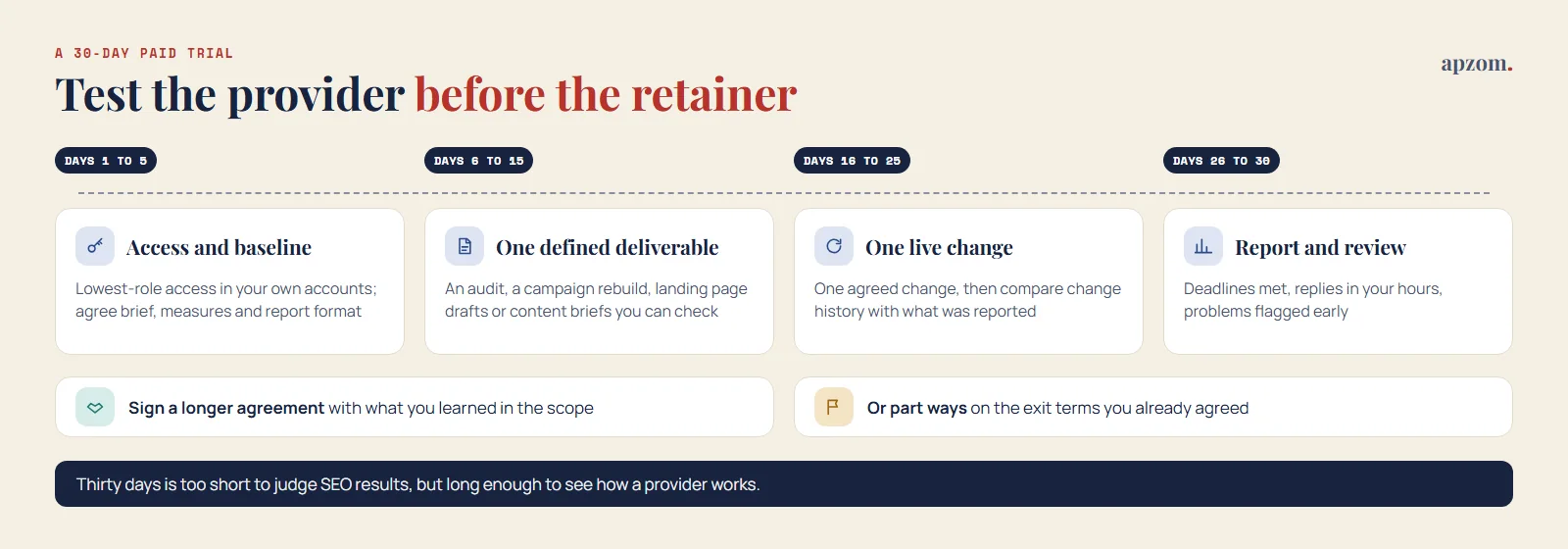
- Days 1 to 5: access and baseline. Give access in your own accounts at the lowest role that does the job. Agree the brief, success measures and report format, and record your starting numbers.
- Days 6 to 15: one defined deliverable. Ask for something you can check: a technical SEO audit with prioritised fixes, a rebuilt campaign structure, landing page drafts or a month of content briefs. Judge the quality and whether it arrived on time.
- Days 16 to 25: one change in the live account. Let the provider make one agreed change, such as fixing conversion tracking or launching one campaign with a capped budget, and check the change history against what it says it did.
- Days 26 to 30: report and review. Get a report in the agreed format and hold a review call. Did the provider meet deadlines, reply in your hours, flag problems early and explain its decisions?
Then either sign a longer agreement with what you learned in the scope, or part ways on the exit terms you agreed.
Common mistakes
- Treating “India” as one decision. A specialist SEO firm, a full-service agency and a solo freelancer are very different choices, wherever they are based.
- Choosing on the hourly rate alone. A low rate with unclear scope and heavy management time can cost more than a higher one with clear deliverables.
- Sharing customer data first and sorting the contract later. Under the GDPR and UK GDPR, the processor contract and the transfer mechanism come first.
How Apzom can help
Apzom Digital is a digital marketing agency founded in 2025 and based in Ahmedabad, India, and our team has 12+ years of combined career experience. We provide SEO, paid advertising, content, social media and website work, and you are welcome to put us through every check in this guide, as you would any other provider. Our published results are Meta lead results for two Ahmedabad property clients: HillTown Group, with “600+ leads every month from Meta ads, for 12 months running”, and Kingston Flats, with “560+ Meta leads every month since June 2025”, both on our case studies page. They are not evidence of results in your market, and we will not quote figures we cannot show you. See our digital marketing services. We work with clients worldwide, remotely, from our base in Ahmedabad, India.
Get a Free Growth Audit and Quote. Send us your brief, your markets and the channels you want to outsource. We send back a written review of your current set-up, a suggested scope for a paid 30-day trial, the hours we would be reachable in your time zone and a fee in writing.
No obligation, no guaranteed rankings or leads. Prefer to talk first? Contact us or read our guide on how to choose a digital marketing agency.
Frequently asked questions
Is it legal for a business in the EU or UK to outsource marketing to India?
Yes, but if the provider will handle personal data, you need a processor contract that meets Article 28 of the GDPR (or the UK GDPR) and a valid transfer mechanism, because India has no EU or UK adequacy decision. For the EU that is usually the Commission’s standard contractual clauses; for the UK, the ICO’s IDTA or Addendum with a transfer risk assessment. Ask your lawyer which applies to your data.
How do I check that an Indian digital marketing agency is a real company?
Search for it on the Ministry of Corporate Affairs “View Company/LLP Master Data” service by name or CIN, and look up its GSTIN with the GST portal’s “Search Taxpayer” tool. The legal names on both records should match your contract and invoices, and both registrations should be active.
Which countries have the most working-hour overlap with India?
Of the cities we checked, Dubai has the most: 7.5 hours of a normal working day, all year. Perth, Central Europe, the UK and Sydney have 3.5 to 6.5 hours, depending on the season. New York, Toronto and Los Angeles have none between two 9-to-6 days, so agree fixed meeting times in your morning, which fall in India’s evening.