
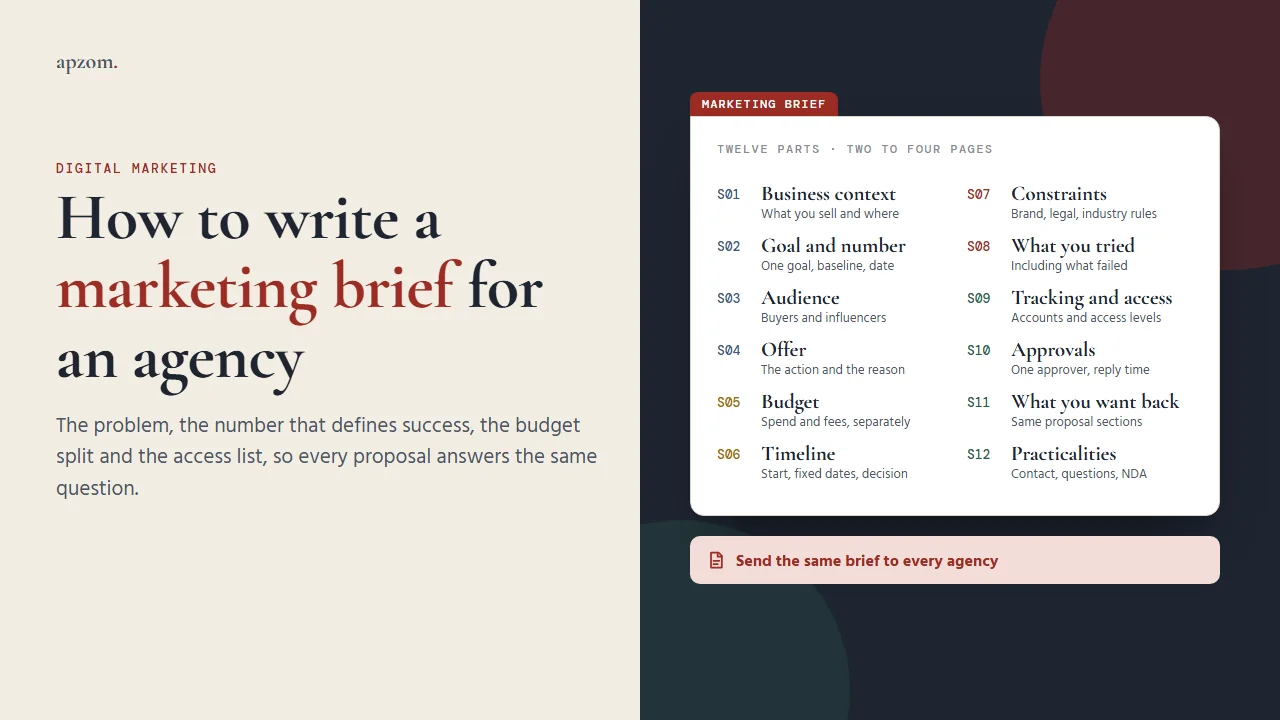
The short answer: A marketing brief for an agency is a two-to-four-page document that tells the agency what your business needs from its ads, SEO, social or email work and how you will judge it. It must cover your business context, one commercial goal and the number that defines success, the audience, the offer, the budget (advertising spend and agency fees shown separately), the timeline, your constraints (brand, legal and regulated-industry rules in each country you sell to), what you have tried and the results you have, your tracking and the accounts the agency will need at what access level, who approves the work, and the proposal format you want back. Send the same brief to every agency so the proposals answer the same question.
This guide is for business owners, founders and marketing managers anywhere in the world who are about to ask agencies for a proposal for paid ads, SEO, social media, email or a mix. It explains each part, gives you a template to copy, shows an illustrative filled-in example and ends with a checklist. We checked the platform policies and advertising rules it mentions against official sources on 23 November 2026. None of it is legal advice.
What a marketing brief is, and what it is not
A marketing brief describes a problem and the conditions around it. It is not a plan: the plan is what you are asking the agency to write. If your brief already says “run Google Ads and three Instagram posts a week”, you have chosen the answer before anyone looked at the question, and every agency will simply price your list.
It is also different from the shorter briefs we cover elsewhere. For a new website, use our guide to how to write a website brief, which covers pages, features, content and integrations. To shortlist agencies, the five-line brief in our guide to choosing a digital marketing agency is enough. To find out what you already have, run the digital marketing audit first; its area scores and biggest gaps belong in parts 8 and 9 of the template below, which is the full brief an agency writes a proposal against.
Expect questions back: an agency that asks about your margins, sales process or tracking before proposing anything has engaged with the problem.
The twelve parts of a marketing brief
Each part answers a question the agency would otherwise guess, and guesses are where proposals stop being comparable.
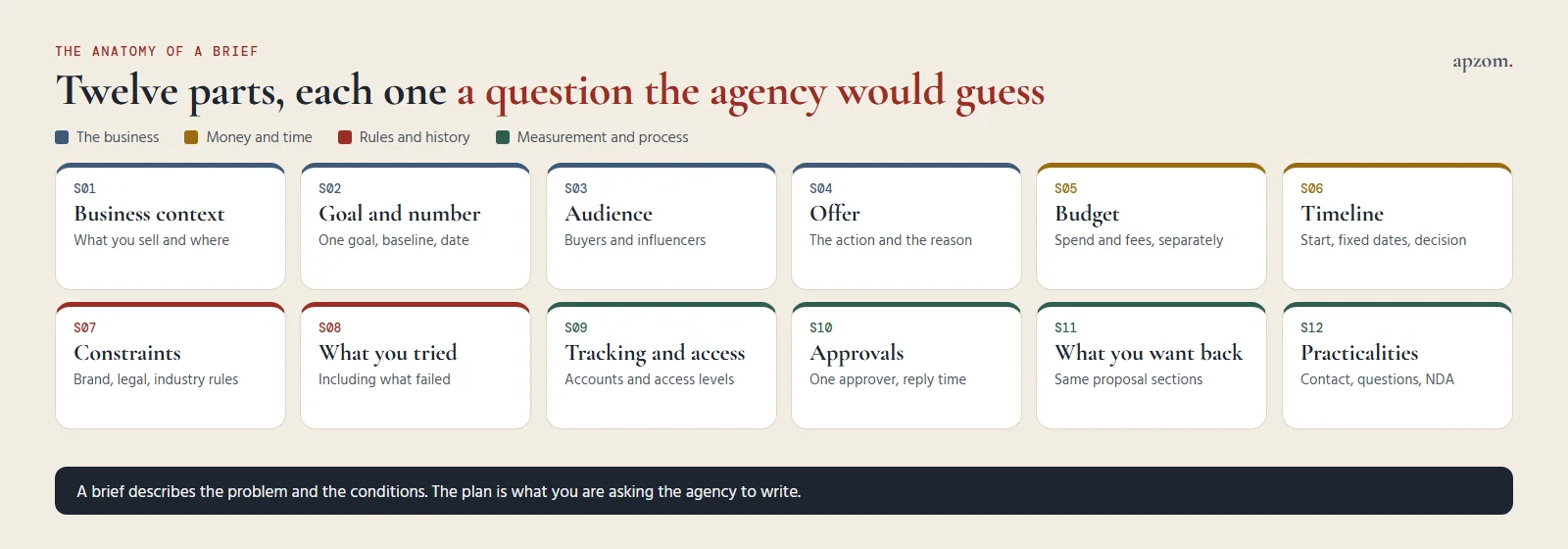
| Part | What to write | Why the agency needs it |
|---|---|---|
| 1. Business context | What you sell, to whom, where, and how customers buy | It decides channels, languages and sales-cycle length |
| 2. Goal and success number | One goal, one number, a baseline and a date | The proposal will be judged on it |
| 3. Audience | Buyers, influencers, what they search for or ask | It shapes targeting, keywords and messages |
| 4. Offer | The action you want and why people would choose you | It decides the landing page and call to action |
| 5. Budget | Advertising spend and agency fees as two ranges | It sets the size of the plan |
| 6. Timeline | Start date, fixed dates, decision date | It decides what comes first |
| 7. Constraints | Brand, legal and industry rules by country | Some rules decide whether an ad can run |
| 8. What you have tried | Past channels, agencies and results, including failures | It stops the agency repeating them |
| 9. Tracking and access | What is measured, and the accounts needed at what level | Without tracking, results are opinion |
| 10. Approvals | Who signs off, and how fast | Slow approvals cost campaign time |
| 11. What you want back | Proposal sections, pricing layout, deadline | It makes proposals comparable |
| 12. Practicalities | Contact, question window, confidentiality | It keeps the process fair |
Business context
Write this part for someone who has never heard of you: what you sell, who buys it, where (countries, regions or cities), and how a typical customer buys, whether that is a phone call after one search, a quote after three meetings or an online checkout. Say roughly how long it takes from first contact to a sale, because a same-day purchase and a six-month B2B decision need very different plans. Add the competitors customers compare you with and why you think they choose you; “we think it is response speed, but we have never asked” beats a slogan.
The goal and the number that defines success
This is the part most briefs get wrong. “More leads”, “brand awareness” and “grow our online presence” are directions, not goals. A proposal written against a direction cannot be judged.
Write one commercial goal, then pin it down:
- The goal in business terms: for example, more qualified enquiries for one service, more first orders from one country, or more booked demos from companies of a certain size.
- The number: the single measure you will use, such as qualified enquiries per month.
- The baseline and its source: what the number is today and where it comes from (CRM, shop back office, a sales spreadsheet). If you do not know, write “not measured” and make fixing that part of the job.
- The date: when you will judge it, for example after six months.
- What “qualified” means: a form fill from a student, a supplier or someone outside your area is not a buyer, so define which enquiries count.
Name two or three supporting measures to report along the way, and say they are not the goal. Our guides to what a marketing report should include and measuring marketing ROI explain the difference between outcomes and leading indicators, and how to connect the number to profit.
Do not ask for a guarantee; results cannot be promised honestly. Ask for a realistic expectation, what it depends on, and what the agency will report if it is not happening.
Audience and offer
For the audience, describe the people who buy and the people who influence the decision, which in B2B are often different. For each, write the problem that brings them to you, what they type into a search engine or ask an AI assistant, their usual objections, and their countries and languages.
For the offer, say what you want someone to do after seeing the marketing (call, request a quote, book, buy) and why they should do it with you: a price, a delivery time, a free survey or sample. More advertising rarely fixes a weak offer. Name the page people will land on and whether the agency may change it; our guide to landing page best practices covers what it needs.
Budget: advertising spend and agency fees, separately
A budget range is better than silence: without one, each agency guesses the size of the plan and the proposals cannot be compared.
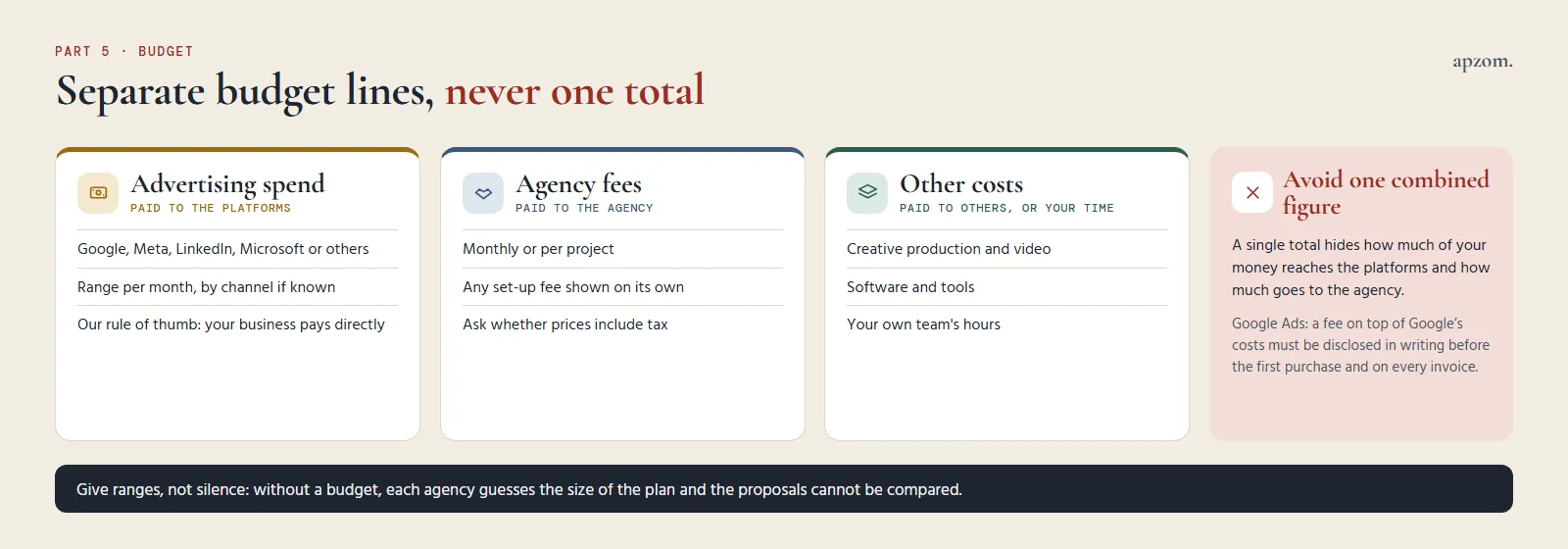
Write the budget as separate lines:
- Advertising spend: the money that goes to Google, Meta, LinkedIn, Microsoft or another platform, per month and by channel if you know. Say who pays the platforms. Our rule of thumb: your business pays them directly from its own payment method, so billing stays in your name.
- Agency fees: what the agency charges for its work, monthly or per project, including any set-up fee.
- Other costs: creative production, video, software and the time your own team will spend.
A combined figure hides how much reaches the platforms. For Google Ads, Google’s “Transparency requirements” for third parties say an agency that charges a fee on top of Google’s costs must tell new customers in writing before their first purchase and disclose the fee on every invoice, must give you your Google Ads customer ID if you ask, and, where the agency’s advertising terms with Google require a monthly performance report for customers, must include cost, clicks and impressions at account level, with cost being “the exact amount charged by Google, exclusive of any fees”.
Our guides to Google Ads management costs and how much Facebook and Instagram ads cost explain fee models and what drives media costs.
Writing a brief for an agency? Ask for a Free Growth Audit. Send us your draft brief and we tell you which parts an agency would still have to guess, check that your goal has a number and a baseline, and look at whether your tracking can measure it, even if you end up hiring someone else.
Timeline and approvals
Give a start date and any fixed dates (a launch, a season, a trade show, the end of your current agency contract), say whether each can move, and when you will choose an agency.
For approvals, name one person who signs off ads, copy, landing pages and budget changes, and say how quickly they reply. If legal, compliance or a franchisor must review anything, say so and how long it usually takes; a two-week review step changes the whole plan. Add meeting frequency, report format and time zone.
Constraints: brand, legal and regulated-industry rules by country
This part lists what the agency must not do. Some items are law or platform policy and decide whether an ad can run at all.
- Brand: guidelines, tone of voice, words and imagery you never use.
- Claims: what you can prove. If you cannot back “fastest” or “number one”, say so; in each market summarised below, unsupported claims are a legal risk.
- Endorsements and privacy: whether you use influencers or testimonials, and whether you have consent to use customer lists for advertising.
- Your industry: your regulator and any wording you must include.
Advertising rules are set country by country. In outline:
- US: Section 5 of the Federal Trade Commission Act prohibits unfair or deceptive acts or practices, and the FTC applies it to deceptive advertising. The FTC’s Endorsement Guides (revised in 2023) say a material connection between an endorser and the business “should be disclosed clearly and conspicuously”, and the FTC tells businesses: “Your company is ultimately responsible for what others do on your behalf.”
- UK: the CAP Code, enforced by the Advertising Standards Authority, covers non-broadcast advertising and “must be followed by all advertisers, agencies and media”. It has separate sections for sectors such as health products, financial products, gambling, alcohol and employment.
- EU: the Unfair Commercial Practices Directive (2005/29/EC) is the main law on misleading and aggressive business-to-consumer practices and is enforced by national authorities in each member state.
- Australia: the ACCC, which enforces the Australian Consumer Law, says “any information or claim that a business provides about its products or services must be accurate”, including in advertising, on websites, on social media and in testimonials.
- Canada: the Competition Act prohibits promoting a product or business with claims that are false or misleading in a material respect, judged on both the literal meaning and the “general impression”.
- India: the ASCI Code is a self-regulatory code that applies to advertisers, advertising agencies and media, including ads from abroad aimed at Indian consumers; ASCI says it is not a government body.
- Other markets, including the UAE: name the regulator and any permits in the brief, and ask the agency to confirm the current rules. We have not summarised them here.
The ad platforms add their own rules. Google Ads’ “Healthcare and medicines” policy says some healthcare content cannot be advertised at all, some advertisers must be certified with Google, and further requirements depend on the locations targeted. Its “Financial products and services” policy requires certain disclosures and, in some locations, advertiser verification. On Meta, the Special Ad Categories are housing, employment, financial products and services, and social issues, elections or politics; campaigns must be declared, and housing, employment and financial ads have restricted audience options, while ads about social issues, elections or politics need advertiser authorisation instead. Flag these in the brief: they change the targeting an agency can propose.
What you have tried, and the results you have
List each channel you have used in the last 12 to 24 months, roughly what you spent, what you measured and what happened, including what did not work and why you think it failed. “Google Ads for two years, results unclear because calls were not tracked” is a useful sentence. Attach exports, and say which numbers you trust.
Mark any figures you will share only under a confidentiality agreement with your shortlist, but do not leave a failed channel out; an agency that does not know about it may propose it again.
Tracking and the data-access list
For tracking, say which tools you use (for example Google Analytics 4, Google Tag Manager, the Meta Pixel and Conversions API, call tracking, a CRM), which actions count as conversions, and whether an enquiry can be followed to a sale. If you are not sure your conversions are counted correctly, say so; a good agency will propose a tracking check first.
For access, list every account the agency will need, who owns it today and the level you plan to give. The principle: your business owns every account, and the agency is a guest at the lowest level that lets it do the work.
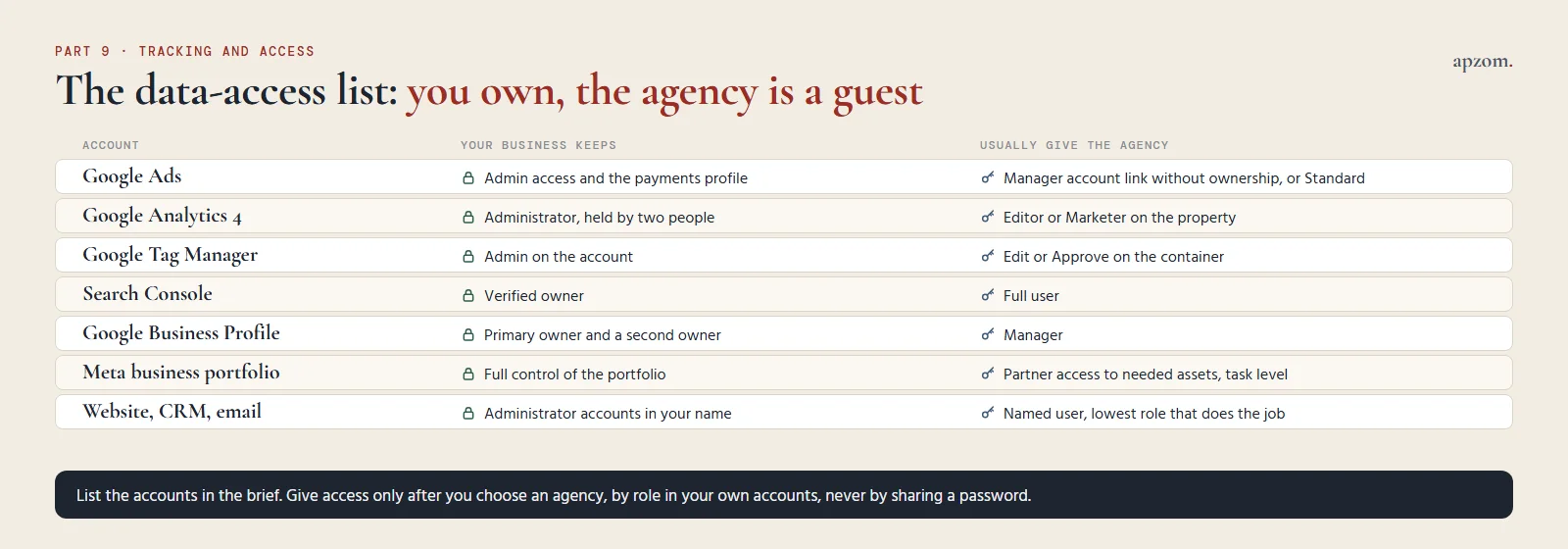
| Account | Your business keeps | Usually give the agency |
|---|---|---|
| Google Ads | Admin access and the payments profile | A link from its manager account without ownership, or Standard access |
| Google Analytics 4 | Administrator, held by two people | Editor or Marketer on the property |
| Google Tag Manager | Admin on the account | Edit or Approve on the container |
| Search Console | Verified owner | Full user |
| Google Business Profile | Primary owner and a second owner | Manager |
| Meta business portfolio | Full control of the portfolio | Partner access to the assets it needs, at task level |
| Website, CRM, email platform | Administrator accounts in your name | A named user with the lowest role that does the job |
Our guides to giving an agency access to Google Analytics, Search Console, Ads and your Business Profile and to giving an agency access to your Meta business portfolio explain each role and the steps. State in the brief that access will be given after you choose an agency, never by sharing a password, and ask each agency to list the access it needs.
These accounts often hold customer data. In the EU and UK, an agency processing it for you usually acts as a processor, and Article 28 of the GDPR and UK GDPR says that processing “shall be governed by a contract or other legal act”, which in practice means a written data processing agreement. Elsewhere, ask how each agency handles your data under your local privacy law.
What you want back: the proposal format
Otherwise you receive five documents in five shapes. Ask every agency for the same sections in the same order:
- Understanding: the problem in their own words, and their remaining questions.
- Plan: channels, what comes first and why, and what they would not do.
- Measurement: how they will track the success number and what they need from you.
- People: who does the work, and how much of their time you get.
- Pricing: fees and recommended advertising spend on separate lines, set-up costs, what is extra, and whether tax is included.
- Terms: contract length, notice period, and who owns the accounts, creative and data.
- Evidence: similar work, with what it actually proved.
Set a proposal deadline and a question window, and share every agency’s questions and your answers with all of them. Our guide to choosing an agency explains how to compare proposals fairly.
The marketing brief template
Copy this into a document and replace the brackets. Where you do not know an answer, write “not known” rather than deleting the line, so the agency knows to ask.
MARKETING BRIEF: [Business name]   Date: [date]   Version: [1]
Contact: [name, role, email]   Proposals due: [date]   Questions until: [date]
1. BUSINESS CONTEXT
What we sell: [products or services in scope]   Who buys: [customer types]
Where: [countries, regions, languages]   How they buy: [call, quote, booking, online]   Time to a sale: [days, weeks, months]
Competitors customers compare us with: [2-3]   Why customers choose us (as far as we know): [reasons]
2. GOAL AND SUCCESS NUMBER
Commercial goal: [one goal in business terms]
Success number: [one measure]   Baseline: [number or "not measured"]   Source: [CRM, shop, spreadsheet]
Judged on: [date]   Qualified means: [definition]   Supporting measures (not the goal): [2-3]
3. AUDIENCE
Buyers: [who, problem, what they search for or ask]   Influencers: [who]   Objections: [list]
4. OFFER
Action we want: [call, quote, booking, purchase]   Reason to act: [offer]
Landing page: [URL or "needs creating"]   Agency may change it: [yes, no, with approval]
5. BUDGET (SEPARATE LINES)
Advertising spend: [range per month, by channel if known]   Paid by: [our business, directly]
Agency fees: [range per month or project]   Other costs: [creative, tools]
6. TIMELINE
Start: [date]   Fixed dates: [launch, season, contract end; fixed or movable]   Agency chosen by: [date]
7. CONSTRAINTS
Brand: [guidelines attached; words and claims to avoid]
Legal and industry rules: [regulator, required wording, countries]
Platform categories: [for example Meta housing, employment, financial; Google healthcare or financial services]
Privacy: [countries whose rules apply; consent status of customer lists]
8. WHAT WE HAVE TRIED
Channel, period, approximate spend, what we measured, what happened: [one line each]
Previous agencies and why we left: [notes]   Data we can share now: [list]   After NDA: [list]
9. TRACKING AND ACCESS
Tools: [GA4, Tag Manager, Meta Pixel and Conversions API, call tracking, CRM]
Conversions counted: [list]   Enquiry followed to sale: [yes, no, partly]
Accounts needed, owner today, access level planned: [one line each]
Access is given after selection, never by sharing passwords.
10. APPROVALS AND WAYS OF WORKING
Sign-off: [name]   Reply time: [days]   Other reviewers: [legal, compliance, franchisor]
Meetings: [frequency]   Reports: [format, frequency]   Time zone and language: [details]
11. WHAT WE WANT BACK
Sections: understanding; plan; measurement; people; pricing (fees and spend separate, tax stated); terms; evidence
Format: [PDF, maximum pages]   Presentation: [yes or no, date]
12. PRACTICALITIES
All questions and answers are shared with every agency.   Confidentiality: [what needs an NDA]
A worked example (illustrative)
This example is invented. The business and numbers are illustrative, not a client of ours and not a benchmark.
- Context: a company in two cities installs and services commercial kitchen equipment for restaurants, hotels and staff canteens. Buyers request a site visit, receive a quote and decide within four to eight weeks.
- Goal and number: more signed service contracts in a new city, measured as site visits booked per month from that city, judged after six months. Baseline: two a month, from the CRM. Qualified means a commercial kitchen in that city, not a home kitchen or a one-off repair.
- Audience and offer: restaurant owners and hotel operations managers, with head chefs influencing which equipment is chosen. The offer is a free site visit and a written quote within three working days.
- Budget: an illustrative advertising range of 2,000 to 3,000 a month in local currency, paid directly by the business, with agency fees as a separate range.
- Constraints: “cheapest in the city” cannot be proved, so it is excluded; hotel clients are not named without written permission.
- Tried: Google Ads for a year in the first city with a previous agency, calls not tracked, results unclear.
- Tracking and access: GA4 and Tag Manager are installed but count only form submissions. Google Ads and GA4 are in the company’s name; the chosen agency gets Standard access and Editor.
The example leaves the channels, the split of money and the first fix to the agency; how each one answers is how you choose.
The checklist before you send the brief
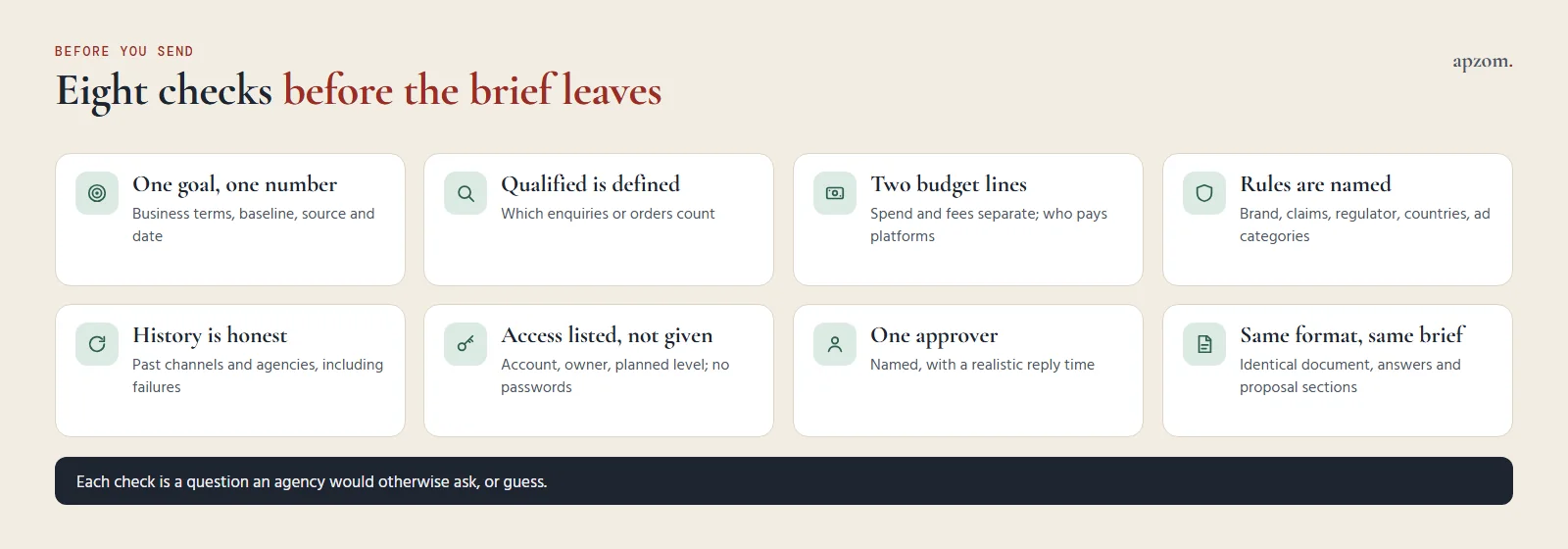
- One goal, one number: in business terms, with a baseline, a source and a date.
- Qualified is defined: you have written which enquiries or orders count.
- Two budget lines: advertising spend and agency fees are separate, and you have said who pays the platforms.
- Rules are named: brand rules, unprovable claims, regulator, countries and any special ad categories.
- History is honest: past channels and agencies listed, including failures.
- Access is listed, not given: every account, its owner and the planned level, with no passwords.
- One approver: named, with a realistic reply time.
- Same format, same brief: every agency gets the identical document, the same answers and the same proposal sections.
Common mistakes
- Writing the plan instead of the problem. A list of channels gets priced, not thought about.
- A goal with no number. “Increase awareness” cannot be judged.
- Hiding the budget, or giving one combined figure. Proposals differ in size, and you cannot see what reaches the platforms.
- Forgetting the regulator. In finance, health, housing, employment and other regulated areas, the rules can decide whether an ad runs.
How Apzom can help
Apzom Digital runs SEO, Google Ads, Meta ads, social media and email campaigns for businesses that want enquiries and sales they can measure. When you send us a brief, we answer it in the seven sections above, with our fees and the advertising spend we recommend on separate lines, and we say plainly if a smaller plan or a tracking fix should come first. We have not published a case study about marketing briefs, so we will not quote results we cannot show; our published results are on our case studies page. See our digital marketing services for what we do. We work with clients worldwide, remotely, from our base in Ahmedabad, India.
Get a Free Growth Audit and Quote against your brief. Send us your marketing brief, or the twelve headings filled in as far as you can. We reply in the seven proposal sections from this guide: our understanding and questions, the plan, measurement, who would do the work, fees and recommended advertising spend on separate lines, terms, and relevant evidence.
No obligation, and no promised number of leads, sales or rankings. Prefer to talk first? Contact us or read our guide to choosing a digital marketing agency.
Frequently asked questions
How long should a marketing brief be?
Usually two to four pages plus attachments such as brand guidelines and data exports.
What is the difference between a marketing brief, an RFP and a proposal?
The brief describes your business, goal and conditions. A request for proposal (RFP) is a formal invitation to bid, usually containing a brief plus process and contract rules. The proposal is the agency’s answer: plan, people, price and terms.
Should I share past results with agencies before I choose one?
Share enough to show what worked and what did not, as summaries or exports. Keep detailed figures and customer data for your shortlist, under a confidentiality agreement if needed, and never share customer lists or passwords at the brief stage.
Who should write the marketing brief?
The person who will own the results, usually the owner or marketing lead, with input from sales on good customers and from finance on budget. An agency can help sharpen a draft, but if it writes the brief, the brief tends to describe what it sells.