The short answer: A good business case study tells a real client’s story in a way a similar buyer can check: who the client was, what problem they had, what you did, who did it, what changed, and where the figures came from. Get the client’s approval before publishing their name or numbers. State what the case study does not show, such as costs you no longer hold or results you cannot attribute. Never invent results, quotes or testimonials. A modest, specific, honest case study persuades careful buyers more than an impressive one they cannot verify.
This guide is for agencies, consultancies, contractors and other service businesses writing case studies for their website or proposals. It draws on how we write Apzom Digital’s own case studies, which are published on our site, so the examples below come from our own practice. Apzom sells content marketing, so read this knowing we have an interest.

What to take from this guide
- Specific beats impressive. A clear account of real work is more persuasive than a large, unexplained number.
- Approval comes first. Do not publish a client’s name, logo or figures without their agreement.
- Say where the numbers came from. And whether anyone checked them.
- Say what you are not claiming. It is the section careful buyers trust most.
What a case study is for
A buyer reading a case study is asking whether you have solved a problem like theirs before, and whether you are telling the truth about it. That makes it different from an advert. Its job is to let a stranger check your work, which is why detail and honesty matter more than adjectives.
The structure
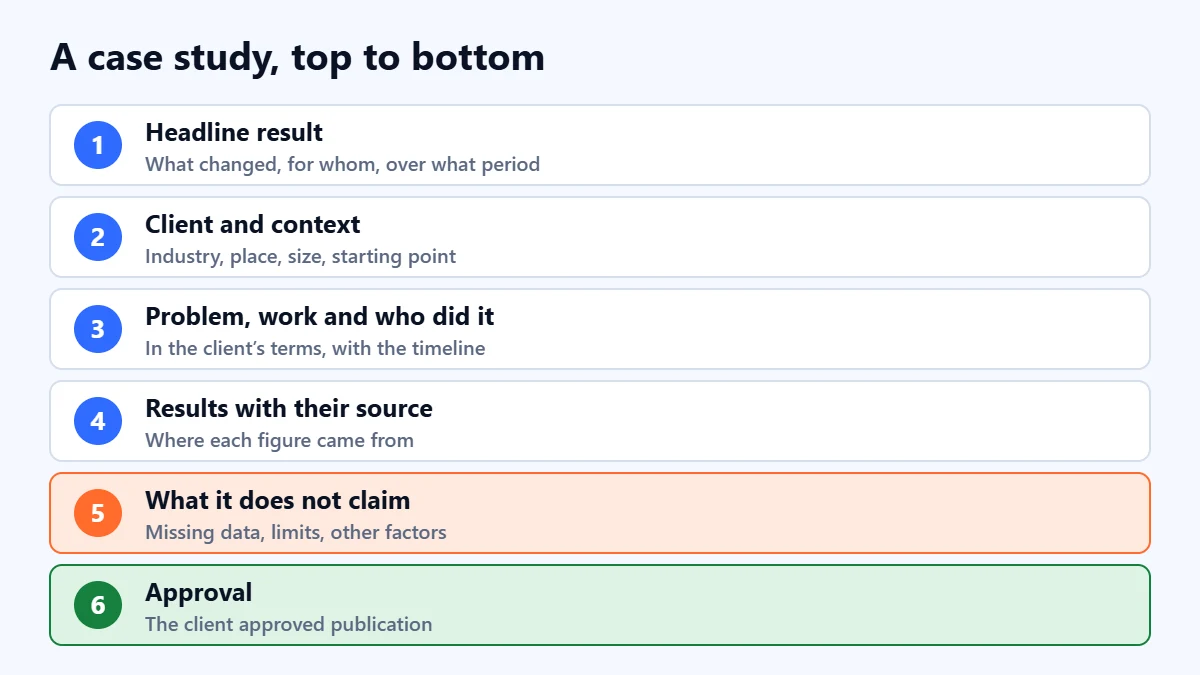
- A headline that states the result plainly. What changed, for whom, over what period.
- The client and context. Industry, location, size and the situation before you started.
- The problem. What the client needed, in their terms.
- What you did, and who did it. The work, the timeline and the people involved.
- The results, with their source. Where each figure came from and the period it covers.
- What the case study does not claim. Limits, missing data and things you cannot attribute.
- Approval. A note that the client approved publication.
How we apply this at Apzom
Our HillTown Group case study is a good example of the structure in practice. It sets out the client, channels and engagement period, then lists these details separately:
- Who did the work. It names Apzom’s founder as the person who led the engagement. It also says the work began before Apzom was founded and continued under Apzom.
- Data source. It says the lead counts come from the Meta Ads campaigns run during the engagement, and that they were not independently audited.
- Approval. It says the name, logo and figures were published with the client’s approval.
- What it does not claim. It publishes no ad spend or cost per lead, because we no longer hold the spend records. It makes no claim about sales or bookings, because we do not hold those figures.
Our case studies page explains the rule behind this. Where a client has not approved their numbers, the case study describes the work without them.
Want help turning your client work into case studies? Ask for a Free Growth Audit. We review your website’s proof, service pages and content, and tell you what would make the biggest difference to enquiries.
Getting the client’s approval
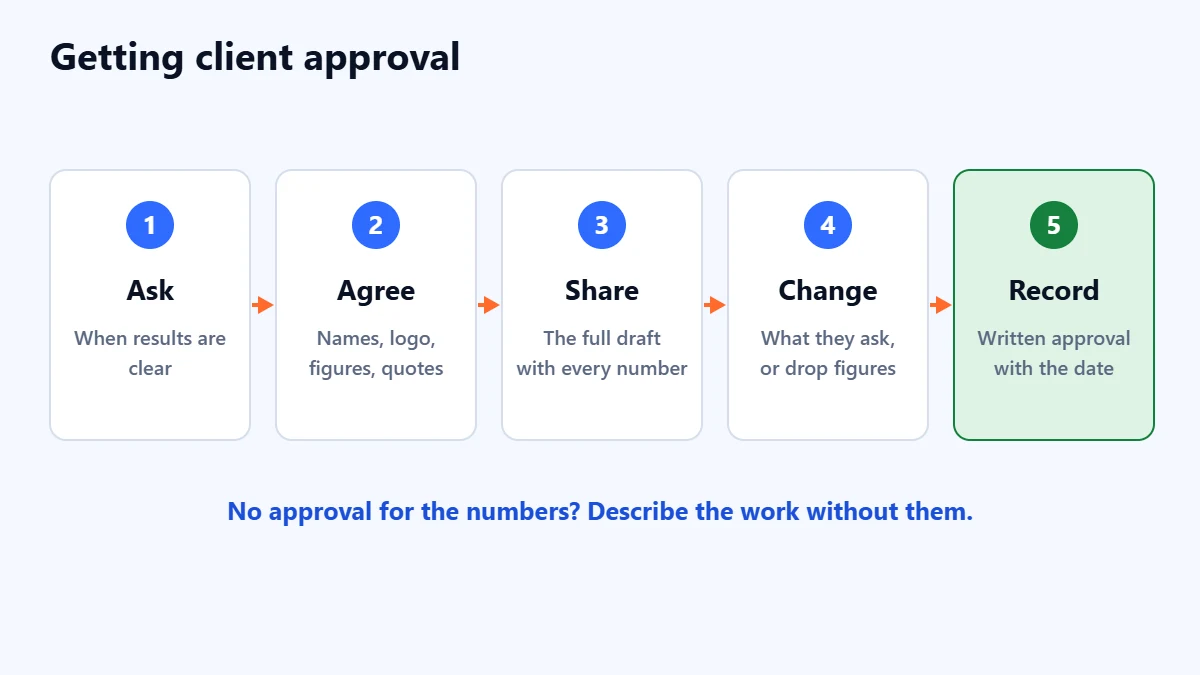
- Ask at the right time, usually once results are clear and the relationship is good.
- Agree what can be named: the company, people, logo, figures and screenshots.
- Share the full draft, including every number and quote.
- Make the changes they ask for. If they will not approve figures, publish the work without them.
- Keep written approval with the date and the version they approved.
If a client prefers not to be named, you can describe them generally, for example “a logistics company in western India”. Do not add details that identify them anyway.
Writing the results honestly
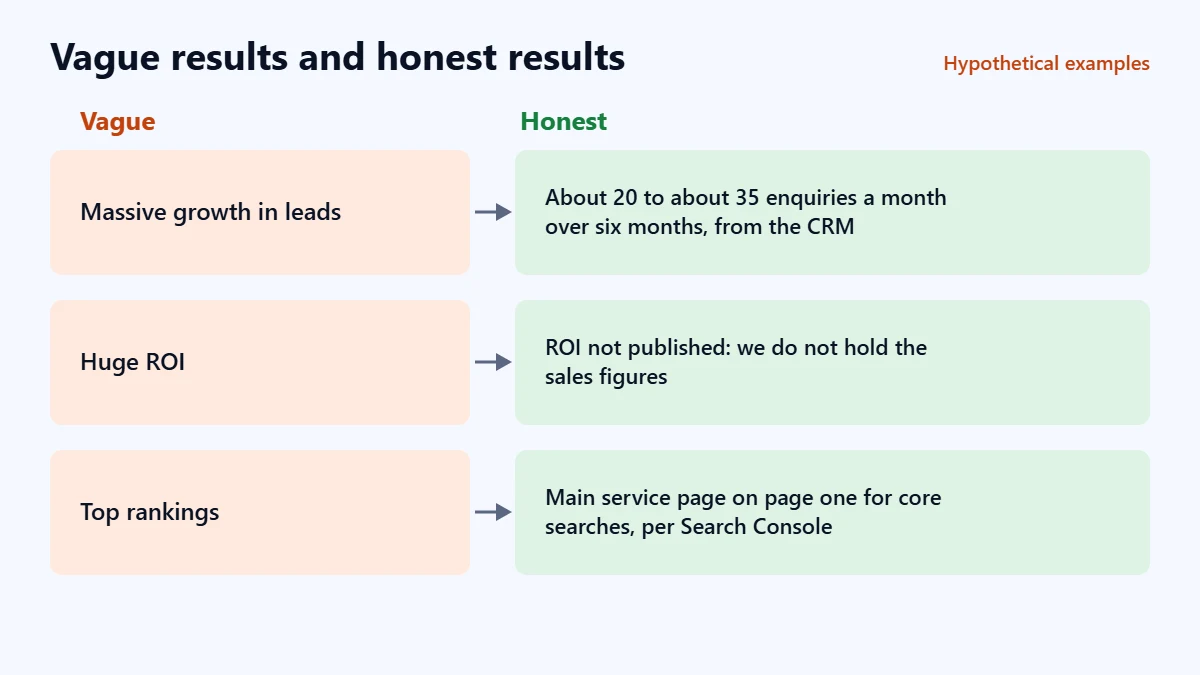
| Vague (hypothetical) | Honest (hypothetical) |
|---|---|
| Massive growth in leads | Enquiries from the website rose from about 20 to about 35 a month over six months, counted in the client’s CRM |
| Huge ROI | We do not publish return on investment, because we do not hold the client’s sales figures |
| Top rankings | The main service page moved onto the first page of results for its core searches, according to Search Console |
- Give the period. A number without dates is hard to judge.
- Give the source. CRM, analytics, ad platform, or the client’s own records.
- Separate your contribution. If other things changed at the same time, such as a price cut or a new salesperson, say so.
- Avoid cherry-picked peaks. A steady result over a year says more than one record month.
What never to do
- Invent a client, result or quote. Made-up testimonials and results can breach advertising and consumer protection rules in many countries, and they are easy to expose.
- Combine figures from different clients into one story.
- Present team members’ past work as company results without saying so. Our About page separates team experience from company figures for this reason.
- Publish confidential information, such as a client’s spend, margins or customer data, without explicit permission.
If you are unsure what the rules are where you operate, take advice before publishing.
Where to use case studies
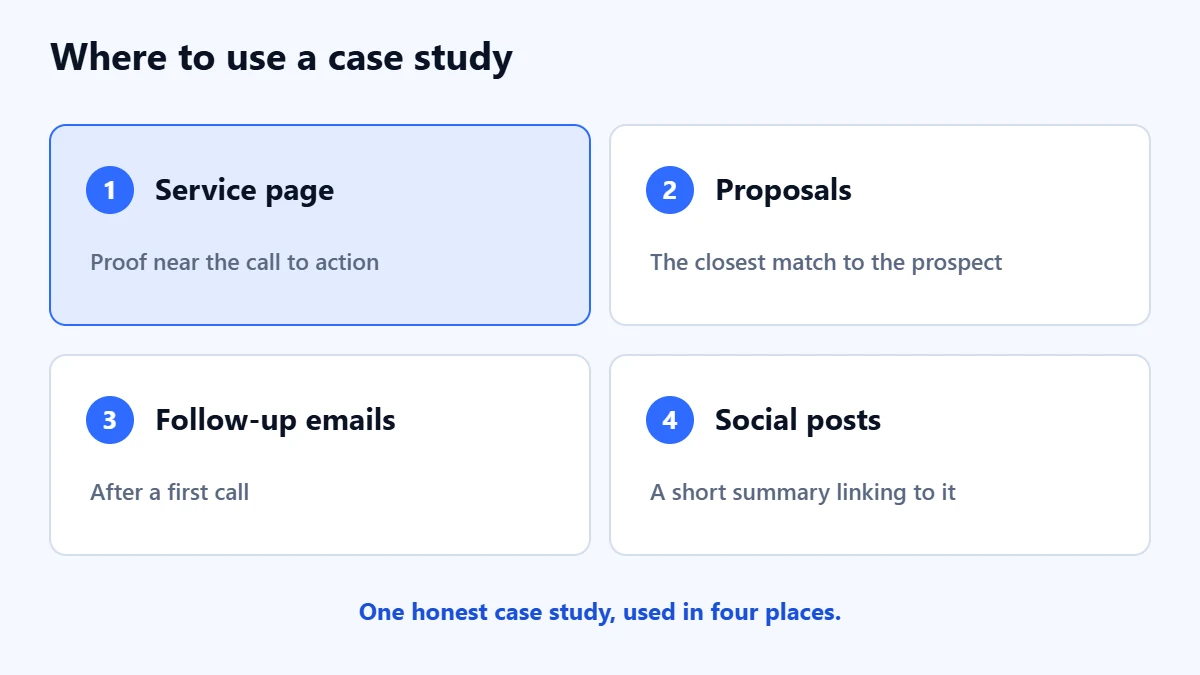
- On the relevant service page, as proof near the call to action. Our guide to writing a service page explains where proof belongs.
- In proposals, choosing the case closest to the prospect’s situation.
- In follow-up emails after a first call.
- As a short summary on social media, linking to the full version.
Frequently asked questions
How long should a case study be?
Long enough to show the problem, the work and the result with their sources. A short summary of a few hundred words can work for a simple project, while a complex one may need a full write-up with screenshots the client has approved.
Can I write a case study without numbers?
Yes. Describe the problem, the work and the outcome in words, and say why figures are not included. An honest case study without numbers is better than one with numbers you cannot support.
Should I include a testimonial?
If the client is willing, a short quote in their own words adds credibility. Use their exact words, with their approval and their name and role as they want them shown.
What if a client’s results were disappointing?
Do not publish it as a success. You can still write about what you learned, without naming the client, if that helps readers.
Get your Free Growth Audit and Quote. We review your website’s content, proof and enquiry path, then send a plain-English list of what we would fix first.
No obligation and no guaranteed results. Prefer to talk first? Contact us or see our content marketing service.