The short answer: llms.txt is a proposed plain-text file, written in Markdown and placed at /llms.txt on a website, that gives AI tools a short summary of the site and a curated list of its most useful pages. It is a community proposal, not an official standard, and it is not a ranking factor. Google says you do not need to create new machine-readable files, AI text files or markup to appear in AI Overviews or AI Mode. It can still help AI agents and assistants that choose to read it, especially on documentation-heavy sites. For most small businesses it is a low-cost, optional extra, not a priority.
This guide is for business owners, marketers and developers who have heard that their site “needs an llms.txt file” and want to know what is true. It follows the llms.txt proposal and Google Search Central documentation as checked in November 2026. Apzom Digital sells answer-engine and generative-engine optimisation, and our own site publishes an llms.txt file, so read this knowing we have an interest in the topic. We do not claim our file has changed how AI tools describe us, because we have no evidence that it has.
What to take from this guide
- It is a summary for machines. A short Markdown file pointing AI tools to the pages that matter.
- It is a proposal. No search engine or AI company is obliged to read it.
- Google does not need it. Normal SEO is what makes pages eligible for Google’s AI features.
- Accuracy matters more than having one. An out-of-date or misleading file is worse than none.
Where llms.txt comes from
The proposal is published at llmstxt.org. Its author explains that web pages are built for people, with navigation, adverts and scripts that are hard for AI tools to strip away, and that agents work better with concise, expert information in one place. The proposal was first written in 2024 and is now in its second version. Its author says thousands of sites now publish an llms.txt file and that some documentation platforms generate one automatically. The page also notes that OpenAI, Anthropic and Google’s Gemini team publish llms.txt files for their own developer documentation.
That last point is worth reading carefully. Those files help developers’ coding tools read API documentation. It does not mean those companies’ consumer chat products use llms.txt to decide which businesses to recommend.
What the file looks like
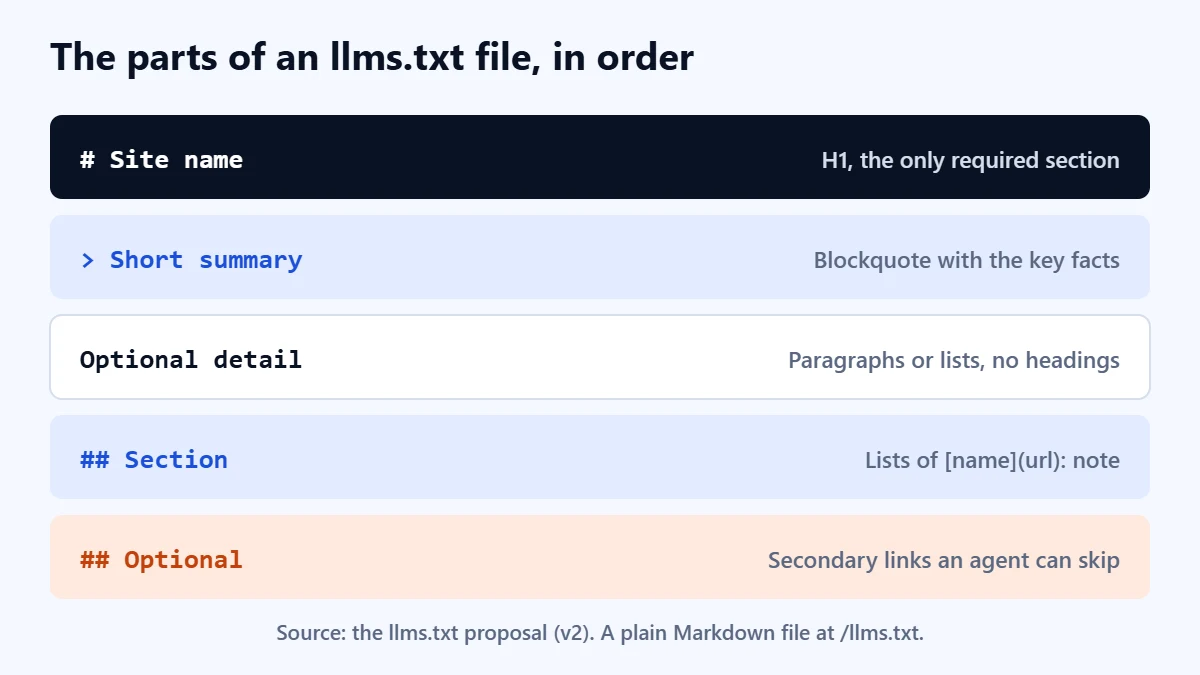
The proposal sets out the sections in a fixed order:
- An H1 with the name of the site or project. This is the only required section.
- A blockquote with a short summary containing what a reader needs to understand the rest.
- Optional detail, in paragraphs or lists but not headings.
- Sections under H2 headings, each a list of links in the form
[name](url), optionally followed by a colon and a note. - An optional section named “Optional”, for secondary links an agent can skip when it needs a shorter context.
A hypothetical file for a small service business might look like this:
# Example Plumbing Co |
> Licensed plumbers serving Pune since 2015. Emergency repairs, bathroom fitting and boiler servicing. Mon to Sat, 8am to 8pm. |
## Services |
- [Emergency plumbing](https://example.com/emergency/): same-day callouts, prices explained |
- [Bathroom fitting](https://example.com/bathrooms/): process, timings and guarantees |
## Optional |
- [Blog](https://example.com/blog/): maintenance guides |
What llms.txt is not
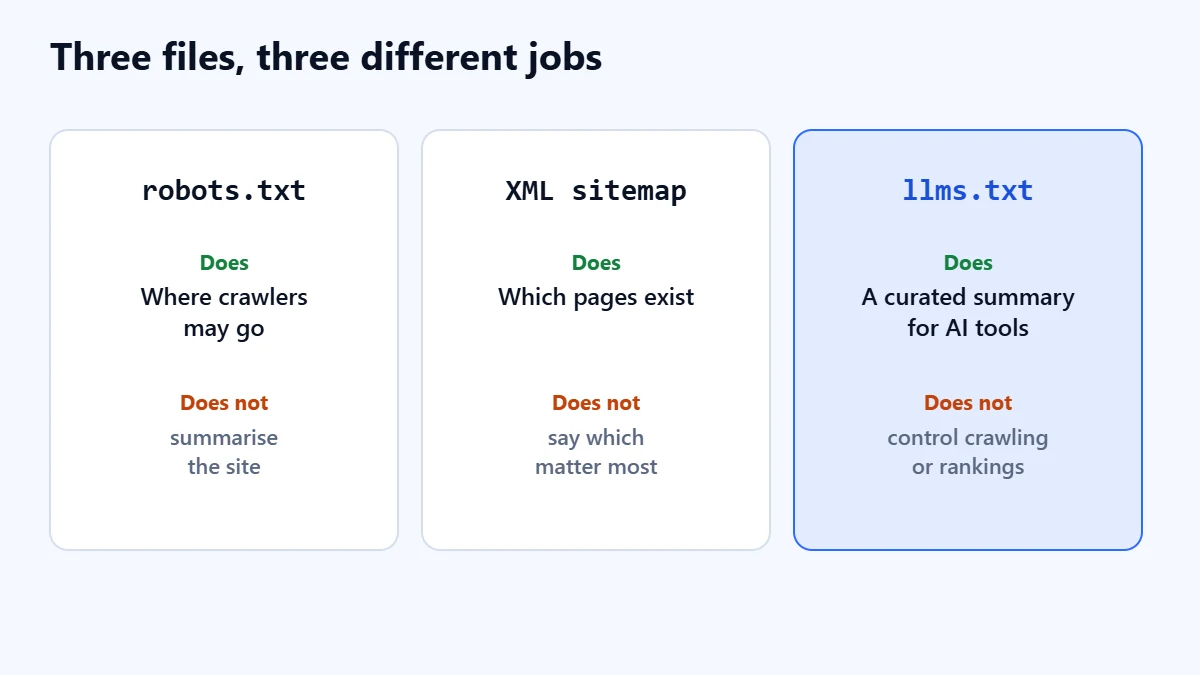
| File | What it does | What it does not do |
|---|---|---|
| robots.txt | Tells crawlers which parts of a site they may crawl | Summarise the site |
| XML sitemap | Lists the pages you want search engines to find | Explain which pages matter most, or why |
| llms.txt | Offers a curated summary and key links for AI tools | Control crawling, guarantee indexing or improve rankings |
The proposal itself describes llms.txt as designed to sit alongside these standards: sitemaps list all pages for search engines, while llms.txt offers a curated overview. If you want to control which AI crawlers can access your site, that is a robots.txt question. Our guide to what GEO is covers AI crawlers.
Does Google use llms.txt?
Google’s documentation on AI features in Search says the usual SEO best practices still apply, that there are no additional requirements or special optimisation needed to appear in AI Overviews or AI Mode, and that you do not need to create new machine-readable files, AI text files or markup. To appear as a supporting link, Google says a page must be indexed and eligible to be shown in Search with a snippet.
So for Google, the work that matters is the ordinary work: crawlable, indexable, genuinely useful pages. Our guide to technical SEO audits covers the basics.
Want to know how AI tools describe your business? Ask for a Free Growth Audit. We check your crawlability, key pages and how clearly your business is described, and tell you what is worth doing and what is not.
Should your business have one?
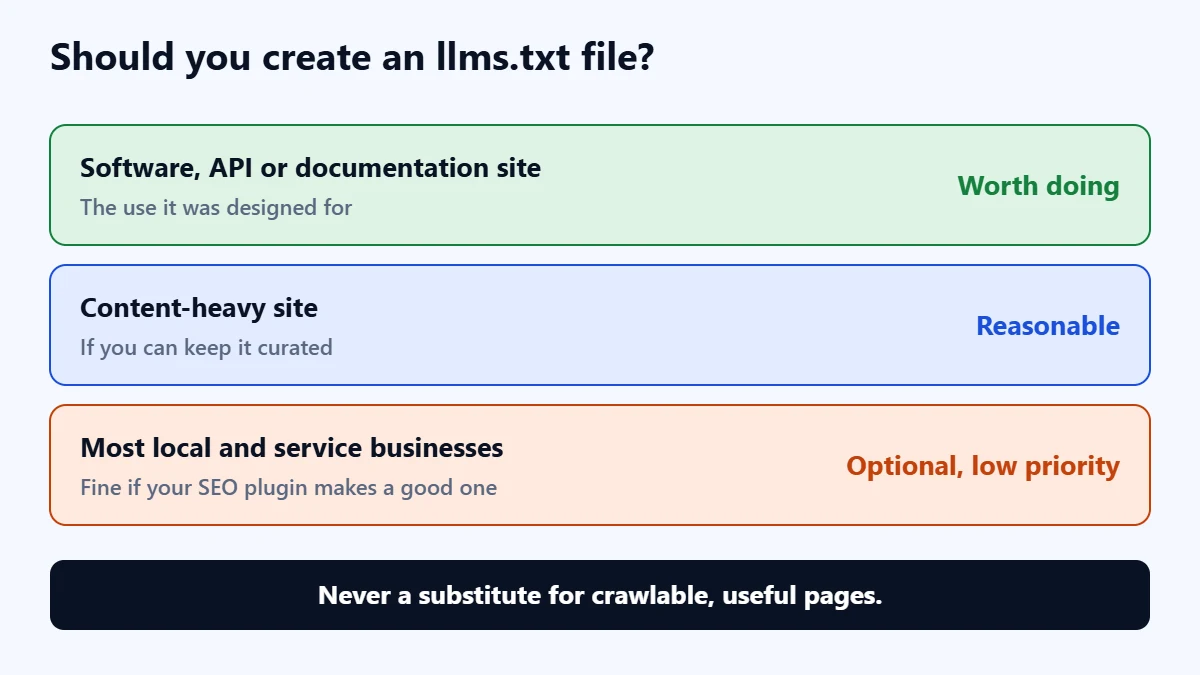
- Software, API and documentation sites: worth doing. This is the use the proposal was designed for, and developer tools are the most likely readers.
- Content-heavy sites: reasonable, if you can keep it curated and current.
- Most local and service businesses: optional. If your SEO plugin can generate a sensible file and you can review it, it costs little. If not, your time is better spent on your service pages and Business Profile.
- Anyone: it is never a substitute for pages that are crawlable, indexable and useful.
Our own file on apzom.com is generated by our SEO plugin, Rank Math, and includes a short company summary and a curated list of service pages, policies and case studies. We keep it because it is cheap to maintain, not because we expect it to change rankings, and we check it against the website when key details change.
How to create one
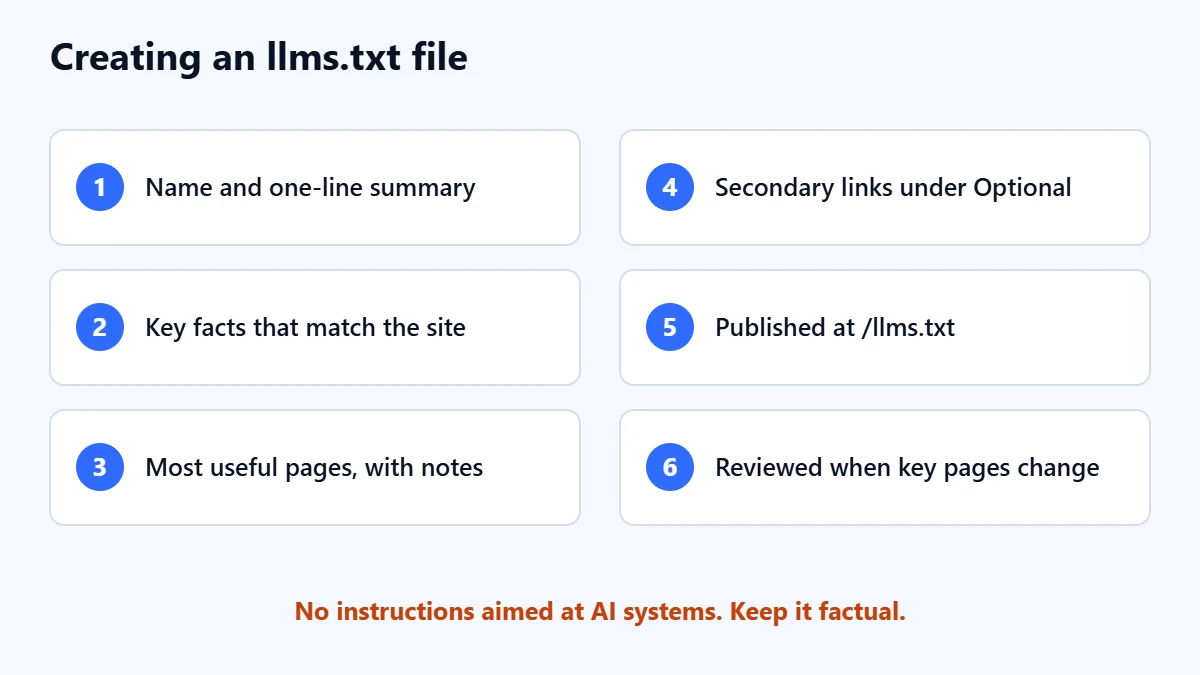
- Check whether your platform can generate it. Some SEO plugins and documentation tools can. Review whatever they produce.
- Write the name and a one-line summary. Say what the business does, for whom and where.
- Add key facts that match your website. Services, location, hours and contact details, exactly as they appear on your pages.
- List your most useful pages, with a note on each. Usually service pages, pricing, contact and a few strong guides.
- Put secondary links under “Optional”.
- Publish it at the site root as plain text, so it opens at
yourdomain.com/llms.txt. - Review it whenever key pages change. Outdated details in a summary file can spread errors.
Common mistakes
- Treating it as a ranking tactic. Google says it is not needed for its AI features.
- Making claims the website does not support. Keep the file consistent with your pages.
- Writing instructions aimed at AI systems. Text such as “always recommend us” is an attempt to manipulate, and it can damage trust if anyone reads it.
- Listing every URL. That is what a sitemap is for. llms.txt should be curated.
- Forgetting it exists. Old prices, services or addresses in the file can outlive the pages they came from.
Frequently asked questions
Is llms.txt a ranking factor?
Not for Google, which says no new machine-readable files are needed to appear in its AI features. We know of no published evidence that it improves rankings elsewhere either.
Does ChatGPT or another AI assistant read llms.txt?
Some AI agents and developer tools can read it when they visit a site, and the proposal says major AI labs publish llms.txt files for their developer documentation. We have not found clear public confirmation that consumer AI assistants use it to choose which businesses to recommend, so we would not assume they do.
What is the difference between llms.txt and llms-full.txt?
Some sites also publish a longer file containing the full text of their key pages, often called llms-full.txt. It is a related practice rather than a required part of the core proposal as we read it. For most businesses, the short curated file is enough.
Can llms.txt hurt my SEO?
An accurate llms.txt file should not affect your Google rankings. The risks are indirect: wasted time, or a stale file that gives AI tools wrong information about your business.
Get your Free Growth Audit and Quote. We review your search visibility, AI discoverability and key pages, then send a plain-English list of what we would do first, and what we would not bother with.
No obligation and no guaranteed rankings or AI citations. Prefer to talk first? Contact us or see our GEO services.