The short answer: Cost per lead is what you pay per click divided by the share of clicks that become leads. So there are only two ways to lower it: pay less per click, or turn more visitors into leads. A third step matters just as much: make sure what you count as a lead is real, or a falling cost per lead can hide worse results. In most accounts the biggest gains come from the landing page, the offer and wasted clicks, not from squeezing bids. Judge every change on cost per qualified lead, not cost per lead alone.
This guide is for business owners and marketers paying for leads through Google Ads, Meta or other channels who want each enquiry to cost less without the quality falling. Platform details follow Google Ads Help as checked in November 2026. Apzom Digital manages paid campaigns, so read this knowing we have an interest. The arithmetic and the checks work wherever you advertise.
What to take from this guide
- Cost per lead has two parts. Cost per click and conversion rate. Find out which one is the problem before changing anything.
- Conversion rate is often the bigger lever. A better page or offer lowers the cost of every lead, whatever you pay per click.
- Cheaper is not always better. A drop in cost per lead that comes from lower-quality leads is not a saving.
- There is no universal good cost per lead. It depends on what a customer is worth to you.
The formula behind cost per lead
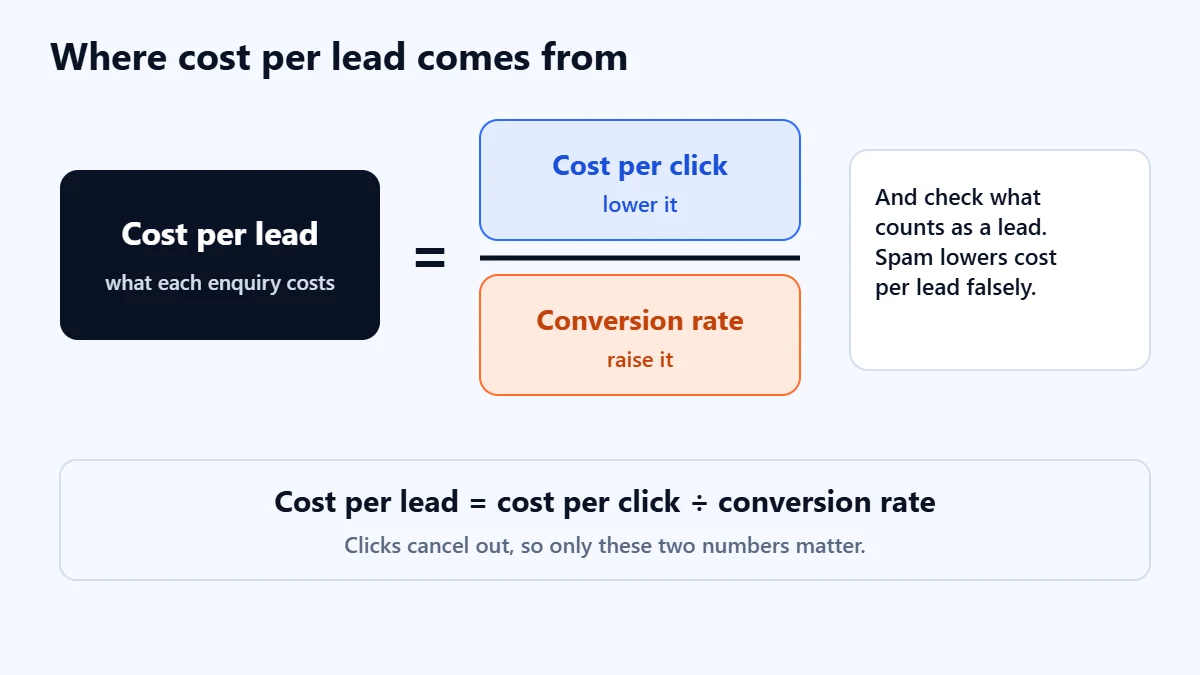
Cost per lead is your spend divided by the number of leads. Because spend is clicks multiplied by cost per click, and leads are clicks multiplied by conversion rate, the number of clicks cancels out:
Cost per lead = cost per click ÷ conversion rate
Here is a hypothetical example. If you pay 4 dollars per click and 5% of visitors enquire, each lead costs 80 dollars. Cut the cost per click to 3 dollars and the lead costs 60. Raise the conversion rate to 8% instead, and the lead costs 50.
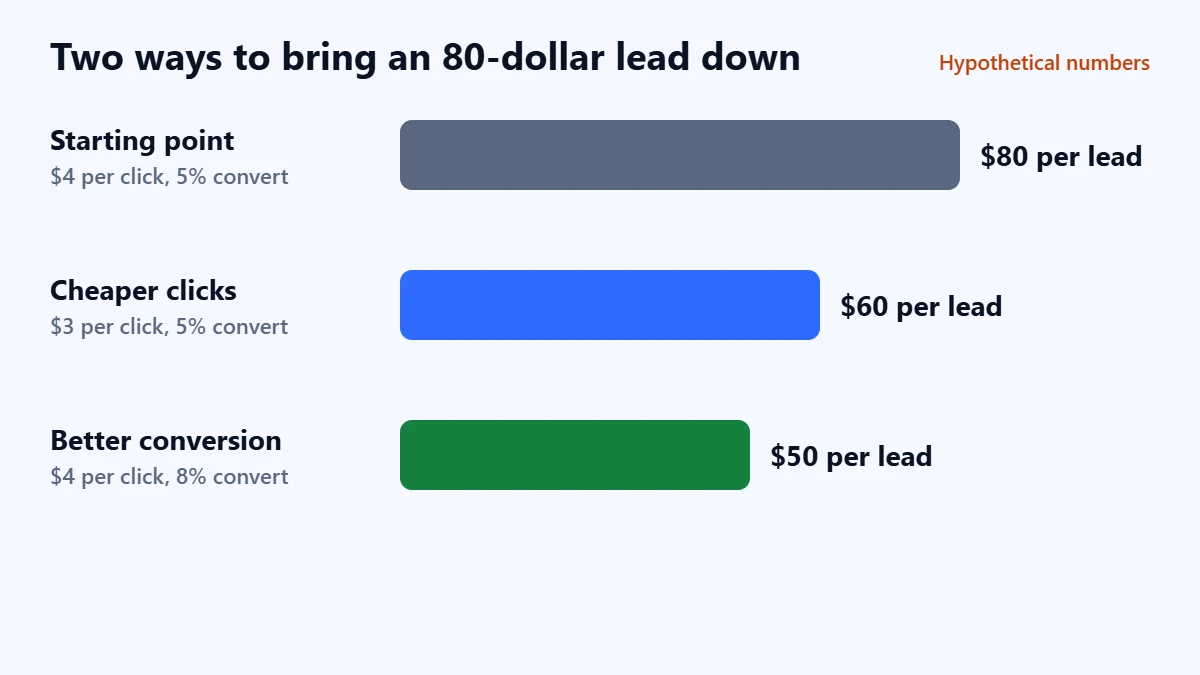
The numbers are invented, but the shape of the arithmetic is not. Small improvements in conversion rate often do more than hard-won reductions in click cost, and they also make every future click worth more.
Step 1: find which side is the problem
- Compare cost per click over time and against your own history. If it has risen sharply, look at competition, targeting and search terms.
- Compare conversion rate by campaign and landing page. If some pages convert far better than others with similar traffic, the weaker pages are your biggest opportunity.
- Check what is being counted. If conversions include spam or duplicate submissions, both cost per lead and conversion rate are misleading. Our guide to improving Google Ads lead quality explains how to clean that up.
Step 2: raise the conversion rate
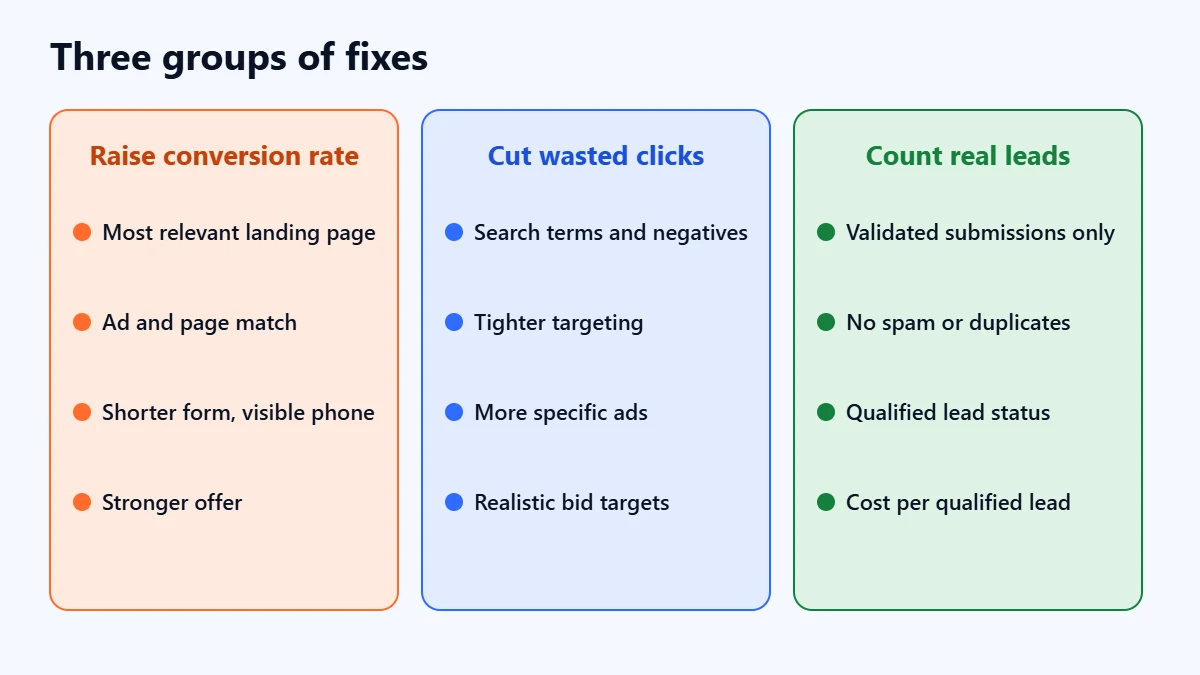
- Send people to the most relevant page. A searcher looking for one service should land on that service’s page, not the home page. Our guide to writing a service page covers what that page needs.
- Match the page to the ad. The promise in the ad should be the first thing the visitor sees.
- Make the next step easy. A short form, a visible phone number and a clear statement of what happens next. Our landing page guide goes into detail.
- Improve the offer. A free site survey, a clear fixed price or a fast quote can lift enquiries more than any design change.
- Fix speed and mobile problems. Visitors who already wanted to contact you should not be lost to a slow or broken page.
Step 3: stop paying for the wrong clicks
- Read the search terms report. Exclude searches that never lead to customers, such as jobs, free or competitor names you do not want.
- Tighten targeting. Location, schedule and audience settings that are too broad bring clicks you cannot convert.
- Improve ad relevance. Google describes Quality Score as a diagnostic tool, not an input in the ad auction, built from expected click-through rate, ad relevance and landing page experience. Use it to find weak keywords, ads and pages, not as a target in itself.
- Be specific in ads. Google notes that a more specific ad can lead to lower click-through rates but higher conversion rates. Fewer, better clicks can lower cost per lead.
Want to know where your leads are getting expensive? Ask for a Free Growth Audit. We look at your click costs, conversion rates, search terms and landing pages, and tell you which lever to pull first.
Step 4: use bidding carefully
With target CPA bidding, Google says you set your desired average cost per conversion, and Google Ads sets bids based on how likely each click is to convert. It is an average, so some conversions will cost more and some less. Google’s lead generation guidance also warns that a target CPA set too low can limit performance. In our judgement, lower the target gradually, after the page and the search terms have improved, rather than forcing the number down first.
When cost per lead should not go down
Sometimes the right move makes cost per lead rise. Adding a qualifying question, removing cheap but poor-quality traffic, or blocking spam can all raise it while improving the business result. That is why the number to watch is cost per qualified lead, and ideally cost per customer. A campaign producing 50-dollar leads that never buy is more expensive than one producing 120-dollar leads that do.
What is a good cost per lead?
We do not quote a benchmark, because published figures mix industries, countries, channels and definitions of a lead. Work it out from your own numbers instead: what a new customer is worth to you over time, and what share of leads become customers. The most you can afford per lead is the value of a customer multiplied by that share, minus the margin you need to keep. Our guide to measuring marketing ROI walks through it.
A 30-day plan
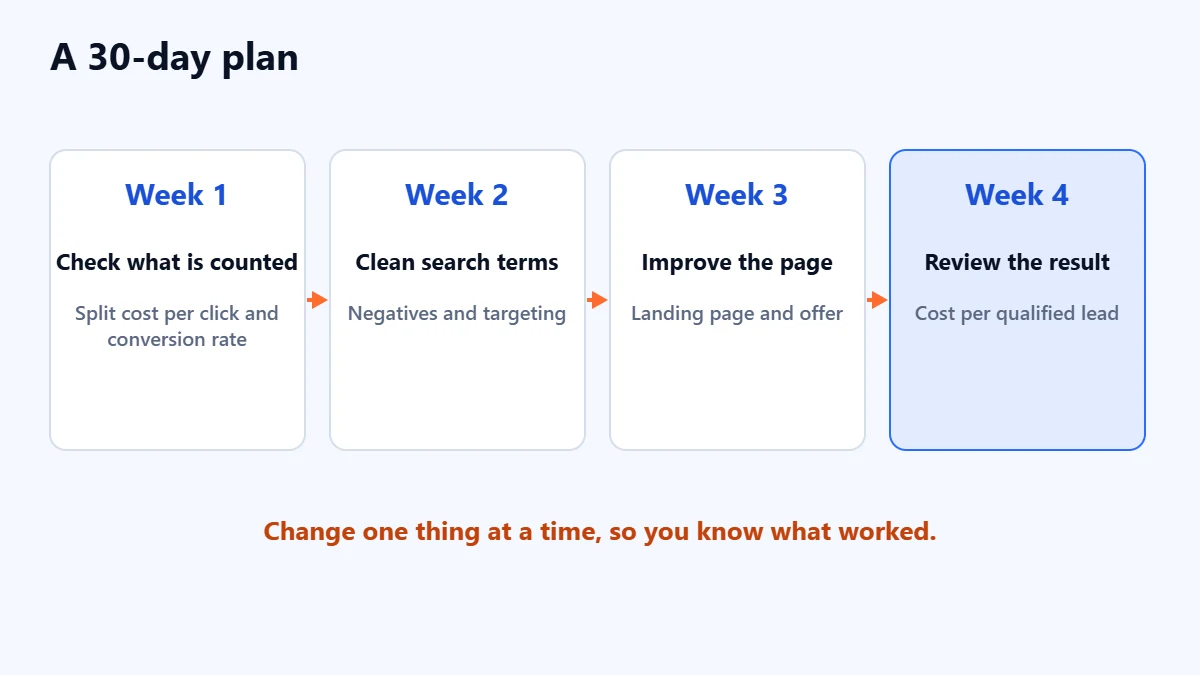
- Week 1: check that conversions are real leads, and split cost per lead into cost per click and conversion rate.
- Week 2: clean up search terms, negatives and targeting.
- Week 3: improve the landing page and offer for your biggest campaign.
- Week 4: compare cost per qualified lead with the starting point, then decide what to change next.
Common mistakes
- Cutting bids first. Lower bids can mean fewer and worse placements without fixing the page.
- Celebrating a lower cost per lead without checking quality. Cheap leads that never buy are not a saving.
- Comparing channels on their own reported numbers. Each platform counts in its own way. Check leads against your own records.
- Changing everything at once. You will not know what worked.
Frequently asked questions
How do I calculate cost per lead?
Divide what you spent by the number of leads in the same period. To see why it changed, split it into cost per click and conversion rate, because cost per lead equals cost per click divided by conversion rate.
Is it cheaper to get leads from SEO than from ads?
Often over time, because there is no charge per click, but SEO still costs money and takes longer to work. Compare channels on cost per qualified lead over the same period, including fees and content costs. Our guide to SEO versus Google Ads explains the trade-off.
Why did my cost per lead suddenly go up?
Check whether the cost per click rose, the conversion rate fell, or tracking changed. A broken form or tag can make it look as though leads collapsed. Our guide to why a website is not generating leads covers how to test the enquiry path.
Will lowering my target CPA reduce cost per lead?
It may reduce the average cost per conversion, but Google warns a target set too low can limit performance, which usually means fewer leads. Improve the page and the search terms first, then lower the target gradually.
Get your Free Growth Audit and Quote. We review your campaigns, tracking and landing pages, then send a plain-English plan for lowering your cost per qualified lead. We will ask for read-only or standard access; you stay the owner.
No obligation and no guaranteed results. Prefer to talk first? Contact us or see our performance marketing service.