The short answer: A good service page answers the questions a buyer would ask before contacting you, in the order they ask them: what the service is, who it is for, where you offer it, how it works, what it costs or how pricing is decided, why they should believe you, and what to do next. Give each main service its own page, with a specific title and headline, real proof and an easy way to get in touch. Write it for the person deciding whether to call you, and it will usually serve search engines too. Google’s own guidance is to write people-first content rather than pages made mainly to rank.
This guide is for owners and marketers of service businesses, from trades and clinics to consultancies and B2B suppliers, who are writing or rewriting the pages that describe what they sell. It follows Google Search Central guidance as checked in November 2026. Apzom Digital writes and builds service pages for clients, so read this knowing we have an interest. You can do all of it yourself.

What to take from this guide
- One page per main service. A single “Services” page listing everything rarely answers anyone’s question well.
- Answer buyer questions in order. Most people want to know whether you do the thing, for them, where they are, before anything else.
- Specific beats impressive. A plain, precise sentence about what you do is more persuasive than claims every competitor also makes.
- Proof must be real. Use named work, genuine reviews and a clear process, never invented figures.
Why each service needs its own page
Someone searching for “commercial roof repair” wants a page about commercial roof repair, not a list of eleven services with a paragraph each. A dedicated page lets you answer that buyer’s specific questions, show relevant proof and use the words they search with. It also gives you a clear page to link to from guides and other pages, which our guide to internal linking for business websites explains.
This does not mean creating near-identical pages for every town you serve. Google’s spam policies describe doorway abuse as pages created to rank for specific, similar searches, and give pages targeted at specific regions or cities that funnel users to one page as an example. Write a separate location page only when you have something genuinely different to say about that place.
The questions a service page must answer
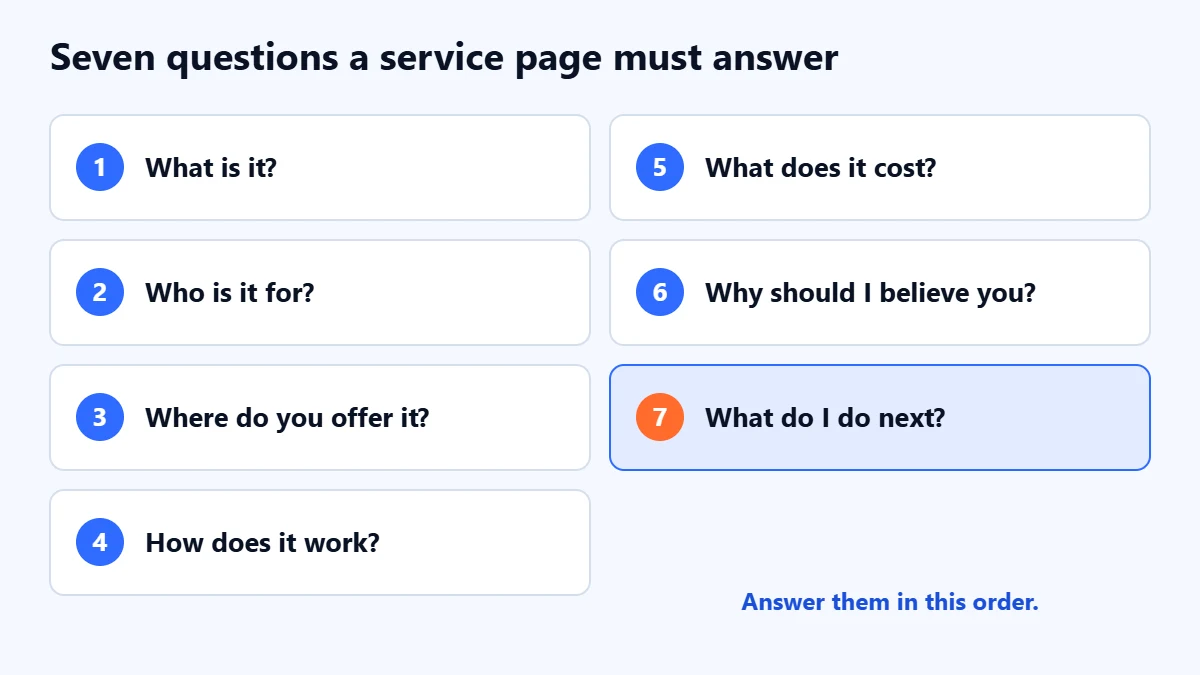
- What is it? Name the service in the words customers use, not internal jargon.
- Who is it for? The type of customer, size of job or situation it suits, and who it does not suit.
- Where do you offer it? Your service area, or that you work remotely.
- How does it work? The steps from first contact to finished job, and how long they usually take.
- What does it cost? A price, a range, or an honest explanation of what the price depends on.
- Why should I believe you? Real work, real reviews, credentials you actually hold, and who does the work.
- What do I do next? One clear next step, with other ways to get in touch.
A structure that works, top to bottom
The layout below is a starting point, not a template to copy word for word. Adapt the order to what your buyers ask first.
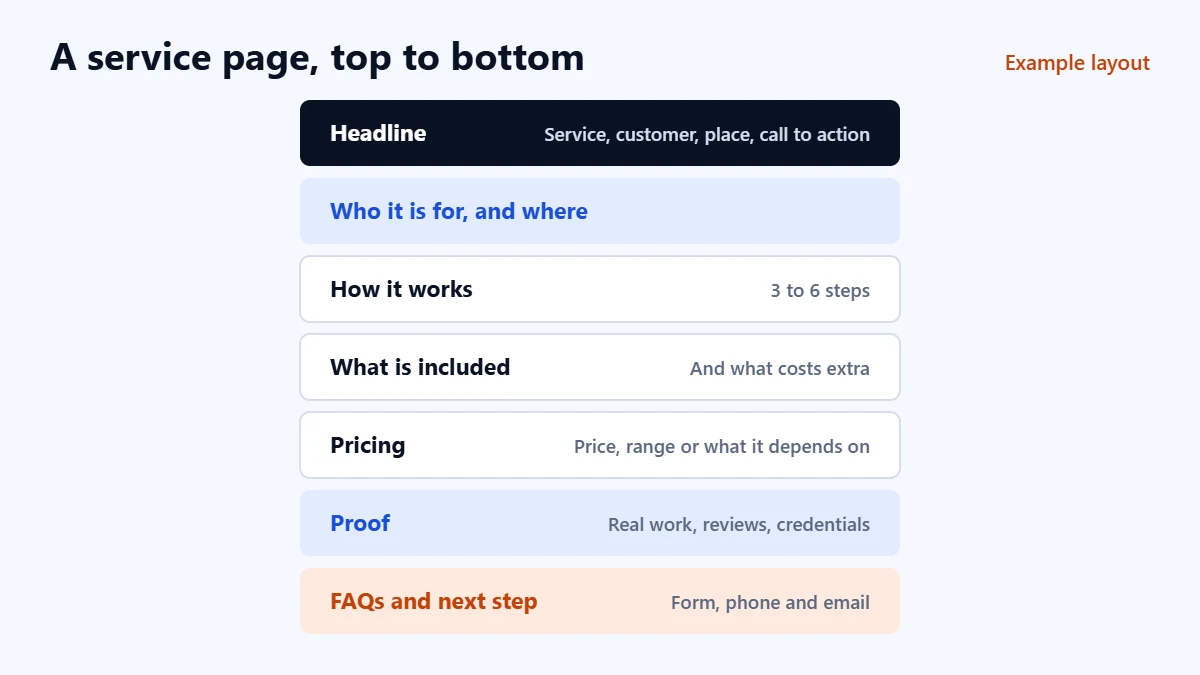
1. Headline and summary
Say what you do, for whom and where, in one line, then add a sentence on what makes the service worth choosing, if you can support it. Put the main call to action and your phone number within easy reach.
2. Who it is for
Describe the customers and situations the service suits. Saying who it is not for builds trust and filters out enquiries you cannot help, which our guide to improving lead quality explains from the advertising side.
3. How it works
Three to six steps from enquiry to completion, with realistic timings. A clear process reduces the uncertainty that stops people getting in touch.
4. What is included, and what is not
List what the customer gets. If common extras cost more, say so. Surprises at the quote stage lose trust and waste both sides’ time.
5. Pricing
If you can publish prices or ranges, do. If every job is different, explain what the price depends on and how you quote. “Contact us for pricing” on its own leaves the buyer with nothing to work with. Our guides to website costs and SEO costs show one way to explain pricing honestly.
6. Proof
Use evidence a stranger could check: named projects you have permission to show, real reviews, photographs of your own work, the qualifications you hold and the people who do the work. If you have little proof yet, describe your process and experience plainly instead. Never invent testimonials, statistics or client results. On our own case studies, we state what each one does not claim.
7. Questions from real conversations
The best FAQs come from your phone calls and emails. Answer the questions people actually ask before buying, such as how soon you can start or whether you work at weekends.
8. The next step
End with one clear call to action, plus a phone number and email. In Nielsen Norman Group’s 2019 research with business professionals, participants expected phone numbers and other contact details, and saw forms as a barrier when offered alone. Say how quickly you reply, and keep the form short. Our guide to why a website is not generating leads covers forms and follow-up.
Want a second opinion on your service pages? Ask for a Free Growth Audit. We review your key pages for clarity, proof, search visibility and the path to an enquiry, and tell you what we would fix first.
Write specifically
The quickest improvement to most service pages is replacing general claims with specific statements. The examples below are hypothetical.
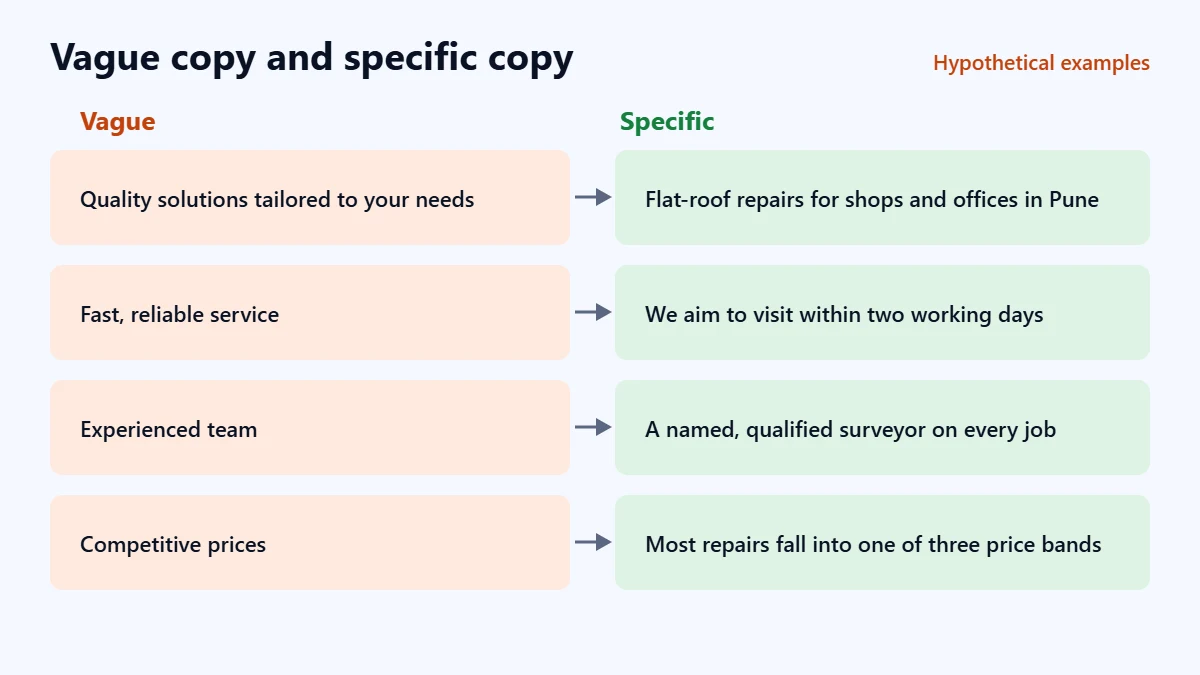
| Vague | Specific |
|---|---|
| Quality solutions tailored to your needs | Flat-roof repairs for shops and offices across Pune |
| Fast, reliable service | We aim to visit within two working days of your call |
| Experienced team | A named, qualified surveyor on every job |
| Competitive prices | Most repairs fall into one of three price bands, explained below |
Only write a specific promise if it is true and you can keep it. A specific claim you fail to meet does more harm than a vague one.
The search basics
- Title: Google recommends descriptive, concise title text and warns against keyword stuffing and repeated boilerplate. “Commercial Roof Repairs in Pune | Company Name” beats a stack of variations.
- Meta description: Google recommends a unique description for each page that accurately describes it, since identical descriptions across a site do not help.
- One clear H1: usually close to the title, naming the service.
- Headings that match questions: they help readers scan and help search engines understand the page.
- Links in from relevant guides: a guide that answers a related question should link to the service that solves it.
- Local details where relevant: your service area and a link to your contact page. Our local SEO checklist covers the rest.
Google’s helpful content guidance asks whether content demonstrates first-hand expertise, has a clear purpose, and leaves readers feeling they have learned enough to reach their goal. Those are good tests for a service page too.
Common mistakes
- Writing about the company instead of the customer. History and values matter less than whether you can solve the reader’s problem.
- Hiding the price completely. Even a range or an explanation helps.
- Using the same text on every service page. Each page should answer that service’s own questions.
- Making the form the only way to get in touch. Add a phone number and email.
- Claims you cannot back up. “Number one” and “best” without evidence are easy to ignore and can damage trust.
A service page checklist
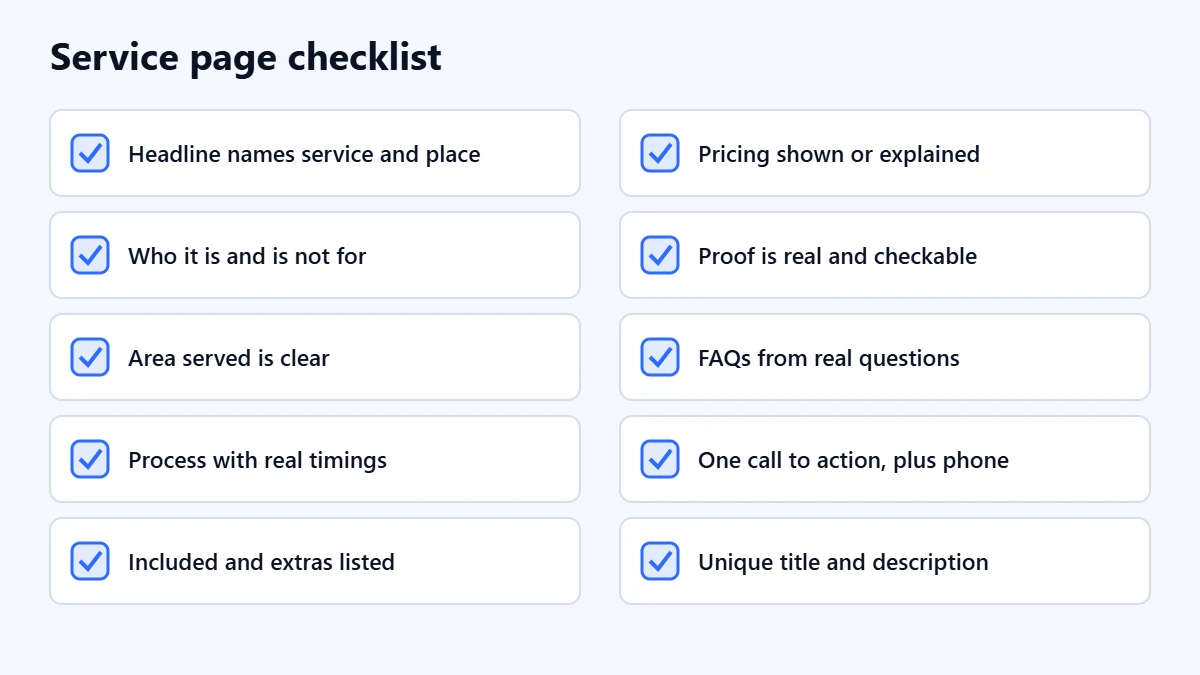
- The headline names the service, customer and place.
- The page says who the service is and is not for.
- The service area, or remote delivery, is clear.
- The process has three to six steps with realistic timings.
- What is included, and what costs extra, is listed.
- Pricing is shown or clearly explained.
- Every piece of proof is real and checkable.
- FAQs come from real customer questions.
- There is one clear call to action, plus phone and email.
- The title and meta description are unique to the page.
Frequently asked questions
How long should a service page be?
Long enough to answer the buyer’s questions, and no longer. A simple, familiar service may need a few hundred words, while a complex or expensive one may need much more. There is no ideal word count. Usefulness matters more than length.
Should I create a page for every city I serve?
Only if each page has something genuinely different and useful to say about that place. Google’s spam policies list city pages that funnel users to one page as an example of doorway abuse. For most local businesses, one strong service page with a clear service area is better.
Should I put prices on my service pages?
If you can, yes, or at least a range or the factors that set the price. Buyers comparing options often look for cost early, and a page with no indication at all gives them little reason to get in touch.
What is the difference between a service page and a landing page?
A service page is a permanent part of your website, found through search and navigation, serving many kinds of visitor. A landing page is usually built for one campaign and one action. Our guide to landing page best practices covers those.
Get your Free Growth Audit and Quote. We review your service pages, search visibility and enquiry path, then send a plain-English list of what we would fix first and what it would cost.
No obligation and no guaranteed results. Prefer to talk first? Contact us or see our content marketing service.