
The short answer: a digital marketing agency for travel agencies and tour operators should help you win bookings you would otherwise lose to big booking sites, and keep those travellers coming back. In travel that means four things. Be visible where people dream and plan, not only where they book. Build trip pages that answer every question a nervous buyer has, including price and financial protection. Answer enquiries fast and turn quotes into bookings. And follow each country’s rules on prices, reviews and package protection. Success is measured in booked trips and margin, not likes or clicks.
This guide is for travel agencies, travel advisors, tour operators, inbound operators and destination management companies (DMCs), and activity and day-tour businesses in any country. It covers how people plan trips, which channels suit which kind of travel business, trip pages that sell, marketplaces and booking platforms, turning enquiries into bookings, the rules that matter by country, and what to measure. Where rules differ by country, we say which country.
Why travel marketing is different
Travel is not an ordinary purchase. Four things make it different:
- People pay a lot, a long time before they travel. A family may pay a large sum months before departure for a trip they cannot see or test. Trust is the real product you are selling until they arrive.
- The research is long and spread out. People move between social media, search, review sites, booking sites, friends’ advice and, more and more, AI assistants before they decide. Few book on their first visit.
- Demand is seasonal and sensitive to events. Holidays, school terms, festivals, weather, exchange rates, visa rules and news all change what people book and when.
- Big platforms sit between you and the traveller. Online travel agencies (OTAs) and activity marketplaces bring real customers, but they charge commission and often keep the customer relationship.
The market is large and competitive. UN Tourism’s World Tourism Barometer (January 2026) counted about 1.52 billion international tourist arrivals in 2025, 4% more than in 2024. Good travel marketing manages all four. It builds trust early, stays present through a long research phase, plans around the season, and uses the big platforms without depending on them.
First, which kind of travel business are you?
“Travel agency” covers very different businesses. The marketing that works for a cruise specialist will not work for a city walking tour. Find your type first.
| Type of business | Who buys | What they need to see | Main marketing jobs |
|---|---|---|---|
| Retail travel agency or travel advisor | Families, couples, older travellers, busy professionals | Expertise, personal service, financial protection, reviews | Local search, referrals, email, expert content |
| Tour operator (multi-day packages) | Travellers who want a planned trip | Day-by-day itinerary, what is included, price, departure dates, protection | Search, trip pages, Meta and YouTube, email |
| Inbound operator or DMC | Overseas travellers and overseas agents | Local knowledge, licences, safety, response speed | International SEO, B2B outreach, trade platforms |
| Activity and day-tour operator | Visitors already at or near the destination | Reviews, photos, time, meeting point, instant booking | Google Business Profile, marketplaces, Things to do |
| Specialist or niche (adventure, pilgrimage, wildlife, luxury, accessible travel) | People with a specific passion or need | Deep expertise and proof you have done it before | Content, communities, search, video |
| Corporate, group and MICE travel | Companies, schools, associations, event planners | Capacity, reliability, duty of care, invoicing | LinkedIn, account-based outreach, case pages |
Most businesses are a mix. A DMC may sell day tours too, and an agency may run its own group departures. Pick the one or two types that bring most of your profit and plan around them.
The trip arc: how travellers decide
The first framework we use with travel clients is the trip arc. Every trip goes through five stages, and your marketing has a different job at each one.
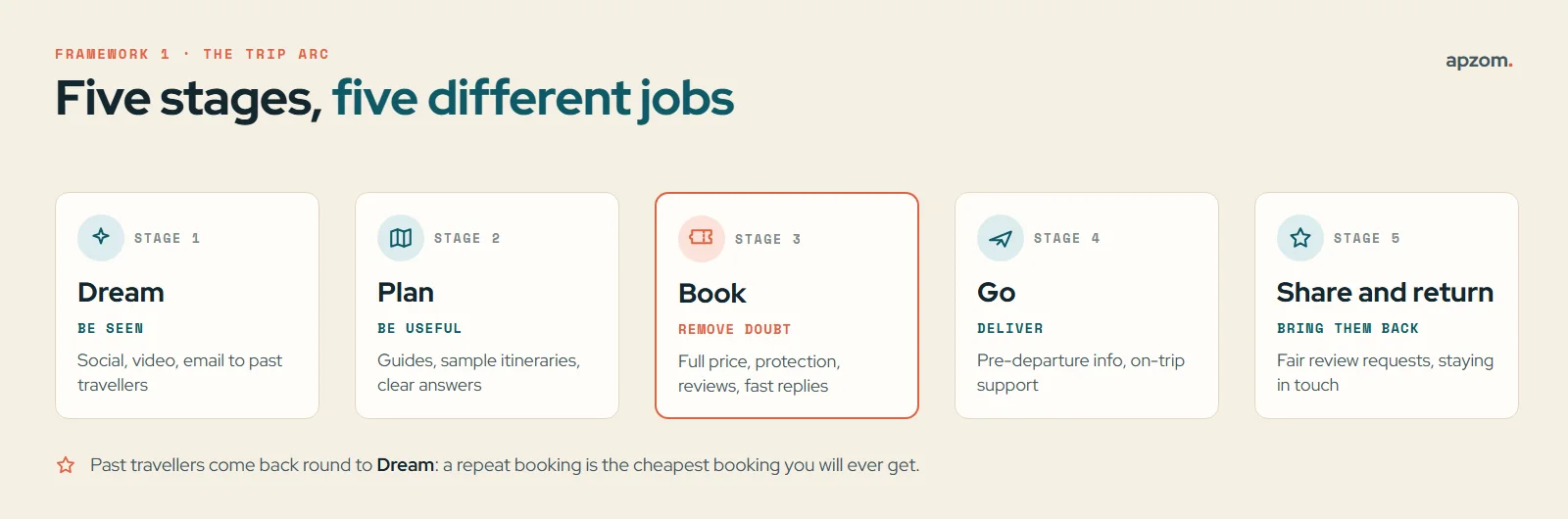
- Dream. Someone gets an idea: a photo, a video, a friend’s story, a festival, a cheaper fare. Your job is to be seen. Social media, video, inspiring guides and email to past travellers work here.
- Plan. They compare destinations, dates, budgets and trip styles. Your job is to be useful. Destination guides, “best time to visit” pages, sample itineraries and clear answers to common questions work here, in search and in AI assistants.
- Book. They choose who to trust with their money. Your job is to remove doubt. Clear prices, what is included, financial protection, reviews, flexible payment and fast replies work here.
- Go. They travel. Your job is to deliver and stay in touch. Pre-departure information, WhatsApp or app updates and on-trip support turn a booking into a story they will tell.
- Share and return. They review, post photos and plan the next trip. Your job is to ask for reviews fairly, stay in touch and make the next booking easy.
Most travel marketing spends almost everything on “Book” with paid ads. The businesses that grow steadily also own a piece of “Dream” and “Plan”, so travellers already know them when it is time to book, and they work hard on “Share and return”, because a past traveller is the cheapest booking you will ever get.
Channels: what fits which travel business
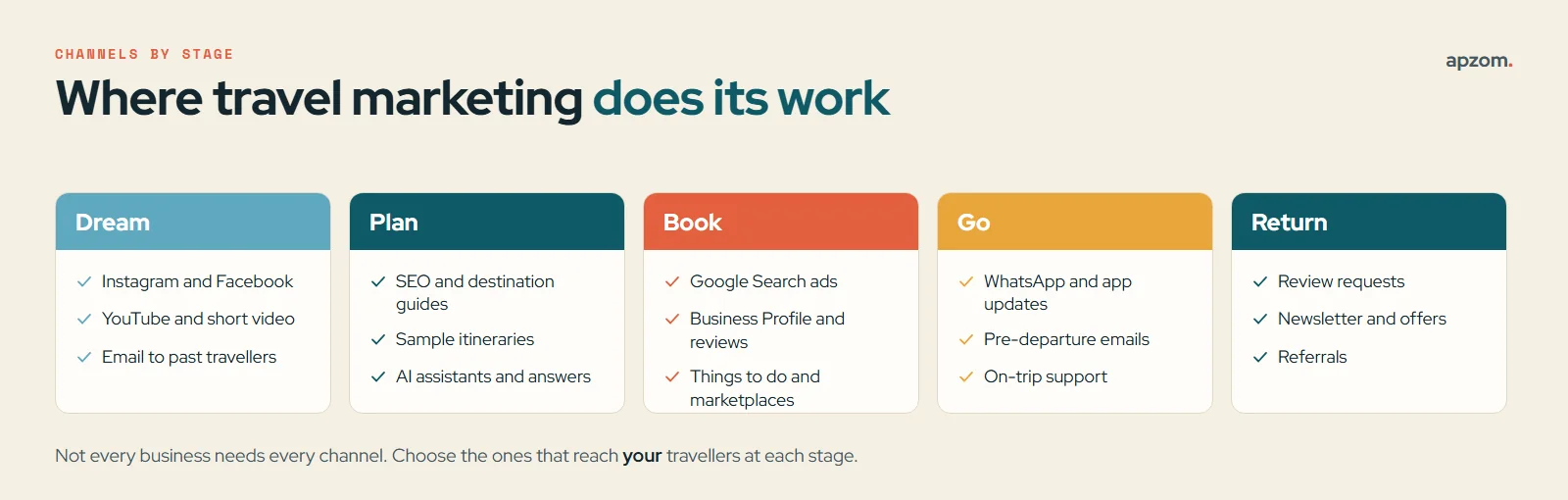
No travel business needs every channel. Here is how they usually fit.
| Channel | Best for | What to watch |
|---|---|---|
| SEO and destination content | Tour operators, specialists, DMCs | Takes months; write from real experience, not copied guides |
| Google Ads (Search) | Agencies and operators with clear trip products | Brand and destination terms get expensive; use negatives and send people to the matching trip page |
| Google Business Profile | Agencies with offices, activity operators | Only for businesses that meet customers in person or serve a local area |
| Google Things to do | Tours, activities and attractions | Google recommends most individual operators join through a connectivity partner, often their booking system |
| Meta (Facebook and Instagram) | Packages, group departures, inspiration | Strong for “Dream”; needs good video and a fast follow-up process |
| YouTube and short video | Specialists, adventure, luxury | Show the real trip; do not use stock clips that oversell |
| Email and WhatsApp | Every travel business | Your cheapest repeat bookings; follow consent rules for each country |
| Marketplaces and OTAs | Activity operators, hotels, new operators | Commission and less control over the customer; use them as one channel, not the only one |
| LinkedIn and outreach | Corporate, MICE, B2B and DMCs | Slow, relationship-led; needs proof and case pages |
Plenty of enquiries, not enough bookings? A Travel Marketing Audit follows a traveller from first search to deposit, and shows where your trip pages, channels and follow-up lose them.
Trip pages that sell
A trip page is your shop window and your sales person. Most travel websites lose bookings here, because the page looks nice but does not answer the questions that stop people paying. The second framework is the trip page test. Before you spend money sending people to a trip page, check it against these eight points.
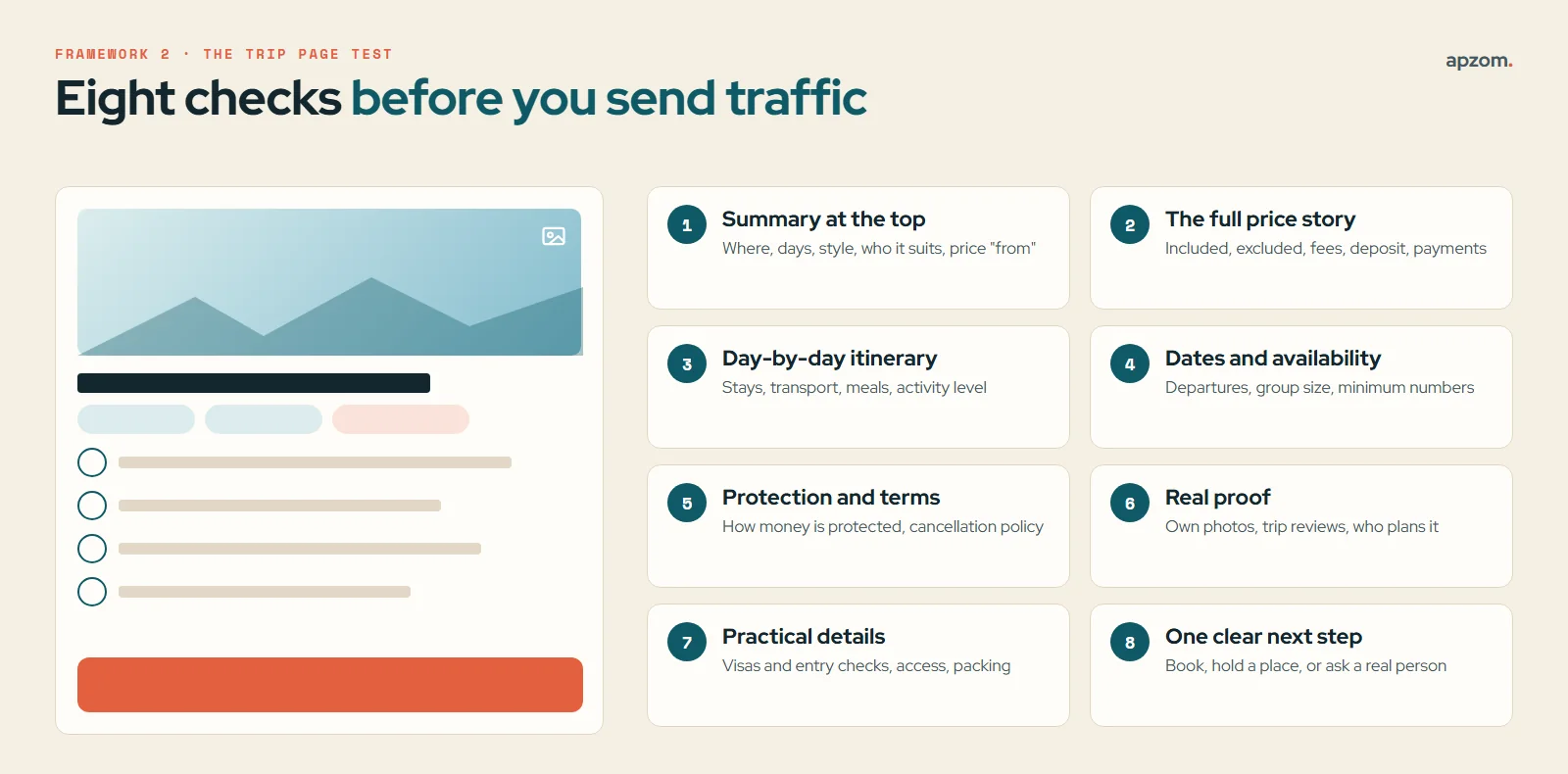
- A clear summary at the top: where, how many days, trip style, who it suits, and the price “from”.
- The full price story: what the price includes and excludes, what is per person and per room, any mandatory fees, and what the deposit and payment schedule look like.
- A day-by-day itinerary: where you sleep, how you travel between places, which meals are included, and how active each day is.
- Dates and availability: departure dates or how to request custom dates, group size, and what happens if a departure does not reach minimum numbers.
- Protection and terms: how the customer’s money is protected in your country (for example, ATOL in the UK for packages with flights), the cancellation policy, and what travel insurance you recommend.
- Real proof: your own photos, reviews that mention this trip, and the experience of the people who plan it.
- Practical details: visas, health and entry requirements to check (with a reminder to confirm with official sources), accessibility, and what to pack.
- One clear next step: book now, hold a place, or ask a question, with a quick way to reach a real person.
A page that passes all eight usually needs fewer back-and-forth emails. It also gives search engines and AI assistants clear, specific facts to quote, which generic “Discover the magic of Bali” pages never do.
Destination pages and guides
Behind your trip pages, build helpful pages about the places you know: when to go, how long to stay, what it costs on the ground, how to get around, and sample routes. Write from your own team’s experience, with your own photos. Google’s guidance on creating helpful content asks whether content shows first-hand expertise, and gives “visiting a place” as an example. In travel, that experience is the one thing copied guides cannot fake.
Marketplaces and booking platforms: use them, do not depend on them
OTAs and activity marketplaces such as Booking.com, Expedia, Viator, GetYourGuide and Klook reach travellers in many countries, and for a new activity operator they can be the fastest way to get bookings and reviews. They also charge commission, set their own rules, and usually keep the customer’s contact details.
The third framework is the platform balance. Treat every platform booking as a first meeting, not a customer for life:
- List where your travellers search, with accurate prices, photos and availability.
- Deliver an excellent trip, because platform reviews also build your name.
- Make your own website the better place to book next time, with a clear reason such as more flexible dates, private options or a direct-booking benefit that follows each platform’s rules.
- Grow your own audience through your website, email and social channels, so a change to one platform’s ranking or commission does not decide your year.
- Track the true cost of each channel, including commission, ad spend and staff time, against the margin on each booking.
Read each platform’s partner terms before you advertise different prices elsewhere. Some contracts have rules about price parity, and the law on parity clauses differs by country.
Turning enquiries into bookings
Many travel businesses get plenty of interest and lose it between the first message and the deposit. The fourth framework is the quote ladder: five steps, and a booking can fall off at each one.
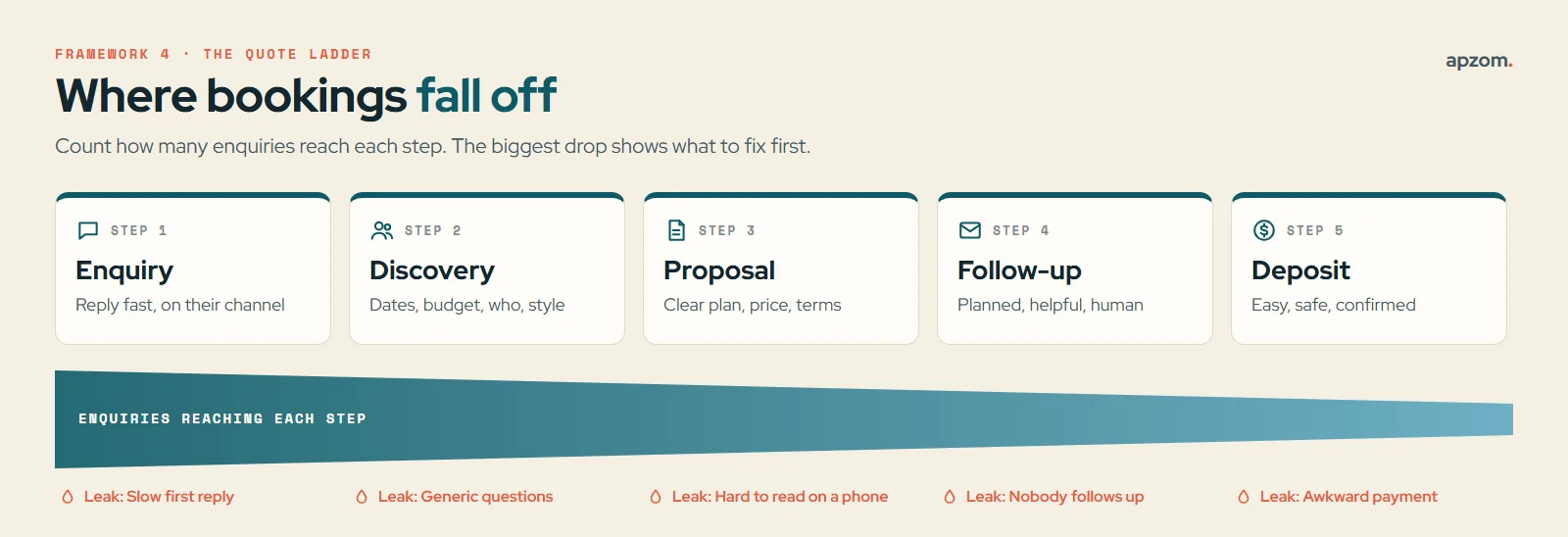
- Enquiry. Reply fast, on the channel the traveller used. Many travellers send the same enquiry to several businesses; the first useful reply often wins.
- Discovery. Ask the questions that shape the trip: dates, budget, who is travelling, travel style, must-haves and deal-breakers.
- Proposal. Send a clear proposal with a summary, a day-by-day plan, what is included and excluded, the price and the payment terms. Make it easy to read on a phone.
- Follow-up. Follow up on a planned schedule, answer objections and offer a call. Many bookings are lost because nobody followed up.
- Deposit and confirmation. Make paying easy and safe, confirm everything in writing, and start the pre-departure journey.
Track how many enquiries reach each step. If many enquiries never get a proposal, the problem is speed or lead quality. If many proposals never convert, the problem is price, trust or follow-up. Ads cannot fix either problem.
Rules to know: protection, prices and reviews
Travel is one of the more regulated areas of consumer marketing, because people pay in advance. Rules change, so check the current wording with the regulator in each country where you sell. These are the areas that most often affect marketing.
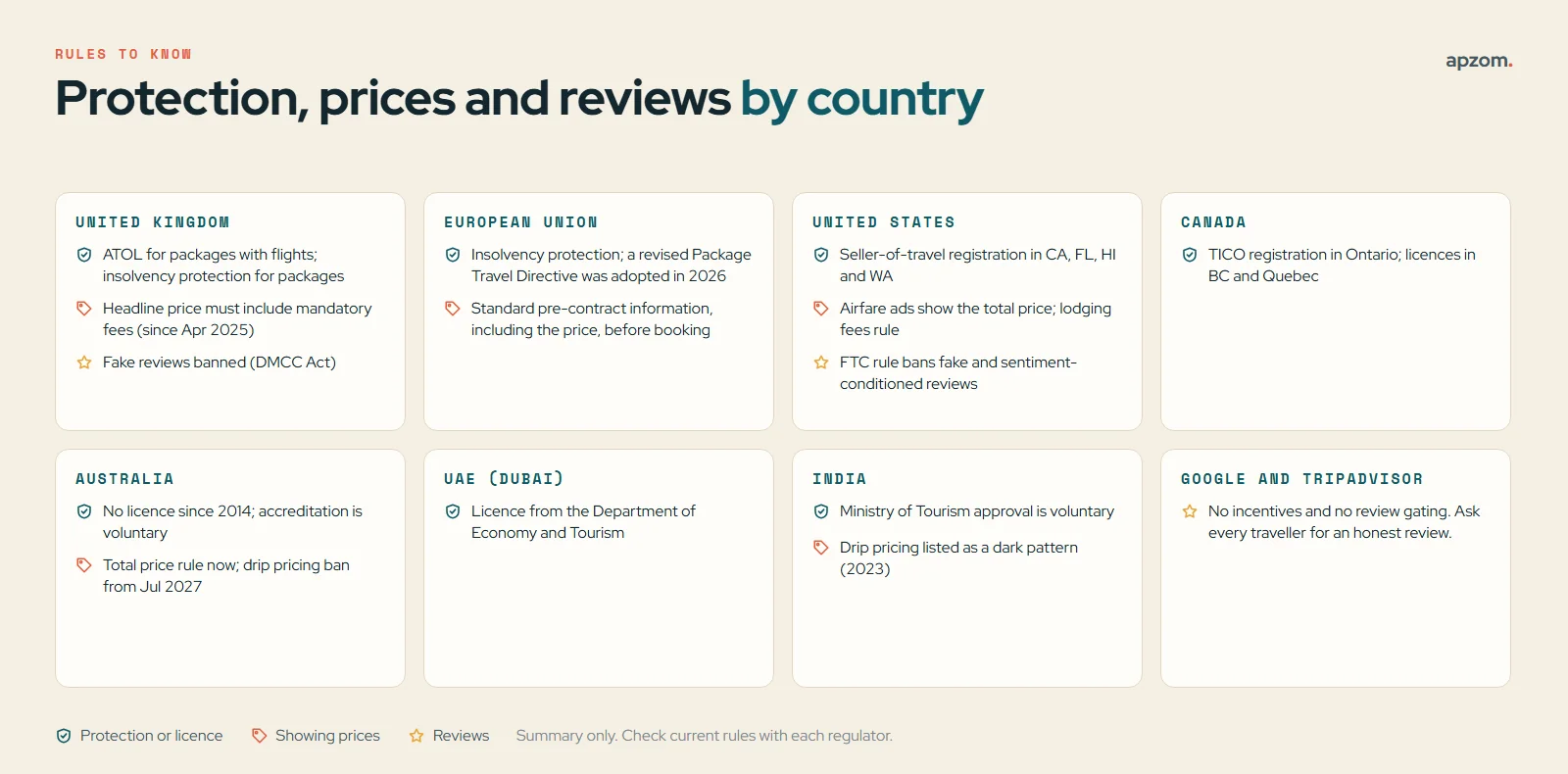
Financial protection and licences
- UK: if you sell package holidays that include flights and you are not an airline or acting in an exempt capacity, the Civil Aviation Authority says you must hold your own ATOL. Under the Package Travel and Linked Travel Arrangements Regulations 2018, package organisers must also protect customers’ money against insolvency; ABTA membership is voluntary, and ABTA’s scheme protects packages that do not include flights. The UK has approved changes to the 2018 rules that take effect on 6 April 2027, including ending “linked travel arrangements”; the insolvency protection duty stays.
- European Union: the Package Travel Directive (EU) 2015/2302 requires organisers to protect travellers against insolvency and to give standard pre-contract information. A revised directive, (EU) 2026/1024, was adopted in April 2026; member states have 28 months to bring it into national law, so check your country’s timetable.
- United States: there is no single national licence for travel sellers. California, Florida, Hawaii and Washington run seller-of-travel registration.
- Canada: travel retailers and wholesalers in Ontario must be registered with the Travel Industry Council of Ontario (TICO). British Columbia requires a licence from Consumer Protection BC, and Quebec a licence from the Office de la protection du consommateur.
- Australia: state licensing of travel agents was repealed from 1 July 2014. Accreditation through the Australian Travel Industry Association (ATIA Accredited) is voluntary.
- UAE (Dubai): tourism businesses, including travel agencies, need a licence from Dubai’s Department of Economy and Tourism. Other emirates have their own authorities.
- India: approval of travel agents and tour operators by the Ministry of Tourism is described by the government as “purely a voluntary scheme”, but it can be a useful trust signal.
If you hold a licence, registration or protection, say so clearly on your trip pages and at checkout, with the number. It is one of the strongest trust signals in travel marketing.
Showing the full price
- US: the Department of Transportation’s full-fare advertising rule (14 CFR 399.84) applies to ticket agents as well as airlines: advertised airfares must show the total price, including government taxes and fees. DOT proposed changes to this rule in July 2026, so check its current status. Separately, the Federal Trade Commission’s rule on unfair or deceptive fees, in force since 12 May 2025, covers short-term lodging such as hotels and vacation rentals, including when travel agents advertise them. It does not cover tours or packages, which are still subject to the general ban on deceptive advertising.
- UK: since 6 April 2025, the Digital Markets, Competition and Consumers Act 2024 requires headline prices to include all mandatory fees. Leaving them out (“drip pricing”) breaks the Act’s rules on material information.
- India: the Central Consumer Protection Authority’s guidelines on dark patterns (30 November 2023) list “drip pricing” among 13 prohibited practices.
- Australia: the Australian Consumer Law already requires a single total price where you advertise part of a price, and the ACCC has taken airlines to court over drip pricing. A specific ban on drip pricing, under the Unfair Trading Practices Act 2026, starts on 1 July 2027.
Reviews
- US: the Federal Trade Commission’s rule on consumer reviews and testimonials, in force since 21 October 2024, bans fake reviews and incentives that depend on whether a review is positive or negative.
- UK: since 6 April 2025, fake reviews are banned outright under the DMCC Act.
- Google counts incentivised reviews as fake engagement, and treats asking only happy customers for reviews (review gating) as rating manipulation.
- Tripadvisor lets businesses ask all guests for reviews, but not offer incentives or ask only selected guests.
Ads for visas and travel documents
If you help travellers with visas or electronic travel authorisations, check Google Ads policy first. Google only lets certified government bodies and authorised providers advertise ESTA and visa services, and it has enforced a tighter definition of “authorised provider” since 5 October 2026. Meta has no special ad category for travel, but its general ad policies still apply.
The safe habit everywhere: ask every traveller for an honest review after the trip, never pay or reward people for reviews, and never hide or filter negative ones.
Measure bookings and margin, not clicks
Travel marketing reports are often full of reach, clicks and “leads”. The fifth framework is the booking scorecard. It asks three questions every month.
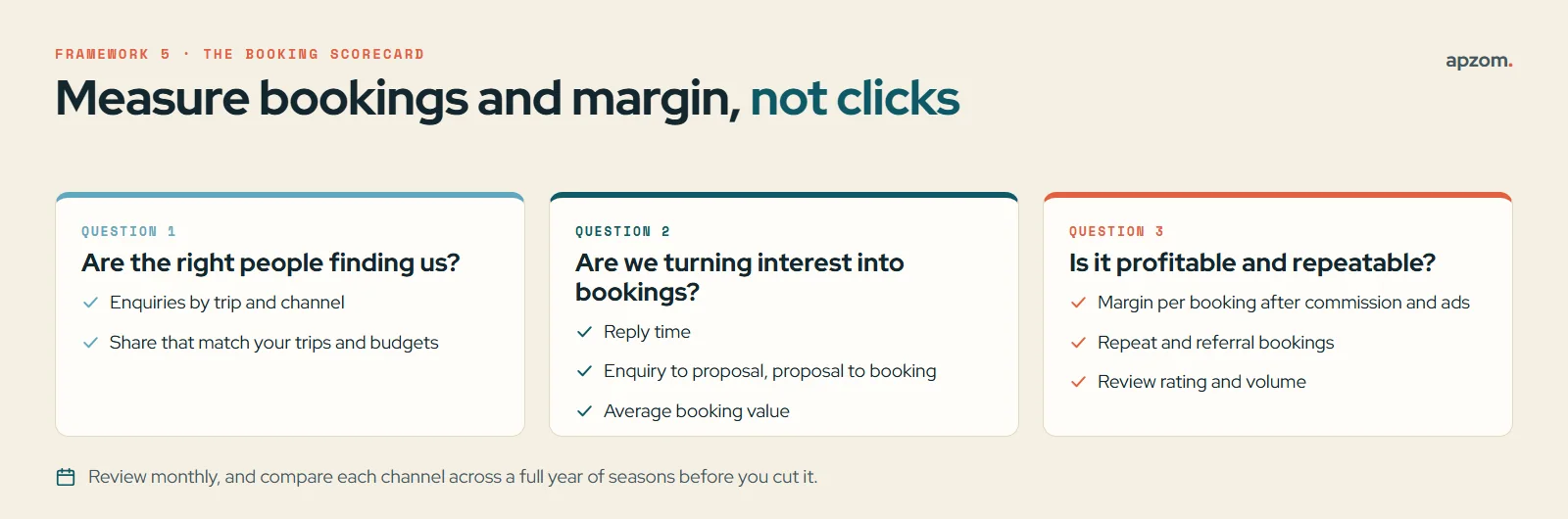
| Question | Measures |
|---|---|
| Are the right people finding us? | Enquiries by trip and channel; share of enquiries that match your trips and budgets |
| Are we turning interest into bookings? | Reply time; enquiry-to-proposal rate; proposal-to-booking rate; average booking value |
| Is it profitable and repeatable? | Margin per booking by channel after commission and ad costs; repeat and referral bookings; review rating and volume |
Set up tracking so a booking can be traced back to its first channel: a booking engine or CRM, call tracking where you take phone bookings, and consistent tags on links. Judge each channel on cost per booking and margin, and look at seasonality across a full year before you cut a channel.
AI search and travel planning
More travellers now ask AI assistants to suggest destinations, compare options and draft itineraries. In the UK, ABTA’s Holiday Habits report (October 2025, 2,001 adults) found that 8% used AI for holiday inspiration, up from 4% the year before, while internet searches (48%) were still the most common way people chose a destination. Nobody can guarantee that an AI tool will mention your business. What you can do is make your information easy to find, read and trust:
- Publish specific facts on your own website: real itineraries, what is included, prices “from”, departure dates, group sizes and protection details.
- Keep your Google Business Profile, marketplace listings and review profiles accurate and consistent.
- Answer real traveller questions in plain language on your trip and destination pages.
- Show who plans your trips and what experience they have.
Our guide to generative engine optimization (GEO) explains how AI search tools choose sources, and what is myth.
What a travel marketing agency should actually do
Whoever you hire, a good travel marketing partner should:
- Start by learning your trips, margins, seasons and the countries you sell to, before proposing channels.
- Fix your trip pages, tracking and enquiry process before raising ad spend.
- Plan campaigns around booking windows, not just the date the trip happens.
- Know the protection, pricing and review rules in your markets, and keep your ads inside them.
- Report bookings and margin by channel, not just clicks and reach.
- Leave you owning your website, ad accounts, data and email list.
Our guide on how to choose a digital marketing agency has the questions to ask any agency before you sign. If you are weighing search ads against organic search, see SEO vs Google Ads. Hotels have different needs: see our guide for hotels.
How Apzom can help
Apzom Digital helps travel businesses get found, trusted and booked. That means SEO and destination content, Google Ads, Meta ads, social media marketing, email marketing, website development with trip pages built to pass the trip page test, and tracking that follows an enquiry through to a booking. We work with clients worldwide, remotely, from our base in Ahmedabad, India.
We have not published a travel case study yet, so we will not show you one. Our case studies page shows the website, search and lead generation work we have done for other businesses. We will not promise a number of bookings or rankings. We will show you where your current marketing loses travellers and what to fix first.
Request a Travel Marketing Audit. We review your trip pages against the trip page test, your search and social channels, marketplace listings, enquiry handling and tracking. You get a prioritised list of what to fix first, for the markets you sell to.
No obligation and no guaranteed booking numbers. Prefer to talk first? Contact us or see all our services.
Frequently asked questions
What is the best way to market a travel agency?
Pick the trips and travellers that bring you the most profit, then build trip pages that answer every question, including price and protection. Add search and social channels that reach those travellers at the dream, plan and book stages. Reply to enquiries fast, follow up properly, and stay in touch with past travellers, who are your cheapest future bookings.
How do tour operators get more direct bookings?
Make your own website the easiest and most trusted place to book: clear prices and terms, a day-by-day itinerary, protection details, real reviews and a simple booking process. Use marketplaces to reach new travellers, then give them good reasons to book with you directly next time, within each platform’s terms.
Is SEO worth it for a travel business?
Usually, if you have trips or destinations you know well and can write about from real experience. Travel SEO is competitive, so focus on specific trips, regions and traveller needs rather than broad terms such as “holidays”. It takes months, so pair it with paid search or social ads while it grows.
Should a small tour operator use Viator or GetYourGuide?
They can bring bookings and reviews quickly, especially for day tours and activities. Both charge commission per booking, and the rate varies by destination, category and supplier, so read the commission and cancellation terms first, keep your own website and Google Business Profile strong, and treat the marketplace as one channel among several.
Are Facebook and Instagram ads good for travel businesses?
They work well for inspiration and for selling group departures and packages with strong photos and video. They work best when you follow up enquiries quickly and judge the ads by bookings, not likes.
Do I need to show financial protection on my website?
If you sell packages, the rules in many countries require you to protect customers’ money, and showing that protection clearly is also one of the strongest trust signals you have. Check the exact rules with the regulator in each country where you sell.
How far ahead should travel businesses advertise?
It depends on the trip. Long-haul and peak-season trips are often booked months ahead, while day tours are often booked close to the date or at the destination. Use your own booking data to see the gap between booking and travel, and plan campaigns around it.
Can Apzom work with travel businesses outside India?
Yes. We work with clients worldwide, remotely, from our base in Ahmedabad, India, and plan marketing around the travellers, search habits and rules of each market you sell to.