
The short answer: a website can cost almost nothing or a great deal, because “a website” covers everything from a one-page profile on a builder plan to a custom online store linked to your stock and accounts systems. The price depends on five things: the platform, the design, the content, the features and integrations, and the care the site gets after launch. The honest way to budget is to decide what the website has to do for your business, list the pages and features that job needs, and compare quotes on the same scope, including the running costs for the next three years, not just the launch price.
This guide is for business owners and marketers in any country who are planning a new website or a rebuild. It explains what you are actually paying for, the main types of website and how they differ in cost, builder plans versus a custom build, the running costs people forget, how to compare quotes fairly, and the questions to ask before you sign. Where rules or taxes differ by country, we say which country. We do not quote typical agency prices, because there is no reliable public survey of them; we explain how prices are built instead, so you can judge any quote you get.
What you are actually paying for
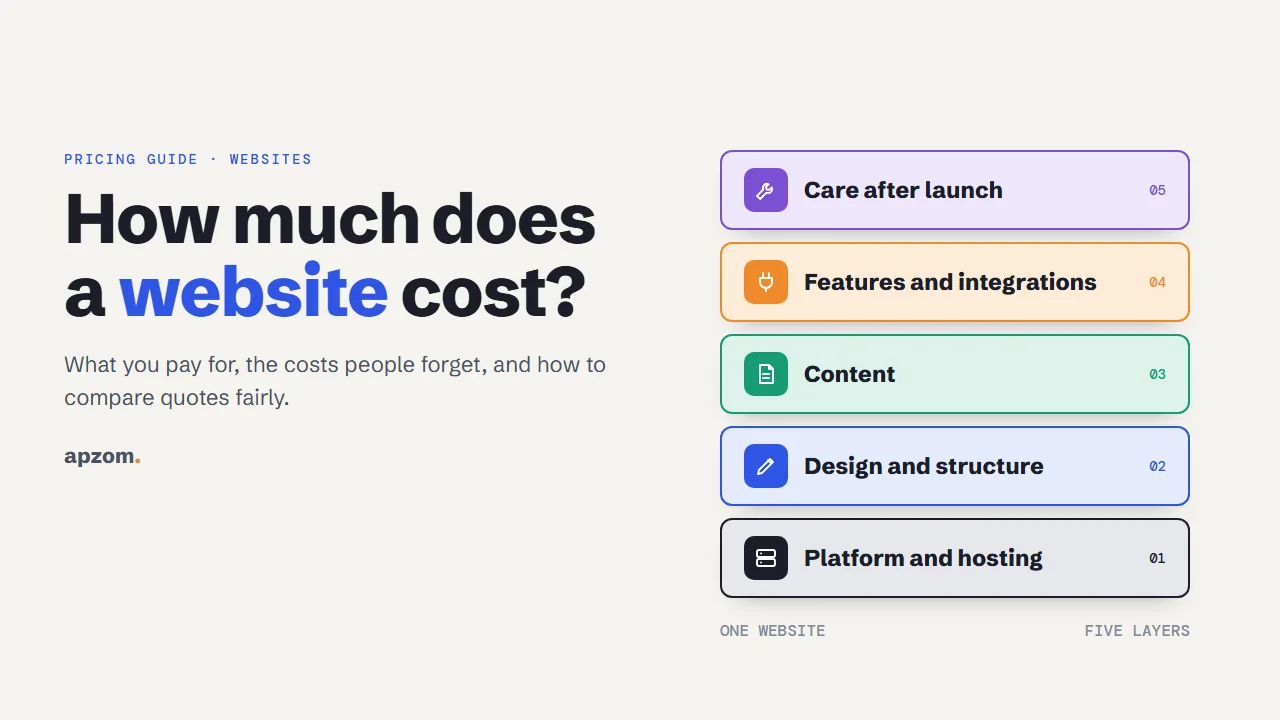
Every website quote, however it is presented, is made of the same five layers. The first framework in this guide is the website cost stack.
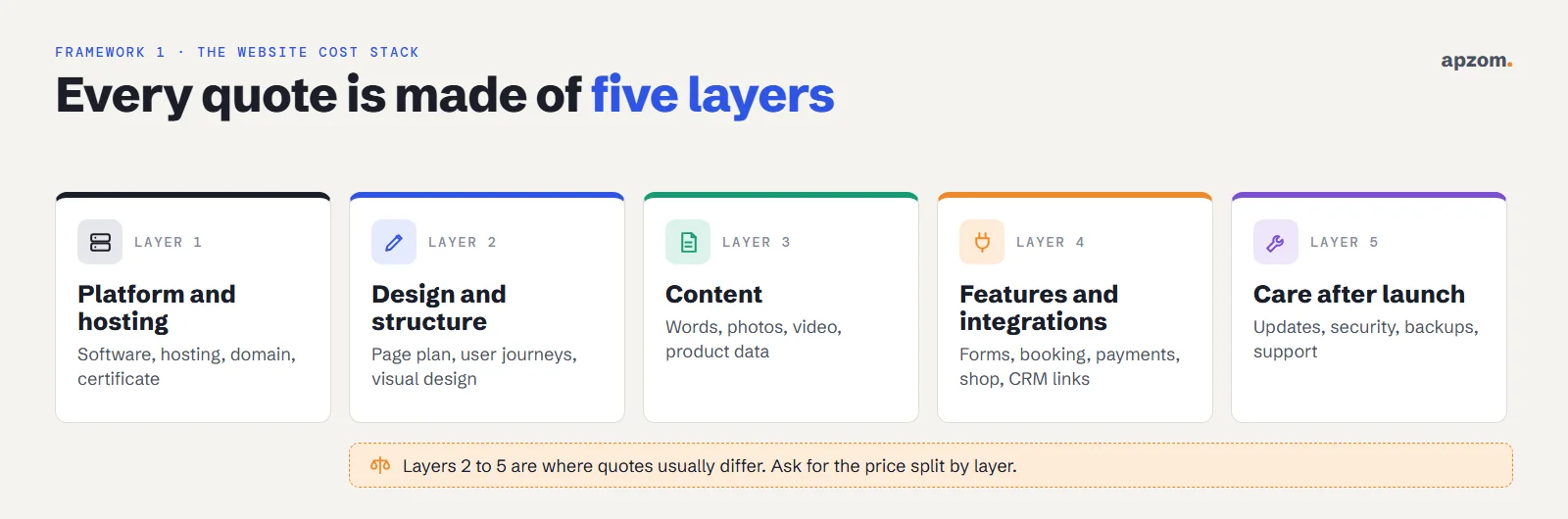
- Platform and hosting. The software the site runs on, where it is hosted, the domain name and the security certificate. This can be a monthly builder plan or open-source software on hosting you choose.
- Design and structure. Planning the pages, how visitors move through them, and the visual design. A template adapted to your brand costs less than a design made for you from scratch.
- Content. The words, photos, video and product data. This is the layer most often left out of quotes, and the one that most often delays launches.
- Features and integrations. Forms, booking, payments, a shop, member areas, multiple languages, and links to your CRM, stock, accounts or booking systems. Each one adds build and testing time.
- Care after launch. Updates, security, backups, hosting renewals, fixes, small changes and support. This continues for as long as the site exists.
When two quotes are very different, the difference is almost always in layers 2 to 5. Ask each provider to break their quote into these five layers, and the comparison becomes much easier.
The main types of website
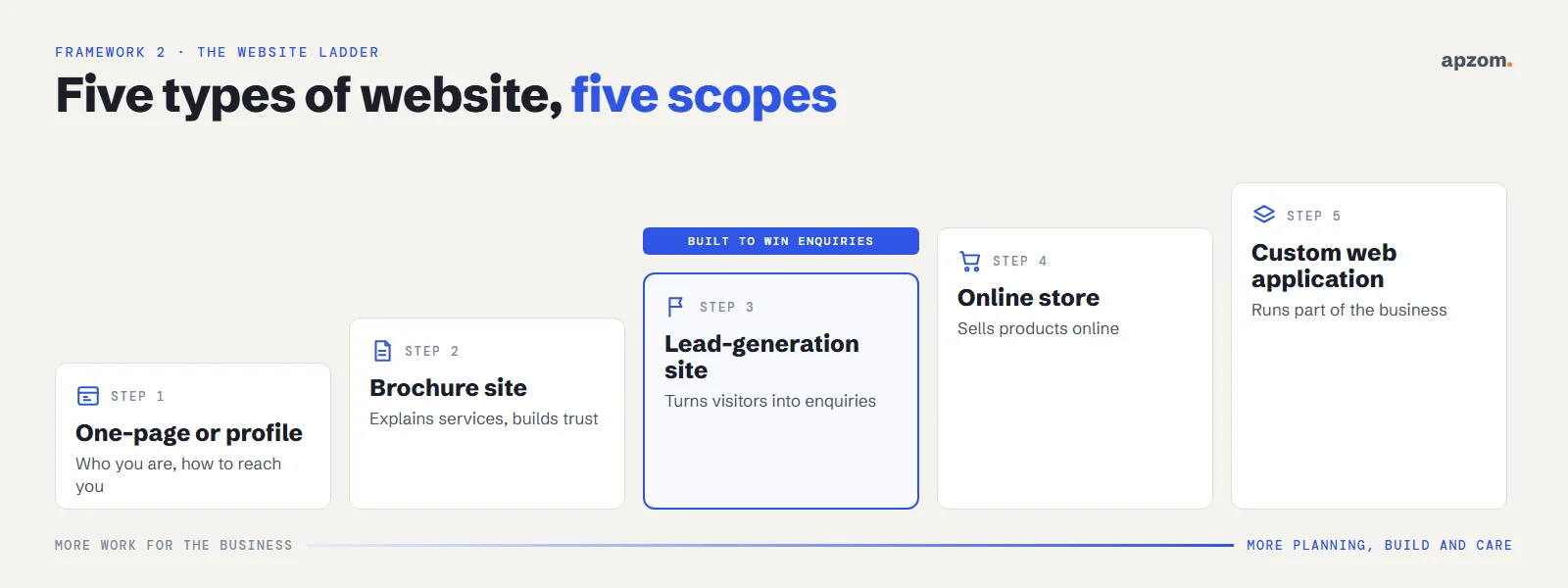
The second framework is the website ladder. Each step up does more work for the business, and needs more planning, building and care.
| Type of website | What it does | Typical features | What drives the cost |
|---|---|---|---|
| One-page or profile site | Says who you are and how to contact you | One page, contact details, a simple form | Mainly the platform and your time |
| Brochure site | Explains your services and builds trust | 5 to 15 pages, about, services, contact, basic SEO | Design, content and the number of page types |
| Lead-generation site | Turns visitors into enquiries | A page per service and location, forms, tracking, case studies, a blog | Structure, copywriting, tracking and conversion work |
| Online store | Sells products online | Catalogue, filters, product pages, cart, checkout, payments, shipping and tax rules | Catalogue size, product data, payments, integrations |
| Custom web application | Runs part of the business: portals, bookings, quotes, dashboards | User accounts, databases, custom logic, integrations | Custom development, testing and security |
Most businesses need the brochure or lead-generation step. A lead-generation site usually costs more than a brochure site because it needs more pages, better copy and proper tracking, but it is also the one that pays for itself. If you sell online, the store step brings its own costs: product data, payment set-up and shipping rules take real time.
Website builder or a custom build?
Website builders such as Wix, Squarespace, Shopify and WordPress.com let you build a site yourself for a monthly or yearly plan. Open-source software such as WordPress (the free software from wordpress.org) runs on hosting you choose, and a designer or developer builds the site for you.
Builder prices change and differ by country, and most builders show prices in your local currency. As examples, here is what the official pricing pages showed on 13 October 2026, for plans billed yearly:
| Builder | What the pricing page showed | Notes |
|---|---|---|
| WordPress.com | Personal $4, Premium $8, Business $25, Commerce $45 a month (US dollars) | Billed every 12 months, excluding taxes |
| Wix | Light $17.77 up to Business Elite $159.77 a month (US dollars) | Wix says “prices and currency vary by location” |
| Shopify | Basic ₹1,499 a month (viewed from India) | Shown in local currency; a 3-day free trial, then an introductory offer that varies by country |
Treat these as a starting point, not the full cost: paid apps, themes, payment fees and your own time come on top.
| Factor | Website builder plan | Custom build on open-source software |
|---|---|---|
| Upfront cost | Low: a plan, a template and your time | Higher: planning, design, build and testing |
| Ongoing cost | Plan fee every month or year, plus apps and add-ons | Hosting, domain, premium plugin licences and maintenance |
| Control | Limited to what the builder allows | Full control of code, design and data |
| Moving later | Can be hard; some content may not export cleanly | Easier to move hosts or developers |
| Best for | Simple sites, testing an idea, very small budgets | Lead-generation sites, growing businesses, custom needs |
Neither is right for everyone. If your budget is very small and your needs are simple, a builder plan is a sensible start. If the website has to win enquiries in a competitive market, connect to other systems, or grow over years, a custom build on open-source software usually gives you more for the money over time.
The running costs people forget
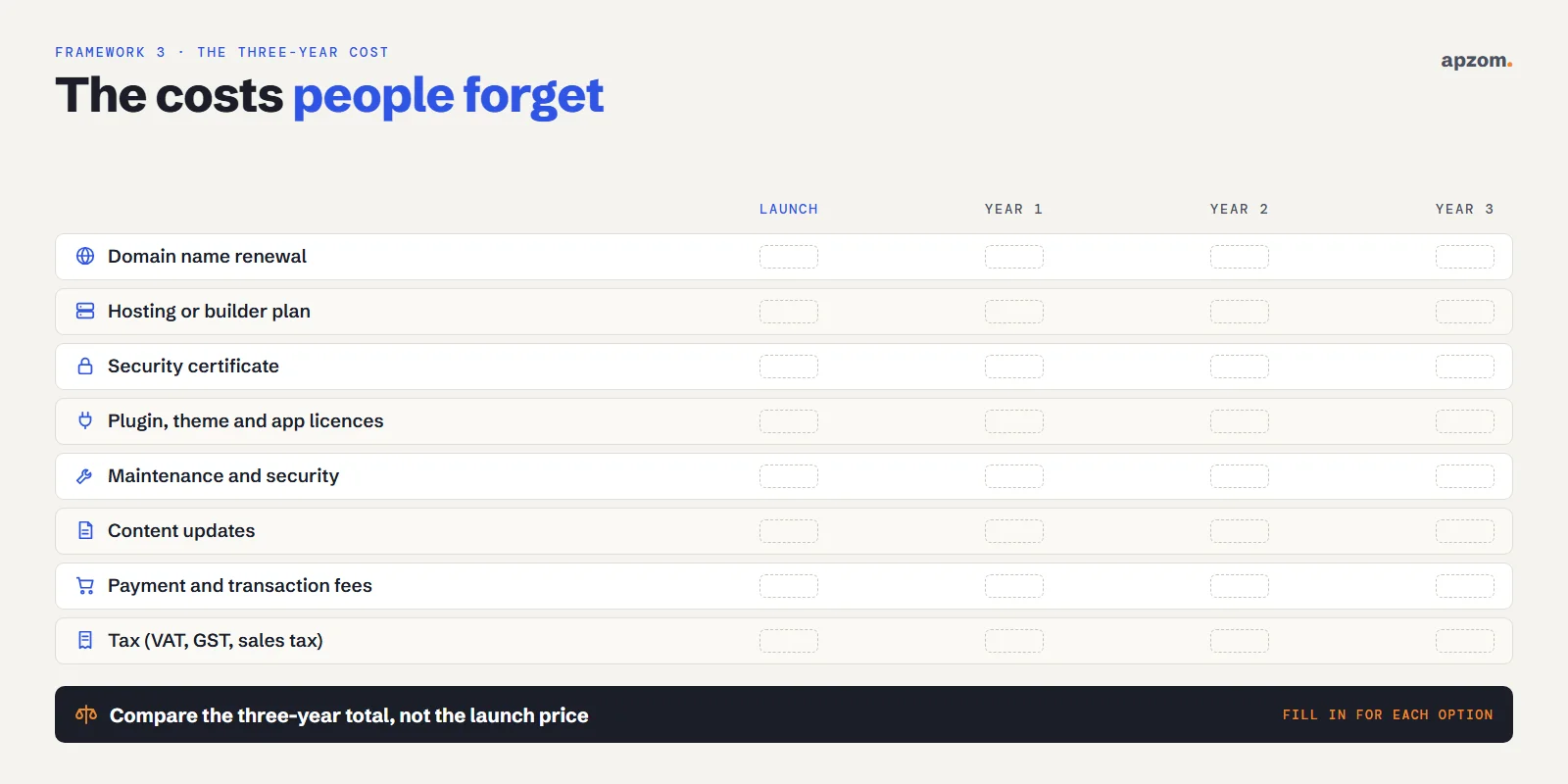
The launch price is only part of the cost. The third framework is the three-year cost: add up what the website costs to launch, plus what it costs to run for three years, before you compare options.
- Domain name. Renewed every year. Registrars set their own retail prices; ICANN, which coordinates domain names, says it is not a price regulator. For .com, the wholesale price the registry Verisign charges registrars is $10.26 a year, rising to $10.97 on 1 November 2026, and registrars add their margin on top. First-year offers are often cheaper than the renewal price.
- Hosting or builder plan. Monthly or yearly. Cheap shared hosting can be slow; good managed hosting costs more but often saves time.
- Security certificate. Many hosts include one; free certificates are available from Let’s Encrypt, a non-profit certificate authority.
- Premium plugins, themes and apps. Many are sold as yearly licences. For example, Yoast SEO Premium, a popular WordPress SEO plugin, is listed at $118.80 a year excluding VAT on its official site.
- Maintenance. Software updates, backups, security monitoring and fixing what breaks. Someone has to do it, whether that is you, a freelancer or an agency.
- Content updates. New pages, photos, offers and blog posts. A website that never changes slowly loses its value.
- Payment and transaction fees. For online stores, payment processors charge per transaction. Shopify, for example, adds its own transaction fee on payments taken through a third-party payment provider (2% on the Basic plan, as listed on its pricing page), on top of that provider’s own fees.
- Tax. Quotes may or may not include sales tax, VAT or GST. Ask, especially when you buy from a provider in another country.
A simple worksheet helps: list each of these costs for year one, year two and year three, for each option you are considering. The cheapest launch price is often not the cheapest three-year cost.
What makes a website cost more or less
These factors push the price up or down, whatever the country:
- Number of page types, not just pages. Ten service pages built from one template cost far less than ten different layouts.
- Who writes the content. Professional copywriting and photography cost money, but missing content is the most common reason launches slip.
- Custom design versus a template. A design made for you takes longer than adapting a well-built theme.
- Integrations. Each link to a CRM, booking system, stock system or accounting tool needs building and testing.
- Languages and countries. Each language adds translation, checking and technical set-up for international SEO.
- Speed, accessibility and SEO done during the build. Doing them properly at the start costs a little more and saves a rebuild later.
- Moving an existing site. A redesign of a site that already ranks needs a redirect plan to protect its traffic. Our website redesign SEO checklist explains what that work involves.
- How fast you need it. Tight deadlines can mean more people working at once.
Planning a new website? Send us your goals and the pages and features you think you need. We will come back with a scope split into the five layers, so you can compare it fairly with any other quote.
Rules that add to the scope
Some legal requirements affect what a website needs, and so what it costs. Check the rules for every country you sell to.
Accessibility
- European Union: the European Accessibility Act has applied to e-commerce services since 28 June 2025. Micro-enterprises providing services (fewer than 10 staff, and annual turnover or balance sheet of no more than €2 million) are exempt.
- United States: the Department of Justice says it “does not have a regulation setting out detailed standards” for the websites of private businesses under the Americans with Disabilities Act, but its guidance says businesses open to the public must still make their websites accessible to people with disabilities. Its 2024 rule for state and local governments uses WCAG 2.1 AA, with deadlines moved in April 2026 to 2027 and 2028.
- United Kingdom: the Equality Act 2010 requires service providers to make reasonable adjustments for disabled people, which can include their website. Public sector websites must meet WCAG 2.2 AA.
- Canada: in Ontario, businesses and non-profits with 50 or more employees must meet WCAG 2.0 AA for web content published since 2012. The Accessible Canada Act applies to federally regulated organisations.
- Australia: the Disability Discrimination Act 1992 applies, and the Australian Human Rights Commission’s guidance covers any individual or organisation developing a website in Australia.
- India: the Rights of Persons with Disabilities Act 2016 applies, and in April 2025 the Supreme Court held that the right to digital access is part of the right to life and liberty under Article 21, in a case about accessible digital KYC.
Building accessibility in from the start costs much less than fixing it later. The recognised technical standard is the Web Content Accessibility Guidelines (WCAG); version 2.2 became a W3C Recommendation on 5 October 2023.
Privacy and cookies
- EU and UK: the GDPR and cookie rules generally require consent before setting non-essential cookies. In the UK, the Data (Use and Access) Act 2025 has relaxed this for some analytics and appearance cookies, as long as people get a simple way to object; advertising cookies still need consent.
- United States: there is no single federal privacy law. State laws such as California’s (the CCPA, as amended) apply to businesses above set thresholds, such as annual revenue over $26,625,000 in California.
- India: the Digital Personal Data Protection Rules were notified on 14 November 2025, with an eighteen-month period for phased compliance.
A privacy policy, consent for non-essential cookies where the law requires it, and forms that collect only what you need are part of a proper build, not extras.
Tax on the quote
Ask whether a quote includes tax, and which country’s. Standard rates on web design services include 20% VAT in the UK, 5% VAT in the UAE, 10% GST in Australia and 18% GST in India. In Canada, GST is 5%, or HST of 13% to 15% in the provinces that use it. EU countries set their own VAT rates (at least 15%), and when a business buys services from a supplier in another EU country, the buyer usually accounts for the VAT under the reverse charge. Buying from abroad can bring different tax rules again, so check with your accountant.
Speed
Google’s Core Web Vitals measure how fast the main content loads (Largest Contentful Paint), how quickly the page responds to taps and clicks (Interaction to Next Paint) and how stable the layout is (Cumulative Layout Shift). Google’s “good” thresholds are an LCP of 2.5 seconds or less, an INP of 200 milliseconds or less and a CLS of 0.1 or less, measured at the 75th percentile of page loads. Fast pages are better for visitors and part of what Google looks at, so speed belongs in the brief from day one.
How to compare website quotes fairly
The fourth framework is the like-for-like quote check. Before you compare prices, make sure every provider is quoting for the same thing.
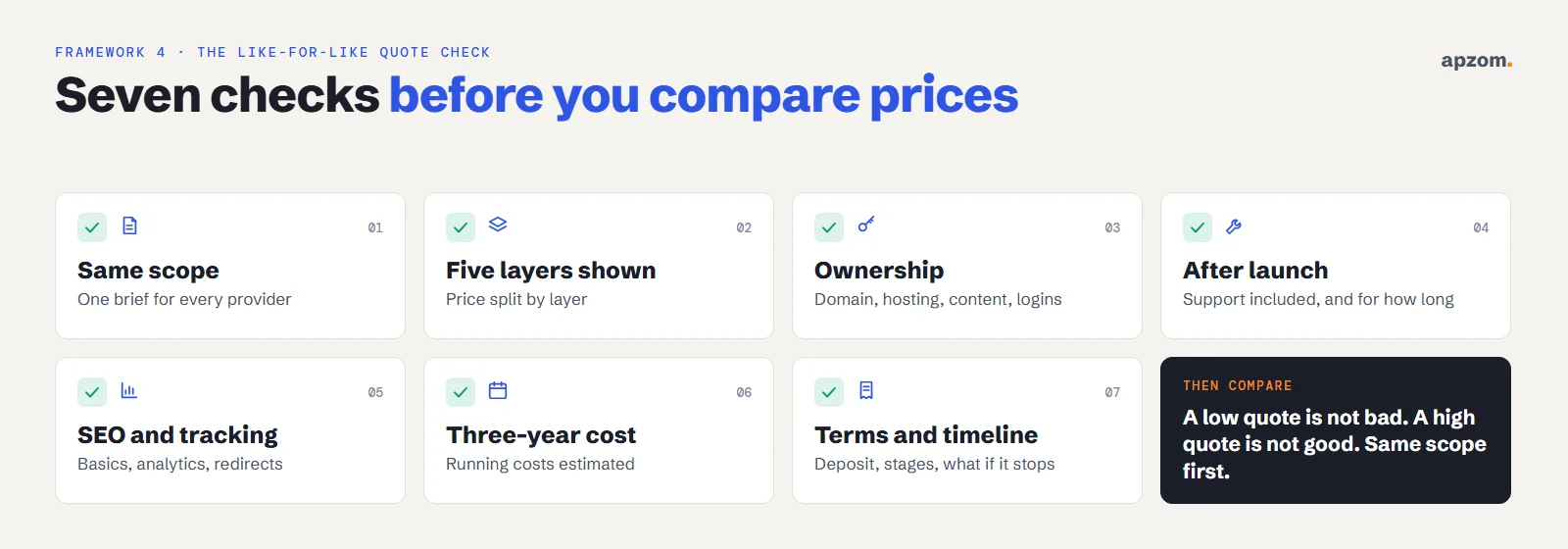
- Same scope. Send every provider the same brief: goals, page list, features, integrations, languages and who supplies the content.
- Five layers shown. Ask for the price split into platform, design, content, features and care.
- Ownership. Confirm that you will own the domain, the hosting account, the content, the design files and the admin logins.
- What happens after launch. Ask what support is included, for how long, and what changes cost after that.
- SEO and tracking. Ask whether basic SEO, analytics and conversion tracking are included, and, for a redesign, whether redirects are.
- Three-year cost. Ask each provider to estimate the running costs for three years.
- Payment terms and timeline. Check the deposit, the stages, what delays the timeline, and what happens if the project stops.
A low quote is not bad and a high quote is not good. What matters is whether the scope matches what your business needs, and whether you will own what you pay for. Our guide on how to choose a digital marketing agency covers contracts and red flags in more detail.
How to set your website budget
Start from the job the website must do, not from a number you have heard:
- If the site must bring in enquiries, work out what a new customer is worth to you and how many you need. A site that wins even a few extra customers a year can justify a bigger budget.
- If the site mainly supports referrals, a smaller, well-made brochure site is often enough.
- If you sell online, budget for product data, photography and payment set-up, not just the design.
- Keep money back for after launch: content, small improvements, maintenance and marketing to bring visitors. A website with no visitors earns nothing.
Spending on SEO or ads at the same time? Our guides on how much SEO costs and SEO vs Google Ads help you plan the whole budget.
Questions to ask before you sign
- Will I own the domain, hosting, content, design and logins?
- What platform will you build on, and why is it right for us?
- Who writes the content and supplies the photos?
- What is included after launch, and for how long?
- How will you handle speed, accessibility and basic SEO?
- If this is a redesign, how will you protect our current search traffic?
- What will the website cost to run each year, and what is that money for?
- Does the price include tax, and in which currency will you invoice?
How Apzom prices websites
Apzom Digital builds business websites on WordPress, and online stores on WordPress with WooCommerce. We do not publish fixed website prices, because the five layers differ for every business. We scope each project from your goals, pages, content and features, and we explain the price layer by layer. A focused business or service site typically takes 4 to 8 weeks, and an online store typically takes 6 to 12 weeks, depending on catalogue size, integrations and content readiness. We build with the WordPress block editor and hand the site over with a walkthrough, so your team can make normal content changes without a developer. We work with clients worldwide, remotely, from our base in Ahmedabad, India.
See our website development and e-commerce development services, and our case studies, which include websites we have built from scratch, such as ARKS Infinity Logistics and AutoHunt.
Request a Website Scope. Tell us what the website has to do, what you have now and what content you can supply. We will suggest the right type of site, list the pages and features, and explain the build and running costs layer by layer.
No obligation. Prefer to talk first? Contact us or see all our services.
Frequently asked questions
How much does a small business website cost?
It depends on the type of site and who builds it. A simple site on a builder plan can cost little more than the monthly plan and your time. A professionally built lead-generation site costs more, because it needs planning, design, content and tracking. Ask for quotes on the same scope, split into platform, design, content, features and care.
Why do website quotes vary so much?
Because providers often quote for different things. One quote may include content, SEO, tracking and a year of support, while another covers only the design. Send every provider the same brief and ask for the price by layer.
Is a website builder cheaper than WordPress?
Usually cheaper to start, but not always cheaper over time. Builder plans charge every month or year, plus apps. A WordPress site costs more to build but gives you more control and can be easier to move. Compare the three-year cost, not just the launch price.
What are the ongoing costs of a website?
The domain, hosting or builder plan, premium plugin or app licences, maintenance and security, content updates, and for online stores, payment fees. Ask any provider to list these for the next three years.
How long does it take to build a website?
A simple builder site can take days. A professionally built business site often takes several weeks, and an online store or custom application longer. Content is usually the slowest part, so start writing early.
Should I pay for a website upfront?
Many providers ask for a deposit and then stage payments as the work is approved. Check what each stage includes and what happens if the project stops before launch.
Does a new website help with SEO?
It can, if it is built with a sound structure, fast pages and useful content. A redesign can also lose rankings if old pages are not redirected. Plan SEO into the build from the start.
Can Apzom build a website for a business outside India?
Yes. We work with clients worldwide, remotely, from our base in Ahmedabad, India, and plan each site around the language, rules and buyers of your market.