
The short answer: Good digital marketing for a home services company gets the phone to ring when something breaks, makes sure a person answers it, and brings the same customer back for servicing next year. That means a complete Google Business Profile, a page for every service you want more of, reviews from every customer, ads that run when and where you can actually send a van, and reminders that turn one-off jobs into maintenance plans. A good agency measures booked jobs, revenue per job and repeat customers, not clicks or “leads”.
This guide is for plumbers, heating and air conditioning (HVAC) companies, electricians, cleaning companies, pest control firms, locksmiths, garage door and appliance repair businesses, in any country. It covers how customers choose a tradesperson, which channels fit which kind of job, why answering the phone is a marketing task, how to plan around the seasons, the rules on licences, reviews, calls and texts, and what to measure.
Home services are different from most local businesses in three ways. Many jobs are urgent, so the first company that answers often wins. The work happens at the customer’s home, so trust matters more than almost anything else. And demand rises and falls with the weather, so marketing that runs at the same level all year wastes money in some months and misses work in others.
How customers choose a home services company
Picture a leaking pipe at 7 in the evening. The customer searches on their phone, looks at the map results, checks the star rating and the number of reviews, and calls the first company that looks trustworthy and open. If nobody answers, they call the next one. The whole decision can take a few minutes.
Now picture someone planning a new boiler, a rewire or a new air conditioning system. They take weeks, compare quotes, read guides, ask neighbours and look for financing. Same trade, completely different buying journey.
So the first question is not “which channel?” but “how urgent is the job?”
Framework 1: the urgency ladder
We sort every service a home services company sells into four rungs, because each rung is won in a different place.
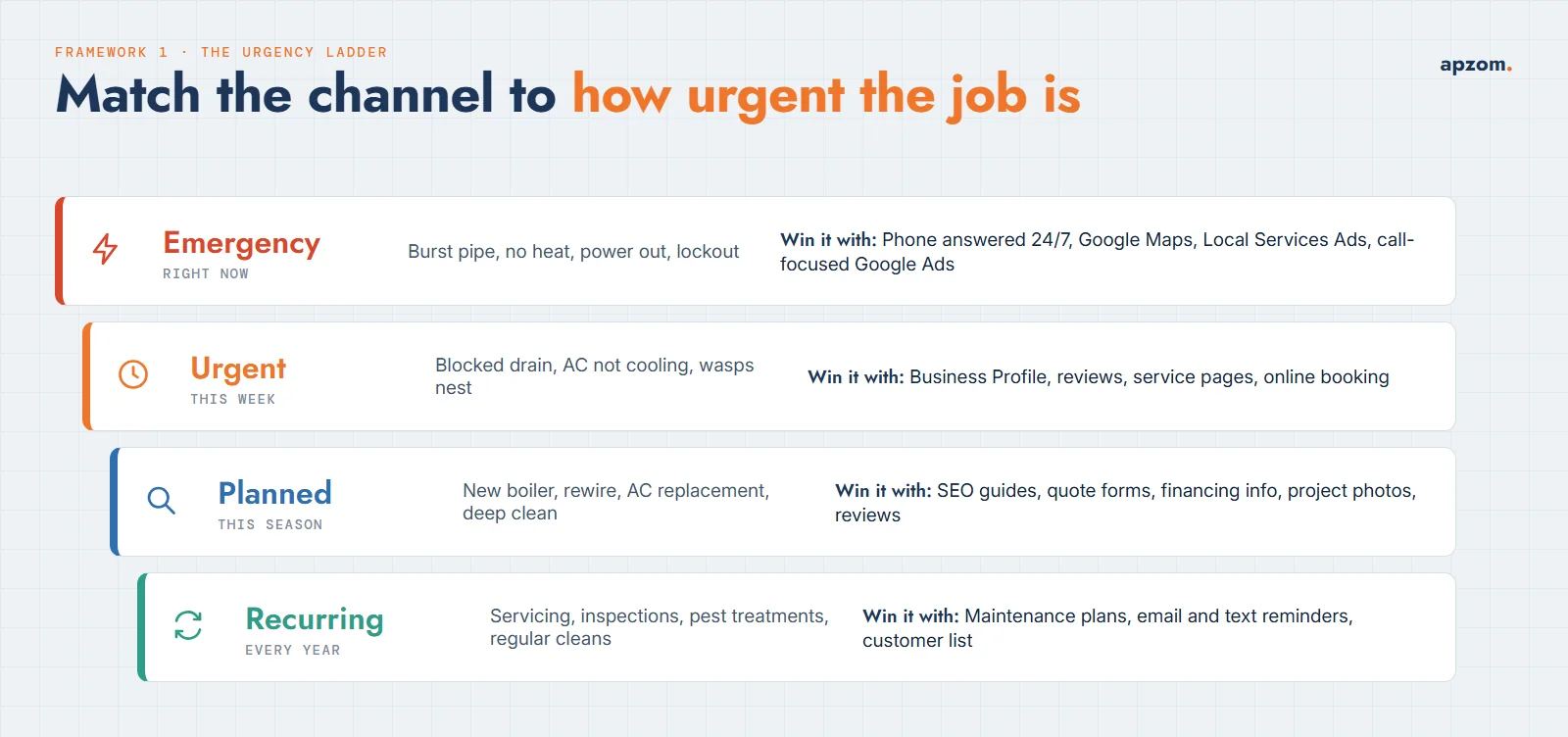
| Rung | Typical jobs | What the customer wants | Channels that fit |
|---|---|---|---|
| Emergency (right now) | Burst pipe, no heat, power cut, lockout | Someone who answers and can come today | Google Maps, call-focused search ads, Local Services Ads where available, a phone that is always answered |
| Urgent (this week) | Blocked drain, air conditioning not cooling, a wasps’ nest | A trusted company with a slot soon | Business Profile, reviews, service pages, online booking |
| Planned (this season) | New boiler, rewire, heat pump, deep clean | Clear information, fair quotes, proof of quality | SEO guides, quote forms, financing pages, project photos, reviews |
| Recurring (every year) | Servicing, inspections, pest treatments, regular cleans | Not to have to think about it | Maintenance plans, email and text reminders, your customer list |
Most companies market only the top rung, because it feels urgent. The planned and recurring rungs are usually where the steadier, better-margin work sits, and they are much cheaper to win from customers you already have.
Be found: Google Business Profile and local search
For most home services companies, the map results are the shop window. Our Google Business Profile optimization checklist covers every field in detail. The points that matter most for trades:
- Set yourself up as a service-area business if customers do not visit your premises. Google says that if customers do not visit your premises, you should hide your address and set a service area instead. You can list up to 20 service areas, and Google says they should be within about two hours’ driving of where you are based. PO boxes and virtual offices are not allowed.
- Use your real business name. Google’s guidelines ask for the name you use in the real world, on your signs, vans and paperwork, without extra keywords such as “24/7 emergency plumber” added on.
- Choose the most specific primary category, such as Plumber, Electrician or HVAC contractor, and add secondary categories only for services you really offer.
- List your services with short, plain descriptions, and keep opening hours accurate. If you offer emergency call-outs, say exactly when.
- Add real photos of your vans, team at work (with permission), and finished jobs. Not stock images.
Then build a page on your website for each service you want more of: “boiler repair”, “emergency electrician”, “drain unblocking”, “termite treatment”. Each page should say what the job involves, what affects the price, how quickly you can come, the areas you cover and how to book. Our local SEO checklist covers the rest, including area pages done properly.
Paid search: ads for the moments that matter
Search ads put you at the top when someone needs you now.
- Local Services Ads, where they are available, can appear above the standard ads for many home service searches. You pay per lead, such as a call, message or booking request, not per click, and Google checks licences and insurance first. In late 2025 Google replaced the old Google Guaranteed, Google Screened and License Verified badges with a single “Google Verified” badge, and the old money-back guarantee ended, so guides that still promise “Google Guaranteed” are out of date. Google offers these ads in the US, Canada, the UK and several European countries, with different trades in each; check Google’s sign-up page for yours. Google now credits some low-quality leads automatically, though credits work differently in Europe.
- Standard Google Ads give you more control over keywords, ad text and landing pages. Run call-focused ads during the hours you can actually answer, and send people to the matching service page, not your home page. Our guide to Google Ads for small businesses walks through set-up.
- Set your ad area to where your vans can reach in a reasonable time, and exclude places you do not want to drive to.
- Track calls, not just clicks. A click is not a job. Use call tracking so you can see which ads and keywords led to booked work.
Some trades face extra checks in Google Ads. Google’s local services policy says locksmiths and garage door repair companies in the US, and locksmiths in Canada, must pass advanced verification before advertising. Locksmith ads are not allowed in some European countries, including Germany, Spain and the Netherlands, and plumber ads are not allowed in the Netherlands. Check the policy for your trade and country before you launch.
If you are unsure whether to start with SEO or ads, our comparison of SEO vs Google Ads explains the trade-off.
Phone quiet, or ringing with the wrong jobs? A Home Services Marketing Audit looks at how customers find you, what happens when they call, your reviews, ads and service pages, and shows where jobs are being lost.
Framework 2: ring to revenue
The second framework follows a job from the first search to the second visit. There are seven steps, and money leaks out at four of them.
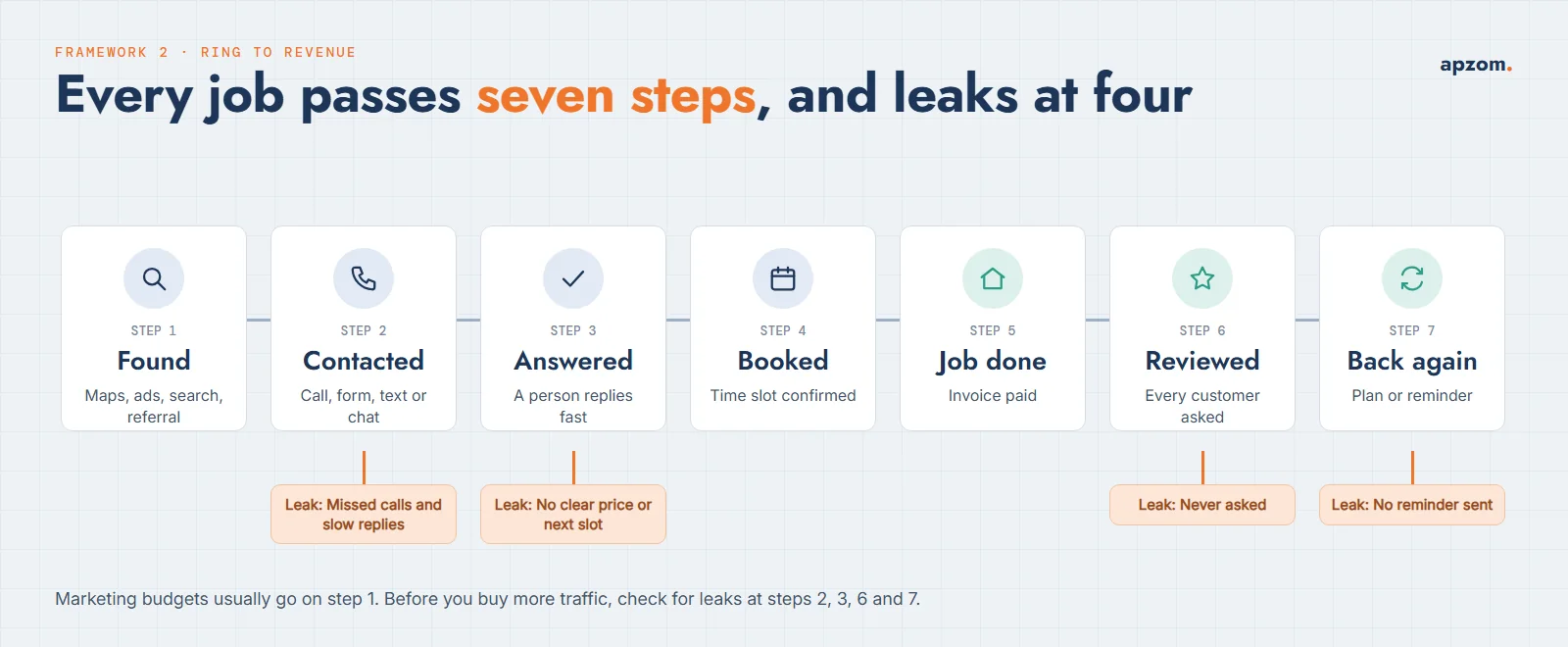
- Found: the customer finds you on Maps, in ads, in search or through a referral.
- Contacted: they call, fill in a form, send a text or a message.
- Answered: a person responds quickly. This is where many companies lose the job: a missed call during a busy day goes straight to a competitor.
- Booked: a time slot is confirmed, with a clear idea of the call-out fee or how pricing works.
- Job done: the work is finished and the invoice paid.
- Reviewed: every customer is asked for a review, in the same way.
- Back again: a reminder or a maintenance plan brings them back next season.
Before spending more on step 1, check steps 2, 3, 6 and 7. Answering the phone is a marketing task. Practical fixes:
- Answer every call during opening hours, with a person or a call-answering service, and call back missed calls quickly.
- Offer online booking or a short form for non-urgent jobs, and reply to forms within the hour during working time.
- Say how you charge before the visit: a call-out fee, an hourly rate, a fixed price for common jobs, or a free quote.
- Send a “technician on the way” message with a name and arrival window. It reduces no-answers at the door and builds trust.
If you record calls for training or quality, say so at the start of every call. In the US, federal law needs only one party’s consent, but several states, including California, Florida, Pennsylvania and Washington, require everyone on the call to agree. In the UK and EU, a recorded call is personal data, so tell callers and explain why you record.
Trust: the home visit problem
Customers are letting a stranger into their home. Before they call, they look for signs that you are safe, qualified and honest.
- Licence and registration details where your trade requires them, shown on your website and, where rules require it, in your ads. More on this in the rules section below.
- Insurance stated clearly.
- Real photos of your team, vans and work.
- Reviews, recent and plentiful, with replies from you.
- Clear prices or pricing rules, and written guarantees if you offer them.
- Named technicians with short profiles, if your team is happy to be named.
Reviews: ask everyone, the same way
Reviews are often the deciding factor between two companies on the map. Build a simple habit: after every completed job, send the customer a short message with a direct link to your Google review form.
- Google bans offering anything in exchange for reviews and bans selectively asking only customers you expect to be happy. Ask everyone, the same way.
- In the US, the Federal Trade Commission’s rule on consumer reviews, in force since 21 October 2024, bans fake reviews, buying reviews and suppressing negative ones, and the FTC can seek civil penalties.
- In the UK, fake reviews have been banned under the Digital Markets, Competition and Consumers Act 2024 since 6 April 2025.
- Everywhere, never write reviews for yourself, buy them, or post them for customers.
Reply to every review calmly and briefly, including critical ones. Our online reputation management service can set up the request process and replies.
Lead platforms and directories
Platforms such as Angi, Thumbtack, Checkatrade, MyBuilder, Bark, hipages and Yelp can bring work, especially for a new company. They work best as one channel among several, not your whole pipeline. You do not own the customer relationship, other companies may receive the same lead, and pricing can change.
Check what you are paying for. In 2023 the US Federal Trade Commission ordered HomeAdvisor, now part of Angi, to pay up to $7.2 million over what it told service providers about the quality and source of the leads it sold.
Measure each platform on booked jobs and profit after the platform’s fees, not on lead counts.
Framework 3: the season planner
Demand for most trades follows the weather and the calendar. The third framework is to market before the rush, not during it.
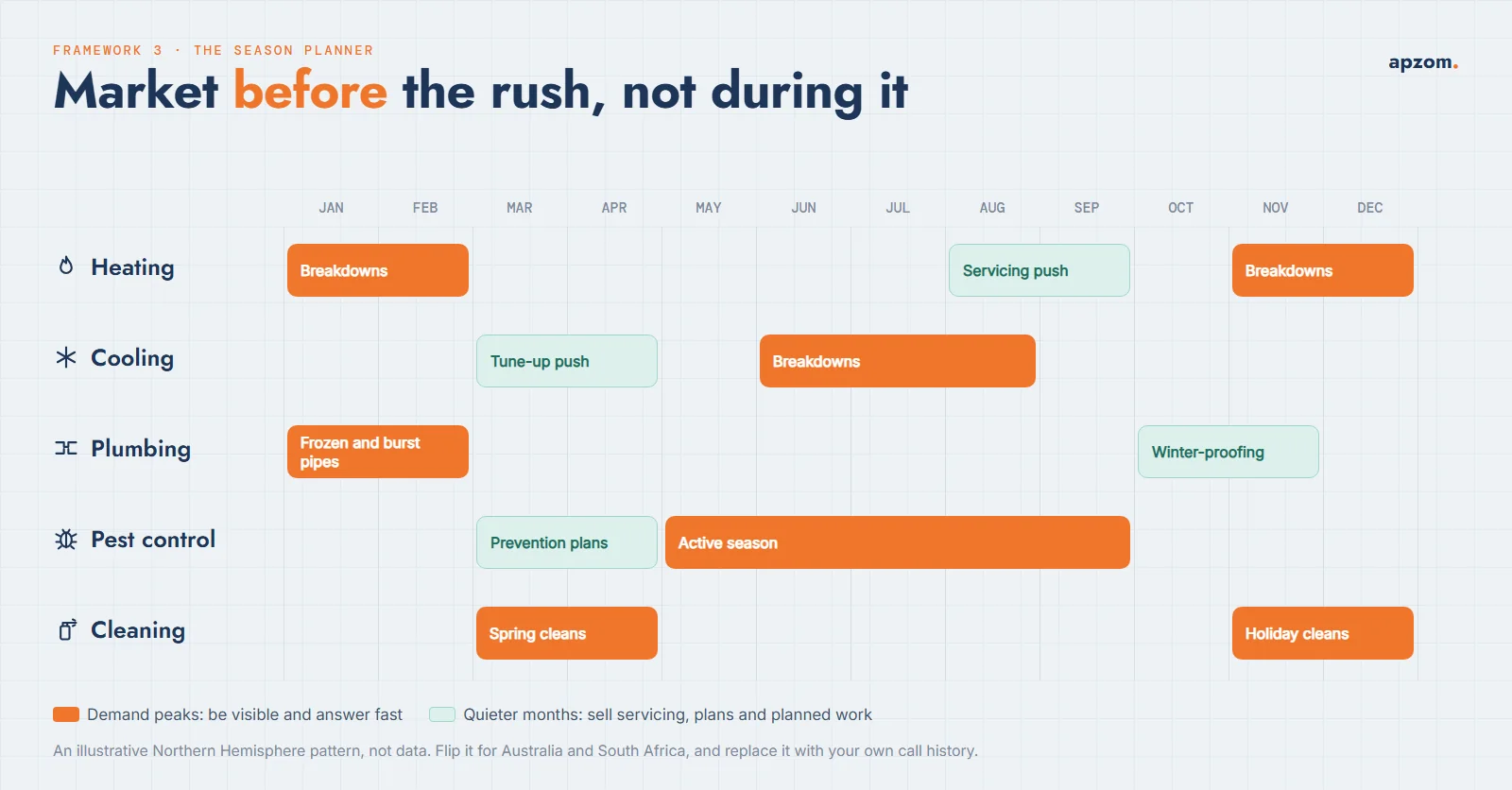
- Before the busy season, sell servicing, tune-ups and prevention plans to your existing customers. A heating service in early autumn or an air conditioning check in spring keeps your team busy and catches faults before they become emergencies.
- During the busy season, keep ads and your Business Profile ready, answer every call, and focus on the jobs you are best at.
- In quieter months, push planned work: replacements, upgrades, deep cleans and inspections.
The pattern flips in the Southern Hemisphere. In Australia, New Zealand and South Africa, heating demand peaks in June to August, and cooling demand around December to February. In hot climates such as the UAE or much of India, cooling demand runs for most of the year, with a sharp peak in the hottest months, while pest activity can rise around the monsoon. Your own call history is the best guide: pull a year of calls and jobs by week and plan around what you see.
Maintenance plans and repeat work
A customer who pays for a yearly service plan is worth far more than one emergency call. Plans smooth out the seasons, fill quiet weeks and keep you first in line when something breaks.
- Offer a simple plan with a clear yearly price, what is included and how to cancel.
- Book the next visit before you leave, or send a reminder when it is due.
- Use email and text reminders with the customer’s permission. Our email marketing service can set these up.
- Keep a clean customer list with addresses, equipment, install dates and service history. It is your most valuable marketing asset.
Make plans easy to cancel, and say how in plain words when people sign up. Subscription rules are tightening in several countries: Australia’s ban on subscription traps applies from 1 July 2027, and the UK has new subscription contract rules on the way. If you sell plans, check the rules where your customers live.
Rules to know: licences, reviews, calls and texts
Home services advertising has more rules than many owners realise. This is a starting point, not legal advice; check the rules for your trade and location.
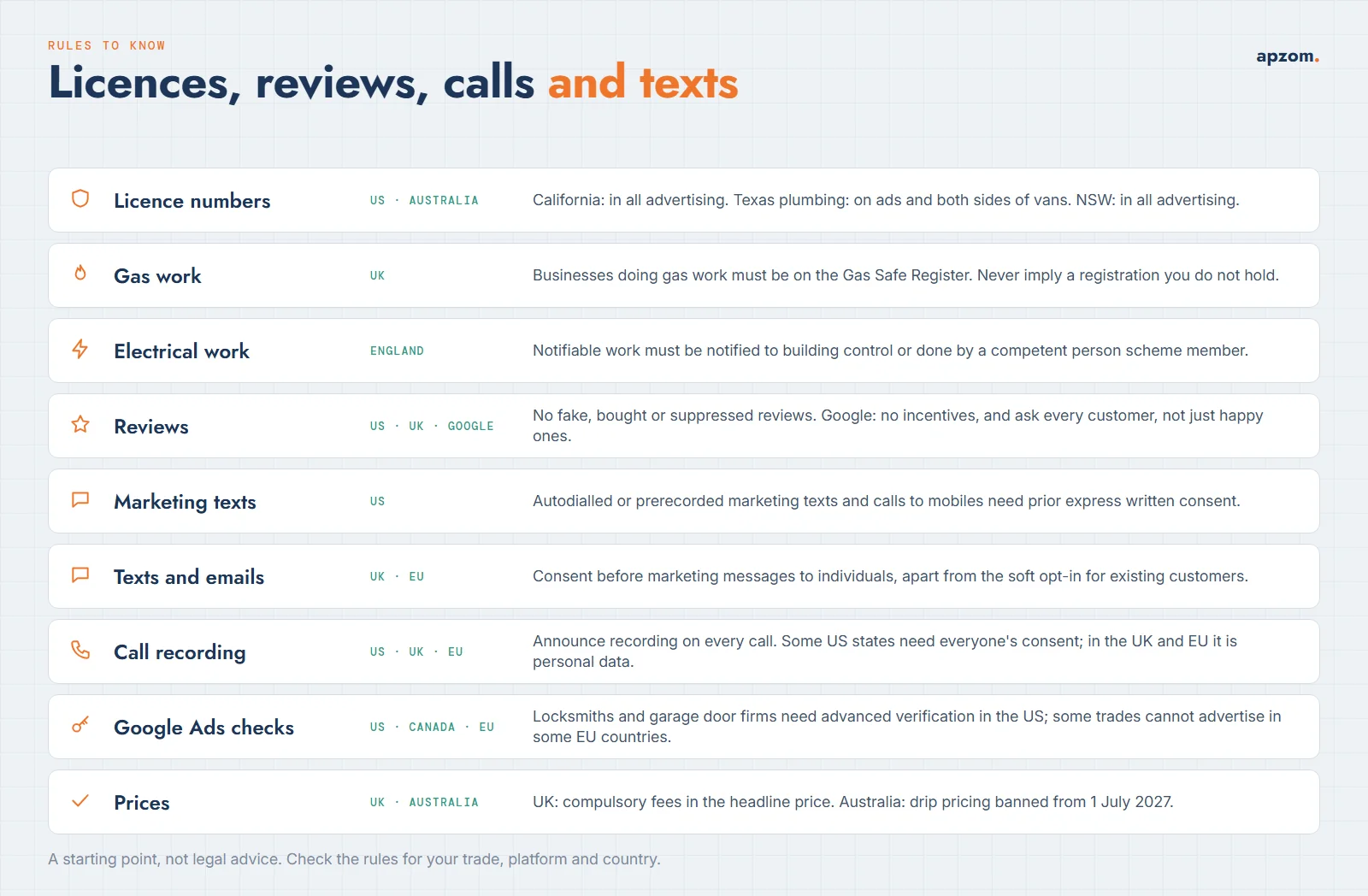
| Area | What to know |
|---|---|
| Licence numbers (California) | State law requires a contractor’s licence number in all forms of advertising (Business and Professions Code section 7030.5). |
| Licence numbers (Texas plumbing) | Texas rules require the responsible master plumber’s licence number on all advertising and on both sides of service vehicles. |
| Licence numbers (New South Wales, Australia) | NSW Fair Trading says the licence number must be shown in all advertising by licensed builders and tradespeople. |
| Gas work (UK) | Businesses doing gas work must by law be on the Gas Safe Register. Never imply a registration you do not hold. |
| Electrical work (England) | Notifiable electrical work must be notified to building control or done by an electrician registered with a competent person scheme. |
| Reviews (US and UK) | The FTC’s consumer reviews rule (since 21 October 2024) and the UK’s fake review ban (since 6 April 2025) cover fake, bought and suppressed reviews. |
| Marketing calls and texts (US) | Under the Telephone Consumer Protection Act, autodialled or prerecorded marketing calls and texts to mobiles need prior express written consent, and opt-outs made by any reasonable means must be honoured. |
| Marketing texts and emails (UK and EU) | UK rules (PECR) need consent before marketing texts or emails to individuals, apart from the “soft opt-in” for existing customers. EU rules work in a similar way. |
| Prices (UK and Australia) | In the UK, compulsory fees must be included in the headline price since 6 April 2025. Australia’s ban on drip pricing applies from 1 July 2027. |
| Misleading claims (India) | The Consumer Protection Act 2019 and the 2022 guidelines on misleading advertisements cover service claims such as “guaranteed” or “certified”. |
AI search and answer engines
People now ask AI assistants questions such as “why is my boiler losing pressure” or “how much does it cost to rewire a house”. To be the source those answers draw on, publish clear, honest answers to the questions your customers ask, with your own photos, prices or pricing rules, and the areas you cover. Use the most specific structured data type that fits, such as Plumber, Electrician, HVACBusiness or Locksmith, and describe only what is true on the page. Our guide to what GEO is explains more.
What to measure
Track these every month, by channel:
- Calls and forms received, and how many were answered or replied to within your target time.
- Booking rate: how many enquiries became booked jobs.
- Cost per booked job, not cost per lead.
- Average job value and gross profit per job.
- Review requests sent and reviews received.
- Maintenance plan sign-ups and renewals.
- Repeat customers as a share of jobs.
What a home services marketing agency should actually do
Questions to ask
- How will you track which calls turned into booked jobs?
- Will the Google Business Profile, ad accounts and call tracking numbers be in our name?
- How will you handle ads outside our working hours?
- What will you do in the quiet months?
- Have you worked within the advertising rules for our trade and country?
Red flags
- Promises of a number one ranking or a fixed number of leads.
- Reporting clicks, impressions or “leads” without booked jobs.
- Buying fake reviews, or setting up fake addresses to appear in more towns.
- Ad accounts and phone numbers held in the agency’s name.
Our guide on how to choose a digital marketing agency has a fuller checklist.
How Apzom can help
Apzom Digital helps local businesses get found, chosen and booked again. For home services companies, that means local SEO, Google Ads, SEO, website development with service pages and booking built in, conversion rate optimization for calls and forms, email marketing for reminders and maintenance plans, and reputation management. We work with clients worldwide, remotely, from our base in Ahmedabad, India.
We have not published a home services case study yet, so we will not show you one. Our case studies page shows the lead generation and search work we have done for other businesses. We will not promise a number of jobs or calls. We will show you where your marketing loses jobs, from the search to the second visit, and what to fix first. Project-based builders and remodellers may find our guide for construction companies a closer fit.
Request a Home Services Marketing Audit. We review your Business Profile and service areas, website and service pages, Google Ads and call tracking, how calls and forms are answered, reviews, lead platforms and repeat-work reminders, plus the advertising rules for your trade. You get a prioritised list of what to fix first.
No obligation and no guaranteed job numbers. Prefer to talk first? Contact us or see all our services.
Frequently asked questions
What is the best way to market a home services business?
Make it easy to find you on Google Maps, answer every call, have a clear page for each service, ask every customer for a review and bring customers back with reminders and maintenance plans. Then use ads to fill gaps and cover busy seasons.
How do plumbers and electricians get more customers?
By being visible in map results and search when people need them, answering quickly, showing licences, insurance and real reviews, and following up after every job. Repeat and referral work grows from good service and simple reminders.
Are Local Services Ads worth it for home services?
Often, where they are available for your trade and country. You pay per lead, such as a call or message, rather than per click, and the ads can appear above other search results. Since late 2025 Google shows a single “Google Verified” badge instead of the old Google Guaranteed badge. Track which leads became booked jobs, and rate your leads in the dashboard.
Should a home services company use lead platforms like Angi or Checkatrade?
They can help, especially early on, but treat them as one channel. Measure them on booked jobs and profit after fees, and build your own Business Profile, website and customer list at the same time.
How can an HVAC company get work in the quiet season?
Sell servicing and tune-ups before each busy season, offer maintenance plans, and push planned replacements and upgrades in the quieter months.
Should I show prices on my website?
Show what you can: a call-out fee, an hourly rate, “from” prices for common jobs or the factors that affect the price. Customers are more likely to call a company that is open about how it charges.
How do I get more Google reviews for my home services company?
Ask every customer after every job, with a direct link. Do not offer discounts or gifts for reviews, and do not ask only the happy customers. Never write or buy reviews.
Can Apzom work with home services companies outside India?
Yes. We work with clients worldwide, remotely, from our base in Ahmedabad, India, and plan marketing around your service area, your trade and the rules that apply where you work.