
The short answer: a digital marketing agency for construction companies should help you win the right projects, not just more enquiries. That means getting found by the people who hire you, whether that is a homeowner planning a renovation or a general contractor looking for a subcontractor, proving you can deliver with real projects and credentials, and filling your pipeline at the pace your crews can actually handle.
This guide is for owners and business development leads at general contractors, builders, remodelers, specialty trade contractors, design-build firms and civil contractors. It explains why residential and commercial construction need two different marketing systems, what a project portfolio should prove, which channels suit which kind of contractor, how to plan marketing around your backlog, and how to measure it in signed contracts rather than clicks.
Why construction marketing is different
Construction has a few features that break most generic marketing advice.
- Two very different buyers. A homeowner choosing a kitchen remodeler and a developer choosing a general contractor for a warehouse buy in completely different ways. One reads reviews on a phone; the other runs a prequalification process with safety records and financial checks.
- Capacity is fixed in the short term. You cannot hire and train skilled crews overnight. Marketing that floods you with leads in a month when you are fully booked wastes money and damages your reputation for response times.
- Every job is local. Even large contractors work within a travel radius. Search visibility outside it is wasted.
- Proof is visual and physical. Buyers want to see finished work, ideally work like theirs, close to them.
- The decision is expensive and hard to reverse. Nobody wants to fire a contractor halfway through a build. Trust carries more weight than price in many decisions.
First, which construction business are you?
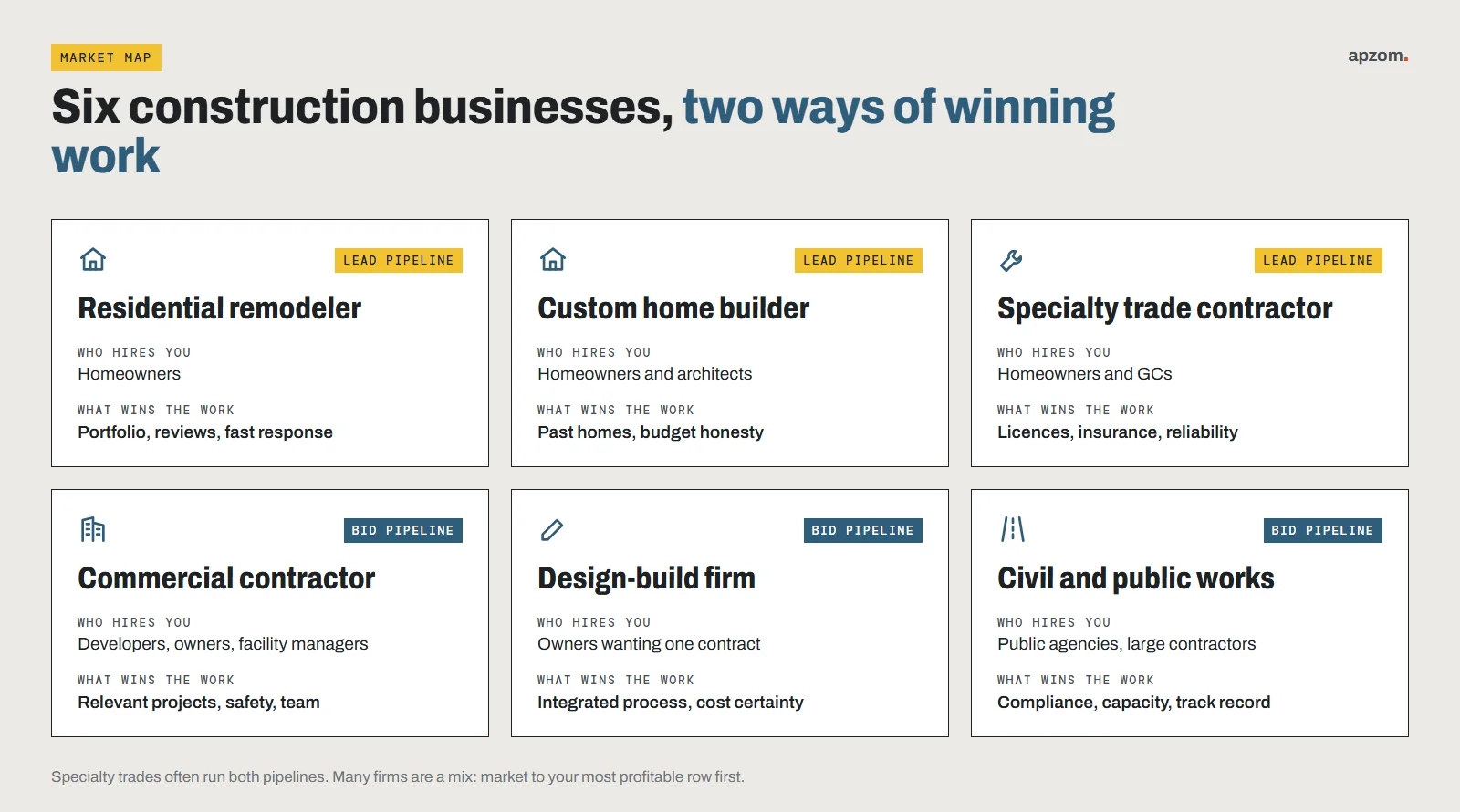
The word “construction” covers businesses that win work in very different ways. Your marketing depends on which of these you are, and many firms are a mix.
| Business type | Who hires you | How they find you | What wins the work |
|---|---|---|---|
| Residential remodeler or renovator | Homeowners | Google search and Maps, referrals, reviews, home design platforms | Portfolio, reviews, clear process, fast response |
| Custom home builder | Homeowners, often with an architect | Referrals, search, architects, local reputation | Past homes, process, budget honesty, relationships |
| Specialty trade contractor (roofing, electrical, HVAC, concrete) | Homeowners, general contractors or both | Maps, search, GC relationships, bid invitations | Licences, insurance, reliability, response speed |
| Commercial general contractor | Developers, business owners, facility managers | Relationships, bid lists, architects, LinkedIn, search | Relevant projects, safety record, team, financial strength |
| Design-build firm | Business owners and homeowners wanting one contract | Search, referrals, architects | Integrated process, past projects, cost certainty |
| Civil and public works contractor | Public agencies and large contractors | Public tender portals and prequalification lists | Compliance, capacity, track record, price |
A residential remodeler that markets like a commercial contractor sounds cold to homeowners. A commercial contractor with a homeowner-style website, all before-and-after photos and five-star badges, looks small to a developer. Decide which rows describe your most profitable work, then build around them.
Two pipelines, not one funnel
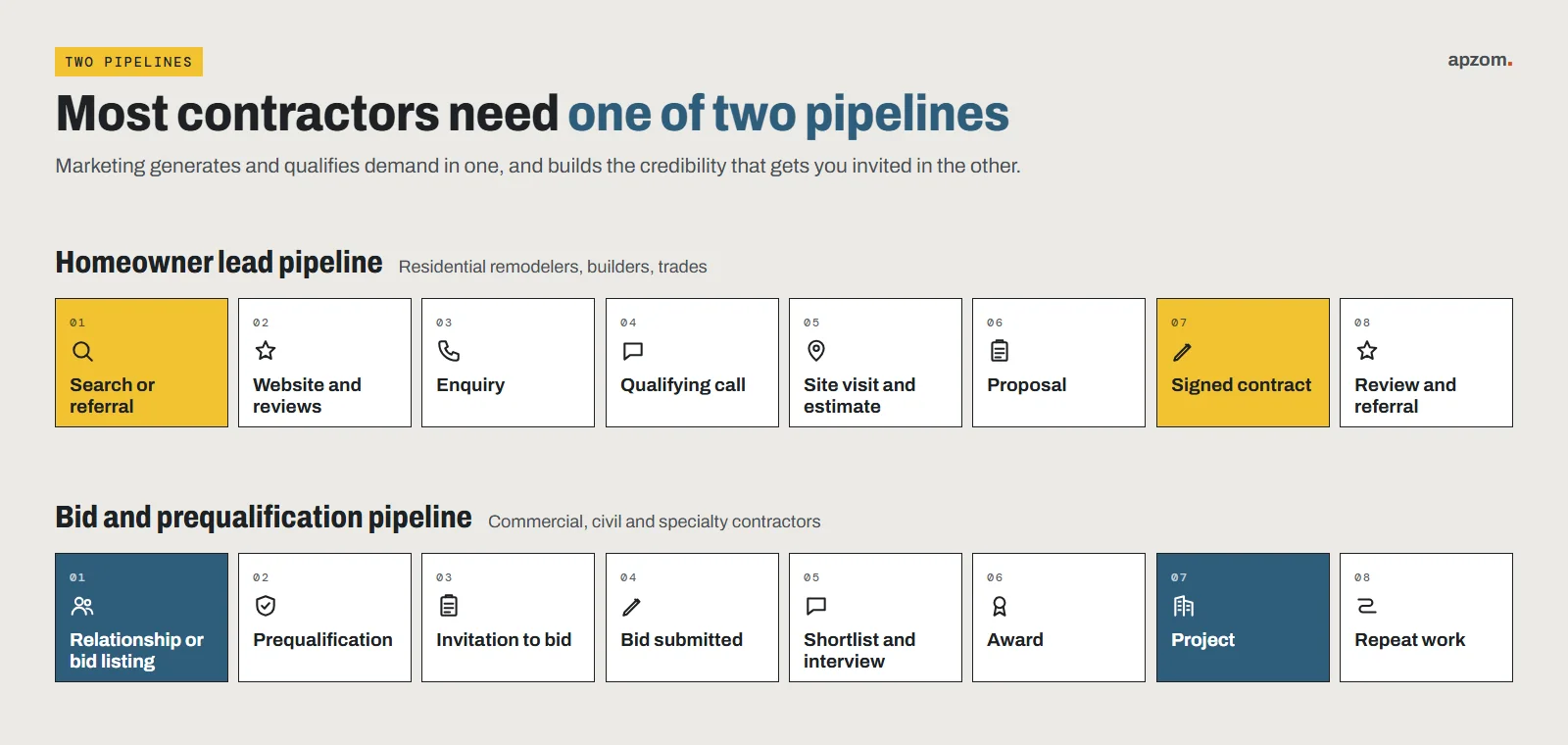
The most useful idea in construction marketing is that most firms need one of two pipelines, and some need both.
The homeowner lead pipeline
Search or referral → website and reviews → enquiry → qualifying call → site visit and estimate → proposal → signed contract → project → review and referral
What breaks this pipeline:
- Leads for work you do not do, in places you do not serve, at budgets that do not fit.
- Slow replies. Homeowners often contact more than one contractor, and the first useful reply has an advantage.
- Site visits that do not convert, usually because the budget conversation never happened.
- No system for asking happy clients for reviews.
The bid and prequalification pipeline
Relationship or bid listing → prequalification → invitation to bid → bid submitted → shortlist and interview → award → project → repeat work
What breaks this pipeline:
- Not being on the bid lists of the general contractors and owners you want to work for.
- A website and capability statement that do not show relevant projects, safety performance or team depth.
- Chasing every bid instead of the ones you can win at a margin.
- No follow-up after a lost bid, so you never learn why.
Marketing’s job is different in each pipeline. For homeowners, it generates and qualifies demand. For commercial work, it builds the credibility that gets you invited and shortlisted. A website, LinkedIn presence and capability statement do not win a commercial bid on their own, but a weak one can lose you the invitation.
The project portfolio: your strongest marketing asset
Every construction buyer wants to see work like theirs. Most contractor websites have a gallery of unlabelled photos. A portfolio built as individual project pages does far more.
What each project page should include
| Element | Why it matters |
|---|---|
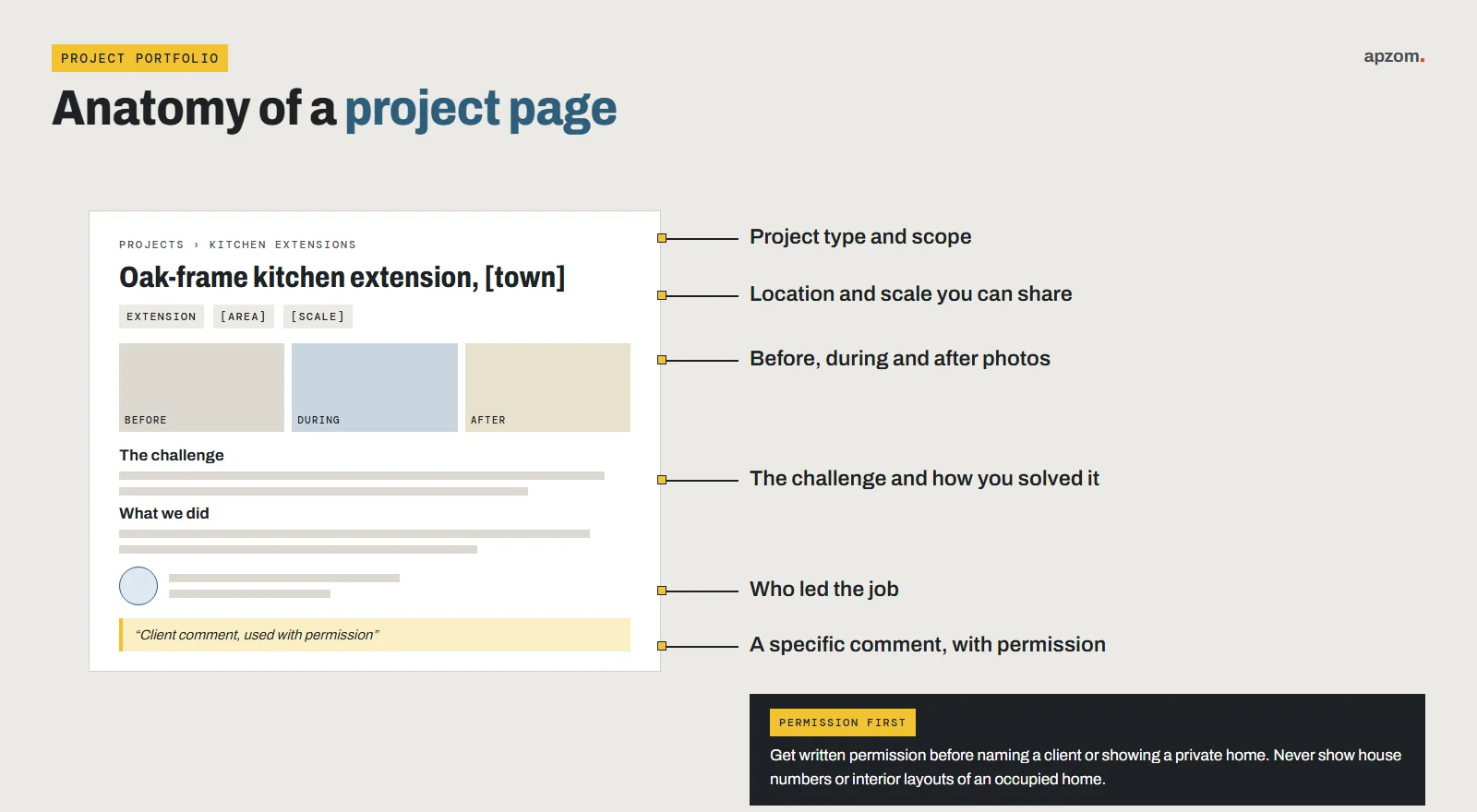
| Project type and scope | Lets the buyer see if it matches their project |
| Location (town or area) | Shows you work near them and helps local search |
| Size or scale, described in words or ranges you are comfortable sharing | Shows you can handle projects of their size |
| The challenge | Shows how you think: a tight site, an occupied building, a difficult schedule |
| What you did | Your actual role, methods and trades involved |
| Photos: before, during and after | During-construction photos prove it was your work |
| The team | Who led it, so buyers can see the people |
| Client comment, with permission | A specific comment is worth more than a star rating |
Get written permission before naming a client or showing a private home, and never publish anything that compromises a client’s security, such as house numbers or interior layouts of an occupied home.
Photos: original, labelled and frequent
Take photos on every job, at every stage. Real photos of your own work build trust, and Google’s image guidance recommends short, descriptive file names, useful alt text and placing images near relevant text, so well-labelled project photos can also be found in image search. A photo named `kitchen-extension-oak-frame-cambridge.jpg` with a sentence describing it does more than `IMG_4521.jpg` in an unlabelled gallery. Never use stock photos of other people’s buildings as if they were your work.
The trust stack for contractors
Construction buyers worry about the same few things: will they turn up, will it be done properly, what happens if something goes wrong, and will the price change halfway through. Your marketing has to answer those worries before the first meeting.
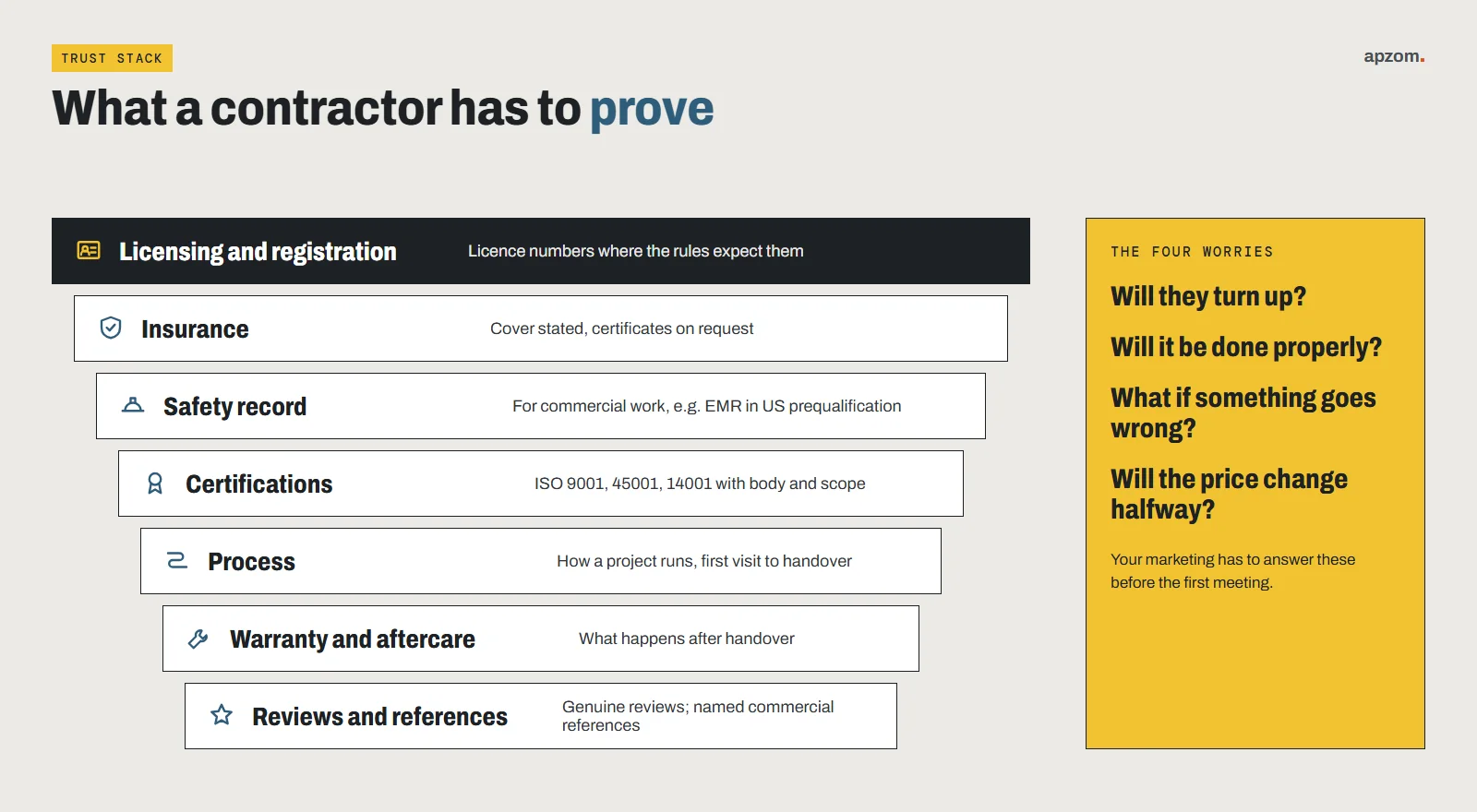
- Licensing and registration. Show the licences and registrations you hold, with numbers where the rules expect it. In some US states this is a legal requirement: California requires a contractor’s licence number in advertising, and Florida requires certified and registered contractors to include their licence number in advertisements. Rules vary by state and country, so check yours.
- Insurance. State the cover you carry and offer certificates on request.
- Safety record. For commercial work, buyers often ask for safety statistics. In the US, many owners and general contractors ask for a contractor’s Experience Modification Rate (EMR), a workers’ compensation rating based on claims history, during prequalification. Share it in your capability statement if it is good; work on it if it is not.
- Certifications. Management system certifications such as ISO 9001 (quality), ISO 45001 (occupational health and safety) and ISO 14001 (environmental) carry weight in commercial and public work. Show the certifying body and scope.
- Process. A clear explanation of how a project runs, from first visit to handover, reduces fear for homeowners and shows maturity to commercial buyers.
- Warranty and aftercare. What happens after handover, in plain language.
- Reviews and references. Genuine reviews for residential work; named references for commercial work.
Reviews: ask everyone, the same way
Reviews matter hugely for residential contractors on Google Maps and review platforms. Ask every client at handover, in the same way. In the US, the Federal Trade Commission’s rule on consumer reviews and testimonials, in force since 21 October 2024, bans fake reviews and incentives conditioned on a review being positive or negative. Google’s Maps policy says businesses may not selectively solicit positive reviews or discourage negative ones. In the UK, fake reviews and concealed incentivised reviews became banned practices under the Digital Markets, Competition and Consumers Act 2024 from April 2025.
The website: built to qualify, not just impress
A contractor website has two jobs: convince the right buyer, and filter out the wrong one.
- Service pages for each type of work you want more of, such as kitchen remodels, extensions, commercial fit-outs, roofing or concrete foundations. Each page explains what is included, your process, typical considerations and relevant projects.
- Service area pages only for areas you genuinely serve, each with real local projects or local information. Google’s spam policies treat near-identical pages for many towns that funnel visitors to one page as doorway abuse.
- Project pages as described above.
- About and team with real people.
- A capability statement for commercial work: a downloadable summary of services, sectors, notable projects, safety, certifications, bonding or financial capacity where relevant, and contacts.
The enquiry form: the lead fit filter
For residential work, a short form that asks the right questions saves hours of wasted site visits.
| Question | Why ask it |
|---|---|
| Type of project | Routes the enquiry and filters out work you do not do |
| Location or postcode | Confirms it is inside your service area |
| Rough budget range | The single biggest time saver; offer ranges, not a blank box |
| Ideal start date | Matches the job to your capacity |
| Stage of planning | Separates “dreaming” from “ready to build” |
| Photos or plans (optional) | Helps you prepare for the first call |
Be honest about your minimum project size if you have one. It loses some enquiries and saves many wasted visits.
Getting leads you cannot use, or not enough of the right ones? A Construction Digital Growth Audit looks at your service and project pages, Google Business Profile, reviews, enquiry form and paid search, and shows where the right projects are slipping away. Free, with no obligation.
Channels: what fits which contractor
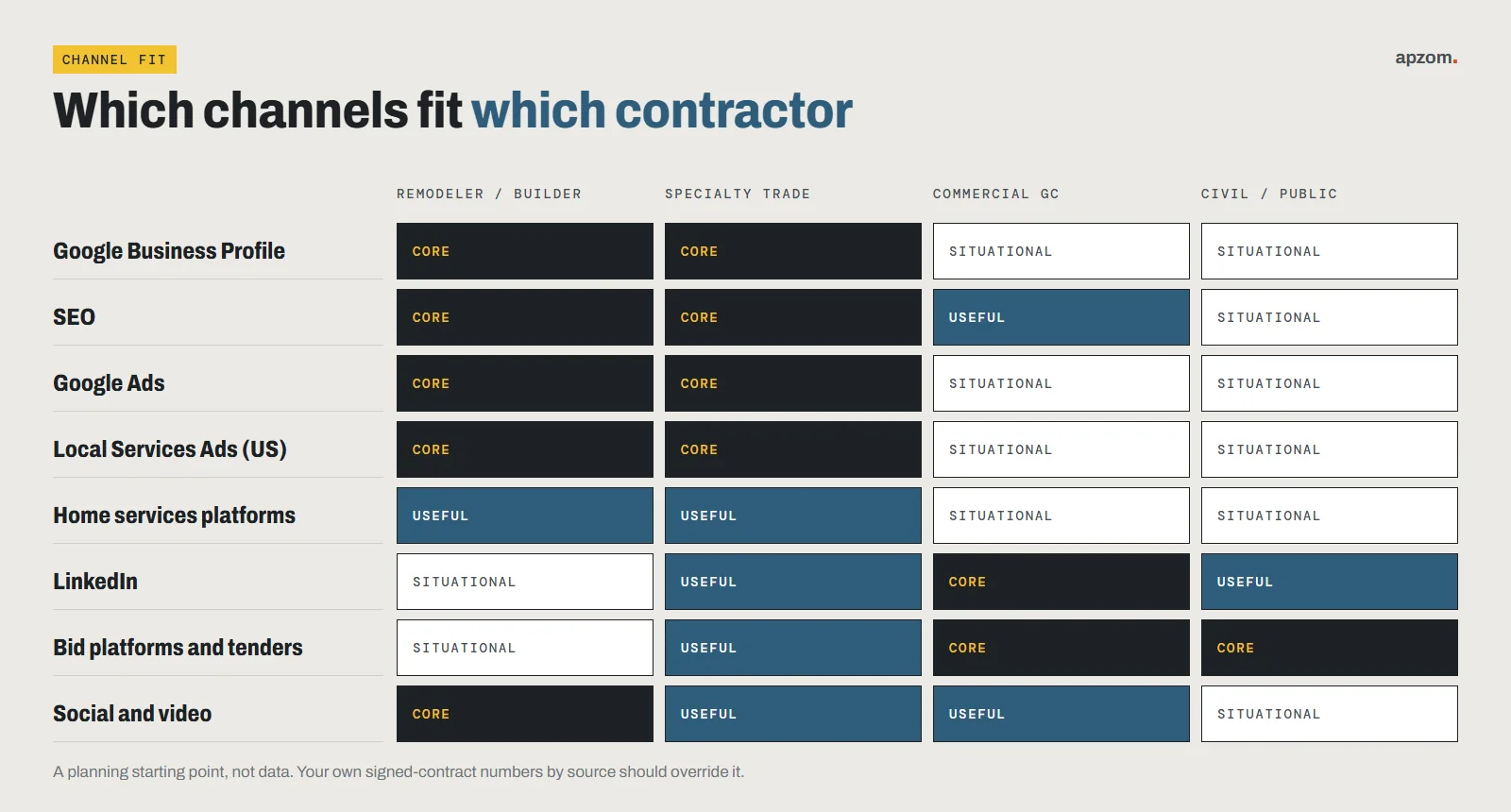
| Channel | Best job | Fits best | Watch out for |
|---|---|---|---|
| Google Business Profile and Maps | Local discovery and reviews | Residential and trade contractors | Profile rules for service-area businesses |
| SEO | Being found for services in your area | Remodelers, builders, trades, design-build | Doorway pages for towns you do not serve |
| Google Ads | Capturing urgent and high-intent searches | Trades, remodelers, emergency work | Broad terms bring DIY and job seekers |
| Local Services Ads (US) | Pay-per-lead placement at the top of results | Eligible trades and contractors | Screening requirements, lead quality |
| Home services platforms | Extra residential leads | Remodelers and trades building volume | Shared leads and price pressure |
| Credibility with developers, architects and GCs | Commercial contractors | Needs real project content, not just ads | |
| Bid platforms and public tenders | Access to commercial and public projects | Commercial, civil and specialty contractors | Bid volume versus win rate |
| Social media and video | Showing work in progress and the team | Residential builders and remodelers | Time-consuming without a plan |
| Staying in touch with past clients, GCs and architects | Everyone | Follow the email law in each market |
Google Business Profile for contractors
Most contractors serve customers at the customer’s address. Google treats these as service-area businesses: you can list the areas you serve, and you should hide your address if customers do not visit your office. You must be a real business that meets customers in person, so a virtual office is not eligible. Do not create more than one profile for the same location (a firm with several staffed offices can have one per office), use your real business name without added keywords, and add project photos regularly.
Google Ads and Local Services Ads
Paid search works best for specific, high-intent services in your area, such as “roof leak repair” or “basement conversion”. Use tight location targeting, strong negative keywords (jobs, DIY, cost of materials, free) and send each campaign to its matching service page. Track calls and forms, then feed back which became estimates and contracts.
In the US, Google’s Local Services Ads charge per lead rather than per click and appear above other results for many home services. Google screens businesses before they can run them, and the checks vary by category. For contractor categories they include a state-level business licence where local law requires one and general liability insurance; some businesses are also background-checked. Being verified by Google is a platform requirement, not a quality endorsement, so do not present it as one.
Home services platforms and lead marketplaces
Platforms such as Houzz, Angi, Checkatrade in the UK and similar services can bring residential leads, especially while your own search presence grows. Many share leads between several contractors, which means price pressure and a race to respond. Treat them as a channel to measure, not a foundation: track cost per signed job, not cost per lead.
Commercial work: relationships, bid lists and public tenders
For commercial contractors, digital marketing supports business development rather than replacing it. Useful digital work includes:
- A LinkedIn presence for the company and key people, sharing real project progress, safety milestones and team news. LinkedIn lets you target ads by company, industry and job title, which helps reach developers, facility managers and architects at specific firms.
- Project pages organised by sector, such as healthcare, education, industrial or retail, so a developer can see relevant experience in seconds.
- Being registered on the right bid platforms and public tender portals. Examples include SAM.gov for US federal opportunities (registration is needed to bid for federal awards), Find a Tender in the UK (since February 2025 the central platform for public contracts in England, Wales and Northern Ireland), and the Central Public Procurement Portal and Government e-Marketplace (GeM) in India.
- Following up every lost bid to ask why, and feeding that back into how you present your work.
Backlog-led marketing: market at the pace you can build
This is the part most agencies miss. A construction company’s capacity is limited by crews, supervisors and cash flow, not by how many leads arrive. Marketing should be planned around your backlog.
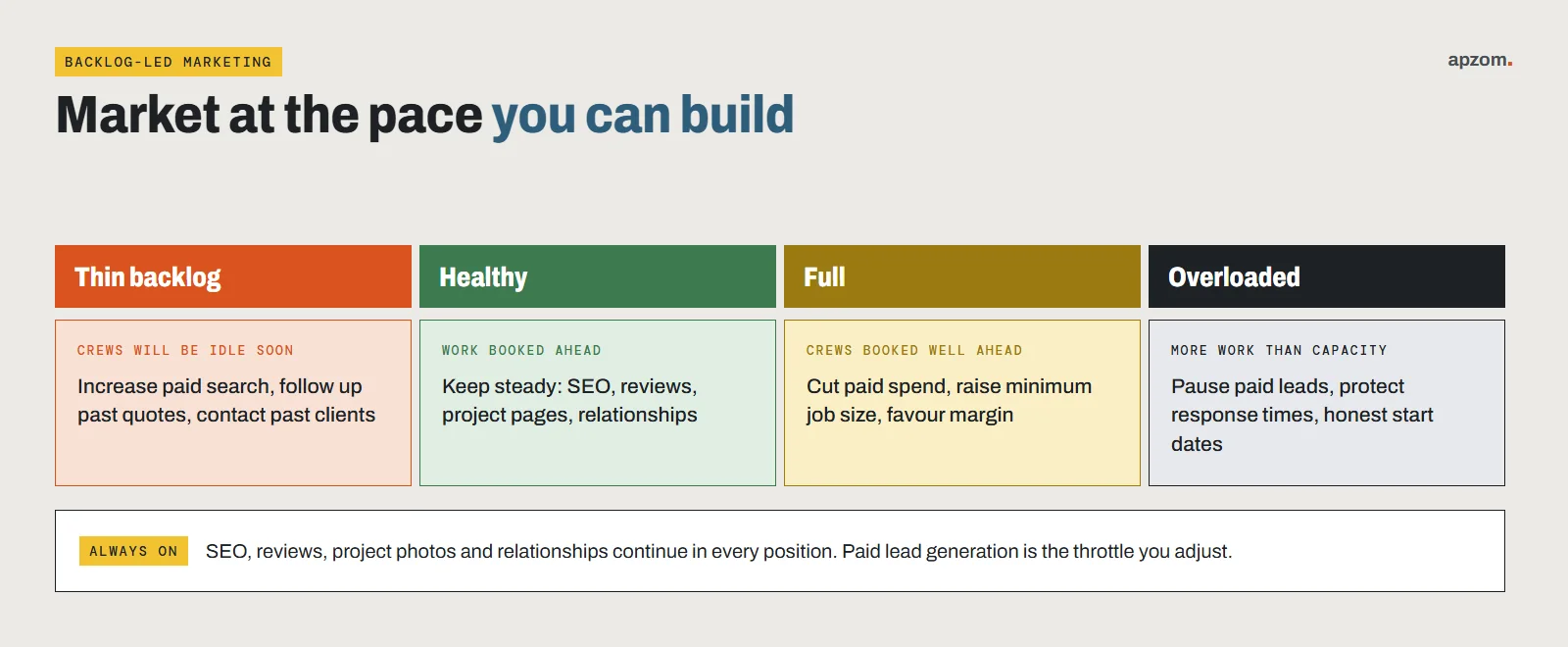
| Backlog position | What marketing should do |
|---|---|
| Thin backlog (crews will be idle soon) | Increase paid search and LSA where available, follow up past quotes, contact past clients and partners |
| Healthy backlog | Keep steady: SEO, reviews, project pages, relationship building |
| Full backlog | Reduce paid spend, raise minimum project size, focus on higher-margin work, keep collecting reviews and photos |
| Overloaded | Pause paid lead generation, protect response times and quality, set honest start dates |
Long-term work such as SEO, reviews, project pages and relationships should continue in every position, because it takes months to build. Short-term paid work is the throttle you adjust. A contractor who markets this way spends less in busy months, stays visible in quiet ones, and keeps its reputation for responding properly.
Measure in signed contracts and margin
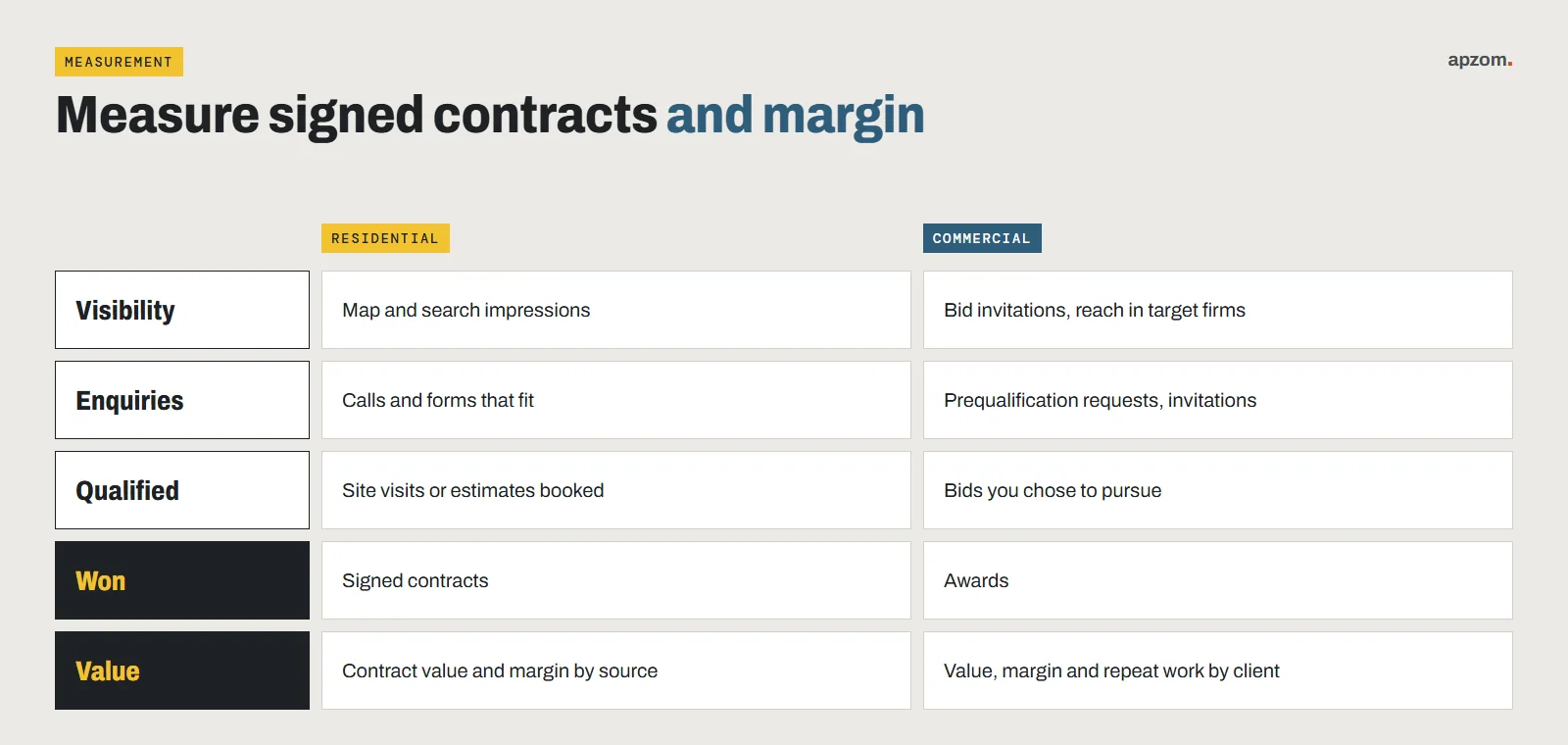
| Stage | Residential | Commercial |
|---|---|---|
| Visibility | Map and search impressions, profile views | Bid invitations, LinkedIn reach among target firms |
| Enquiries | Calls and forms that fit your work and area | Prequalification requests, invitations to bid |
| Qualified | Site visits or estimates booked | Bids submitted that you chose to pursue |
| Won | Signed contracts | Awards |
| Value | Contract value and gross margin by source | Contract value, margin and repeat work by client |
Record the source of every enquiry and bid, then look at signed work and margin by source every quarter. Cost per lead is a poor guide in construction: a cheap lead for a job you will never win, or will win at a loss, is expensive.
Be wary of anyone quoting typical cost per lead or conversion rates for contractors. They vary enormously by trade, location, job size and season.
AEO, GEO and AI search for contractors
People are starting to ask AI tools questions such as “how long does a kitchen extension take” or “what should I ask a builder before signing”. Nobody can guarantee your firm will be mentioned in the answer. Google’s guidance says there are no special requirements to appear in its AI features; the same foundations apply.
What helps contractors:
- Clear, consistent business facts everywhere: name, services, service area, licences and contact details.
- Honest, useful answers to the questions clients ask, written by people who do the work.
- Project pages with real detail that other sources do not have.
- Structured data that describes what is true. Schema.org has LocalBusiness types for construction, such as HomeAndConstructionBusiness, GeneralContractor, RoofingContractor, Electrician, Plumber and HVACBusiness.
Platform rules worth knowing before you advertise
- Google housing policy: Google’s restricted targeting for housing ads in the US and Canada covers places people live and services enabling the sale or rental of homes. It does not name contractor or home improvement services, so most contractor ads fall outside it, but check the current policy if your ads also promote homes for sale or rent.
- Meta special ad categories: Meta limits targeting for ads about housing opportunities for advertisers in or reaching the US, and those reaching Canada and some European countries. Whether a particular renovation or repair ad falls inside that category is not always clear, so check Meta’s current definition for your ads and market before launching.
- Email: in the US, the CAN-SPAM Act applies to commercial email, including business-to-business email. In the UK, the rules depend on whether you are emailing individuals or companies.
What a construction marketing agency should actually do
Questions to ask
- Which type of work, and which pipeline, would you focus on first for us?
- How will you match marketing to our backlog and crew capacity?
- How will you get project photos and details from our sites?
- Will you create pages for towns we do not really serve?
- How will you report on estimates, contracts and margin, not just leads?
Red flags
- Guaranteed rankings or a guaranteed number of leads.
- Dozens of near-identical city pages.
- Stock photos of buildings you did not build.
- Reports that stop at clicks and form fills.
- Pushing more lead volume when you are already fully booked.
How Apzom can help
Apzom Digital works with businesses where trust is built before the first meeting. For contractors, that usually means local SEO, SEO built around your real services and areas, tightly managed Google Ads, and website development with project pages and enquiry forms that qualify leads properly. We also manage online reputation work such as review systems that follow platform rules.
We have built websites for property developers and for an engineering and fabrication business, which you can see on our case studies page. We do not have a construction contractor case study to show yet, and we will not invent results. If you also develop property, our real estate marketing guides cover the sales side.
Request a Construction Digital Growth Audit. We review which work and pipeline to prioritise, your project portfolio and trust signals, Google Business Profile and reviews, service and area pages, enquiry qualification, paid search and lead platforms, and how leads are tracked to signed contracts. You get a prioritised list of what to fix first, matched to your capacity.
The audit is free, with no obligation and no guaranteed rankings. Prefer to talk it through? Contact us or see all our services.
Frequently asked questions
What does a digital marketing agency for construction companies do?
It helps construction firms get found by the clients they want, proves their capability with projects, credentials and reviews, and turns enquiries or bid invitations into signed contracts. A good one also matches marketing effort to the firm’s capacity and measures results in signed work and margin.
Is SEO worth it for contractors?
Usually, yes, especially for residential contractors, trades and design-build firms whose clients search locally. Service pages, project pages and a strong Google Business Profile can bring steady enquiries. It takes months to build, so many contractors pair it with paid search at first.
Should contractors use Google Ads?
Google Ads works well for specific, high-intent services in a defined area. It wastes money on broad terms. Use tight location targeting, negative keywords, matching service pages and tracking through to signed contracts. Reduce spend when your backlog is full.
Are lead platforms like Angi, Houzz or Checkatrade worth it?
They can add residential leads, especially while your own search presence grows. Leads are often shared with other contractors, so respond quickly and measure the cost per signed job, not the cost per lead.
How can a commercial contractor win more bids?
Get on the bid lists of the owners and general contractors you want to work for, make sure your website and capability statement show relevant projects, safety and team depth, choose bids you can win at a margin, and follow up on lost bids to learn why.
Should a contractor put its licence number on its website?
Often yes, and in some places it is required in advertising, for example in California and Florida for licensed contractors. Rules vary, so check the requirements where you work. Showing your licence also builds trust.
How do I get more Google reviews for my construction company?
Ask every client at handover in the same way, make it easy with a direct link, and reply to reviews professionally. Do not ask only happy clients, do not offer rewards for reviews, and never post or buy fake ones.
How much should a construction company spend on marketing?
There is no reliable single figure. Base it on the value and margin of the work you want, how much capacity you need to fill, and what each channel produces in signed contracts. Adjust paid spend with your backlog.