
The short answer: local SEO is everything that helps a business appear when people nearby search for what it offers: on Google Maps, in the local results on Google and other search engines, and on the business’s own website. A Google Business Profile is the centre of it, but it is not all of it. Your website, your listings on other platforms, your reviews and your reputation in the local community all decide whether you show up and whether people choose you.
This checklist is for owners and marketers at local businesses, from a single shop or clinic to a chain with many branches or a trade that visits customers’ homes. It covers five layers beyond the profile itself, how the checklist changes for multi-location and service-area businesses, and a simple routine to keep it all current. If you have not set up your profile properly yet, start with our Google Business Profile checklist, then come back here.
How local search works, briefly
Google says local results are mainly based on relevance (how well your listing matches the search), distance (how far you are from the searcher or the place in the search) and popularity, which Google also describes as prominence (how well known your business is). It also says there is no way to pay for a better local ranking.
You cannot change your distance from a searcher. You can improve relevance, by describing what you do clearly and consistently everywhere, and prominence, by earning reviews, mentions and links and by having a strong website. That is what the five layers below are for.
The five layers of local SEO
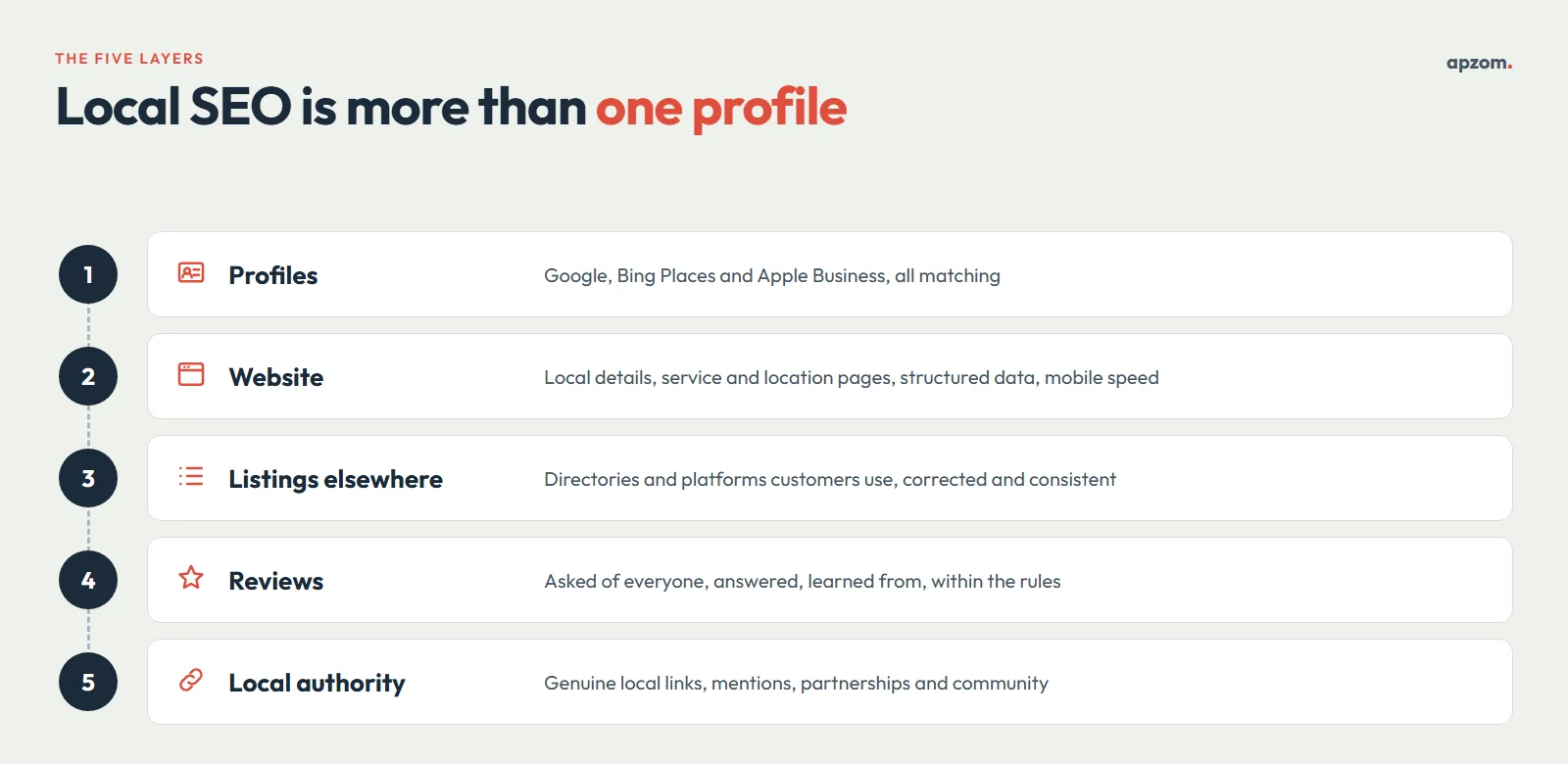
- Your profiles: Google Business Profile, plus Bing Places and Apple Business.
- Your website: the pages, details and technical health that support your local presence.
- Your listings elsewhere: directories, industry sites and platforms where your business appears.
- Your reviews: on Google and the other platforms your customers use.
- Your local authority: links, mentions and community presence that show you are a real, known local business.
Layer 1: Profiles beyond Google
Most local SEO advice stops at Google. Your customers may not.
- Google Business Profile: the most important single listing for most local businesses. Our Business Profile checklist covers it step by step.
- Bing Places for Business: a free listing that shows on Bing and Bing Maps. Bing lets you import your details from Google Business Profile, which saves time.
- Apple Business (formerly Apple Business Connect): a free way to manage how your business appears in Apple Maps, Wallet and other Apple apps. Many iPhone users find local businesses there.
Check each profile shows the same business name, address, phone number, hours, categories and website.
Layer 2: Your website
Your website is where local searchers check whether you are the right choice. It also gives search engines the detail your profile cannot hold.
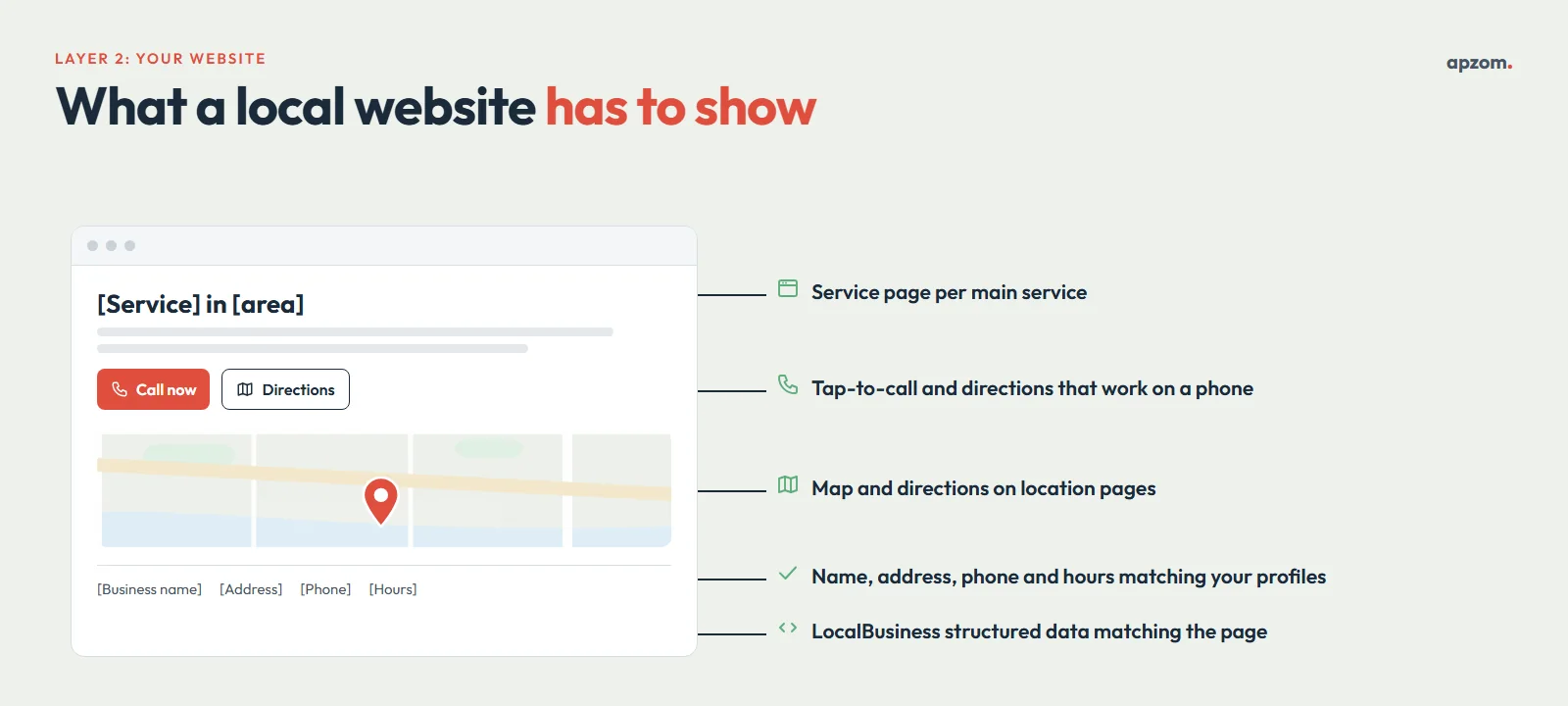
Local details on every page
- Your business name, address and phone number, written the same way as on your profiles, usually in the footer.
- Opening hours, kept in step with your profile, including holidays.
- A tap-to-call phone number and directions link that work on a phone.
- An embedded map on the contact or location page, if it helps visitors.
Service pages
One page for each main service, written for local searchers: what the service is, who it is for, how it works, typical questions, and how to book. A dental practice should have separate pages for implants, braces and emergency appointments rather than one “Treatments” page. Our guides for dentists, law firms and construction companies show what this looks like in each industry.
Location pages
- One location: your contact page, with real directions, parking or transit, photos and hours, does this job.
- Several locations: one page per real location, with its own address, phone number, hours, team, photos and local details, linked to that location’s Business Profile.
- Service-area businesses: pages for the main areas you genuinely serve, each with something real and different to say, such as local projects, area-specific services or travel details. Google’s spam policies describe pages created for many cities or regions that funnel visitors to one page as doorway abuse. Ten thin copies with a swapped town name are a risk, not a strategy.
Structured data
Google supports LocalBusiness structured data, which describes your business name and address (the two required properties), plus details such as phone number, opening hours and coordinates, in a format machines read easily. Google says it can be used to show business details, such as in a knowledge panel; it does not promise a ranking benefit. Use the most specific type that fits, such as Dentist or Plumber, and only describe what is true and visible on the page.
Mobile speed and usability
Most local searches happen on phones, often in a hurry. Check that pages load quickly, buttons are easy to tap and forms work on mobile. Google says its ranking systems use Core Web Vitals: Largest Contentful Paint (loading), Interaction to Next Paint (responsiveness) and Cumulative Layout Shift (visual stability).
Layer 3: Your listings elsewhere
Your business appears on many sites you may never have checked: general directories, industry directories, maps, review sites, chambers of commerce and data aggregators.
- Find them. Search for your business name, your phone number and your address. Note every listing.
- Fix them. Correct wrong names, old addresses, old phone numbers and closed locations. Remove duplicates where the platform allows it.
- Add the ones that matter. Prioritise platforms your customers actually use and respected directories in your industry and country, such as Yelp in the US, Yell in the UK or Justdial in India, rather than hundreds of low-quality directories.
Keeping your name, address and phone number consistent across the web is a widely followed local SEO practice. It helps customers find accurate details, and it helps search engines confirm which business is which. Google does not publish exactly how much consistency counts, so treat it as basic hygiene rather than a ranking shortcut.
Layer 4: Your reviews
Reviews influence both whether you appear and whether people choose you. Google says more reviews and positive ratings can help a business’s local ranking.
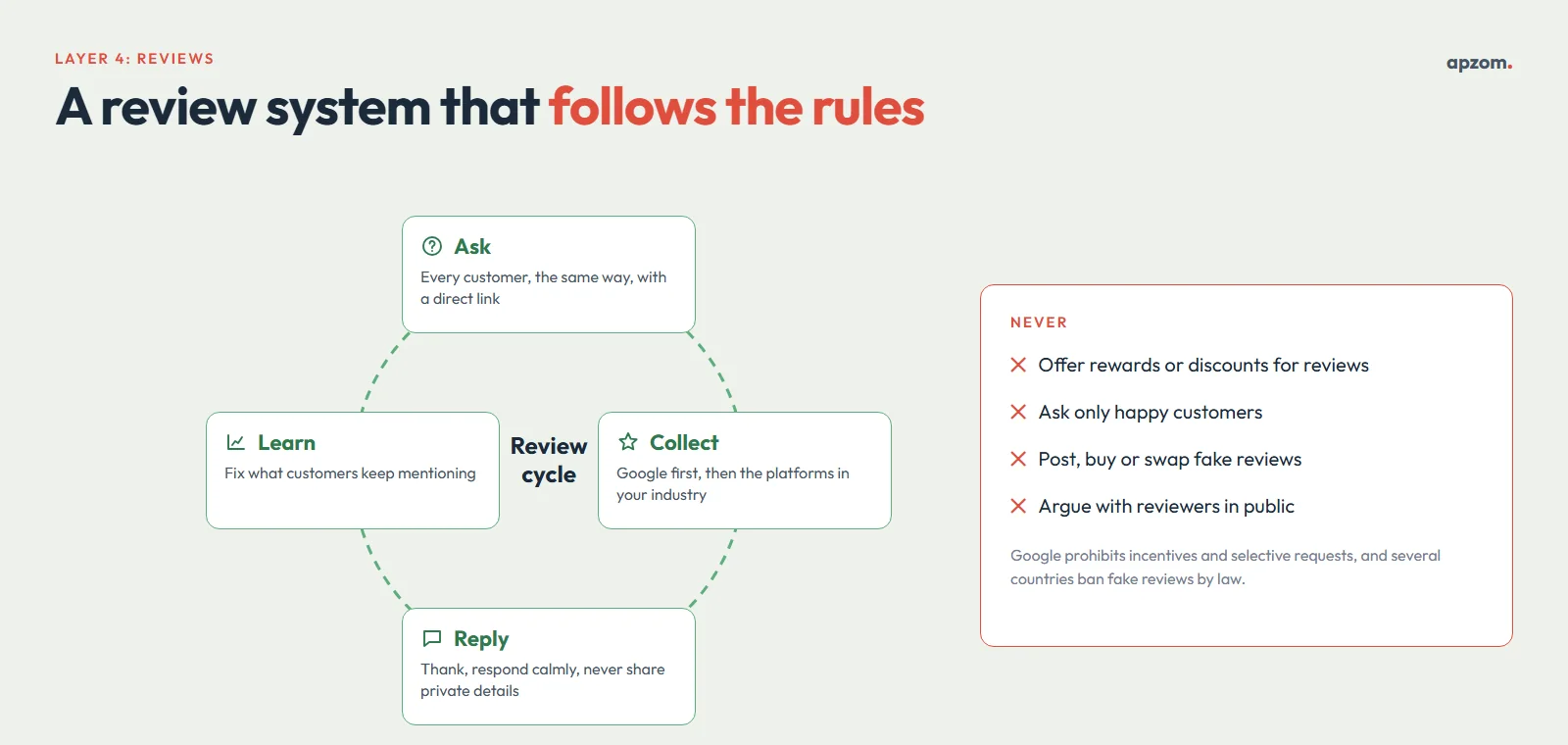
- Ask every customer, the same way. At the end of the service or in a follow-up message, with a direct link.
- Spread your effort. Google first for most businesses, then the platforms that matter in your industry.
- Reply to every review. Thank people for positive reviews and respond calmly and briefly to negative ones, without sharing private details.
- Learn from them. Repeated complaints are a business problem first and a marketing problem second.
- Follow the rules. Do not offer rewards for reviews, do not ask only happy customers, and never post or buy fake reviews. Google’s policies prohibit incentives and selective requests, and consumer laws in several countries ban fake reviews.
Layer 5: Local authority
Search engines look for signs that a business is real and known in its area. The best signs come from genuine local activity:
- Links and mentions from local news, community groups, schools, charities, events and suppliers you work with.
- Sponsorships and partnerships that come with a mention on the partner’s website.
- Local guides or resources on your website that other local sites want to link to.
- Membership of local business associations and industry bodies.
Avoid buying links or joining link networks. Google’s spam policies treat this as link spam, and it is easy to spot in a small local market.
Single location, multiple locations or service area?
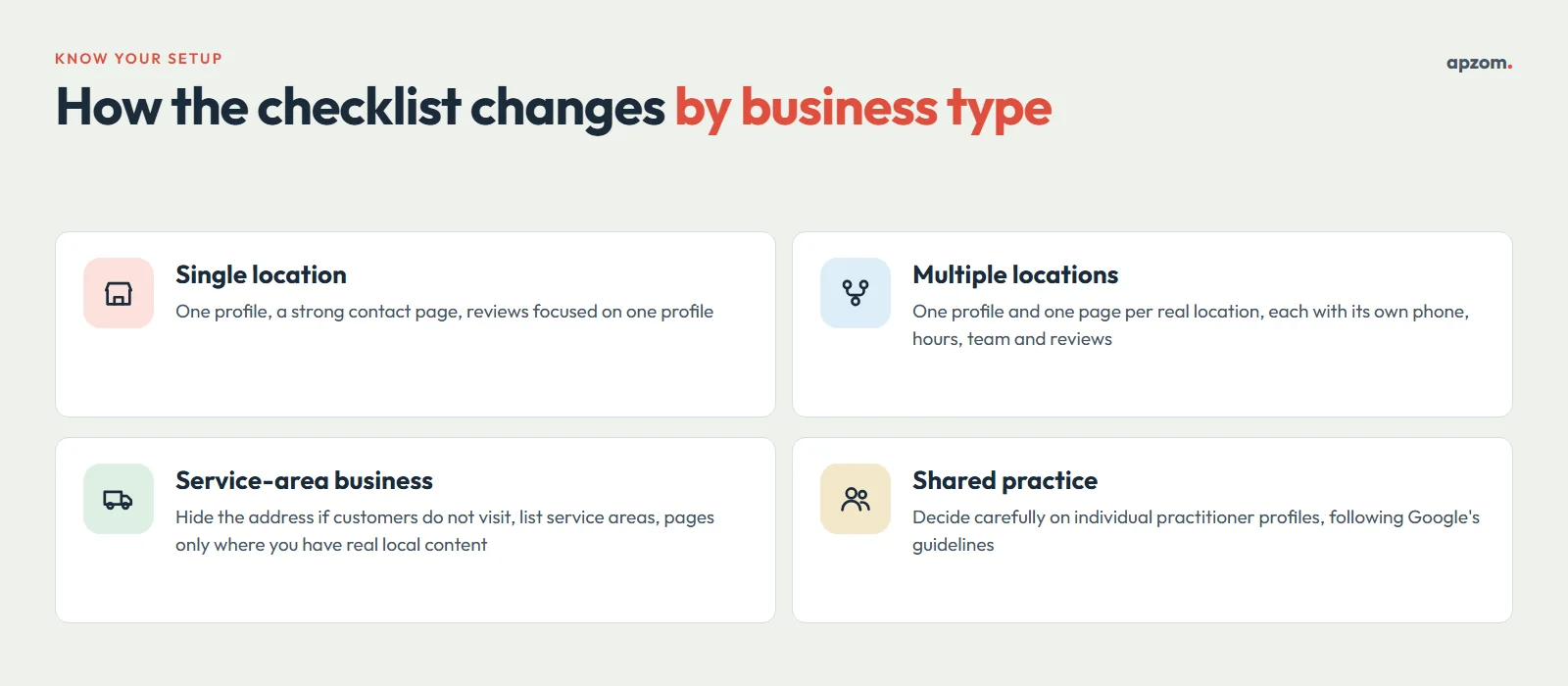
| Business type | What changes |
|---|---|
| Single location with a storefront | One profile, a strong contact page, reviews focused on one profile |
| Multiple locations | One profile and one website page per real location, each with its own phone, hours, team and reviews; consistent naming across all |
| Service-area business (visits customers) | Hide the address on your profile if customers do not visit, list service areas, build pages only for areas with real local content |
| Practitioners in a shared practice (doctors, lawyers) | Decide carefully whether individual practitioners need their own profiles, following Google’s guidelines |
Want to know which layer is holding you back? A Local SEO Audit checks your profiles, website, listings, reviews and local authority, and gives you a fix list in order of impact.
Measuring local SEO
| What to measure | Where |
|---|---|
| Profile views, searches, calls, direction requests and website clicks | Google Business Profile performance |
| Organic clicks and impressions for location pages and service pages | Google Search Console, filtered by page |
| Calls and forms from local pages | Call tracking and analytics |
| Review volume, rating and response rate | Your profiles and review platforms |
| Customers by source | Ask, and record it in your booking or sales system |
Search Console has no separate report for Google Maps, so combine it with your Business Profile performance data. Measure what matters most: calls, bookings and customers, not just rankings.
The quarterly local SEO checklist
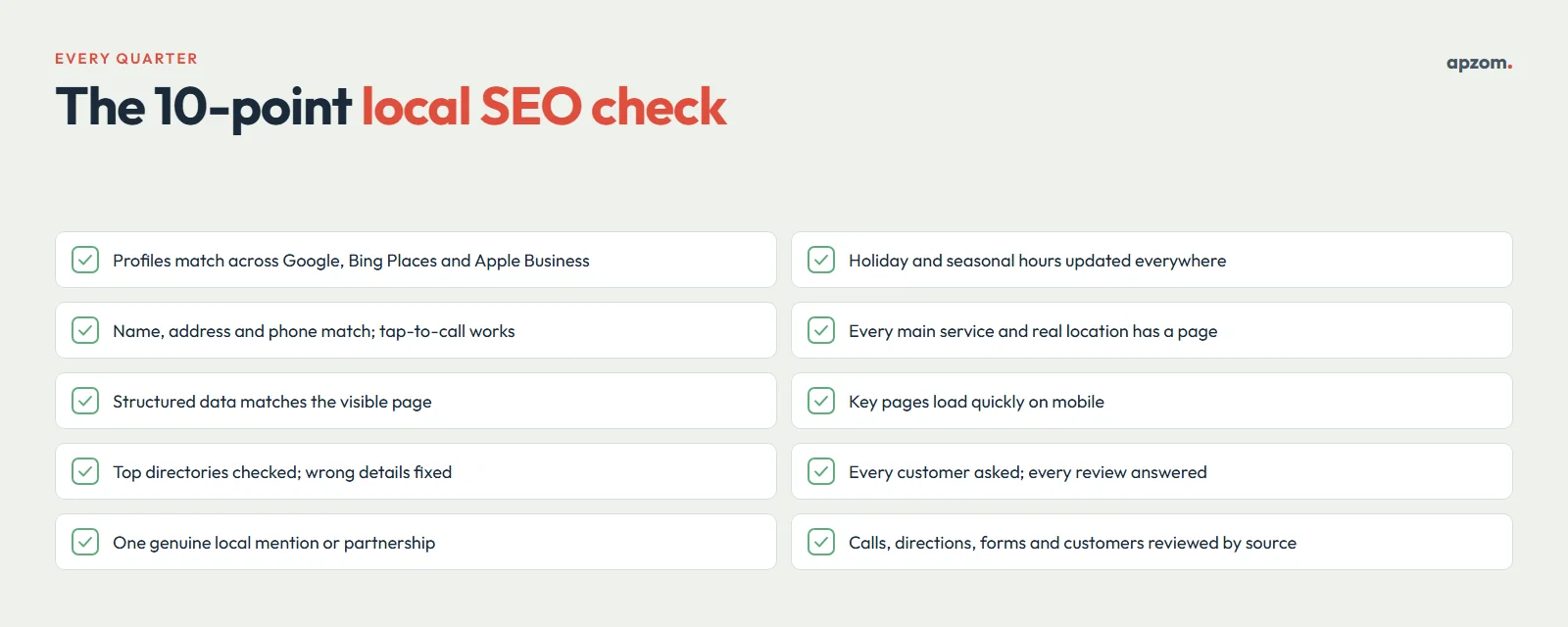
| Area | Check |
|---|---|
| Profiles | Google, Bing Places and Apple Business show the same name, address, phone, hours and website |
| Hours | Holiday and seasonal hours updated everywhere |
| Website | Name, address and phone match; tap-to-call and directions work on a phone |
| Pages | Every main service has a page; every real location has a page |
| Structured data | LocalBusiness details match the visible page |
| Speed | Key pages load quickly on mobile |
| Listings | Top directories checked; wrong details and duplicates fixed |
| Reviews | Every customer asked; every review answered; recurring issues raised internally |
| Authority | At least one genuine local mention or partnership this quarter |
| Measurement | Calls, directions, forms and customers by source reviewed |
Common local SEO mistakes
- Treating the Google Business Profile as the whole of local SEO.
- A website address or phone number that differs from the profile.
- Dozens of near-identical town pages.
- Old listings with a previous address or phone number left uncorrected.
- Asking only happy customers for reviews, or offering rewards for them.
- Measuring rankings instead of calls and customers.
Local SEO and paid search
Local SEO takes time. If you need customers this month, paid search can cover the gap while organic visibility grows. Our guide to SEO vs Google Ads explains how to decide and how to use both together.
How Apzom can help
Apzom Digital’s local SEO services cover all five layers: profiles, the website, listings, reviews and local authority, with reporting on calls and customers rather than rankings alone. We follow platform guidelines and will not create fake reviews, keyword-stuffed business names or doorway pages. Read how we approach search in our SEO methodology.
Request a Local SEO Audit. We check your Google, Bing and Apple profiles, website details and location pages, structured data, mobile speed, directory listings, reviews and local mentions, and how calls and customers are tracked. You get a prioritised checklist built for your business type.
The audit is free, with no obligation and no guaranteed rankings. Prefer to talk it through? Contact us or see all our services.
Frequently asked questions
What is local SEO?
Local SEO is the work that helps a business appear when nearby people search for what it offers, on Google Maps, local search results and other map apps. It covers your Business Profile, your website, your listings elsewhere, your reviews and your local reputation.
Is a Google Business Profile enough for local SEO?
It is the most important single piece, but not enough on its own. Your website, listings on other platforms, reviews and local mentions all affect whether you appear and whether people choose you.
Do I need a separate page for each location?
If you have several real locations, yes. Each one should have its own page with its own address, phone number, hours and local details. Do not create pages for places where you have no presence and nothing specific to say.
How do I rank in more nearby towns if I visit customers?
Set up your profile as a service-area business, list the areas you serve, and build website pages for your main areas only where you have real local content, such as projects or area-specific details. Near-identical town pages can be treated as doorway pages.
Does NAP consistency matter?
Keeping your business name, address and phone number consistent everywhere is a widely followed practice. It helps customers and search engines trust your details. Google does not say exactly how much it counts, so treat it as basic hygiene.
Should I list my business on Bing and Apple Maps?
Yes. Bing Places and Apple Business (formerly Apple Business Connect) are free, and many customers use them. Bing can import your details from Google Business Profile.
How long does local SEO take?
Fixing profiles, listings and website details can show effects within weeks. Building reviews, local authority and strong location pages takes months. Track calls and customers over time.
Can I pay Google to rank higher in local results?
No. Google says there is no way to request or pay for a better local ranking. Paid local visibility comes through ads, which are labelled separately.