
The short answer: a digital marketing agency for restaurants should help you fill tables and win orders from the right customers, at a profit. That means showing up in the few minutes when hungry people decide where to eat, making your menu, photos and reviews easy to trust on a phone, balancing delivery apps against your own direct orders, and bringing customers back so you are not paying to win them every time.
This guide is for owners and managers of restaurants, cafes, bars, cloud kitchens and multi-outlet chains. It explains how diners choose, which channels suit which kind of restaurant, how to treat your menu as marketing, the menu labelling and review rules that apply in several countries, and how to measure marketing in covers, orders and margin rather than likes.
Why restaurant marketing is different
- Decisions are fast. Many people choose where to eat within minutes, often on a phone, often while already hungry. Slow pages and missing menus lose them.
- The local radius is small. Most diners will only travel a short distance, and delivery zones are limited. Visibility outside your area is wasted.
- Photos and reviews do the selling. Diners trust what other diners say and what the food looks like more than anything a restaurant says about itself.
- Delivery apps are both partner and competitor. They bring orders you would not get alone, and they take a commission and often keep the customer relationship.
- Margins are thin. A marketing channel that brings orders at a loss is worse than no channel at all.
First, which kind of restaurant are you?
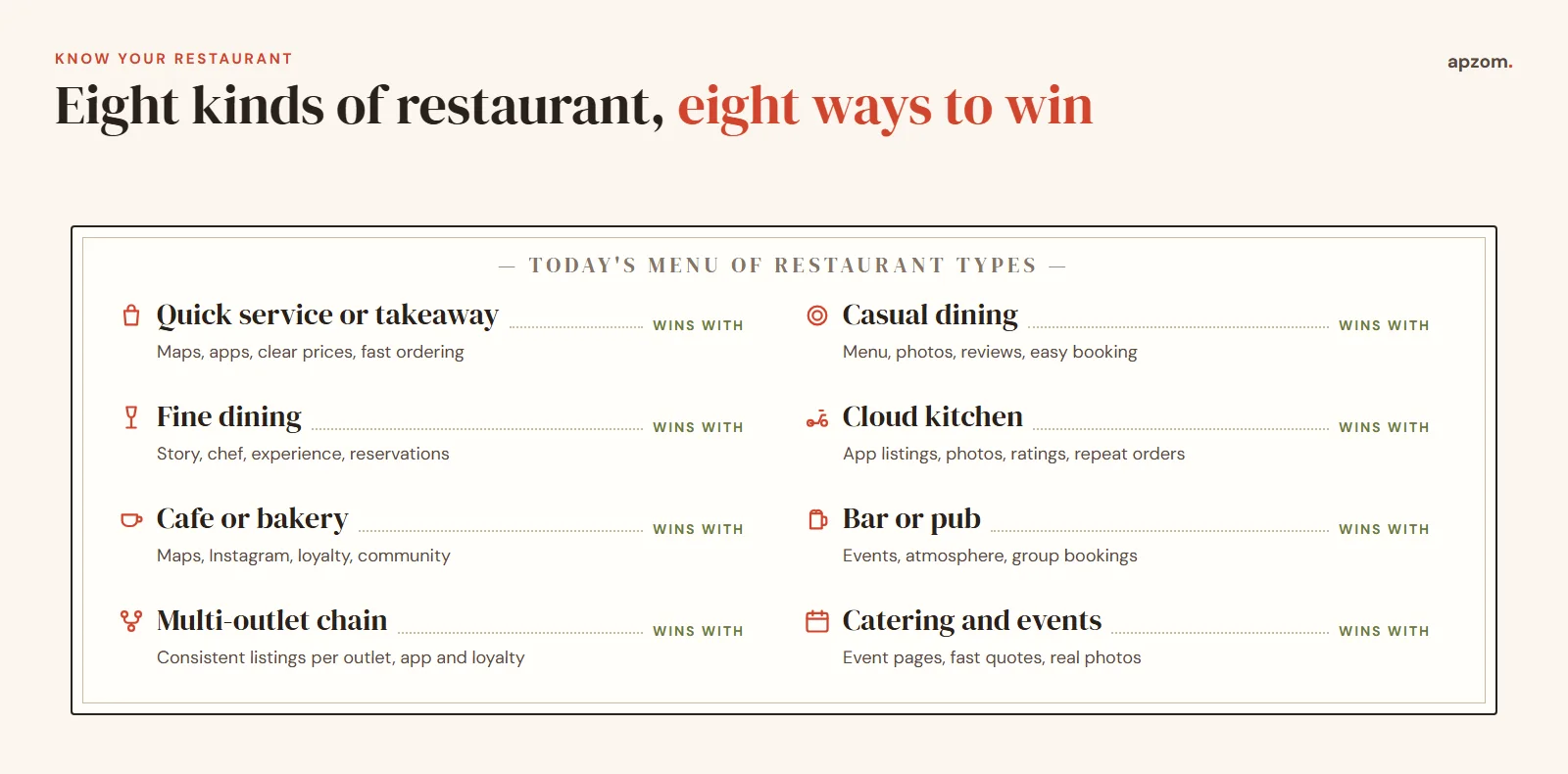
| Restaurant type | How customers choose | What wins them |
|---|---|---|
| Quick service or takeaway | Speed, price, location, delivery apps | Visibility on Maps and apps, clear prices, fast ordering |
| Casual dining | Occasion, reviews, photos, location | Menu, photos, reviews, easy booking or walk-in |
| Fine dining | Occasion, reputation, critics, word of mouth | Story, chef, experience, reservations, press |
| Cloud kitchen or delivery-only brand | Delivery apps, search, social media | App listings, photos, ratings, repeat ordering |
| Cafe or bakery | Habit, location, atmosphere | Maps presence, Instagram, loyalty, local community |
| Bar or pub | Events, atmosphere, groups | Events calendar, social media, group bookings |
| Multi-outlet chain | Brand familiarity, nearest outlet, offers | Consistent listings per outlet, app and loyalty, local pages |
| Catering and private events | Planning ahead, trust, menus and capacity | Event pages, fast quotes, reviews, photos of real events |
The hunger moment: how diners decide
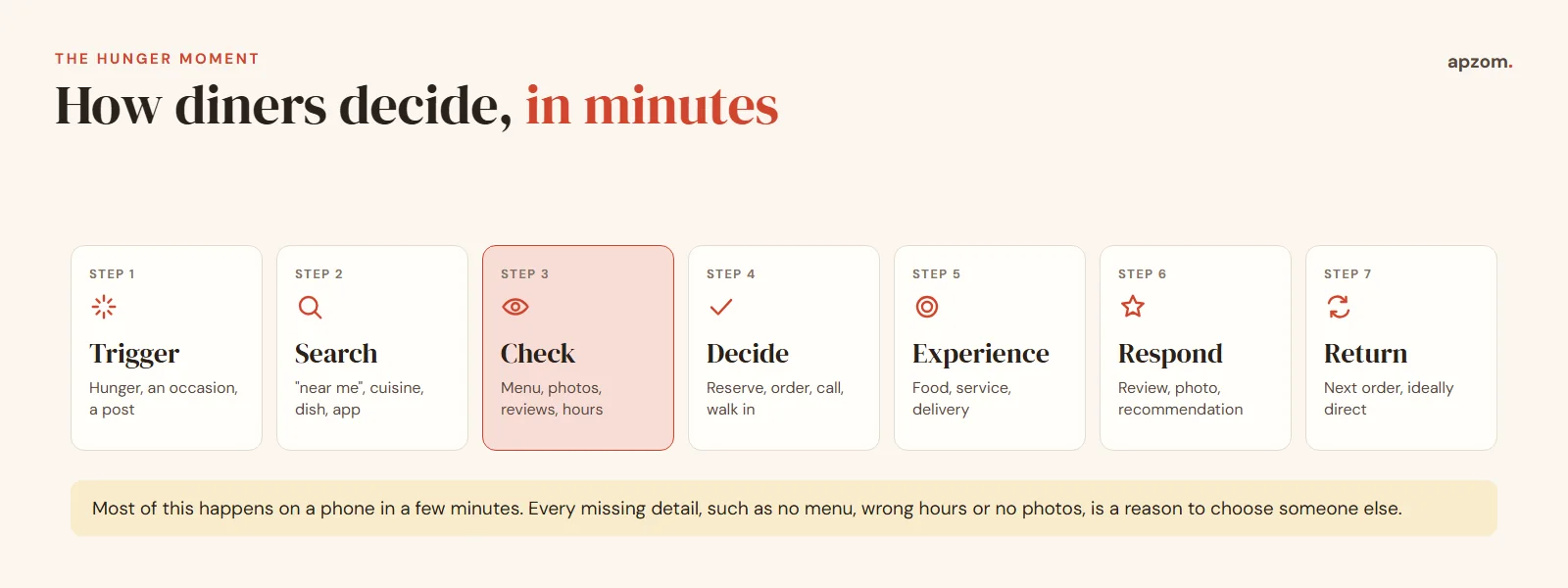
- Trigger: hunger, an occasion, a craving, a recommendation, a post on social media.
- Search: “near me”, a cuisine, a dish, a delivery app, or a specific restaurant name.
- Check: menu, prices, photos, reviews, opening hours, distance or delivery time.
- Decide: reserve, order, call or walk in.
- Experience: the food, the service, the delivery.
- Respond: a review, a photo, a recommendation, or silence.
- Return: the next order or visit, ideally direct.
Most of this happens on a phone in a few minutes. Every missing detail (no menu, wrong hours, no prices, no photos) is a reason to choose someone else.
Your Google Business Profile is your shop window
For most restaurants, the Google Business Profile shown in Search and Maps is the most important piece of online marketing. Many diners see it before they ever see your website.
- Hours that are always right, including holidays and special closures.
- A menu, using Google’s menu tools or a link to an up-to-date menu page on your website.
- Ordering and reservation links, pointing to your preferred route: your own ordering page, your reservation system or the platforms you use. Google’s “Order online” button can use ordering providers or your own links, and Reserve with Google works with supported booking providers in some countries.
- Real photos: dishes, interior, exterior, the entrance, so people recognise you when they arrive. Add new ones regularly.
- Attributes and service hours: set details such as outdoor seating or accessibility, and separate hours for delivery and takeaway if they differ from your opening hours.
- Review replies, to every review, briefly and professionally.
Our Google Business Profile checklist covers every setting in detail, and our local SEO checklist covers what to do beyond the profile.
Your menu is your best marketing page
Diners search for dishes, cuisines and dietary needs. A menu published as a photo or a PDF cannot be read well by search engines and is hard to use on a phone.
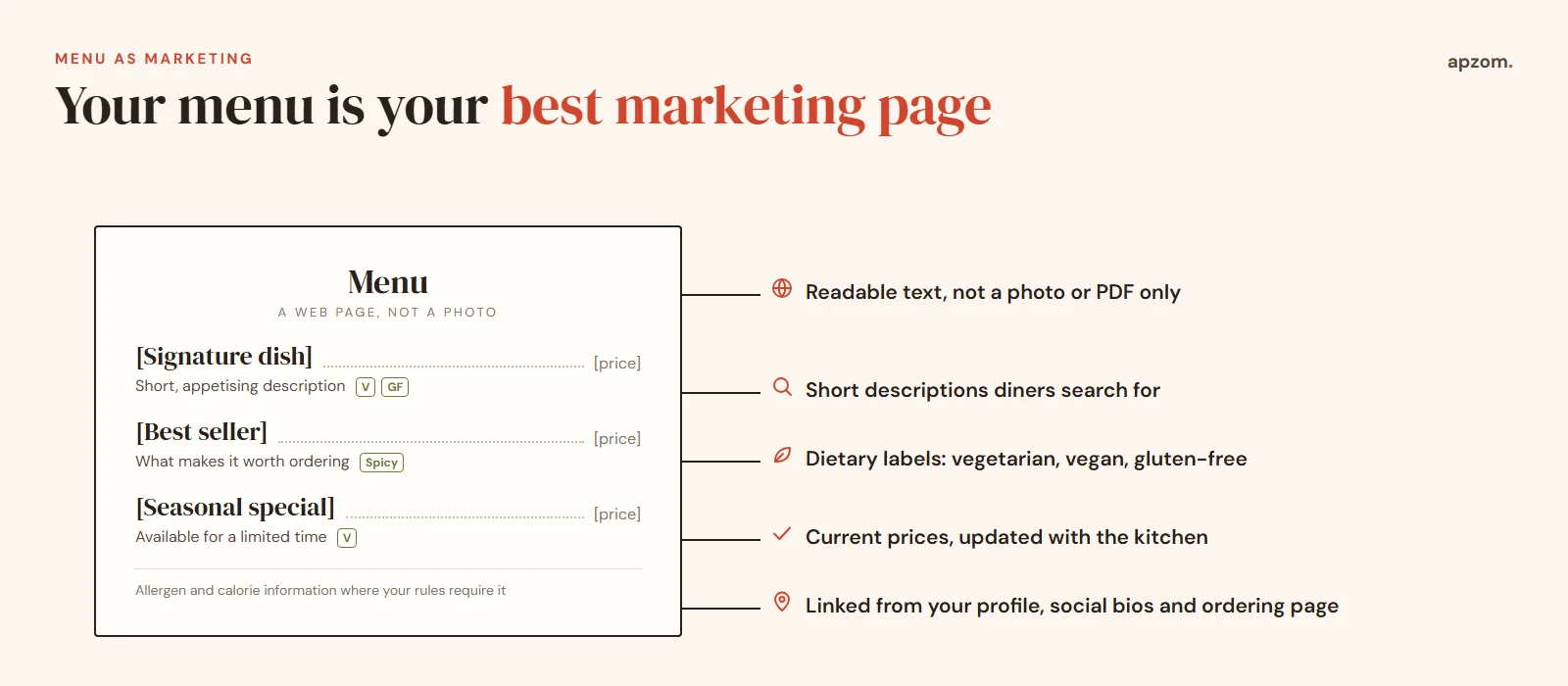
- Put the menu on an HTML page, with dish names, short descriptions and current prices.
- Mark dietary information clearly: vegetarian, vegan, gluten-free, spice level, and allergens where your rules require it.
- Use real photos of your best-selling dishes, not stock images.
- Keep it current. An old menu or old prices create disappointed customers and bad reviews.
- Link it everywhere: your Business Profile, your social media bios and your ordering page.
Menu labelling rules
Several countries require certain restaurants to show calories or allergen information, including online and on menus customers see before ordering:
- United States: chain restaurants with 20 or more locations must show calorie information on menus and menu boards, under FDA rules.
- United Kingdom: in England, larger businesses (250 or more employees) selling food out of home must show calories on menus, including online menus. Allergen information for the 14 major allergens must be available, and for food ordered online or by phone it must be available before purchase and at delivery.
- India: under FSSAI’s labelling and display rules, food service businesses with a central licence or outlets in ten or more locations must show calories per serving on menus, along with allergen information and the vegetarian or non-vegetarian symbol. Every food business must display its FSSAI licence or registration number at its premises, and food delivery platforms must show the licence number of each restaurant they list.
Check exactly which rules apply to your business. They change over time and depend on size and location.
Delivery apps or direct orders?
Delivery and ordering platforms such as Swiggy and Zomato in India, or Uber Eats, DoorDash and Deliveroo in other markets, bring customers who would never find you otherwise. They also charge commission and fees, and the customer often belongs to the platform rather than to you.
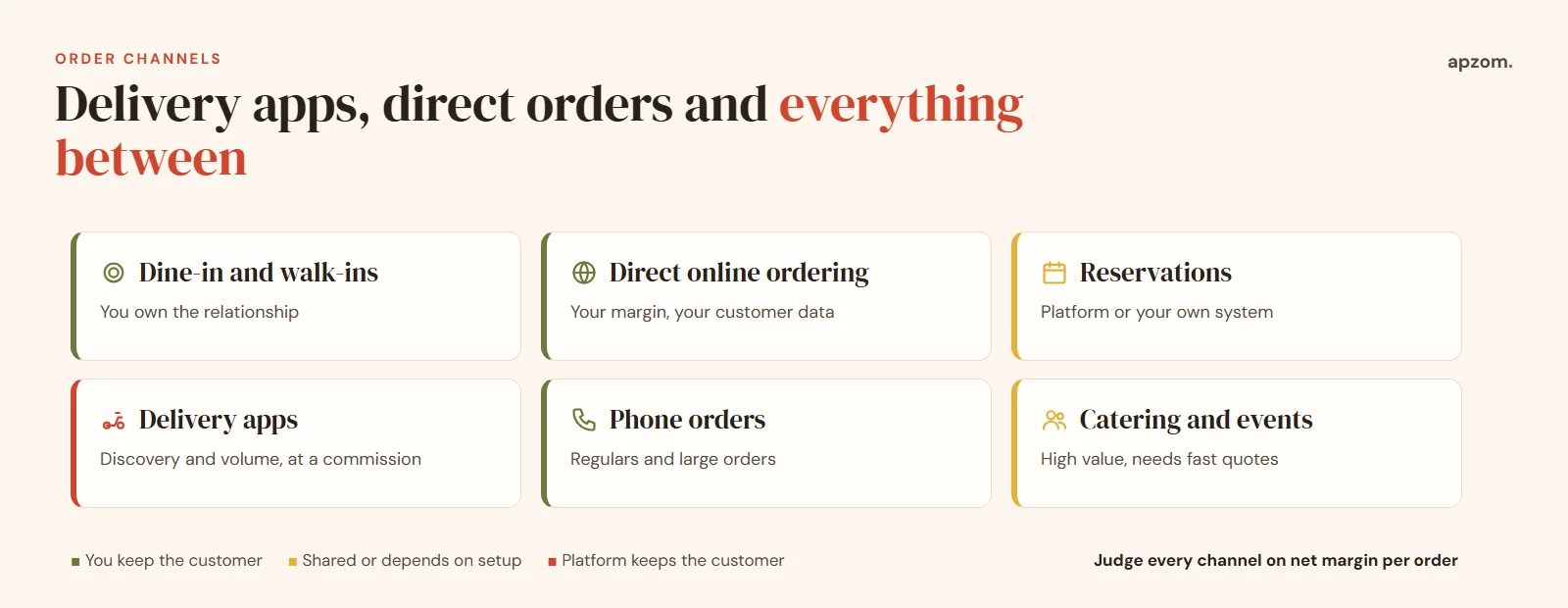
The practical goal is not to leave the platforms. It is to:
- Know your margin by channel. Compare what each order is worth after commission, packaging, discounts and marketing costs. Use your own contracts, not industry averages.
- Use platforms for discovery. Many first orders will come through apps, especially for cloud kitchens and new outlets.
- Move repeat customers to direct ordering where it makes sense, with a simple reason to order direct: a loyalty reward, a better portion, a direct-only dish or a faster pickup.
- Keep platform listings excellent anyway. Photos, descriptions, ratings and response to complaints affect how often platforms show you.
Read your platform contracts before advertising different prices or offers on your own channels.
Reviews: the engine of restaurant marketing
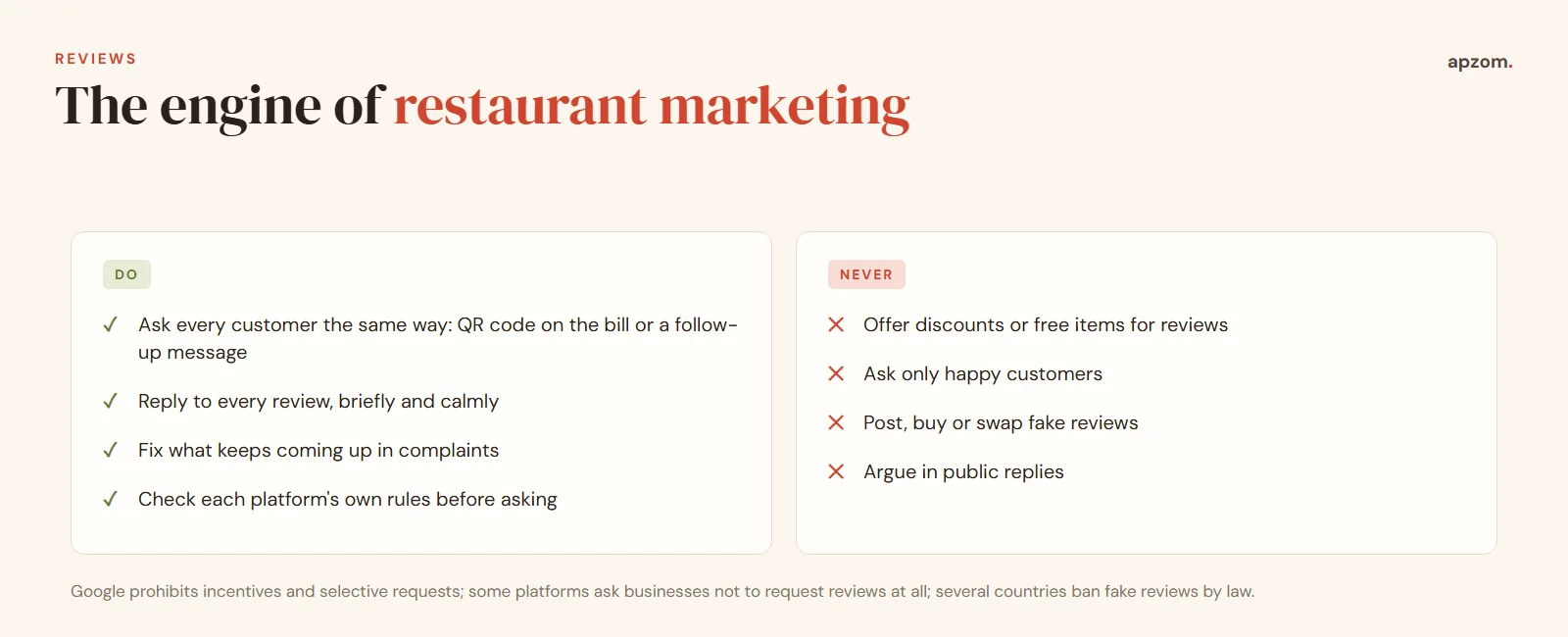
Reviews influence where diners go and how platforms and maps rank you.
- Ask in the right way. A small card, a QR code on the bill or a follow-up message works. Ask every customer the same way.
- Reply to every review. Thank people, and answer complaints calmly with an offer to put things right offline.
- Fix what keeps coming up. If several reviews mention slow service or cold delivery food, that is an operations problem marketing cannot hide.
- Follow platform rules. Google’s policies prohibit offering incentives such as discounts or free items for reviews and asking only happy customers. Some platforms take a stricter line: Yelp warns that proactively asking for reviews may hurt your Yelp rating. Consumer laws in several countries ban fake reviews.
Apzom’s online reputation management work is built around these rules.
Social media and content
Restaurants are made for visual platforms. Instagram, short video and YouTube show the food, the room and the people.
- Show real food and real people, with consent: the kitchen at work, a dish being plated, regulars, the team.
- Plan around occasions: festivals, sporting events, holidays, weekends, seasonal menus and local events.
- Answer messages fast. Many bookings and catering enquiries start as direct messages.
- Work with local creators carefully. Paid partnerships must be disclosed under advertising rules, and creators should experience the real food and service.
Our social media marketing service is built around this kind of planned, real content.
Busy in some places, quiet in others? A Restaurant Marketing Audit checks your Business Profile, menu page, reviews, social media, delivery listings and direct ordering, and shows where diners are choosing someone else.
Paid ads: local and timely
- Google Ads for high-intent searches such as “[cuisine] near me”, “[dish] delivery” or “private dining [area]”, tightly limited to your area and to opening hours. Send people to the matching menu or booking page. Our Google Ads management covers this.
- Meta Ads for reaching people nearby with new menus, events, offers and openings, and for reminding past customers. Our Meta Ads management covers local campaigns.
- Platform ads inside delivery apps can raise your visibility there. Measure them on net margin per order, not just order volume.
Bring customers back
Winning a new customer costs more than keeping one. A simple retention system:
- Collect contact details with consent, through direct ordering, reservations or a loyalty programme.
- Send useful, occasional messages: a new menu, an event, a birthday offer, a reminder for a regular order.
- Reward regulars in a way that suits your margins.
- Follow the email and messaging rules in each market. Our email marketing service handles this kind of programme.
Multi-outlet chains
Chains have extra work:
- One Business Profile and one website page per outlet, each with accurate hours, menu, photos and contact details.
- Consistent brand standards across outlets, with room for local events and offers.
- Review monitoring per outlet, so problems at one branch are spotted early.
- Reporting by outlet, so marketing spend follows the outlets that need it.
Measure covers, orders and margin
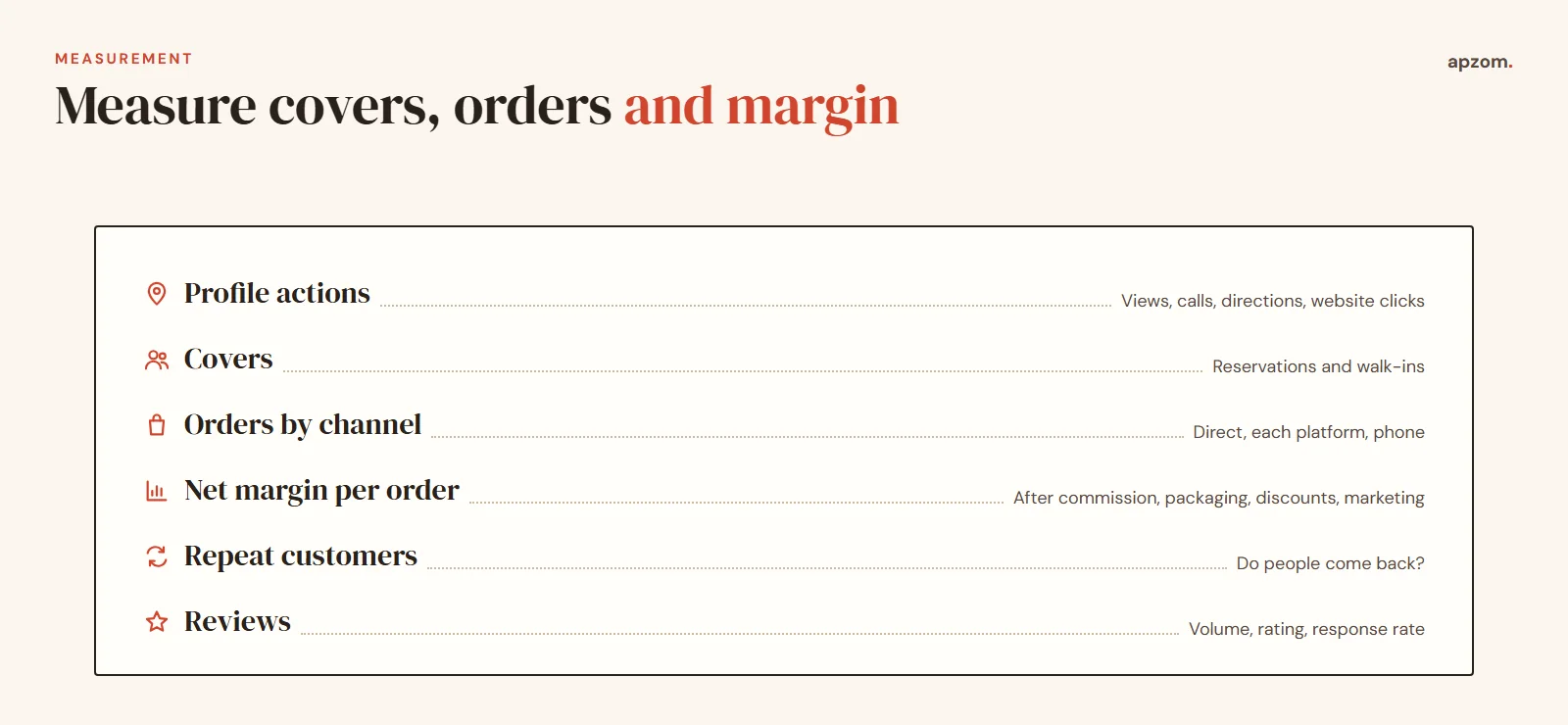
| Measure | Why it matters |
|---|---|
| Profile views, calls, direction requests and website clicks | Shows whether people find and act on your Maps presence |
| Reservations and walk-in covers | The core result for dine-in restaurants |
| Orders by channel (direct, each platform, phone) | Shows where demand comes from |
| Net margin per order, by channel | Shows which orders actually make money |
| Repeat customer rate | Shows whether the experience and follow-up bring people back |
| Review volume, rating and response rate | Drives trust and ranking |
Be wary of anyone quoting typical order values, commission rates or return-on-ad-spend for restaurants. They vary enormously by cuisine, city, platform contract and season.
AI search and dining decisions
People increasingly ask AI tools where to eat or what to order. Nobody can guarantee your restaurant will be suggested. Google says there are no special requirements to appear in its AI features; the same foundations apply. Accurate hours, a readable menu, real photos, recent reviews and consistent details across your website, profiles and platforms give you the best chance of being understood and recommended.
What a restaurant marketing agency should actually do
Questions to ask
- How will you measure results in covers, orders and margin by channel?
- How will you balance delivery platforms and direct orders for us?
- How will you keep our menu, hours and photos accurate everywhere?
- How will you handle reviews within platform rules?
- How will you plan around our busy and quiet periods?
Red flags
- Promises of guaranteed footfall or orders.
- Reporting only followers, likes and impressions.
- Stock photos of food that is not yours.
- Fake or incentivised reviews.
- Campaigns that bring orders at a loss.
How Apzom can help
Apzom Digital helps local businesses get found and chosen. For restaurants, that means local SEO, social media, Google and Meta ads limited to your area, website development with readable menus and direct ordering paths, review management and customer email. We do not have a restaurant case study to show yet, and we will not invent results. If you are comparing agencies, our guide on how to choose a digital marketing agency lists the questions to ask. We work with clients worldwide, remotely, from our base in Ahmedabad, India.
Request a Restaurant Marketing Audit. We review your Google Business Profile and Maps presence, menu and photos, reviews and replies, delivery platform listings, direct ordering and reservations, social media, local ads, and how you track covers, orders and margin by channel. You get a prioritised list of what to fix first.
The audit is free, with no obligation and no guaranteed footfall. Prefer to talk it through? Contact us or see all our services.
Frequently asked questions
What does a digital marketing agency for restaurants do?
It helps restaurants get found by nearby diners, makes the menu, photos and reviews easy to trust, balances delivery platforms with direct orders, and brings customers back. A good one measures results in covers, orders and margin by channel.
How can a restaurant get more customers online?
Keep your Google Business Profile complete and accurate, publish a readable menu with real photos, ask every customer for a review and reply to them all, post real food and events on social media, and run small, local, well-timed ads.
Should restaurants use delivery apps?
Usually yes, especially for discovery and for delivery-led concepts, but measure the net margin per order after commission and costs. Encourage repeat customers to order direct where it makes sense.
Is SEO worth it for restaurants?
Yes, mainly local SEO: a strong Business Profile, a readable menu page, accurate details across platforms and reviews. Many restaurant searches happen on Maps, so the profile matters as much as the website.
Should our menu be a PDF?
Offer a PDF if you like, but publish the menu as a normal web page too. A web page is easier to read on a phone, easier to keep current and easier for search engines to understand.
Do restaurants need to show calories on online menus?
It depends on where you operate and how big you are. US chains with 20 or more locations, larger businesses in England and certain food businesses in India have calorie labelling rules. Check the rules that apply to you.
How do we get more restaurant reviews?
Ask every customer the same way, with a QR code or follow-up message, and reply to every review. Do not offer discounts or free items for reviews, and check each platform’s own rules: Google allows asking, while Yelp advises against it.
How do we measure restaurant marketing?
Track reservations and covers, orders by channel, net margin per order, repeat customers and reviews. Judge every channel on the money it actually brings in after costs.