
The short answer: Good digital marketing for a recruitment or staffing agency wins on two sides at once: it brings in clients with jobs to fill, and candidates who can fill them. It does that with a clear specialism, a website built around the sectors and roles you really place, job pages that search engines can read and candidates can apply to on a phone, steady proof for clients, and job ads that follow the law in each market. A good agency will measure results in roles briefed, candidates submitted and placements made, not clicks or followers.
This guide is for recruitment agencies, staffing and temp agencies, executive search firms, contract and labour hire providers and niche recruiters, in any country. It covers how clients and candidates search, how to structure your website, job pages and Google’s job results, winning clients, paid ads and their targeting limits, candidate data, reviews, the rules on job adverts by country, and what to measure.
Staffing is a big market, and a crowded one. In the US alone, the Bureau of Labor Statistics counted about 2.49 million jobs in temporary help services in September 2026 (Current Employment Statistics, seasonally adjusted, preliminary). Every one of those roles needed a client to brief it and a candidate to fill it. That is the problem recruitment marketing has to solve.
Why recruitment marketing is different
Most businesses market to one kind of customer. A recruitment agency markets to two, and they want different things:
- Clients (hiring managers, HR teams, business owners) want to know you understand their sector, can find people they cannot find themselves, and will not waste their time.
- Candidates want real jobs, honest pay information, a quick way to apply and to be treated well, even when they do not get the job.
A placement only happens when both sides say yes. Three more things make recruitment different:
- Your stock expires. Jobs open and close every week, so job pages come and go, while the pages that build search visibility over time are the ones that stay.
- Trust is fragile. Fake job ads and recruiter scams are common, so candidates are wary. FTC data show reports of job and employment agency scams tripled between 2020 and 2024 in the US, and reported losses rose from $90 million to $501 million (FTC, March 2025).
- Job adverts are regulated. What an advert must say, what it must not say and how it can be targeted is set by law in many countries, and the rules differ by country and even by state.
Two audiences, one brand
The first framework we use with recruitment clients is the two-sided map. Write down, for each side, what they search for, what they need to see, where you can reach them, and what you will measure.
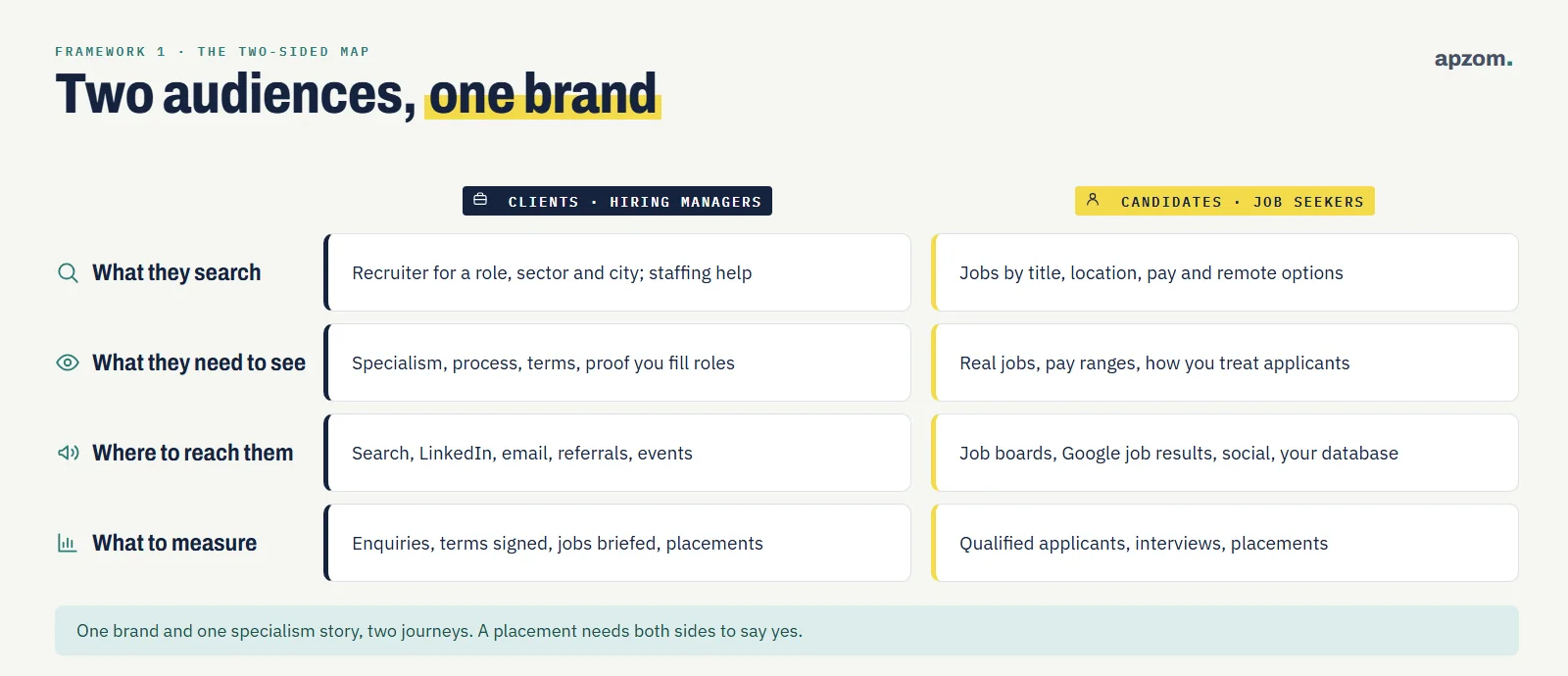
| Question | Clients and hiring managers | Candidates and job seekers |
|---|---|---|
| What they search | “IT recruitment agency London”, “temp staffing for warehouses”, “executive search firm healthcare” | Job titles with a location, pay or “remote”; your agency name once they have heard of you |
| What they need to see | Your specialism, process, terms, speed and proof that you fill roles like theirs | Real, current jobs, pay information, what happens after they apply, and how you handle their data |
| Where to reach them | Search, LinkedIn, email, referrals, events, your own content | Job boards, Google’s job results, social media, your own candidate database |
| What to measure | Enquiries, terms agreed, jobs briefed, placements, repeat clients | Qualified applications, candidates submitted, interviews, placements |
The brand ties the two together. One clear specialism story, such as “we place finance staff for mid-sized firms in Manchester” or “we supply licensed warehouse staff in Melbourne”, works better on both sides than “we recruit for all industries”.
Build your website around what you place
Most agency websites are a job board with a homepage on top. The second framework is the specialism-first site: build evergreen pages around the sectors, roles and places you really work in, and let job pages come and go beneath them.
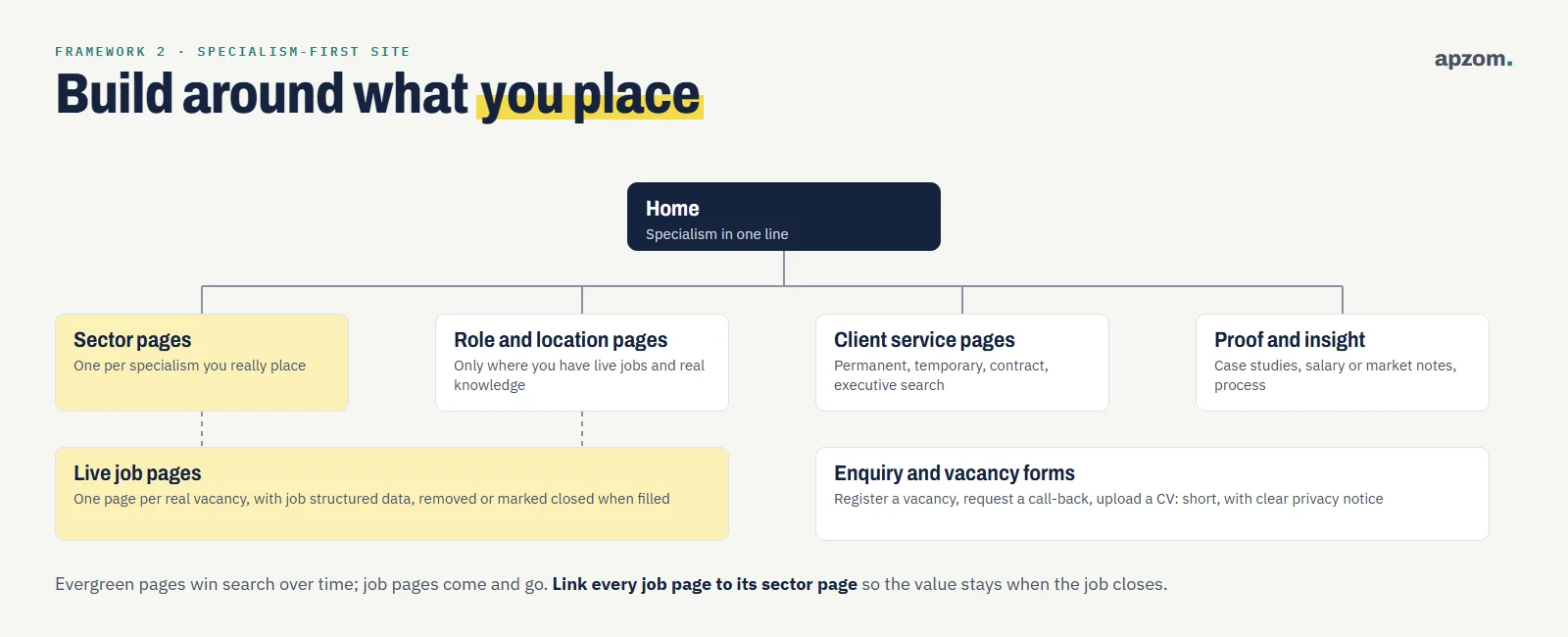
- Sector pages, one for each specialism you really place: who you place, which roles, typical contract types, how your process works for that sector, and the live jobs in it.
- Role and location pages, only where you have regular jobs and real knowledge, such as “accounts payable recruitment in Leeds” or “registered nurse agency shifts in Sydney”. A page for every city in the country, with the same text and a different name, will not help you and may count as doorway pages under Google’s spam policies.
- Client service pages for permanent recruitment, temporary and contract staffing, executive search or labour hire, with how you work, what you need from the client and your terms in plain words.
- Proof and insight: case studies with the client’s permission, notes on your market based on your own placement data, and your process.
- Short forms: register a vacancy, request a call-back, upload a CV. Each with a clear privacy notice.
Link every job page to its sector page. When the job closes, the sector page keeps the value of the links and visits it brought in.
Job pages that get found and get applications
The third framework is the job page test. Before you promote a job, check its page against eight points.
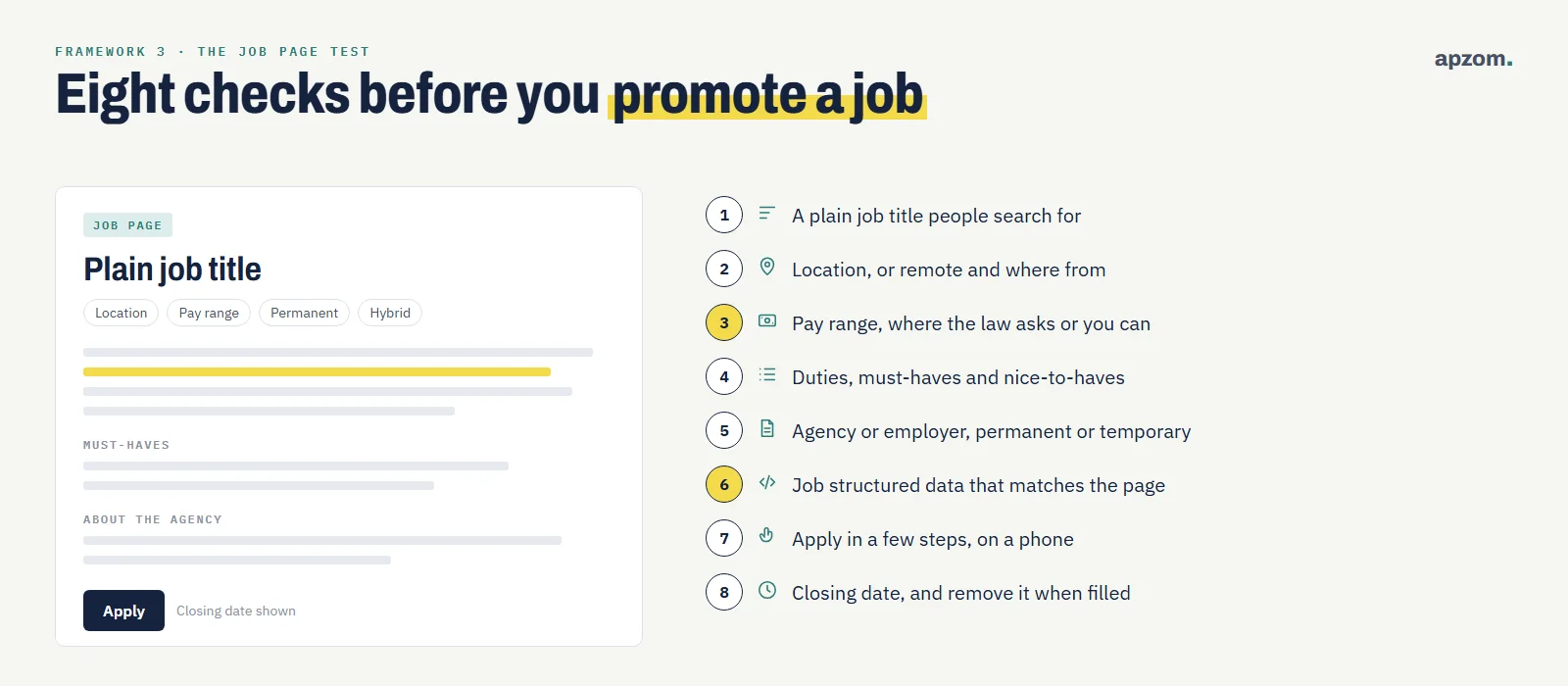
- A plain job title people really search for, such as “Payroll Administrator”, not “Payroll Ninja”.
- The location, or if the job is remote, where the person can be based.
- Pay information where the law requires it, and wherever you can share it anyway.
- The duties, the must-haves and the nice-to-haves, in short lists.
- Who is hiring and on what basis: your agency’s name, and whether the role is permanent or temporary.
- Job structured data that matches what the page shows.
- A short application that works on a phone.
- A closing date, and the page updated or removed as soon as the job is filled.
Google’s job results and JobPosting markup
Google shows job listings in a special search experience, built from JobPosting structured data on employers’ and agencies’ own pages. Google’s rules are strict:
- One job per page. Google says the markup “must only be used on pages that contain a single job posting”, and not on pages that list several jobs.
- No expired jobs. “We don’t allow expired job postings.” Remove the markup or the page when the role closes, or add a validThrough date.
- Required details: the title, description, date posted, hiring organisation and job location. Google also recommends pay (baseSalary), employment type, a direct apply flag, an identifier, and remote-work details for remote roles.
- Faster updates: Google recommends its Indexing API for job posting URLs. The API is officially supported only for job posting pages and livestream video pages.
- Not every country. The feature works in many countries, including the US, Canada, the UK, India and parts of the EU, but Google’s region list leaves out some European countries, including Ireland and Poland. Check the list before you count on it in a market.
Your job board or applicant tracking system may add this markup for you. Check that it does, that the details match the page, and that closed jobs really disappear.
Job boards, LinkedIn and your own website
Job boards and LinkedIn bring volume, and most agencies need them. They also charge you to reach people, and the candidates you meet there are easy for competitors to reach too.
- LinkedIn promoted job posts are pay-per-click, capped by a daily or total budget you set. LinkedIn’s help pages say you only pay for clicks from the country where the job is posted.
- Indeed charges for sponsored jobs either per click or per started application, depending on the market and the budget type. In Australia, Indeed describes a pay-per-started-application model for qualifying jobs.
- Your own website and database are the assets you control. Every candidate who applies through a job board is a chance to bring them into your own talent pool, with their permission, so you can contact them about the next role without paying again.
Compare channels by cost per qualified candidate and per placement, not by cost per click or application.
Winning clients
Candidate marketing fills the pipeline. Client marketing keeps the business alive. Clients choose agencies they trust to understand their world, so show that you do:
- Be specific. A page that explains how you recruit warehouse supervisors across three named regions beats a page that says “we provide end-to-end talent solutions”.
- Publish what you know. Short notes on pay trends, notice periods or skills shortages in your sector, based on your own placement data, give hiring managers a reason to read and share. Never invent numbers. If you publish a salary guide, explain where the data comes from.
- Show proof. Case studies, with the client’s permission, that explain the brief, what you did and how long it took. Named client logos only where you have permission.
- Use LinkedIn properly. Recruiters’ own posts often reach more people than a company page. Share real insight, not just “hot jobs”.
- Email carefully. In the UK, the ICO says the PECR rule on marketing emails does not apply to companies, but you must say who you are and give a working way to opt out. Sole traders and some partnerships count as individuals and need consent. Rules on business email differ in the EU, US, Canada and elsewhere, so check them before you build a list.
- Answer vacancy enquiries fast. A hiring manager who fills in your form has often contacted other agencies too. Reply the same day with a clear next step.
Plenty of applicants, not enough placements? A Recruitment Marketing Audit follows clients and candidates from first search to placement and shows where each side drops off.
Paid ads for recruiters: know the targeting limits
Paid ads can fill hard-to-fill roles and reach hiring managers, but job ads carry special targeting rules on the big platforms.
- Meta (Facebook and Instagram) requires job ads that reach the US, Canada or Europe to run in the Employment special ad category. According to Meta’s developer documentation, you cannot choose a specific age range or gender, target postcodes, exclude detailed-targeting groups or use lookalike audiences, and location targets need a minimum radius of 15 miles (25 km) in the US and Canada, or 15 km in Europe. Our guide to Facebook and Instagram ads for local businesses explains the set-up.
- Google Ads says that in the US and Canada, ads for employment cannot be targeted by gender, age, parental status, marital status or ZIP code. Radius targeting of at least 1 km and city or country targeting are still allowed. See our guide to Google Ads for small businesses.
- LinkedIn ads suit reaching hiring managers by job title, industry and company size, for your client-side marketing.
These limits exist to stop job ads excluding people unfairly. Write the ad so it appeals to the right candidates through the job itself, not through who you exclude.
Candidate data and privacy
Recruiters handle a lot of personal data, and candidates notice how you treat it.
- Sourced candidates (UK and EU): under GDPR, if you collect someone’s details from somewhere else, such as a professional network, you must give them your privacy information within a reasonable period, at the latest within one month, or when you first contact them if that is sooner.
- Social media (UK): the ICO’s draft recruitment guidance says recruiters should not search candidates’ personal social media profiles, even public ones, and that a direct message on social media counts as direct marketing.
- Keep it short and clear: say on every form what you will do with a CV, who you will share it with, and how long you keep it.
- Never send a CV to a client without the candidate’s agreement for that role.
Reviews and reputation
Clients and candidates both check reviews before they trust an agency. Google allows you to ask genuine clients and placed candidates for reviews. You cannot offer any incentive, ask only the people you expect to be positive, or let your own recruiters review the firm, because Google treats reviews based on “current or former employment” as a conflict of interest.
Glassdoor lets employers encourage honest reviews, but bans incentives such as cash, time off, gift cards or merchandise. Our guide on how to get more Google reviews explains how to ask without breaking the rules, and our Google Business Profile optimization checklist covers your profile if candidates or clients visit your office.
Reply to reviews calmly, especially from candidates who did not get a job. Thank them, explain what you can, and never share private details in a reply.
Rules to know: job adverts, pay and licences
This is a starting point, not legal advice. Job advert rules change often, so check them for each market you recruit in.
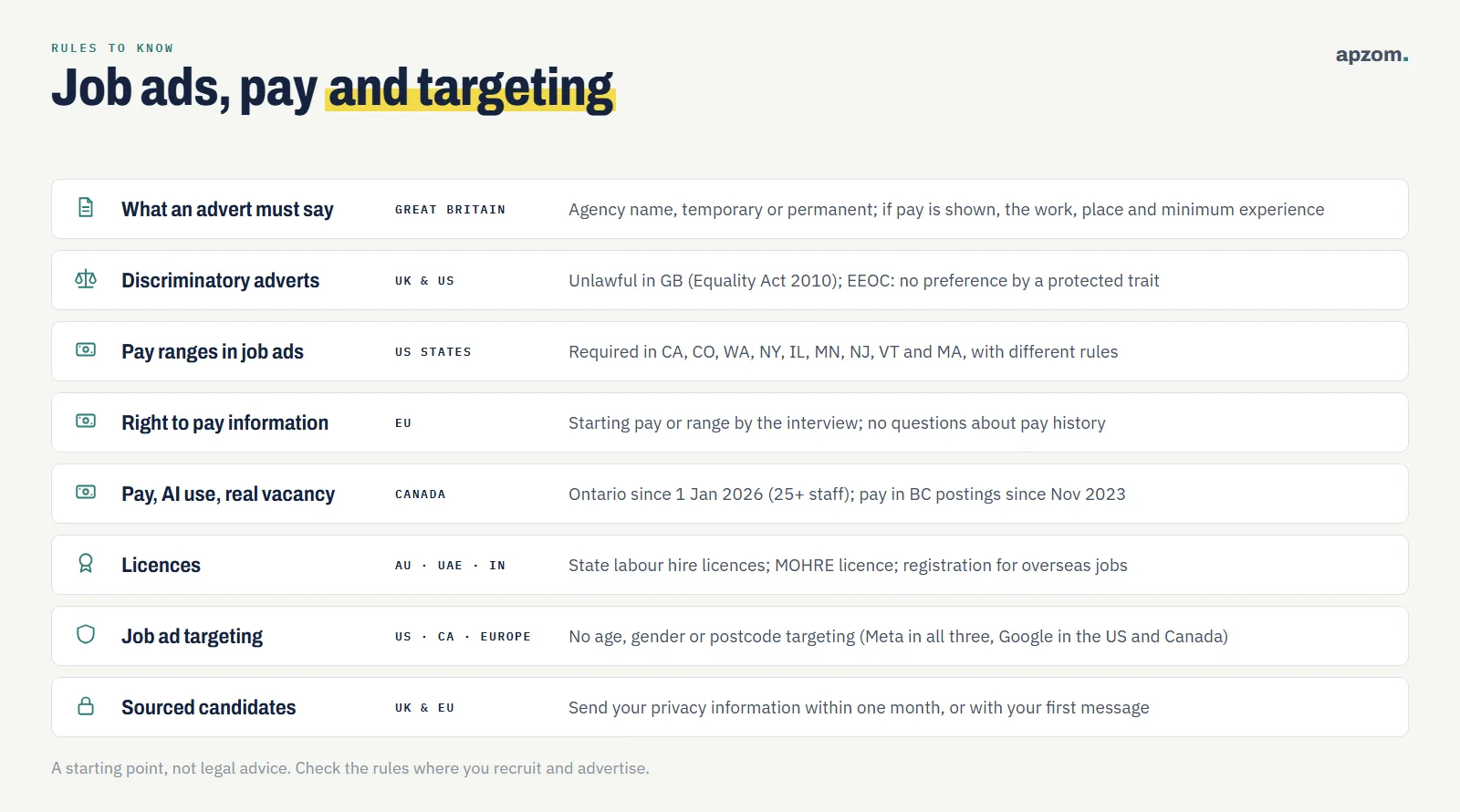
| Country or region | What to know |
|---|---|
| Great Britain | Under the Conduct of Employment Agencies and Employment Businesses Regulations 2003, every advert must show the agency’s full name and whether each role is temporary or permanent. If it quotes a pay rate, it must also state the nature of the work, the location and the minimum experience, training or qualifications. Agencies generally cannot charge candidates a fee for finding them work. Since 7 April 2026 the Fair Work Agency, which replaced the Employment Agency Standards Inspectorate, enforces these rules in England, Scotland and Wales. |
| UK (discrimination) | Placing or publishing a discriminatory job advert is unlawful under the Equality Act 2010, and this covers employment agencies. The EHRC gives “salesgirl” and “young and dynamic” as examples of wording to avoid. |
| United States | The EEOC says job adverts must not show a preference for, or discourage, people based on race, colour, religion, sex, national origin, age (40 and over), disability or genetic information. Several states require pay ranges in job ads, including California, Colorado, Washington, New York, Illinois, Minnesota, New Jersey, Vermont and Massachusetts. In California, Washington, Illinois and Minnesota the rules expressly cover postings made through third parties such as recruiters. In New York, temp-agency postings for client assignments are carved out. |
| European Union | Under the Pay Transparency Directive, which EU countries had to bring into national law by 7 June 2026, candidates have a right to the starting pay or pay range, for example in the advert or before the interview. Employers may not ask about pay history, and adverts and job titles must be gender-neutral. National rules differ, so check each country. |
| Canada | Since 1 November 2023, British Columbia employers must include the expected pay or a pay range in publicly advertised jobs. Since 1 January 2026, Ontario employers with 25 or more employees must include expected pay (or a range no wider than $50,000) unless it is over $200,000, disclose AI used in screening, say whether the vacancy exists, and drop “Canadian experience” requirements. Ontario temporary help agencies and recruiters have needed a licence since 1 July 2024. |
| Australia | There is no single national labour hire licence. Queensland, Victoria, South Australia and the ACT run their own schemes. In Victoria it is an offence to advertise labour hire services without a licence, including on social media or a website, with maximum penalties in 2026-27 of $41,820 for individuals and $167,280 for companies. |
| UAE | Recruitment and employment mediation needs a licence from the Ministry of Human Resources and Emiratisation (MOHRE), and workers must not be charged recruitment fees. The labour law bans discrimination on race, colour, sex, religion, national or social origin or disability, while measures that promote Emirati employment are allowed. |
| India | Any agency recruiting people for jobs abroad must hold a registration certificate under the Emigration Act 1983. Candidates can check an agent on the government’s eMigrate portal, and the Ministry of External Affairs refers illegal recruiters to the police. Show your registration number clearly if you recruit for overseas roles. |
Measure the placement, not the click
The fourth framework is placement maths. Track both sides of the funnel, by source, and join them at the placement.
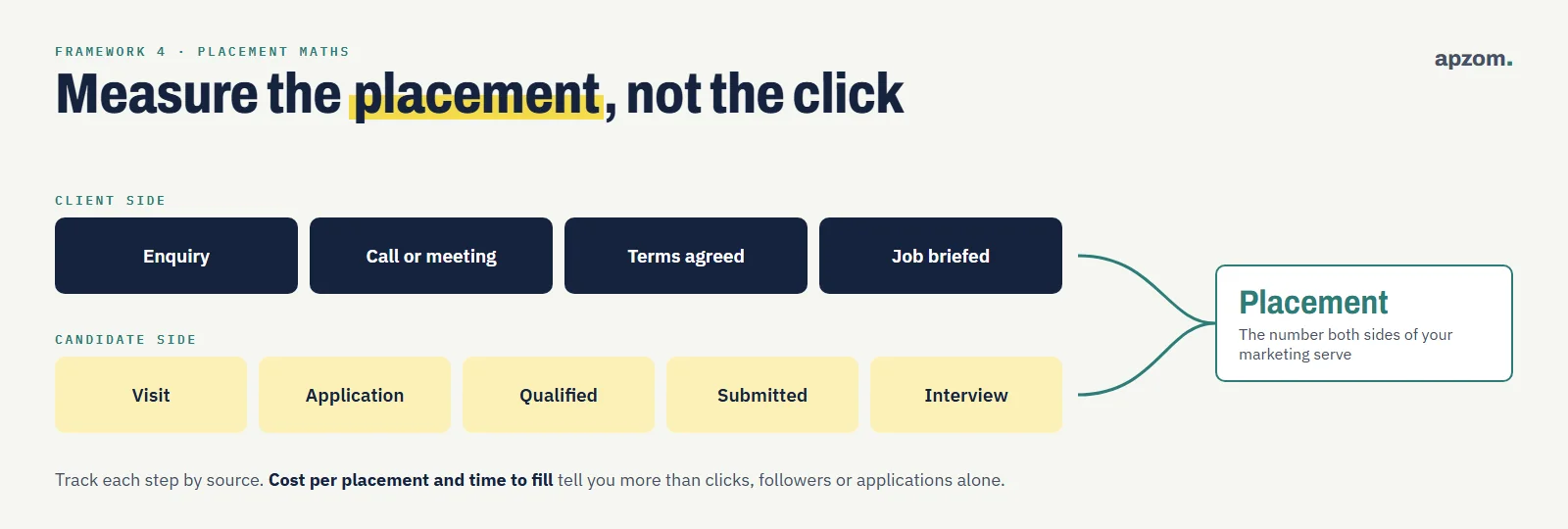
- Client side: enquiries, calls or meetings, terms agreed, jobs briefed, and repeat clients.
- Candidate side: visits to job pages, applications, qualified candidates, candidates submitted to clients, interviews, placements.
- The numbers that matter most: cost per placement and time to fill, by channel and by sector.
- Fill rate: how many briefed jobs you actually fill. Marketing that brings more jobs you cannot fill is not helping.
- Database growth: how many candidates join your own talent pool each month, with permission, so you rely less on paid job boards.
Most of this data already sits in your applicant tracking system or CRM. The job of marketing is to tag every enquiry and application with its source so you can see which channels lead to placements.
How Apzom can help
Apzom Digital helps service businesses win the right clients and measure what matters. For recruitment and staffing agencies, that means SEO for sector, role and job pages, website development with job pages and structured data done properly, Google Ads and Meta ads set up within each platform’s employment rules, social media marketing, content marketing for your sector insight, email marketing to clients and candidates, and reputation management. We work with clients worldwide, remotely, from our base in Ahmedabad, India.
We have not published a recruitment industry case study yet, so we will not show you one. Our case studies page shows the lead generation and search work we have done for other businesses. We will not promise a number of placements. We will show you where clients and candidates drop off and what to fix first. If you are comparing agencies, our guide on how to choose a digital marketing agency has the questions to ask, and our guide to SEO vs Google Ads explains how to split your budget.
Request a Recruitment Marketing Audit. We review your sector and job pages, job structured data, job board and LinkedIn spend, ads and their targeting settings, client marketing, forms and privacy notices, reviews and tracking. You get a prioritised list of what to fix first, for the countries you recruit in.
No obligation and no guaranteed placement numbers. Prefer to talk first? Contact us or see all our services.
Frequently asked questions
What is the best marketing for a recruitment agency?
A clear specialism, a website with strong sector pages and well-built job pages, a steady presence on LinkedIn and the job boards your candidates use, regular contact with clients, and good reviews. Then measure cost per placement by channel and put more into what works.
How do recruitment agencies get more clients?
By being specific about the sectors and roles they fill, showing proof such as case studies and market insight from their own data, answering vacancy enquiries the same day, and staying in touch with hiring managers through LinkedIn and email, within each country’s marketing rules.
Do recruitment agencies need SEO?
Usually, yes. Sector and role pages can bring clients searching for a recruiter in their field, and job pages with correct JobPosting markup can appear in Google’s job results in many countries. SEO takes months, so most agencies pair it with job boards and ads.
Can recruitment agencies target job ads by age or gender?
Not on the main platforms in many countries. Meta’s Employment category removes age, gender and postcode targeting for ads reaching the US, Canada and Europe, and Google Ads blocks the same kinds of targeting for job ads in the US and Canada. Discrimination law also applies to the advert itself.
Do I have to show pay in job ads?
It depends on where the job is. Several US states, British Columbia, Ontario (for employers with 25 or more staff) and EU countries under the Pay Transparency Directive require pay information. In Great Britain pay is not required, but if you quote it the advert must also give the nature of the work, the location and the minimum requirements.
How should a recruitment agency use LinkedIn?
Use recruiters’ own profiles to share real insight about your sector, promote key jobs with a set budget, and use LinkedIn ads to reach hiring managers. Follow your country’s rules on direct messages: in the UK, the ICO’s draft guidance treats a direct message on social media as direct marketing.
Can we ask placed candidates for reviews?
Yes. Google allows businesses to ask genuine clients and placed candidates for honest reviews. You cannot offer incentives, ask only the people you expect to be positive, or have your own staff review the firm.
Can Apzom work with recruitment agencies outside India?
Yes. We work with clients worldwide, remotely, from our base in Ahmedabad, India, and plan marketing around the countries you recruit in, their job advert rules and the platforms your clients and candidates use.