The short answer: Good digital marketing for an insurance agency or broker reaches people at the moments they actually look for cover (a new home, a new car, a renewal price rise, a new business contract) and makes it easy for them to get a quote from someone they trust. It does that with clear pages for each line of business, local search profiles for each office, search ads at renewal and life-event moments, honest reviews, and follow-up that brings clients back at renewal. A good agency knows the insurance promotion, licensing and consent rules in your country, and measures policies bound and renewed, not leads.
This guide is for independent agencies, brokers, captive agents, specialist and wholesale brokers, in any country. It covers how people shop for insurance, the website and content you need, local search, paid ads and their special rules, lead generation and consent, reviews, the promotion rules by country, renewals and retention, and what to measure. It does not cover marketing for insurers themselves, or the special rules for selling Medicare plans in the US.
Shopping around is now normal. In the UK, the Financial Conduct Authority’s Financial Lives 2024 survey found that 94% of people who had recently bought motor insurance shopped around, and 86% of those who shopped around used a price comparison website. The pattern is similar in many markets: people compare first, then choose who to trust.
Why insurance marketing is different
Insurance is not like most products. Six things make marketing it different:
- People rarely want to think about it. Nobody browses insurance for fun. They search when something forces them to: a purchase, a life change, a renewal notice or a claim.
- The product is a promise. Clients only find out how good their cover is when they claim. Trust, clear terms and claims help matter more than a low headline price.
- It is regulated as a financial product. Insurance promotions must meet financial promotion rules in most countries, and agents and brokers must be licensed or authorised.
- Price comparison is everywhere. In personal lines, clients compare prices on aggregator sites and direct insurers. An agency wins on advice, choice and service, not on being cheapest.
- The value is in renewals. A client who renews for years is worth far more than one sale. Retention is a marketing job, not just an account management one.
- Leads are a regulated product too. Buying leads, calling and texting people all carry consent rules, and some of the biggest fines in insurance marketing come from getting this wrong.
Framework 1: the cover moments map
The first framework maps the five moments when people look for cover, and what your marketing should show at each one.
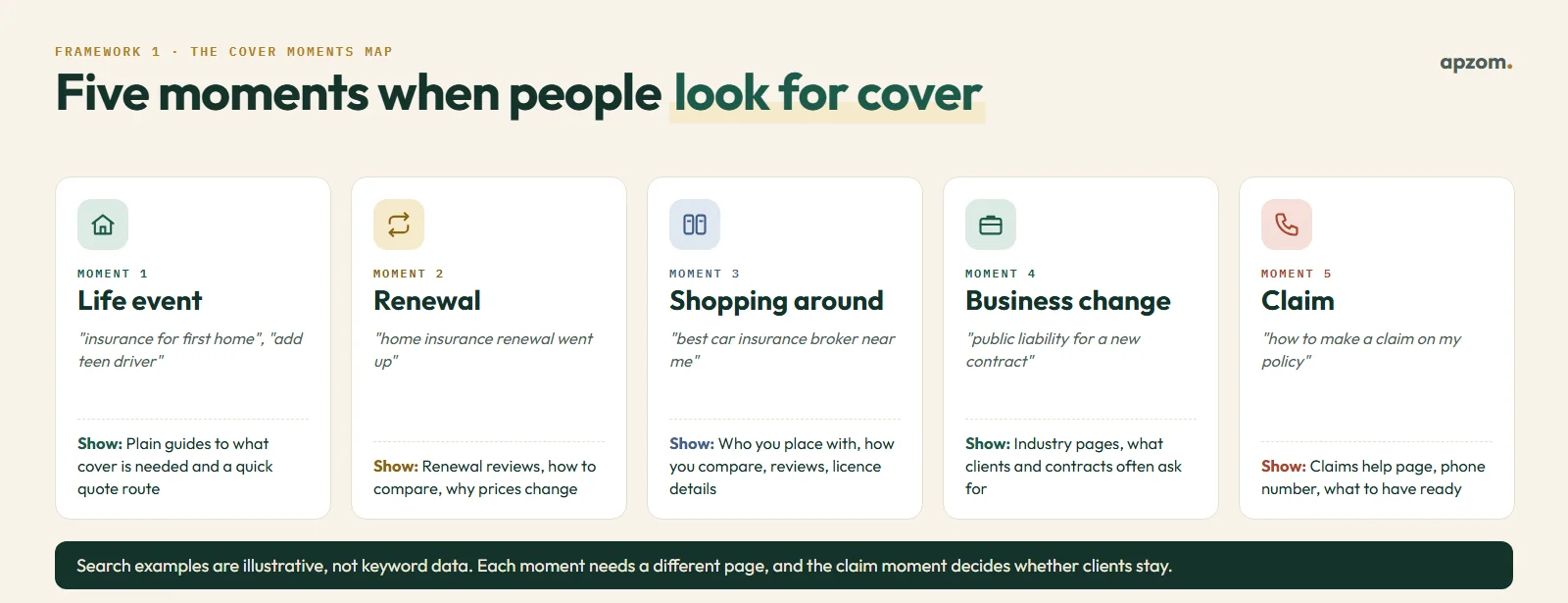
| Moment | What the client is thinking | What to show them |
|---|---|---|
| 1. Life event | “We just bought a house. What cover do we need?” | Plain guides to what cover a situation needs, and a quick quote route |
| 2. Renewal | “Why did my premium go up so much?” | A renewal review offer, how to compare fairly, why prices change |
| 3. Shopping around | “Is a broker better than buying direct?” | Who you place cover with, how you compare, reviews and licence details |
| 4. Business change | “A new client wants proof of liability cover.” | Industry pages, what contracts commonly ask for, fast certificates |
| 5. Claim | “How do I make a claim? Will anyone help?” | A claims help page, a phone number, what to have ready |
Most agency websites cover the quote and little else. The claim moment is the one most often forgotten, and it decides whether a client stays.
Build a website that turns searches into quotes
The core pages:
- One page for each line of business you want more of, such as home, car, landlord, business liability, professional indemnity, fleet, cyber or life cover. Say who it is for, what it usually covers, common exclusions and how quoting works.
- Industry pages for commercial clients, such as insurance for builders, restaurants, logistics firms or clinics. Speak each trade’s language and explain the risks and contract requirements they face.
- Who you are and how you work: whether you are a broker, an agent for one insurer or a group of insurers, how you are paid, and the insurers you work with, if you can name them.
- Licence and regulatory details in the footer and on an about page, in the form your regulator expects.
- A short quote form that asks only what you need to start, with a phone number and a clear privacy notice.
- A claims help page. What to do first, who to call, what you will do for the client.
- Renewal review page. An easy way for anyone, client or not, to ask you to review their cover before it renews.
- Office or location pages for each real office, with address, hours and the team.
Use plain English. Insurance language puts people off: if you must use a term such as excess, deductible or indemnity, explain it in the same sentence.
Content that wins trust, and AI answers
Insurance questions are a large part of what people ask search engines and AI tools. “Do I need landlord insurance?” “What does professional indemnity cover?” “Is my van covered for business use?” Clear, accurate answers written by people who know the subject win searches, build trust and are the content AI search tools quote. Our guide on what GEO is explains how AI search works.
Google’s Search Quality Rater Guidelines, the instructions Google gives the people who evaluate its results, treat money topics as “Your Money or Your Life” subjects that could affect someone’s financial security, and hold them to a higher standard of accuracy and trust. The guidelines are for raters, not a list of ranking factors, but they show what Google tries to reward.
Good insurance content:
- Answers the question in the first paragraph, then explains.
- Uses real examples of what is and is not usually covered, without promising what any policy will pay.
- Says when it depends on the policy wording, the insurer or the country.
- Is checked by a licensed person and dated, and reviewed when rules or products change.
Be found: local search and Google Business Profile
Many people still want a local broker or agent they can call or visit. Our Google Business Profile checklist covers every field. For agencies:
- Choose the primary category that best describes your business, then add secondary categories only for what you really do.
- Agent profiles. Google’s Business Profile guidelines name insurance agents as individual practitioners who can have their own profile if they are public-facing and can be contacted at the verified location. If one agent is the only public-facing practitioner at a branded office, Google asks for a single shared profile named “[brand]: [agent name]”.
- Give each real office its own profile and its own location page.
- Answer reviews without revealing anything about the client’s policy or claim.
Our local SEO checklist covers multi-office set-ups.
Paid ads: search, social and the financial services rules
Search ads work well for insurance because people search when they need cover. Focus on high-intent searches such as a line of business plus a place, or “business insurance for” a trade, and on renewal-season searches. Expect high costs per click in competitive personal lines, where direct insurers and comparison sites bid heavily. Specialist commercial lines and local searches are often better value for an agency.
Insurance is a restricted category on the major ad platforms:
- Google Ads. Google requires financial services verification before you can advertise insurance and other financial services in 42 locations, including the UK, India, Australia and every country in the European Economic Area. It is not currently required in the US, Canada or the UAE. Lead form ads on Google have their own eligibility bar, based on account spending history, and Google may refuse lead-generation and affiliate businesses.
- Meta (Facebook and Instagram). Meta’s insurance ad policy requires ads to target people aged 18 and over. In the US, ads for financial products and services must run in Meta’s special ad category, which fixes the age range at 18 to 65+, removes gender and postcode targeting, sets a minimum location radius and blocks lookalike audiences. Check whether your insurance ads fall into that category before you plan targeting around age or postcode.
- LinkedIn is useful for commercial lines, where you can reach business owners and finance directors by industry and job role.
Every ad must meet the same promotion rules as your website: no headline price or benefit without its conditions, and no implication that cover is guaranteed. Our guides to Google Ads for small businesses and Meta ads for local businesses cover the basics of running both.
Leads, calls and consent
Insurance runs on follow-up: quotes, calls, reminders and renewal offers. Every one of them carries consent rules.
- United States. The Telephone Consumer Protection Act (TCPA) requires prior express written consent for marketing calls and texts made with an autodialer or a prerecorded voice. The FCC’s “one-to-one consent” rule for lead generators was vacated by the 11th Circuit in January 2025 and later removed, so it does not apply, but buying leads is still risky if the consent behind them is weak. Opt-out requests must be honoured within 10 business days, and the FCC adopted further changes to its revocation rules in September 2026. Medicare plans have their own marketing rules from CMS, which changed again for 2027 materials.
- Australia. Since 5 October 2021, the hawking ban (section 992A of the Corporations Act) stops you offering insurance during or because of unsolicited real-time contact, such as a cold call.
- Everywhere. Email and text marketing need consent under data protection and anti-spam laws in most countries, including GDPR in the EU and UK.
The safest approach is simple. Collect consent yourself, in plain words, for each channel you will use. Record when and how you got it. Honour opt-outs quickly. If you buy leads, check exactly what each person agreed to and who they agreed to hear from. A cheap lead that breaks a consent rule is the most expensive lead you will ever buy.
Getting leads but not bound policies? An Insurance Agency Marketing Audit follows clients from the first search to the bound policy and the renewal, and checks every ad and lead source against the promotion and consent rules.
Framework 2: the promotion check
The second framework is a six-point check for every ad, landing page, social post and email before it goes live.
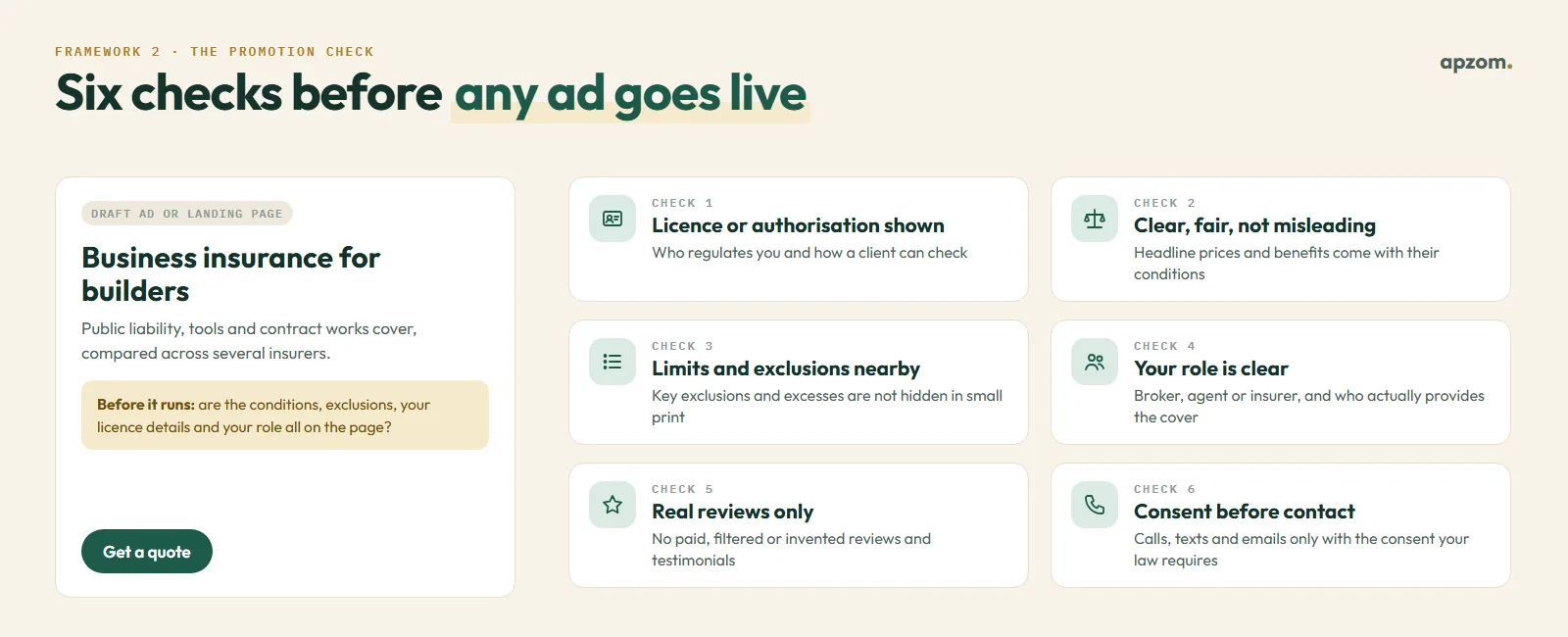
- Licence or authorisation shown: who regulates you, and how a client can check.
- Clear, fair and not misleading: headline prices and benefits come with their conditions.
- Limits and exclusions nearby: key exclusions and excesses are not hidden in small print.
- Your role is clear: broker, agent or insurer, and who actually provides the cover.
- Real reviews only: no paid, filtered or invented reviews and testimonials. In the US, the FTC’s rule on consumer reviews and testimonials has banned fake and bought reviews since 21 October 2024.
- Consent before contact: calls, texts and emails only with the consent your law requires.
The rules on insurance marketing, by country
The rules depend on where you are and what you sell. This table gives examples, not a complete list, and none of it is legal advice. Check with your regulator or compliance adviser.
| Where | Who sets the rules | What it means for marketing |
|---|---|---|
| United States | State insurance departments, the NAIC model laws, the FCC (TCPA), CMS for Medicare | Agents must be licensed in each state where they sell; many states base their advertising rules on the NAIC’s model regulations for accident and sickness and for life insurance and annuities; Medicare marketing has its own CMS rules |
| United Kingdom | Financial Conduct Authority (FCA) | Communications must be clear, fair and not misleading (ICOBS 2.2.2R); the Consumer Duty requires communications consumers can understand; FCA guidance FG24/1 covers promotions on social media and by finfluencers; home and motor renewal prices cannot be higher than the equivalent new-business price |
| European Union | Insurance Distribution Directive (IDD), national regulators | Marketing communications must be fair, clear, not misleading and clearly identifiable as marketing (Article 17(2)); non-life products need a standard product information document (IPID) |
| Australia | ASIC, the Corporations Act | ASIC’s advertising guidance RG 234 was reissued in June 2026; design and distribution obligations and the hawking ban apply from October 2021; general advice needs a warning |
| Canada | Provincial regulators such as FSRA (Ontario) and the AMF (Québec), with national CCIR and CISRO guidance | The Fair Treatment of Customers guidance applies to insurers and intermediaries; Ontario’s unfair or deceptive practices rule took effect on 1 April 2022; Québec bans implying AMF endorsement |
| UAE | Central Bank of the UAE (CBUAE), which took over insurance regulation in 2020 | Federal Decree-Law No. 48 of 2023 governs insurance; the CBUAE’s consumer protection rules require advertising to be accurate, not misleading and clearly identifiable; brokers must be licensed by the CBUAE |
| India | IRDAI | The 2021 advertising regulations were repealed; advertising rules now sit in the 2024 policyholder protection regulations and master circular, and ads by intermediaries need the insurer’s prior written approval |
The common thread: marketing can make an agency easier to find and easier to choose. It cannot make an unclear promise acceptable.
Framework 3: each line of business needs its own plan
Personal, commercial, life and specialist insurance are bought in different ways by different people. The third framework gives each its own plan.
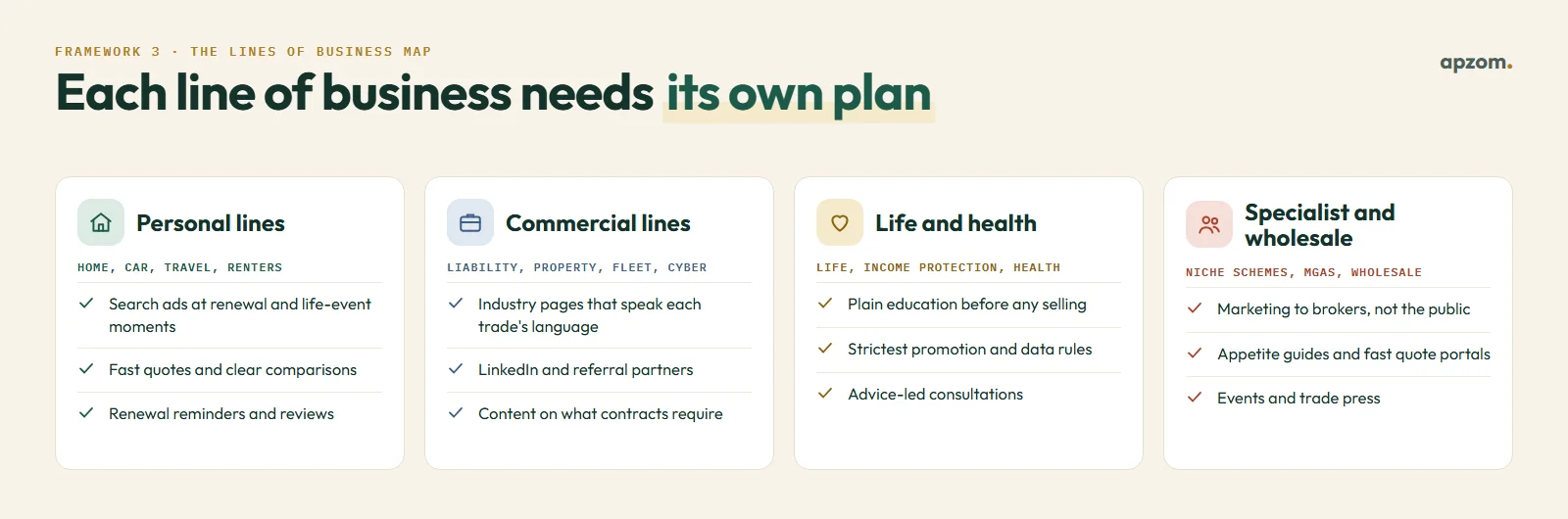
| Line of business | Who buys | Focus first |
|---|---|---|
| Personal lines (home, car, travel, renters) | Individuals and families, often price-driven | Search ads at renewal and life events, fast quotes, clear comparisons, renewal reminders |
| Commercial lines (liability, property, fleet, cyber) | Business owners and finance managers | Industry pages, LinkedIn, referral partners such as accountants, content on contract requirements |
| Life and health | Individuals and employers | Plain education before selling, the strictest promotion and data rules, advice-led consultations |
| Specialist and wholesale | Other brokers, or niche groups | Marketing to brokers, appetite guides, fast quote portals, events and trade press |
Renewals and retention
The cheapest new premium is the one you keep. Retention marketing for an agency:
- Start the renewal conversation early, with a review offer weeks before renewal, not a notice a few days before.
- Explain price changes honestly. Clients accept increases they understand better than ones that arrive without a word.
- Show what you did for the client this year: claims handled, cover checked, savings found.
- Offer related cover that fits their situation, such as landlord cover when a client buys a second home, without pushing products they do not need.
- Ask for reviews and referrals after a good claim or renewal experience, the same way for every client.
In the UK, the FCA’s general insurance pricing rules mean a home or motor renewal price cannot be higher than the equivalent price for a new customer. That removed “price walking”, and it is one reason UK renewal marketing now leans on service and advice rather than retention discounts.
Framework 4: from enquiry to renewal
The fourth framework is a measurement path. Count each step, and judge each channel by policies bound and renewed, not by leads.
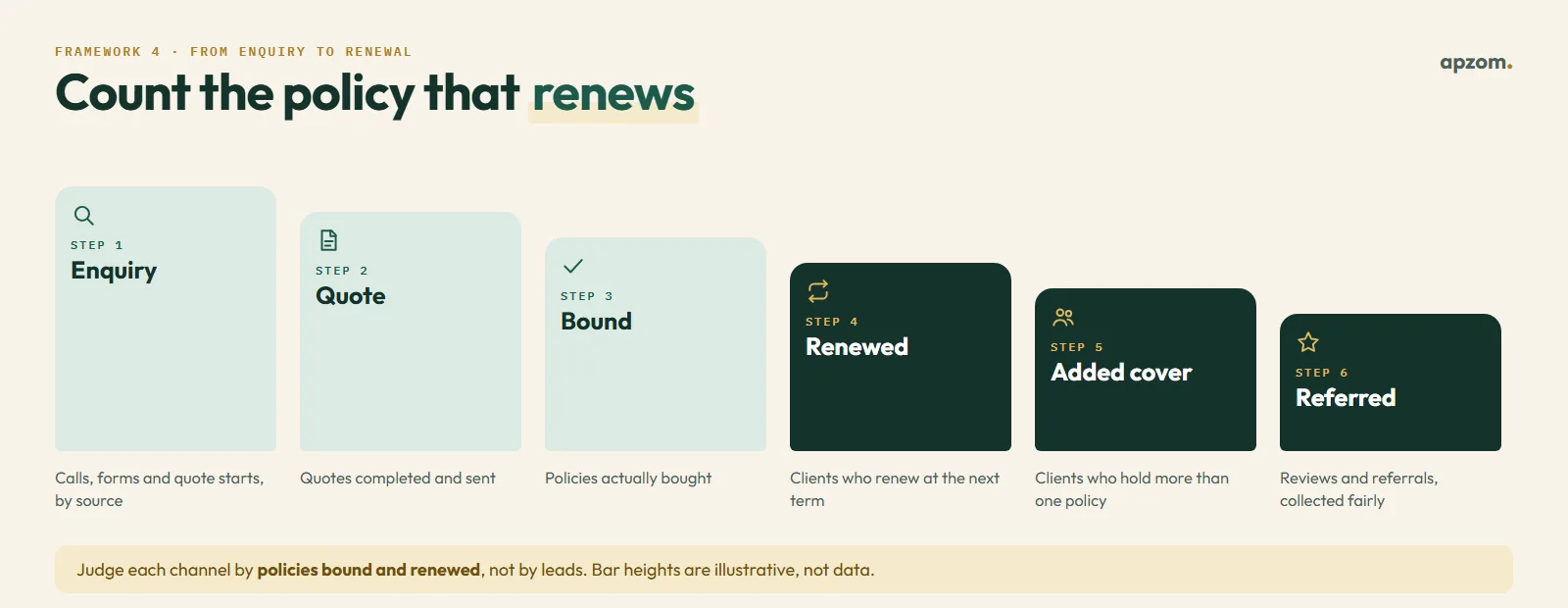
- Enquiry: calls, forms and quote starts, by source.
- Quote: quotes completed and sent.
- Bound: policies actually bought.
- Renewed: clients who renew at the next term.
- Added cover: clients who hold more than one policy with you.
- Referred: reviews and referrals, collected fairly.
Record the source of every new client in your agency management system, so you can compare channels by cost per bound policy and by retention. Our guide on how to measure marketing ROI explains how to turn these counts into a return on spend.
What an insurance marketing agency should do
Questions to ask
- Have you worked within insurance promotion and consent rules in our country? How do you check ads before they run?
- Who writes insurance content, and will our licensed staff approve it?
- Where do leads come from, and how is consent collected and recorded?
- How will you report quotes, bound policies and renewals, not just leads?
- Who owns the website, ad accounts, Business Profiles and data if we stop working together?
Red flags
- Promises of a set number of policies or a guaranteed top ranking.
- Cheap leads with no clear record of consent.
- Ads with headline prices or “covered for everything” claims and no conditions.
- Plans to buy reviews or filter out unhappy clients.
- Reports that show only clicks, leads and impressions.
Our guide on how to choose a digital marketing agency has a longer checklist.
How Apzom can help
Apzom Digital helps local businesses win the right customers and measure what matters. For insurance agencies and brokers, that means SEO and local SEO for line-of-business, industry and office pages, website development with clear quote, claims and renewal pages, content marketing for plain-English insurance guides, Google Ads and Meta ads that follow the financial services rules, email marketing for renewals with proper consent, and reputation management. We work with clients worldwide, remotely, from our base in Ahmedabad, India.
We have not published an insurance case study yet, so we will not show you one. Our case studies page shows the local search and lead generation work we have done for other businesses. We will not promise a number of policies. We will show you where enquiries drop off between the first search and a bound policy, and what to fix first.
Request an Insurance Agency Marketing Audit. We review your line-of-business, industry and office pages, Google Business Profiles and reviews, Google and Meta ads, lead sources and consent records, quote journey, renewal emails and tracking, against the insurance promotion and consent rules in your country. You get a prioritised list of what to fix first.
No obligation and no guaranteed policy numbers. Prefer to talk first? Contact us or see all our services.
Frequently asked questions
What is the best marketing for an insurance agency?
Clear pages for each line of business and industry you serve, an accurate Google Business Profile for each office, search ads at renewal and life-event moments, real reviews, and renewal marketing that keeps clients. Then measure policies bound and renewed by channel.
How do insurance agents get clients online?
Mostly from local search, search ads for specific lines of business, referrals from partners such as accountants and estate agents, reviews, and helpful content that answers insurance questions. Commercial brokers also do well on LinkedIn and with industry-specific pages.
Can insurance agencies advertise on Facebook and Google?
Yes, but with extra rules. Google requires financial services verification in many countries, including the UK, India, Australia and the European Economic Area. In the US, Meta requires ads for financial products and services to use a special ad category with limited targeting, and its insurance policy requires ads to target adults. Every ad must also meet the insurance promotion rules in your country.
Is buying insurance leads a good idea?
It can be, if you know exactly how each lead was collected and what the person agreed to. Leads without a clear consent record can break calling and texting laws. Many agencies get better results by building their own lead flow from search and referrals.
Do insurance agencies need SEO?
Yes. Line-of-business, industry and office pages bring people who are already looking for cover, and plain-English guides win questions that ads cannot. SEO takes months, so most agencies pair it with search ads.
How can an insurance agency keep more clients at renewal?
Start the renewal conversation early, explain price changes honestly, show the client what you did for them during the year, and offer a review rather than just a renewal notice.
Can Apzom work with insurance agencies outside India?
Yes. We work with clients worldwide, remotely, from our base in Ahmedabad, India, and plan marketing around the countries you work in, their insurance promotion and consent rules, and the platforms your clients use.