The short answer: Good digital marketing for a healthcare clinic helps the right patients find you, trust you and book, without putting their privacy or your registration at risk. It does that with clear pages for each service and condition you treat, clinician-reviewed health content, accurate Google Business Profiles for the clinic and its clinicians, search ads that follow healthcare rules, honest reviews, and measurement that counts attended appointments without sending health details to ad platforms. A good agency knows the advertising and privacy rules in your country and will say when a question needs a lawyer.
This guide is for primary care and family practices, physiotherapy and rehabilitation clinics, dermatology and skin clinics, specialist and multi-specialty clinics, diagnostic centres and telehealth services, in any country. It covers how patients choose a clinic, the website and content they need, local search, paid ads, reviews, privacy-safe measurement, the rules by country, and what to ask an agency. Dental practices have their own guide: digital marketing for dentists.
Patients look for health information online all the time. Google said in 2015 that about one in 20 Google searches are for health-related information, and Eurostat found that 60% of people aged 16 to 74 in the EU used the internet to look for health information in 2025. Most of those searches start long before anyone picks up the phone.
Why healthcare marketing is different
Marketing a clinic is not like marketing a shop or a restaurant. Six things make it different:
- The stakes are high. Health information can affect someone’s wellbeing and safety. Search engines hold health pages to a higher standard, and so do patients.
- It is a regulated profession. Doctors, physiotherapists and other clinicians work under professional rules on advertising, titles and testimonials, and medicines advertising is restricted in most countries.
- Privacy rules are strict. Health information is a special kind of personal data almost everywhere. Marketing tools that are normal elsewhere, such as ad pixels and remarketing, need far more care on a clinic website.
- Patients often arrive through other people. Referrals from family doctors, insurers, employers and other clinicians matter as much as search. Your marketing has to work for the referrer as well as the patient.
- Some searches are urgent. A person with chest pain needs emergency advice, not a booking form. Good clinic marketing knows when not to sell.
- Capacity is limited. A clinician’s diary is the product. Marketing that brings the wrong appointments, or more than the clinic can see, wastes money and frustrates patients.
Framework 1: the patient decision path
The first framework maps the five stages patients go through, and what your marketing should show at each one.
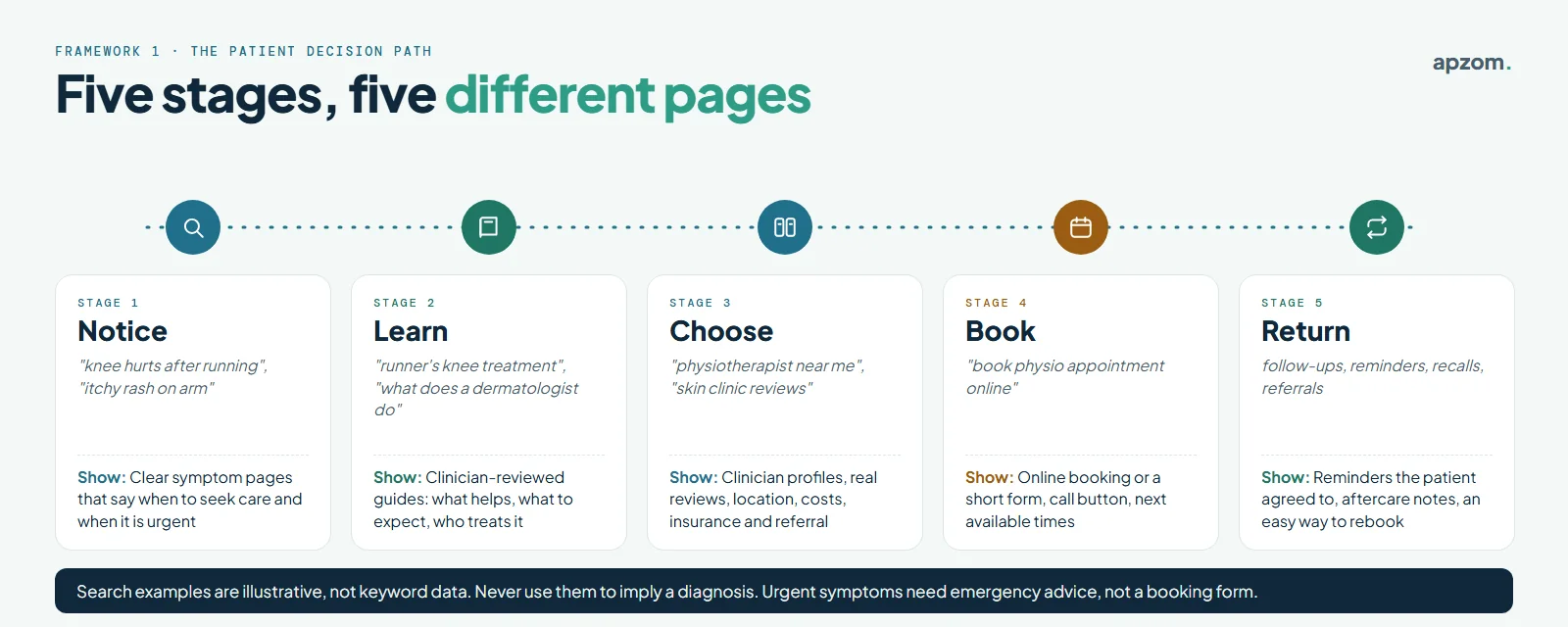
| Stage | What the patient is thinking | What to show them |
|---|---|---|
| 1. Notice | “My knee hurts after running. Is it serious?” | Clear symptom pages that say when to seek care, when it is urgent and where to go |
| 2. Learn | “What helps runner’s knee? Who treats it?” | Clinician-reviewed guides: what helps, what to expect, which clinician to see |
| 3. Choose | “Which physio near me is any good? What will it cost?” | Clinician profiles, real reviews, location and access, costs, insurance and referral rules |
| 4. Book | “Can I get an appointment this week?” | Online booking or a short form, a call button, next available times |
| 5. Return | “When is my follow-up? Can I rebook easily?” | Reminders the patient agreed to, aftercare notes and an easy way to rebook or get a referral letter |
Most clinic websites cover stage 4 well and stage 2 badly. Stages 1 to 3 are where patients decide who to trust, so they are where new patients find you.
Build a website that turns searches into appointments
Your website has to answer a worried person’s questions quickly, then make the next step easy. The core pages:
- One page for each service or treatment you want more of, such as a physiotherapy assessment, a skin check, a sports injury clinic, a menopause clinic or a diagnostic scan. Say who it is for, what happens, how long it takes and how to prepare.
- Condition pages for the problems you treat most, reviewed by a clinician who works in that area. Say when the condition needs urgent care.
- Clinician profiles with real names, roles, qualifications and registration details where your country expects them, and the conditions each clinician sees. Patients often choose the person before the clinic.
- Costs, insurance and referral. Prices or price ranges for self-paying patients, which insurers you work with, and whether patients need a referral. Unclear costs are one of the main reasons people leave a clinic website.
- Locations with opening hours, parking, public transport, step-free access and photos of the entrance.
- Booking online where your practice software supports it, with a short form as a backup and a phone number that is answered.
- Urgent care signposting on every relevant page: what to do in an emergency and out of hours, and the local emergency number.
- Telehealth or video appointments, if you offer them: which appointments work remotely, which countries or states you can treat patients in, and what the patient needs.
Accessibility matters more for clinics than for most websites, because many visitors are unwell, older or using assistive technology. Use readable text sizes, strong contrast, clear buttons and forms that work with a screen reader. A fast mobile site matters too, since most first searches happen on a phone.
Use structured data to describe the clinic. schema.org has a MedicalBusiness type with more specific types beneath it, such as MedicalClinic and Physician. Google’s local business documentation asks you to use the most specific type that fits. There is no special medical rich result, but accurate markup for your name, address, phone number and opening hours helps search engines understand the clinic. Everything in the markup must also be visible on the page. Our schema markup guide explains how to add it and test it.
Clinical content that patients and search engines trust
Health content is where clinics win or lose trust. Google’s Search Quality Rater Guidelines, the instructions it gives the people who evaluate its results (latest version dated 11 September 2025), put health in a category it calls “YMYL Health or Safety”: topics that could harm someone’s health or safety. Pages on these topics are judged against a higher bar for accuracy and trust. The guidelines are for raters, not a list of ranking factors, but they show what Google is trying to reward. In plain terms: a health page should be written or checked by someone qualified, it should be accurate and current, and it should not mislead.
The second framework is a six-point trust check for every health page.
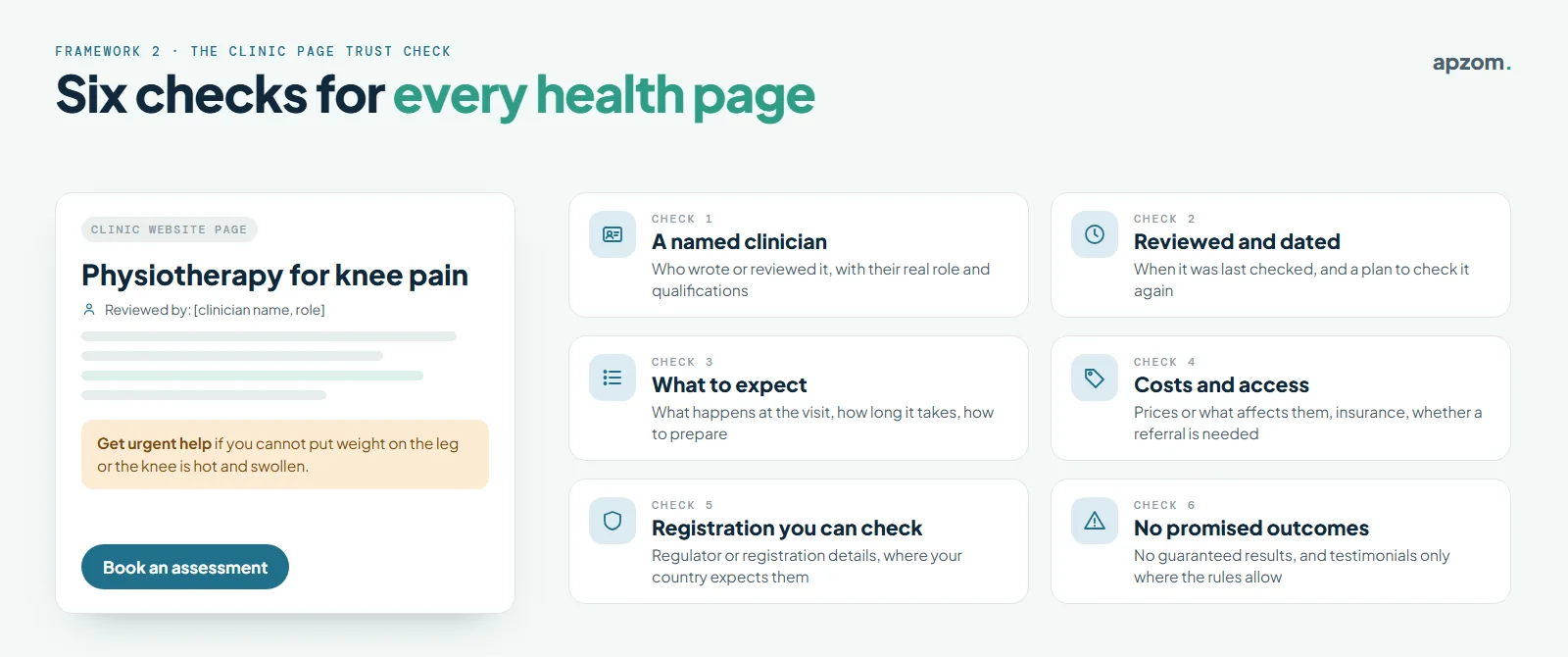
- A named clinician wrote or reviewed it, with their real role and qualifications.
- Reviewed and dated. The page says when it was last checked, and someone owns checking it again.
- What to expect. What happens at the appointment, how long it takes and how to prepare.
- Costs and access. Prices or what affects them, insurance, and whether a referral is needed.
- Registration you can check. Registration details where your country expects them, so a patient can look the clinician up.
- No promised outcomes. No guaranteed results, no “cure” claims, and testimonials only where your rules allow them.
Write in plain language for the patient, not for other clinicians. Answer the question in the first paragraph, then explain. Avoid scaring people into booking, and never suggest a diagnosis. These same pages are what AI search tools read and quote, so clear, specific answers written by qualified people help you there too. Our guide on what GEO is explains how AI search works.
Be found: clinic and clinician profiles
Most patients compare clinics on the map results before they visit a website. Our Google Business Profile checklist covers every field. The points that matter most for clinics:
- Choose the primary category that best describes the clinic, then add secondary categories only for services you really provide.
- Clinician profiles. Google’s Business Profile guidelines let public-facing practitioners, such as doctors, have their own profile if patients can reach them at the verified location during stated hours. Support staff should not have profiles, and one practitioner should not have several profiles for different specialties. If several practitioners work at one location, the clinic gets its own location profile and each practitioner’s profile uses only their own name. If one practitioner is the only public-facing practitioner and represents a branded clinic, Google asks for one shared profile named “[brand]: [practitioner]”. Keep these listings accurate when clinicians join or leave.
- Keep hours exact, including holiday hours, and say clearly if you do not see walk-in or urgent patients.
- Add real photos of the entrance, reception and treatment rooms. Never show patients without their written consent.
- List your services in plain words, with short descriptions.
If you run several clinics, give each real location its own profile and its own location page, with its own team, hours and services. Our local SEO checklist covers multi-location set-ups.
Paid ads: search, social and the health rules
Search ads work well for clinics because people search when they need care. Keep campaigns tight: one campaign per service, ads that say what you offer and where, and landing pages that match the search. Bid on service and location searches, not on symptoms that may be urgent.
Healthcare is a restricted category on every major ad platform.
- Google Ads. Google’s healthcare and medicines policy requires certification for some advertisers, including online pharmacies and prescription drug services (in the US, through LegitScript or NABP), addiction treatment services in some countries, and some others, and the rules vary by country. Google’s personalised advertising policy lists health as a sensitive interest category: you cannot use remarketing lists, Customer Match or similar audiences you build yourself for health-related ads, though Google’s own predefined audiences are allowed.
- Meta (Facebook and Instagram). Meta’s ad standards ban ads that assert or imply someone’s personal attributes, including physical or mental health. Meta’s own example of a violation is “Do you have diabetes?”. Ads for health products and services must target people aged 18 and over. Meta may also restrict the data a health website can send it: its help centre describes restrictions that strip custom parameters and parts of page addresses, or block certain lower-funnel events, and custom conversions that mention specific health conditions are not allowed.
- Remarketing. Showing ads to people because they visited a page about a condition can reveal something about their health. Google does not allow remarketing for health-related ads, as above, and privacy laws may restrict it too. Most clinics are better off without condition-based remarketing at all.
Our guides to Google Ads for small businesses and Meta ads for local businesses cover the basics of running both.
Patients finding you but not booking? A Clinic Marketing Audit follows patients from the first search to the attended appointment, and checks which tools receive data they should not.
Reviews and testimonials
Reviews are one of the strongest signals patients use to choose a clinic. Ask every patient the same way, at a sensible time, and make it easy. Our guide on how to get more Google reviews covers the platform rules.
Healthcare adds three extra rules of thumb:
- Never pay for reviews, write your own or ask only happy patients. In the US, the FTC’s rule on consumer reviews and testimonials, in force since 21 October 2024, bans fake reviews, buying reviews and suppressing negative ones, and the FTC’s Endorsement Guides (updated in 2023) explain how to disclose any connection with a reviewer.
- Check your professional rules on testimonials. Some countries restrict them heavily. Australia’s National Law bans testimonials about the clinical aspects of a regulated health service, such as symptoms, treatment and outcomes. Ontario’s College of Physicians and Surgeons bans testimonials in physicians’ advertising. In India, the National Medical Commission’s advertising guidelines of 6 October 2026 bar doctors and hospitals from requesting or sharing patient testimonials for promotion, and say patient consent alone does not make a testimonial acceptable.
- Reply without confirming anyone is a patient. Thank people for feedback and invite them to contact the clinic, but never mention their condition, treatment or visit in a public reply, even if they did.
Framework 3: privacy-safe measurement
You need to know which marketing brings patients. You do not need to send anyone’s health information to an ad platform to find out. The third framework sorts what to keep out of ad and analytics tools from what is safe to measure.
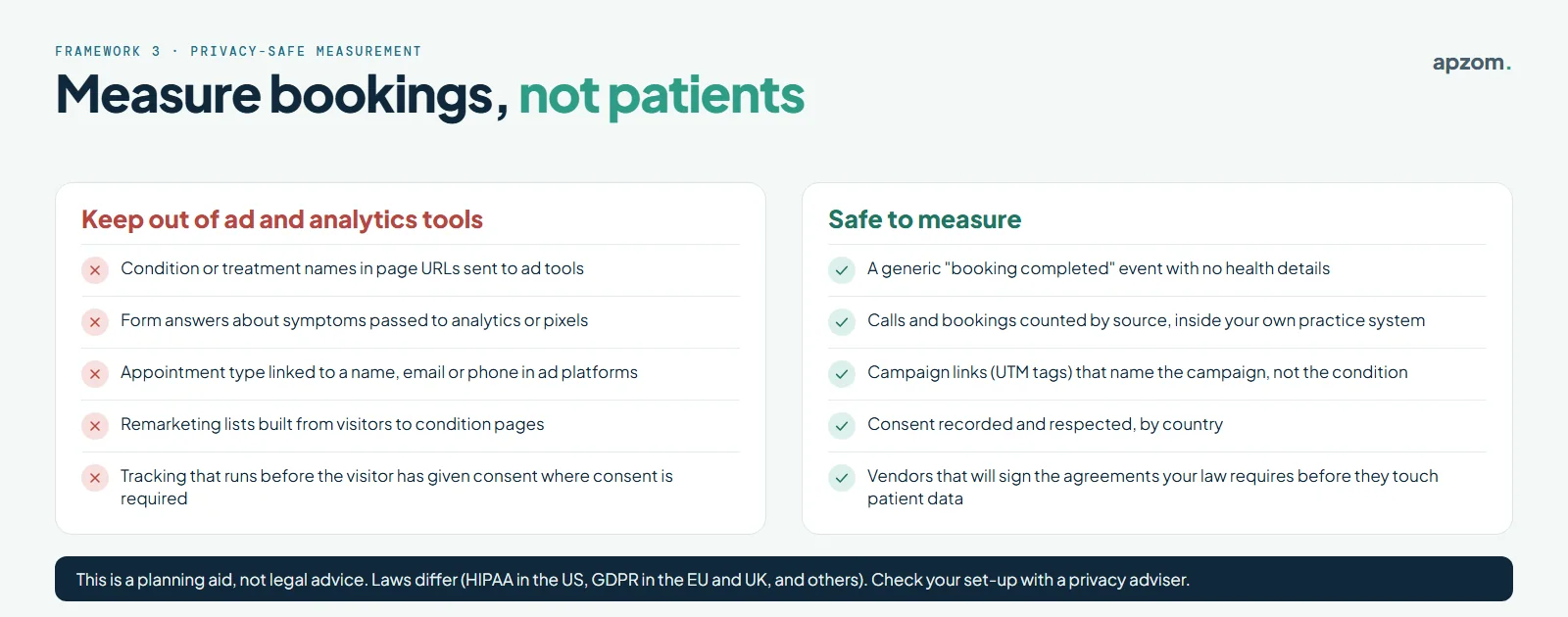
Every analytics tool, ad pixel, chat widget, call tracking service, booking tool and form receives some data from your website. Before adding or keeping any of them, ask one question: what patient data does this tool receive? A pixel on a blog post is a different risk from a pixel on an appointment confirmation page.
The law depends on where you are:
- United States. HIPAA applies to clinics that are covered entities. The HHS Office for Civil Rights has published guidance on online tracking technologies. In June 2024, a federal court in *American Hospital Association v. Becerra* vacated part of it: the part saying HIPAA is triggered when a tracking tool connects someone’s IP address with a visit to an unauthenticated public page about health conditions or providers. The rest still applies: where tracking tools receive protected health information, for example in booking flows or patient portals, the disclosure must be permitted. Google Analytics is a clear example. Google says it does not offer business associate agreements for Analytics, that customers must not send it protected health information, and that tags should not be set on logged-in pages. State laws add more: Washington’s My Health My Data Act covers consumer health data beyond HIPAA and bans geofencing around health facilities.
- EU and UK. Health data is a special category of personal data under GDPR, and processing it generally needs explicit consent or another specific condition. European data protection authorities say tracking pixels need consent under the ePrivacy rules unless an exemption applies, and the UK’s Information Commissioner’s Office says the same for third-party pixels.
- Everywhere else. Most countries treat health information as sensitive. India’s Digital Personal Data Protection Act 2023 and its 2025 Rules apply to clinics and hospitals there, for example.
A sensible review covers:
- Which pages each tool runs on, and whether any involve logins, booking or health information.
- What each tool collects and where it sends it, including page addresses that name conditions.
- Whether a vendor would handle patient data, and whether it will sign the agreement your law requires.
- Consent, by country and by state.
- Whether a simpler set-up would answer the same business question. Often it would: count bookings by source inside your practice system, and keep the ad platforms out of it.
A marketing agency can map the tools and the data flows. It should also say plainly when a question needs a privacy lawyer.
The rules on healthcare advertising, by country
The rules depend on where the clinic is and who it treats. This table gives examples, not a complete list, and none of it is legal advice. Check with your regulator, professional body or adviser.
| Where | Who sets the rules | What it means for marketing |
|---|---|---|
| United States | State medical boards, the FTC, HHS (HIPAA), state privacy laws | Advertising must not be false or misleading; the FTC’s reviews rule bans fake and bought reviews; HIPAA applies to covered clinics; rules on titles and testimonials vary by state |
| United Kingdom | GMC and other regulators, the ASA (CAP Code), CQC, medicines law | Prescription-only medicines and treatments cannot be advertised to the public, so Botox ads are out, though the consultation can be promoted; claims must be backed by evidence; cosmetic intervention ads must not be aimed at under-18s; clinics rated by CQC in England must show their rating on their website; the GMC requires information about services to be accurate and not exploit patients’ vulnerability |
| European Union | National medical councils and advertising laws, GDPR | Rules differ by country; prescription medicines cannot be advertised to the public; health data and tracking pixels need consent |
| Australia | Ahpra and the National Boards, the National Law, the TGA | Section 133 bans testimonials about clinical aspects and claims that create unreasonable expectations; prescription medicines cannot be advertised to the public; separate rules cover cosmetic surgery and higher-risk cosmetic procedures |
| Canada | Provincial colleges, such as the CPSO in Ontario | Ontario’s policy bans testimonials and comparative claims, and allows before-and-after images only under strict conditions |
| UAE | MOHAP, plus the DHA in Dubai and the Department of Health in Abu Dhabi | Health advertisements need a MOHAP licence before they run, including on websites and social media; in Dubai, clinics’ social media accounts must show their advertising licence number |
| India | National Medical Commission, the Drugs and Magic Remedies Act | New NMC guidelines (6 October 2026) cover doctors and hospitals: no fake or paid reviews, no promotional patient testimonials, AI-generated promotional campaigns banned, and posts must show the doctor’s name, qualifications and registration number; using an agency does not move the responsibility; the 1954 Act bans ads claiming to treat listed diseases |
The common thread is simple: marketing can make a clinic easier to find and easier to choose. It cannot make a misleading claim acceptable.
Marketing differs by type of clinic
| Type of clinic | Focus first |
|---|---|
| Primary care and family practices | New patient registration, opening hours, which services you offer, online booking and repeat requests |
| Physiotherapy and rehabilitation | Condition and injury pages, self-referral rules, sports and work injury pathways, packages explained honestly |
| Dermatology and skin clinics | Separating medical dermatology from cosmetic treatments, strict care with before-and-after images and claims |
| Specialist and multi-specialty clinics | Clinician profiles, referral pathways for doctors and insurers, clear “who to see for what” pages |
| Diagnostic and imaging centres | Which scans and tests you offer, referral needs, waiting times, preparation instructions, results process |
| Telehealth services | Where you can legally treat patients, what can be handled remotely, prescribing rules, privacy on video platforms |
Clinics that rely on referrals should treat referrers as a second audience. A short page for referring clinicians, with how to refer, what you need from them and how you report back, often brings more patients than a blog post.
Framework 4: from search to attended appointment
The fourth framework is a simple measurement path. Count each step, and judge each marketing channel by the patients who attend, not by clicks or form fills.
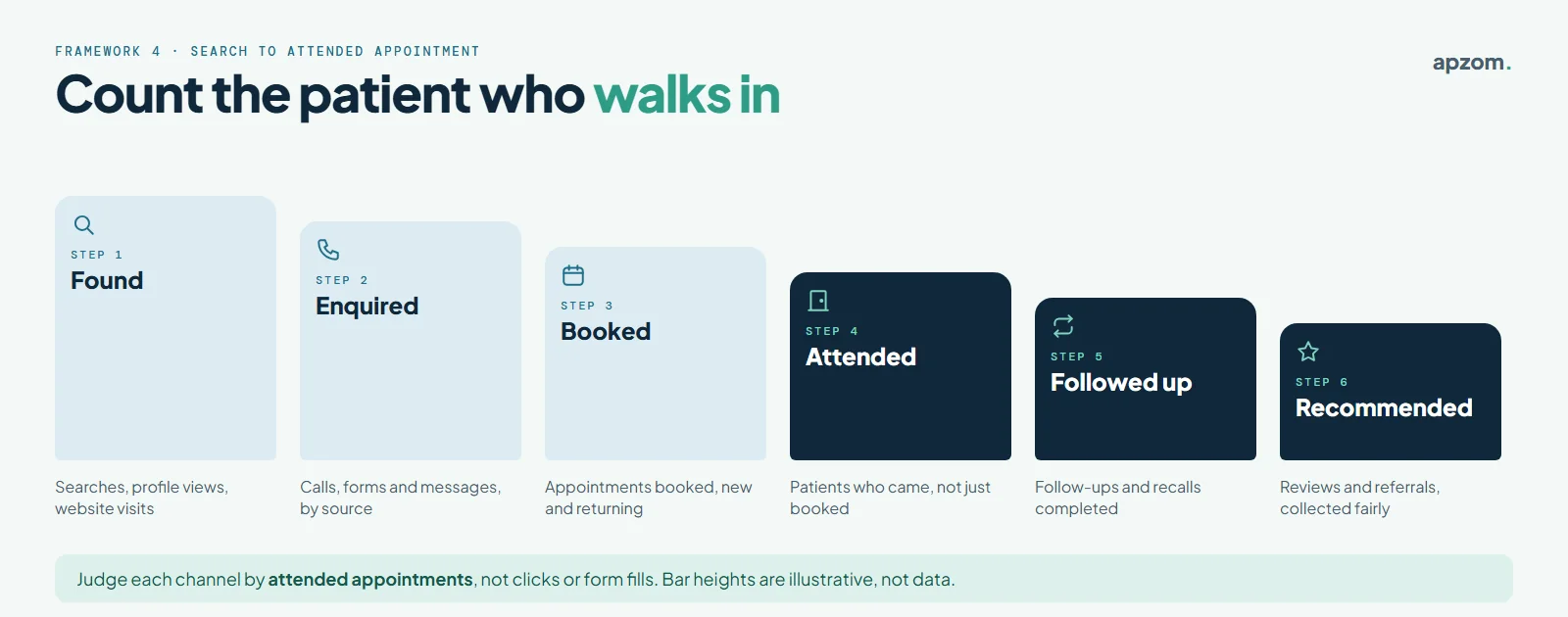
- Found: searches, profile views and website visits.
- Enquired: calls, forms and messages, by source.
- Booked: appointments booked, split into new and returning patients.
- Attended: patients who came, not just booked. No-shows hide here.
- Followed up: follow-ups and recalls completed.
- Recommended: reviews and referrals, collected fairly.
Record the source of every new patient in your practice system, so you can compare channels without sending health information anywhere. Our guide on how to measure marketing ROI explains how to turn these counts into cost per new patient and return on spend.
What a healthcare marketing agency should do
Questions to ask
- Have you worked within healthcare advertising and privacy rules in our country? How do you check claims before they go live?
- Who writes clinical content, and will our clinicians review and approve every page?
- Which tracking tools will you install, and what data will each one receive?
- How will you report attended appointments and cost per new patient, not just clicks?
- Who owns the website, ad accounts, Business Profiles and data if we stop working together?
Red flags
- Promises of a set number of new patients or a guaranteed top ranking.
- Plans to buy reviews, filter out unhappy patients or post fake ones.
- Ads that suggest the viewer has a health condition, or that promise outcomes.
- Clinical content written without any clinician checking it.
- Pixels and remarketing added to every page without asking what data they collect.
- Reports that show only clicks, likes and impressions.
Our guide on how to choose a digital marketing agency has a longer checklist.
How Apzom can help
Apzom Digital helps local businesses win the right customers and measure what matters. For healthcare clinics, that means SEO and local SEO for service, condition and location pages, website development with clear booking, cost and referral pages, content marketing for clinician-reviewed health content, Google Ads and Meta ads that follow the healthcare rules in your country, conversion rate optimisation for booking journeys, and reputation management. We work with clients worldwide, remotely, from our base in Ahmedabad, India.
We have not published a healthcare clinic case study yet, so we will not show you one. Our case studies page shows the local search and lead generation work we have done for other businesses. We will not promise a number of new patients. We will show you where patients drop off between the first search and the first appointment, which tools receive data they should not, and what to fix first.
Request a Clinic Marketing Audit. We review your service, condition and clinician pages, Google Business Profiles and reviews, Google and Meta ads, booking journey, and every tracking tool on your site, against the healthcare advertising and privacy rules in your country. You get a prioritised list of what to fix first.
No obligation and no guaranteed patient numbers. Prefer to talk first? Contact us or see all our services.
Frequently asked questions
What is the best marketing for a healthcare clinic?
Clear service and condition pages reviewed by clinicians, accurate Google Business Profiles for the clinic and its clinicians, real reviews collected fairly, search ads for service and location searches, and easy booking. Then measure attended appointments by channel, without sending health information to ad platforms.
How do clinics get new patients online?
Mostly from local search and the map results, referrals from other clinicians and insurers, reviews, search ads and helpful health content. Patients usually compare two or three clinics, so clinician profiles, costs and booking times often decide the choice.
Can a clinic use Google Analytics and Meta pixels?
Sometimes, with care. The answer depends on your country’s privacy law, which pages the tools run on and what data they receive. Keep health details, condition names and form answers out of ad and analytics tools, get consent where it is required, and take legal advice where you are unsure.
Can doctors and clinics use patient testimonials?
It depends on the country and the profession. Australia’s National Law bans testimonials about the clinical aspects of a regulated health service, Ontario’s physicians’ college bans them in advertising, and India’s National Medical Commission now bars doctors and hospitals from using patient testimonials for promotion. Where they are allowed, they must be real, typical and collected fairly. Check your regulator’s rules first.
Can clinics advertise prescription medicines?
In most countries, no. The UK, the EU and Australia, among others, ban advertising prescription-only medicines to the public. The US is a notable exception, where drug companies can advertise prescription drugs under FDA rules. Clinics should advertise their consultations and services instead, and check their local rules.
Should a clinic show prices on its website?
Usually, yes, for self-paying patients. Prices, price ranges or a clear list of what affects the cost build trust and save phone time. Explain insurance and referral rules on the same page.
How long does SEO take for a medical clinic?
Usually several months for new pages to rank well, and longer in competitive cities. Your Google Business Profile, reviews and search ads can bring patients sooner while content builds.
Can Apzom work with clinics outside India?
Yes. We work with clients worldwide, remotely, from our base in Ahmedabad, India, and plan marketing around the countries you work in, their healthcare advertising and privacy rules, and the platforms your patients use.