The short answer: Online reputation management (ORM) is the work of monitoring what people see and say about your business online, responding to it well, and fixing the problems behind it. Done honestly, it means watching your reviews, search results and mentions, replying to every review, asking all your customers for reviews in the same way, reporting reviews that break a platform’s rules, and using legal routes only for content that is genuinely unlawful. It cannot legally make true negative reviews disappear. Fake reviews, buying reviews and pressuring people to remove honest reviews are now banned in many countries, including the US and the UK, and asking only happy customers breaks Google’s rules and UK guidance.
This guide is for business owners and managers anywhere in the world who want to understand what reputation management is, what an agency can and cannot do for them, and how to set up monitoring themselves. It gives you three tools: a clear line between what ORM can and cannot do, a monitoring set-up with how often to check each source, and a four-question path for handling a negative review. It is written by an agency that offers reputation management, so read it knowing we have an interest; everything here works just as well if you do it yourself. It is not legal advice.
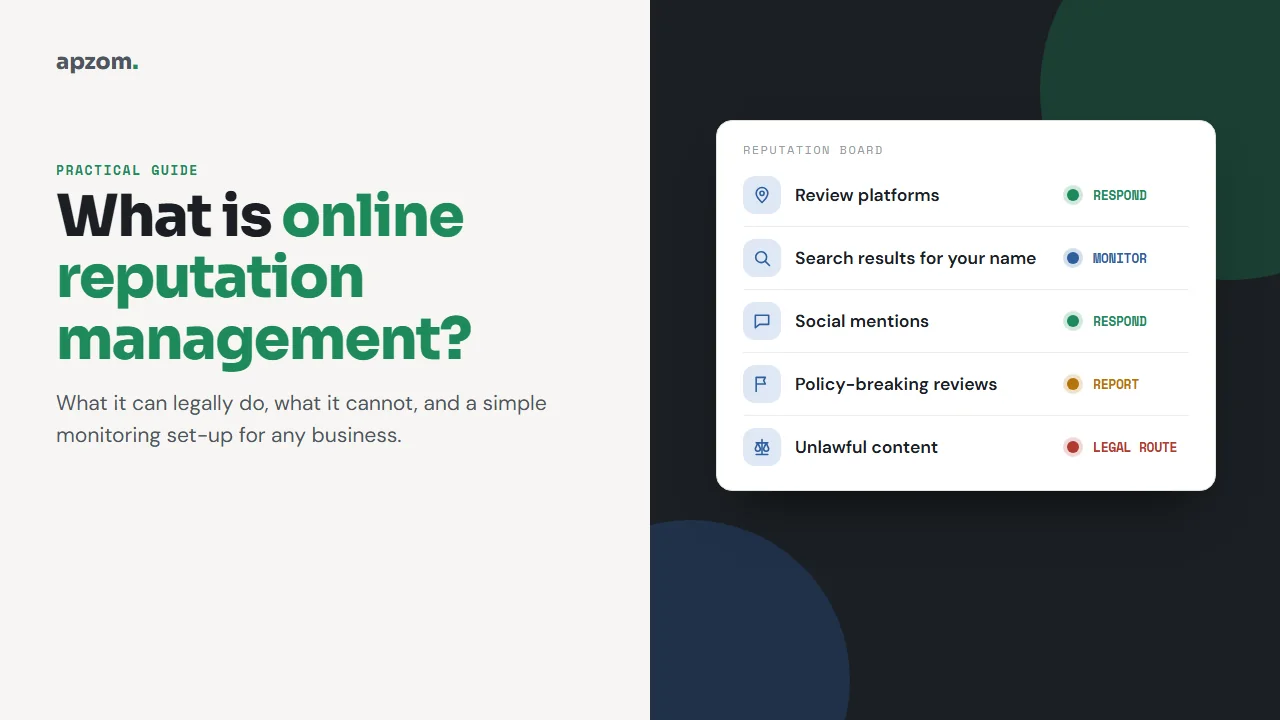
What online reputation management is
Your online reputation is what people find when they look you up: reviews on Google and other platforms, search results for your business name, what people say on social media and in forums, and the profiles and pages you control. ORM is the ongoing work of keeping that picture accurate and fair.
In practice, honest ORM has four parts:
- Monitor. Know what is being said, where, and soon enough to respond.
- Respond. Reply to reviews and comments, good and bad, in a way that helps the next person reading.
- Improve. Fix the problems that complaints point to, and make it easy for satisfied customers to share their experience.
- Correct. Report content that breaks a platform’s rules and, rarely, use legal routes for content that is unlawful.
What ORM is not: a way to buy a better reputation. The most effective reputation work is usually operational. Answer the phone, keep promises, reply quickly and fix mistakes, and the reviews follow.
Framework 1: what reputation management can and cannot do
The first framework draws the line. Everything on the left is legitimate. Everything on the right is either banned in some countries or against the rules of the major platforms, and often both.
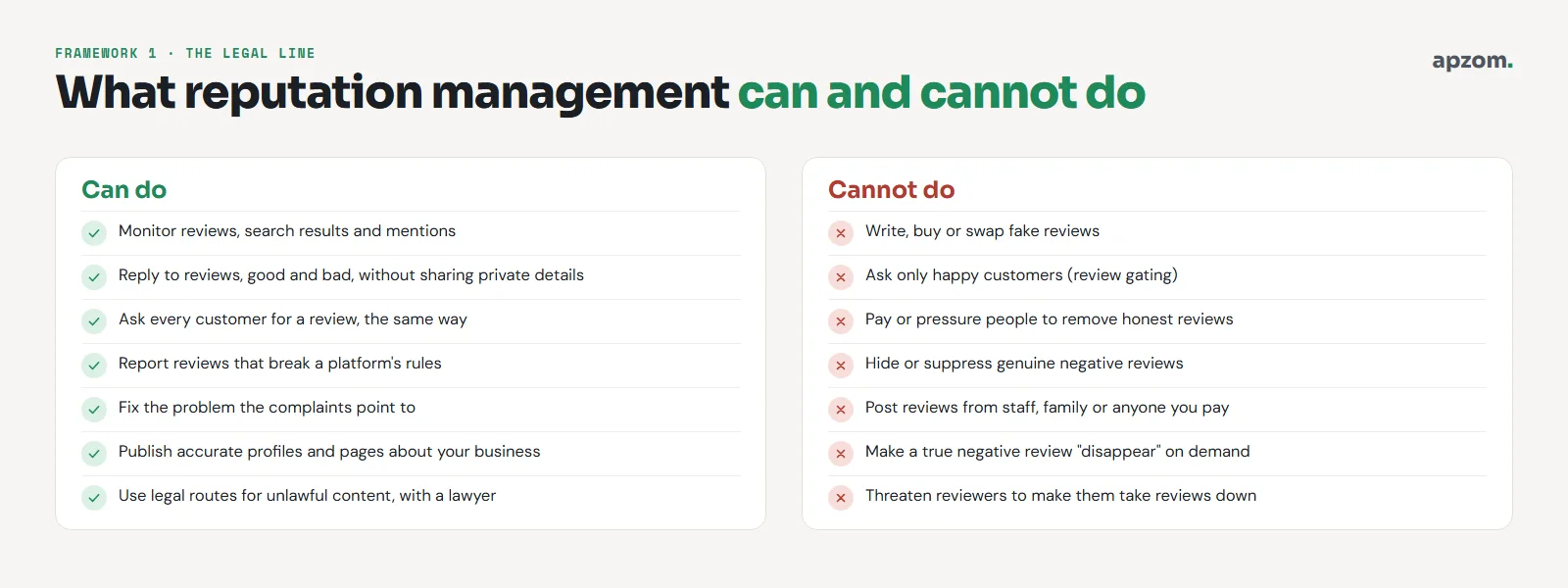
| Can do | Cannot do |
|---|---|
| Monitor reviews, search results and mentions | Write, buy or swap fake reviews |
| Reply to reviews without sharing private details | Ask only happy customers (review gating) |
| Ask every customer for a review, the same way (except on Yelp, which asks businesses not to ask at all) | Pay or pressure people to remove honest reviews |
| Report reviews that break a platform’s rules | Hide or suppress genuine negative reviews |
| Fix the problem the complaints point to | Post reviews from staff, family or anyone you pay (Google bans these even when disclosed) |
| Publish accurate profiles and pages | Make a true negative review “disappear” on demand |
| Use legal routes for unlawful content, with a lawyer | Threaten reviewers to make them take reviews down |
The law on fake and suppressed reviews
The rules have tightened in recent years:
- United States. The Federal Trade Commission’s rule on consumer reviews and testimonials has been in force since 21 October 2024. It bans fake reviews and testimonials, buying positive or negative reviews, undisclosed reviews by company insiders, company-controlled “independent” review sites, and review suppression, such as using unfounded legal threats or intimidation to stop or remove reviews. Civil penalties for knowing violations can reach $53,088 per violation (the FTC kept the figure unchanged for 2026). So far the FTC has enforced the rule with warning letters (December 2025), not fines. The FTC has acted on suppression before the rule, too: in 2022 the fashion retailer Fashion Nova paid $4.2 million after it held back reviews below four stars. Separately, the Consumer Review Fairness Act makes contract clauses that ban customers from posting honest reviews void.
- United Kingdom. Since April 2025, the Digital Markets, Competition and Consumers Act 2024 has banned fake reviews, concealed incentivised reviews and misleading presentation of reviews. The Competition and Markets Authority can fine businesses directly, up to 10% of global turnover. Its guidance names, as an example of a banned service, “a search engine optimisation service that promises to improve a trader’s rating” through fake reviews, and says suppressing genuine negative reviews is itself a problem, including arbitrarily stopping and starting review invitations, or making a refund depend on the customer not leaving a bad review.
- European Union. Since 28 May 2022, businesses that show consumer reviews must say whether and how they check that reviews come from real customers, and must not post or commission fake reviews.
- Elsewhere. Australia’s competition regulator, the ACCC, says hiding or removing genuine negative reviews can mislead consumers, and it has taken businesses to court over misleading reviews. India has a national standard for online reviews (IS 19000:2022) that is voluntary for now. Other countries have their own consumer laws; check the rules where you trade.
Platform rules
Platforms add their own rules on top of the law. Google’s policies for reviews on Maps prohibit fake engagement, offering incentives for reviews, and selectively asking only satisfied customers to leave reviews. Review sites such as Trustpilot have similar rules on how you invite reviews. Breaking them can get reviews removed or a profile restricted. Our guide to how to get more Google reviews explains how to ask for reviews within the rules.
Not sure what people see when they look you up? Ask for a Free Growth Audit. We check your reviews, replies, profiles and search results for your name, and tell you what to fix first, within the platforms’ rules.
Framework 2: the monitoring set-up
You cannot respond to what you have not seen. The second framework is a simple monitoring set-up: six places to watch and how often to check them.
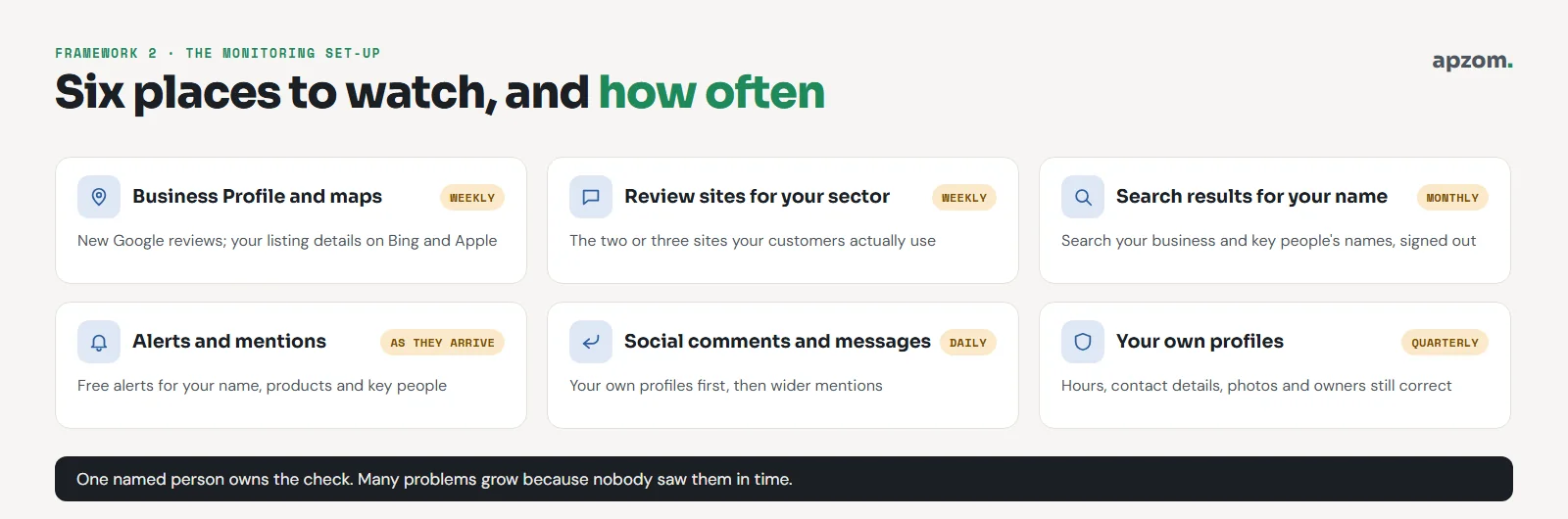
| Where | What to watch | How often |
|---|---|---|
| Business Profile and maps | New reviews and photos on Google; your listing details on Bing Places and Apple Business Connect | Weekly |
| Review sites for your sector | The two or three sites your customers actually use | Weekly |
| Search results for your name | Your business name and key people’s names, searched while signed out | Monthly |
| Alerts and mentions | Free alerts for your business name, products and key people | As they arrive |
| Social comments and messages | Your own profiles first, then wider mentions | Daily |
| Your own profiles | Hours, contact details, photos and who has owner access | Quarterly |
Free tools cover most of this. Turn on review notifications in your Google Business Profile, and claim your listings on Bing Places and Apple Maps so you control the details shown there. Neither has a documented way for businesses to reply to ratings; Bing shows reviews from third-party sites such as Yelp and Tripadvisor, so watch those. Google Alerts can email you when new pages mention your name. Our guide to how to use Google Search Console shows how to see which searches for your name lead to your site.
Give one named person responsibility for the checks. Many reputation problems grow because nobody saw them in time, not because nobody could fix them.
Framework 3: the negative review path
A negative review is not an emergency. The third framework is four questions to ask, in order, before you do anything.
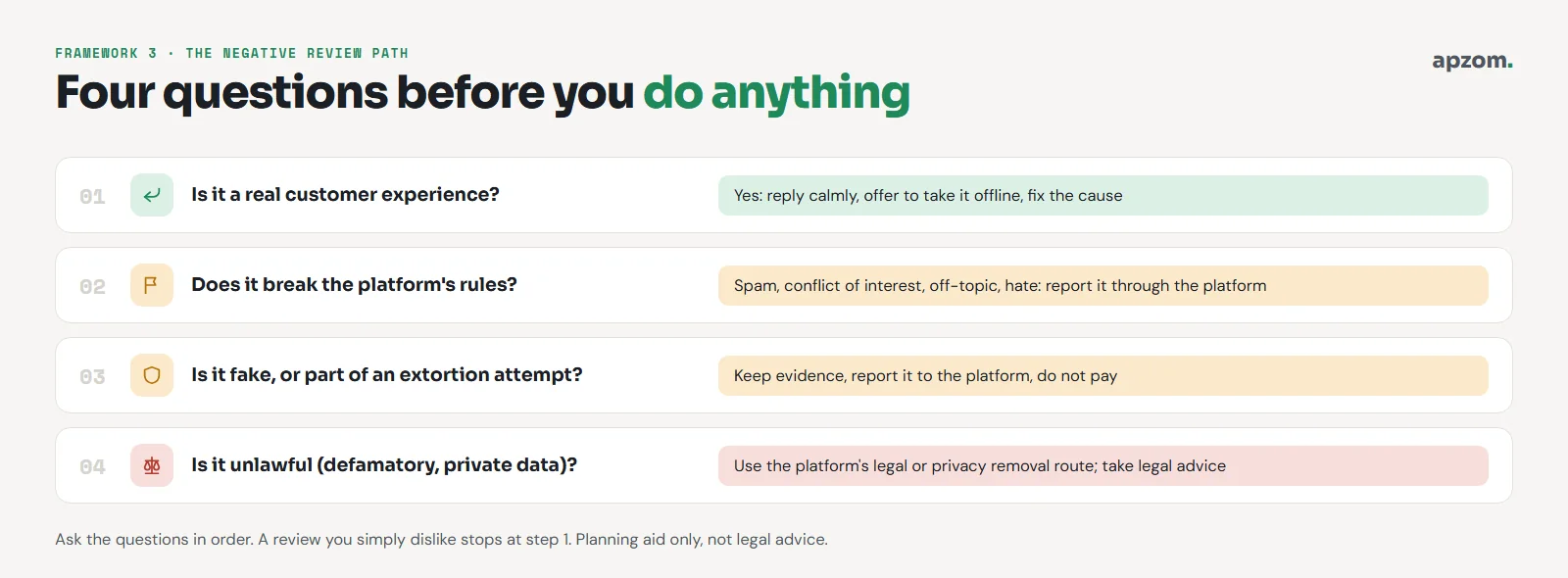
- Is it a real customer’s experience? If yes, reply. Thank them, acknowledge the problem without arguing, offer to take it offline, and fix the cause. Many negative reviews stop here.
- Does it break the platform’s rules? Spam, conflicts of interest, off-topic rants, harassment or hate speech can be reported through the platform. On Google, you report a review through your Business Profile; you cannot delete it yourself. Google says not to report a review just because you disagree with it, checks typically take several days, and a rejected report gets one appeal.
- Is it fake, or part of an extortion attempt? Some businesses receive a sudden wave of 1- and 2-star reviews followed by a demand for payment to stop. Google has a dedicated form for reporting review extortion through your Business Profile, and says not to pay, because paying “can encourage further attempts”. Keep evidence and report it.
- Is it unlawful? If content is defamatory or exposes private information, the platform’s legal or privacy removal process, and advice from a lawyer, are the right route. Disliking a review does not make it unlawful. Rules differ by country: in the US, Section 230 generally protects platforms from liability for what their users post, so a claim is usually against the person who wrote it; in England and Wales, website operators have a defence for statements they did not post, which they can lose if the poster cannot be identified and they do not respond properly to a formal notice of complaint. Never use a false copyright claim to remove a review; in the US, knowingly filing a false takedown notice can make the sender liable for damages.
How to reply to a negative review
- Reply calmly and briefly. You are writing for the next customer as much as the reviewer.
- Do not confirm private details. Treat reviewers’ details as personal data and never add information about them that they have not made public themselves. In regulated sectors such as healthcare, do not confirm someone is a customer at all. In the US, a dental practice paid $23,000 to settle a federal HIPAA case after revealing patients’ information in replies to online reviews. Our healthcare marketing guide explains the rules.
- Offer a route to resolve it. A phone number or email address, and a named person.
- Do not offer anything in exchange for changing the review. Fix the problem; let them decide whether to update it.
Search results for your name
When people search for your business, the first page of results is part of your reputation. You cannot control what other sites publish, but you can make sure accurate information about you is easy to find:
- Your own website should have clear pages about who you are, what you do and how to contact you.
- Your profiles on Google, Bing, Apple Maps, LinkedIn and the social platforms you use should be complete and consistent.
- Outdated or wrong information on other sites can often be corrected by contacting the site owner.
- Your Business Profile is how a local business manages its information in Google’s knowledge panel; keep it complete and accurate.
- Personal information about you as a person, such as home addresses or contact details posted to harass, can in some cases be removed from Google Search through Google’s personal information removal process. Removal from Search does not delete the page itself. These policies cover people, not businesses: Google says “we only remove content about people”.
- The EU’s “right to be forgotten” under the GDPR applies to individuals, not companies, and has an exception for freedom of expression. Google’s own guidance says reviews of a professional by past clients are likely to be of legitimate interest, so a request to delist them may well be refused.
- Wikipedia: if your business has an article, do not edit it yourself or pay someone to without disclosure. Wikimedia’s terms require paid editors to disclose who pays them, and Wikipedia asks people with a conflict of interest to suggest changes on the article’s talk page instead.
Be wary of anyone who promises to “push down” or “remove” true negative results. Legitimate work can add accurate content; it cannot erase honest criticism.
A monthly reputation health check
Once a month, run through nine checks. They take little time once the monitoring is set up.
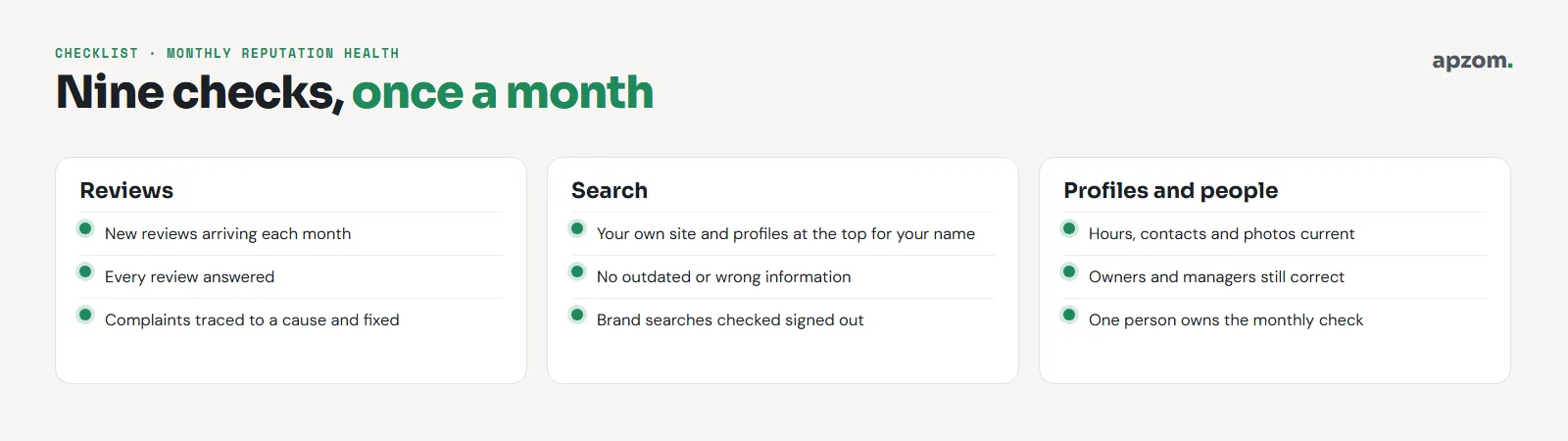
- Reviews: new reviews are still arriving; every review has a reply; complaints have been traced to a cause and fixed.
- Search: your own site and profiles appear for your name; nothing outdated or wrong is showing; you checked while signed out.
- Profiles and people: hours, contact details and photos are current; owners and managers on each profile are still correct; one person owns the monthly check.
Choosing reputation management help
If you hire an agency, ask how they will do the work, not just what results they promise. Red flags:
- They offer to post reviews, or “seed” reviews from their own network.
- They promise to remove negative reviews that are genuine.
- They suggest asking only satisfied customers for reviews, or filtering who gets the review link.
- They will not explain their methods in writing.
Green flags: they monitor and report, help you reply well, build a fair review request process into your customer journey, and tell you plainly when something cannot be removed.
How Apzom can help
Apzom Digital offers online reputation management for businesses that want to monitor and respond properly: monitoring set-up, reply guidance and templates, a fair review request process, profile clean-up and monthly reporting. We do not write or buy reviews, we do not gate review requests, and we will tell you when content cannot be removed. Legal removal requests are for you and your lawyer; we can help you prepare the evidence.
We work with clients worldwide, remotely, from our base in Ahmedabad, India.
Frequently asked questions
Can an agency remove bad reviews?
Not genuine ones. Reviews that break a platform’s rules can be reported, and unlawful content can be challenged through legal routes, but honest negative reviews stay. Anyone promising otherwise is either breaking rules or misleading you.
Is it legal to offer a discount for a review?
It depends on the country and the platform. Google’s policies prohibit offering incentives for reviews, and in the US and UK, undisclosed incentivised reviews and incentives tied to positive reviews are banned. The safest approach is to ask every customer, without any reward.
Should I reply to every review, even old ones?
Yes, ideally. Short thanks for positive reviews, and calm, helpful replies to negative ones. Replies show future customers how you treat people. For reply wording and when to ask for reviews, see our guide to how to get more Google reviews.
What is review gating?
Asking customers how they feel first and only sending happy ones to review sites, while steering unhappy ones to a private form. Google, Trustpilot and Tripadvisor prohibit it. In the UK, the CMA’s guidance treats “encouraging just those who are satisfied to leave reviews” as misleading. In the US, the FTC says gating “could violate the FTC Act”.
How long does it take to improve an online reputation?
It depends on how many reviews you get, how quickly you fix the underlying problems and how competitive your market is. Steady improvement usually comes from months of good service and consistent review requests, not from a one-off campaign.
Do I need reputation management if I have few reviews?
Monitoring and a fair review request process help most at that stage, because each new review has a bigger effect on how you look.
Get your Free Growth Audit and Quote. We review your Business Profile and review-site presence, reply quality, review request process and brand search results, and send a plain-English plan. We do not write, buy or gate reviews, and we will tell you plainly what cannot be removed.
No obligation and no promised ratings. Prefer to talk first? Contact us or see our online reputation management service.