The short answer: A small business needs a minimum brand kit, not a 100-page brand book. That means a name and logo (with a one-colour version and a small icon), two to four colours with exact codes, one or two properly licensed fonts, a one-page note on how you sound, a photo style and a handful of templates. Before you print signs, packaging or vehicle wraps, run trade mark checks on your name and logo, because registering a company or a domain name does not give you the right to use a brand. Full brand guidelines can wait until other people start producing your materials without you.
This guide is for founders and owners anywhere in the world who are starting a business, renaming one or tidying up a brand that has grown messy. It gives you three tools: the minimum brand kit (six things you actually need), a simple test for when you need full brand guidelines, and a six-step trade mark check to run before you commit money to print. It is written by an agency that does branding work, so read it knowing we have an interest; everything here works just as well if you do it yourself or hire someone else. It is not legal advice: for trade marks, a qualified attorney in your country is worth the fee.
What brand identity is, and what it is not
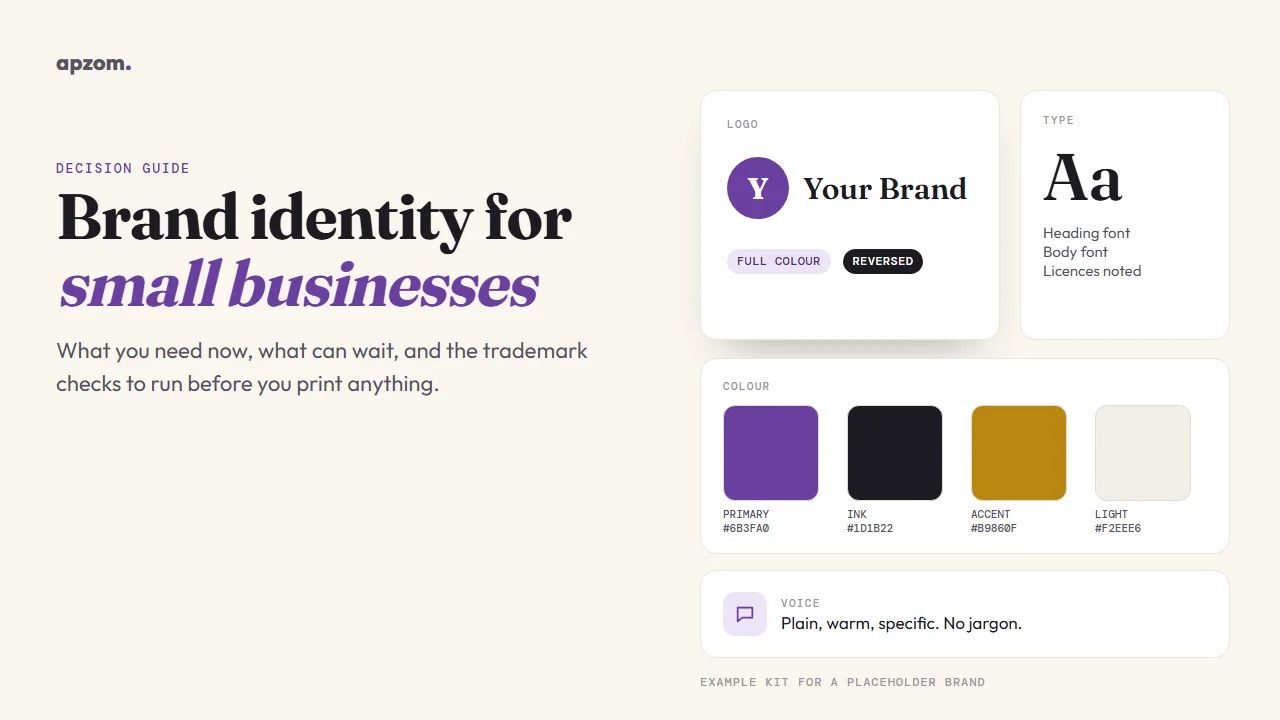
Your brand identity is the set of things people see and hear that tell them it is you: your name, logo, colours, type, images and the way you write and speak. Your brand, more broadly, is what people think and feel about your business, and that comes mostly from what you do, not from your logo.
That distinction matters for a small business, because it tells you where to spend. A clear, consistent identity helps people recognise and remember you. It cannot fix a weak offer, slow replies or poor service, and no amount of design will make up for them.
Framework 1: the minimum brand kit
The first framework is the six things a small business actually needs. Everything else can wait.
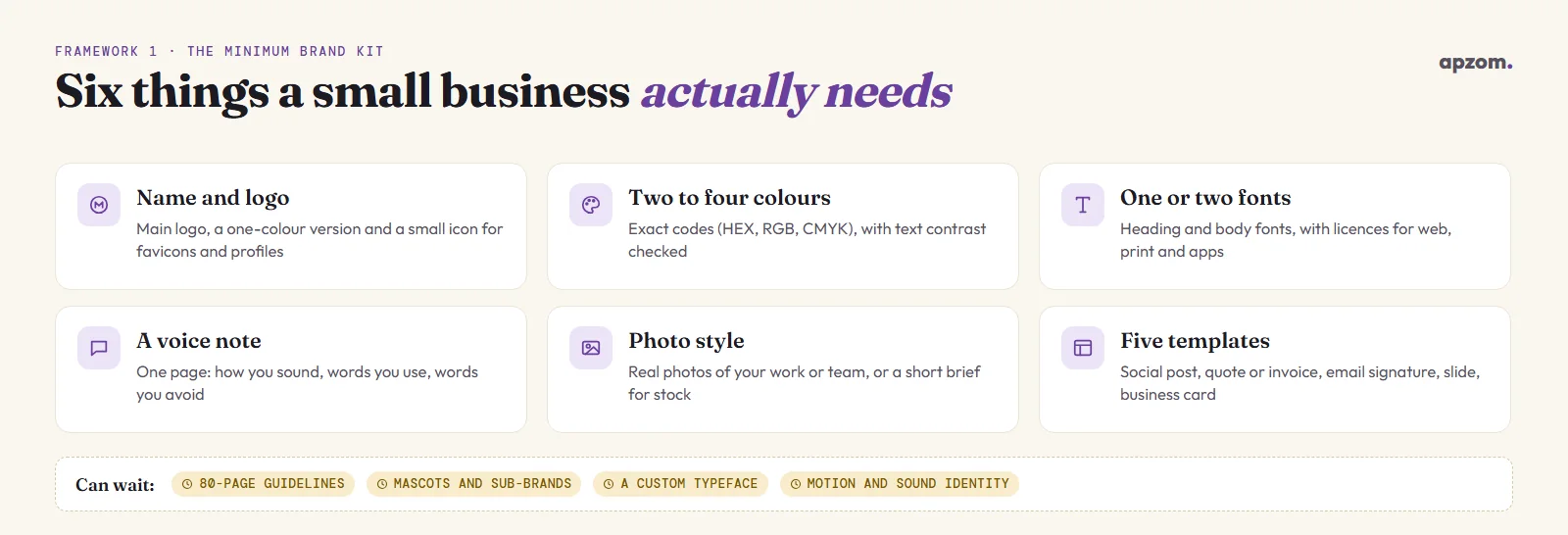
- Name and logo. A main logo, a one-colour version (for stamps, embroidery and single-colour print) and a small square icon that still works at favicon and profile-picture size.
- Two to four colours. A main colour, a dark colour for text, and one or two accents, each written down with exact codes: HEX and RGB for screens, CMYK for print. Check that text colours have enough contrast against their backgrounds to be readable.
- One or two fonts. A heading font and a body font, with licences that cover how you will use them: website, print, apps and documents.
- A voice note. One page on how you sound: three or four words that describe your tone, phrases you use, words you avoid, and a few before-and-after examples.
- A photo style. Real photos of your work, premises or team where you can, or a short brief for choosing stock images so they look like they belong together.
- Five templates. A social post, a quote or invoice, an email signature, a simple slide and a business card. These are where inconsistency often creeps in.
What can wait: an 80-page guidelines document, mascots and sub-brands, a custom typeface, and motion or sound identity. These are useful for larger organisations; for most small businesses they cost more than they return.
Framework 2: brand kit or full brand guidelines?
A brand kit is a short set of files and rules for the people who make your materials, often just you, a designer and a printer. Full brand guidelines are a manual: detailed rules, examples and “do and do not” pages, written so that many people can use the brand consistently without you in the room.
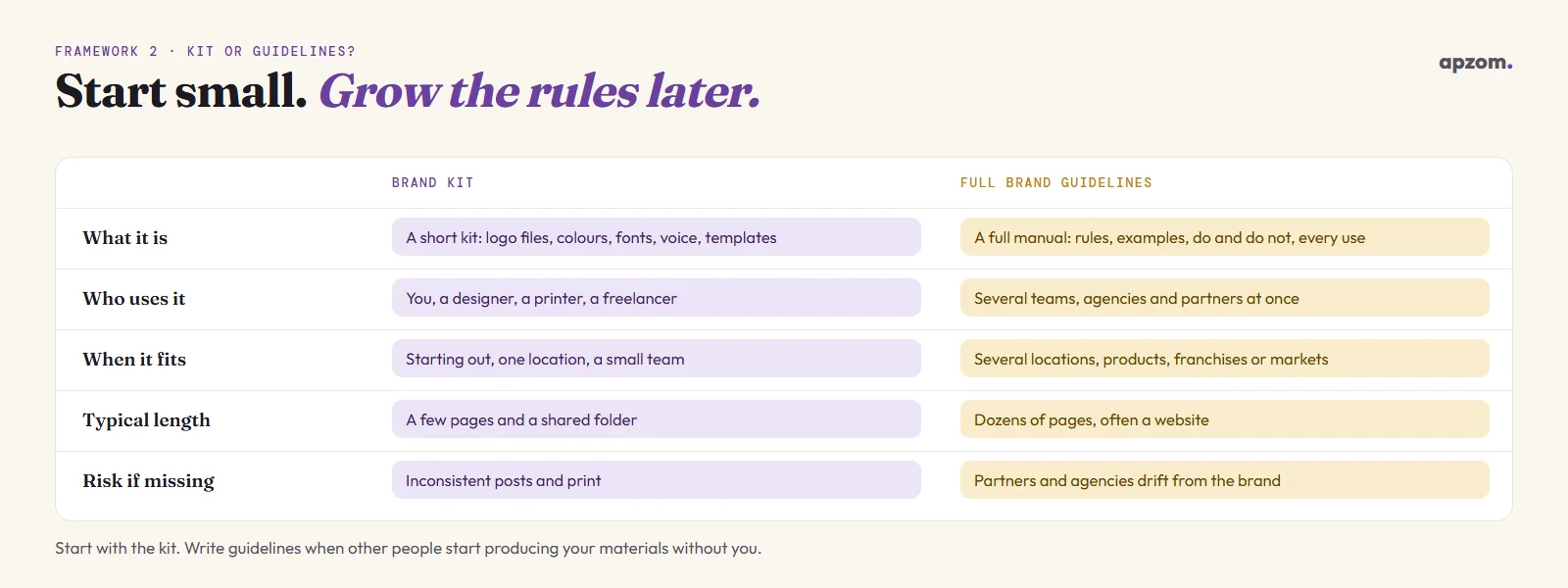
| Question | Brand kit | Full brand guidelines |
|---|---|---|
| What it is | Logo files, colours, fonts, voice, templates | Rules, examples and do-and-do-not pages for every use |
| Who uses it | You, a designer, a printer, a freelancer | Several teams, agencies and partners at once |
| When it fits | Starting out, one location, a small team | Several locations, products, franchises or markets |
| Typical size | A few pages and a shared folder | Dozens of pages, often a website |
A simple test: write full guidelines when other people start producing your materials without you checking them. Until then, the kit is enough.
Before you design: check the name
The most expensive branding mistake is not an ugly logo. It is building a brand on a name you cannot use. Signs, vehicle wraps, packaging, uniforms and a website all cost money to change, and a dispute over a name can force you to change them.
Company names, domains and trade marks are different things
Registering a company, a trading (“doing business as”) name or a domain does not give you trade mark rights in that name. The UK’s Companies House says so directly, and the USPTO says the same about business names and domain names. Company registers mainly check whether a name is already taken on that register; most do not run a full trade mark check, so approval of a company name is not a sign that the name is free to use as a brand. A trade mark protects a name, logo or other sign that identifies your goods or services, in specific classes of goods and services, usually country by country.
Framework 3: six trade mark checks before you print
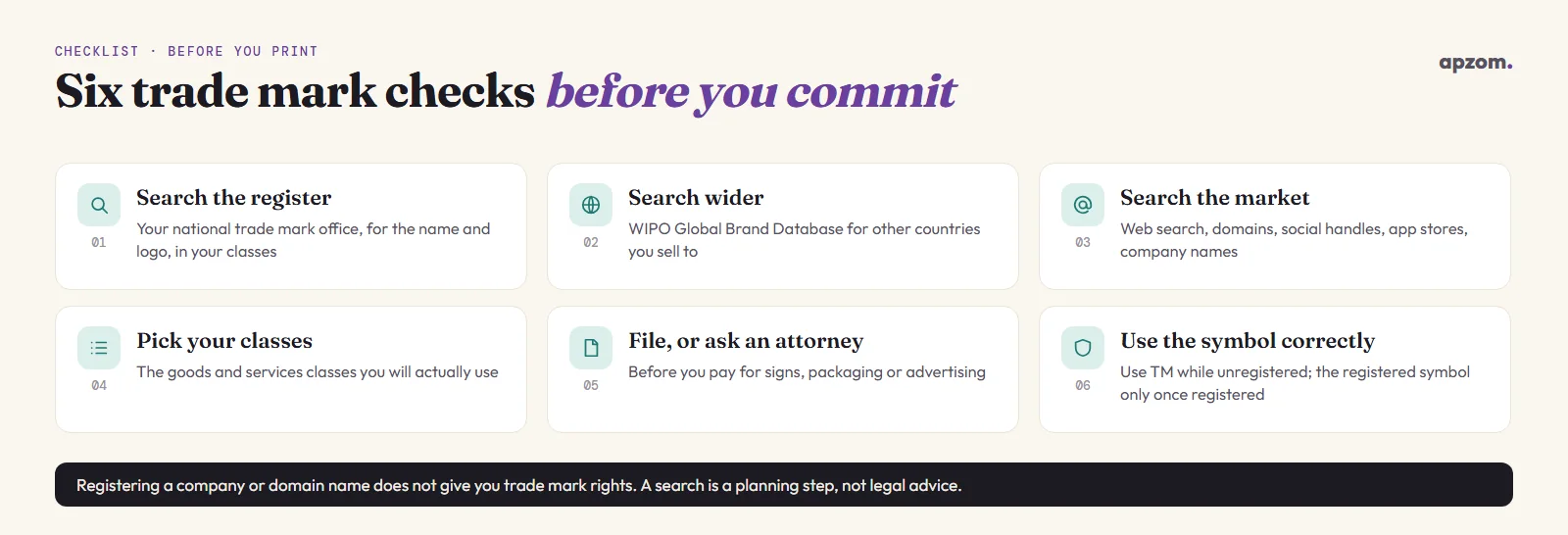
- Search the register. Search your national trade mark office’s free database for your name and logo, in the classes of goods and services you will use. Look for identical and similar marks, including ones that sound alike, not just exact matches. The table below lists the official search tools.
- Search wider. If you sell, or plan to sell, in other countries, search WIPO’s free Global Brand Database, which lets you search international registrations and many national registers in one place.
- Search the market. Search the web, domain names, social media handles, app stores and company registers. Someone using a name without registering it may still have rights in some countries.
- Pick your classes. Trade marks are registered for specific classes of goods and services under the international Nice Classification, which has 45 classes (34 for goods and 11 for services). Choose the classes you will actually use; most offices charge per class.
- File, or ask an attorney. If the name is clear, consider filing before you spend heavily on print, signage or advertising. A trade mark attorney can run a proper clearance search and advise on how strong the name is. If you will sell in several countries, WIPO’s Madrid System lets you file one international application to seek protection in many of them.
- Use the symbols correctly. Use the TM symbol (or SM for services in the US) for a mark you are claiming but have not registered. Use the registered symbol only once the mark is registered in that country, and only for the registered goods or services. In the UK, falsely presenting a mark as registered is a criminal offence under section 95 of the Trade Marks Act 1994, and India’s Trade Marks Act 1999 also prohibits it.
Where to search, and what filing costs
Official fees change, so check the office’s own fee page on the day you file. These are the official search tools and the base online fee for one class, as published by each office when we checked in November 2026. Attorney fees are extra.
| Where | Free official search | Official fee, one class, online |
|---|---|---|
| United States | USPTO Trademark Search (replaced TESS in 2023) | US$350 per class (surcharges apply, for example $200 per class if you write your own description instead of using the ID Manual) |
| United Kingdom | UK IPO trade mark search | £205, plus £60 per extra class (since 1 April 2026) |
| European Union | EUIPO eSearch plus, and TMview for EU and national offices | €850 for one class, €50 for the second, €150 for each class from the third |
| India | IP India public trade mark search | ₹4,500 per class for individuals, startups and small enterprises; ₹9,000 for others |
| Australia | IP Australia’s Australian Trade Mark Search | AUD 250 per class using the goods and services picklist, or AUD 400 per class without it (standard application) |
| Canada | CIPO’s Canadian Trademarks Database | CAD 491.06 for the first class, plus CAD 149.04 per extra class (2026) |
| UAE | No public self-service search listed by the Ministry of Economy and Tourism; it checks for similar marks during examination | AED 6,500 in total across the application, publication and registration stages |
| Many countries | WIPO Global Brand Database | Not a filing route; use WIPO’s Madrid System for international filing |
A search is a planning step, not a guarantee. If the name matters to your business, pay for professional advice.
Building or refreshing your brand? Ask for a Free Growth Audit. We look at how your name, logo, colours and messages show up across your website, Business Profile and social profiles, and tell you what to fix first.
Who owns your logo?
If someone else designs your logo, make sure you own it. In many countries, paying a freelancer or agency does not by itself transfer copyright to you; you need a written assignment. Our guide to choosing a web design company explains the rules in the US, UK and India, and the same principle applies to logo and brand design. Ask for a written transfer of rights in the final logo and artwork on payment, and a list of anything licensed instead, such as fonts and stock images. In India, the assignment should also say “worldwide” and “for the full term of copyright”, because otherwise it is presumed to cover India only and five years.
Also check what can and cannot be protected. In the US, typeface designs cannot be registered for copyright (font software is treated differently), and a word-only or simple-shape logo usually cannot be either (US Copyright Office, Compendium of Copyright Office Practices). In the US, that makes a trade mark, not copyright, the main protection for most small-business logos.
Fonts need licences too
Fonts are software, and their licences differ. Fonts from Google Fonts are open source, mostly under the SIL Open Font License, and can be used commercially, including in a logo; check each font’s licence on its page. Adobe Fonts are licensed for commercial use with a Creative Cloud subscription, but web use runs through Adobe’s hosting, so if the subscription lapses your website falls back to other fonts. Commercial foundries often sell desktop, web and app licences separately: a desktop licence on your designer’s computer may not cover your website or app. Agree whose licence covers the brand fonts, and keep a copy of every licence in your brand folder.
AI-generated logos
AI tools can help explore ideas quickly, but check two things before you use an AI-generated logo: whether the tool’s terms let you use the output commercially, and whether the result is protectable. The US Copyright Office’s January 2025 report on AI and copyrightability says that prompts alone are not enough to make someone the author of the output, so an AI-generated logo may not be protected by copyright in the US. Other countries treat computer-generated works differently: UK law currently has a special rule for them, but the UK government’s March 2026 report on copyright and AI proposes removing it, and no legislation has been introduced yet. A trade mark search is just as important for an AI-generated name or logo.
The hand-over folder
Whether you design it yourself or hire someone, finish with one shared folder that you own.
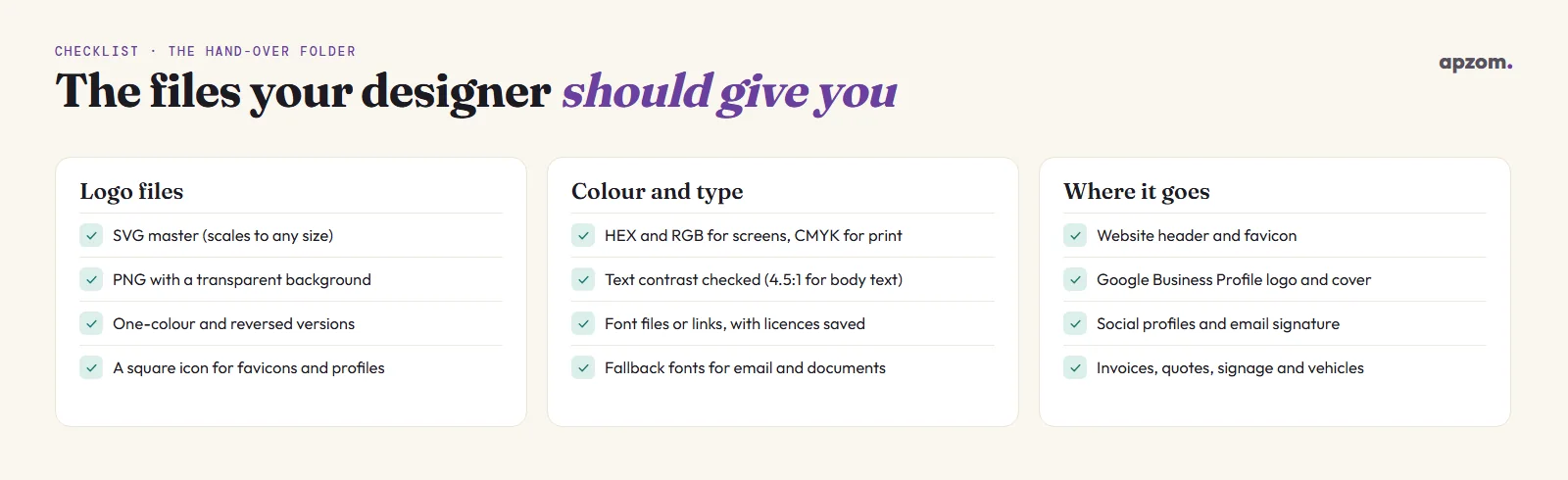
- Logo files: a vector master (SVG, or the designer’s source file) that scales to any size, PNG files with transparent backgrounds, one-colour and reversed versions, and a square icon. For Google Search, a favicon must be square, should be larger than 48 by 48 pixels, must use a supported format such as PNG or ICO (SVG is not on Google’s list), and must be crawlable by Google (Google Search Central, checked November 2026).
- Colour and type: colour codes for screen and print, contrast checked, font files or links with their licences, and fallback fonts for email and documents.
- Where it goes: your website header and favicon, your Google Business Profile logo and cover photo (Google accepts JPG or PNG photos between 10 KB and 5 MB recommends 720 by 720 pixels and needs at least 250 by 250, so upload a square version of your logo; Google does not guarantee which photo it shows first), social profiles, email signature, and print items such as invoices, signage and vehicles.
Your logo itself can use any colours: the Web Content Accessibility Guidelines (WCAG) exempt logos from their contrast rules. But brand colours used for text need a contrast ratio of at least 4.5:1 against their background (3:1 for large text, meaning 18 point, or 14 point bold) under WCAG 2.2 Level AA, and buttons, icons and form borders need 3:1. Never rely on colour alone, for example an error shown only in red. A free contrast checker will tell you whether your colours pass.
Applying the brand consistently
Many small business brands do not fail at design. They fail in daily use: a different logo on the van, an old colour on the website, a stretched image on social media. Three habits help:
- One source. Keep the brand folder in one place and send people the link, not attachments.
- Templates over freehand. Use the templates for anything you make often.
- A twice-yearly check. Look at your website, Business Profile, social profiles, email signatures and printed materials side by side, and fix anything that has drifted.
If you are also planning a new website, our guides to how much a website costs and choosing a web design company cover the next steps.
Common brand identity mistakes
| Mistake | Why it hurts | Fix |
|---|---|---|
| Printing before checking the name | A dispute can force an expensive rebrand | Run the six trade mark checks first |
| Only one logo file | It breaks on dark backgrounds, small sizes and single-colour print | One-colour, reversed and icon versions |
| No colour codes | Every printer and designer guesses | Written HEX, RGB and CMYK codes |
| Unlicensed fonts | Legal risk and surprise costs | Licences saved for every font and use |
| No written ownership of the logo | You may not own what you paid for | A signed assignment on payment |
| A 100-page brand book nobody reads | Time and money spent, nothing changes | Start with the kit; add rules when you need them |
How Apzom can help
Apzom Digital’s branding and design services cover brand kits for small businesses: logo files in every format, colour and type systems with contrast checked, a voice note and templates, delivered in a folder you own, with a written assignment of rights in the final artwork agreed in the contract. We can work alongside your trade mark attorney, but we do not give legal advice or run official clearance searches.
We work with clients worldwide, remotely, from our base in Ahmedabad, India.
Frequently asked questions
What is the difference between a brand and a brand identity?
Your brand is what people think and feel about your business. Your brand identity is the set of visible and verbal signals, such as name, logo, colours, type and voice, that help people recognise you.
How many colours should a small business brand use?
Two to four is usually enough: a main colour, a dark colour for text and one or two accents. More colours make consistency harder.
Do I need to register a trade mark?
Not always, but registration usually gives stronger and clearer rights than relying on use alone. In the UK, for example, an unregistered brand is protected only through the law of passing off, which means proving goodwill, misrepresentation and damage. If your name matters to your business, get advice from a trade mark attorney in your country.
Is registering my company name enough to protect it?
No. A registered company name or domain name is not a trade mark. Search the trade mark register before you commit to a name, and check that the matching domain and social handles are free. If someone registers a domain that is confusingly similar to your trade mark, has no legitimate interest in it and registered and uses it in bad faith, a complaint under ICANN’s dispute policy (the UDRP) can lead a panel to order the domain transferred or cancelled.
Can I use a free logo maker?
You can, but check the terms for commercial use and whether you get exclusive rights. Many free tools use templates that other businesses can use too, which can make the logo hard to protect as a trade mark and easy to confuse with someone else’s.
When should I update my brand identity?
When it no longer fits what you do or who you serve, or when it creates practical problems such as poor readability or confusion with another business. Refreshing a kit is cheaper than a full rebrand.
Get your Free Growth Audit and Quote. We check your current brand kit against the minimum kit in this guide, look at consistency across your website and profiles, and, if you need design work, quote for a brand kit or guidelines separately. Trade mark searches and filing are for you or your attorney; we do not give legal advice.
No obligation. Prefer to talk first? Contact us or see our branding and design services.