
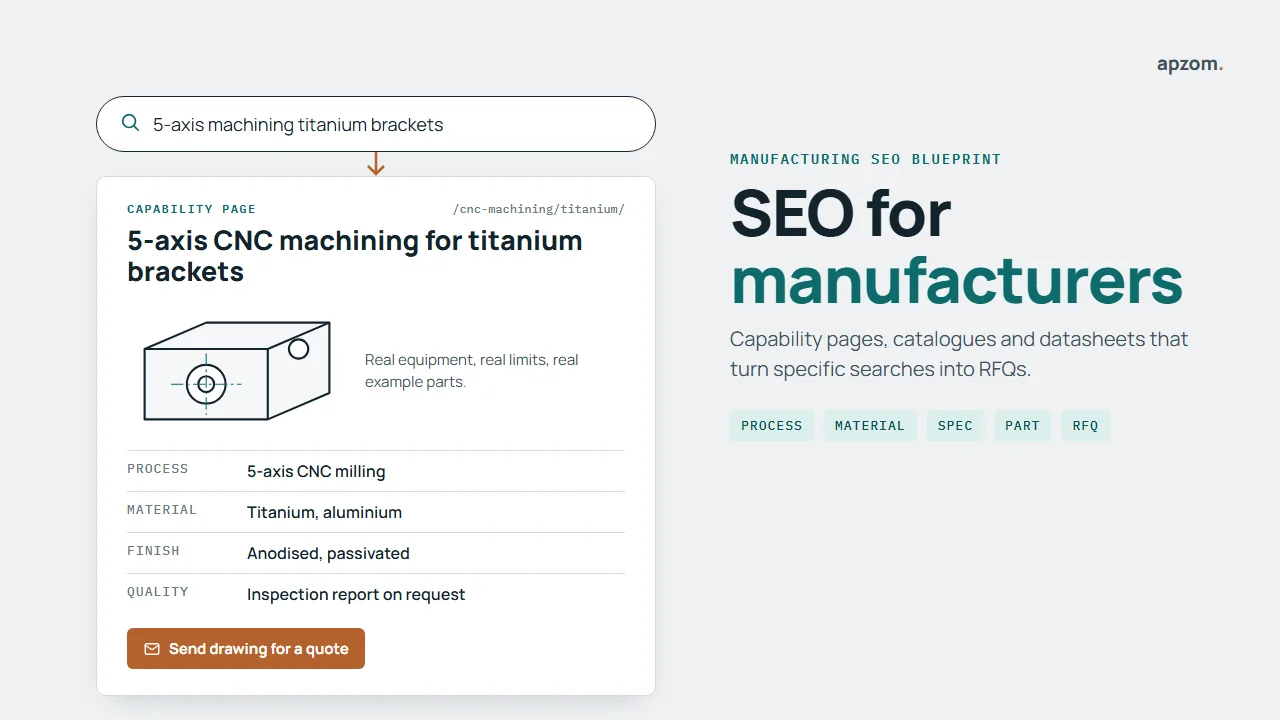
The short answer: SEO for manufacturers means structuring your website so engineers and buyers who search for a process, material, specification or part can find a page that proves you make it, and can send you a request for quote (RFQ) from there. It is less about blog posts and more about capability pages, product and datasheet pages, clean catalogue structure and technical health.
This guide is for marketing managers, sales leads and owners at machine shops, fabricators, contract manufacturers, component makers and OEMs who want search to bring in quotable work. It is a practical blueprint: how industrial buyers search, which pages to build, how to fix the technical problems catalogues create, how to handle distributors and export markets, and how to measure SEO in RFQs. For the wider picture, including paid search, LinkedIn, trade shows and sales handoff, read our guide to digital marketing for manufacturers.
How industrial buyers search
Engineers and sourcing teams rarely search for “manufacturing company”. They search for the specific thing they need, and the search gets more specific as they get closer to sending an RFQ. We call this the spec query ladder.
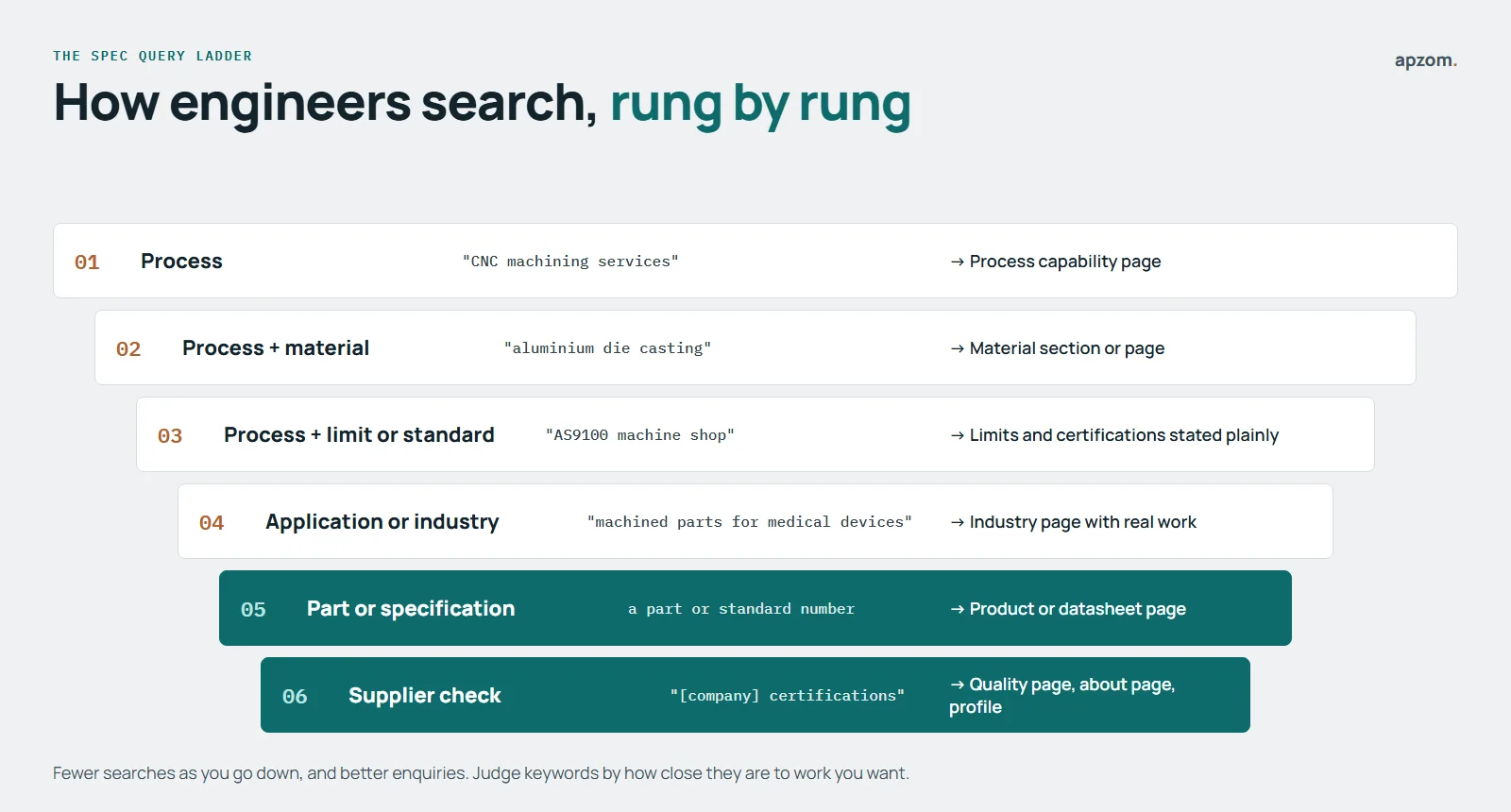
| Rung | What they type (examples) | What they need to land on |
|---|---|---|
| 1. Process | “CNC machining services”, “laser cutting” | A process capability page |
| 2. Process + material | “aluminium die casting”, “stainless steel sheet metal fabrication” | A material-specific section or page |
| 3. Process + limit or standard | “5-axis machining tight tolerance”, “AS9100 machine shop” | Capability limits and certifications, stated plainly |
| 4. Application or industry | “machined parts for medical devices”, “enclosures for EV chargers” | An industry or application page with relevant work |
| 5. Part or specification | a part number, a standard number, “M12 stainless hex standoff” | A product or datasheet page |
| 6. Supplier check | your company name, “[company] certifications”, “[company] reviews” | Homepage, quality page, about page, Google Business Profile |
The lower rungs bring fewer searches and better enquiries. A page that ranks for “5-axis machining of titanium aerospace brackets” may get a handful of visits a month, and one of them may be the RFQ that matters. Judge keywords by how close they are to work you want, not by volume.
Exact search volumes for industrial terms are often small and unreliable in keyword tools. Search Console data from your own site, filtered by page and query, is usually a better guide than any tool’s estimate once your pages are live.
The page families every manufacturing site needs
Most manufacturer websites have a homepage, a single “Capabilities” page, a contact form and a news section. That structure cannot match the spec query ladder. Build page families instead.
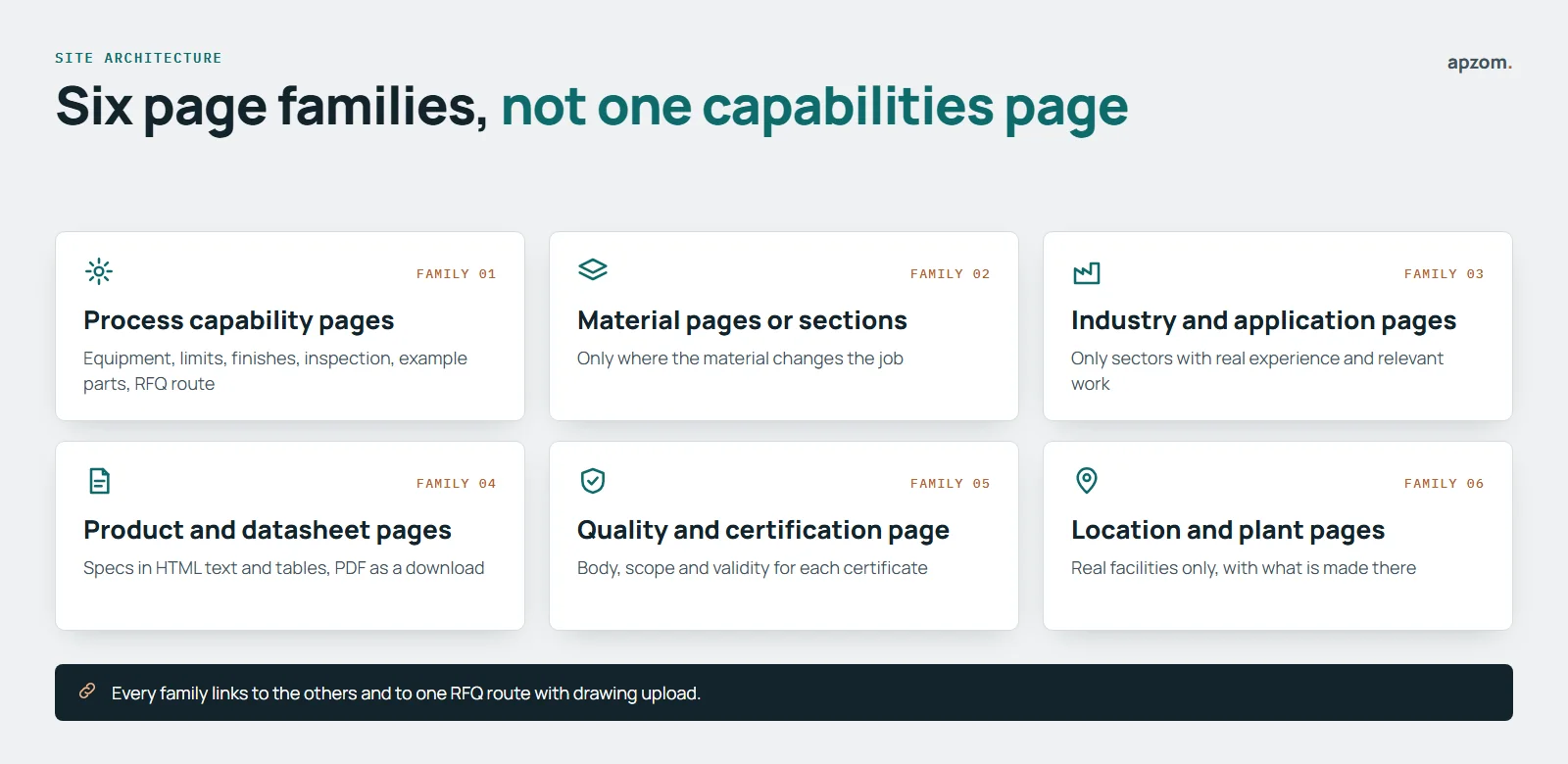
1. Process capability pages
One page per process you run, such as CNC turning, 5-axis milling, laser cutting, press brake forming, MIG and TIG welding, powder coating or injection moulding. Each page should state:
- What the process is good for, in a sentence a buyer would recognise.
- Your equipment, with useful limits: maximum part size, materials, typical tolerances you hold, batch sizes from prototype to production.
- Secondary operations and finishes you offer with it.
- Inspection and quality control for that process.
- Two or three real example parts, with permission and without customer drawings.
- A clear RFQ route with drawing upload.
2. Material pages or sections
Create these where the material changes the job: stainless steel grades, aluminium alloys, titanium, engineering plastics, copper and brass. A material section can live on the process page; give it its own page only when there is enough genuinely different content, such as grades, typical applications and finishing differences.
3. Industry and application pages
Only for sectors where you have real experience. An industry page should explain what that sector needs from a supplier, such as documentation, traceability or cleanliness standards, and show relevant work. If you replaced the industry name and the page still made sense, it is not specific enough.
4. Product and datasheet pages
For component makers and OEMs: one HTML page per product or product family, with specifications in text and tables (not only in a PDF), applications, compatible parts, downloads and an enquiry or sample request. Search engines read HTML text far more reliably than text inside images.
5. Quality and certification page
List each certification with the certifying body, scope and validity, plus inspection equipment and how you control quality. Quality engineers look for this page specifically, often by searching your company name with “certifications”.
6. Location and plant pages
Only for real facilities, with address, what is made there and the equipment on site.
Technical SEO for manufacturing websites
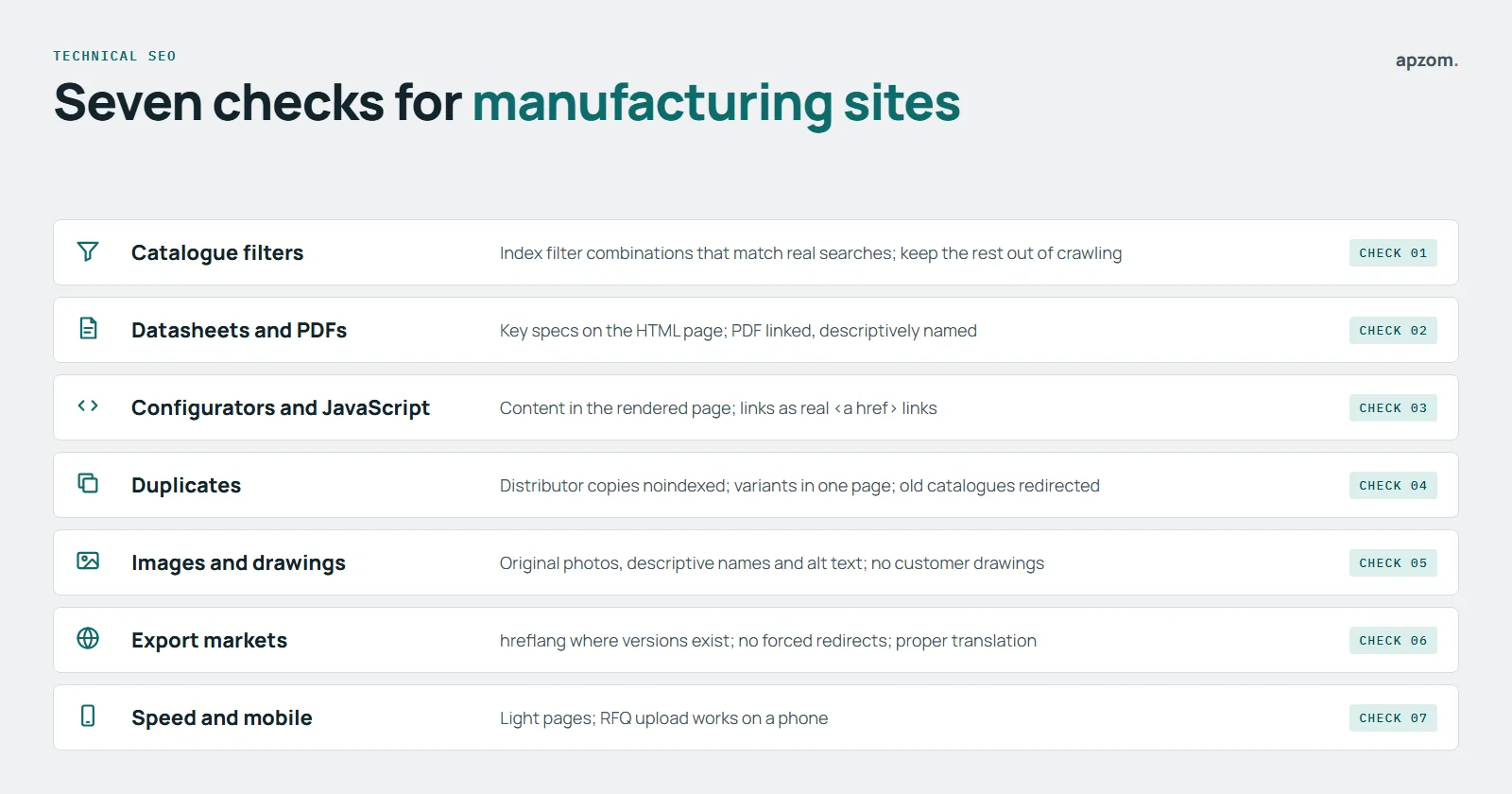
Manufacturing sites have technical problems that most small business sites never meet: large catalogues, filters, PDFs, configurators and multiple languages. These are the issues we check first.
Catalogue filters and faceted navigation
Product catalogues with filters for material, size, thread, finish and standard can create thousands of URL combinations. Google’s guidance on faceted navigation warns that these URLs can cause overcrawling, where search engines spend their time on near-duplicate filter pages instead of your important pages. Its options include blocking filter URLs you do not want crawled with robots.txt, or using URL fragments for filters that should not be separate pages.
A practical rule: let search engines crawl and index filter combinations that match real searches, such as “stainless steel hex standoffs”, and keep the rest out of crawling. Decide this deliberately rather than letting the catalogue software decide for you.
Datasheets and PDFs
Google can index PDFs, so datasheets can appear in search. But a buyer who lands on a PDF has no navigation, no RFQ button and no idea what else you make. Put the key specifications on the HTML product page and link to the PDF from it. Give PDFs descriptive file names and a title in the document properties.
Product configurators and JavaScript
Configurators and filter tools built in JavaScript can hide content and links from search engines. Google can render JavaScript, but important content should appear in the rendered page, and links between pages should be real links with an href, not click handlers. Test key pages with the URL Inspection tool in Search Console.
URLs, titles and headings
Use simple, descriptive URLs with hyphens, such as `/cnc-machining/titanium/`, rather than long parameter strings. Write titles that say what the page offers in the words buyers use: “5-Axis CNC Machining Services for Titanium and Aluminium” beats “Capabilities | Company Name”. One clear H1 per page.
Images and technical drawings
Many industrial searches start or end with an image: a part, a profile, a fitting. Use original photos of your parts and equipment, descriptive file names, alt text that says what the image shows, and place images next to the text that explains them. Never publish customer drawings or confidential parts.
Page speed and mobile
Engineers often research at a desk, but plenty of buyers and site managers check suppliers on a phone. Compress images, avoid heavy sliders and video backgrounds, and make sure RFQ forms with file upload work on mobile.
Not sure which pages are holding you back? A Manufacturing SEO Audit checks your capability and product pages, catalogue crawling, datasheets, duplicate content and how organic RFQs are tracked.
Duplicate content: distributors, variants and copied descriptions
Manufacturers run into duplicate content from three directions.
- Distributors copy your product descriptions word for word, and a large distributor site can outrank you for your own product. Keep your pages richer than any copy, give distributors a shorter, different description, and where a partner republishes your full content, ask them to keep their copy out of search with a noindex tag. Google’s current guidance recommends this for syndicated content instead of relying on a cross-domain canonical.
- Product variants such as sizes, threads or finishes can create many near-identical pages. Often one product page with a variant table serves buyers better than dozens of thin pages.
- Old and new catalogues leave duplicate pages after a redesign. Redirect retired pages to their closest replacement and remove internal links to old URLs.
Google says some duplicate content on a site is normal and is not a violation of its spam policies. It picks the version it judges most complete and useful and shows that one. The problem is that it may not pick yours, and your crawl and link signals get split.
International SEO for exporters
Many manufacturers sell abroad. International SEO should follow where you actually sell and support customers, not every country you could ship to.
- Choose a structure you can maintain: country domains, subdomains or subfolders.
- Use hreflang to connect language or country versions where they genuinely exist. Each version should list itself and its alternatives.
- Do not automatically redirect visitors to a language based on their browser or location; let them choose.
- Translate properly. Technical terms, standards and units differ between markets, and a rough machine translation of a datasheet can be worse than none.
- Show local proof where you have it: agents, distributors, export experience and the standards you work to in that market.
Structured data for manufacturers
Schema.org has no special “Manufacturer” business type, so use the types that describe what is true:
- Organization for the company, with name, logo, address, contact details and official profiles.
- Product for product pages, with properties such as name, description, manufacturer, model, material, mpn (manufacturer part number) and, where real, gtin.
- BreadcrumbList for the page hierarchy.
Google’s product rich results need offers, reviews or ratings. Many industrial products have no public price and no reviews, so they may not get rich results, and that is fine. Never invent prices or ratings to trigger them. Structured data helps search engines understand what is on the page; it does not replace the page content.
Content that earns RFQs and links
The best manufacturing content answers questions engineers and buyers actually have, from people who do the work:
- Design-for-manufacturing guides: “how to design sheet metal parts for lower cost”, “tolerances that drive up machining cost”.
- Material and process comparisons: “die casting vs CNC machining for low-volume aluminium parts”.
- Buying guides: “what to include in an RFQ for machined parts”, “how to qualify a new contract manufacturer”.
- Standards explainers where you work to those standards every day.
Each piece should link to the matching capability page, and the capability page should link back. This kind of practical content is also what trade publications and educational sites link to, which builds authority the honest way. Apzom’s content marketing work starts from these buyer questions.
Measuring manufacturing SEO in RFQs
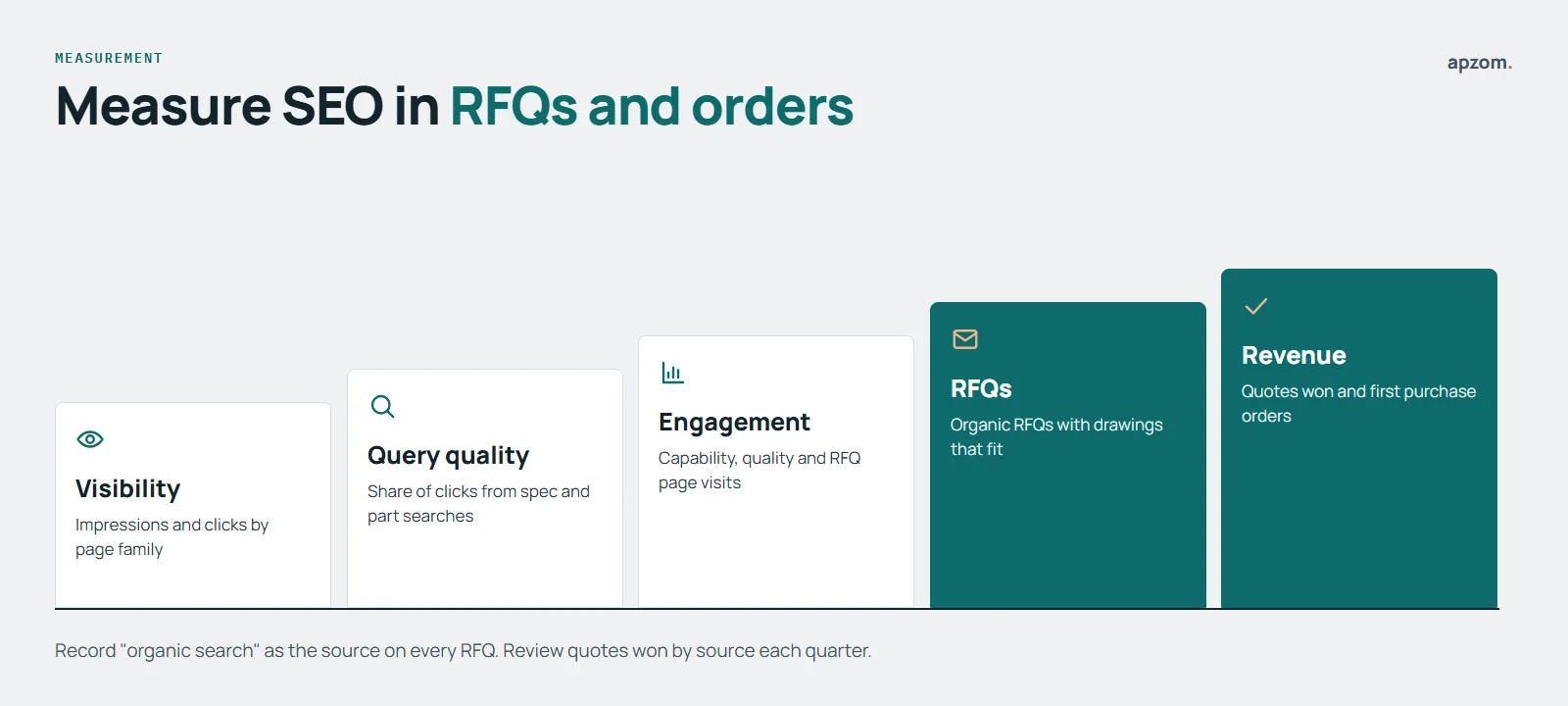
| Level | Measure | Where |
|---|---|---|
| Visibility | Impressions and clicks by page family (process, material, product) | Search Console, filtered by page |
| Query quality | Share of clicks from specific spec and part searches | Search Console, filtered by query (regex helps group terms) |
| Engagement | Visits to capability, quality and RFQ pages from organic search | Analytics |
| RFQs | Organic RFQs, with drawings attached, that fit your capability | CRM or RFQ inbox, source recorded |
| Revenue | Quotes won and first purchase orders from organic RFQs | CRM |
Record “organic search” as the source on every RFQ that comes from it, and review quotes won by source every quarter. Rankings for a single keyword are a weak signal; RFQs that fit your shop are the result.
AI search and answer engines
Engineers increasingly ask AI tools which processes suit a part, or how to choose a supplier. You cannot control what those tools say, and nobody can honestly promise citations. Google’s guidance says no special markup or files are needed to appear in its AI features. Clear capability facts, consistent company information, specific technical content and original knowledge from your engineers give you the best chance of being understood and referenced. Our GEO services build on exactly those foundations.
A 90-day manufacturing SEO plan
Days 1 to 30: fix the foundations
- Crawl the site and fix indexing problems, broken links, duplicate catalogue pages and missing titles.
- Check how filters, PDFs and configurators are crawled.
- Set up Search Console and record “organic search” as an RFQ source in your CRM.
Days 31 to 60: build the money pages
- Rebuild the capability pages for your two or three most profitable processes, with limits, equipment, example parts and RFQ routes.
- Move key datasheet content into HTML product pages.
- Create the quality and certification page.
Days 61 to 90: expand and connect
- Add material and industry pages where you have real depth.
- Publish two or three engineer-written guides linked to the capability pages.
- Review Search Console queries and RFQs by page, then plan the next pages.
Common manufacturing SEO mistakes
- One “Capabilities” page listing every process in a sentence each.
- Specifications only inside PDFs or images.
- Thousands of indexable filter URLs and a few unindexed product pages.
- Industry pages that would work for any industry.
- Distributors outranking you for your own products.
- Blog posts written for volume with no link to a capability page.
- Measuring SEO by traffic instead of RFQs.
How Apzom can help
Apzom Digital’s SEO services for manufacturers start with an audit of your page families, catalogue structure, technical health and how RFQs are tracked. We then rebuild capability and product pages with your engineers, fix crawl and duplicate issues, and connect content to RFQs. If your site needs rebuilding, our website development team builds the structure in from the start. You can read how we approach search in our SEO methodology.
We will not promise rankings or a number of RFQs. We will tell you plainly which pages and fixes are most likely to bring in work you want.
Request a Manufacturing SEO Audit. We review your page families against the spec query ladder, catalogue filters and indexing, PDFs and configurators, distributor duplicates, international setup, structured data and RFQ tracking. You get a prioritised fix list in order of impact.
The audit is free, with no obligation and no guaranteed rankings. Prefer to talk it through? Contact us or see all our services.
Frequently asked questions
What is manufacturing SEO?
Manufacturing SEO is optimising a manufacturer’s website so engineers and buyers searching for specific processes, materials, specifications and parts find pages that prove the company can make what they need, and can send an RFQ easily.
Which pages matter most for a manufacturer’s SEO?
Process capability pages, material sections, industry pages with real experience, product or datasheet pages in HTML, and a quality and certification page. Together they match the specific searches industrial buyers make.
Should we put our datasheets online as PDFs?
Yes, but not only as PDFs. Put the key specifications on an HTML product page and offer the PDF as a download. Google can index PDFs, but HTML pages give buyers navigation and a way to send an RFQ.
How do we stop distributors outranking us for our own products?
Keep your product pages more detailed than any copy, give distributors a shorter, different description, and ask partners who republish your full content to add a noindex tag to their copy.
Do filter pages in our product catalogue hurt SEO?
They can. Uncontrolled filter combinations create huge numbers of near-duplicate URLs that waste crawling. Keep the combinations that match real searches indexable and keep the rest out of crawling.
How long does SEO take for a manufacturing company?
Technical fixes can show effects within weeks. New capability pages and authority usually take several months, depending on competition and your site’s history. Measure progress in RFQs over quarters.
Do we need structured data on product pages?
It helps search engines understand products, part numbers and materials. Product rich results need prices, reviews or ratings, which many industrial products do not have, and that is fine. Never invent them.
Is SEO or Google Ads better for manufacturers?
They work together. Google Ads can bring RFQs quickly for specific capabilities, while SEO builds lasting visibility for the many specific searches buyers make. Our manufacturing marketing guide covers how to combine them.