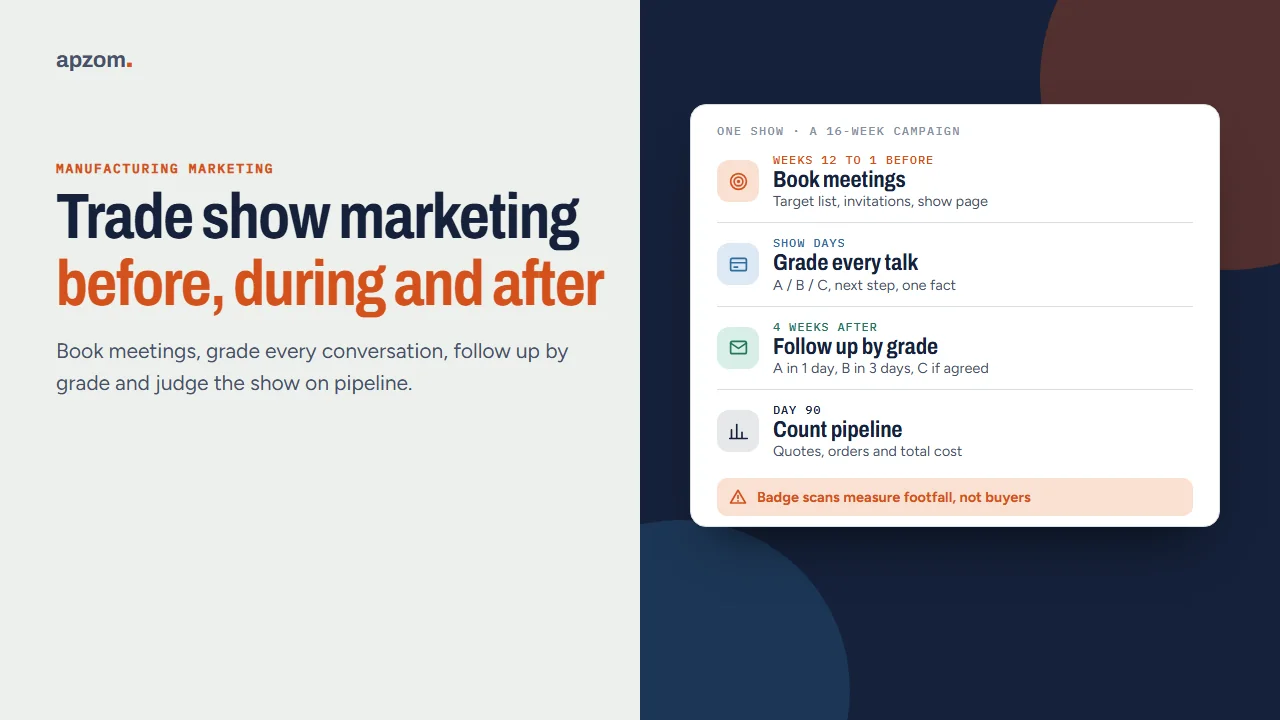
The short answer: Trade show marketing for manufacturers works when the show is run as a 16-week campaign, not a three-day event. Decide what the show must produce and which accounts you want to meet, book most of your important meetings before the doors open, grade every conversation at the stand in a few seconds, follow up each grade within an agreed number of hours, and judge the show on meetings, qualified conversations, quote requests and pipeline, not on badge scans. A stand that does all five can be measured, and one that does none of them usually cannot.
This guide is for marketing leads, sales directors and owners of manufacturers anywhere in the world who exhibit at a handful of trade shows a year: component makers, fabricators, machine builders and contract manufacturers. It gives you a test for whether to exhibit at all, a timeline for before, during and after the show, a grading card for the stand, follow-up rules by grade, the data and email rules that apply to badge scans in the main markets, and a one-page scorecard. We checked the platform features and the legal points against official sources on 19 November 2026. None of this is legal advice; check the rules for your markets with a qualified adviser before you rely on them.
First decide: should you exhibit at this show?
A trade show is one of the most expensive things a small manufacturer does in a year once you add up the stand, travel, samples, freight and the days your best people are away from the factory. Before you book, answer five questions honestly.
- Are your buyers there? Ask the organiser for the previous visitor profile by job role, industry and country, and check it against your own customer list. A big attendance figure means little if your engineers and buyers are a small share of it.
- What must the show produce? Pick one main goal: new accounts in a target market, meetings with existing customers you rarely see, a product launch, or distributor and agent recruitment. Each needs a different stand and follow-up.
- Can you name 30 accounts you want to meet? If you cannot write down the companies, you are hoping for passing traffic.
- Will the right people be on the stand? Visitors to engineering shows often arrive with drawings and technical questions. If no one on the stand can answer tolerances, materials or lead times, the conversation ends with “we will get back to you”.
- Can you follow up within days? If the team returns to a backlog and the leads wait a fortnight, much of the value is gone. Our guide to speed to lead explains why response time matters and what the research does and does not show.
If you answer “no” to two or more, consider visiting the show instead of exhibiting: book meetings with exhibitors and visitors in advance, walk the floor, and spend the stand budget on campaigns you can measure.
The 16-week plan at a glance
The show itself is the middle of the campaign. Most of the results are decided in the 12 weeks before it and the four weeks after it.
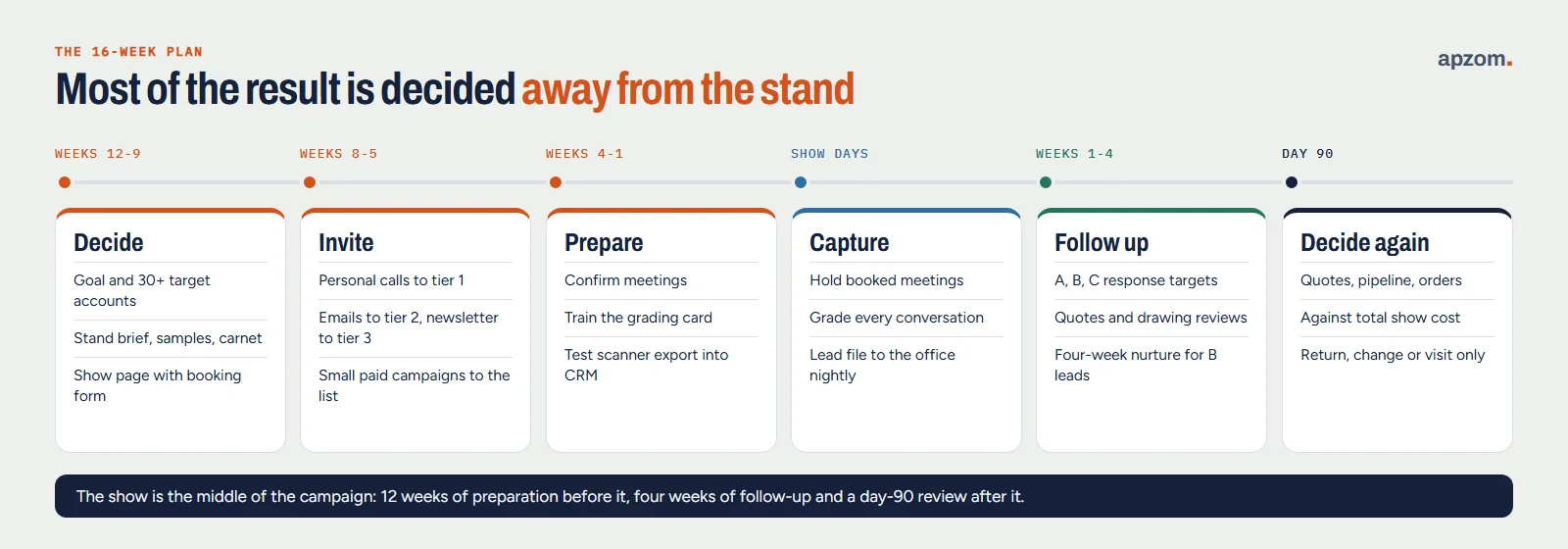
| When | What to do | Who owns it |
|---|---|---|
| Months ahead for large shows (check the organiser’s deadlines) | Book stand space, set the budget, order the stand build | Owner with sales director |
| Weeks 12 to 9 before | Goal, target account list, stand brief, samples and shipping (including any customs documents), landing page | Marketing lead with sales director |
| Weeks 8 to 5 before | Invitations to target accounts, meeting booking opens, content about what you will show, paid campaigns to the target list | Marketing, with sales making personal calls |
| Weeks 4 to 1 before | Confirm meetings, train the stand team on the grading card, test the scanner app and the CRM import | Sales director |
| Show days | Hold booked meetings, grade every conversation, send a daily lead file to the office | Stand team |
| Weeks 1 to 4 after | Follow up by grade, send quotes, run a short nurture series for B and C leads, fill the scorecard | Sales, with marketing support |
| Day 90 after | Count pipeline and orders linked to the show, decide on next year | Sales director |
Before the show: book meetings, not hopes
Passing traffic is unpredictable. Booked meetings are the part of a show you can plan, so make them the main pre-show goal.
Build a three-tier target list
Split your 30 or more target accounts into three tiers and give each a different invitation.
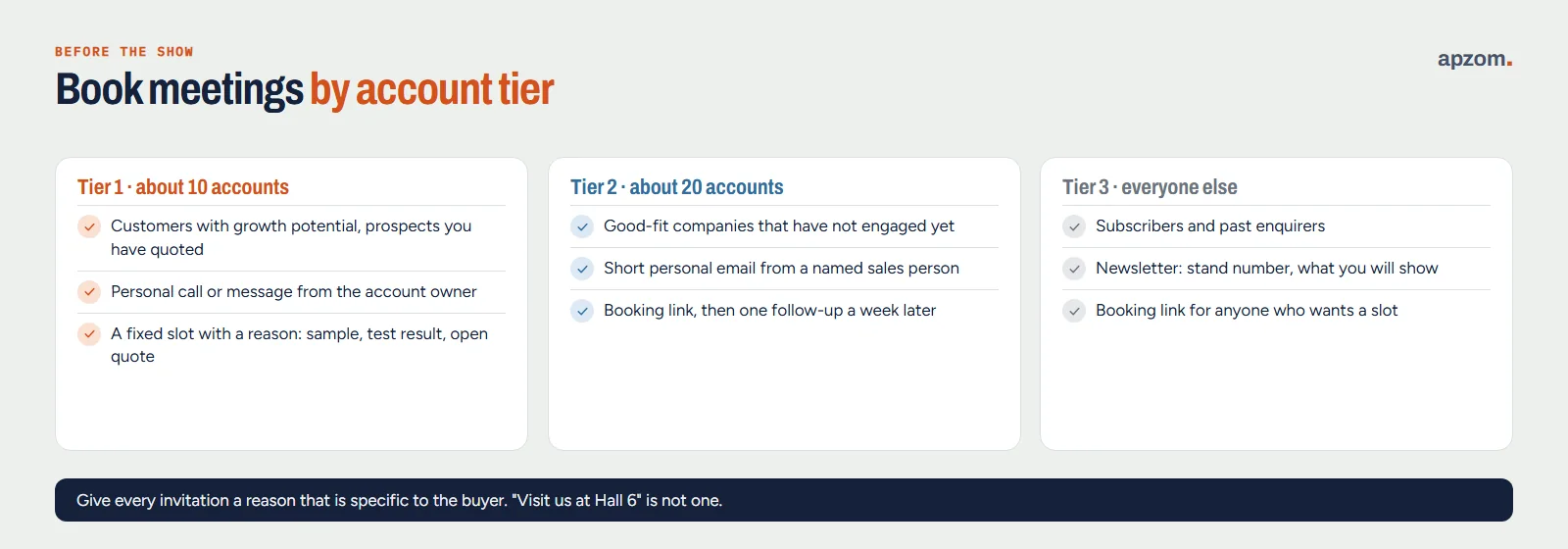
- Tier 1 (about 10 accounts): current customers with growth potential and named prospects you have already quoted. A sales person phones or messages the contact personally and offers a fixed meeting slot, ideally with a reason: a sample of a new part, a test result you can share, or a review of an open quote.
- Tier 2 (about 20 accounts): companies that fit your ideal customer but have not engaged yet. They get a short personal email from a named sales person with a link to a meeting-booking page, and a follow-up a week later.
- Tier 3 (everyone else on your lists): existing subscribers and past enquirers. They get a newsletter announcement with your stand number, what you will show and the booking link.
Give the invitation a real reason
“Visit us at Hall 6” is not a reason. Good reasons are specific to the buyer: a live demonstration of a process they have asked about, a new material or certification, an engineer available to review drawings, or a short technical talk. Publish a page on your website for the show with the stand number, what you will show, who will be there and a booking form. Our guide to landing page best practices covers what that page needs to convert.
Use paid campaigns only to support the list
Paid media works best here as a reminder to accounts you have already chosen, not as broad awareness.
- LinkedIn: LinkedIn’s Matched Audiences let you upload a list of companies or contacts and show ads to people at those companies. LinkedIn says a company list needs at least 300 rows to upload and must match at least 300 members before an ad set can run, so your 30 or so tier-1 and tier-2 accounts are far too few on their own. Upload a wider list of 300 or more companies that fit your ideal customer, with tiers 1 and 2 inside it, or a contact list of customers and past enquirers large enough to match 300 members, and run the invitation message to that. If you create a LinkedIn Event for a talk at your stand, LinkedIn also lets you promote it with an event ad set.
- Google Ads: location targeting can reach people within a radius around the venue’s address (Google’s minimum radius is 1 km), which you can use during the show for searches about your product category. Change the location option from the default “Presence or Interest” to “Presence” (people in or regularly in your targeted locations), and keep budgets small; this is a test, not the plan.
- Email: your best channel for tiers 2 and 3. Check that your sending domain is authenticated before the campaign starts; our guide to SPF, DKIM and DMARC explains how.
Tag every link with UTM parameters so the show page visits and bookings appear separately in your analytics. Our guide to creating UTM links has a naming template.
Ship samples with the right documents
Machines, parts and samples crossing a border for a show may need customs paperwork. An ATA Carnet is an international customs document that lets you temporarily import goods for exhibitions and fairs, professional equipment and commercial samples without paying import duties and taxes, as long as they leave again within the carnet’s validity of up to one year. It is accepted in over 80 countries and territories, including the UK, Canada, Australia, India and the UAE, and issued by national chambers of commerce or equivalent bodies (in the US by USCIB, in India by FICCI, in the UAE by Dubai Chamber). It does not cover giveaways, consumables or goods you plan to sell at the show, and countries differ on which categories they accept, so check with your national issuer before you ship and allow time to apply.
Check your claims before they go on the stand
Stand graphics, brochures and product claims are advertising. In the US, an unqualified “Made in USA” claim needs final assembly or processing and all significant processing in the US, and all or virtually all components made and sourced there. The Federal Trade Commission’s Made in USA Labeling Rule applies this to product labels and to Made in USA seals or marks in mail-order and online promotional material; other claims, such as stand graphics and brochures, are judged by the same standard under the FTC Act. In the UK, misleading business-to-business advertising is prohibited by the Business Protection from Misleading Marketing Regulations 2008, and in the EU by the Misleading and Comparative Advertising Directive (2006/114/EC). Certifications should show their scope (which site, which process), not just a logo. Our manufacturers marketing guide explains what quality engineers look for in certifications, including scope.
Exhibiting in the next few months? Ask for a Free Growth Audit. We review your target account list, show page, invitation plan and CRM set-up, and tell you what we would change before the show, including whether a smaller campaign would do the job.
During the show: grade every conversation
At a busy stand, a badge scan without a note is close to useless a week later. Nobody remembers which of 140 scans was the engineer with a live project.
The three-field grading card
Give every stand member the same three fields to fill in, in the scanner app’s notes or on a printed card, before the visitor leaves.
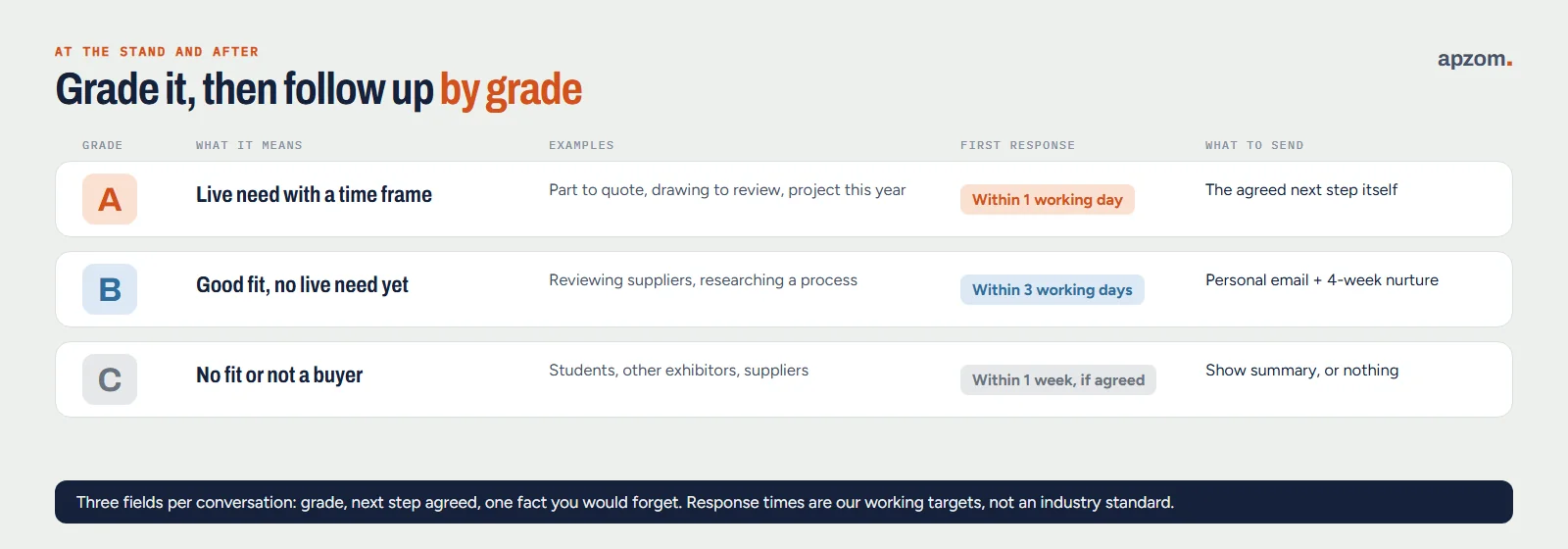
- Grade: A, B or C, using the definitions below.
- Next step agreed: for example “send quote for 2,000 units”, “call on Tuesday”, “send the test report”, or “none”.
- One fact you would forget: the part, the material, the volume, the competitor they use or the decision date.
The grades mean:
- A: a live need with a time frame, such as a part to quote, a drawing to review or a project starting this year.
- B: a good fit with no live need yet, such as a buyer reviewing suppliers or an engineer researching a process.
- C: everyone else: students, other exhibitors, suppliers selling to you, or visitors with no fit.
That is all. A long form at the stand slows the conversation and the team stops filling it in.
Send a lead file to the office every evening
At the end of each day, export the scans and notes and send them to whoever is back at the office, so A leads can get a first response while the show is still running. Test the scanner export and the import into your CRM before the show; finding out on the first evening that the file does not match your CRM fields costs you a day.
Know what a badge scan does and does not permit
When a visitor lets you scan their badge, the organiser passes you their details under its own terms. That does not, by itself, give you permission to send anything you like afterwards. Which rules apply depends on where your company is, where the show is and where the visitor is, and more than one set often applies to the same contact. In outline:
- EU and UK (GDPR and UK GDPR): you need your own lawful basis for using the data. Legitimate interests can cover direct marketing (GDPR Recital 47), but only after you have weighed your interest against the person’s, and only where the email rules below do not require consent. People have an absolute right to object to direct marketing, and you must tell them how you use their data.
- UK email (PECR): emails to individuals, including sole traders and some partnerships, need consent or the “soft opt-in”. The soft opt-in covers only your own similar products, only when you collected the details during a sale or negotiations for a sale, and only if you offered an opt-out then and in every message; in our reading, a bare badge scan is unlikely to qualify. Emails to people at limited companies, LLPs and other corporate bodies do not need PECR consent, but you must identify yourself and give a simple way to opt out, and UK GDPR still applies to named business addresses. Since 5 February 2026, fines under PECR can reach £17.5 million or 4% of global turnover (Data (Use and Access) Act 2025).
- EU email (ePrivacy): the rules for business email addresses vary by member state, so check the country of each contact before you send.
- US (CAN-SPAM Act): business-to-business email is covered. You do not need prior consent, but every commercial email must have accurate header information and a non-deceptive subject line, identify itself as an advertisement (unless the recipient opted in), include your valid physical postal address and offer a clear opt-out that you honour within 10 business days. The FTC’s maximum penalty is $53,088 per email in violation.
- Canada (CASL): you need consent. Implied consent can apply when someone hands you their address (for example on a business card) or publishes it without saying they do not want messages, and your message is relevant to their job. An inquiry they make to you creates implied consent for six months, and a purchase for two years. Every message must identify you and include a working unsubscribe, and the sender must prove consent, so record how you got each address.
- Australia (Spam Act 2003): commercial messages need consent, express or inferred; a work address someone has conspicuously published, without saying they do not want messages, can count when the message is relevant to their role. Every message must identify you and carry a free unsubscribe that you action within five working days.
- India (Digital Personal Data Protection Act 2023): the DPDP Rules were notified in November 2025 and phase in over 18 months, so the main notice and consent duties apply from about May 2027. The government consulted in 2026 on shortening that period; when we checked we found no notification changing it, so confirm the current date with India’s Ministry of Electronics and IT (MeitY) before your show. Build a clear notice and consent step into your stand process now rather than redesigning it later.
- UAE (Federal Decree-Law No. 45 of 2021): the federal personal data law has been in force since January 2022 and generally requires consent. Businesses established in free zones with their own data laws, such as DIFC and ADGM, follow those instead. When we checked, we could not confirm that the law’s detailed executive regulations had been issued.
Our B2B lead generation guide has the wider outreach rules by country, including calls. At the stand, the practical answer is simple: ask. “Can we send you the test report and the occasional technical update?” is a normal sentence in a stand conversation. Record the answer, the date and what they agreed to receive in your CRM: that is your strongest position in every market above, though each message still needs the sender details and opt-out those laws require.
After the show: follow up by grade
Follow-up is where most show value is lost. Agree these targets with the sales team before the show, write them down, and check them afterwards.
| Grade | First response target | What to send | Owner |
|---|---|---|---|
| A | Within one working day of the conversation (during the show if possible) | The agreed next step itself: the quote, the drawing review, the call, the report | The person who had the conversation |
| B | Within three working days after the show | A personal email that refers to the fact on the card, plus one useful resource (case study, process guide, test data) | Sales |
| C | Within one week, only if they agreed to hear from you | The show summary email or nothing | Marketing |
These are our working targets, not an industry standard. Set your own, but set them in hours or days, not “soon”.
A four-week nurture for B leads
B leads are where next year’s orders often come from, but they are not ready to buy. Plan four short, useful messages over four weeks, each one written by someone who knows the product:
- Week 1: the personal follow-up with the one fact from the stand.
- Week 2: the technical piece they were interested in, such as a process explanation, material comparison or tolerance guide.
- Week 3: proof, such as a case study, a test result or a short video of the process.
- Week 4: a direct question: “Is this worth a call before your next sourcing review?”
Anyone who does not reply moves into your normal newsletter if they agreed to it. Our guides to B2B lead generation and email marketing for small businesses cover the lead stages and the sequences in more detail.
Make the website keep working
After the show, update the show page with a short summary, the talk slides or the demonstration video, and a link to request a quote. Visitors who picked up a brochure will often look you up later, and that page becomes the best way to catch them.
Measure the show on pipeline, not scans
Badge scans measure footfall. They tell you little about whether the show was worth it. Use the same scorecard after every show, filled in at day 30 and again at day 90.
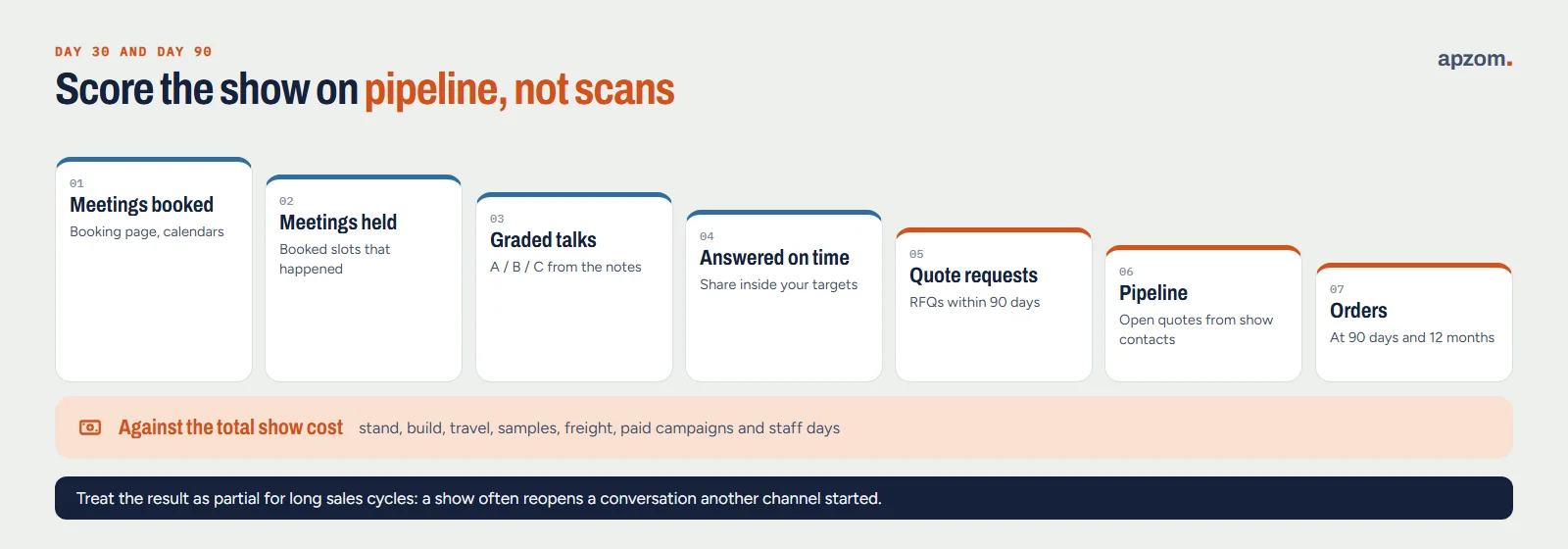
| Line | How to count it |
|---|---|
| Meetings booked before the show | From the booking page and sales calendars |
| Meetings held | Booked meetings that actually took place |
| Graded conversations (A / B / C) | From the scanner notes or cards |
| First response within target | Share of A and B leads answered inside your targets |
| Quote requests | RFQs and drawings received from show contacts within 90 days |
| Pipeline | Value of open quotes linked to show contacts |
| Orders | Orders from show contacts within 90 days, and again at 12 months |
| Total show cost | Stand, build, travel, samples, freight, paid campaigns and staff days |
Link each quote and order to the contact record in your CRM, and mark the show as the source or as an influence. If your enquiries pass through Google Ads as well, our guide to importing offline conversions into Google Ads shows how to send those outcomes back to the ad account. For long B2B sales cycles, treat the show figure as partial: a show often reopens a conversation that another channel started. Our guide to marketing attribution models explains why one number never tells the whole story.
Compare each show with the previous one and with what the same money would buy elsewhere. That is how you decide whether to go back next year, change the stand, or visit instead of exhibiting.
Common mistakes
- Measuring success by scans or brochures handed out. These count activity, not buyers.
- Booking no meetings in advance. The stand then depends on whoever walks past.
- Sending the same email to everyone. An A lead who asked for a quote and receives “Thanks for visiting our stand” feels ignored.
- Leaving engineers at the factory. Technical buyers want technical answers on the spot.
- Forgetting the data rules. A scan is not consent to every kind of message in every country.
- Starting the follow-up after the team has caught up. By then, competitors who exhibited at the same show may already have replied.
How Apzom can help
Apzom Digital runs the digital side of trade show campaigns for B2B firms: target account lists, invitation emails and booking pages, LinkedIn and Google Ads around the show, lead capture into your CRM, follow-up sequences and the scorecard afterwards. We have not published a manufacturing or trade show case study yet, so we will not show you figures we cannot prove. Our closest published B2B work is the 51-page website we built from scratch on WordPress for ARKS Infinity Logistics, a freight forwarding and customs advisory company whose website had to stand up to scrutiny from corporate procurement teams. See our digital marketing services and performance marketing pages for how we work. We work with clients worldwide, remotely, from our base in Ahmedabad, India.
Get a Free Growth Audit for your next show. Tell us which show you are planning, who you want to meet and how leads reach your CRM today. We send back a written plan for the pre-show campaign, the stand grading card, the follow-up targets and the scorecard, with a quote if you want us to run it.
No obligation, and no promised number of leads or orders. Prefer to talk first? Contact us or see our B2B lead generation guide.
Frequently asked questions
How far in advance should a manufacturer start planning for a trade show?
About 12 weeks before the show for the marketing campaign, and earlier for anything with long lead times, such as stand construction, shipping machines or customs documents. The core campaign in this guide runs 16 weeks, from 12 weeks before the show to four weeks after it, with a final pipeline check at day 90.
Is exhibiting at trade shows still worth it for manufacturers?
It can be when your buyers attend, you book meetings in advance and you follow up quickly. It is hard to justify when you cannot name the accounts you want to meet or cannot follow up within days. Use the five-question test at the top of this guide before you book.
How do you follow up on trade show leads?
Grade each conversation at the stand as A, B or C, then follow up by grade: A leads within one working day with the agreed next step, B leads within three working days with a personal email and a short nurture series, and C leads only if they agreed to hear from you.
Can I email everyone whose badge I scanned?
Not automatically. In Canada and Australia you need consent, which may be implied or inferred in limited cases. In the UK, emails to individuals need consent or the soft opt-in, while emails to staff at limited companies and other corporate bodies do not but still need an opt-out; EU rules vary by country. In the US, CAN-SPAM does not require consent but sets rules for every commercial email. Every one of these laws gives recipients a way to opt out. Asking at the stand and recording the answer is the simplest way to stay on the safe side in every market.
What should we measure after a trade show?
Meetings held, graded conversations, how quickly you responded, quote requests, pipeline and orders from show contacts at 90 days and 12 months, against the total cost of the show. Badge scans alone do not tell you whether the show paid off.