
The short answer: SEO for accounting firms means building pages that match how people actually search for accounting help: by service, by type of client, by location and by deadline. Those pages have to be accurate for a named jurisdiction, kept up to date when tax rules change, written or reviewed by qualified accountants, and within your professional body’s advertising rules. Done well, search brings the clients you want in the months you have capacity to serve them.
This guide is for partners, practice managers and marketing leads at CPA firms, chartered accountancy practices, tax preparers and bookkeeping firms. It covers how clients search, the page structure that matches those searches, a tax-season SEO calendar, how to keep financial content trustworthy, local search, technical basics and measurement. For the wider picture, including the advertising rules by country, paid search, referrals and enquiry handling, read our guide to digital marketing for accounting firms.
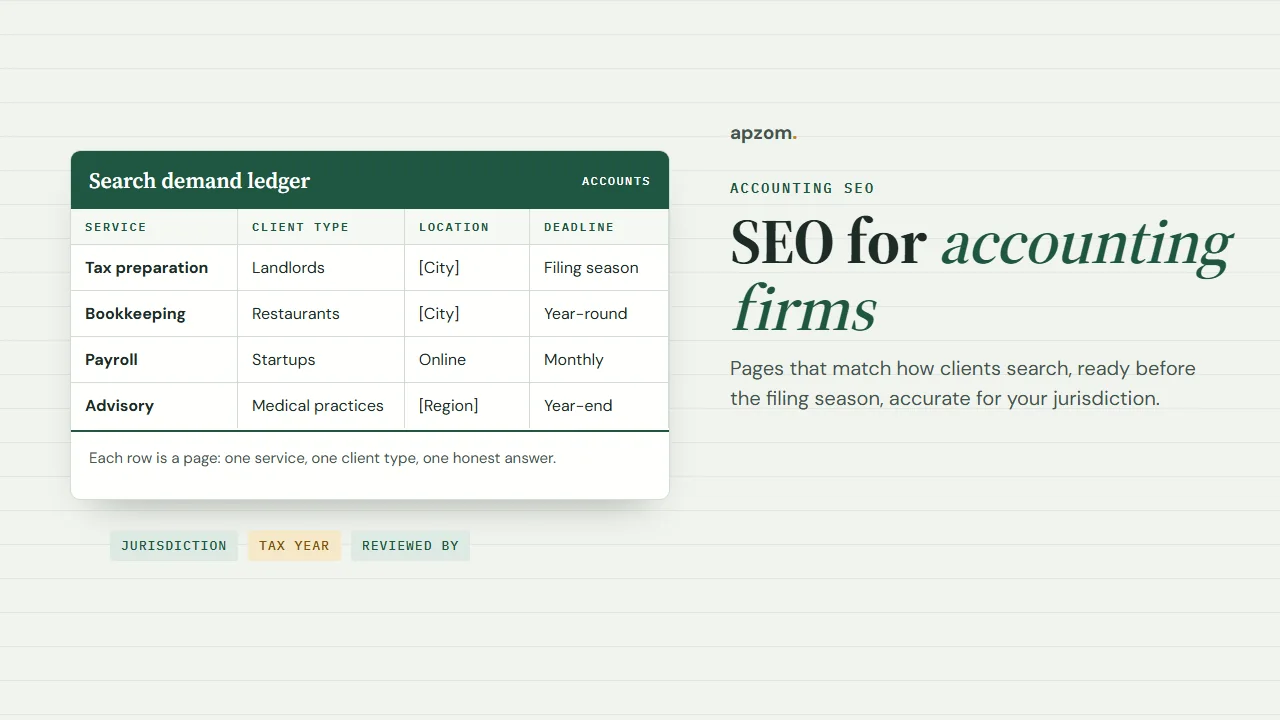
How people search for an accountant
People rarely search for “accounting firm”. They search from a need, and the need shapes which page should answer.
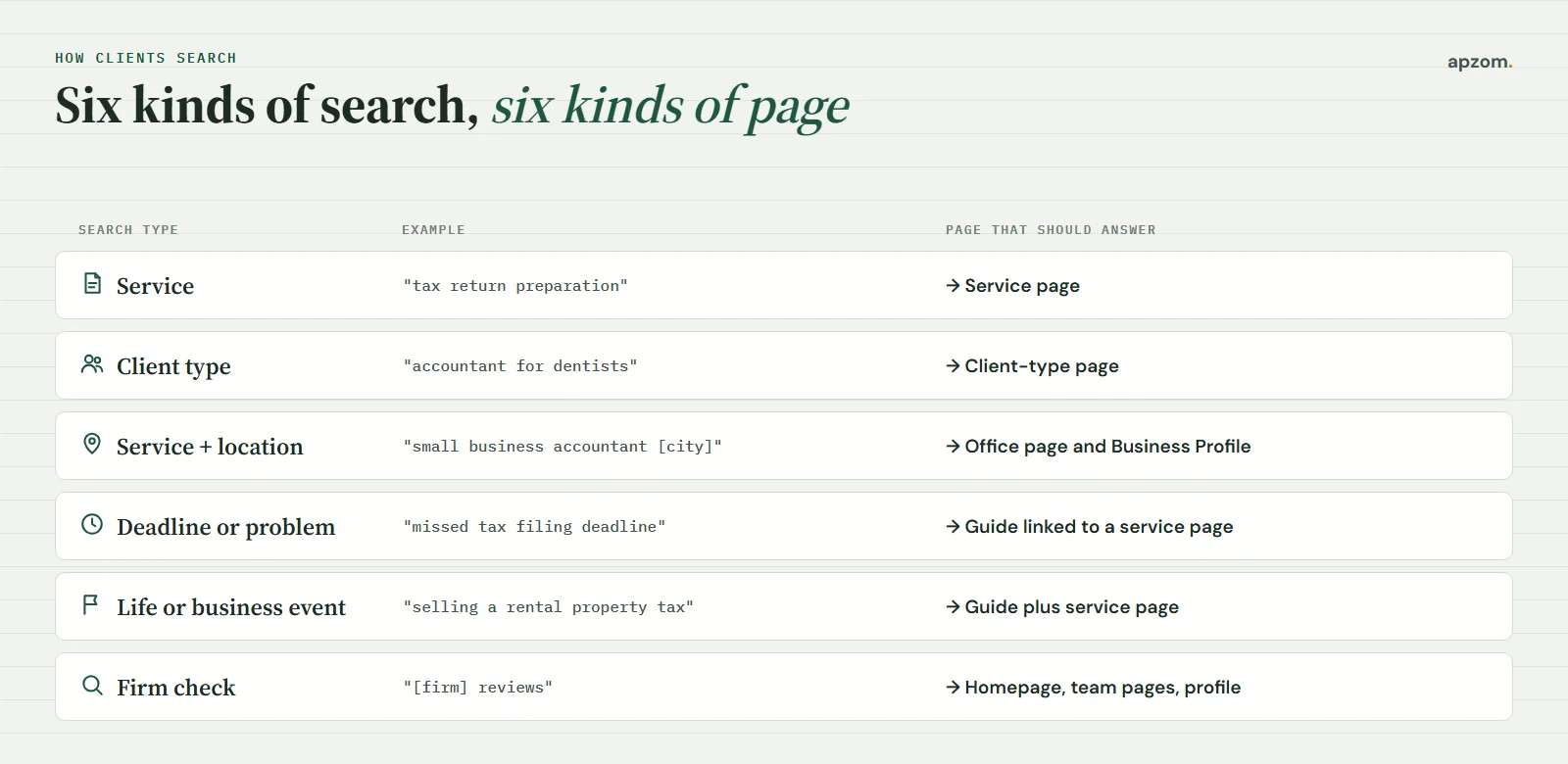
| Search type | Examples | The page that should answer |
|---|---|---|
| Service | “tax return preparation”, “bookkeeping services”, “payroll services” | A service page |
| Client type | “accountant for dentists”, “tax help for landlords”, “CA for startups” | A client-type (niche) page |
| Service + location | “small business accountant [city]”, “CA firm near me” | Office page and Business Profile |
| Deadline or problem | “missed tax filing deadline”, “how to file revised return” | A guide linked to the service page |
| Life or business event | “selling a rental property tax”, “registering for GST”, “hiring first employee payroll” | A guide plus the matching service page |
| Firm check | your firm’s name, “[firm] reviews”, a partner’s name | Homepage, team pages, Business Profile |
The most valuable searches combine a service, a type of client and sometimes a place. A firm with a page that answers “bookkeeping for restaurants in [city]” will often win that client before a general firm with a better-looking homepage.
The page matrix: services by client type
Most accounting websites have one “Services” page listing everything in a line each. That cannot match the searches above. Build two families of pages and connect them.
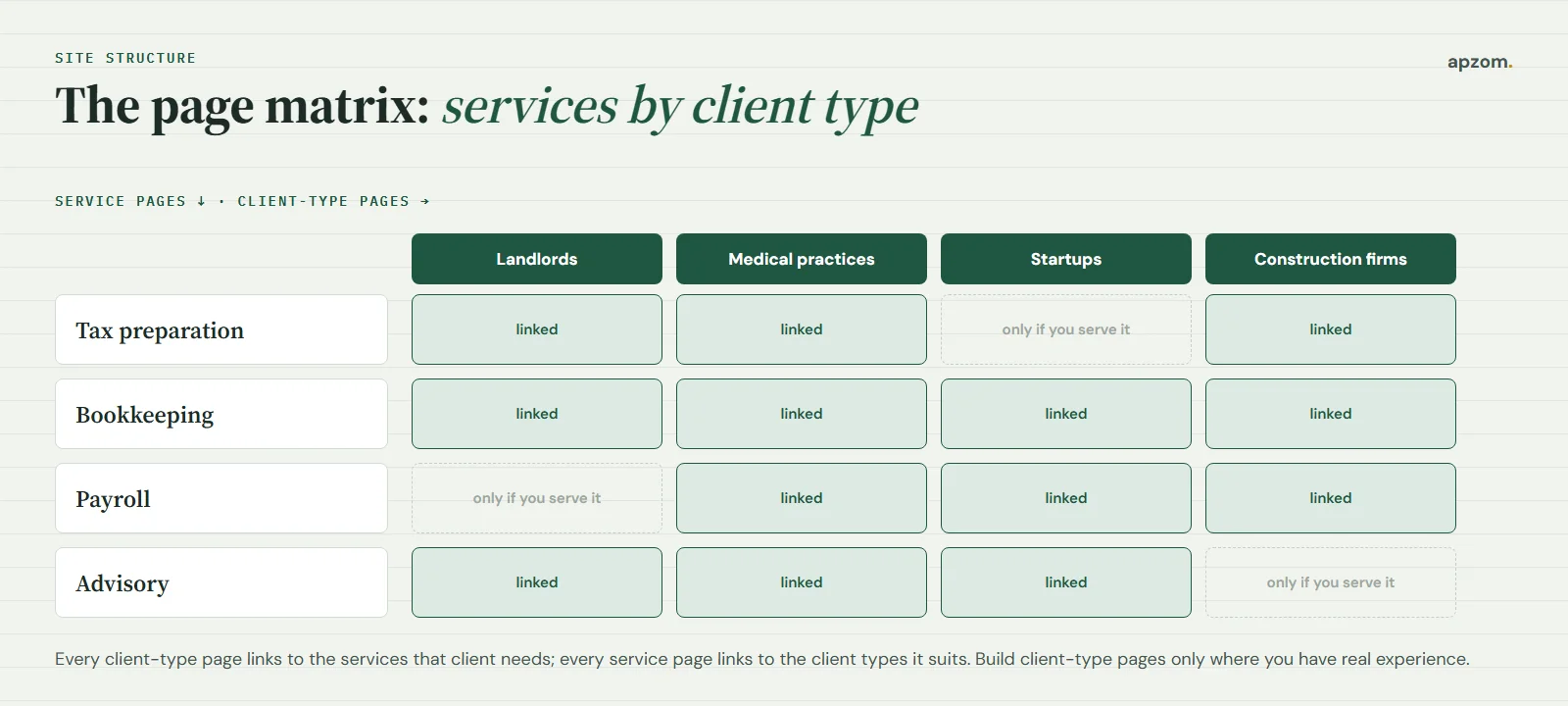
- Service pages: one per main service, such as tax preparation, bookkeeping, payroll, management accounts, audit or assurance (where your rules allow it to be promoted), advisory, and business setup.
- Client-type pages: one per niche where you have genuine experience, such as medical practices, landlords, startups, construction firms, non-resident clients or charities. Each should explain the specific issues that client faces, not just repeat the service list.
- Links between them: every client-type page links to the services that client usually needs, and every service page links to the client types it suits.
Build client-type pages only where you can show real experience, such as partners who specialise, typical issues you solve and the documents those clients need. A page for every industry with the same text swapped in is exactly what Google’s spam policies call scaled content abuse.
What a strong service page includes
| Section | Why it matters |
|---|---|
| Who it is for and the jurisdiction it covers | Confirms the reader is in the right place |
| What is included, and what is not | Sets expectations and filters unsuitable enquiries |
| How the process works, step by step | Reduces anxiety and shows experience |
| What documents to prepare | Genuinely useful and often searched |
| Deadlines that apply, with the current tax year | Matches deadline searches and builds urgency honestly |
| Who does the work | Named, qualified people build trust |
| Fees or how fees are set, where your rules allow | Answers the question everyone has |
| Reviewed by and last reviewed date | Shows the information is current and accountable |
| One clear way to start | A consultation request or document checklist download |
Rules that shape the copy
Your professional body’s advertising rules apply to every page. Two examples that affect SEO copy directly:
- India: under the ICAI’s 13th edition Code of Ethics, in force since 1 April 2026, CA firms may publish a factual write-up of their services, but without exaggerated claims, testimonials, fees, logos or most awards. Services reserved for chartered accountants, such as audit, may only be shown to people who come looking for them. Write service pages as plain, factual descriptions and check them against the ICAI’s guidelines.
- United States: the AICPA Code and IRS Circular 230 ban false, misleading or deceptive claims, and enrolled agents must not describe themselves as “certified”. Phrases such as “guaranteed refund” or “the best CPA in [city]” are risks, not keywords.
Our accounting marketing guide covers the rules for the US, UK and India in more detail.
The tax-season SEO calendar
Search demand for accounting help rises sharply before filing deadlines, at exactly the time your team is busiest. SEO takes time to work, so the pages people find in the rush have to be ready months before it.
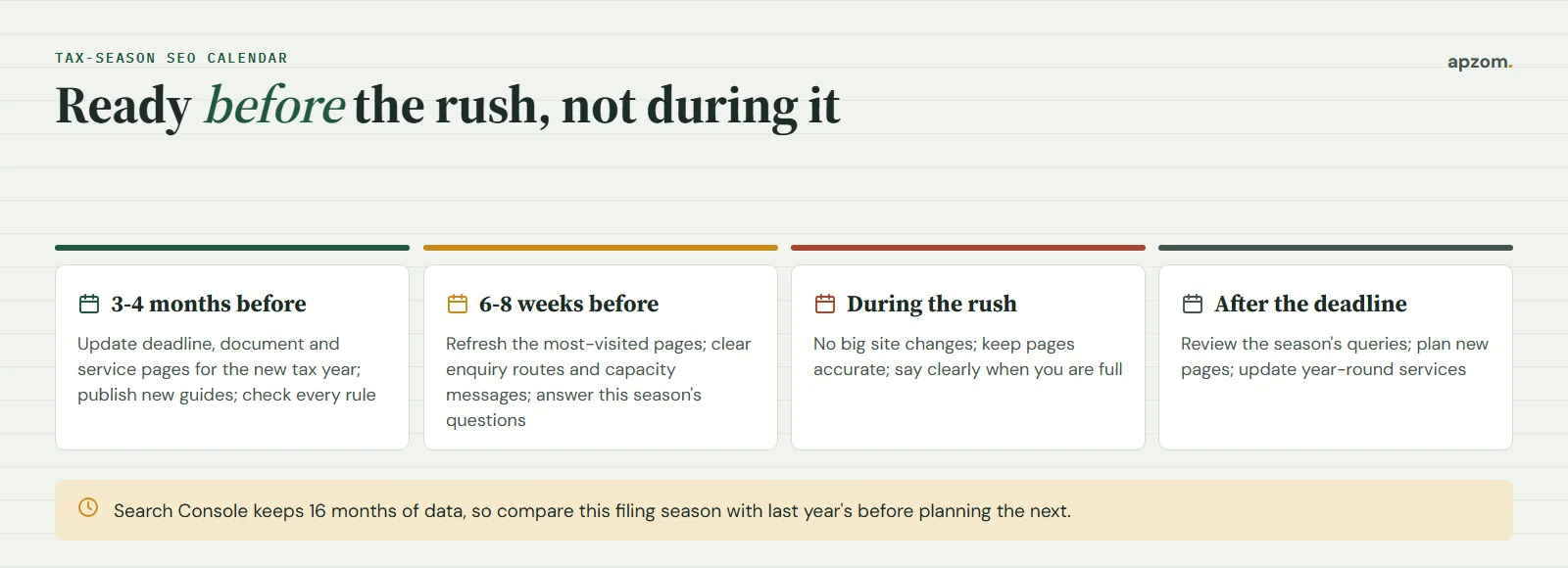
| When | SEO work |
|---|---|
| Three to four months before a major deadline | Update deadline, document and service pages for the new tax year; publish new guides; check every page still matches the current rules |
| Six to eight weeks before | Refresh the most-visited pages; make sure enquiry routes and capacity messages are clear; add answers to the questions clients are asking this season |
| During the rush | Avoid big site changes; keep pages accurate; say clearly when you are full for new compliance work |
| After the deadline | Review Search Console for the season’s queries; plan new pages for questions you could not answer; update year-round service pages such as advisory and bookkeeping |
Google Search Console keeps up to 16 months of performance data, so you can compare this filing season with last year’s and see which searches grew. Google Trends shows how interest in a topic rises and falls over the year, which helps time updates.
Keep financial content trustworthy
Tax and money content can seriously affect people’s finances. Google’s search quality rater guidelines describe “Financial Security” topics as those that could damage a person’s ability to support themselves and their families, and give filling out tax forms as an example. These “Your Money or Your Life” topics are where trustworthiness matters most. In practice that means:
- Name the jurisdiction and tax year near the top of every guide. A US guide and a UK guide on the same topic say different things.
- Have a qualified accountant write or review it, and show their name and qualification with a link to their team page.
- Date reviews honestly. Change the “last reviewed” date only when someone has actually checked the content. Google’s guidance specifically warns against changing dates to make pages seem fresh when nothing substantial has changed.
- Update when the law changes. Budgets, finance acts and new tax laws can make pages wrong overnight. Keep a simple list of which pages depend on which rules.
- Separate information from advice. Explain the rules and the process, and say clearly when someone needs advice on their own situation.
AI writing tools
Many firms now draft content with AI tools. Google’s guidance says using generative AI to create many pages without adding value for users may violate its spam policy on scaled content abuse. AI can help with drafts and structure, but a qualified accountant must check every figure, deadline and rule before publication, and the result must genuinely help the reader.
Ready for the next filing season? An Accounting SEO Audit checks your service and client-type pages, content accuracy and review dates, Business Profile and local listings, and what to update before the rush.
Local search for accounting firms
Most small business and personal tax clients still look for an accountant nearby, even if the work is done online.
- Google Business Profile for each genuine office: real name, accurate categories, hours, services, photos of the office and team, and replies to reviews. Our Google Business Profile checklist covers every setting.
- Office pages on your website, one per real office, matching the profile details exactly.
- Professional directories such as your professional body’s member directory, where you are eligible, with consistent details.
- Reviews gathered within your rules. Some bodies restrict testimonials on your own website, and confidentiality means you should never confirm someone is a client when replying to a review.
Our local SEO checklist covers the website, listings and reviews in more depth.
Technical basics
- Fast, mobile-friendly pages. Many people check an accountant on a phone between other tasks.
- Secure, simple enquiry forms. Collect only what you need to start, never full financial details or identity documents through a basic web form. Use a secure client portal for documents.
- Clear site structure: service pages and client-type pages in logical sections, with breadcrumbs.
- Structured data: Schema.org has an AccountingService type for accounting firms, plus Person for team members and Article for guides. Describe only what is visible on the page.
- No duplicate pages for the same service in different folders, and no thin location pages for places you do not serve.
Measuring accounting SEO
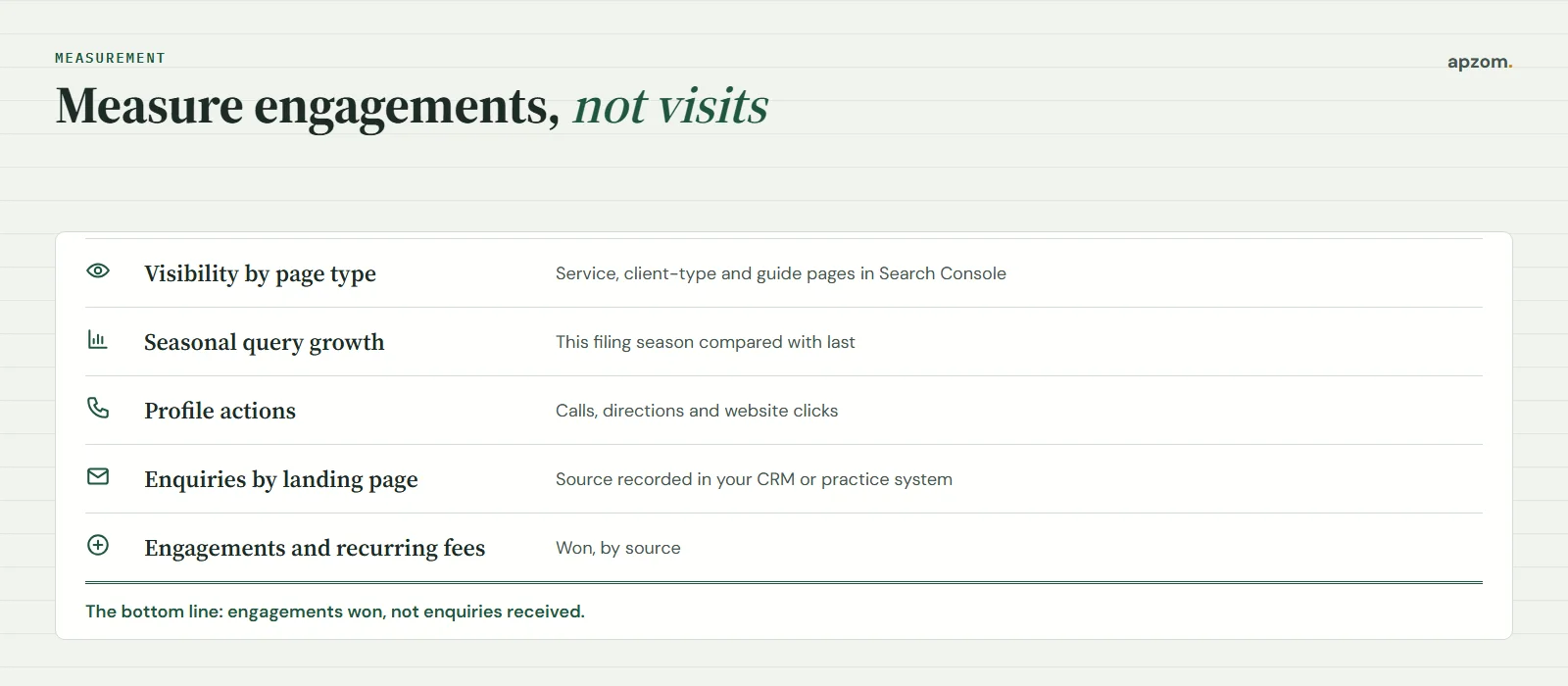
| Measure | Where |
|---|---|
| Impressions and clicks by page type (service, client type, guide) | Search Console, filtered by page |
| Seasonal query growth compared with last year | Search Console, 16-month comparison |
| Calls, direction requests and website clicks | Google Business Profile performance |
| Enquiries by landing page and source | Analytics and your CRM or practice management system |
| New engagements and recurring fees by source | Practice management system |
Record the source of every enquiry, and look at engagements won, not just enquiries. A page that brings ten enquiries for work you do not do is less valuable than one that brings two ideal clients.
A 90-day accounting SEO plan
Days 1 to 30: foundations
- Audit existing pages for accuracy, jurisdiction, tax year and professional rules.
- Fix Business Profile and office page details.
- Set up Search Console and enquiry source tracking.
Days 31 to 60: build the matrix
- Rebuild your two or three most profitable service pages.
- Create one or two client-type pages where you have real expertise.
- Add named reviewers and honest review dates.
Days 61 to 90: get ready for the season
- Publish guides that answer the questions your team hears most before deadlines.
- Link guides to the matching service and client-type pages.
- Plan the next season’s updates from Search Console data.
How Apzom can help
Apzom Digital’s SEO services for accounting firms start with an audit of your pages, your rules and your calendar. We build service and client-type pages with your accountants, keep content dated and reviewed, and time updates for the filing seasons. We flag professional rule questions for your firm to decide rather than deciding them ourselves. Read how we approach search in our SEO methodology. We work with clients worldwide, remotely, from our base in Ahmedabad, India.
Request an Accounting SEO Audit. We review your page structure against how clients search, jurisdiction and tax-year accuracy, professional rule questions for your firm to decide, local presence, technical health and enquiry tracking, then set out what to fix before your next deadline.
The audit is free, with no obligation and no guaranteed rankings. Prefer to talk it through? Contact us or see all our services.
Frequently asked questions
Is SEO worth it for accounting firms?
Yes, when it focuses on the services and client types you want more of. People search for specific accounting help, often months before deadlines, and well-built pages can bring steady enquiries for years.
What pages should an accounting firm website have?
A page for each main service, a page for each client type where you have real experience, a page for each office, team pages for your accountants, and guides that answer common questions, all linked together.
How far ahead should we prepare for tax season SEO?
Start updating pages three to four months before a major deadline. SEO takes time to show results, so pages published in the rush usually come too late for that season.
Can CA firms in India do SEO?
Under the ICAI’s 13th edition Code of Ethics, in force since 1 April 2026, CA firms may publish factual write-ups of their services on websites, within the ICAI’s guidelines. Pages must avoid exaggerated claims, testimonials, fees and logos, and reserved services such as audit may only be shown to people who come looking for them. Check the current guidelines before publishing.
Can we use AI to write our tax content?
AI can help with drafts, but a qualified accountant must check every figure, deadline and rule. Google says generating many pages without adding value for users may break its spam policies, and wrong tax information can harm readers and your firm.
Should we create pages for every industry we serve?
Only for client types where you have genuine experience and something specific to say. Near-identical industry pages with swapped names are treated as scaled content abuse.
How do we show our tax content is trustworthy?
Name the jurisdiction and tax year, show the qualified accountant who wrote or reviewed it, date reviews honestly and update pages when the rules change.
How long does SEO take for an accounting firm?
Fixes to profiles and existing pages can help within weeks. New service and client-type pages usually take several months. Judge results by engagements won over a full season or year.