The short answer: Ad Strength is a rating Google Ads gives your responsive search ads, from Incomplete through Poor, Average and Good to Excellent. It measures whether you have given Google enough relevant, varied headlines and descriptions to build good ads. Google says Ad Strength does not decide whether your ad can serve, and is not used to calculate Ad Rank, Quality Score or auction wins. It is feedback, not a score that Google ranks you on. To improve it, add more unique headlines and descriptions, include your main keywords, add sitelinks and pin less.
This guide is for business owners and marketers who see a “Poor” or “Average” Ad Strength and want to know whether to worry. It follows Google Ads Help as checked in November 2026. Apzom Digital manages Google Ads, so read this knowing we have an interest. Improving Ad Strength takes a few minutes per ad.
What to take from this guide
- Ad Strength is feedback. Google says it does not affect eligibility, Ad Rank or Quality Score.
- It still points to real improvements. More varied, relevant assets give Google more combinations to test.
- Keywords, uniqueness and quantity drive the rating. So do sitelinks.
- Pinning lowers flexibility. Pin only what you must.
What Ad Strength is
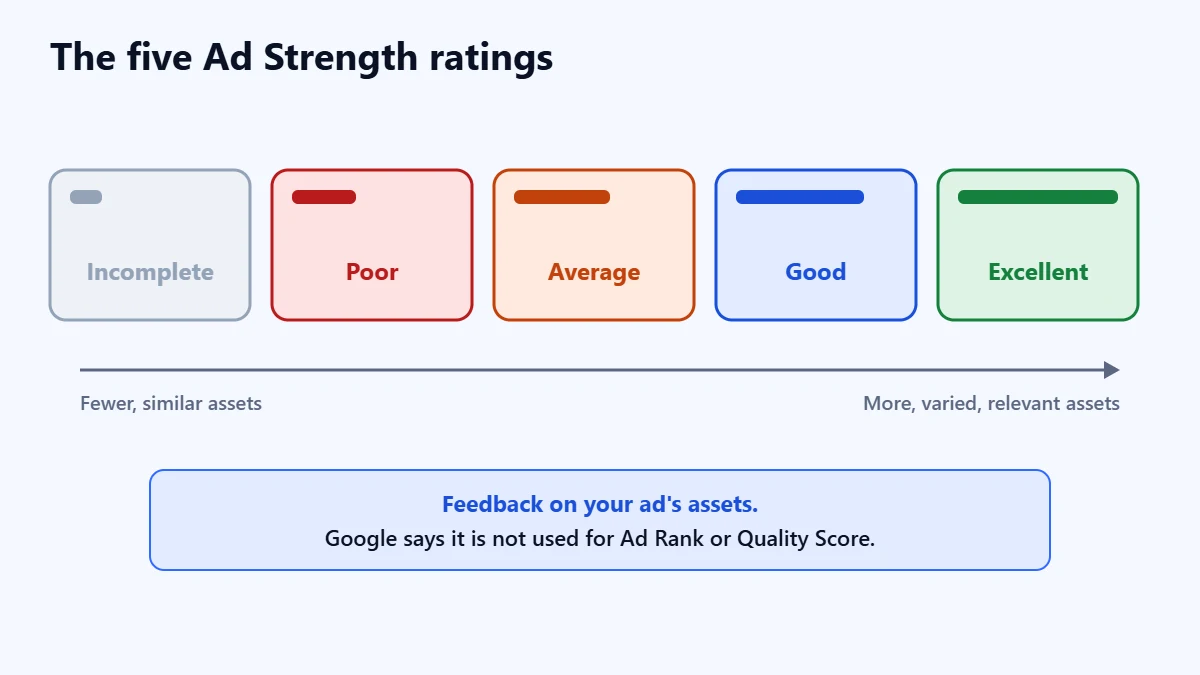
A responsive search ad is built from several headlines and descriptions, which Google combines in different ways for different searches. Google describes Ad Strength as a feedback tool that checks whether you have given it a sufficient, relevant mix of assets. It has two parts: an overall rating, and action items that suggest what to change. You see it while creating or editing an ad, and in the Ad strength column of the Ads table.
Google calls it a dynamic metric. It recalculates when your keywords, assets or account structure change. It does not measure factors outside the ad, such as the quality of your landing page.
Does Ad Strength affect your ads?
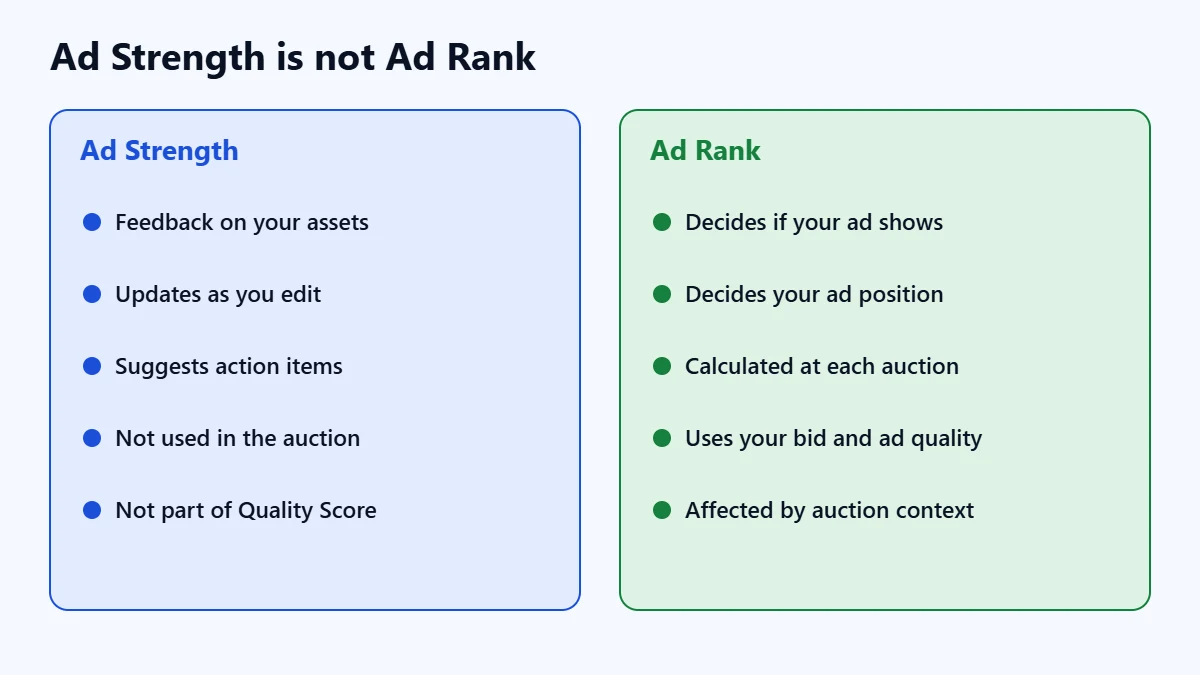
Google is direct about this. It says Ad Strength does not determine whether your ad is eligible to serve, and that it is not used to calculate Ad Rank, Quality Score or auction wins. Google lists the opposite belief as a common misconception.
Google does link higher Ad Strength with better results. On its Ad Strength help page, it says advertisers who improve their responsive search ads and sitelinks from Poor to Excellent see 15% more conversions on average, based on its own internal data. That is Google’s figure, from its own data, and averages hide wide variation. In our judgement, it is a reason to act on the suggestions, not a promise for any single account.
The practical reading: a Poor rating will not stop your ad running, but it usually means Google has too few or too similar assets to work with. Fix it when you can. Do not judge an ad on Ad Strength alone. Clicks, conversions and cost per lead are what matter.
What Ad Strength measures
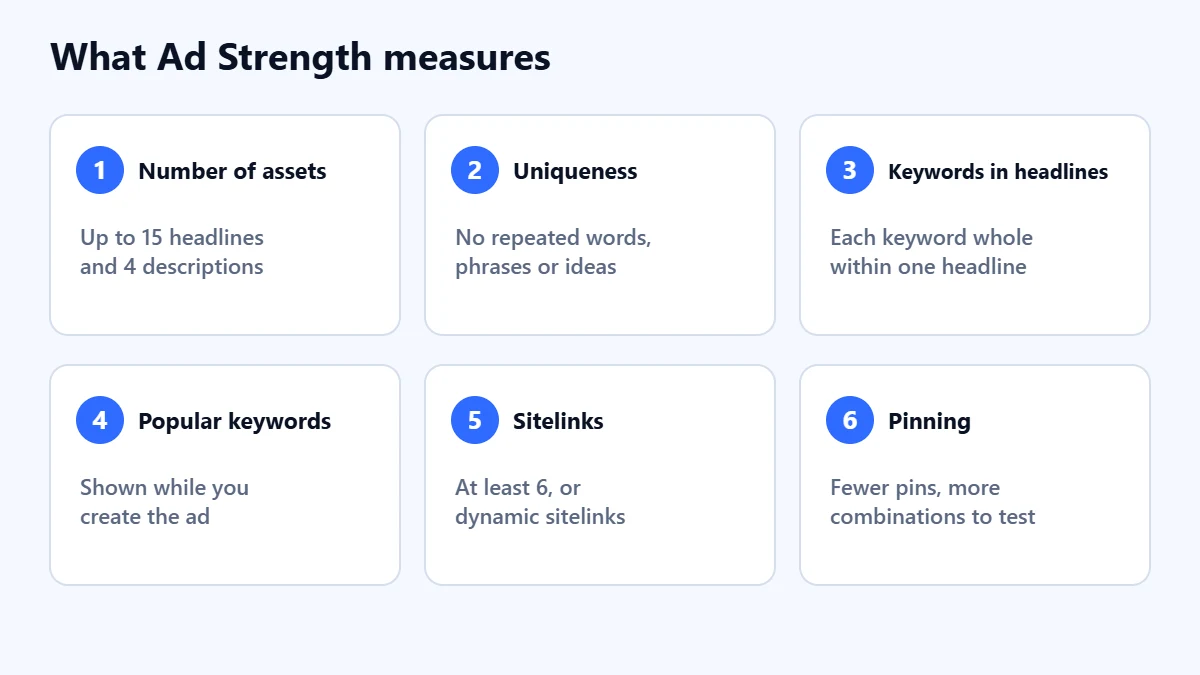
| Factor | What Google looks for |
|---|---|
| Number of assets | Up to 15 headlines and 4 descriptions. Google asks for as many as you can provide |
| Uniqueness | Headlines and descriptions that avoid repeating the same words, phrases or ideas |
| Keyword relevance | Your most relevant keywords in the headlines. A keyword counts only if it fits entirely within one headline |
| Popular keywords | The ad group’s popular keywords, which Google shows while you create the ad |
| Sitelinks | At least six sitelinks at account, campaign or ad group level |
| Pinning | Limited pinning, because each pin reduces the combinations Google can test |
Missing a final URL, ad group or keywords leads to an Incomplete rating. Headlines can be up to 30 characters and descriptions up to 90. An ad needs at least 3 headlines and 2 descriptions.
Want ads that perform, not just score well? Ask for a Free Growth Audit. We review your ads, keywords and landing pages, and tell you what we would change first.
How to improve Ad Strength
- Add more headlines. Aim for 15, each saying something different: the service, the location, a benefit, a proof point, an offer, the call to action.
- Add all four descriptions. Use the extra space for detail a headline cannot hold.
- Put your main keywords in headlines. Keep each keyword whole inside one headline. Long keywords can go in descriptions.
- Vary the wording. Ten headlines that all say “Best Plumber in Pune” in slightly different ways do not help. Our guide to match types helps you see which searches each ad group covers.
- Add sitelinks. At least six, or turn on dynamic sitelinks. Our guide to sitelinks covers the organic kind, which are separate.
- Pin sparingly. Google says pinning is not recommended for most advertisers. If you must, for example for a legal disclaimer, pin two or three different versions to the same position rather than one.
- Run at least two good ads per ad group. Google suggests at least two responsive search ads rated Good or Excellent in each ad group.
Keep the ad honest while you do this. Every headline can appear with any other, so each one must be true on its own. In our judgement, a clear, accurate Average ad that matches its landing page beats an Excellent ad full of claims the page does not support. Our guide to improving Google Ads lead quality covers that trade-off.
A checklist
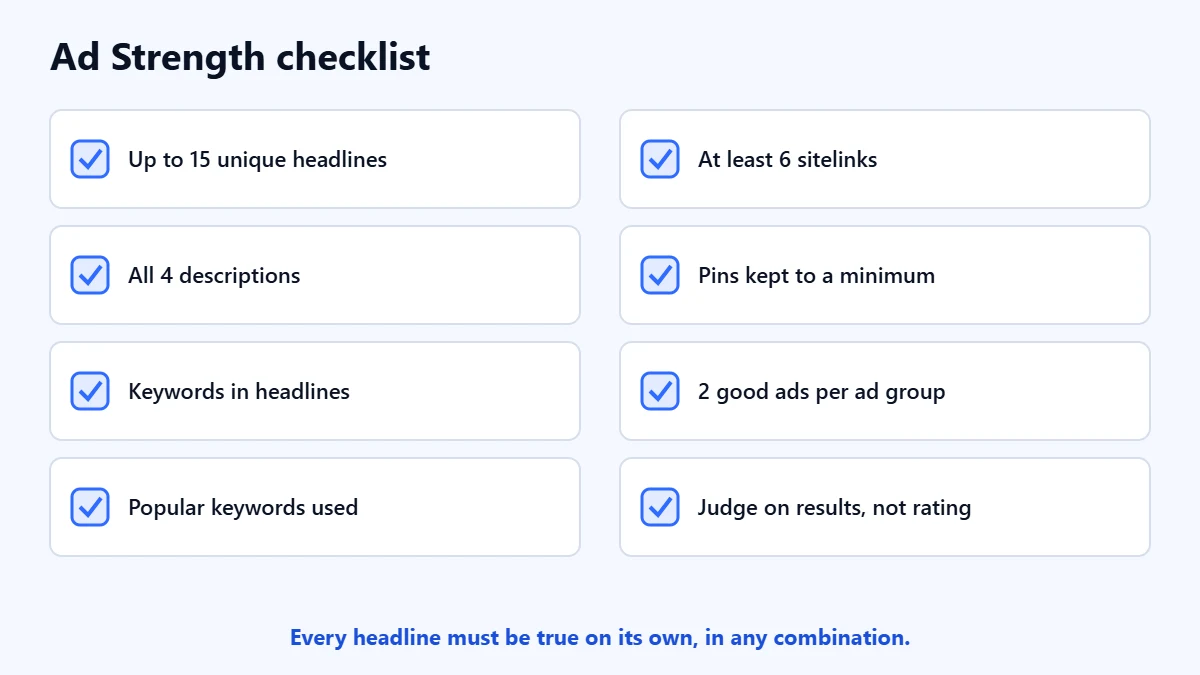
- Up to 15 headlines, each different.
- All 4 descriptions filled.
- Main keywords in headlines, each whole within one headline.
- The ad group’s popular keywords used.
- At least 6 sitelinks, or dynamic sitelinks on.
- Pins kept to the minimum.
- At least 2 ads rated Good or Excellent per ad group.
- Results checked on conversions and cost, not on the rating.
For a wider review of your account, see our Google Ads audit checklist.
Frequently asked questions
Does Ad Strength affect Quality Score?
No. Google says Ad Strength is not used to calculate Ad Rank, Quality Score or auction wins.
Will a Poor Ad Strength stop my ad from showing?
No. Google says Ad Strength does not determine whether an ad is eligible to serve. A Poor rating is a sign that the ad has too few or too similar assets.
Should I always aim for Excellent?
Aim to act on the suggestions, but judge the ad on results. Sometimes legal or brand rules require pinning or fixed wording, which can lower the rating. That is a reasonable trade-off.
Why did my Ad Strength change when I had not edited the ad?
Google calculates it from your keywords and account structure as well as the ad. Adding or removing keywords or sitelinks can change the rating.
Get your Free Growth Audit and Quote. We review your Google Ads account, ads and landing pages, then send a plain-English list of what we would fix first.
No obligation and no guaranteed results. Prefer to talk first? Contact us or see our Google Ads management service.