
The short answer: Good digital marketing for a solar company turns wary, slow-moving buyers into signed installs. It does that with a website that leads with proof (real installs, credentials, warranties and reviews), honest savings and incentive claims that are dated and explained, local search for the areas you really cover, paid ads that bring buyers who own a suitable roof or site, and fast follow-up after every enquiry. A good agency will measure results in site surveys booked, contracts signed and systems installed, not clicks or cheap leads.
This guide is for residential solar installers, battery and EV charger installers, commercial solar and EPC companies, and solar retailers, in any country. It covers how solar buyers decide, how to structure your website, honest advertising claims, local search, paid ads and bought leads, commercial solar marketing, the rules on solar marketing by country, and what to measure.
Solar is now a mass market, and a crowded one. The International Energy Agency says the world added more than 600 GW of solar in 2025, a new record. Country markets move in different directions: the UK had a record 267,032 MCS-certified rooftop solar installations in 2025 (MCS data), Australia added about 2.8 GW of rooftop solar (Clean Energy Regulator), while US home solar dipped about 2% to around 4.6 GW (SEIA and Wood Mackenzie). In every one of those markets, buyers have more installers to choose from than ever.
Why solar marketing is different
Selling solar is not like selling most home services. Five things make it harder:
- It is a big, slow decision. A homeowner may read for months, get several quotes and talk to neighbours before signing. A business may need board approval and a finance case.
- Demand follows policy. Incentives, tax credits, export payments and net metering rules change, sometimes with little notice. In the US, the 30% federal tax credit for homeowners who buy solar (known as 25D) ended for systems finished after 31 December 2025, according to the IRS. Canada’s federal Greener Homes Grant and Loan have both closed to new applicants. Australia, by contrast, added a home battery discount from 1 July 2025. Marketing that worked last year can be wrong this year.
- Buyers are wary. Hard selling, door-knocking and “free solar” offers have made many people suspicious, and regulators in several countries have acted against misleading solar sales. Trust is the main thing you sell.
- Not every lead can buy. A renter, a heavily shaded roof or a home outside your area can never become an install, however keen the person is.
- Several products, one customer. Panels, batteries, EV chargers, heat pumps and maintenance can all be sold to the same household over time, so the relationship after installation matters.
The solar buyer path
The first framework we use is a seven-stage buyer path. For each stage, decide what the buyer is asking and what your marketing should show.
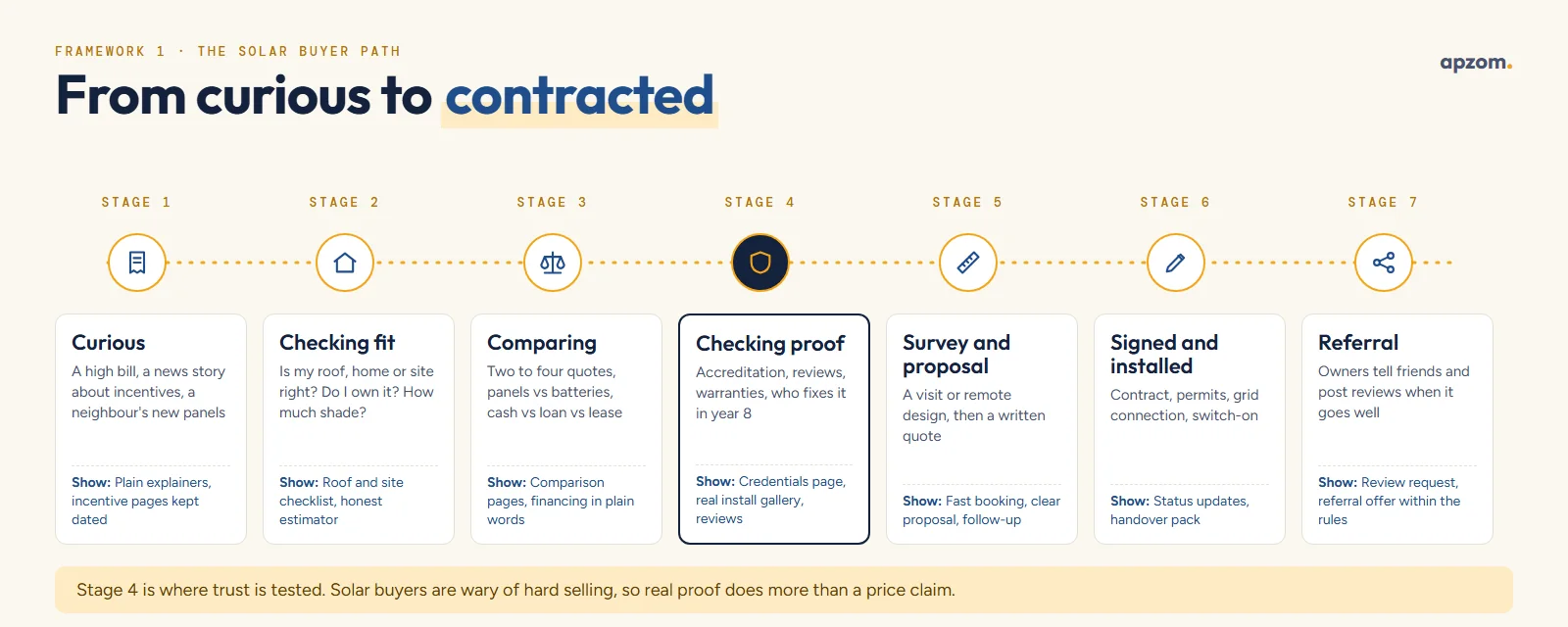
| Stage | What the buyer is asking | What to show them |
|---|---|---|
| 1. Curious | “Could solar cut my bill?” | Plain explainers, and incentive pages that say when they were last checked |
| 2. Checking fit | “Is my roof or site right? Do I need to own it?” | A roof and site checklist, and an honest estimator that shows its assumptions |
| 3. Comparing | “Panels or panels plus a battery? Cash, loan, lease or power purchase agreement?” | Comparison pages and financing explained in plain words |
| 4. Checking proof | “Can I trust this company? Who fixes it in year eight?” | Credentials, real installs, reviews, warranties and how long you have been trading |
| 5. Survey and proposal | “What exactly will I get, and for how much?” | Fast booking, a clear written proposal and a named contact |
| 6. Signed and installed | “What happens now?” | Status updates on permits, installation and grid connection |
| 7. Referral | “Should I recommend them?” | A review request and a referral scheme that follows the local rules |
Most solar websites put all their effort into stages 1 and 5. Stage 4 is where the decision is usually made.
Build a proof-first website
The second framework is the proof-first solar site. Build it around what you install, where, and why people should trust you.
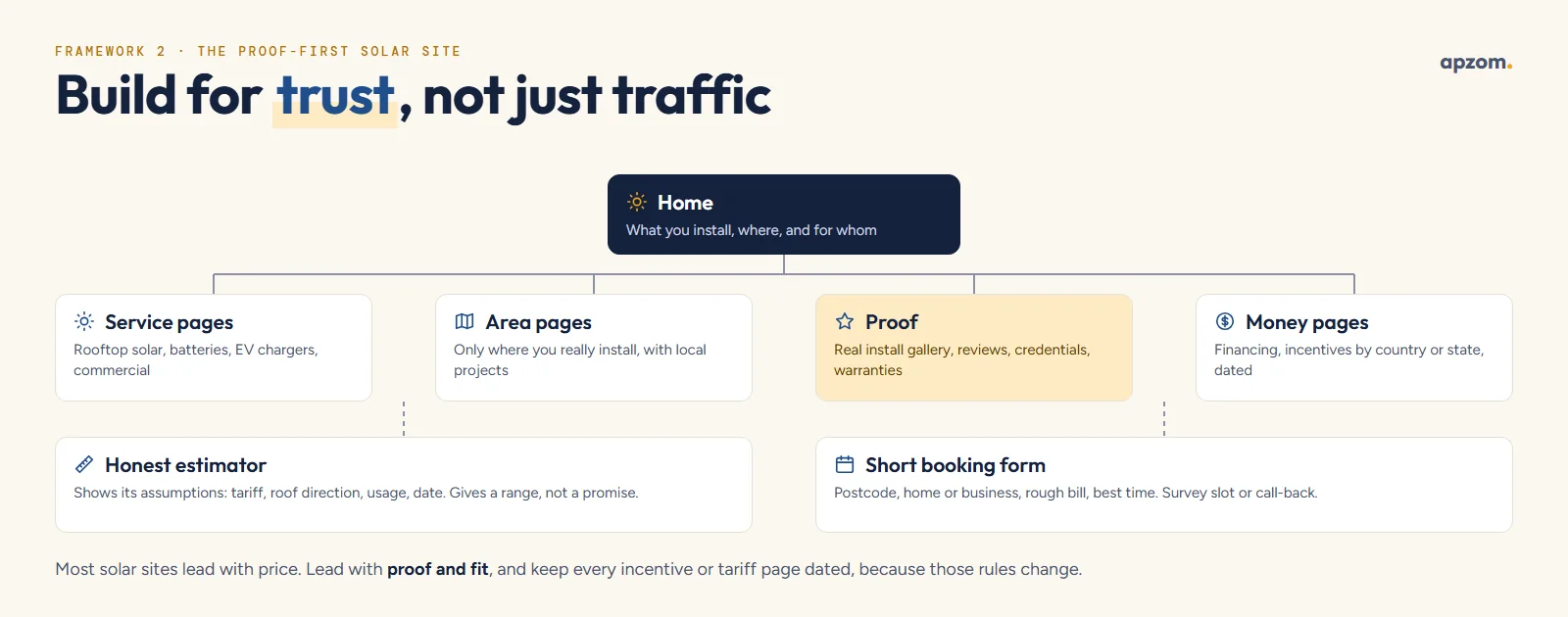
- Service pages, one for each thing you really install: rooftop solar, batteries, EV chargers, commercial systems, maintenance and repairs. Say who each is for, what affects the price, what the process is, and what warranties apply.
- Area pages, only for places you really install, each with real local projects, local rules or utility notes and the team who covers it. A page for every town with the same text and a different name may count as doorway pages under Google’s spam policies.
- Proof pages: a gallery of real installations (with the owner’s permission), reviews, your accreditations with numbers, insurance, warranties, and who services the system later.
- Money pages: financing options explained honestly, and incentive pages by country or state that show the date they were last checked.
- An honest estimator, if you offer one. Show the assumptions next to the result: the electricity tariff, the roof direction and shade, the household’s usage and the date. Give a range, not a single promise.
- A short booking form: postcode or address, home or business, roughly how big the electricity bill is, and the best time to call. Every extra field loses people, so ask the rest on the call.
Use LocalBusiness structured data with your real business name, address or service area and phone number. schema.org has no solar installer type, so use HomeAndConstructionBusiness (or Electrician or RoofingContractor, if that is accurate) and describe your solar services in the markup and on the page.
Honest claims: the solar advertising test
Solar is one of the industries where advertising claims attract the most complaints. The third framework is a six-point test for every ad, landing page and sales script.
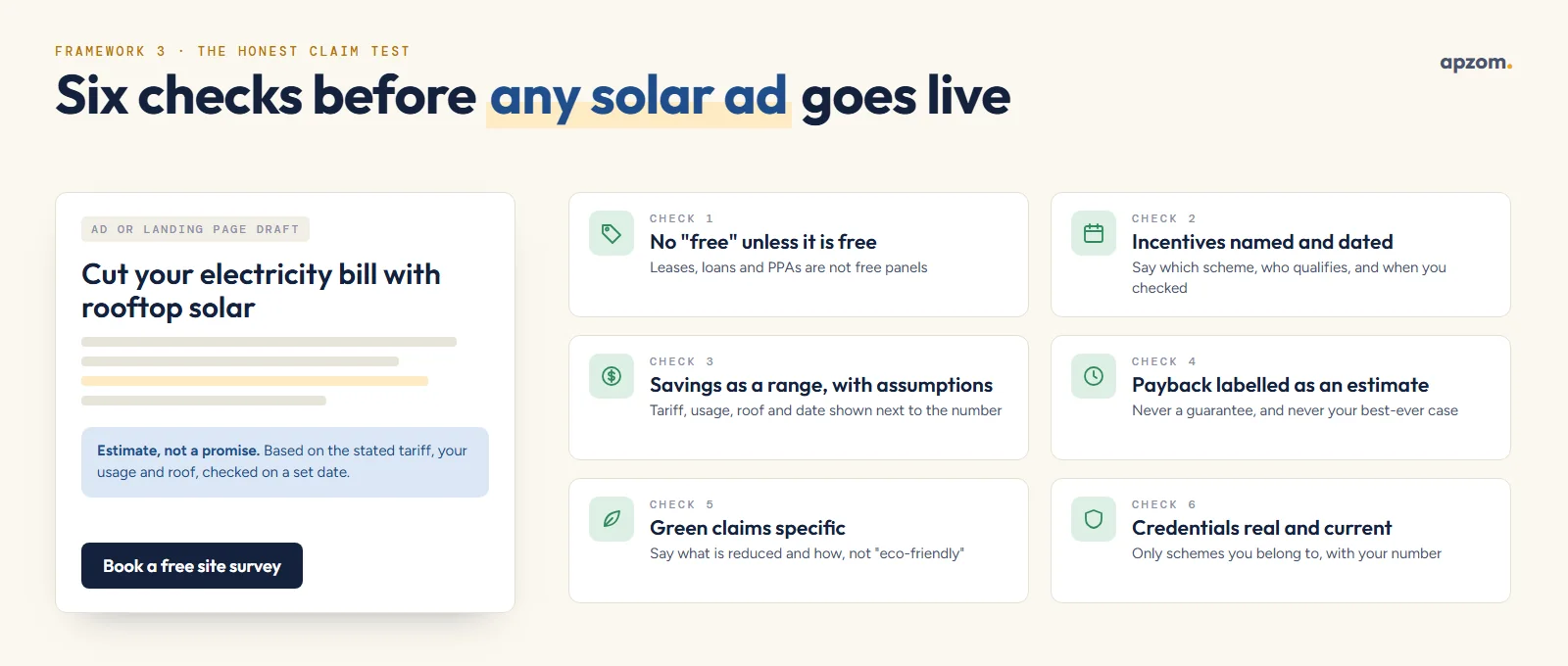
- No “free” unless it is free. Leases, loans and power purchase agreements are not free panels. If the customer pays anything, over any period, it is not free.
- Incentives named and dated. Say which scheme, who qualifies and when you last checked. Remove claims about schemes that have closed.
- Savings as a range, with the assumptions. State the tariff, usage, system size and date next to any savings figure.
- Payback labelled as an estimate. Never a guarantee, and never your best-ever customer presented as typical.
- Green claims specific. Say what is reduced and how. Vague words like “eco-friendly” or “carbon neutral” are increasingly restricted, especially in the EU and UK.
- Credentials real and current. Only show schemes and memberships you hold, with your registration number where there is one.
Regulators do act on this. The UK’s Advertising Standards Authority has upheld complaints against solar and battery ads with savings claims such as “up to 94%” (March 2026) and “drastically reduced bills” (November 2025), because the evidence or the assumptions behind them were missing. In the US, the Federal Trade Commission warns consumers about solar sellers who say a government program will pay the whole cost, or who claim to be from the government. Google Ads’ misrepresentation policy also bans ads that falsely suggest government backing.
Local search and your Google Business Profile
Most residential solar buyers search for an installer near them, then check reviews. Local search matters a lot:
- Google Business Profile: choose the most accurate primary category, set a service area that matches where you really install, add photos of real installations, and keep opening hours and phone numbers current. Our Google Business Profile checklist covers the full set-up.
- Reviews: ask every customer after switch-on, not only the happy ones, and reply to every review. Google does not allow incentives for reviews or asking only selected customers. Our guide on how to get more Google reviews explains the rules.
- Local pages and citations: keep your name, address and phone number the same on your website, directories and trade association listings. Our local SEO checklist covers the rest.
Paid ads and bought leads
Search ads catch people who are already looking: “solar panel installers near me”, “solar battery cost”, “commercial solar installer”. Social ads on Facebook and Instagram can create interest earlier, but bring more people who are only curious.
- Google Ads: target the areas you serve, use phrase and exact match for buying searches, and add negative keywords for jobs, DIY, free and grants if you do not handle them. Send each ad to a matching service page, not the homepage. In some markets, Google’s Local Services Ads include a “Solar energy contractor” category. Check Google’s eligibility tool for your area.
- Meta ads: lead forms are quick to fill, which means more leads and lower quality. Add a question about home ownership and roof or site type, and call within minutes. If you advertise solar loans or finance, Meta may place the ad in a special ad category with limited targeting options, so check the category when you set up the campaign.
- Bought or shared leads: many solar companies buy leads from comparison sites and lead sellers. Shared leads go to several installers at once, so speed matters, and the quality varies widely. In the US, a federal appeals court struck down the FCC’s planned “one-to-one” consent rule for lead generators in January 2025, but the general rule still applies: you need clear prior express written consent before autodialed or prerecorded marketing calls or texts. Check how every lead seller collects consent before you call or text anyone. Track bought leads by source all the way to signed contracts, and stop the sources that do not convert.
Our guide on SEO vs Google Ads explains how to split a budget between long-term search and paid ads, and our Facebook and Instagram ads guide covers lead forms in more detail.
Plenty of solar enquiries, not enough signed installs? A Solar Marketing Audit follows your leads from first click to signed contract and shows where they drop off.
Commercial solar is a B2B sale
Selling solar to factories, warehouses, offices, schools and farms is a different job. The buyer is a business owner, a finance director, a facilities manager or a procurement team, and they need:
- A financial case, with the assumptions clear: energy use, tariff, system size, financing or power purchase agreement terms, and how the numbers were worked out.
- Proof of delivery: case studies of similar sites (with permission), project timelines, safety record, and who handles grid connection and permits.
- Content for each person involved: a short overview for the owner, a detailed technical page for the engineer, and finance and tax notes for the finance team, checked by their own advisers.
- LinkedIn and email to reach decision makers in your target sectors, plus search pages for “commercial solar installer” in the regions you cover.
If you sell to manufacturers, our guide to digital marketing for manufacturers explains how industrial buyers search and compare suppliers.
Solar marketing rules by country
The rules on what solar companies can claim, and who can install, differ by country. This is a summary for marketers, not legal advice. Check the current rules for each market you advertise in.
| Market | What solar marketers need to know |
|---|---|
| United States | The FTC’s Green Guides still apply to environmental claims, and the FTC warns against sellers who claim government links or say a government program pays the whole cost. California home buyers must receive the state’s solar disclosure documents before they sign, and homes that applied to connect from 15 April 2023 are on the Net Billing Tariff, which pays less for exported power, so batteries and self-use are central to the message there. In Texas, home solar sellers and salespeople must now register with the TDLR, must not claim links to a utility or the government, and must give a 5-business-day right to cancel. For business solar, the federal 48E and 45Y credits apply only if construction started by 4 July 2026 or the system is in service by the end of 2027; a tax adviser must confirm each project. |
| United Kingdom | Installers usually need MCS certification, and the Smart Export Guarantee normally needs an MCS-certified system and installer (or an approved equivalent). Under MCS’s redeveloped scheme, joining a consumer code such as RECC is becoming optional, but it is still a useful trust signal. Installed solar panels and batteries in homes have 0% VAT until 31 March 2027. The ASA expects savings claims to be backed by evidence with the assumptions explained. In England, new homes will need on-site renewable electricity under rules that start on 24 March 2027. |
| European Union | Since 27 September 2026, EU consumer law (Directive 2024/825) bans generic green claims such as “eco-friendly” unless they can be proven, and bans “climate neutral” product claims based on carbon offsets. The separate Green Claims Directive is on hold. Incentives are national, so check each country. |
| Australia | Systems must be installed by an SAA-accredited installer to earn small-scale technology certificates (STCs), a rebate that gets smaller every year and ends in 2030. Retailers can become New Energy Tech Approved Sellers under the New Energy Tech Consumer Code. The Cheaper Home Batteries Program cuts the upfront cost of a home battery by around 30%, with lower support for larger batteries since May 2026. Door-to-door and phone sales come with a 10-business-day cooling-off period. |
| Canada | The federal Greener Homes Grant and Greener Homes Loan are both closed to new applicants. Point buyers to provincial and utility programs instead, and keep any incentive page dated. |
| UAE | In Dubai, rooftop solar under DEWA’s Shams Dubai net-metering programme must be designed and installed by a DEWA-enrolled consultant or contractor, so show your enrolment. Abu Dhabi’s Department of Energy has a 2026 policy that lets eligible customers install solar and batteries for their own use under its licensing and safety rules. |
| India | Under the PM Surya Ghar scheme, homes get a central subsidy of Rs 30,000 per kW for the first 2 kW and Rs 18,000 for the third kW, up to Rs 78,000. Panels must be made in India from Indian cells, and buyers choose a vendor registered on the national portal. Show your registration, and never imply you are the government. |
Measure the signed install, not the lead
The fourth framework is lead-to-install maths. Cheap leads are easy to buy. Signed, installed and not cancelled contracts are what pay the bills.
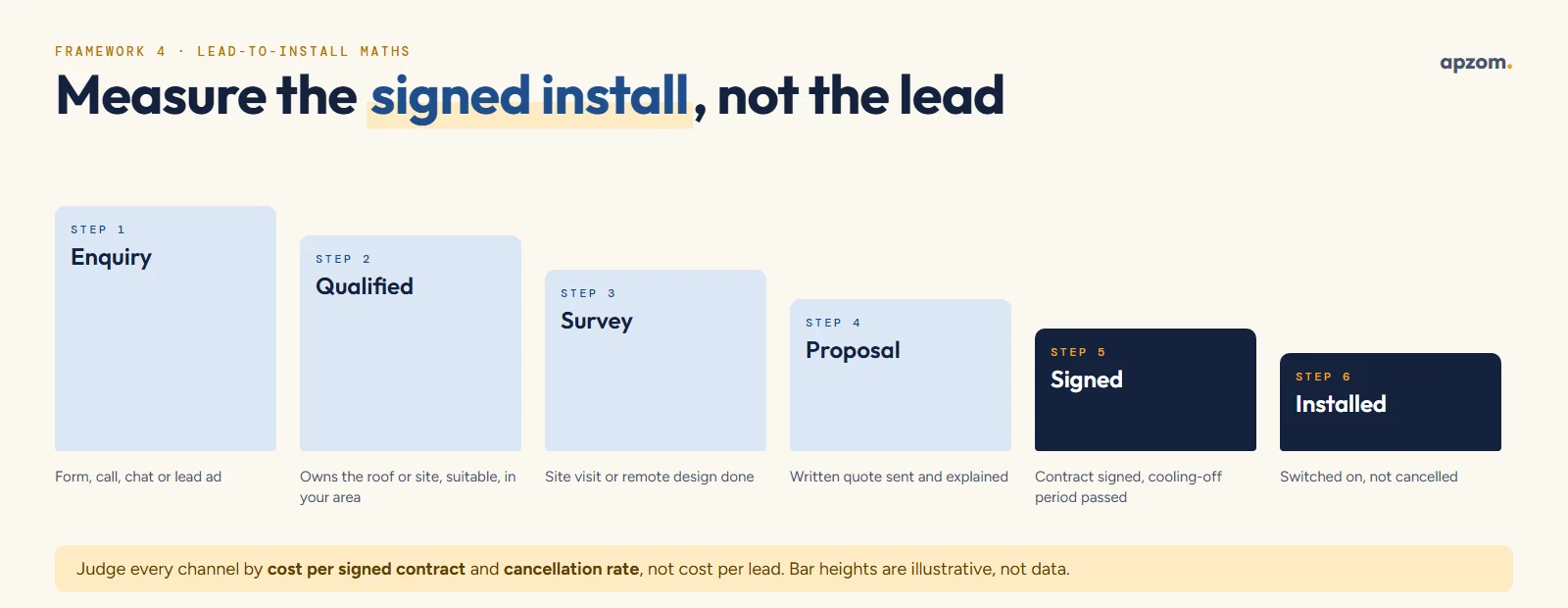
- Track every step by source: enquiry, qualified (owns the roof or site, suitable, in your area), survey done, proposal sent, contract signed, installed.
- The numbers that matter most: cost per signed contract and cost per installed system, by channel.
- Cancellation rate by source. A channel that brings many signed contracts that later cancel is not a good channel.
- Speed to first contact. Solar leads often go cold within hours, especially shared ones. Measure how fast your team calls back.
- After-install value: battery add-ons, EV chargers, servicing and referrals from past customers.
Most of this data sits in your CRM. Marketing’s job is to tag every enquiry with its source so you can see which channels lead to installs. Our guide on how to measure marketing ROI explains how to set this up.
How Apzom can help
Apzom Digital helps service businesses win the right customers and measure what matters. For solar companies, that means SEO and local SEO for service and area pages, website development with proof-first pages and short booking forms, Google Ads and Meta ads built around qualified enquiries, content marketing that explains incentives and financing honestly, conversion rate optimization for your forms and estimators, and reputation management. We work with clients worldwide, remotely, from our base in Ahmedabad, India.
We have not published a solar industry case study yet, so we will not show you one. Our case studies page shows the lead generation and search work we have done for other businesses. We will not promise a number of installs. We will show you where enquiries drop off between the first click and the signed contract, and what to fix first. If you are comparing agencies, our guide on how to choose a digital marketing agency has the questions to ask.
Request a Solar Marketing Audit. We review your service, area and proof pages, savings and incentive claims, Google Business Profile and reviews, Google and Meta ads, bought lead sources, booking forms, follow-up speed and tracking. You get a prioritised list of what to fix first, for the countries you install in.
No obligation and no guaranteed install numbers. Prefer to talk first? Contact us or see all our services.
Frequently asked questions
What is the best marketing for a solar company?
A proof-first website, a strong Google Business Profile with real reviews, search ads for buyers who are already looking, honest content about incentives and financing, and fast follow-up on every enquiry. Then measure cost per signed and installed contract by channel and put more into what works.
How do solar companies get leads?
From search (organic and paid), Google Business Profile, social media ads, referrals from past customers, partnerships with builders and electricians, and bought leads from comparison sites. Your own channels usually bring better leads than shared ones, but take longer to build.
Should a solar company buy leads?
It can, as one channel among several. Track every bought lead to a signed contract, call back within minutes, and check the seller’s consent practices before you call or text anyone, because the rules on telemarketing consent are strict in many countries.
Can I advertise solar panels as free?
Only if the customer truly pays nothing, now or later. Leases, loans and power purchase agreements are not free panels, and regulators in several countries have acted against “free solar” claims.
How should solar companies show savings in ads?
As an estimate or a range, with the assumptions next to it: the tariff, the household’s usage, the system size and the date. Do not present your best result as typical, and do not promise a payback period.
Do solar companies need SEO?
Usually, yes. Most buyers research online for weeks before they ask for quotes. Service, area and proof pages bring people who are already looking, and the results last longer than paid ads. SEO takes months, so most installers pair it with search ads.
How is commercial solar marketing different from residential?
Commercial buyers need a financial case, proof of similar projects and content for several decision makers, and the sale can take months. LinkedIn, email and detailed case studies matter more than social media ads.
Can Apzom work with solar companies outside India?
Yes. We work with clients worldwide, remotely, from our base in Ahmedabad, India, and plan marketing around the countries you install in, their incentive and advertising rules and the platforms your customers use.