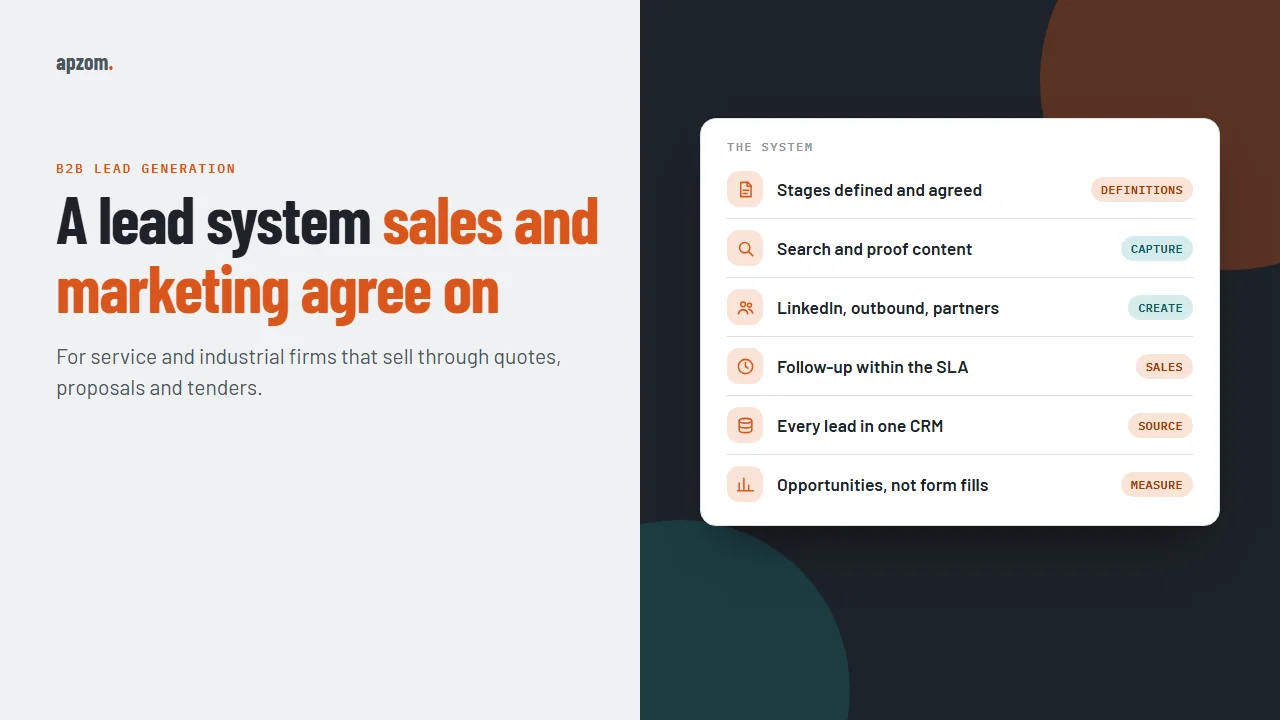
The short answer: B2B lead generation works best as a system, not a channel. Agree in writing what counts as a lead at each stage (contact, lead, marketing-qualified, sales-accepted, opportunity), so marketing and sales stop arguing about quality. Pick two or three channels that match how your buyers buy: search and case-study content for buyers already looking, LinkedIn and targeted outreach for buyers who are not, and partners and referrals for trust. Then set a service-level agreement for how fast and how often sales follows up, keep every lead in one CRM with its source, and judge the system by qualified opportunities and won revenue by channel, not by the number of form fills.
This guide is for owners, sales leaders and marketers at B2B service and industrial firms anywhere in the world, such as engineering, logistics, manufacturing, IT services, professional services and B2B software, that sell to other businesses through quotes, proposals or tenders. It explains the lead stages and definitions to agree first, how inbound, outbound, partner and paid channels fit together, the follow-up rules that stop good leads going cold, the outreach rules by country, how to measure what actually produces revenue, and a 12-week plan to put it in place.
Why B2B lead generation is different
Selling to a business is rarely one person’s decision. Gartner’s research puts B2B buying groups at five to 16 people across as many as four functions (Gartner press release, May 2025), and its survey of 646 B2B buyers, published in March 2026, found that 67% prefer a buying experience without a sales rep. A May 2026 Gartner release from the same survey wave found that 69% still want to check AI-generated insights with a sales rep. In other words, buyers do much of their research alone, and then want a knowledgeable person when it matters.
That changes what lead generation has to do:
- Several people need convincing. The person who fills in your form is often not the one who signs. Your website and follow-up need material for the engineer, the finance lead and the procurement team.
- Buyers check you before they talk to you. Certifications, case studies, delivery areas, capacity and a real address matter more than slogans.
- Cycles are long. A lead that is not ready today may be ready in six months, so nurturing and recycling matter as much as capture.
- Volume is not the goal. Ten enquiries from companies that fit your ideal customer profile are worth more than a hundred that do not.
Framework 1: agree the lead stages first
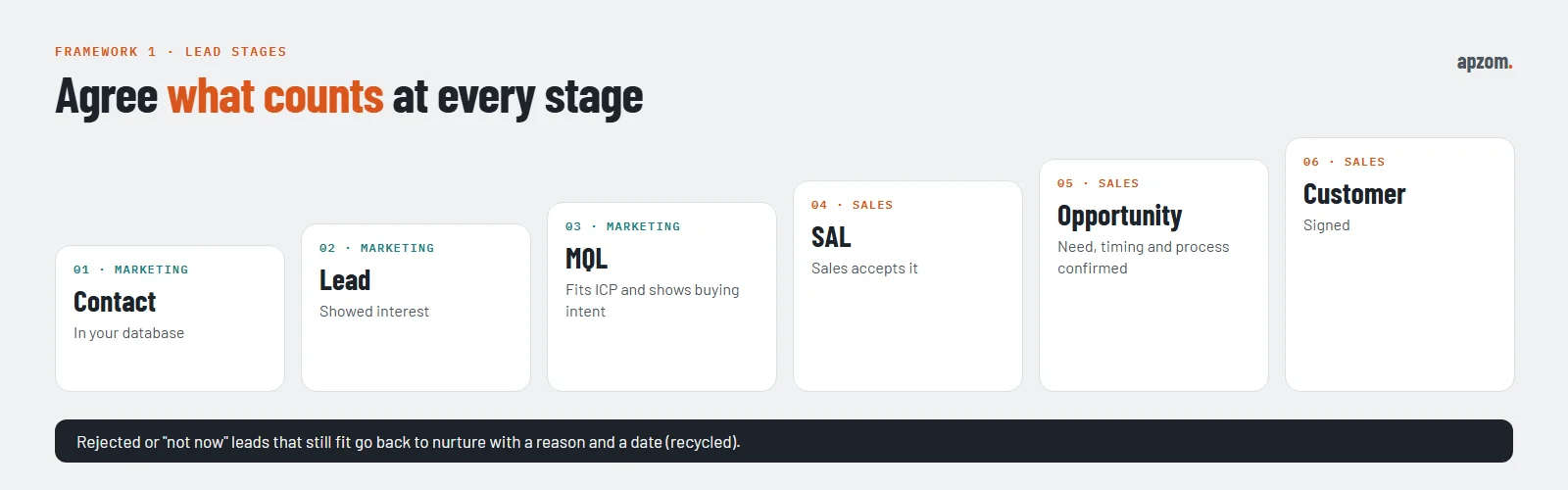
Most arguments between marketing and sales are really arguments about definitions. Write these down, agree them together, and set them up in your CRM before you spend more on any channel. The stage names below follow the lifecycle stages common in CRMs; HubSpot’s default lifecycle stages, for example, run from subscriber and lead through marketing-qualified and sales-qualified lead to opportunity and customer. No standards body defines these terms, so the definitions below are a starting point to adapt and agree.
| Stage | Entry rule (example) | Who owns it | What happens next |
|---|---|---|---|
| Contact | Any person in your database | Marketing | Nurture with useful content, with the consent your country’s rules require |
| Lead | Showed interest: downloaded a guide, attended a webinar, replied | Marketing | Score fit and interest |
| Marketing-qualified lead (MQL) | Fits your ideal customer profile and showed buying interest (for example requested a quote, visited pricing, asked a specific question) | Marketing hands to sales | Sales reviews within the agreed time |
| Sales-accepted lead (SAL) | Sales agrees it is worth a conversation | Sales | First meaningful contact |
| Opportunity (or SQL) | Confirmed need, timing and a buying process; a proposal or quote is likely | Sales | Proposal, negotiation |
| Customer | Signed | Account team | Onboarding, then referrals and repeat business |
| Recycled | Not ready now, but still a fit | Marketing | Back to nurture with a reason and a date |
Some CRMs, including HubSpot, keep SQL and Opportunity as separate stages: SQL when sales confirms fit, Opportunity when a quote or deal is open. Use whichever your CRM supports, as long as everyone uses the same definitions.
Three rules make the stages work:
- Write your ideal customer profile (ICP) in plain terms: industries, company size, locations, the problem you solve and the trigger events that make someone buy (a new site, a contract win, a regulation change, a failed supplier).
- Make every stage change visible. If sales rejects a lead, it records why. Those reasons are the most useful feedback marketing will get.
- Recycle instead of discarding. A “not now” from a company that fits is a future opportunity.
A simple lead score combines fit and intent. An illustrative example, to adapt to your own business:
| Signal | Points (example) |
|---|---|
| Industry and company size match your ICP | +20 each |
| Located in a region you serve | +10 |
| Requested a quote or visited the pricing or capacity page | +30 |
| Downloaded a technical document or attended a webinar | +10 |
| Student, job seeker or competitor | Disqualify |
Set the MQL threshold (for example 50 points) together, then check monthly whether high-scoring leads really become opportunities.
Framework 2: choose two or three channels that fit how your buyers buy
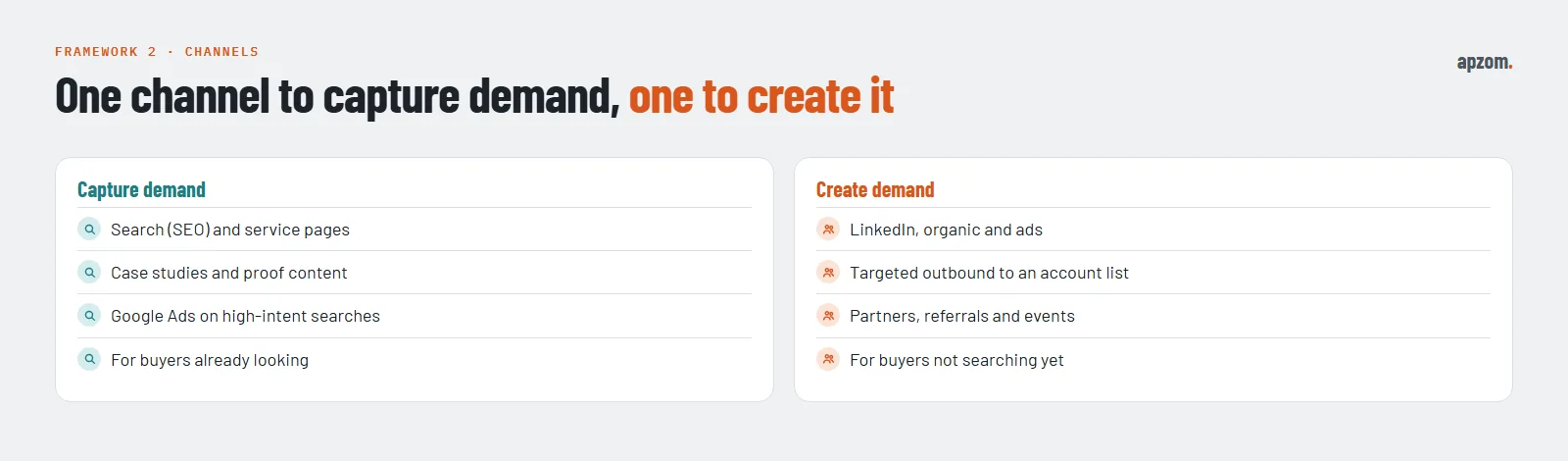
| Channel | Best for | How long before results | What to measure |
|---|---|---|---|
| Search (SEO) and service pages | Buyers already looking for what you do | Months, then compounding | Qualified enquiries and opportunities from organic search |
| Case studies and proof content | Buyers comparing suppliers | Builds over time | Use in sales conversations; assisted opportunities |
| Google Ads (search) | High-intent searches such as “[service] supplier [region]” | Days to weeks, while you pay | Cost per qualified opportunity, not cost per click |
| LinkedIn (organic and ads) | Reaching specific job roles and companies that are not searching | Weeks to months | Conversations and meetings with ICP accounts |
| Targeted outbound (email, LinkedIn, phone) | A defined list of accounts you want | Weeks | Meetings booked with ICP accounts, replies, opt-outs |
| Partners and referrals | Trust-heavy sales; complementary suppliers who serve the same buyers | Months to set up | Referred opportunities and win rate |
| Trade shows and events | Industries where buyers still meet suppliers in person | Event-based | Meetings and opportunities per event, followed up within days |
Pick by your sales cycle, not by fashion. A firm whose buyers search (“freight forwarder for Mundra port”, “CNC machining supplier near me”) should start with search and service pages. A firm selling something buyers do not know they need should start with outbound, LinkedIn and partners. Most firms need one “demand capture” channel (search, paid search) and one “demand creation” channel (LinkedIn, outbound, partners or events).
Our guides go deeper on the channels and industries: B2B and industry SEO pages, digital marketing for manufacturers and logistics firms, landing pages that turn visits into enquiries, and Google Ads management costs.
Losing good leads between marketing and sales? Ask for a Free Growth Audit. We review where your enquiries come from, how they reach your CRM and how fast they are followed up, and tell you what to fix first.
Framework 3: the follow-up agreement (SLA)
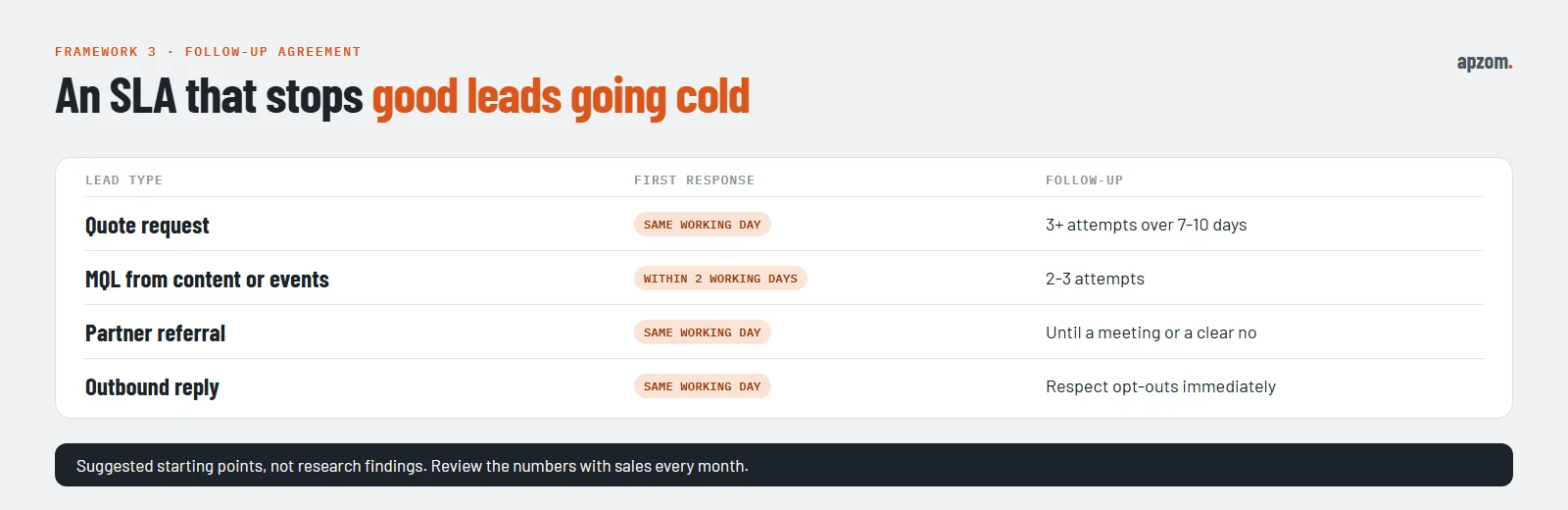
A service-level agreement (SLA) between marketing and sales is a short written promise: marketing will send leads that meet the MQL definition, and sales will act on them within a set time. The numbers below are our suggested starting points, not research findings; set your own and review them monthly.
| Lead type | First response | Follow-up attempts | If no response |
|---|---|---|---|
| Quote request or “contact sales” | Same working day, ideally within an hour | At least 3 attempts over 7 to 10 days, by phone and email | Recycle to nurture with a reason |
| MQL from content or events | Within 2 working days | 2 to 3 attempts | Back to nurture |
| Referral from a partner | Same working day, and tell the partner | Until a meeting or a clear no | Report back to the partner |
| Outbound reply | Same working day | Until a meeting or a clear no | Respect opt-outs immediately |
Speed matters. A 2011 Harvard Business Review study of how companies handle online leads opened with the finding that “most companies are not responding nearly fast enough.” The research is now 15 years old, so treat it as a direction rather than a benchmark, and measure your own response times and outcomes.
Make the agreement two-way. Sales agrees response times; marketing agrees on lead quality and volume; both review a short report every month: leads by source, acceptance rate, reasons for rejection, opportunities and wins.
Quotes, tenders and buying groups
Many service and industrial firms win work through quotes and tenders, so treat them as stages with their own rules:
- A bid or no-bid rule. Before quoting, check the request against your ICP, capacity and chance of winning. Saying no quickly to a poor fit frees time for good ones.
- A “quote sent” stage with its own follow-up rule, for example a call within three working days to answer questions, then agreed check-ins until a decision.
- Tender portals as a channel. Public-sector and large-company buyers often publish tenders on procurement portals; if that is your market, monitor them and record tender wins and losses by source like any other channel.
- Map the buying group. For each important account, list the roles involved (for example the user, the technical evaluator, finance and procurement), and make sure each gets what they need: specifications for the engineer, costs and terms for finance, certifications and policies for procurement.
Outreach rules by country
Outbound only works long term if it stays within the rules. This section is general information, not legal advice; our guide to email marketing for small businesses covers consent in more detail.
| Country | Cold email to business addresses | Cold calls |
|---|---|---|
| United States | Allowed without prior consent under CAN-SPAM, but every email must follow its rules (accurate headers and subject lines, your postal address, a working opt-out honoured within 10 business days, and a clear statement that the message is an ad); the FTC says the law “makes no exception for business-to-business email” | Most B2B calls are exempt from the National Do Not Call rules, but not from the ban on misrepresentation; autodialled or prerecorded calls to mobile numbers need prior express consent under the FCC’s TCPA rules (prior express written consent when the call is telemarketing); calls selling office or cleaning supplies are not exempt |
| United Kingdom | No prior consent needed under PECR for limited companies and other corporate bodies; sole traders and most partnerships count as individuals and need consent or the soft opt-in. Every email must identify you and give a valid opt-out address. UK GDPR still applies to a named employee’s data | Do not call numbers on the preference register kept under PECR (which covers businesses as well as individuals) or anyone who asked you not to |
| European Union | GDPR Recital 47 says direct marketing “may be regarded as carried out for a legitimate interest”, and people can object at any time; the ePrivacy Directive leaves email to businesses to each member state, so rules vary by country | Varies by country |
| Canada | CASL implies consent if the person conspicuously published their work address without a “no unsolicited messages” note, or gave it to you (for example on a business card), and your message is relevant to their business role. Every message must still identify you and include a working unsubscribe | Calls to businesses are exempt from the National Do Not Call List rules, but the CRTC Telemarketing Rules still apply (identify yourself, calling hours, keep an internal do-not-call list) |
| Australia | A published address alone is not consent; consent can be inferred only if the work address was conspicuously published with the person’s agreement, carries no “no spam” note, and your message relates to their role. Every message must still identify you and include a working unsubscribe | Business numbers cannot be listed on the Do Not Call Register, but the telemarketing industry standard (calling hours, identifying yourself) still applies |
India, the UAE and other markets: rules differ (India, for example, has its own telemarketing rules and a data-protection law being phased in), so take local advice before cold outreach.
Since February 2026, UK GDPR itself lists direct marketing as an example of processing that may rest on legitimate interests; you still need to show it is necessary and not overridden by the person’s interests, and PECR applies on top.
LinkedIn has its own rules. Its User Agreement and help pages ban bots, scrapers and automation extensions, and LinkedIn says accounts using them can be restricted or shut down. It limits how many connection invitations you can send but does not publish the number. Write personal messages by hand to a short list of people who fit your ICP, and use LinkedIn’s own tools, such as Sales Navigator (a paid product) for finding accounts and Lead Gen Forms for ads. Lead Gen Forms pre-fill details from the member’s profile and can sync leads straight to your CRM.
Measure what produces revenue
Most B2B ad platforms optimise for whatever you tell them is a conversion. If that is every form fill, they will find more form fills, qualified or not. Close the loop:
- Google Ads: with enhanced conversions for leads, you send Google the leads your CRM marks as qualified or won, matched by hashed email or phone, so bidding can aim at those stages instead of raw form fills. Google recommends one conversion action per funnel stage and daily uploads.
- Microsoft Advertising, in markets where LinkedIn profile targeting is available, lets you raise bids for searchers by LinkedIn company, industry or job function; it adjusts bids rather than narrowing the audience.
- LinkedIn and Meta both accept CRM or offline conversion data in similar ways; see our guide to the Meta pixel and Conversions API.
Track these by channel, every month:
- Qualified opportunities (not just leads), and their value.
- Acceptance rate: the share of MQLs that sales accepts. Low rates mean the definition or the targeting is wrong.
- Win rate and sales-cycle length.
- Cost per opportunity and per customer, including staff time, not just ad spend.
- Source of won deals, including “how did you hear about us?” asked by a person, because many B2B buyers research quietly before they ever fill in a form.
Tag every campaign link with UTM parameters and record the source on every CRM record, so this report is possible.
A 12-week plan
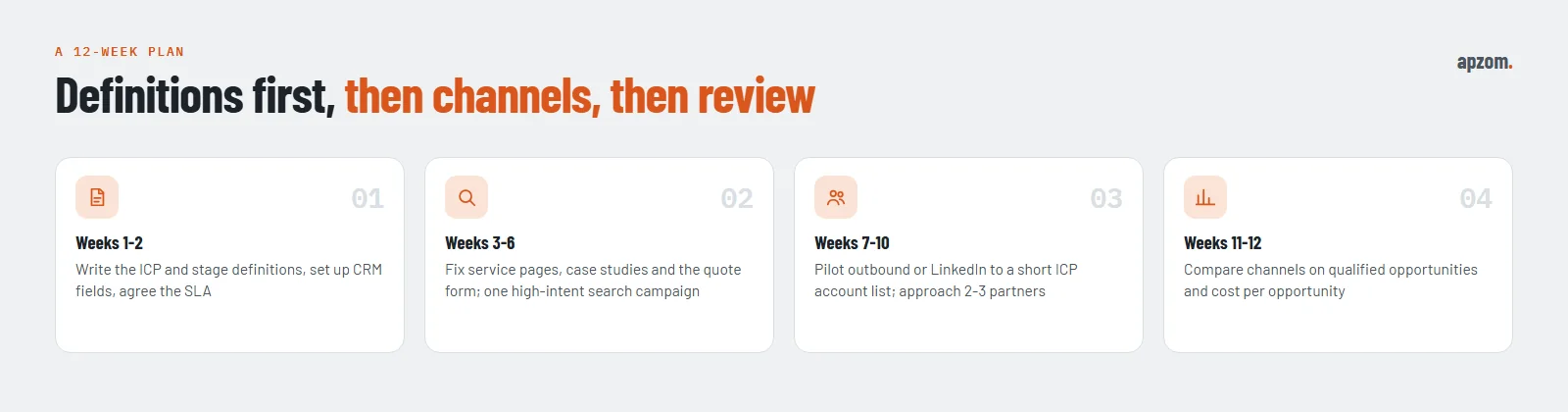
- Weeks 1 to 2: definitions and plumbing. Write the ICP and stage definitions, set up the CRM stages and required fields (source, ICP fit, reason for rejection), and agree the SLA.
- Weeks 3 to 6: capture the demand you already have. Fix your service pages, case studies and quote form; make sure every enquiry reaches the CRM; start one paid search campaign aimed at high-intent searches if budget allows.
- Weeks 7 to 10: create demand. Pilot one outbound or LinkedIn programme aimed at a short list of ICP accounts, within the rules for each country, and approach two or three potential referral partners.
- Weeks 11 to 12: review. Compare channels on qualified opportunities and cost per opportunity, keep what works, and fix or drop what does not.
Common mistakes
- Counting leads, not opportunities. A channel that sends many unqualified enquiries can look good on a dashboard and still waste sales time.
- No agreed definitions. Marketing celebrates MQLs that sales never accepts.
- Slow or single follow-up. One email to a quote request is not a follow-up process.
- Buying contact lists and blasting them. It risks breaking consent rules, platform rules and your domain’s reputation.
- Automation that breaks platform rules, such as LinkedIn bots and scrapers.
- Generic content. Industrial and B2B buyers want specifications, capacity, certifications, delivery areas and proof, not slogans.
- Ignoring partners and existing customers, often the fastest sources of trusted introductions.
How Apzom can help
Apzom Digital builds the parts of this system that sit online: the performance marketing channels (search, Google Ads and Meta ads), the service pages and case studies that buyers check, and the tracking that connects enquiries to opportunities in your CRM. For ARKS Infinity Logistics, a freight forwarding and customs advisory firm, we built a 51-page website from scratch; we have not published lead-generation results for that project. We can review your current lead flow and tell you where qualified leads are being lost.
We work with clients worldwide, remotely, from our base in Ahmedabad, India.
Frequently asked questions
What is the difference between an MQL and an SQL?
A marketing-qualified lead fits your ideal customer profile and has shown buying interest, so marketing hands it to sales. A sales-qualified lead (or opportunity) is one that sales has spoken to and confirmed a real need, timing and buying process. The exact rules are yours to define; what matters is that both teams agree them in writing.
How many leads does a B2B firm need?
Work backwards from revenue: your target new revenue, divided by your average deal size, gives the deals you need; divide by your win rate for the opportunities you need; divide by your opportunity rate for the qualified leads you need. Use your own numbers, not industry averages.
Is cold email legal for B2B?
It depends on the recipient’s country and whether the address belongs to a company or an individual. In the US, cold email to business addresses is allowed if it follows CAN-SPAM. In the UK, emails to limited companies do not need prior consent but must identify you and offer an opt-out; sole traders need consent. In the EU, rules for business addresses vary by country; in Canada and Australia, consent can be implied only in specific circumstances, such as a published work address and a message relevant to the person’s role. When in doubt, take local advice.
Should a B2B firm use LinkedIn ads or Google Ads?
Google Ads captures people already searching for what you do; LinkedIn reaches specific roles and companies who are not searching yet. Many firms start with search if buyers search for their service, and add LinkedIn for a defined list of target accounts.
How long does B2B lead generation take to work?
Paid search and outbound can produce conversations within weeks; SEO, content and partnerships usually take months but keep working. Judge each channel against its own expected timeline.
Get your Free Growth Audit and Quote. We review your lead stages, channels, follow-up times and tracking, and send a plain-English plan showing what to fix first, with your CRM, ad accounts and data kept in your business’s name.
No obligation and no guaranteed results. Prefer to talk first? Contact us or see our performance marketing service.