
The short answer: a good digital marketing agency for logistics does not start with blog posts or ad budgets. It starts with one question: which logistics business do you want more of? Then it helps the right shippers find the services, lanes and capabilities you actually have, makes it easy for them to send a usable request for quote (RFQ), and tracks which of those requests become quotes, first shipments and long-term accounts.
That last part is where most logistics marketing breaks. Traffic goes up, form submissions go up, and the sales team says the leads are useless: a student asking about jobs, a family moving house, a shipper on a lane you do not serve. Marketing reports a good month. Sales has a bad one.
This guide is written for freight forwarders, 3PLs, warehouse and fulfilment operators, trucking companies, customs brokers and the marketing or commercial teams inside them. It shows how a logistics growth system works from market fit to account expansion, which channels fit which kind of logistics business, and what to measure after the form is submitted.
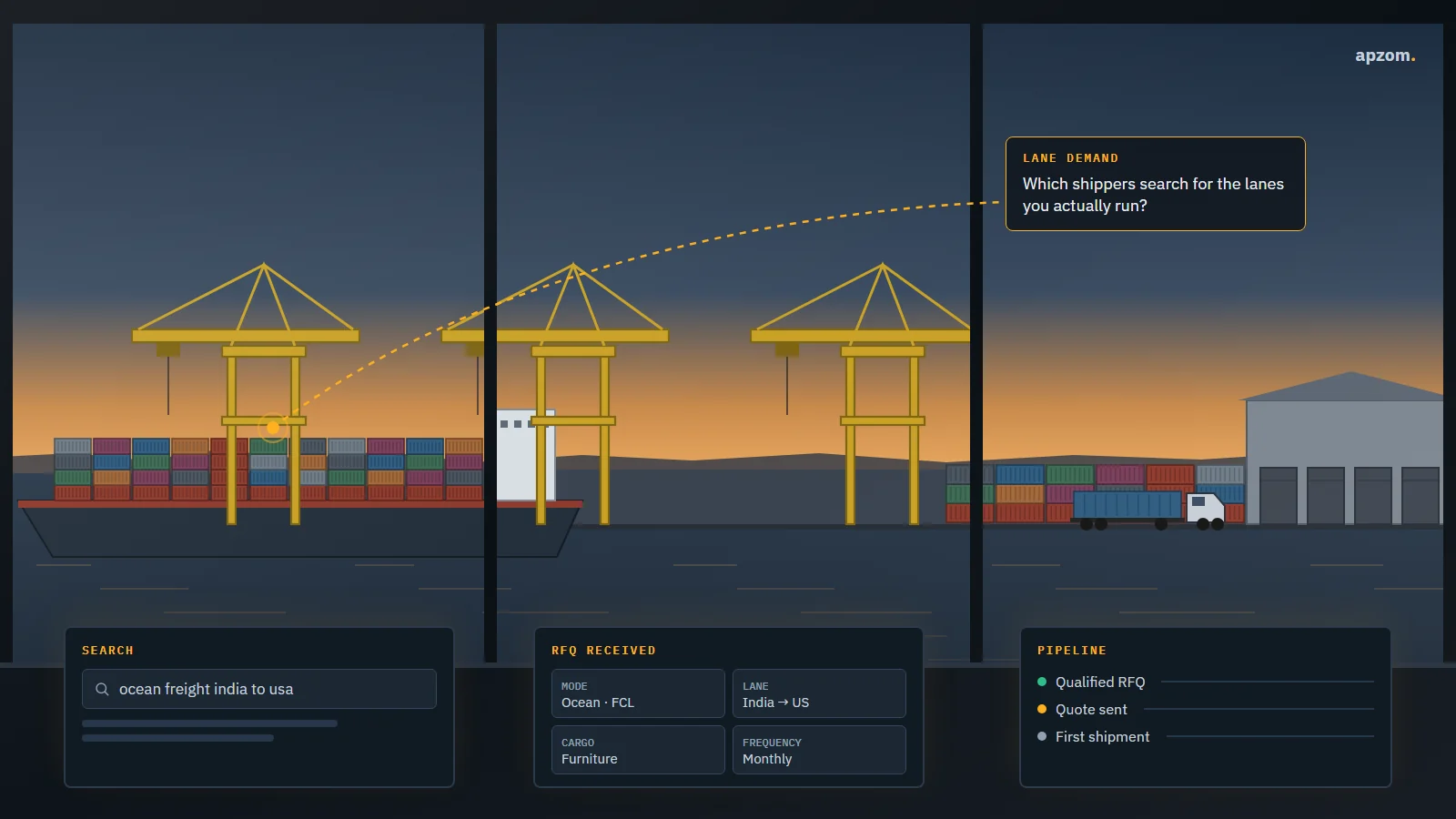
The logistics growth control tower
A control tower in logistics gives a team one view of many moving parts: bookings, carriers, exceptions, customers. Marketing for a logistics company needs the same thing. Instead of a list of channels, it needs one view of how a shipper moves from “I have cargo to move” to “this is now our regular provider”.
The journey looks like this:
Market fit → demand discovery → capability proof → qualified RFQ → quote or proposal → sales opportunity → first shipment → repeat shipments → account expansion
Every stage depends on the one before it. If your market fit is vague, your search demand is vague. If your proof is weak, good shippers leave before they ask for a quote. If the RFQ form asks the wrong questions, sales cannot price the lane. And if nobody tracks what happens after the quote, the marketing budget keeps paying for the wrong enquiries.
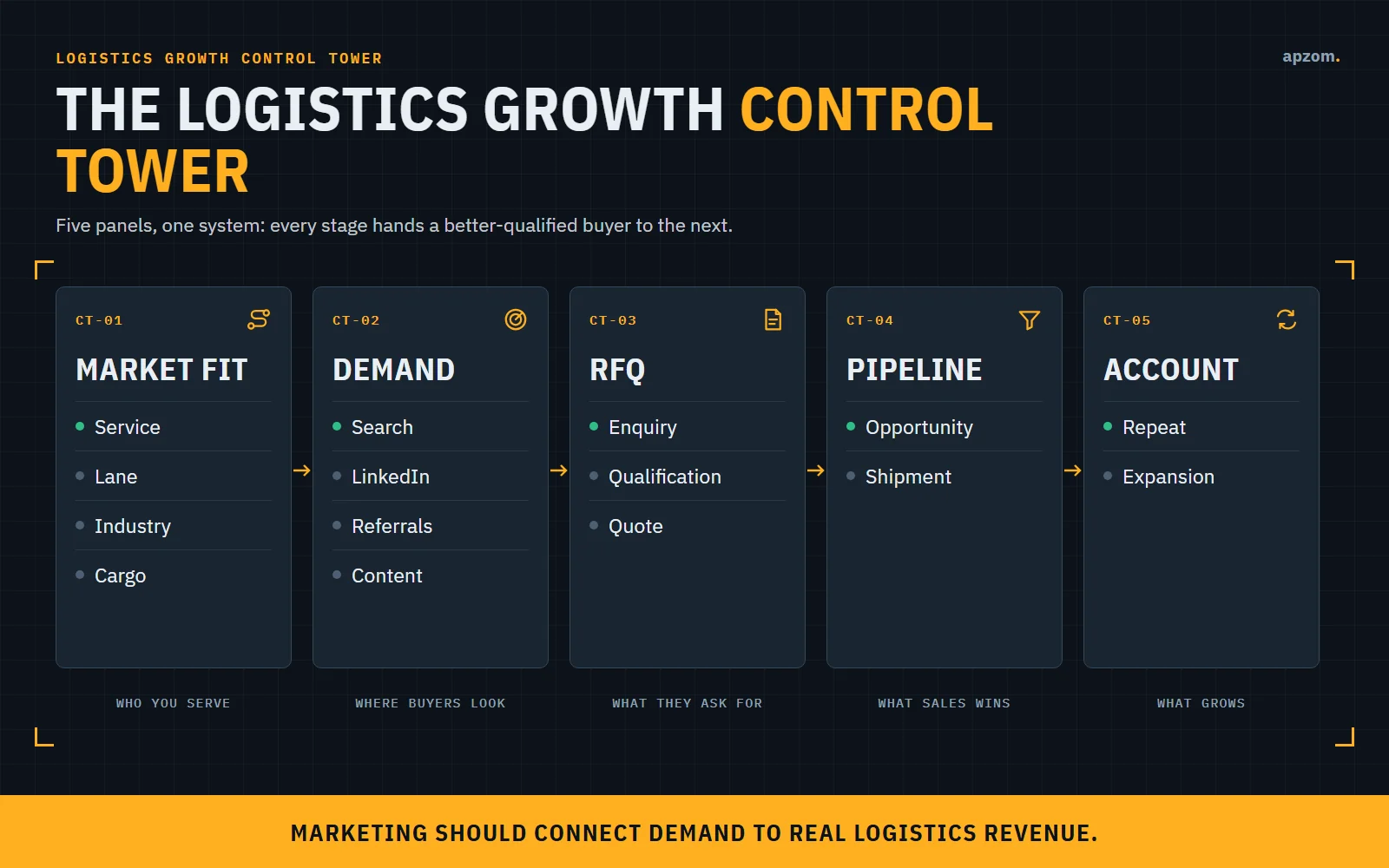
The rest of this guide works through seven panels of that control tower:
- Market fit: what you move, for whom, from where, to where and how often.
- Demand radar: where real shippers look for a provider like you.
- Capability proof: what a buyer needs to believe before handing you cargo.
- RFQ engine: how the website turns interest into a request sales can price.
- Sales handoff: how marketing and sales share one picture of lead quality.
- Account expansion: how a first shipment becomes a growing account.
- Revenue measurement: what to track beyond clicks and form fills.
The central idea is simple. Logistics marketing should not be judged by traffic or raw leads. It should connect the right shipper with the right service, route and team, then measure how marketing contributes to qualified RFQs, opportunities, shipments and long-term accounts.
First, “logistics” is not one business
A freight forwarder, a warehouse operator and a last-mile courier all call themselves logistics companies. They have very different buyers, sales cycles and marketing needs. Treating them as one market is the first mistake many agencies make.
| Segment | What buyers usually look for | Typical first conversion | Watch-outs |
|---|---|---|---|
| Freight forwarders (ocean, air, road, multimodal) | Lane coverage, mode options, documentation support, responsiveness | Lane-specific quote request | Never publish transit times or rates you cannot honour |
| 3PL providers | Transport plus warehousing, inventory and distribution as one service | Requirements call or RFP response | Long evaluations with several decision-makers |
| Warehousing and fulfilment | Location, space, systems, accuracy, returns handling | Capacity enquiry or site visit | Location pages must match real facilities |
| Trucking and road freight | Coverage, capacity, FTL or part-load, tracking | Quick quote or call to dispatch | Terminology and authority rules differ by country |
| Courier and last-mile | Speed, price, coverage, simple booking | Instant quote or account sign-up | Closer to consumer marketing; volume matters more |
| Customs brokers | Correct filings, licensed status, jurisdiction knowledge | Consultation request | Highly regulated; content must not become legal advice |
| Cold chain | Temperature control, monitoring, handling procedures | Specialist conversation | Proof of equipment and process matters more than copy |
| Project cargo and heavy lift | Engineering capability, past moves, risk planning | Project brief | Long cycles; case studies carry the sale |
| Ecommerce logistics | Integrations, fulfilment speed, returns, cost per order | Discovery call with order volumes | Buyers compare many 3PLs quickly |
Industry-specialised logistics, such as automotive, pharma, food, chemicals or electronics, sits on top of these. A forwarder that handles chemical cargo well has a different story to tell from one that moves garments, even on the same lane.
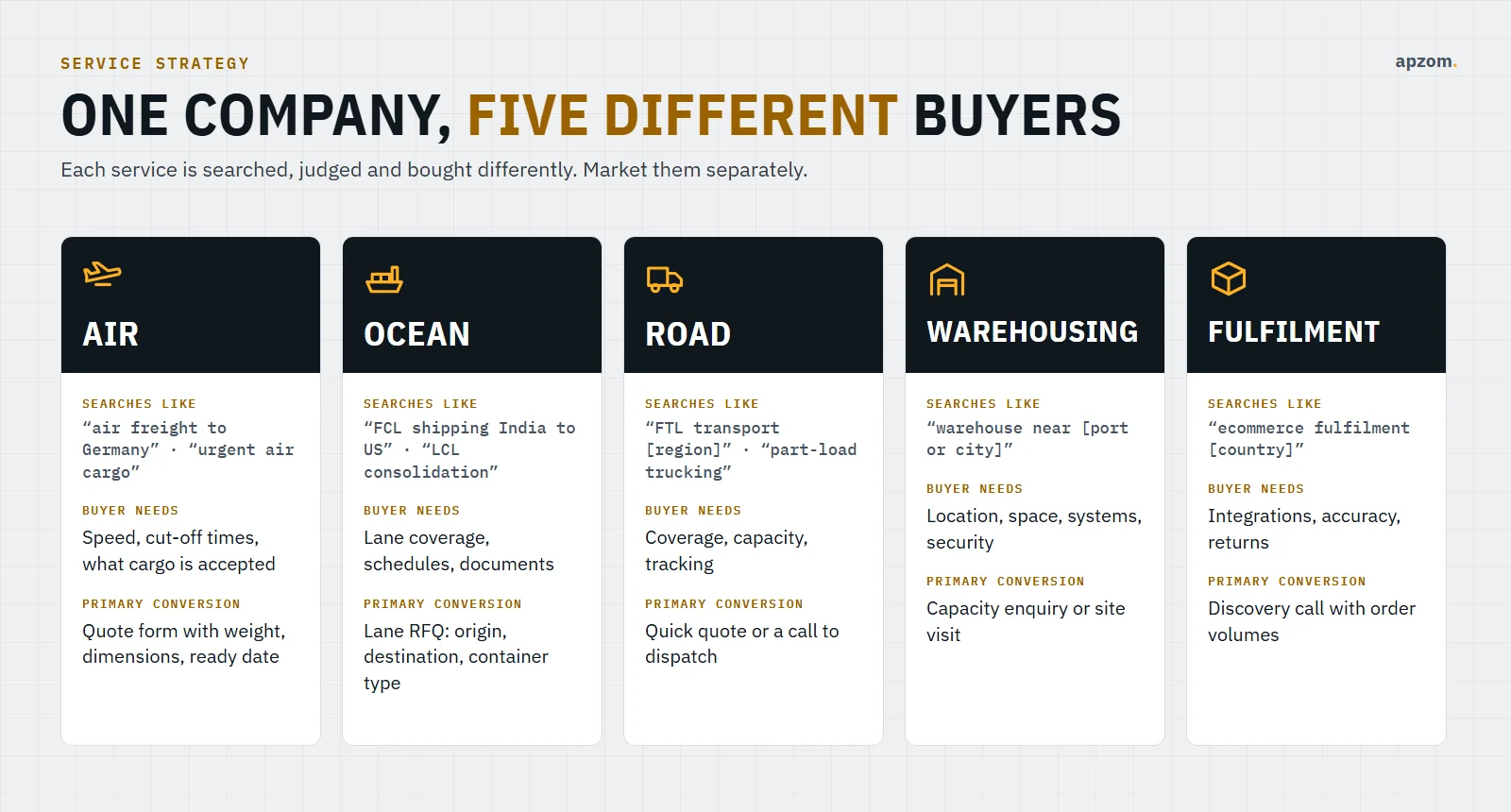
The practical point: each service you sell may need its own pages, proof, calls to action and sometimes its own channel mix. One company, five different buyers.
Panel 1: Market fit
Before any marketing, a logistics company should be able to answer six questions in plain words:
- What do you move? Cargo type, size, special handling.
- For whom? Industry and type of shipper.
- From where? Origins, regions, ports, airports or warehouses.
- To where? Destinations and the lanes you actually run.
- How? Ocean, air, road, rail, warehousing, fulfilment, customs support.
- How often? One-off projects, monthly volumes, daily distribution.
If the answer is “we offer complete logistics solutions”, the market fit is not finished. That line tells a buyer nothing, gives search engines nothing to match, and gives a sales team no way to tell a good enquiry from a poor one.
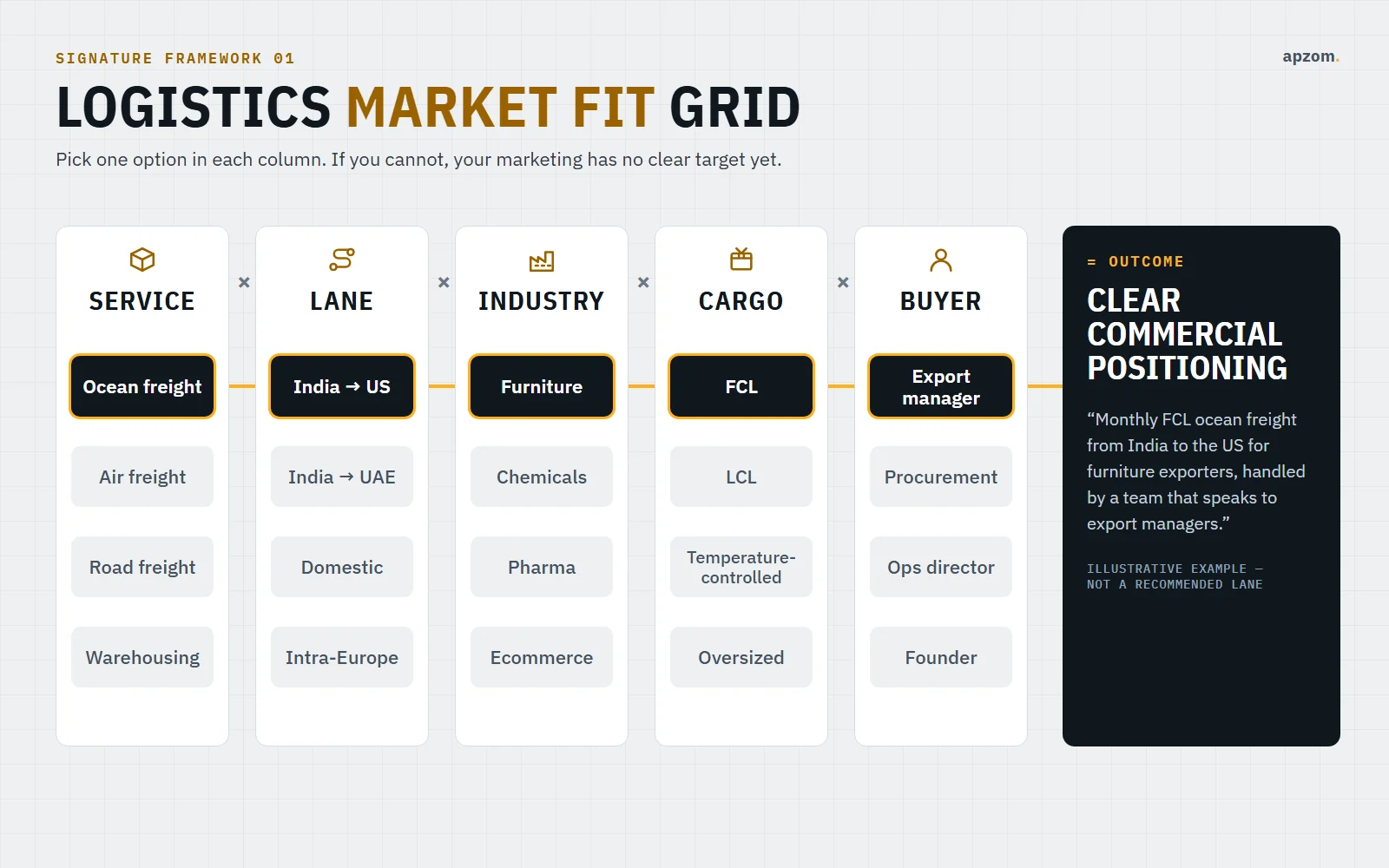
The logistics market fit grid
A simple way to turn your business into marketable offers is to combine five things:
Service × lane × industry × cargo × buyer = a marketable logistics offer
For example: ocean freight + India to the United States + furniture exporters + FCL (full container load) + export manager. That is an offer someone can search for, a page can explain and a salesperson can qualify. It is only an illustration. It is not a lane every company should target.
How to choose which combinations to market first:
- Start with what you already win and deliver well. Your best current customers usually point to your strongest market fit.
- Look at margin and capacity, not just demand. A busy lane where you have no capacity or poor rates is not a marketing priority.
- Pick two or three offers to start. You can add more once the first ones produce qualified RFQs.
- Write down what you do not do. Clear limits (“we do not handle hazardous cargo by air”) save sales time and build trust.
Panel 2: Demand radar
Logistics demand shows up in more places than Google. Where it shows up depends heavily on the service.
- Google Search: shippers searching for a service, a mode, a lane or a problem. Strongest for forwarders, 3PLs, warehousing and customs.
- Google Maps: local searches for warehouses, trucking yards or courier counters. Only useful for genuine customer-facing locations.
- Industry directories and freight marketplaces: some buyers compare providers there before they visit any website.
- Referrals: often the largest source of good logistics business. Marketing can make referrals easier, not replace them.
- LinkedIn: where supply chain, procurement and operations people check a provider’s credibility and follow industry discussion.
- Trade associations and events: relationships that turn into RFQ invitations later.
- Procurement and tenders: formal RFQ or RFP processes where your website and documents are checked during evaluation.
- Partner networks: agents and partners abroad who pass on work.
- AI and answer search: buyers asking AI tools how to choose a forwarder or what a 3PL does.
- Existing customers: usually the cheapest source of new lanes and services.
The logistics search intent map
People who search for logistics services tend to fall into six groups. Each group needs a different page, different proof and a different call to action.
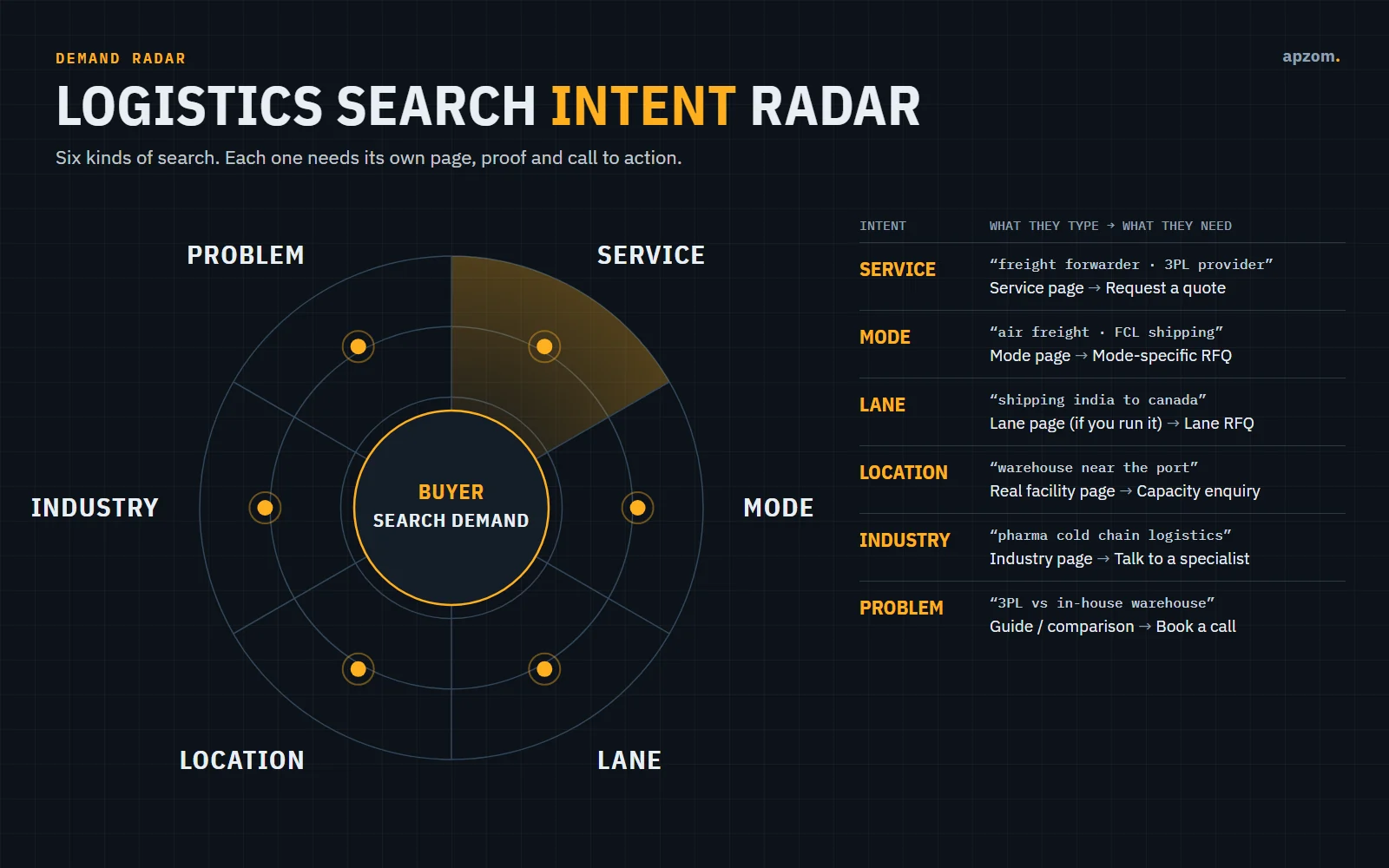
| Intent | Example search | Page it needs | Proof that matters | Best call to action |
|---|---|---|---|---|
| Service | “freight forwarder”, “3PL provider” | Service page | Scope, process, who it suits | Request a quote |
| Mode | “air freight”, “FCL shipping” | Mode page | Cargo accepted, documentation, limits | Mode-specific RFQ |
| Lane | “shipping from India to Canada” | Lane page, only if you run it | Real routing options, partners, caveats | Lane RFQ |
| Location | “warehouse near the port” | Real facility or office page | Address, photos, capabilities | Capacity enquiry |
| Industry or cargo | “pharma cold chain logistics” | Industry page | Handling process, relevant credentials | Talk to a specialist |
| Problem or decision | “3PL vs in-house warehouse” | Guide or comparison | Honest trade-offs | Book a call |
Keyword quality beats search volume
A search like “logistics company” gets plenty of volume and very little intent. It could come from a job seeker, a student or someone looking up a parcel. A specific search that combines service, lane and industry may get very few searches a month and still be worth more, because the person typing it has cargo and a problem to solve.
So judge keywords by how close they are to a real shipment you can handle. Do not judge them by volume alone.
Panel 3: Capability proof
Logistics buyers are handing over cargo, deadlines and sometimes regulatory responsibility. Before they ask for a quote, they want to know one thing: can this company actually handle my shipment?
The logistics trust stack
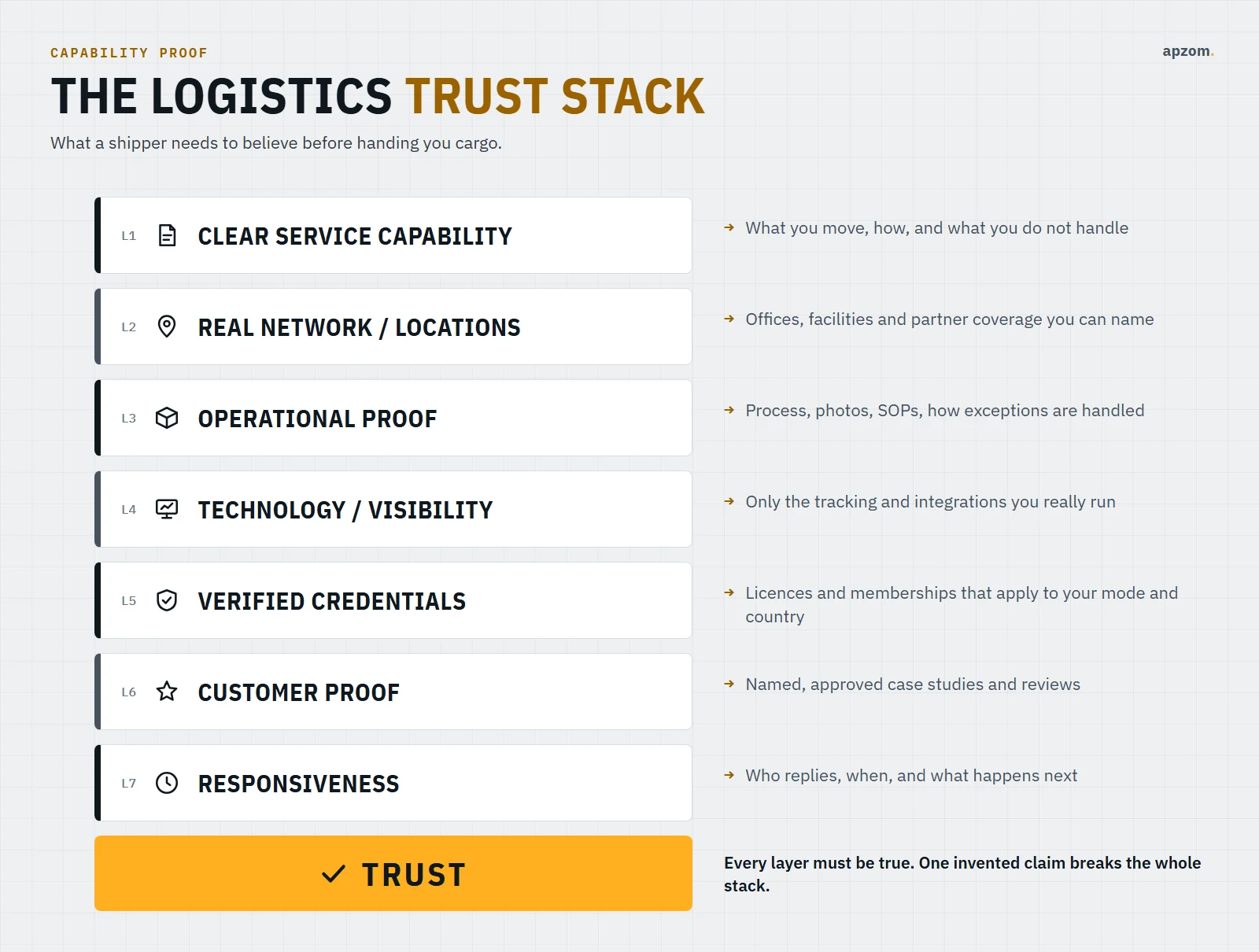
- Clear service capability: what you move, how, and what you do not handle. Vague service lists weaken trust.
- Real network and locations: offices, warehouses and partner coverage you can name. Never imply facilities you do not have.
- Operational proof: how bookings, documents and exceptions are handled. Real photos of real operations beat stock images of ships.
- Technology and visibility: tracking, integrations and reporting, but only what you actually run. If tracking is manual, say how updates are sent.
- Verified credentials: licences, registrations and memberships that apply to your mode and country.
- Customer proof: named and approved case studies, references and reviews.
- Responsiveness: who replies, how quickly in practice, and what happens next.
Each layer has to be true. One invented claim, such as a certification you do not hold or a warehouse you do not run, can undo every other layer when a procurement team checks.
Credentials depend on the mode and the country
Logistics credentials are not universal. Which ones apply depends on the service, the transport mode, the country and the regulator. A few verified examples show how much they vary:
- In the United States, the Federal Maritime Commission requires US-based ocean freight forwarders and NVOCCs to hold an FMC licence. Non-US NVOCCs may hold a licence or a registration.
- Also in the United States, FMCSA says for-hire motor carriers and those arranging interstate transport need operating authority (an MC, FF or MX number) in addition to a DOT number.
- In India, customs brokers are licensed under the Customs Brokers Licensing Regulations, 2018. Regulation 6 covers the examination and Regulation 7 the grant of the licence. Passing the examination is not the same as the company holding a licence.
- IATA cargo agency accreditation is an industry programme that tells airlines an agent is financially sound and trained. It is not a government licence.
- CTPAT in the US and Authorised Economic Operator (AEO) programmes run by customs administrations, including India’s, are voluntary.
The marketing lesson: show the credentials you genuinely hold, explain what each one means in plain words, and never let a page suggest a licence or certification the company does not have. If a credential belongs to a person rather than the company, say so.
Sustainability claims need evidence
Many shippers now ask about emissions, and procurement teams increasingly score it. That makes “green logistics” and “carbon neutral” tempting phrases. Use them carefully.
- Emissions numbers should come from a recognised method. ISO 14083:2023 sets a common approach for quantifying and reporting greenhouse gas emissions from transport chains, and the GLEC Framework (version 3.2, October 2025) is aligned with it.
- Describe specific actions instead of broad labels: lower-carbon mode options, fleet changes, route planning, packaging changes, with the evidence behind each.
- Rules are tightening. In the EU, Directive (EU) 2024/825 applies from 27 September 2026 and bans generic environmental claims that cannot be shown to reflect recognised excellent environmental performance, as well as claims of neutral impact based on offsetting. It is aimed at consumer-facing practices, but it shows the direction. In India, the Central Consumer Protection Authority issued guidelines on greenwashing and misleading environmental claims in October 2024.
If you cannot measure it, do not claim it.
Turn real technology into trust evidence
If your company genuinely uses shipment tracking, warehouse management software, carrier integrations or exception alerts, show them. A short screen recording of how a customer sees a shipment status is more convincing than the words “real-time visibility”. If a self-service portal is still being built, say so. Buyers forgive an honest roadmap. They do not forgive a demo of a feature that does not exist.
Write for the whole decision group
For larger accounts, the person who searches is rarely the only person who decides. The economic buyer, the operational user and the procurement reviewer are often three different people.
| Stakeholder | What they want to know | Content that helps |
|---|---|---|
| Operations | Can you handle our cargo reliably? | Process pages, handling procedures, exception management |
| Procurement | Are you commercially and contractually sound? | Clear scope, compliance documents, how pricing works |
| IT | Will your systems connect to ours safely? | Integration options, data handling, security practices |
| Management | What is the business value and the risk? | Case studies, service levels you can honour, references |
| Sustainability team | Can your environmental data be trusted? | Method used, data available, limits stated |
Panel 4: The RFQ engine
A logistics website should not just collect “contact us” messages. It should make it easy for a good shipper to ask for the right service with enough detail for your team to respond properly.
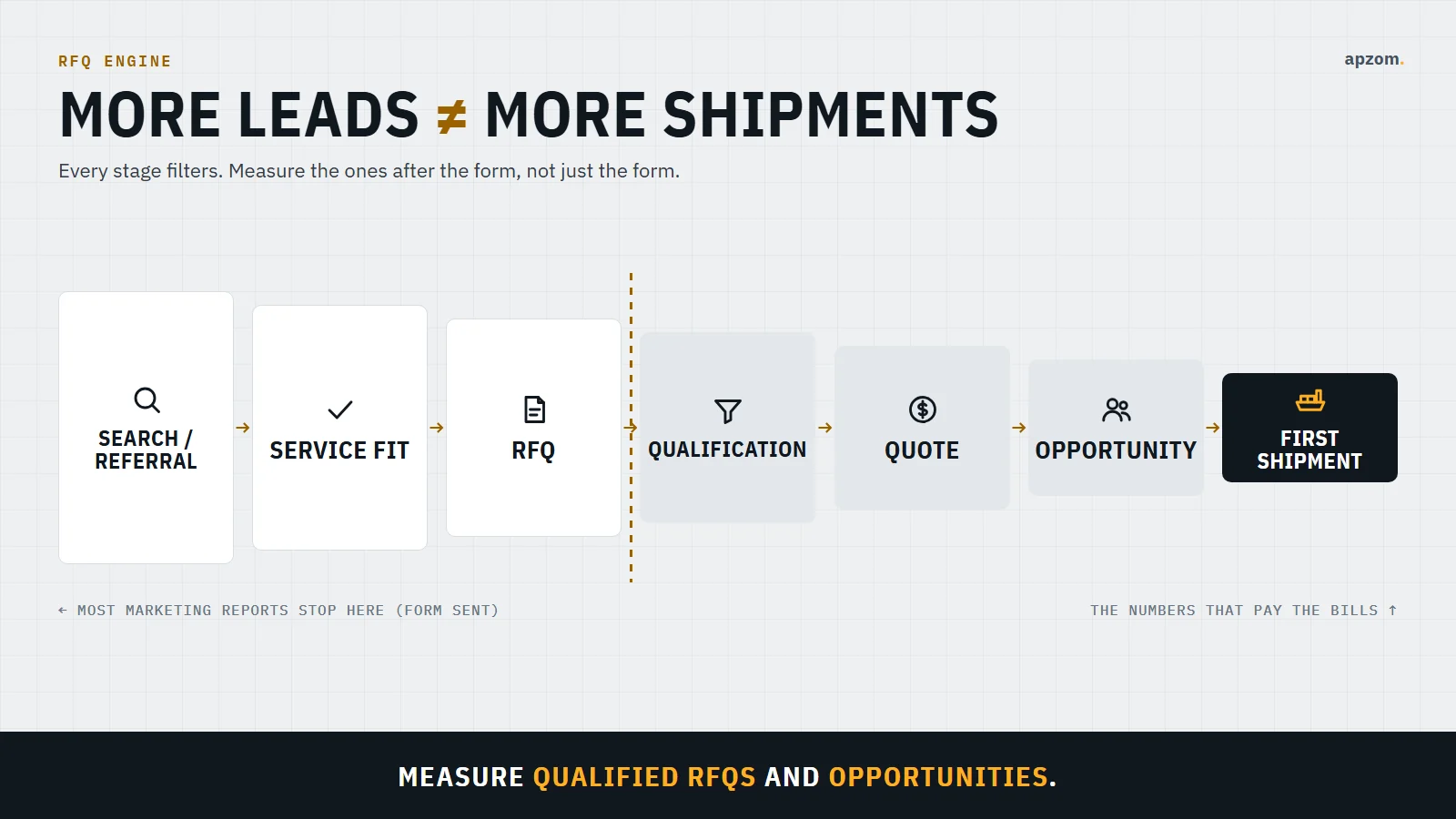
Search, referral or campaign → service page → capability check → RFQ → qualification → sales review → quote or proposal → opportunity
Design the RFQ form for routing, not interrogation
Long forms with 30 required fields stop good buyers. Forms that only ask for name and email leave sales chasing basic details. Aim for the middle: enough to route and roughly qualify the request, with the rest gathered in the first conversation.
| Service | Fields worth asking first | Can wait for the follow-up |
|---|---|---|
| Ocean freight | Origin, destination, FCL or LCL, container type, cargo category, frequency | Exact dimensions, commodity codes, Incoterms |
| Air freight | Origin, destination, approximate weight and dimensions, ready date | Packaging details, dangerous goods documents |
| Road freight | Pickup and delivery regions, full or part load, frequency | Access restrictions, exact time windows |
| Warehousing and fulfilment | Location needed, storage type, rough volume, order profile | Systems, returns rules, value-added services |
| Customs support | Import or export, country, type of goods | Detailed product classification |
Practical rules:
- Ask only what changes the next step. Make other fields optional.
- Use progressive qualification: a short first form, then a follow-up form or call for detail.
- Let people attach a document such as a packing list or tender file instead of retyping it.
- Tell the buyer what happens next and when: “A pricing specialist will review your lane and reply during business hours.”
- Make the form work properly on mobile, with sensible field types and no tiny tap targets.
Match the call to action to the page
“Contact us” everywhere is a missed opportunity. The call to action should match what the visitor came for:
- Request a freight quote on lane and mode pages.
- Discuss your 3PL requirements on 3PL and contract logistics pages.
- Find warehousing capacity on facility pages.
- Speak with a logistics specialist on industry and cold-chain pages.
- Send us your RFQ or tender for procurement-led buyers.
Avoid pressure tactics that do not fit logistics buying. “Only two slots left this week” on a freight quote page damages credibility. Real capacity constraints are fine to state when they are real.
The response is part of the marketing
A strong campaign can still fail if nobody answers the RFQ properly. Check who receives each type of enquiry, what happens outside working hours, which time zones you cover, whether the reply comes in the buyer’s language, and how long a quote really takes. There is no single “correct” response time. But a buyer comparing three forwarders will notice which one replied with useful questions first.
Panel 5: Sales handoff
This is where most logistics marketing plans stop, and where most of the waste happens. Marketing does not finish when the RFQ is submitted.
For every enquiry, someone should be able to answer: who owns it, has it been qualified, was a quote sent, what happened to the quote, and if it was lost, why?
The logistics qualification ladder
- Raw enquiry: any form, call, email or LinkedIn message.
- Service fit: is it a service you actually sell?
- Lane or geography fit: can you cover the origin and destination?
- Cargo and capability fit: can you handle the cargo, the volume and the special requirements?
- Commercial fit: does the volume, frequency and likely margin make sense for you?
- Qualified RFQ: a request sales believes is worth pricing.
- Quote or proposal: pricing or a formal response sent.
- Sales opportunity: a real chance of winning, with a decision process you understand.
- First shipment: the business actually moves.
Every company’s percentages between these steps are different, and they change by service and lane. Measure your own instead of trusting benchmark numbers from an agency deck.
The marketing-to-sales feedback loop
Marketing should know which leads were real, which were poor fit and why, which received quotes, which became opportunities and which became shipments. Without that loop, marketers optimise towards whatever is easiest to count, usually form submissions, and ad platforms do the same.
The fix is usually simple and unglamorous:
- One CRM, even a basic one, with clear stages that match the ladder above.
- A required “reason lost” or “reason disqualified” field, with a short fixed list such as “lane not served”, “cargo not suitable”, “price”, “timing” or “no response”.
- The marketing source captured with every enquiry and kept when it becomes an opportunity.
- A short monthly review between marketing and sales: what came in, what was good, what was not, what to change.
Send real outcomes back to the ad platforms
If you use Google Ads, optimising only to online form submissions teaches the system to find more people who fill in forms, including the wrong ones. Google’s current recommendation for lead businesses is enhanced conversions for leads. It is an upgraded form of offline conversion import that matches CRM outcomes back to ads using hashed first-party data such as email addresses. It is set up through Google Ads Data Manager, which has connectors for CRMs including Salesforce and HubSpot.
In practice, that means:
- Creating a separate conversion action for each stage you can track reliably, such as qualified RFQ, opportunity and won account.
- Assigning values that reflect what each stage is worth to you, so bidding can favour better leads rather than more leads.
- Uploading only what your privacy notice, consent records and local law allow. Google asks advertisers to accept its customer data terms and strongly recommends sending consent information with uploads.
LinkedIn offers a similar route through its Conversions API, which can connect CRM events from tools such as HubSpot and Salesforce.
This is one of the clearest differences between generic lead generation and logistics marketing that works. The aim is not more forms. The aim is to teach every system what a good shipper looks like.
If you want a second opinion on how your enquiries are routed, qualified and tracked today, Apzom can review it as part of a Logistics Digital Growth Audit.
Panel 6: Account expansion
For many B2B logistics businesses, the first shipment is a trial. The real value comes from what follows: repeat shipments, new lanes, extra modes, warehousing, customs support, new locations and cross-border growth.
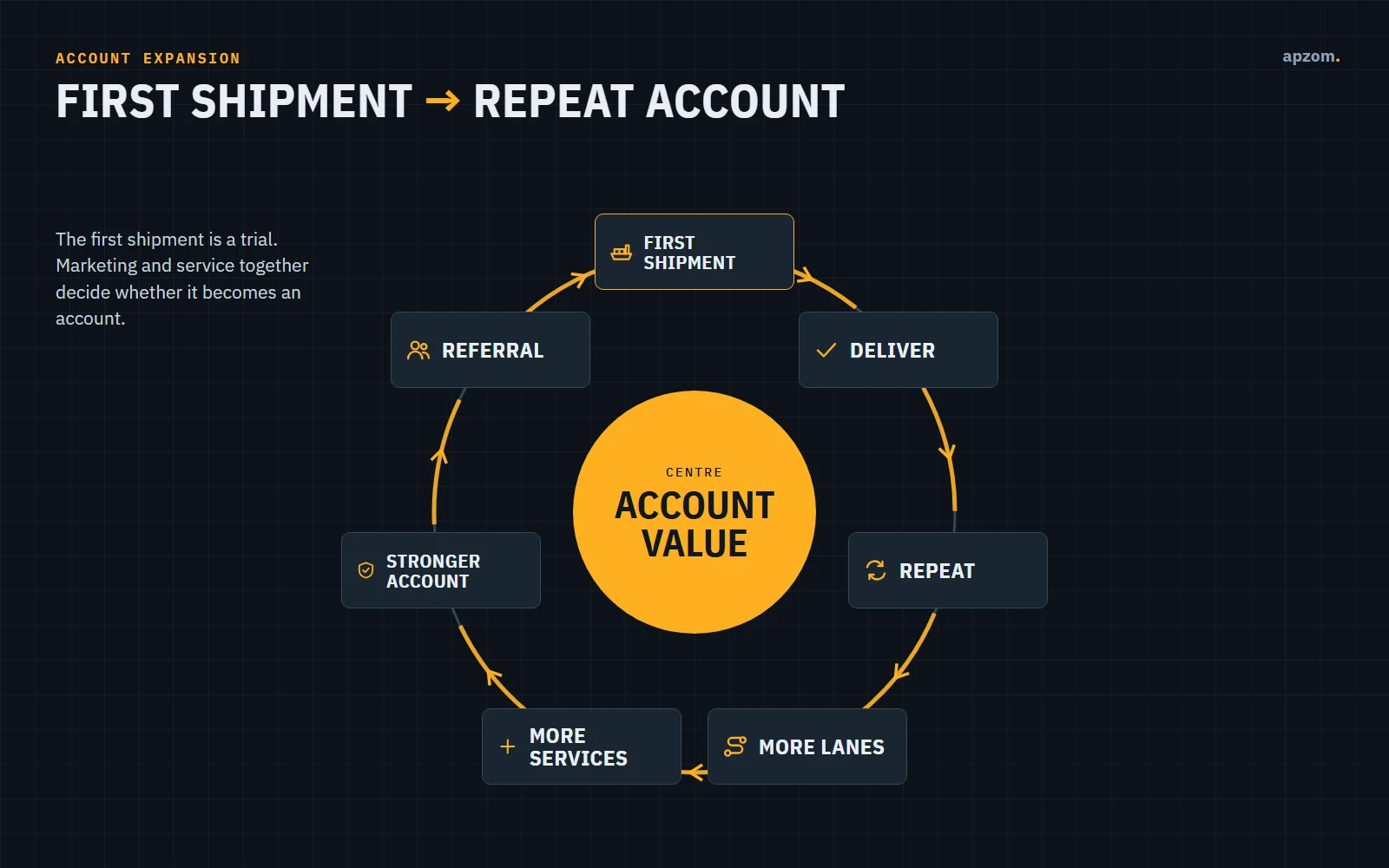
First shipment → deliver the experience → repeat shipment → more lanes and services → stronger account → referral
Marketing has a real role after the sale:
- Onboarding content: how bookings, documents and updates work, so the first shipment goes smoothly.
- Service reviews: a simple quarterly summary of what moved and what was learned, prepared by the account owner.
- Expansion education: short guides on services the customer does not use yet, sent to the right contact at the right time.
- Customer updates: useful, relevant information about the lanes they actually ship on, not a generic newsletter.
- Approved case studies and referrals: asked for after a good result, with the customer’s permission.
The service itself is the most important marketing here. No email sequence saves an account after a badly handled delay. Clear, honest exception handling usually does more for retention than any campaign.
Panel 7: Revenue measurement
Impressions, clicks and form submissions are easy to report and easy to inflate. A logistics scorecard should follow the buyer further.
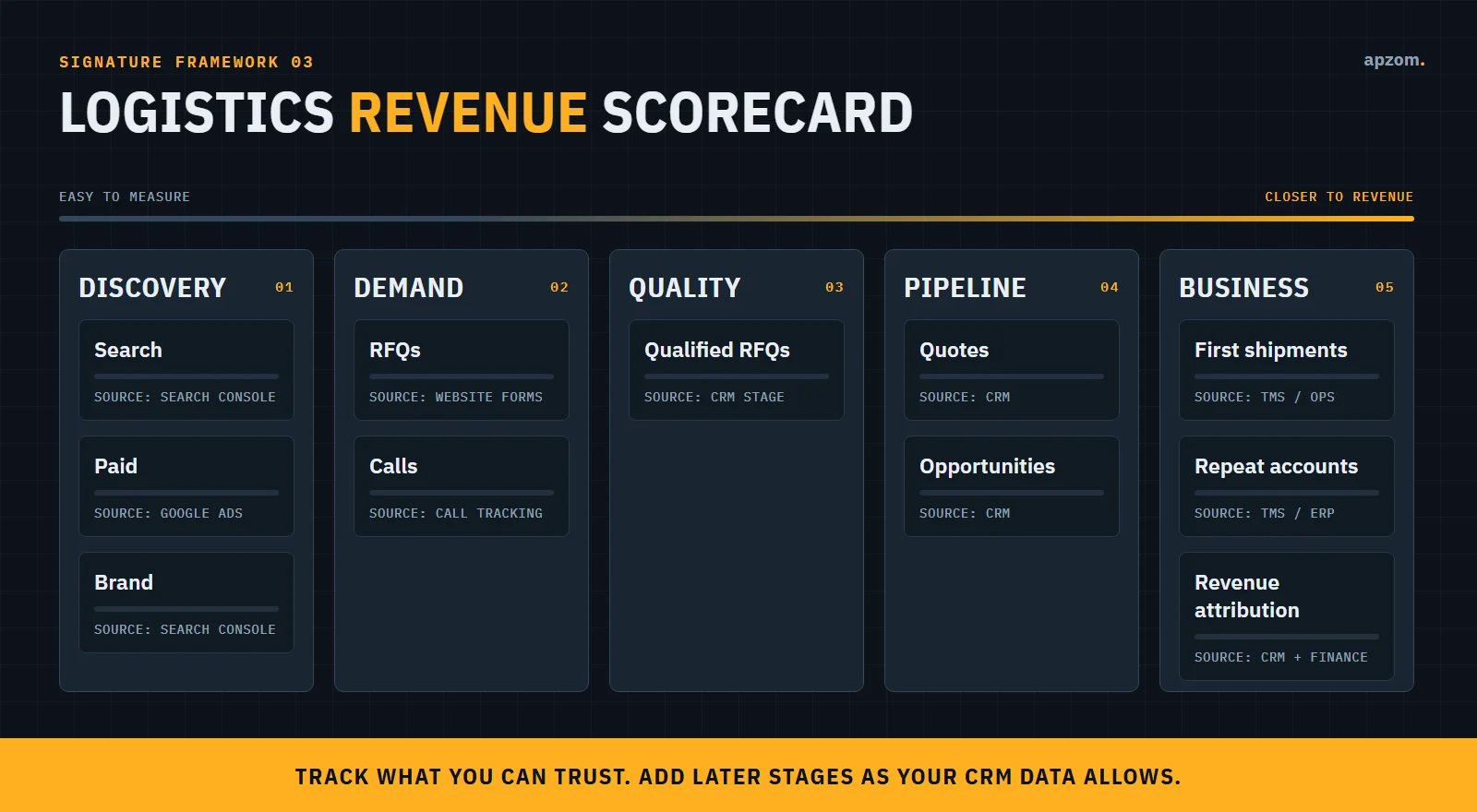
| Stage | What to track | Where the data usually lives |
|---|---|---|
| Discovery | Search visibility, paid visibility, brand searches, LinkedIn engagement where relevant | Search Console, ad platforms, LinkedIn |
| Demand | RFQs, calls, quote requests | Website forms, call tracking, CRM |
| Qualification | Qualified RFQs, service fit, lane fit | CRM stages and disqualification reasons |
| Pipeline | Quotes, proposals, opportunities | CRM |
| Operations and customer | First shipments, repeat shipments | TMS, operations or ERP system |
| Business | Pipeline value, won revenue, account value, acquisition cost, gross margin contribution | CRM plus finance |
Not every company will have every metric on day one, and that is fine. Start with what you can trust, then add later stages as your CRM data improves. A scorecard with four honest numbers is more useful than one with twenty guesses.
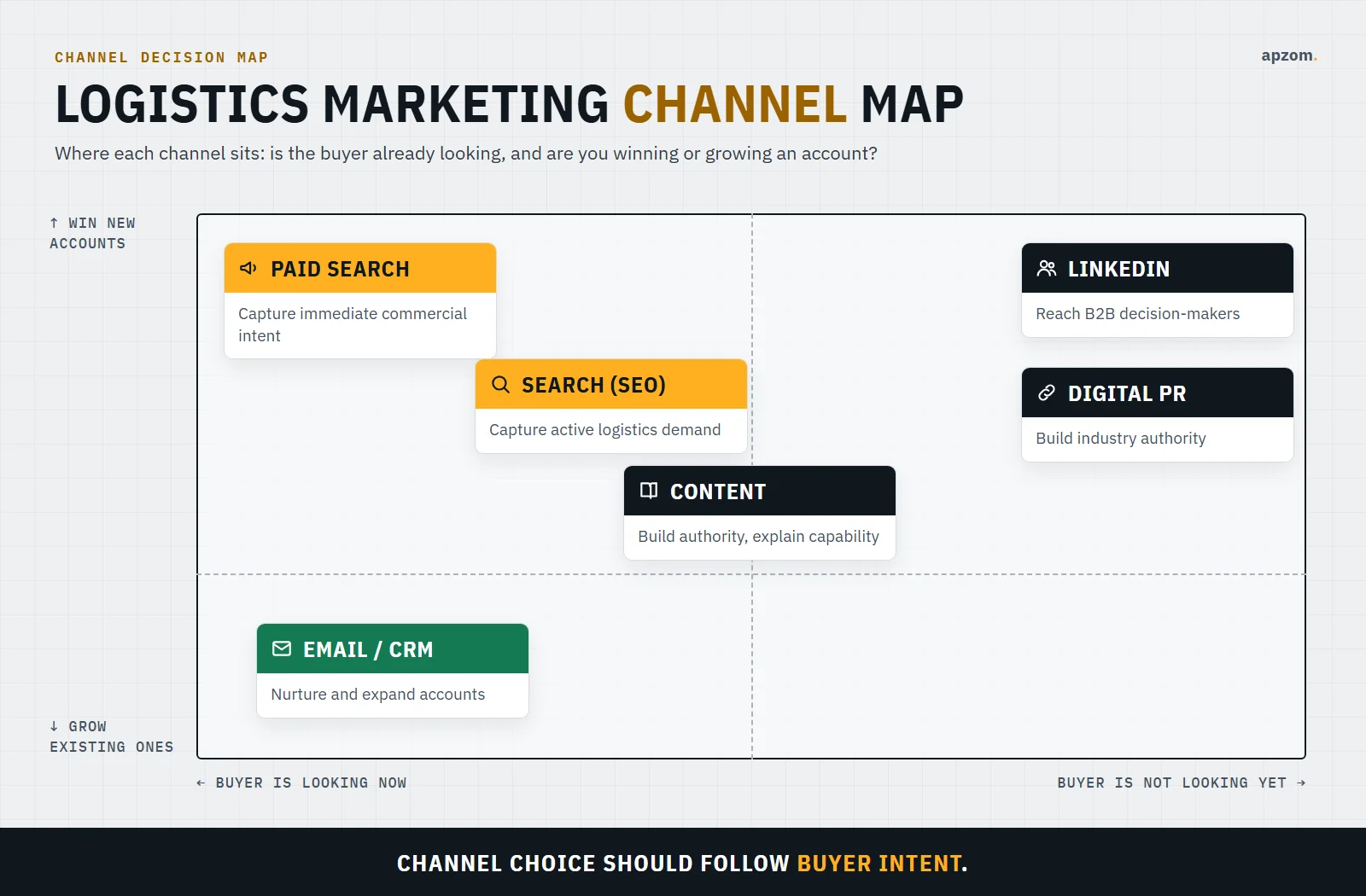
How the channels fit together
Once the control tower is clear, channel choice gets much easier. Each channel does a specific job. Choose the ones that match where your buyers actually are and how your service is sold.
SEO for logistics: service first
Search engine optimisation for a logistics company should follow the shape of real demand, not a generic technical checklist. Build page families around what you genuinely offer:
- Service pages: ocean freight, air freight, road freight, warehousing, fulfilment, customs support, cold chain. Only services you actually provide.
- Industry pages: only where you have real experience and something specific to say.
- Location pages: only genuine offices, warehouses or service points.
- Lane or corridor pages: only when the lane is meaningful, operationally supported and useful to explain.
- Resource content: guides that help buyers make decisions.
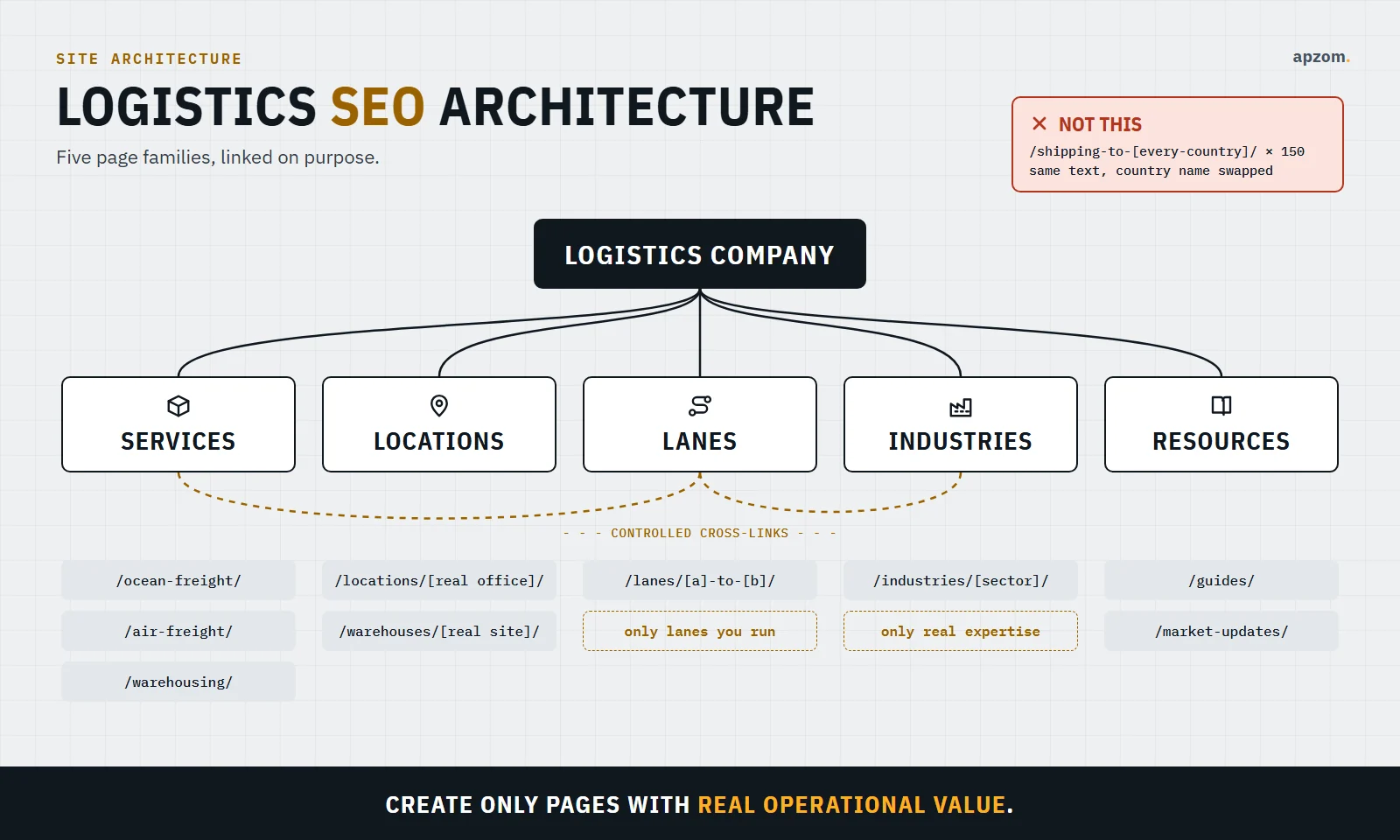
Technical health still matters: fast pages, clean internal links, one clear page per intent, accurate titles, indexable content. But the architecture above is what lets a logistics site match compound searches such as service plus lane plus cargo. Apzom’s SEO services are built around that kind of structure.
Lane SEO: a big opportunity with a big spam risk
Lane pages can work very well, because people really do search by origin and destination. They are also the easiest pages to abuse.
Google’s spam policies describe doorway abuse as pages created to rank for specific, similar searches. One example they give is “having multiple domain names or pages targeted at specific regions or cities that funnel users to one page”. Their scaled content abuse policy covers pages generated mainly to manipulate rankings “no matter how it’s created”. A site with 150 “shipping to [country]” pages with the same text and a swapped country name is exactly what those policies describe.
A useful lane page contains things that are actually different for that lane:
- Services and modes genuinely available on it.
- Origin and destination context, including the ports, airports or border crossings you typically use.
- Transit considerations described honestly, as ranges with conditions rather than promises.
- A documentation overview, with a clear note that requirements change and must be confirmed per shipment.
- How the process works, including handover points and partners.
- Limitations: cargo you do not handle on that lane, seasonal issues, known risks.
- A route to a real person who knows the lane.
Never publish guaranteed transit times, fixed prices or definitive customs advice on a lane page.
International SEO and multilingual content
Many logistics companies work across borders, but that does not mean they need 50 country sites. International architecture should match real operations: where you have offices, partners, sales staff and customers.
Google’s guidance on multi-regional and multilingual sites recommends separate URLs for each language version instead of relying on cookies or browser settings. It also recommends against automatically redirecting users to another language version. The common choices are country domains, subdomains or subfolders, with hreflang used to connect language and regional versions where they genuinely exist.
When you do localise, translate properly rather than machine-translating every freight page. Local service terms, port and city names, and the way people search all differ between markets. A page that reads like a rough translation weakens trust exactly where you are trying to build it.
Local SEO and Google Business Profile
For genuine offices, warehouses and customer-facing locations, local search matters. Keep Google Business Profile information accurate: name, address, hours, services, photos, reviews, website and contact details.
Google’s eligibility rules are strict. A business must make in-person contact with customers during its stated hours to qualify. A rented address you do not operate from, a so-called virtual office, is not eligible. Businesses that serve customers at their premises need permanent signage at the address. An unstaffed yard or a storage site customers never visit does not automatically qualify. Create profiles only for locations that genuinely meet the rules, never just for SEO, and never stuff keywords into the business name. Apzom’s local SEO services follow these guidelines.
Content: the logistics content pyramid
Generic “top logistics trends” posts rarely win freight. Content works when it helps a buyer make a real decision.
- Top, high commercial intent: service, lane, location and RFQ pages. These are where enquiries happen.
- Middle, decision content: industry pages, mode comparisons (air or ocean for this kind of cargo), capability explanations and process pages.
- Base, authority content: market insights, research, practical guides and original data.
The levels support each other. Authority content earns links and citations that strengthen the whole site. Decision content moves readers towards the right service page. Commercial pages convert. A pyramid with only a top falls over. A pyramid with only a base never sells anything.
Useful content clusters for logistics include service education, lane and trade information where you have real expertise, mode selection, industry logistics challenges, warehousing and fulfilment, RFQ preparation for buyers, and current market updates on ports, capacity or regulation, using primary sources.
Two cautions. First, do not let content turn into customs, sanctions, duties or dangerous goods advice without qualified review and current official sources. Explain concepts, link the reader to their adviser, and state that rules change. Second, when you explain trade terms, cite the original. Incoterms 2020, published by the International Chamber of Commerce, is still the current edition, and pages claiming a newer version come from third parties.
Original data and digital PR
Logistics companies often sit on data that journalists, analysts and buyers would find genuinely interesting: lane trends, booking patterns, seasonal peaks, warehouse demand or customer survey results. Published carefully, with permission, anonymised and verified, that data can earn links, citations and mentions in AI answers that no amount of ordinary blogging will.
Ethical ways to earn authority include data reports, trade-lane analysis, expert commentary for industry publications, conference talks, trade association involvement and replies to journalist requests. Avoid private blog networks, paid link farms, mass guest posting, irrelevant directories and pay-to-win “awards”. Never publish first-party research you cannot back up.
Google Ads: capture active freight demand
Paid search is often the fastest way to reach shippers who are ready to ask for a price. The difference between profit and waste is usually in the details:
- Intent: bid on service, mode, lane and industry searches that match your market fit. Separate them into their own campaigns or ad groups, so budgets and messages stay specific.
- Negative keywords: logistics terms attract a lot of irrelevant searches: jobs and salaries, courses, parcel tracking, household moving, personal shipments. Review search terms every week at the start.
- Geography: target the places where buyers sit, which may differ from where cargo moves.
- Match types and automation: broad matching and Google’s AI Max for Search campaigns can widen reach, so they need strong negatives and good conversion data. Without them, automation finds cheap, poor-quality leads.
- Landing pages: send each ad group to the most specific relevant page, not the homepage.
- Measurement: optimise towards qualified RFQs and opportunities as soon as you have enough data, using the CRM connection described above.
We will not quote typical cost per click or cost per lead figures here. They vary too much by country, service and season to be useful, and any agency quoting one without seeing your market is guessing. Apzom’s Google Ads management starts from your own account data.
Microsoft Ads
For some B2B audiences, Microsoft Advertising adds extra search coverage. It also offers LinkedIn profile targeting by company, industry and job function on search campaigns. That targeting adjusts bids rather than restricting who sees the ads. Test it when your Google campaigns are already working and the extra volume in your markets justifies the effort, not to make a plan look complete.
LinkedIn and account-based marketing
LinkedIn is where many supply chain, logistics, procurement, operations, ecommerce and import or export managers spend professional time. Useful features for logistics include Lead Gen Forms, which come pre-filled with members’ profile details, and Matched Audiences, which can target lists of specific companies.
That makes LinkedIn a natural fit for account-based marketing when account values justify it:
Target accounts → relevant industry content → LinkedIn, search and email → sales outreach → opportunity
Build target account lists from your own research: manufacturers, retailers, ecommerce brands, importers and exporters that fit your market fit grid. Do not buy scraped databases or send mass cold messages. They damage your reputation and can break privacy and direct-marketing laws.
LinkedIn is not automatically profitable. Clicks can be expensive and sales cycles long. Test it against account value, not cost per lead.
Meta and other social channels
Meta is rarely a core channel for enterprise freight or 3PL sales. It can be useful for local courier and small-business logistics services, recruitment and employer branding (drivers and warehouse staff), awareness in specific regions, and retargeting where policies and consent allow. Decide based on who actually buys your service.
Email works well in logistics for nurturing B2B prospects, onboarding new customers, account expansion, service updates and sharing genuinely useful insight. Rules differ by country. The US CAN-SPAM Act makes no exception for business-to-business email. In the UK, the ICO’s guidance allows marketing emails to corporate subscribers without prior consent, provided you identify yourself and offer an easy opt-out, but sole traders are treated as individuals. Check current local rules before any campaign, never buy email lists, and never scrape procurement contacts. Apzom’s email marketing work follows consent-based practice.
Video
Video can carry a lot of trust for logistics: a warehouse walkthrough, how a shipment is handled, how tracking looks to a customer, a short expert explanation of a process. Keep it practical and real. Before publishing, check that no customer cargo details, security procedures, access points or confidential operations are visible, and get approval from customers and staff who appear.
Your website: capability before creativity
A logistics website has to answer seven questions quickly:
- What services do you provide?
- Where do you operate?
- Which modes do you support?
- Which industries do you understand?
- Can you handle my shipment?
- Why should I trust you?
- How do I request a quote?
Do not hide those answers behind slow animations, vague brand slogans or a cinematic video that autoplays on mobile. Clarity wins.
A typical structure for a logistics site includes home, services, industries, locations, trade lanes where justified, warehouses or facilities, technology and visibility, resources, about, contact and a request-a-quote page. Use only the sections that match your real business. For larger sites, let people navigate by service, mode, industry or region, with simple labels and a menu people can actually scan. Apzom’s website development and conversion rate optimisation services focus on exactly this: clear structure, fast pages and forms that sales can use.
AEO, GEO and AI search for logistics
These terms sound new, but the work behind them is familiar.
AEO (answer engine optimisation) means making useful logistics answers clear enough that search and answer systems can understand and reuse them easily. For a question like “what information do I need for a freight quote?”, write a direct answer first, then the explanation, then an example or caveat. Do this where it helps readers, not on every paragraph.
GEO (generative engine optimisation) means making sure AI search tools can find accurate, consistent and citable information about your company and your subject. Nobody can promise placement or citations in ChatGPT, Gemini or Google’s AI Overviews, and you should be wary of anyone who does.
Google’s own guidance is clear. Its AI features are rooted in its core Search ranking and quality systems, so normal SEO best practices still apply. There are no special AI files, extra markup or hidden tags needed to appear. Search Console now reports how often a site appears in Google’s generative AI features. Google announced these reports in June 2026, and they reached all sites by 31 August 2026. They show impressions, not enquiries, so treat them as visibility data, not results.
What helps logistics companies in practice:
- Clear service, location and industry information that matches across your website, Google Business Profile, LinkedIn and directories.
- Accurate operational details, written plainly.
- First-party content and original data that other sources do not have.
- Clear definitions and well-structured passages that answer real buyer questions.
- References to primary sources for any regulatory or factual claim.
The logistics entity map
It helps to think of your website as a set of connected facts:
Logistics company → service → mode → location → lane → industry → cargo need → facility or network → buyer → RFQ → quote → shipment
When those relationships are clear in your pages, navigation and internal links, people find what they need faster, and search and AI systems understand what you do. Write naturally. Do not stuff entities into every sentence.
Structured data for logistics websites
Schema.org has no logistics-specific business type: there is no “FreightForwarder” or “LogisticsBusiness”. A logistics company can usually describe itself accurately with Organization, LocalBusiness for genuine customer-facing locations, Service for the services it offers, and BreadcrumbList and Article where they fit. Shipping-related types in Schema.org, such as shipping details for product offers, are for retailers describing delivery terms, not for describing a logistics provider. Structured data helps machines read what is already true on the page. It does not guarantee rankings, and it should never invent locations, reviews, ratings or service areas.
What a logistics marketing agency should actually do
A capable agency should understand your services, lanes, buyer roles, freight modes, how you qualify customers, your sales cycle, your CRM and the value of a good account before it proposes any marketing.
The first question should not be “how many blog posts do you want?” It should be “which logistics business do you want more of?”
Questions to ask an agency
- Do you understand our services, and can you explain them back to us correctly?
- How will you research our lanes and the demand on them?
- How will you separate qualified RFQs from poor leads?
- How will marketing connect to our CRM and our sales team?
- What will you measure after a form is submitted?
- How will you create service, location and lane pages without doorway content?
- How will you check technical logistics claims before they are published?
- Who owns the ad accounts, the analytics and the website?
- Who owns our data if we stop working together?
- How do you build links?
- How do you use AI, and who reviews what it produces?
- How will you avoid publishing fabricated logistics content?
Red flags
- Guaranteed rankings or a guaranteed number of freight leads.
- Generic packages that look the same for a forwarder, a dentist and a software company.
- Hundreds of automated lane or city pages.
- Invented transit times, certifications, coverage or customer logos.
- Bought links or link “packages”.
- AI-written logistics content published without expert review.
- Reports that show only traffic and clicks.
- No interest in your CRM, and no conversations with your sales team.
- Treating every form submission as a good lead.
- Fake reviews or testimonials.
- Ad accounts set up in the agency’s name, so you cannot see or keep them.
DIY, specialist, general agency or in-house?
There is no single right answer. Here is a fair comparison:
| Model | Best for | Strength | Limitation |
|---|---|---|---|
| In-house team | A large, ongoing programme | Deep operational knowledge and fast access to sales | Hiring cost, and hard to cover every skill |
| Logistics-specialist agency | Complex, industry-specific positioning | Already knows the terminology and buyers | May cost more, and may work for your competitors |
| General growth agency | Cross-channel execution with strong measurement | Broad skills across SEO, ads, web and analytics | Must learn logistics properly before advising |
| Freelancer | A narrow, well-defined task | Flexible and often cost-effective | Limited capacity and continuity |
| Doing it yourself | Very early stage or small budgets | Full control and close to the customer | Time-consuming, and easy to measure the wrong things |
Many logistics companies end up with a mix: an internal owner who knows the business, plus outside specialists for SEO, paid media, web development or analytics.
How Apzom can help
Apzom Digital is a digital marketing agency based in Ahmedabad, India, founded in 2025. We are a general growth agency, not a logistics specialist, and we are not a logistics company. We do not claim freight credentials, and we will not invent logistics results.
What we can show is directly relevant work. We designed and built the website for ARKS Infinity Logistics, a freight forwarder based in Ahmedabad. The ARKS Infinity Logistics case study explains how we structured the site around three connected page families, services, trade lanes and commodities, so that compound searches such as service plus destination have a real page to land on. It also covers a quote form that asks for origin, destination and the service required. That was a website, architecture and SEO-foundation project. We do not publish marketing results from it, and we will not imply any.
For logistics companies, we work across SEO, local SEO, Google Ads, Meta Ads, content marketing, social media, website development, conversion rate optimisation, email marketing, AEO and GEO, with analytics and lead-quality measurement running through all of it. Our SEO methodology explains how we approach search work.
Request a Logistics Digital Growth Audit
A Logistics Digital Growth Audit looks at how your business is found, judged and contacted today, and what happens to enquiries afterwards. It typically covers:
- Service positioning and market fit
- SEO, technical SEO and lane or location strategy
- Google Ads, LinkedIn and content
- The website and the RFQ journey
- CRM connection, attribution and lead quality
- AEO and GEO readiness
- Competitor visibility in your key services and markets
You get a clear list of what to fix first, and why. The audit is free, with no obligation and no guaranteed rankings. Request your Logistics Digital Growth Audit, or see all our services.
Frequently asked questions
What does a digital marketing agency for logistics companies do?
It helps a logistics business attract the right shippers and turn them into accounts. In practice that means clarifying which services, lanes and industries to target, building pages and campaigns that match how buyers search, making it easy to request a quote, and tracking which enquiries become quotes, shipments and repeat business.
Is SEO effective for freight forwarders?
Yes, when it follows real demand. Service, mode and lane pages with genuine operational detail can match the specific searches shippers make. SEO works poorly when it means mass-produced lane pages or generic blog posts. It also takes time, so it usually works best alongside referrals, paid search and direct sales.
How can freight forwarders get more qualified RFQs?
Be specific about the lanes and cargo you handle, show real proof of capability, use a short quote form that collects origin, destination, mode and cargo basics, and reply quickly with useful questions. Then track which RFQs become quotes and shipments, and put more effort into the sources that produce them.
Is Google Ads useful for logistics companies?
It can be, especially for services people search for when they need a provider now, such as freight forwarding, warehousing, customs support or a specific lane. It needs careful negative keywords, specific landing pages and measurement that goes beyond form submissions, ideally by sending qualified-lead and won-account data back from your CRM.
Does LinkedIn work for logistics marketing?
It often works for brand credibility, thought leadership and account-based campaigns aimed at supply chain, procurement and operations decision-makers. It is not automatically profitable. Judge it on account value and pipeline, not on cost per lead, and test before committing a large budget.
What pages should a logistics website have?
At minimum: clear service pages, a page explaining where you operate, an about page with real company details, a contact page and a quote request page. Add industry pages, facility pages, lane pages and resources only where you have genuine expertise and something specific to say.
What is lane SEO?
Lane SEO means creating pages for specific trade routes, such as one origin country to one destination, so shippers searching for that route can find you. It works when each page explains real services, routing, documentation and limits for that lane. It becomes doorway spam when hundreds of near-identical pages are generated with only the place names changed.
How should logistics companies measure marketing ROI?
Follow enquiries beyond the form: qualified RFQs, quotes, opportunities, first shipments, repeat accounts and, where your data allows, revenue and gross margin. Compare that with what you spent on each channel. Start with the stages you can track reliably and add more as your CRM improves.
What are AEO and GEO for logistics?
They are ways of making your logistics information easy for search engines and AI tools to understand and cite: clear answers to buyer questions, consistent company and service details, original data and primary sources. Google says normal SEO best practices remain the foundation for its AI features, and no one can guarantee AI citations.
Sources
All sources were checked on 2 October 2026.
- Google Search Central: spam policies for Google web search (doorway abuse, scaled content abuse), last updated 28 August 2026.
- Google Search Central: managing multi-regional and multilingual sites, last updated 10 December 2025.
- Google Search Central: AI features and your website; Google’s guide to optimising for generative AI features on Google Search, last updated 10 July 2026.
- Google Search Central blog: Search generative AI performance reports in Search Console, 3 June 2026.
- Google Business Profile Help: guidelines for representing your business on Google, and business eligibility rules.
- Google Ads Help: about enhanced conversions for leads; setting up enhanced conversions for leads with Google Ads Data Manager; Salesforce and HubSpot connections; best practices for offline conversions; AI Max for Search campaigns.
- Microsoft Advertising Help: LinkedIn profile targeting, updated July 2026.
- LinkedIn Marketing Solutions: Lead Gen Forms; Matched Audiences company and contact targeting; Conversions API.
- US Federal Maritime Commission: licensing and registration of ocean transportation intermediaries.
- US Federal Motor Carrier Safety Administration: what operating authority (MC number) is and who needs it.
- US Customs and Border Protection: CTPAT programme overview.
- World Customs Organization: SAFE Framework of Standards, 2021 edition (Authorised Economic Operator).
- Press Information Bureau, Government of India: Authorised Economic Operator programme release, 29 November 2024.
- Central Board of Indirect Taxes and Customs: Customs Brokers Licensing Regulations, 2018 (as amended).
- IATA: Cargo Agency Program.
- ISO 14083:2023, Greenhouse gases: quantification and reporting of greenhouse gas emissions arising from transport chain operations.
- Smart Freight Centre: GLEC Framework version 3.2.
- EUR-Lex: Directive (EU) 2024/825 on empowering consumers for the green transition.
- Press Information Bureau, Government of India: CCPA guidelines for prevention and regulation of greenwashing or misleading environmental claims, 15 October 2024.
- International Chamber of Commerce: Incoterms 2020.
- Schema.org: full type hierarchy.
- US Federal Trade Commission: CAN-SPAM Act compliance guide for business.
- UK Information Commissioner’s Office: guide to PECR, electronic mail marketing.