
The short answer: Good digital marketing for a salon or spa keeps the appointment book full with clients who come back. That means being easy to find and book on Google Maps and Instagram, showing real work from your own team, filling quiet days on purpose, and getting clients to rebook before they leave. A good agency will connect your booking system, Business Profile, social channels and reminders, and measure results in bookings, rebooking rate and revenue per client, not likes. For aesthetics and med spa treatments, it will also know the extra advertising rules that apply.
This guide is for hair salons, barbers, nail, lash and brow studios, day spas, med spas and aesthetic clinics, and mobile or home-based stylists, in any country. It covers how clients choose a salon, which channels suit which kind of business, how to make booking easy, how to fill empty chairs, how to keep clients coming back, the rules on reviews, before-and-after photos and treatment advertising, and what to measure.
Beauty is a large industry made up mostly of small businesses. The US Bureau of Labor Statistics counts about 670,800 jobs for barbers, hairstylists and cosmetologists in 2025, with 7% growth projected over the following ten years. In the UK, the National Hair & Beauty Federation, an industry body, reports around 50,400 hair, barbering and beauty businesses, about 81% of them employing fewer than five people. Most salons compete locally, so local marketing matters most.
How clients choose a salon or spa
Beauty is personal and repeat. A new client is taking a risk on your skills; a regular is a relationship. The first framework we use with salon clients is the rebooking loop: five steps that turn a first visit into a loyal client.
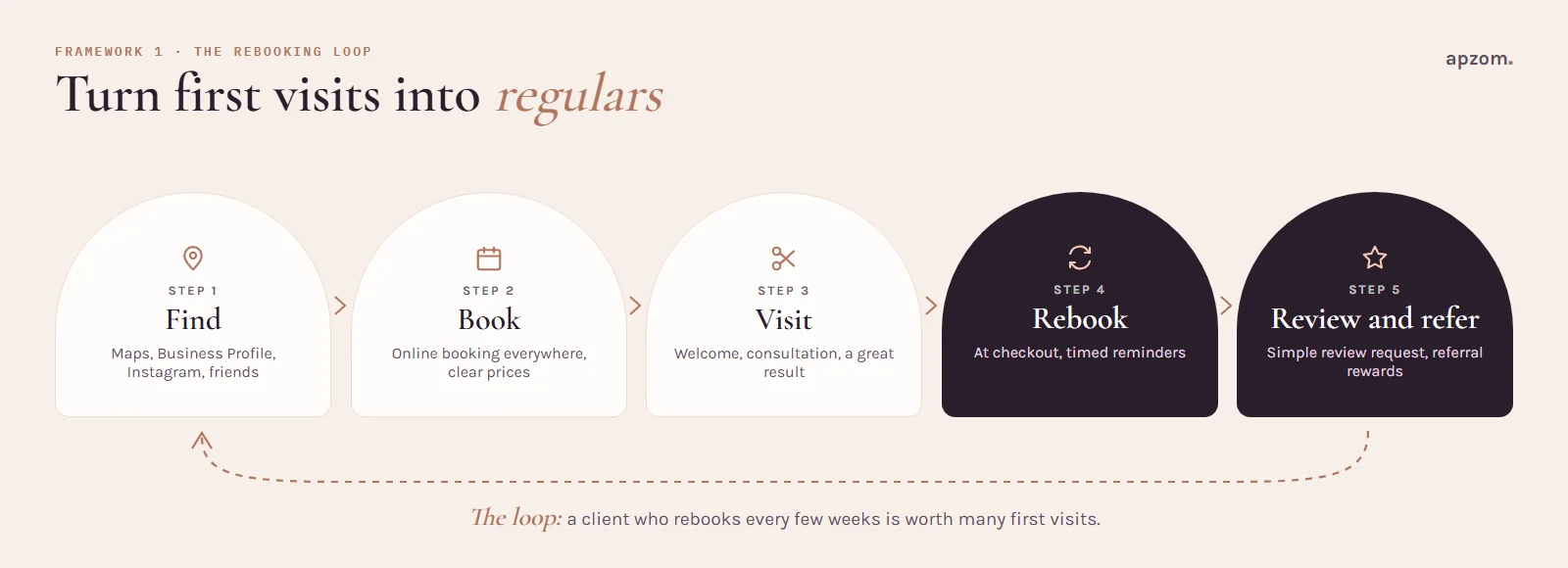
| Step | What the client is doing | What helps |
|---|---|---|
| 1. Find | Looking for someone nearby who does the look or treatment they want | Google Maps, a complete Business Profile, Instagram, recommendations |
| 2. Book | Checking prices, availability and how to book | Online booking from Google, Instagram and your website; a clear service menu with prices |
| 3. Visit | Deciding whether you are worth coming back to | Welcome, consultation, a great result and a pleasant space |
| 4. Rebook | Choosing whether to book the next appointment now | Rebooking at checkout, reminders timed to when the service needs redoing |
| 5. Review and refer | Telling others | A simple review request, referral rewards, shareable results |
Most salons focus on step 1. The ones that grow steadily get very good at steps 4 and 5, because a client who rebooks every six weeks is worth many times more than one who visits once.
Which channels suit which kind of beauty business
The second framework: choose channels by business type. A barber shop and a med spa sell very different things to very different people.
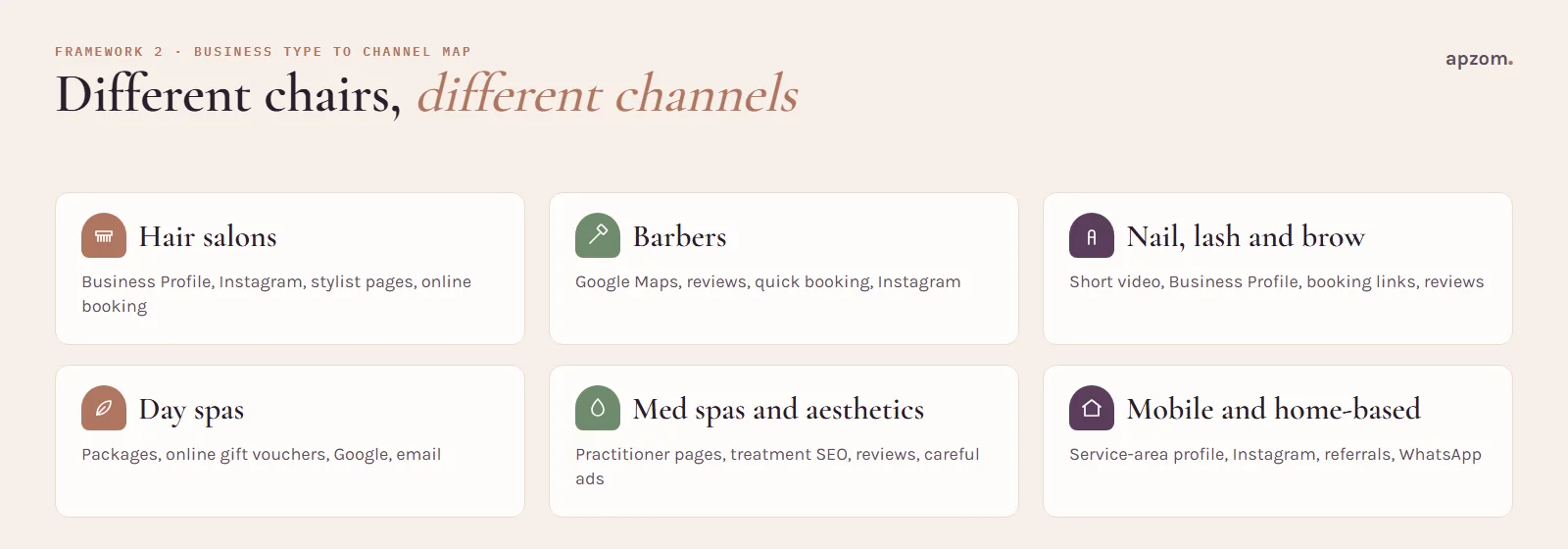
| Business type | What clients care about | Channels to start with |
|---|---|---|
| Hair salons | Stylist skill, style match, price, location | Google Business Profile, Instagram, stylist pages, online booking |
| Barbers | Convenience, consistency, walk-ins or quick booking | Google Maps, reviews, simple booking, Instagram |
| Nail, lash and brow studios | Design, hygiene, price, availability | Instagram and TikTok-style video, Business Profile, booking links, reviews |
| Day spas | Atmosphere, packages, gift vouchers | Website with packages, gift vouchers online, Google, Instagram, email |
| Med spas and aesthetic clinics | Qualifications, safety, results, trust | Practitioner pages, SEO for treatments, reviews, careful ads within the rules |
| Mobile and home-based stylists | Trust, area covered, availability | Business Profile as a service-area business, Instagram, referrals, WhatsApp |
Make booking easy everywhere
Every extra step between “I want this” and “I’ve booked” loses clients. Make sure people can book from:
- Google: in your Business Profile, open Bookings to connect a supported booking provider. Google says connected providers show up on your profile within a week. You can also add your own booking link, though Google says performance data is not available for custom links. If your business category supports it, list your services and prices in the profile too.
- Instagram and Facebook: a booking button or link in your profile, and booking links in posts and stories.
- Your website: a clear service menu with prices or “from” prices, how long each service takes, and a booking button on every service page.
- WhatsApp or messages: many clients prefer to ask a quick question first. Reply quickly, and send a booking link.
Show your full price list. Clients who see prices up front are less likely to cancel or complain, and they arrive knowing what to expect.
Show your work: content that brings clients
Beauty is visual, so your own photos and videos are your best marketing.
- Real results from your team, photographed in good natural light, with the client’s permission.
- Stylist and therapist pages: who they are, what they specialise in and examples of their work. Many clients book a person, not a salon.
- Short videos: a transformation, a technique, a tour of the space. Keep them honest; heavy filters on results mislead clients and can break advertising rules.
- Treatment pages for higher-value services such as colour correction, extensions, facials, massage packages or aesthetic treatments, explaining what is involved, aftercare and prices.
Chairs empty on weekdays? A Salon and Spa Marketing Audit looks at how clients find and book you, your reviews, social channels, quiet times and rebooking, and shows what to fix first.
Fill empty chairs on purpose
The third framework is the empty-chair plan. Every unfilled appointment is income you never get back.
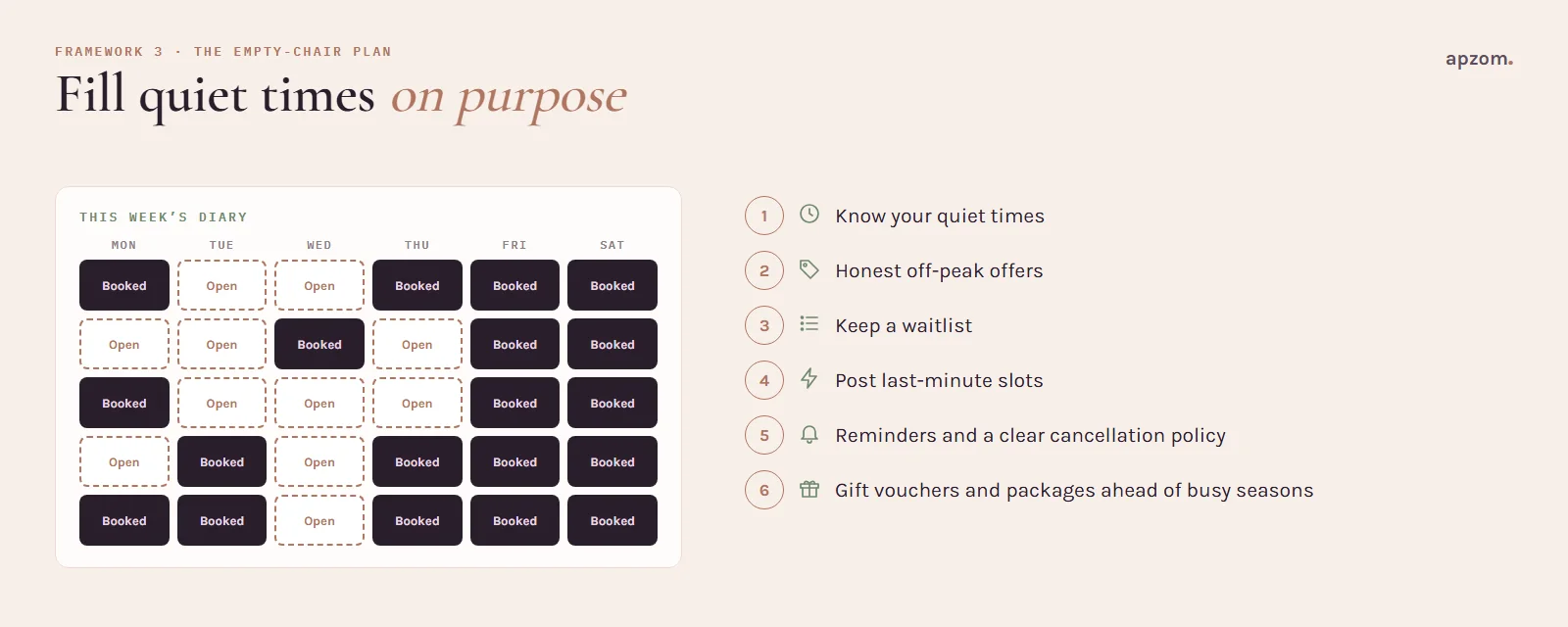
- Know your quiet times. Use your booking data to see which days and hours are slow.
- Make an off-peak offer for those times, such as a weekday treatment or a midweek package, with honest terms.
- Keep a waitlist and message it when a slot opens.
- Post last-minute availability on Instagram stories, WhatsApp or by text to clients who have opted in.
- Reduce no-shows with reminders and a clear cancellation policy. If you take deposits or charge cancellation fees, explain them before people book.
- Sell gift vouchers and packages online ahead of busy seasons, so quiet weeks still bring revenue.
Keep clients coming back
The fourth framework is the rebooking system.
- Rebook at checkout. Suggest the right time for the next appointment based on the service, and book it before the client leaves.
- Send reminders timed to when a service usually needs redoing, such as a colour refresh or a lash infill.
- Keep notes on each client’s preferences and formulas, so every visit feels personal.
- Reward loyalty and referrals in a simple, honest way.
- Follow up after first visits to ask how they found it and to invite a review.
Our email marketing service can help set up reminders and follow-ups that do not feel like spam.
Reviews and reputation
Clients read reviews before trying a new salon. A steady flow of genuine reviews on Google matters more than a few old ones.
The rules on asking for reviews are stricter than many salons realise:
- Google bans offering payment, discounts, free goods or services in exchange for reviews, and bans selectively asking only happy clients. Ask all your clients, in the same way.
- Yelp tells businesses not to ask anyone to review them on Yelp at all. Ask for Google reviews instead, and let Yelp reviews come naturally.
- In the US, the Federal Trade Commission’s rule on reviews, in force since 21 October 2024, bans incentives that depend on a review saying something positive. The FTC says general requests to all customers are fine.
- In the UK, fake reviews are banned under the Digital Markets, Competition and Consumers Act 2024, with the CMA enforcing it from April 2025.
Reply to reviews, including critical ones, calmly and briefly. If something went wrong, offer to put it right offline. See our online reputation management service and our guide to Google Business Profile optimization for more.
Rules to know: before-and-after photos, treatments and prices
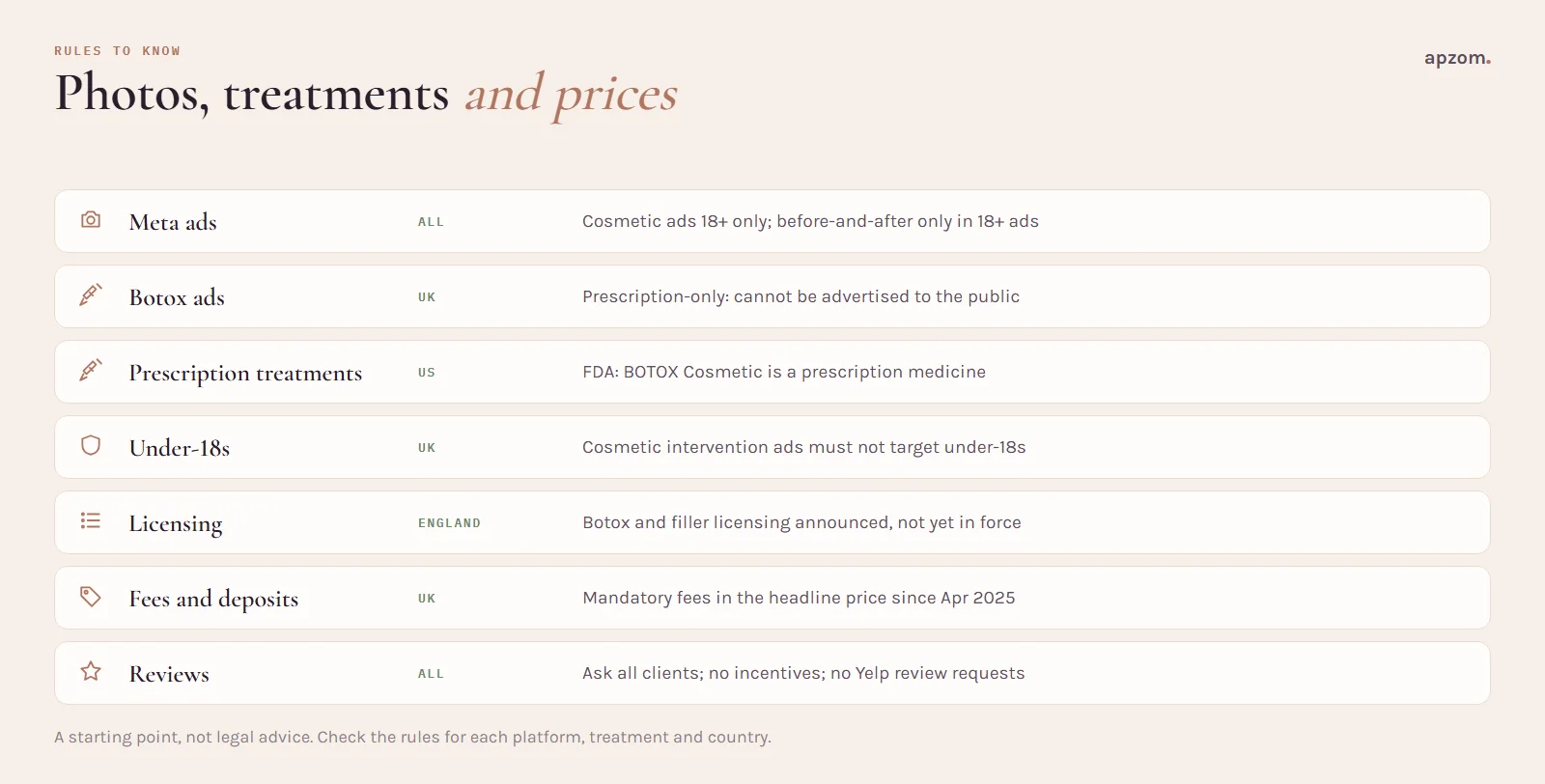
Beauty and aesthetics advertising is closely watched, especially for treatments with medical risks. This is a starting point, not legal advice.
| Area | What to know |
|---|---|
| Meta ads (all countries) | Meta says ads for cosmetic products, procedures or surgeries must be targeted to people aged 18 or over. Before-and-after images are only allowed within those 18+ ads, and ads must not contain statements of inferiority about physical appearance. |
| Botox and prescription treatments (UK) | The UK advertising regulator says Botox is a prescription-only medicine and cannot be advertised to the public. Clinics can advertise a consultation instead. |
| Prescription treatments (US) | The FDA describes BOTOX Cosmetic as a prescription medicine. Market injectables with care and check the rules in your state. |
| Under-18s (UK) | Since 25 May 2022, the UK advertising code says marketing for cosmetic interventions must not be directed at people under 18. |
| Licensing (England) | In August 2025 the government announced plans to license Botox and fillers through local councils and to limit the highest-risk procedures to qualified healthcare professionals. These rules are not yet in force; watch for updates. |
| Fees and deposits (UK) | Since 6 April 2025, mandatory fees such as a compulsory booking fee must be included in the headline price. Deposits are not banned, but explain them clearly before people book. |
| Influencers (India) | ASCI requires an upfront label such as “Ad”, “Sponsored” or “Collaboration” on paid or gifted posts. Health influencers who make treatment claims must state their qualifications. |
Whatever the treatment, use only real, unfiltered results from your own clients, with their written permission.
Paid ads that work for salons and spas
- Google Ads suit people searching for a specific service in your area, such as a treatment or a stylist type. Send each ad to the matching service page with prices and booking. See our guide to Google Ads for small businesses.
- Meta ads suit showing your work and offers to people nearby, especially for new clients and gift vouchers. Follow Meta’s health and wellness ad rules for any cosmetic treatment. See our guide to Facebook and Instagram ads for local businesses.
- Retargeting can remind people who looked at your services but did not book.
Judge ads by bookings and first-visit clients who rebook, not by clicks or likes.
How to measure what matters
Track these each month:
- New clients by source: Google, Instagram, referrals, walk-ins.
- Online booking rate: how many enquiries or profile visits become bookings.
- No-show and late-cancellation rate.
- Rebooking rate: how many clients book their next visit before leaving.
- Client retention: how many first-time clients return within a few months.
- Average spend per visit and revenue per client over a year.
- Chair or room utilisation: how full your diary is, by day and time.
How Apzom can help
Apzom Digital helps local businesses get found, booked and chosen again. For salons and spas, that means local SEO, social media marketing, Meta ads, Google Ads, website development with service menus and booking built in, email marketing for reminders and rebooking, and reputation management. We work with clients worldwide, remotely, from our base in Ahmedabad, India.
We have not published a salon or spa case study yet, so we will not show you one. Our case studies page shows the lead generation and search work we have done for other businesses. We will not promise a number of bookings. We will show you where your marketing loses clients and what to fix first. If you are comparing agencies, our guide on how to choose a digital marketing agency may help.
Request a Salon and Spa Marketing Audit. We review your Business Profile and booking set-up, website and service menu, Instagram and ads, reviews, no-shows, quiet times and rebooking, plus the advertising rules for any treatments you offer. You get a prioritised list of what to fix first.
No obligation and no guaranteed booking numbers. Prefer to talk first? Contact us or see all our services.
Frequently asked questions
What is the best way to market a salon?
Make it easy to find and book you on Google Maps and Instagram, show real work from your own team, keep a full price list online, and get clients to rebook before they leave and to leave a review afterwards. Then use ads to fill gaps.
How do salons get more clients?
By being visible where people search, making booking take seconds, filling quiet times with honest off-peak offers, and building a steady flow of genuine reviews. Referral rewards help too.
Is Instagram enough to market a salon?
Instagram is powerful for showing your work, but many new clients find salons through Google Maps and reviews. A complete Business Profile, online booking and a simple website with prices make Instagram work harder.
Can salons use before-and-after photos in ads?
Often, with care. Use only real, unfiltered results from your own clients, with their permission. On Meta, before-and-after images for cosmetic products and procedures are only allowed in ads targeted at people aged 18 or over, and some countries, such as the UK, ban advertising prescription treatments like Botox to the public.
How can a salon reduce no-shows?
Send reminders, make rescheduling easy and have a clear cancellation policy. If you take deposits or charge late-cancellation fees, explain them clearly before people book.
Should a salon show prices online?
Yes, at least “from” prices. Clients want to know what they will pay, and clear prices reduce cancellations and awkward conversations at checkout.
How do I get more Google reviews for my salon?
Ask all your clients, at the right moment, with a simple link. Google bans asking only happy clients and bans offering discounts or gifts for reviews. Never write or buy reviews, and do not ask for Yelp reviews, which Yelp forbids.
Can Apzom work with salons and spas outside India?
Yes. We work with clients worldwide, remotely, from our base in Ahmedabad, India, and plan marketing around your market, booking system and the rules that apply where you operate.