
The short answer: to choose a digital marketing agency, start with a clear brief, shortlist agencies that have done similar work, and judge them on proof, people, process and transparency rather than promises. Make sure you will own every account and asset from day one, compare proposals on the same terms, and read the contract for notice periods, ownership and exit. An agency that guarantees rankings, hides its methods or wants to own your ad accounts is not the right one, however good the pitch.
This guide is for business owners, founders and marketing managers who are hiring an agency for the first time or replacing one that did not work out. It covers the types of agency, how they charge, the questions worth asking, the red flags, how to compare proposals fairly and what to check in the contract. We are an agency ourselves, so we have tried to write the guide we would want a client to read before talking to anyone, including us.
Start with the job, not the agency
Most bad agency relationships start with a vague brief. “We need more leads” or “we want to rank on Google” can mean almost anything, and every agency will answer it with whatever it sells. Before you speak to anyone, write down five lines. We call this the five-line brief.
- The goal. What should change in the business, in plain words? More enquiries for one service, more online sales, a new market, a launch.
- The customer. Who buys from you, and how do they usually find you today?
- The offer. What are you selling, and what makes someone choose you over the alternatives?
- The budget and time frame. A realistic monthly or project budget, including any ad spend, and when you need results.
- How you will judge success. Enquiries, sales, booked calls or another measure you can actually track.
The five-line brief does two things. It lets you compare agencies on the same problem, and it shows you quickly which agencies listen. An agency that ignores your brief and pitches its standard package is telling you how the relationship will go.
Which kind of agency do you need?
“Digital marketing agency” covers businesses that work very differently. Picking the right type matters as much as picking the right firm.
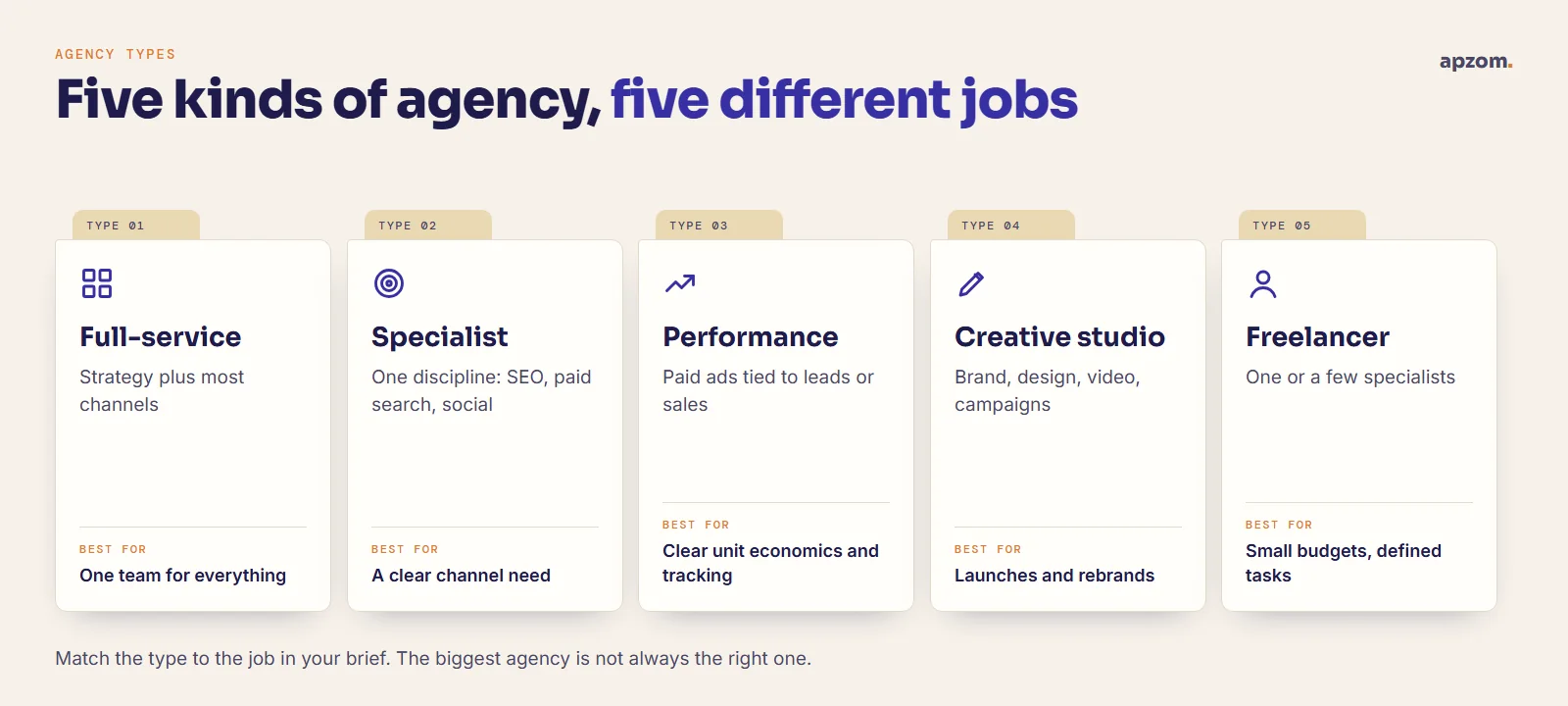
| Type | What they do | Best for | Watch out for |
|---|---|---|---|
| Full-service agency | Strategy plus most channels: SEO, ads, social, content, website | Businesses that want one team to plan and run everything | Strong in some channels, average in others |
| Specialist agency | One discipline, such as SEO, paid search or social | A clear channel need, or a business with its own marketing lead | Will recommend its own channel for every problem |
| Performance agency | Paid advertising focused on measurable sales or leads | Businesses with clear unit economics and tracking | Chasing cheap conversions that are not good customers |
| Creative or branding studio | Brand, design, video, campaigns | Launches, rebrands, content-led brands | Strong ideas without a plan to measure them |
| Freelancer or small collective | One or a few specialists | Small budgets and well-defined tasks | Capacity, holidays and continuity |
There is no single best type. A small local business with one main service might be better served by a specialist in local search than by a large full-service agency. A growing e-commerce brand might need a performance specialist plus a creative partner.
How agencies charge
You will see five main pricing models. None is automatically better; each suits a different situation.
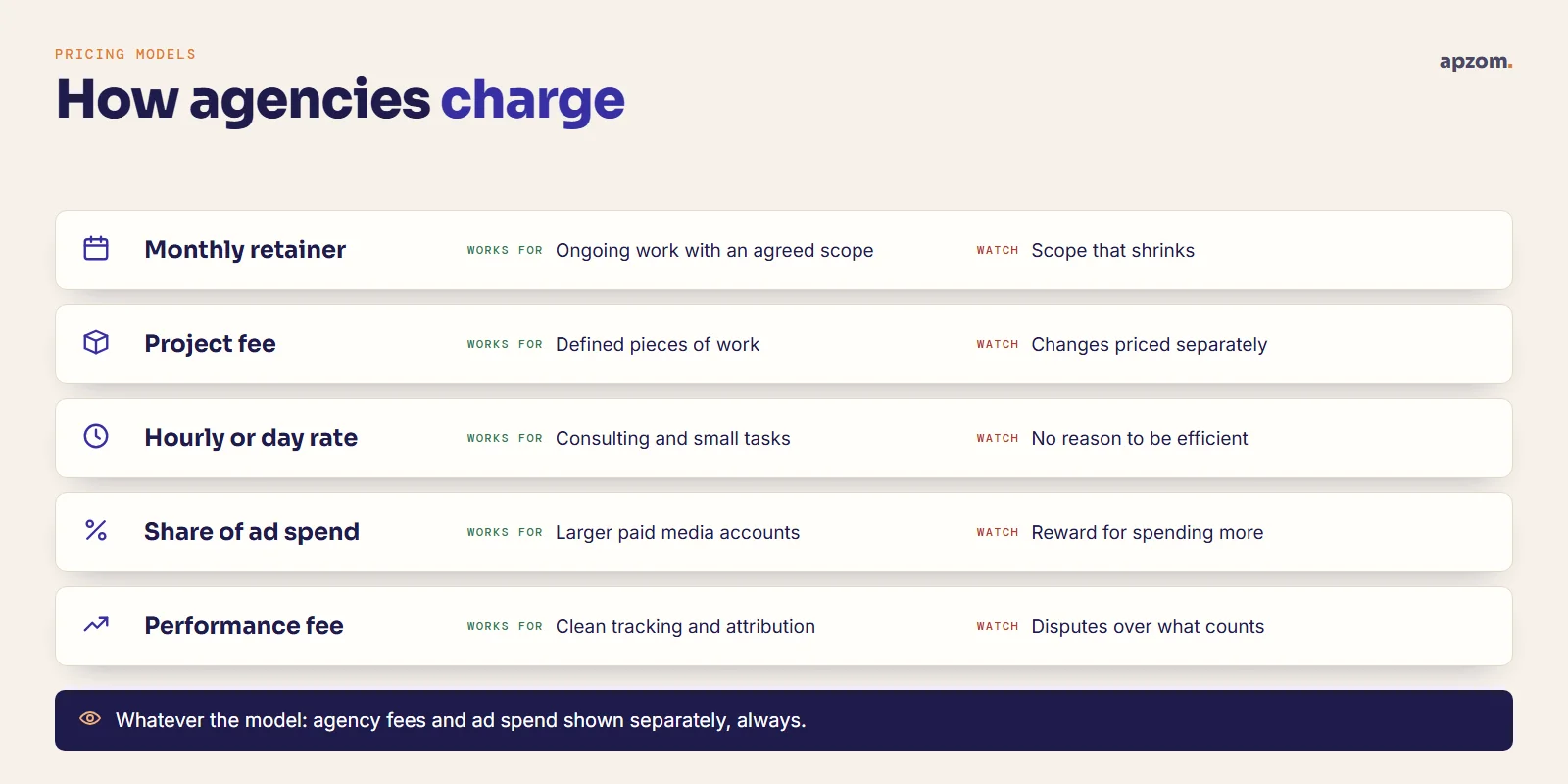
| Model | How it works | Works well when | Watch out for |
|---|---|---|---|
| Monthly retainer | A fixed monthly fee for an agreed scope | The work is ongoing, such as SEO, social or campaign management | A vague scope that shrinks over time |
| Project fee | A fixed price for a defined piece of work | Websites, audits, launches, rebuilds | Changes outside the scope priced separately |
| Hourly or day rate | Pay for time used | Consulting, training, small or unpredictable tasks | No incentive to be efficient |
| Percentage of ad spend | A management fee linked to how much you spend on ads | Larger paid media accounts | An incentive to raise spend, not results |
| Performance or commission | Fees tied to leads or sales | Businesses with clean tracking and clear attribution | Disputes over what counts, and pressure on lead quality |
Whatever the model, ask for the agency fee and your advertising spend to be shown separately. You should always know exactly how much of your money goes to the ad platforms and how much goes to the agency. For Google Ads this is not just good practice: Google’s third-party policy requires agencies that manage Google Ads for clients to disclose their management fees in writing, to show Google’s actual charges separately from their own fees, and to give clients their Google Ads customer ID on request.
The ownership test
This is the most important section in this guide. Many businesses discover, when they leave an agency, that they do not own their own ad accounts, analytics, website or domain. Rebuilding years of data and history is slow and expensive. Before you sign, check that you will own every one of these.
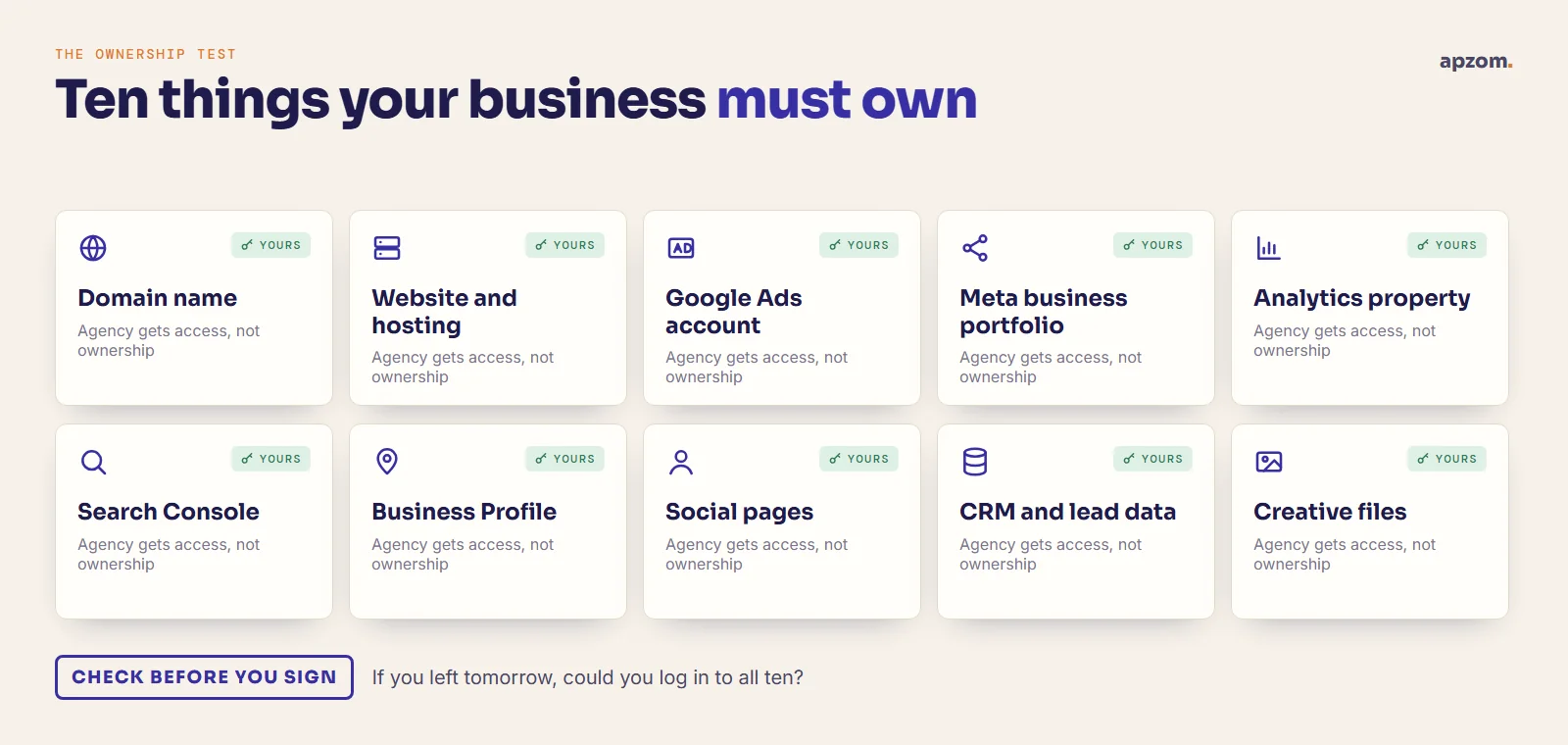
| Asset | What “you own it” means |
|---|---|
| Domain name | Your business as the registrant (ICANN’s term for the holder of the domain), with your own email as the contact |
| Website and hosting | Your account with the host; the agency has a user login, not ownership |
| Google Ads account | Your account, with you keeping Admin access; the agency is linked through its manager account. Only Admin users can manage access and unlink an agency |
| Meta business portfolio and ad account | Owned by your business portfolio, with the agency given partner access |
| Google Analytics | Your property, with you holding the Administrator role (the highest role in Google Analytics 4) |
| Google Search Console | You as a verified owner, with the agency added as a user. When an agency leaves, remove its verification too, or it can verify itself again |
| Google Business Profile | You as the owner; the agency as a manager |
| Social media pages | Owned by your business accounts, not personal agency accounts |
| CRM and lead data | In your system, or exported to you regularly |
| Creative files and content | Transferred to you on payment, as written in the contract |
A good agency will ask you to set things up this way, because it protects both sides. If an agency insists on creating accounts in its own name “to make things easier”, ask how you would take them over if you parted ways, and get the answer in writing.
Twelve questions to ask every agency
Ask every shortlisted agency the same questions, and write the answers down. What you are looking for is proof, not promises.
- Which of your clients are most like us, and what did you do for them?
- Can we speak to one or two of them?
- Who will actually work on our account, and what is their experience?
- What will you do in the first 30, 60 and 90 days?
- What will you need from us, and how much of our time?
- How will you measure success, and how will you report it?
- How often will we meet, and who is our main contact?
- What happens if results are not on track after three months?
- Do you outsource any of the work, and to whom?
- Will we own all accounts, data and creative?
- How do you charge, and what is not included in the price?
- What is the notice period, and what do we get when we leave?
Listen for specifics. “We will improve your SEO” is not an answer to question 4. “We will audit the site, fix the indexing problems we found, rewrite your five main service pages and set up call tracking” is.
A note on badges: a Google Partner badge shows that an agency met Google’s requirements for managing Google Ads, such as account optimisation, ad spend and certified staff. It covers Google Ads only and does not guarantee results for you. Treat badges as a starting point, not proof.
Red flags
Some warning signs are worth walking away over.
- Guaranteed rankings or results. Google’s page on hiring an SEO, “Do you need an SEO?”, says plainly: “No one can guarantee a #1 ranking on Google.” It also warns against anyone claiming a “special relationship” with Google or offering “priority submit” to Google. Any agency that guarantees rankings is either misleading you or planning to use tactics that put your site at risk.
- Secret methods. A good agency can explain what it will do in plain language. “Proprietary techniques” it will not describe are a warning.
- Buying links or reviews. Google’s spam policies treat buying or selling links for ranking purposes as link spam. Fake reviews are banned in the US under the FTC’s rule on consumer reviews (in force since 21 October 2024), which can also apply to agencies and reputation firms that supply them, and in the UK under the Digital Markets, Competition and Consumers Act since April 2025. If an agency offers either, it is putting your business at risk.
- They will not give you access. You should be able to log in to your ad accounts and analytics at any time.
- Reports full of vanity numbers. Impressions, followers and “reach” with no link to enquiries or sales.
- Long lock-in contracts with no exit for poor performance, especially for a first engagement.
- A pitch that ignores your brief and sells the same package to everyone.
- Hidden markups on advertising spend or third-party tools.
Comparing proposals fairly
Proposals are hard to compare because every agency structures them differently. Put them side by side on the same six criteria. We call this the agency scorecard.
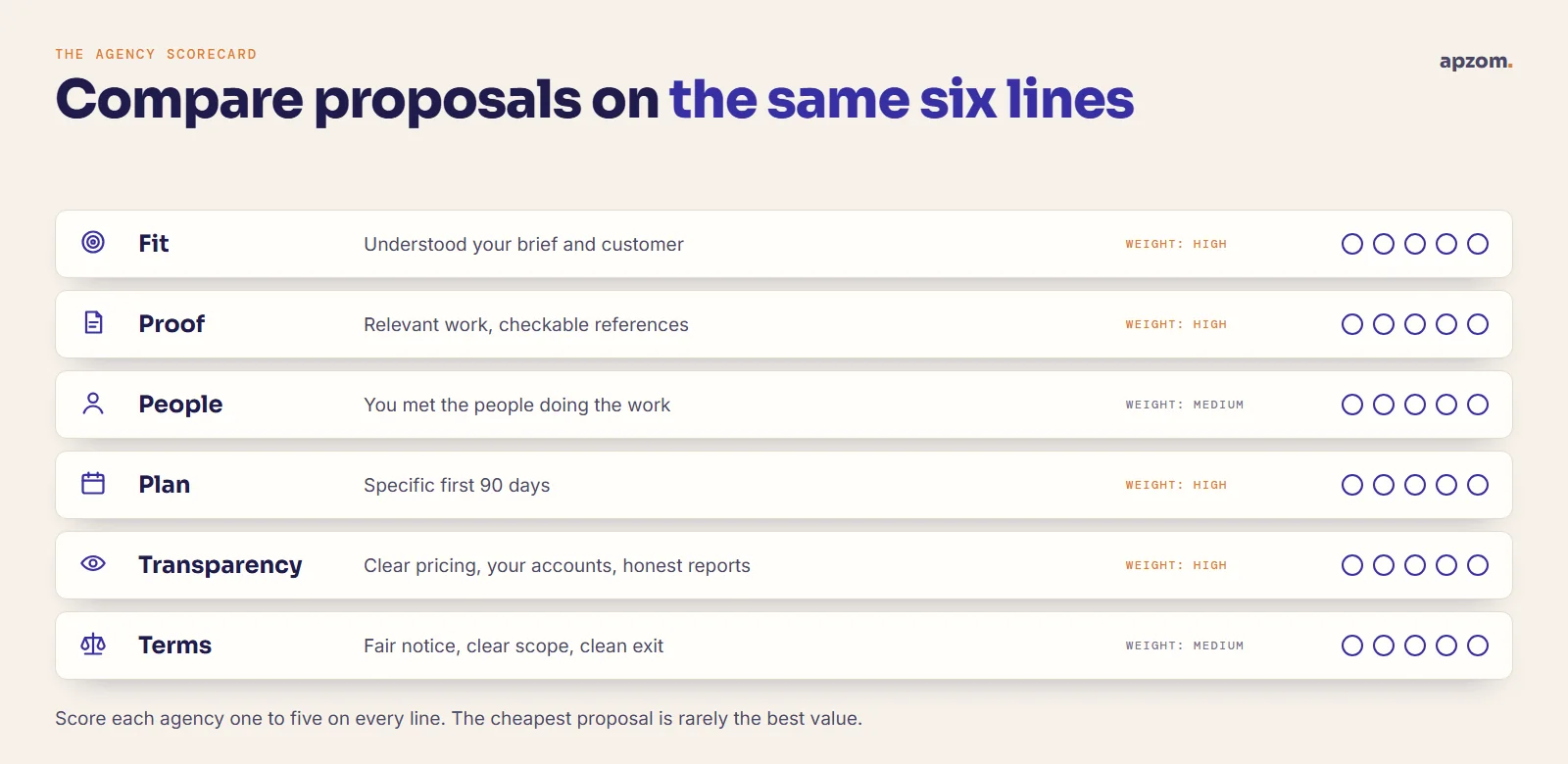
| Criterion | What good looks like | Weight |
|---|---|---|
| Fit | They understood your brief, customer and market | High |
| Proof | Relevant past work, references you can check | High |
| People | You met the people who will do the work | Medium |
| Plan | A specific plan for the first 90 days, not just a package | High |
| Transparency | Clear pricing, your ownership of accounts, honest reporting | High |
| Terms | Fair notice period, clear scope, clean exit | Medium |
Score each agency from one to five on each line. The cheapest proposal is rarely the best value, and the most impressive pitch deck is rarely the best plan. If two agencies score closely, choose the one whose people you would rather work with every week.
What to check in the contract
- Scope. Exactly what is included each month or in the project, and what is not.
- Minimum term and notice period. How long you are committed, and how much notice you need to give.
- Ownership. That accounts, data, website and creative belong to you, and when ownership transfers.
- Ad spend. Whether ad spend is paid directly by you to the platform, and how any management fee is calculated.
- Reporting. What you will receive, how often, and in what format.
- Data protection. How the agency handles your customers’ personal data, in line with the laws that apply to you.
- Exit. What the agency will hand over when the engagement ends, and how quickly.
Agency, in-house team or freelancer?
| Option | Strengths | Limits |
|---|---|---|
| Agency | A team with several skills, fast start, experience across many businesses | Less time inside your business; quality varies by account team |
| In-house marketer | Deep knowledge of your business, full-time focus | Hard to cover every channel; hiring and training take time |
| Freelancer | Specialist skill at lower cost, flexible | Limited capacity and cover |
| Mix | An in-house lead working with an agency or specialists | Needs clear ownership of decisions |
Many growing businesses end up with a mix: one person inside the business who owns the strategy and the numbers, working with an agency or specialists for execution.
What good onboarding looks like
The first month tells you a lot. A good agency will:
- Ask for access to your existing accounts and data before recommending anything.
- Audit what is already working, so it does not break it.
- Agree how leads and sales will be tracked before spending on ads.
- Share a written plan for the first 90 days with owners and dates.
- Set a regular meeting and reporting rhythm.
If the first month is mostly invoices and introductions, raise it early.
Comparing agencies right now? Send us your brief. We will give you an honest read on what is achievable, which channels fit and what it is likely to take, even if the answer is that you do not need an agency yet.
How Apzom works with clients
Apzom Digital is a digital marketing agency based in Ahmedabad, India, working with clients in India and abroad. Search, content, design and build are done by one in-house team, with no silent outsourcing, and we report in business terms: leads, cost per lead and pipeline. If paid advertising is unlikely to pay back for your margins, we will tell you rather than take the budget. You are welcome to put every question in this guide to us. You can read more about why businesses choose us, see how we work, and look at our case studies before you decide. Our full list of services covers search, paid media, social, content and websites.
We do not guarantee rankings or a fixed number of leads. If we are not the right fit for your brief, we will say so.
Put us through the same test. Share your five-line brief and we will answer the twelve questions in this guide in writing, with a plan for the first 90 days and a clear breakdown of what is included.
No obligation and no guaranteed rankings. Prefer to talk first? Contact us or read how we work.
Frequently asked questions
How do I choose a digital marketing agency?
Write a clear brief, shortlist agencies with relevant experience, ask each the same questions, and compare them on fit, proof, people, plan, transparency and terms. Make sure you will own every account and asset before signing.
What questions should I ask a digital marketing agency?
Ask who will work on your account, what they will do in the first 90 days, how they will measure success, how they charge, whether they outsource, whether you will own all accounts and data, and what happens when you leave.
How much does a digital marketing agency cost?
It depends on the scope, the channels and the market. Agencies charge through monthly retainers, project fees, hourly rates, a percentage of ad spend or performance fees. Always ask for agency fees and ad spend to be shown separately.
What are the red flags when hiring a digital marketing agency?
Guaranteed rankings, secret methods, buying links or reviews, refusing to give you access to your accounts, vanity-metric reports, long lock-in contracts and hidden markups on ad spend.
Should my business own its Google Ads and Meta ad accounts?
Yes. Your business should own its ad accounts, analytics, domain and Business Profile, and give the agency access. That way you keep your data and history if you change agencies.
Is it better to hire an agency or an in-house marketer?
It depends on your budget and needs. An agency gives you several skills and a fast start; an in-house marketer gives you full-time focus. Many businesses combine an in-house lead with an agency or specialists.
How long before a digital marketing agency shows results?
Paid advertising can bring enquiries within weeks once tracking is in place. SEO and content usually take several months. A good agency will tell you what to expect for each channel before you start.
Can a digital marketing agency guarantee first-page rankings?
No. Search engines decide rankings, and Google itself warns that no one can guarantee a number one ranking. Treat any guarantee as a red flag.