
The short answer: SEO for construction companies means making sure that when someone near you searches for the work you do, they find a page that proves you do it well, in their area, and makes it easy to ask for an estimate. For most contractors that comes down to five things: a well-managed Google Business Profile, one strong page for each service you want more of, area pages only where you have real work to show, project pages that prove it, and a website that loads fast on a phone.
This guide is for owners and marketing leads at general contractors, builders, remodelers, specialty trades and commercial contractors who want search to bring in jobs they actually want. It is the search-focused companion to our guide to digital marketing for construction companies, which covers the wider picture: paid ads, lead platforms, bids and planning marketing around your backlog.
How people search for a contractor
Nobody searches for “construction company” when they need a new roof. They search for the job, the place, or the company they have already heard of. Each kind of search needs a different kind of page, and most contractor websites only have one or two of them.
We call this the contractor search map.
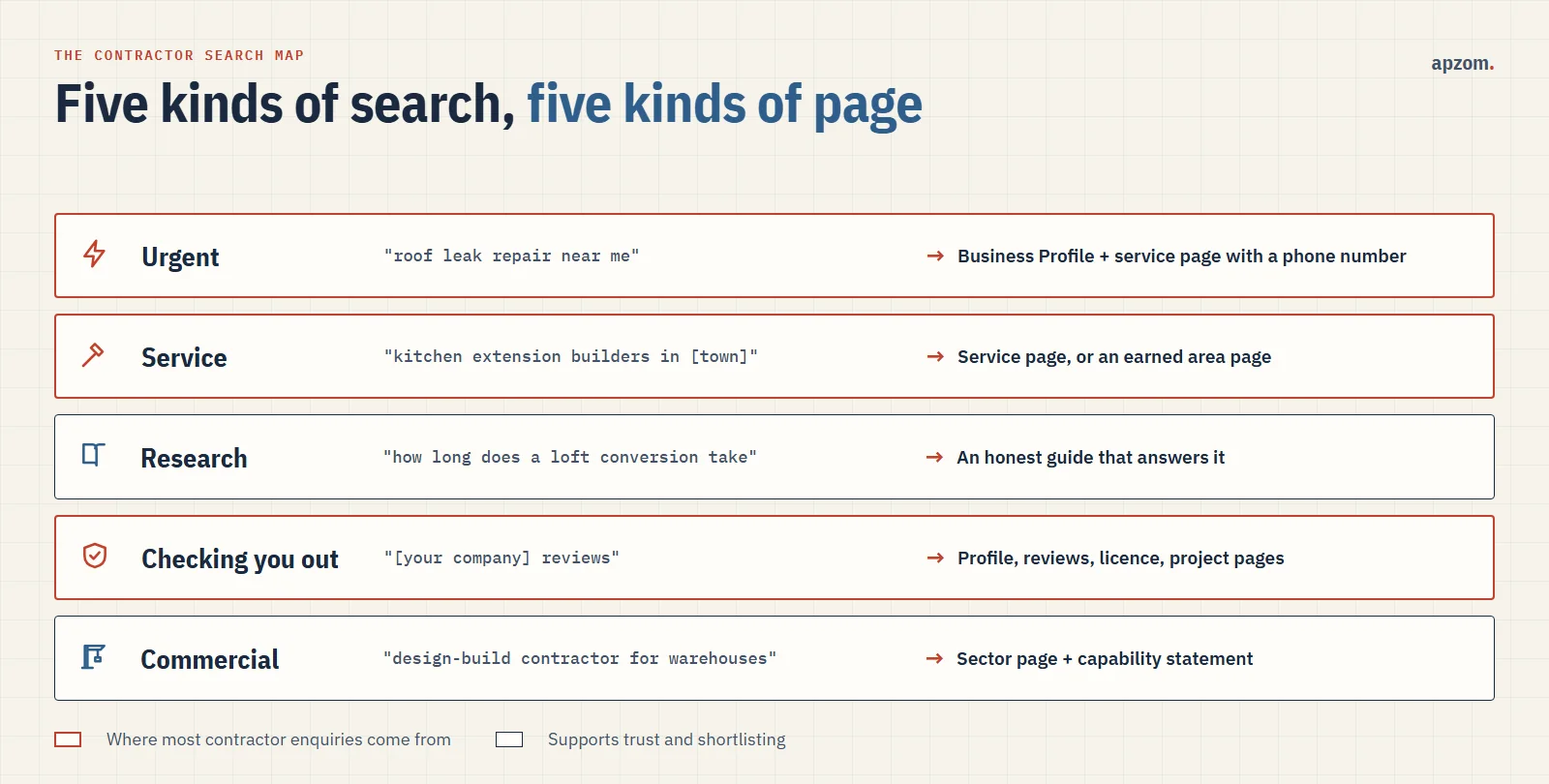
| Search type | Example search | What the searcher wants | The page that should answer it |
|---|---|---|---|
| Urgent | “roof leak repair near me” | Someone who can come soon | Google Business Profile and a service page with a clear phone number |
| Service | “kitchen extension builders in Leeds” | A contractor who does this job here | A service page, or an area page if you have real work there |
| Research | “how long does a loft conversion take” | To understand the job before calling anyone | A guide that answers the question honestly |
| Checking you out | “[your company] reviews” | Proof you are real and reliable | Profile, reviews, licence and project pages |
| Commercial | “design-build contractor for warehouses” | A firm with relevant experience | Sector page with projects and a capability statement |
Two things follow from this. First, the money is mostly in the urgent, service and checking-you-out searches, which are local and specific. Second, the “checking you out” search happens after almost every referral. A homeowner who gets your name from a neighbour still searches for you before calling. If what they find is thin, the referral can be lost.
Start with your Google Business Profile
For residential and trade contractors, the map results are often the first thing a searcher sees. Your Business Profile is the foundation of local search, and it has rules that trip up contractors more than most businesses.
- Service-area businesses hide their address. Google’s Business Profile help says that if you don’t serve customers at your business address, you should remove the address from your profile. Most contractors work at the customer’s site, so this applies to them. You can then list up to 20 service areas, such as cities or postal codes. Google’s guidance is that a service area should not extend beyond about two hours’ driving time from where your business is based.
- No virtual offices or mailboxes. Google’s guidelines say a virtual office or remote mailbox is not eligible for a profile. You need a real location where the business operates.
- One profile per location. A firm with several staffed offices can have one profile for each office. Do not create extra profiles for the same location to cover more towns.
- Use your real business name. Do not add keywords or town names that are not part of your actual name. “Smith Roofing” stays “Smith Roofing”, not “Smith Roofing Best Roofer Manchester”.
- Choose the most specific category for your main work, then add secondary categories only for work you really do.
- Add photos of your own work, regularly. Finished jobs, work in progress, your vans and your team on site. Never use stock images of other companies’ buildings.
Our local SEO services cover profile setup and management in detail. The rest of this guide is about your website, which is where most contractors lose the work their profile earns. For a walkthrough of every profile setting, see our Google Business Profile optimization checklist.
Service pages: one page for each job you want more of
The most common problem on contractor websites is a single “Services” page with a sentence about each trade. Search engines and buyers both need a page that is clearly about one job.
Build a separate page for every service that matters to your business, especially the ones with the best margin or the most demand. A roofer might have pages for roof replacement, flat roofs, roof repairs and guttering. A builder might have extensions, loft conversions, new builds and renovations.
| What to include | Why it matters |
|---|---|
| What the job includes, in plain words | Answers the first question every buyer has |
| How the job runs, step by step | Reduces fear and shows you know what you are doing |
| Typical considerations, such as permits, access, materials and timing | Shows expertise and filters out poor-fit enquiries |
| Three to six relevant projects, linked to their project pages | Proof that you do this job, not just list it |
| Who does the work: your team or named trades | Buyers want to know who will be on site |
| Licences, certifications and insurance that apply to this job | Answers the trust question on the page that needs it |
| Questions people actually ask you, answered honestly | Matches research searches and saves phone time |
| One clear way to ask for an estimate | The page has a job; make it easy to do |
Write each page about the job, not about keywords. If a sentence would fit on every service page you have, it is not helping that page.
Area pages: the earned area test
Contractors are often told to build a page for every town near them. This is where many sites get into trouble. Google’s spam policies describe doorway abuse with this example: “multiple domain names or pages targeted at specific regions or cities that funnel users to one page”. A set of near-identical pages that only swap the town name is exactly that.
That does not mean area pages are bad. It means each one has to earn its place. Before building an area page, ask four questions.
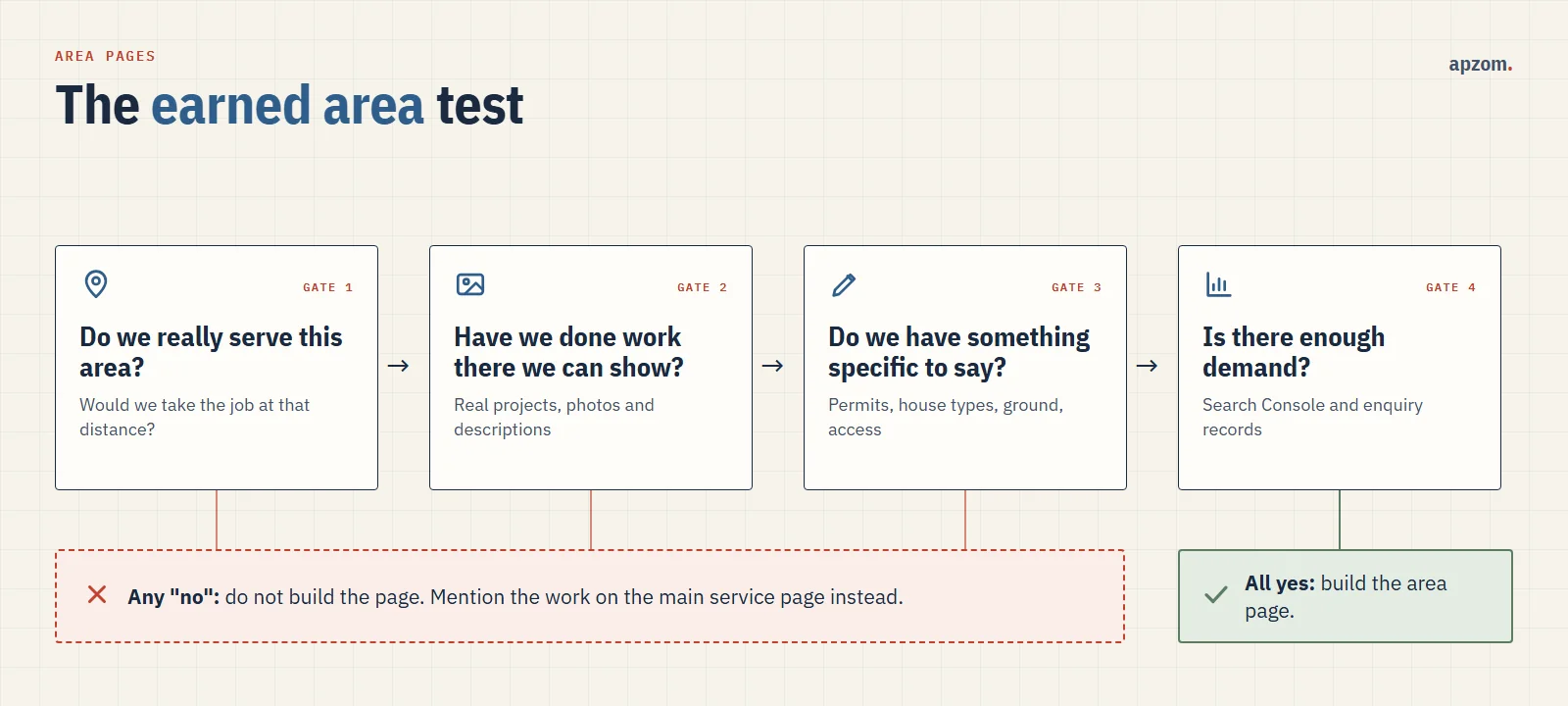
- Do we really serve this area? If you would turn the job down because of travel time, do not build the page.
- Have we done work there that we can show? Real projects in that area, with photos and descriptions, are what make the page different from every other area page.
- Do we have something specific to say about it? Local planning or permit points, common house types, ground conditions, access problems or the kind of work people there usually want.
- Is there enough demand to justify it? Check Search Console and your enquiry records. Some towns bring enquiries; many do not.
If any answer is no, do not build the page yet. Mention the work you have done there on the main service page instead. If all four answers are yes, the page almost writes itself: real projects, local knowledge and the services you most often do there.
Project pages: the proof mesh
Project pages are a contractor’s strongest SEO asset, because each one is original content about a real job in a real place. Our construction marketing guide explains what each project page should include. For SEO, what matters just as much is how the pages connect.
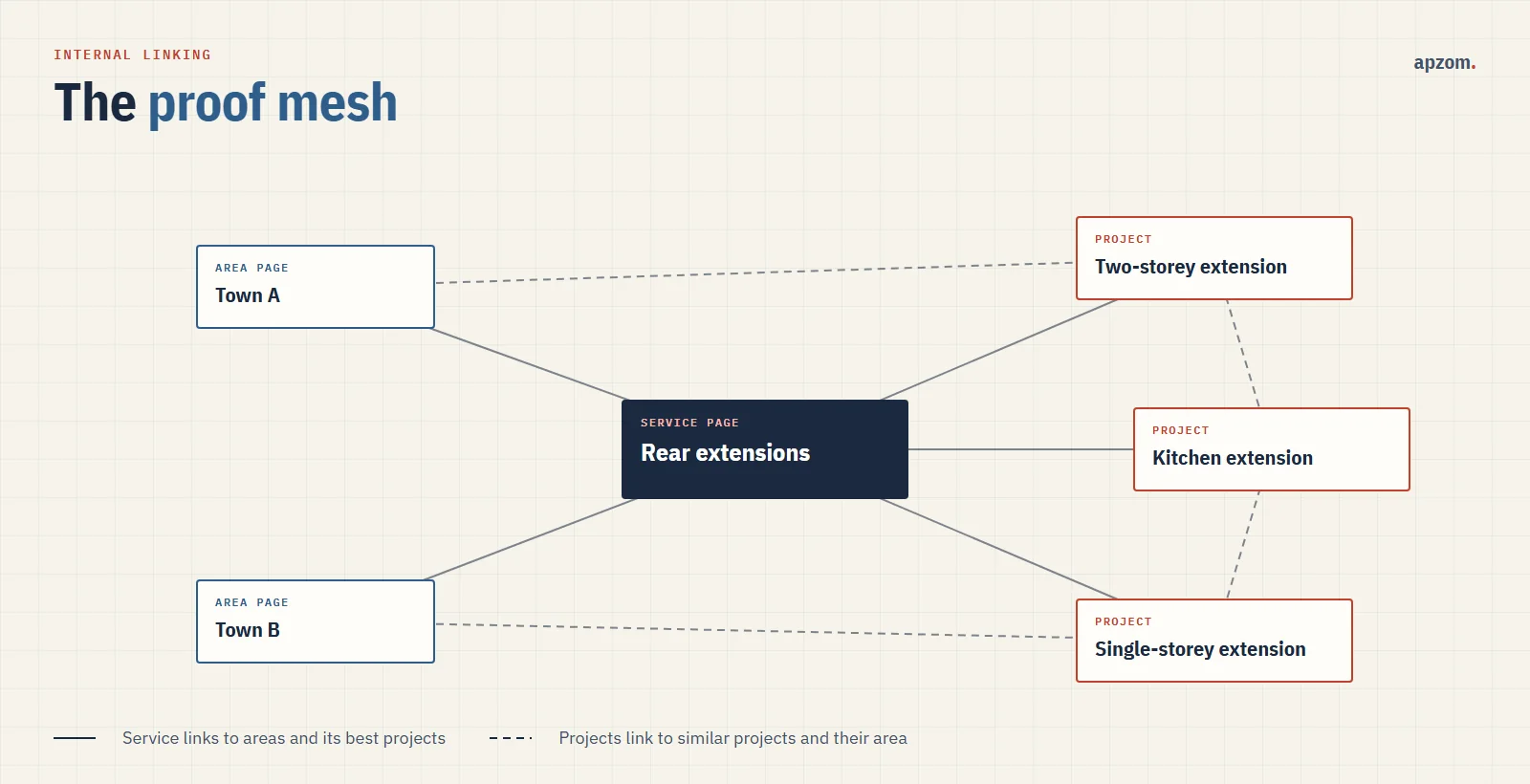
We call this the proof mesh. Every project page links to:
- The service page for the work it shows, such as “rear extension”.
- The area page for where it was done, if one exists.
- Two or three similar projects, so the buyer keeps seeing relevant work.
And every service and area page links back to its best projects. The result is a site where a buyer can move from “do they do this?” to “have they done it near me?” to “is it any good?” in a few clicks, and where search engines can see the same relationships.
A few practical rules for project pages:
- Give each project its own page with a descriptive title, such as “Two-storey rear extension in Headingley” rather than “Project 14”.
- Write at least a short description: the brief, the challenge, what you did, how long it took. A page with only photos says very little to a buyer or a search engine.
- Name and describe photos. Google’s image SEO guidance recommends short, descriptive file names and useful alt text. A file named `oak-frame-garden-room-otley.jpg` does more than `IMG_4521.jpg`.
- Get permission before naming a client or showing a private home, and never show house numbers or anything that would compromise a client’s security.
Trust signals: the details buyers and search engines both read
When someone searches your company name, they are checking whether you are real, qualified and safe to hire. Put the answers where they can find them.
- Licence and registration numbers. In some places this is the law. California’s Business and Professions Code requires licensed contractors to include their licence number in all forms of advertising, and Florida requires certified and registered contractors to show their number in every advertisement, regardless of medium. In Great Britain, anyone working on gas appliances must by law be on the Gas Safe Register. In India, developers of real estate projects registered under the RERA Act must quote the project’s registration number and the state authority’s website address in their advertisements. Voluntary schemes count too: in the UK, TrustMark is the Government Endorsed quality scheme for work in and around the home. Rules vary, so check your own state, country and trade.
- Insurance. State the cover you carry and offer certificates on request.
- Certifications and memberships, with the certifying body and what they cover.
- Consistent business details. Your business name, address (if shown) and phone number should match across your website, Business Profile and the directories you are listed on.
- Real people. A team page with names and roles is a trust signal for buyers, and a clear “about” page helps search engines understand who you are.
Reviews: a system, not a scramble
Reviews influence both who gets the call and how prominent your profile is in local results. The best approach is boring and consistent: ask every client at handover, the same way, with a direct link.
Stay inside the rules. Google’s review policy says businesses must not discourage negative reviews or selectively solicit positive ones, and must not offer incentives for reviews. In the US, the FTC’s rule on consumer reviews and testimonials has banned fake reviews and incentives tied to a positive or negative review since 21 October 2024, and the FTC has said that asking only happy customers for reviews could still break the wider FTC Act. In the UK, fake reviews and concealed incentivised reviews have been banned practices under the Digital Markets, Competition and Consumers Act 2024 since April 2025.
Reply to reviews, good and bad, briefly and politely. Never reveal private details about a client’s home or job in a reply.
Not sure why your website brings so few estimate requests? A Construction SEO Audit checks your Business Profile, service and area pages, project pages, reviews and how search enquiries are tracked, and shows which fixes matter most.
Technical SEO for contractor websites
Most construction websites are small, so technical SEO is not about complex crawling problems. It is about a handful of things that quietly cost enquiries.
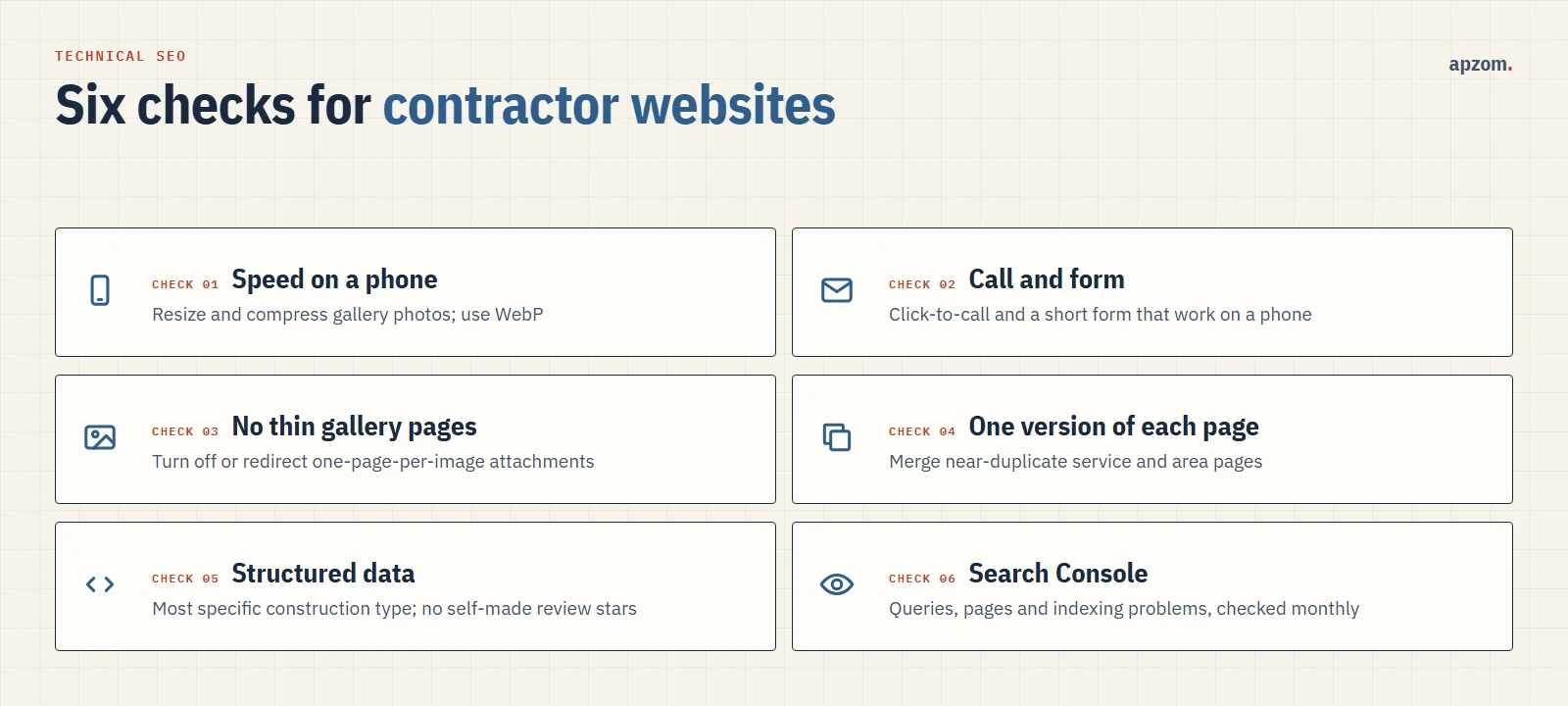
- Speed on a phone. Many people search for a contractor on their phone, often on site or at home. Heavy galleries are the usual problem: resize and compress photos before uploading, and use modern formats such as WebP. Google’s Core Web Vitals set “good” thresholds for loading (Largest Contentful Paint within 2.5 seconds), responsiveness (Interaction to Next Paint within 200 milliseconds) and visual stability (Cumulative Layout Shift under 0.1).
- A click-to-call number and a simple form that work on a phone. Test them yourself every month.
- No thin gallery pages. Many website builders create a separate page for every uploaded image. These add hundreds of empty pages. Turn them off or redirect them to the project page.
- One version of each page. Template-built sites often end up with near-duplicate service and area pages. Google says duplicate content is not a violation of its spam policies in itself, but cloned town pages can count as doorway or scaled content abuse, and duplicates split your signals. Merge pages that say the same thing.
- Structured data. Schema.org has types for construction businesses, including GeneralContractor, RoofingContractor, Plumber, Electrician, HVACBusiness and HousePainter, all under HomeAndConstructionBusiness. Use the most specific type that fits, with details that match your Business Profile. Do not mark up your own reviews to try to get star ratings: Google’s review snippet documentation says that when a business controls the reviews about itself, its LocalBusiness or Organization markup is not eligible for review stars.
- Search Console set up and checked. It shows which searches bring people to which pages, and warns you about indexing problems.
Commercial contractors: SEO for the bid list
For commercial, industrial and civil contractors, search works differently. Developers, architects, facility managers and procurement teams rarely pick a contractor from a search result. But they almost always search for you before shortlisting, and some searches do bring new opportunities.
- Sector pages such as healthcare, education, logistics and warehousing or retail fit-out, each with relevant projects. A procurement team wants to see work like theirs in seconds.
- Your capability statement as a web page, not only a PDF: services, sectors, notable projects, safety, certifications and contacts. Keep the PDF as a download.
- Specialist service pages for subcontract trades, such as structural steel erection, curtain walling or groundworks. General contractors do search for specialist subcontractors in a region.
- People pages for directors and project leads. In commercial work, buyers hire people as much as companies.
Measure commercial SEO by invitations to tender, prequalification requests and shortlists, not by traffic.
Content that brings in the right enquiries
Contractors do not need a blog with a post every week. They need a small set of genuinely useful guides that answer the questions buyers ask before they call.
- Process guides: what happens during a loft conversion, a re-roof or a commercial fit-out, from first visit to handover.
- Planning and permit guides for your area, written carefully and dated, because rules change.
- Cost guides, if you can be honest. Explain what drives the price and give ranges you are prepared to stand behind. Never publish prices you would not quote.
- Comparisons that come up in every estimate: flat roof materials, extension versus moving, timber frame versus masonry.
Each guide should link to the service page it supports and to relevant projects. Google’s guidance on helpful content asks site owners: “Are you producing lots of content on many different topics in hopes that some of it might perform well in search results?” For contractors, that means writing about the work you do, in the places you do it.
AI search and answer engines
Search tools that give AI-written answers use the same web pages as everyone else. Google says there are no extra requirements or special optimisations needed to appear in its AI features. What helps is what helps SEO anyway: clear service pages, real projects, consistent business details and honest answers to common questions. Our AEO services and GEO services pages explain how we approach this.
Measure SEO in signed contracts
Rankings and traffic are signals, not results. A contractor’s SEO is working when it brings in estimates for the jobs you want, in the areas you want, and some of them sign.
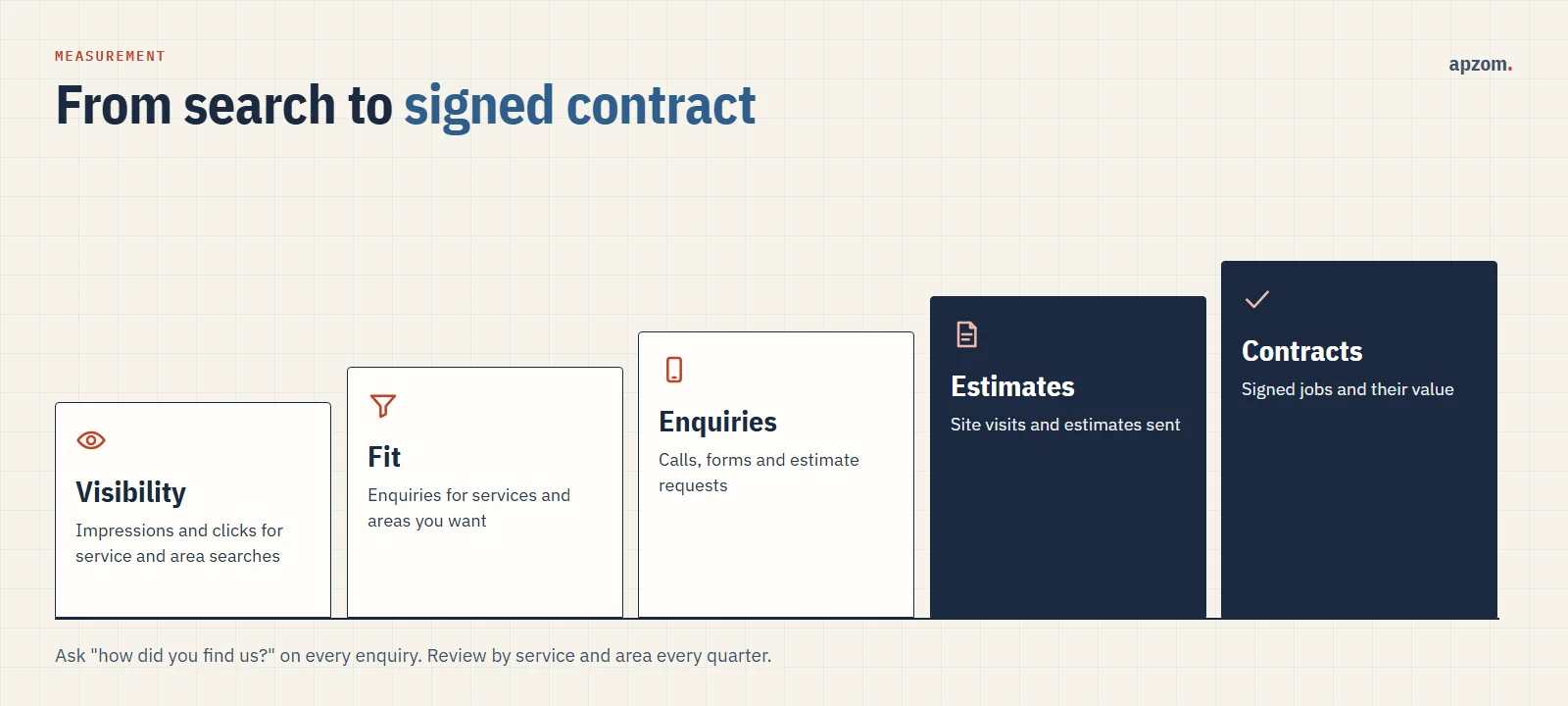
| Stage | What to track | Where |
|---|---|---|
| Visibility | Impressions and clicks for service and area searches | Search Console, Business Profile performance |
| Fit | Share of enquiries for services and areas you want | Enquiry form fields, call notes |
| Enquiries | Calls, forms and estimate requests from organic search and maps | Call tracking, form source |
| Estimates | Site visits and estimates sent | Your CRM or job tracker |
| Contracts | Signed jobs and their value | Your CRM or job tracker |
Ask “how did you find us?” on every enquiry, and record the answer. Review it by service and area every quarter. That tells you which pages to improve, which areas deserve a page, and which ones do not.
A 90-day construction SEO plan
Days 1 to 30: fix the foundations
- Clean up your Business Profile: address setting, service areas, real name, categories, photos.
- Set up Search Console and analytics, and add “how did you find us?” to your enquiry process.
- Remove or redirect thin gallery and duplicate pages. Fix mobile speed on your heaviest pages.
Days 31 to 60: build the money pages
- Write one full service page for each of your three to five most valuable services.
- Turn your best recent jobs into project pages, with descriptions and named photos.
- Link projects, services and areas into the proof mesh.
Days 61 to 90: expand where you have earned it
- Build area pages only for areas that pass the earned area test.
- Publish two or three guides that answer the questions you hear most.
- Start a simple review routine at every handover.
Common construction SEO mistakes
- One “Services” page listing every trade in a sentence.
- Dozens of town pages with the same text and a different town name.
- Galleries of unlabelled photos with no project descriptions.
- Stock photos of other companies’ work.
- Keywords stuffed into the Business Profile name.
- Licence and insurance details missing or hard to find.
- Judging SEO by traffic instead of estimates and contracts.
How Apzom can help
Apzom Digital’s SEO services for construction companies start with an audit of your Business Profile, service and area pages, project pages, technical health and how enquiries are tracked. We then rebuild the pages that matter with your team, using your real projects, and connect search to signed work. If your website needs rebuilding, our website development team builds the structure in from the start. You can read how we approach search in our SEO methodology.
We will not promise rankings or a number of leads. We will tell you plainly which pages and fixes are most likely to bring in the jobs you want.
Request a Construction SEO Audit. We review your pages against the contractor search map, test every area page with the earned area test, check your project pages and proof mesh, Business Profile, trust signals, mobile speed and structured data, and trace search enquiries through to signed jobs. You get a prioritised fix list, in order of impact.
The audit is free, with no obligation and no guaranteed rankings. Prefer to talk it through? Contact us or see all our services.
Frequently asked questions
What is SEO for construction companies?
It is improving a contractor’s website and Google Business Profile so that people searching for the work you do, in the areas you serve, find pages that prove you do it well and can easily ask for an estimate.
How long does SEO take for a contractor?
Business Profile fixes and technical cleanup can show effects within weeks. New service and project pages usually take a few months to build visibility, depending on competition in your area and your site’s history. Judge it over quarters, in estimates and signed jobs.
Should a contractor create a page for every town it serves?
No. Build an area page only where you genuinely work, have real projects to show and have something specific to say. Near-identical town pages can be treated as doorway pages under Google’s spam policies.
Can a contractor show an address on Google if it works from home?
If customers do not visit your address, Google’s guidelines say to hide it and set service areas instead. Your profile still appears in local results for the areas you serve.
Do project photos help SEO?
Yes, when they sit on project pages with descriptions, descriptive file names and alt text. Unlabelled photos in a gallery do much less. Use only photos of your own work.
Should contractors use schema markup?
It helps search engines understand your business type, location and contact details. Use the most specific construction type that fits, keep the details consistent with your Business Profile, and do not mark up your own reviews for star ratings.
Is SEO or Google Ads better for construction companies?
They do different jobs. Google Ads can bring enquiries quickly for urgent and high-value services, while SEO builds lasting visibility and supports every referral that searches your name. Our construction marketing guide covers how to combine them.
Do commercial contractors need SEO?
Yes, but measured differently. Procurement teams and general contractors search for you before shortlisting, and some search for specialist capabilities. Sector pages, project pages and a web version of your capability statement do most of the work.