
The short answer: SEO for law firms means making the firm’s practice areas, lawyers and offices easy for people and search engines to find, understand and trust, so that someone with a real legal problem in your jurisdiction finds the right page and contacts the right lawyer. It is ordinary SEO with three extra constraints: the content affects people’s lives and money, the copy is governed by professional conduct rules, and most enquiries are local.
This guide is for managing partners, marketing leads and practice managers at law firms of any size. It is written as an audit, the way we would review a firm’s site: seven layers to check, the mistakes we see most often in each one, and how to fix them without breaking advertising rules. If you want the wider picture, including paid search, intake and the full client acquisition system, start with our guide to digital marketing for law firms. This article goes deep on search.
Why law firm SEO is different
Most SEO advice is written for businesses that can say almost anything about themselves. Law firms cannot.
- The rules apply to the website. In the US, the American Bar Association’s Model Rules of Professional Conduct, and each state’s version of them, govern lawyer advertising. A web page, a Google Business Profile description and a blog post are all communications about the lawyer’s services. In England and Wales the Solicitors Regulation Authority sets its own rules, and in India the Bar Council of India restricts advertising almost entirely.
- The content can change people’s lives. Someone reading about custody, deportation or a criminal charge may act on what they read. Google does not publish a special “legal” ranking rule, but its people-first content guidance and its quality rater guidelines both put weight on who wrote something and whether they are trustworthy. For legal content, that means named, qualified authors and accurate, current information.
- Most demand is local and jurisdictional. A family lawyer licensed in one state cannot take a matter in another. Search visibility outside the places where you can practise is wasted at best and misleading at worst.
- One enquiry can be worth a great deal. A single signed matter can pay for months of work. That makes quality of enquiry more important than volume.
The law firm SEO audit: seven layers
When we review a law firm’s search presence, we look at seven layers in this order. The early layers decide what the firm can rank for; the later ones decide whether it deserves to.
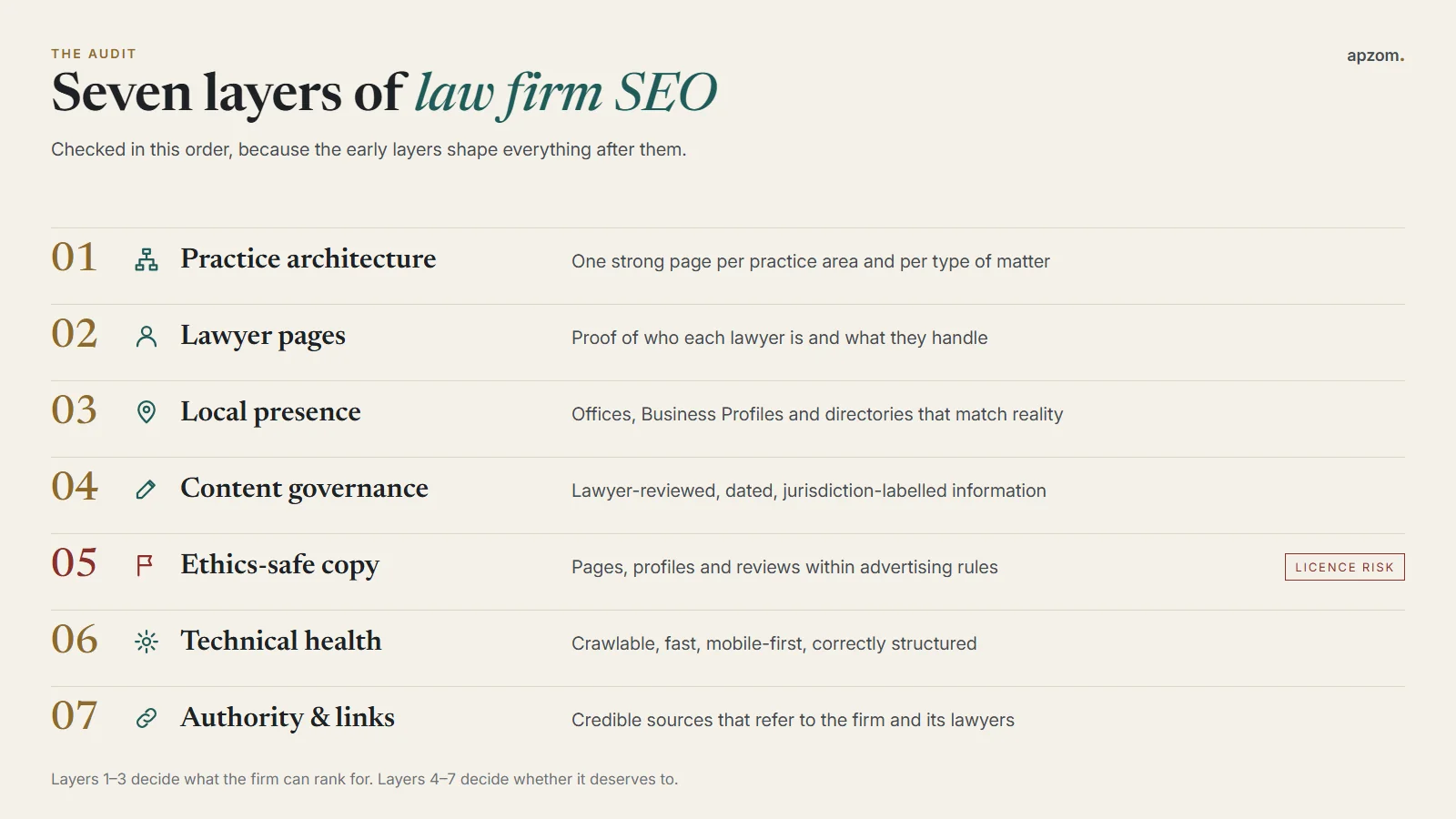
- Practice architecture: does the site have one strong page for each practice area and each important type of matter?
- Lawyer pages: does each lawyer have a page that proves who they are and what they handle?
- Local presence: do offices, Google Business Profiles and directory listings match reality?
- Content governance: is legal information written or reviewed by a lawyer, dated, jurisdiction-labelled and kept current?
- Ethics-safe copy: do pages, profiles and reviews follow the advertising rules where the firm practises?
- Technical health: can search engines crawl and understand the site, and does it load quickly and work on a phone?
- Authority and links: do credible, relevant sources refer to the firm and its lawyers?
The rest of this guide takes each layer in turn.
Layer 1: Practice architecture
The most common structural problem on law firm websites is a single “Practice Areas” page with a paragraph for each service. It cannot rank for anything specific, and it gives a worried reader nothing to hold on to.
Build a hub for each practice area, then matter pages under it
Think of each practice area as a small section of the site:
- Practice hub: for example, Family Law. Explains what the firm handles in this area, who does the work, where, and how to get in touch.
- Matter pages: for example, Divorce, Child Custody, Prenuptial Agreements, Domestic Violence Protective Orders. Each answers the questions people in that specific situation ask.
- Supporting guides: for example, “What happens at a first custody hearing in [state]”. Each answers one question in depth and links back to the matter page.
- Lawyer pages: the people who handle these matters, linked from every page in the section.
- Office pages: the genuine locations from which the practice is handled.
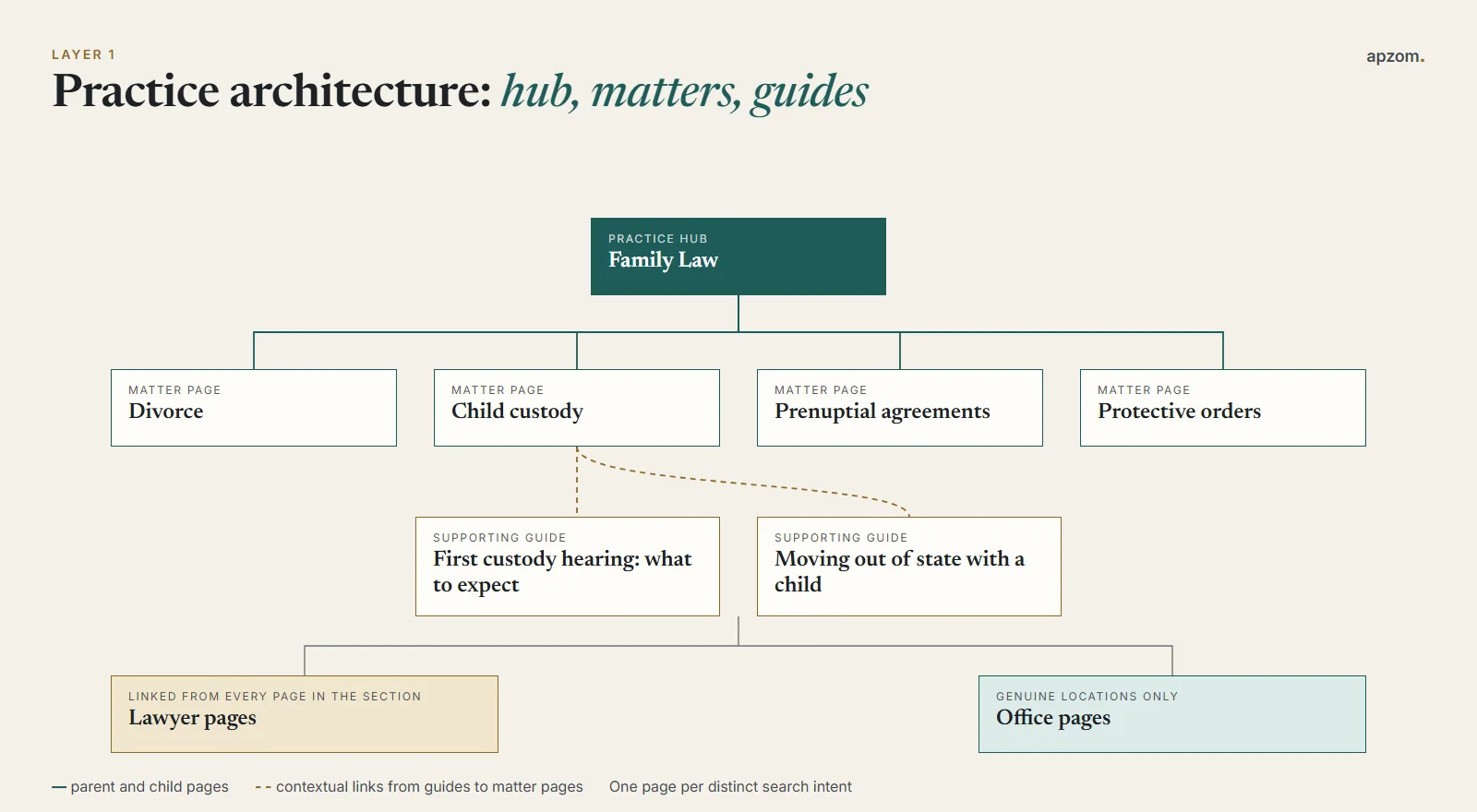
A page earns its place when its search intent is distinct. “Divorce lawyer” and “uncontested divorce” are different situations and can deserve different pages. “Divorce attorney” and “divorce lawyer” are the same intent and should be one page.
What a strong matter page contains
| Section | What it does | Common mistake |
|---|---|---|
| Who this page is for | Confirms the reader is in the right place in the first lines | Opening with the firm’s history |
| What the firm handles, and what it does not | Sets expectations and filters out unsuitable enquiries | Implying the firm handles everything |
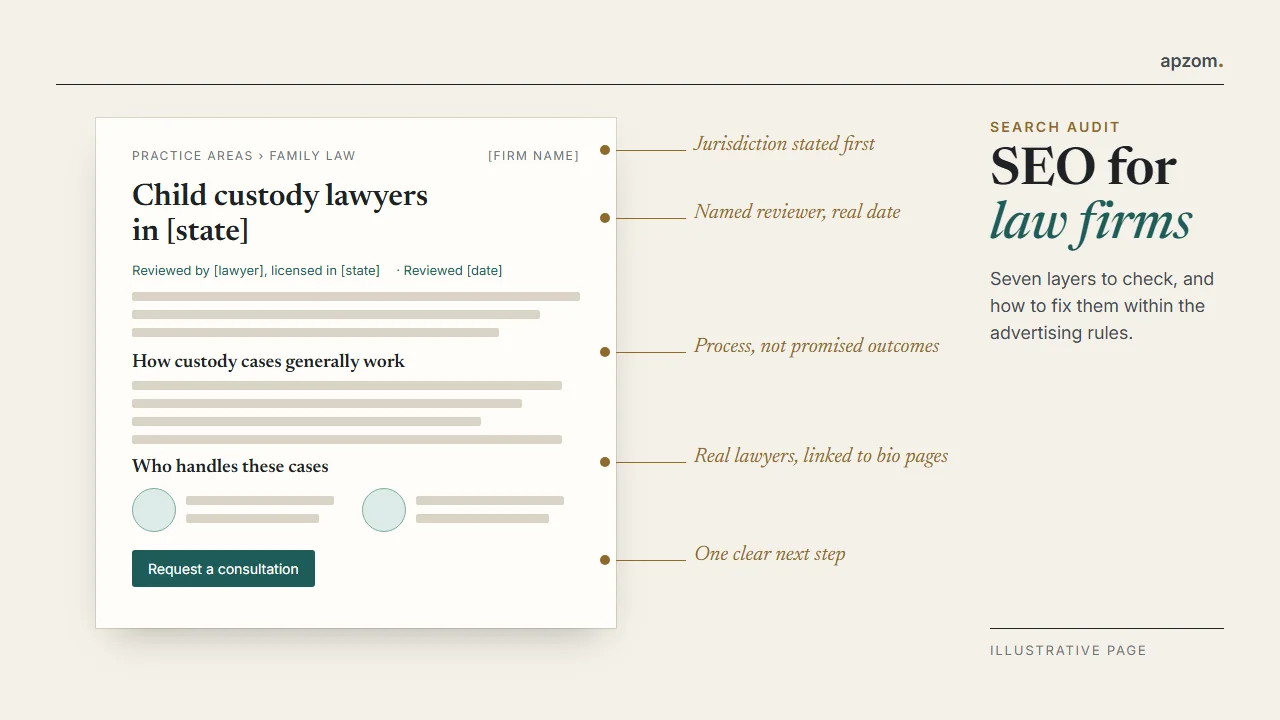
| How the process generally works | Reduces fear and shows experience | Promising outcomes or timelines |
| Which lawyers do this work | Connects the reader to real people | No names, or stock photos |
| Jurisdiction | States which courts, states or countries the page applies to | Legal explanations with no jurisdiction |
| Costs and fee approach, where you can share it | Answers the question everyone has | Silence, which sends readers to competitors |
| Next step | One clear way to start, with what to expect | “Free case evaluation” buttons everywhere |
| Reviewed by and updated date | Shows who stands behind the information | Undated pages with no author |
There is no right word count for these pages. Google says it has no preferred word count. Write until the reader’s questions are answered, then stop.
Do not create practice pages for work you do not do
Listing 40 practice areas to catch more searches backfires. Thin pages for work the firm rarely handles dilute the site, bring unsuitable enquiries, and can mislead people about the firm’s experience. The comments to ABA Model Rule 7.1 explain that even a truthful statement can mislead if it is likely to lead a reasonable person to a conclusion about the lawyer’s services that has no reasonable factual foundation. Implying broad experience you do not have is a fair example of that risk.
Layer 2: Lawyer pages are your strongest trust asset
For law firms, the lawyer is often the product. People search for lawyers by name after a referral, and they check who will actually handle their matter. A thin bio with a photo and two lines is one of the most common gaps we find.
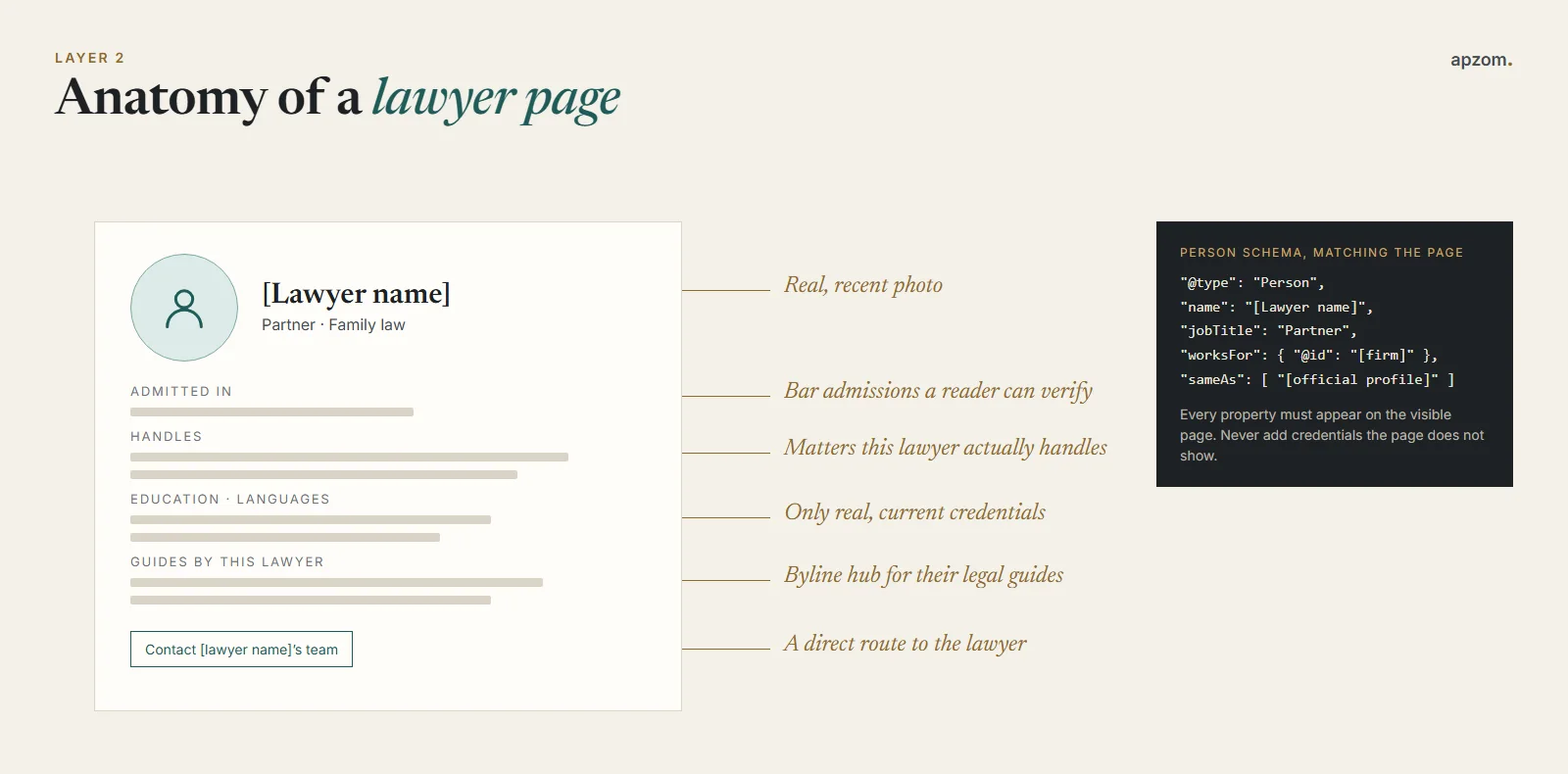
What a lawyer page should include
- Full name, role and a real, recent photo.
- Bar admissions and jurisdictions, and how a reader can check them with the relevant licensing body.
- Practice areas and the types of matters this lawyer actually handles.
- Education and relevant professional history.
- Languages spoken, if they help clients.
- Publications, talks and professional memberships that are real and current.
- Any specialist certification, named exactly as the certifying body describes it (see Layer 5).
- Links to the lawyer’s guides and articles on the site.
- A direct way to contact the lawyer or their team.
Make lawyers the visible authors of legal content
Google’s guidance on creating helpful, reliable content asks whether it is clear who created the content, and encourages bylines that lead to more information about the author. Its latest version is blunt about the opposite: fabricating author profiles, such as made-up names or false credentials, is described as a form of deception.
So put the responsible lawyer’s name on every legal guide, link the byline to their page, and say plainly if a guide was written by marketing staff and reviewed by a lawyer. “Written by Apzom Marketing, reviewed by [lawyer], licensed in [state]” is honest and useful. A fake “Senior Legal Editor” is neither.
Person schema that matches the page
Structured data can describe each lawyer as a Person with their name, job title, the firm they work for and their official profiles, as long as every property matches what the page visibly says. It helps machines connect the lawyer, the firm and the content they write. It does not create rankings by itself, and it should never include credentials that are not on the page.
Layer 3: Local presence
Most people looking for a lawyer search locally, so Google Business Profile, Maps and office pages carry a lot of weight. The rules here are specific, and breaking them can get profiles suspended.
Google Business Profile for firms and individual lawyers
Google treats lawyers as individual practitioners. Under its current guidelines:
- A solo lawyer practising under a firm brand should share one profile with the firm, named in the format “[Firm]: [Lawyer name]”.
- At a location with several lawyers, the firm can have its own profile, and each public-facing lawyer can have their own profile using only their name.
- A lawyer should not have separate profiles for different practice areas.
- The profile must be for a real office where clients can be met during stated hours. Virtual offices are not eligible.
- The business name must be the firm’s real name, without added keywords such as “Best Divorce Lawyer”.
Creating a profile for every lawyer by default splits reviews and creates duplicates. Decide lawyer by lawyer, based on who clients search for by name.
Office pages, not city pages
Each genuine office deserves its own page: address, directions, parking or transit, hours, the lawyers based there, the practice areas handled from that office, real photos, and local court context where it is accurate.
What does not work is a page for every nearby town where the firm has no office, each with the same text and a swapped place name. Google’s spam policies describe doorway abuse, including pages targeted at specific regions or cities that funnel users to one page. Beyond the search risk, those pages can mislead someone about where the firm can actually help them.
Legal directories and citations
Directories such as bar association lawyer referral listings and established legal directories are legitimate places to be listed, and they help people and search engines confirm the firm’s details. Keep the name, address and phone number identical across all of them. Treat paid “best lawyer” award badges with care (see Layer 7).
Layer 4: Content governance
Content is where law firm SEO is won over the long term, and where most of the risk sits. Generic posts written to a keyword list rarely bring signed matters, and inaccurate legal content can harm the reader and the firm.
A simple governance standard
- Jurisdiction first: every legal guide says which jurisdiction it covers, near the top.
- Lawyer review: a lawyer licensed in that jurisdiction reviews substantive legal content before publication.
- Dates that mean something: show when the content was last reviewed, and change that date only when a lawyer has actually reviewed it. Updating dates without real changes is a practice Google specifically discourages.
- Change triggers: when a statute, rule or leading case changes, update the affected pages. Keep a simple list of which pages depend on which laws.
- Information, not advice: explain the law and the process clearly, and say when someone needs advice on their own facts.
Write for the person, not the keyword
People search from situations, not legal categories. “My ex won’t let me see my kids” and “can I move out of state with my child” are the real queries behind custody work. Answer those questions directly in the first lines of a section, then explain, then give the caveats. That structure helps readers, and it is also the kind of clear, self-contained answer that search features and AI tools can understand. Apzom’s content marketing work follows this answer-first approach.
What to write first
Start with the questions closest to a decision to hire. In most practices, that means process questions (“what happens after I’m charged with a DUI in [state]”), cost and timing questions, and “do I need a lawyer for this” questions. Broad “top 10 legal tips” posts usually come last, if at all.
Layer 5: Ethics-safe copy
This is the layer most SEO agencies skip, and the one that matters most to a law firm’s licence. The examples below use the ABA Model Rules because many US states base their rules on them, but every state adopts its own version, so always check the rules where your lawyers are admitted.
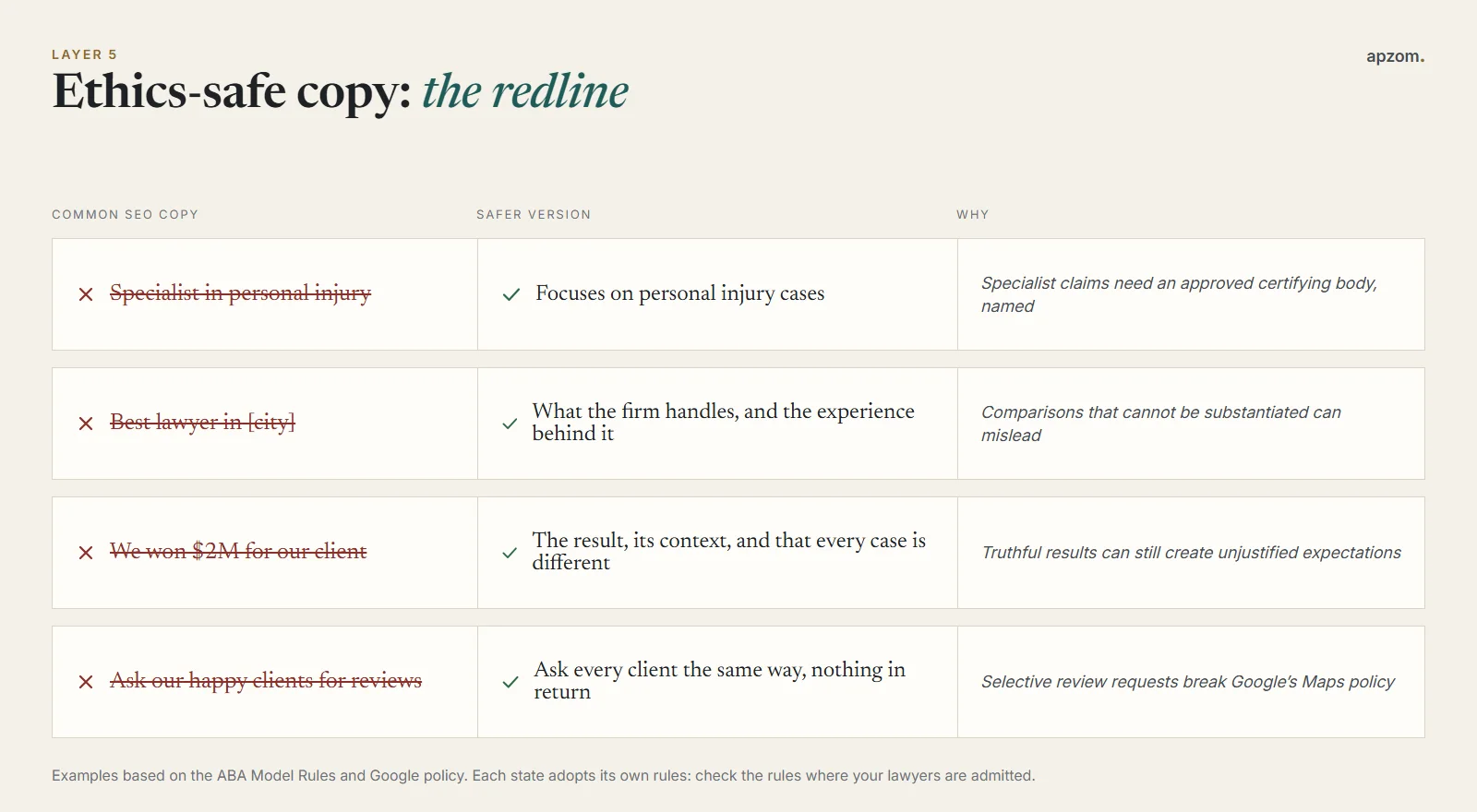
| Common SEO copy | The risk | Safer approach |
|---|---|---|
| “Specialist in personal injury” | ABA Model Rule 7.2(c) bars stating or implying certification as a specialist unless the lawyer is certified by an approved organisation, and that organisation is clearly named | “Focuses on personal injury cases”, or name the actual certification and certifying body |
| “We won $2 million for our client” | Comment 3 to Rule 7.1 says truthful reports of results can still mislead if they create unjustified expectations | Give context, explain that every case is different, and add qualifying language where your rules require it |
| “Best lawyer in [city]” | A comparison that cannot be factually substantiated can be misleading | Describe what the firm actually does and the experience behind it |
| Anonymous web copy | Rule 7.2(d) requires the name and contact information of at least one lawyer or firm responsible for the content | Show the responsible lawyer or firm on every page, usually in the footer |
| Reviews requested only from happy clients | Google’s Maps policy prohibits merchants from selectively soliciting positive reviews | Ask every client in the same way, and never offer anything in exchange for a review |
| Reviews quoted on practice pages without context | Testimonials can create the same unjustified expectations as results | Use them carefully, with any disclaimers your rules require |
State rules can add requirements
Some states add their own website rules. New York is a good example: its Rule 7.1(f) requires the label “Attorney Advertising” on the home page of a law firm website, and Rule 7.1(k) requires the firm to keep a copy of the website when it launches, after major changes, and at least every 90 days. If you practise in more than one state, the strictest applicable rule often decides what the site has to do.
Reviews and testimonials
Reviews matter for local search and for trust, and they come with rules:
- In the US, the Federal Trade Commission’s rule on consumer reviews and testimonials, in force since 21 October 2024, bans fake reviews and bans offering incentives for reviews that are conditioned on them being positive or negative.
- Google’s Maps policy says businesses may not discourage or prohibit negative reviews, or selectively solicit positive ones. The FTC has also said that review gating can breach the wider FTC Act even though its review rule does not cover it directly.
- Responding to a negative review must not reveal confidential client information. ABA Formal Opinion 496 (2021) deals with this directly: the safest reply is usually short, polite and says nothing about the matter.
Outside the US
- England and Wales: the SRA Transparency Rules require firms offering certain services, including conveyancing, probate, employment tribunal claims, immigration and some debt recovery and road traffic work, to publish price and service information on their website. Rule 4.1 also requires the SRA number and digital badge to be displayed prominently. These pages are a legal requirement first, but they also answer the cost questions searchers ask.
- India: Rule 36 of the Bar Council of India Rules prohibits advocates from advertising or soliciting work. A 2008 amendment allows a website that gives only specified information, such as name, contact details, enrolment, qualifications and areas of practice. Conventional SEO tactics, blog marketing and promotional landing pages can conflict with that. Indian firms should take advice before doing any of it.
Want a second pair of eyes on your site? A Law Firm SEO Audit checks all seven layers, flags advertising rule questions for your lawyers to decide, and gives you a fix list in order of risk and value.
Layer 6: Technical health
Technical SEO for law firms is mostly ordinary technical SEO, with a few traps specific to how firms run their sites.
- One URL per page, one page per intent. Duplicate practice pages, old campaign landing pages left indexable, and “/practice-areas/” plus “/services/” versions of the same content split signals.
- Call tracking that does not break your details. Dynamic number insertion should swap numbers for visitors, but the phone number search engines see in the page code, your Google Business Profile and your directory listings should be the firm’s main number.
- Chat and intake widgets. Third-party chat tools can slow pages badly on phones. Load them after the main content, and check that the site still responds quickly to taps.
- Forms that do not collect too much. ABA Formal Opinion 10-457 notes that websites inviting enquiries may create a prospective client relationship under Rule 1.18. Keep first-contact forms short and avoid asking for detailed facts before a conflict check. Our law firm marketing guide covers conflict-safe intake in more detail.
- Mobile first. Many people searching for a lawyer are on a phone, often at a stressful moment. Tap-to-call, readable text and a fast first screen matter more than design flourishes.
- Indexing hygiene. Thank-you pages, internal search results, staging sites and tag archives should not be indexed. Check Search Console for pages that are crawled but not indexed, which often points to thin or duplicate practice content.
Structured data for law firms
Schema.org has a LegalService type, a kind of LocalBusiness, that fits a law firm’s office. Its older Attorney type is deprecated; Schema.org says LegalService “is more inclusive and less ambiguous”. Use Organization or LegalService for the firm and its offices, Person for lawyers, and BreadcrumbList and Article where they fit.
Two cautions. Google has no special rich result for law firms, so structured data helps understanding rather than earning a special display. And reviews a firm publishes about itself on its own site are not eligible for review stars in Google’s results, so adding rating markup to your homepage will not produce stars and can look like manipulation.
Layer 7: Authority and links
Search engines treat a firm as an authority when credible, relevant sources treat it as one. For law firms, the best links come from real professional activity:
- Bar associations, law schools and legal publications where lawyers write, teach or speak.
- Local news, where lawyers comment on legal developments in their field.
- Community organisations the firm genuinely supports.
- Original legal analysis or data that others cite.
What to avoid: private blog networks, paid guest posts, link exchanges and mass directory submissions. Google’s spam policies treat buying or selling links for ranking purposes as link spam. If the firm pays for a directory placement or a sponsorship, the link should carry a rel=”sponsored” attribute, which Google asks for on advertisements and paid placements.
Be careful with paid awards and “top lawyer” badges. Displaying one can raise the same questions as any comparison claim, and some state rules restrict how such awards may be described.
Measuring law firm SEO: from search to signed matter
Rankings and traffic are early signals, not results. A firm that ranks first for “lawyer” in a city it does not serve has gained nothing.
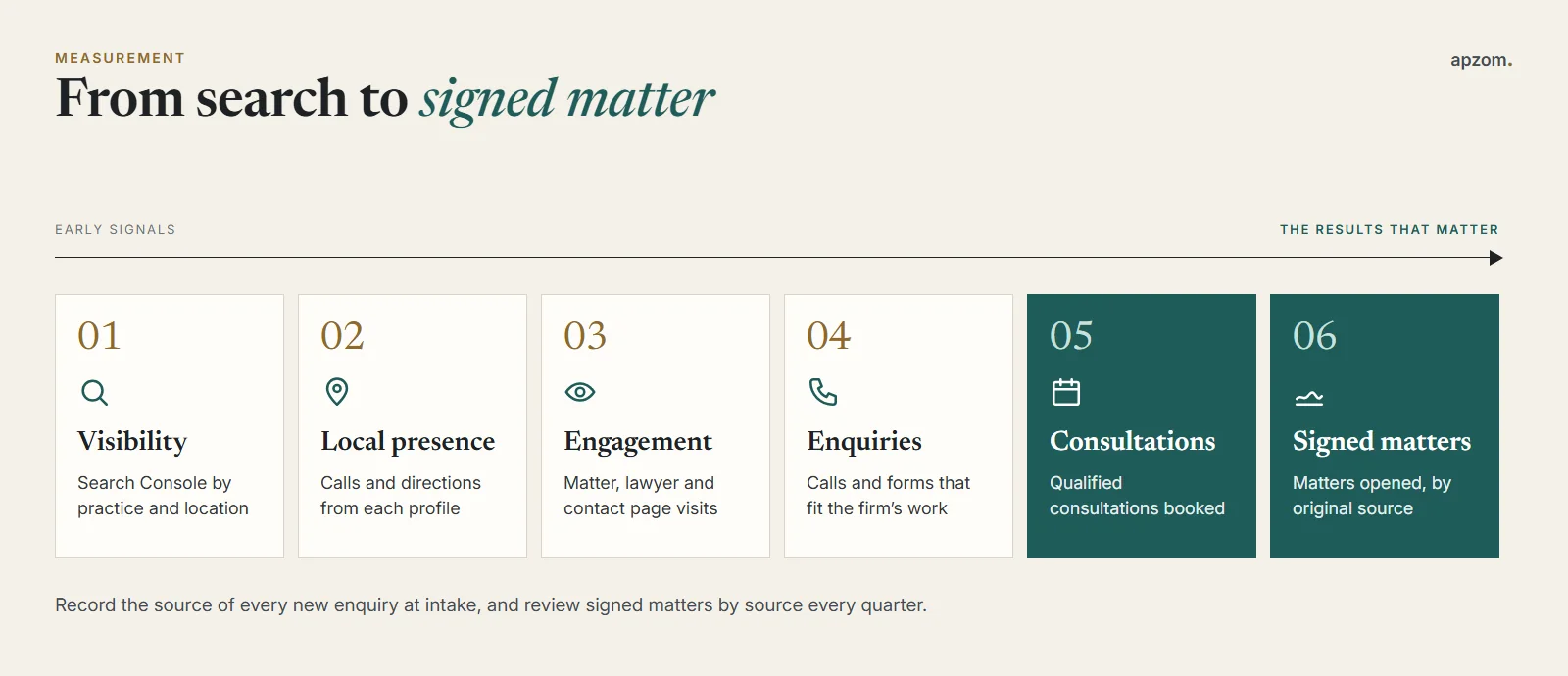
| Stage | What to measure | Where to find it |
|---|---|---|
| Visibility | Impressions and clicks by practice area and location | Google Search Console, filtered by page section |
| Local presence | Calls, direction requests and website clicks from each profile | Google Business Profile performance |
| Engagement | Visits to matter pages, lawyer pages and contact pages | Analytics |
| Enquiries | Calls and forms by practice area, and how many fit the firm’s work | Call tracking and the intake system |
| Consultations | Qualified consultations booked | Intake or practice management system |
| Signed matters | Matters opened, by original source | Practice management system |
The last two rows are the ones that matter, and they need a habit: record the source of every new enquiry in intake, and review signed matters by source every quarter.
Google Search Console now also reports how often a site appears in Google’s generative AI features. These are impressions only, so read them as visibility data alongside the rows above.
SEO for AI search and answer engines
People now ask AI tools legal questions before they ever contact a lawyer. Nobody can promise that a firm will be cited in AI Overviews, ChatGPT or similar tools, and an agency that does is overselling.
Google’s own guidance says there are no additional requirements to appear in AI Overviews or AI Mode, and no special optimisation is necessary. The same foundations apply: accurate, jurisdiction-specific answers, clear authorship by real lawyers, consistent firm and lawyer information across the web, and pages that answer a question directly before explaining it. If you want to go further, our answer engine optimisation and generative engine optimisation services build on exactly these foundations.
A 90-day law firm SEO plan
Days 1 to 30: audit and fix the foundations
- Run the seven-layer audit above and list issues by risk: ethics first, then structure, then technical.
- Fix advertising rule issues on existing pages, profiles and review requests.
- Clean up Google Business Profiles: names, categories, offices and practitioner profiles.
- Set up enquiry source tracking in intake.
Days 31 to 60: rebuild the money pages
- Restructure the most valuable practice area into a hub with matter pages.
- Rebuild lawyer pages for the lawyers in that practice.
- Add jurisdiction labels, reviewer names and genuine review dates to legal content.
Days 61 to 90: build authority
- Publish the first few decision-stage guides for that practice, written or reviewed by its lawyers.
- Start one real authority activity: a talk, a column, local media commentary or original analysis.
- Review enquiries and consultations by source, then choose the next practice area.
Choosing a law firm SEO agency
Questions to ask
- How do you check our content against the advertising rules in our jurisdictions?
- Who writes legal content, and how do our lawyers review it?
- Will you create pages for places where we have no office?
- How do you handle reviews and review requests?
- How will you report on consultations and signed matters, not just rankings?
- What would you not do for us, and why?
Red flags
- Guaranteed first-page rankings or a guaranteed number of cases.
- City pages for towns where the firm has no office.
- Content written with no lawyer review.
- Links bought from networks or “guest post” packages.
- Fake reviews, review gating or review incentives.
- Rating stars added to the firm’s own pages.
How Apzom can help
Apzom Digital’s SEO services start with an audit very close to the seven layers in this guide. For law firms we focus on practice architecture, lawyer pages, local SEO, technical health and content governance that a firm’s lawyers can actually maintain. We write and structure content, but substantive legal content must be reviewed by the firm’s own lawyers, and we flag advertising rule questions for the firm to decide rather than deciding them ourselves. You can read how we approach search in our SEO methodology.
We will not promise rankings, cases or AI citations. What we can promise is a clear, prioritised list of what is holding your site back, and a plan to fix it in the right order.
Request a Law Firm SEO Audit. We review your practice architecture, lawyer pages, Google Business Profiles and office pages, content governance, copy that may raise advertising rule questions, technical health, links, and how enquiries are tracked to signed matters. You get a prioritised list of what to fix first and why.
The audit is free, with no obligation and no guaranteed rankings. Prefer to talk it through? Contact us or see all our services.
Frequently asked questions
How long does SEO take for a law firm?
Fixes to Google Business Profiles and technical problems can show results within weeks. Rebuilding practice areas and earning authority usually takes several months, and competitive practices in large cities take longer. Judge progress by qualified consultations over quarters, not rankings week to week.
Is SEO or Google Ads better for law firms?
They do different jobs. Google Ads captures urgent searches immediately, at a cost per click that can be high. SEO builds visibility that keeps working, but it takes time. Many firms use ads for urgent, high-value matters while SEO builds, then rebalance based on which brings signed matters.
Do law firms need a blog?
Not a blog in the sense of regular general posts. Firms need useful guides that answer the questions clients ask before hiring, written or reviewed by lawyers and linked to the matching practice pages. A few strong guides beat many thin posts.
Can a law firm use the word “specialist” on its website?
In US states that follow ABA Model Rule 7.2(c), a lawyer should not state or imply that they are a certified specialist unless they are certified by an approved organisation, and that organisation is clearly named. Other jurisdictions have their own rules. Words like “focuses on” are usually safer.
Should every lawyer have their own Google Business Profile?
Not automatically. Google allows public-facing lawyers at a shared office to have their own profile alongside the firm’s, and a solo lawyer under a firm brand should share one profile with the firm. Create individual profiles only where clients search for that lawyer by name.
Can we ask clients for Google reviews?
Yes, if you ask every client in the same way. Do not ask only happy clients, do not offer anything in exchange for a review, and never post or buy fake reviews. When you reply to reviews, never reveal anything about the client’s matter.
Should we create pages for every city near our office?
Only for places where you have a genuine office or a real, specific reason to have a page with different, useful content. Near-identical city pages are treated as doorway pages by Google and can mislead people about where you can help them.
Does schema markup help law firms rank?
Structured data helps search engines understand the firm, its offices and its lawyers. It does not create rankings by itself, there is no special rich result for law firms, and adding review stars about yourself will not show in Google.
How do AI search tools affect law firm SEO?
People increasingly ask AI tools legal questions first. The same foundations help: accurate, jurisdiction-specific answers, named lawyer authors, and consistent firm information. Nobody can guarantee AI citations.