The short answer: Google Ads management cost is the fee you pay an agency or freelancer to run your campaigns. It is separate from your ad spend, which is the money Google charges for clicks. Agencies price management as a flat monthly fee, a percentage of ad spend, a hybrid of the two, tiers by spend, an hourly rate or a performance fee, and some add a one-off set-up fee. We found no regulator survey, Google report or other sound source that publishes what agencies typically charge, so the useful question is not “what is the average price?” but “what will each quote cost me in total at my budget, what work does it include, and who owns the account?”
This guide is for business owners and marketing leads anywhere in the world who are comparing Google Ads quotes, or wondering whether the fee they already pay is fair. It explains the six fee models and what each one rewards, two simple tests for comparing quotes that are built differently, what Google requires of agencies that manage accounts for clients, the extra charges that sit on the Google side in some countries, and the questions to ask before you sign. Google’s policies and help pages were checked on 26 October 2026.
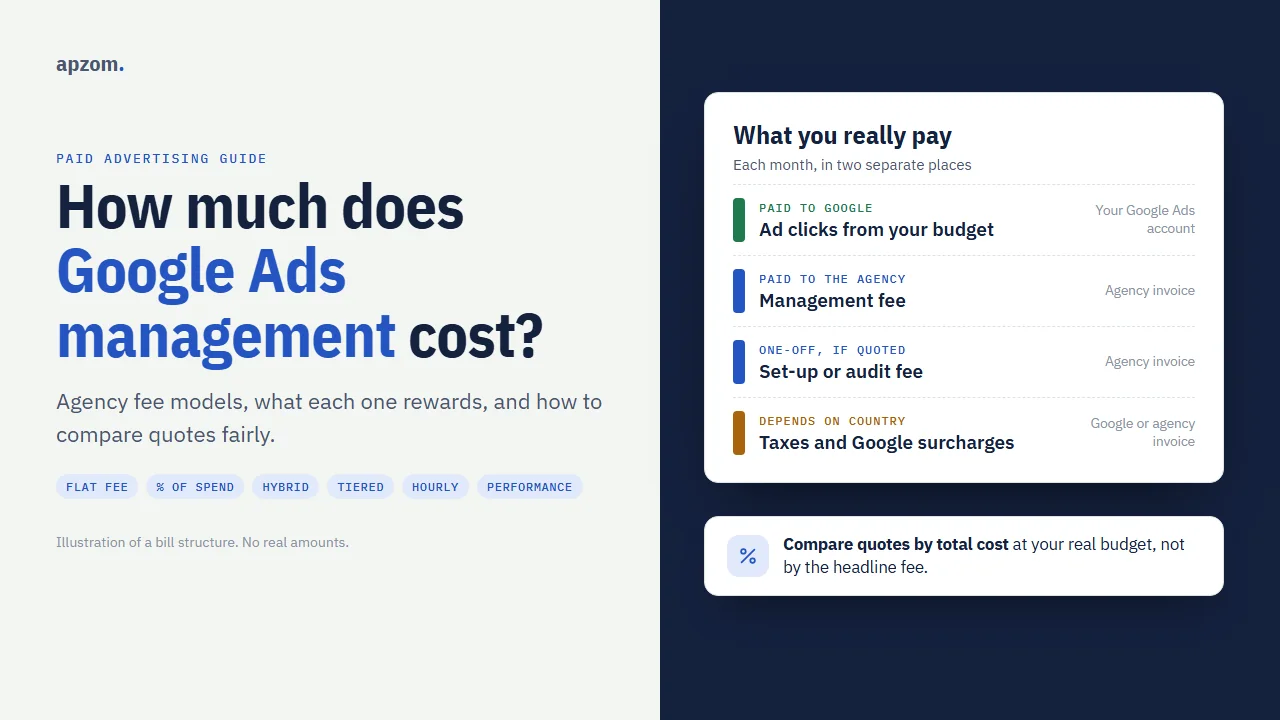
Two different bills: the management fee and your ad spend
Every Google Ads arrangement has two kinds of cost, and good quotes keep them apart.
- Ad spend is what Google charges for your ads: clicks (or, for some campaign types, impressions or views). It is set by your budget and bids, and it goes to Google.
- The management fee is what you pay a person or agency for the work: building campaigns, choosing keywords and bids, writing ads, excluding wasted searches, checking tracking and reporting. It goes to the agency.
On top of those, you may see a one-off set-up or audit fee, taxes, and in some countries a Google surcharge on the ad spend itself (covered below). Extra work such as landing pages, video or design is often priced separately.
Ad spend has its own rules, which are sometimes mistaken for agency charges. You set an average daily budget, and on a given day Google can spend up to twice that amount, but over a month you will not be charged more than 30.4 times your average daily budget. Google also filters invalid clicks automatically and credits invalid activity it finds after billing (Google Ads Help).
Keeping the two bills apart matters for three reasons. You can see what each part costs. You can change your budget without renegotiating the fee, or the other way round. And you can check that the money meant for Google actually reached Google. Google’s own rules for agencies push the same way, as the section on Google’s requirements explains.
The six ways agencies charge for Google Ads
Quotes usually use one or more of six models. None is right or wrong in itself; each rewards different behaviour, and that is what you should judge.
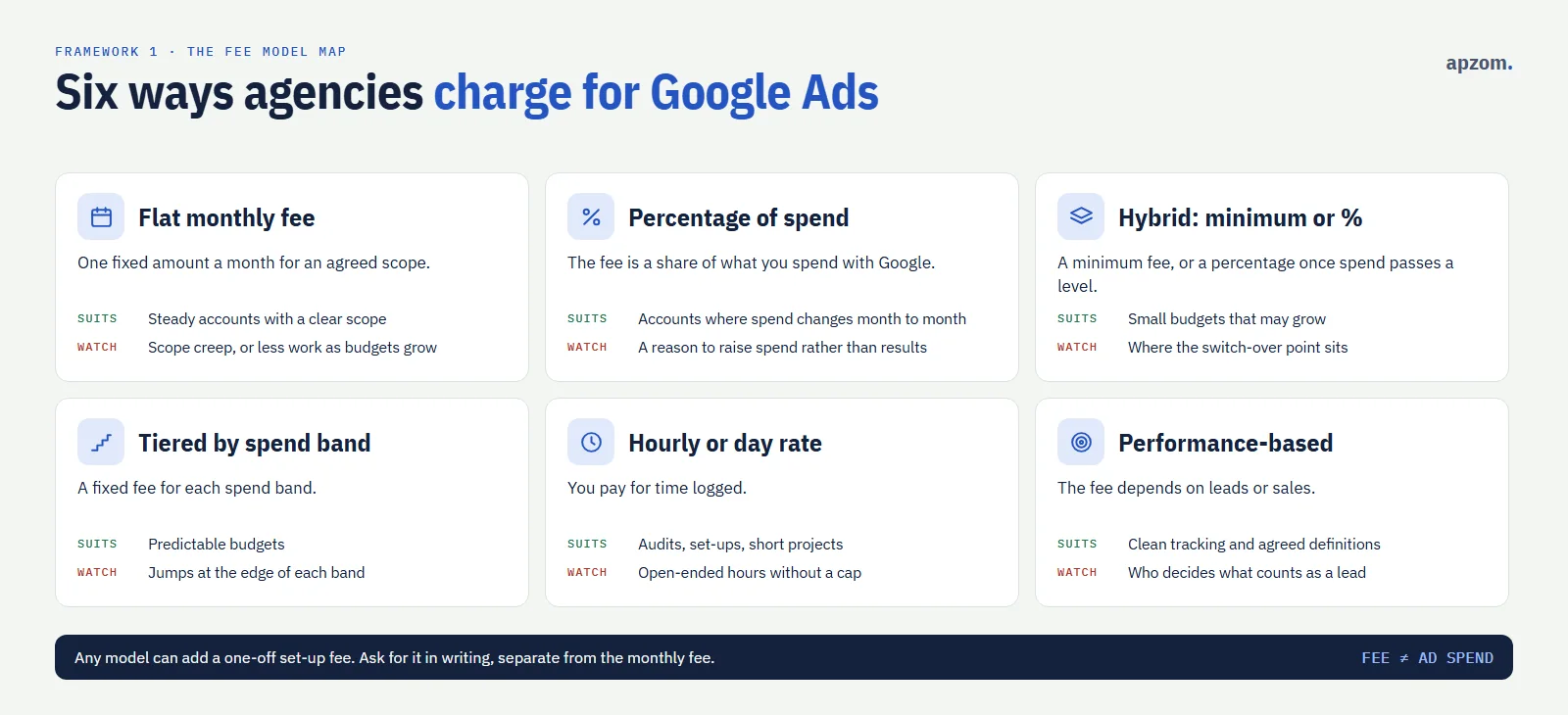
| Fee model | How it works | Suits | What to watch |
|---|---|---|---|
| Flat monthly fee | A fixed amount each month for an agreed scope | Steady accounts with a clear, written scope | Scope creep, or less attention as your budget grows |
| Percentage of ad spend | The fee is a share of what you spend with Google | Accounts whose spend changes a lot from month to month | The agency earns more when you spend more, whether or not results improve |
| Hybrid | A minimum monthly fee, or a percentage once spend passes a level | Small budgets that may grow | Where the switch-over point sits, and what happens if spend falls |
| Tiered by spend band | A fixed fee for each band of monthly spend | Budgets that are predictable | Fee jumps at the edge of each band |
| Hourly or day rate | You pay for time logged | Audits, set-ups, one-off projects | Open-ended hours with no cap or estimate |
| Performance-based | The fee depends on leads, sales or another result | Businesses with reliable tracking and clear definitions | Who decides what counts as a lead, and whether low-quality leads still get paid for |
The incentive problem with percentage of spend
Percentage-of-spend pricing is common because it scales: a bigger account usually takes more work. Its weakness is the incentive. Under a pure percentage, the agency’s income rises when your spend rises, even if the extra spend buys nothing useful. You should not have to rely on good intentions. If you choose a percentage model, agree in writing who decides budget increases, and judge every increase by cost per qualified lead or sale, not by clicks or impressions.
Performance fees need clean tracking first
Paying per lead or per sale sounds safe, because you pay only for results. In practice it moves the argument to definitions. Is a form filled in by a competitor a lead? A duplicate? A call that lasted ten seconds? Performance pricing works only when conversion tracking is accurate, every lead can be checked against your inbox or CRM, and both sides have agreed in writing what counts. Without that, it is the model most likely to end in a dispute.
Set-up fees
Many agencies charge a one-off fee to audit an existing account, fix conversion tracking and rebuild campaigns. That can be fair: the first month is usually the most work. Ask for a written list of what the set-up covers, whether the campaigns and assets it creates stay in your account if you leave, and whether it overlaps with the first month’s management fee.
Why we do not quote an “average” price
Search for Google Ads management cost and you will find confident price ranges. We checked for a source we could stand behind: Google does not publish what agencies charge, and its own page on working with a Google Partner tells advertisers to ask partners directly about their fees. We found no regulator or government survey of agency fees, and the ranges we found on agency and software blogs did not say how many agencies were asked, in which countries or when. So we will not give you a number that looks precise but is not. Instead, the two tests below let you judge any quote in your own currency.
What drives the price, so you can tell whether a quote is in proportion to the work:
- How many campaigns and campaign types. Search alone is less work than Search plus Shopping, Performance Max, Demand Gen, video and remarketing.
- How many markets and languages. Each country or language needs its own keywords, ads, exclusions and often its own budget.
- Tracking work. Setting up and checking conversion tracking, offline conversion imports and call tracking takes real time, especially the first time.
- Creative. Writing ads is usually included; producing images, video and landing pages often is not.
- How often someone looks. Weekly search-term reviews cost more than a monthly check, and search terms are often where wasted spend shows up.
- Seniority. Who actually does the work, and whether the person who sold you the service is the person who manages your account.
- Where the agency is based. Rates differ a great deal between countries. A lower day rate is not a lower total cost if the work takes longer or needs redoing.
Test 1: cost every quote at three budgets
Quotes built on different models cannot be compared by their headline numbers. “1,000 a month” and “15% of spend” sound different, but which is cheaper depends entirely on your budget. The fix is simple: work out the fee for each quote at your real budget, at half that budget and at double, and add the ad spend to get the total.
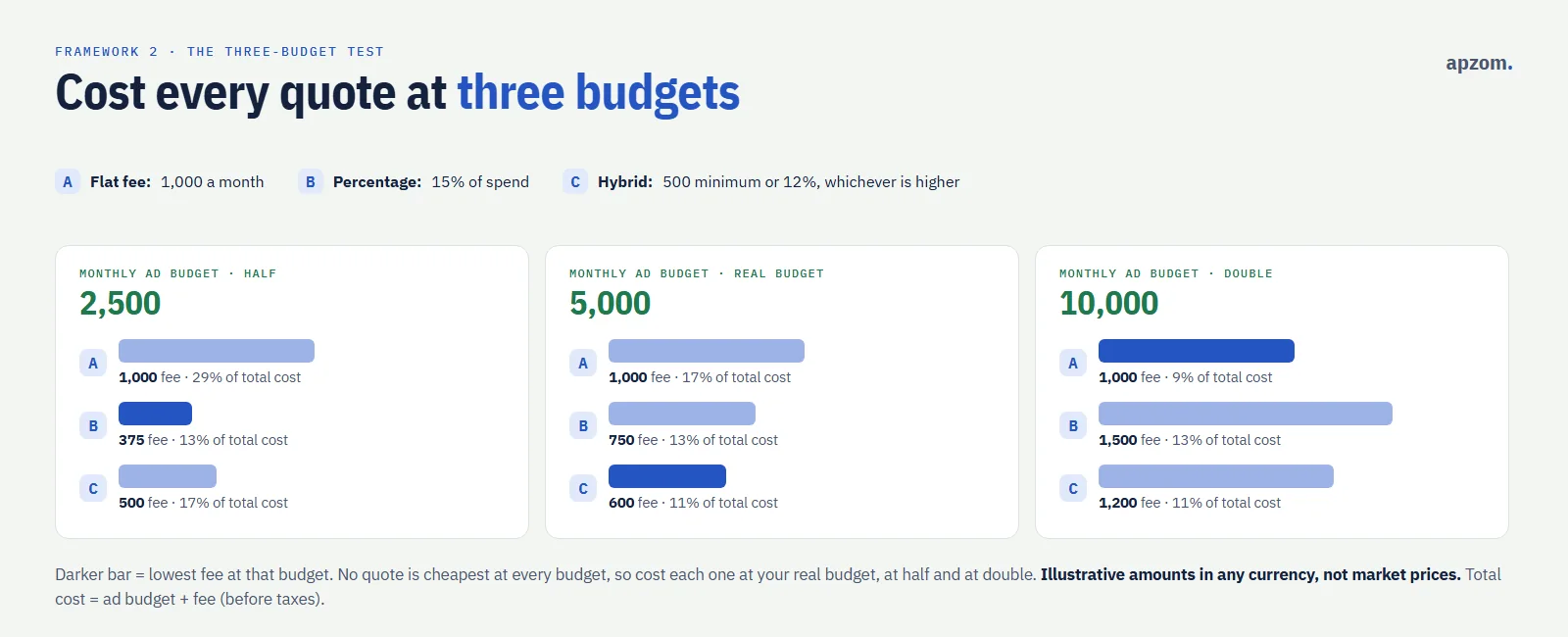
Here is an illustrative example in any currency, for a business with a real budget of 5,000 a month. Quote A charges a flat 1,000 a month, B charges 15% of spend, and C charges a 500 minimum or 12% of spend, whichever is higher. These are invented numbers to show the method, not market prices.
| Monthly ad budget | Quote A fee (flat) | Quote B fee (15%) | Quote C fee (500 or 12%) |
|---|---|---|---|
| 2,500 (half) | 1,000 (29% of total cost) | 375 (13%) | 500 (17%) |
| 5,000 (real budget) | 1,000 (17%) | 750 (13%) | 600 (11%) |
| 10,000 (double) | 1,000 (9%) | 1,500 (13%) | 1,200 (11%) |
“Total cost” here means ad budget plus fee, before taxes. Three things stand out:
- No quote is cheapest at every budget. B is cheapest at 2,500, C at 5,000 and A at 10,000.
- A flat fee is a large share of a small budget. At 2,500 a month, more than a quarter of everything you spend goes on management, so the campaigns have to work hard to pay for it.
- A percentage fee never gets cheaper as a share. At 15%, the fee is always 13% of the total, however large the account grows, even though the work rarely grows at the same rate.
Test 2: work out the implied hourly rate
The three-budget test tells you what you pay. This one tells you what you get for it. Ask each agency to estimate, in writing, how many hours a month it expects to spend on your account, and what those hours cover. Then divide the monthly fee by the hours.
For example, with illustrative numbers: a fee of 1,000 for an estimated 8 hours is 125 an hour, while a fee of 750 for an estimated 4 hours is 187.50 an hour. The cheaper quote buys less time. Compare the implied rate with what freelancers or consultants charge in your own market, and ask what happens to the hours when your budget changes. An agency that cannot estimate its hours at all may not have planned the work.
Run both tests on the quotes on your desk, then compare what each one includes. A cheaper quote that excludes tracking, landing-page advice or regular search-term reviews may cost more in wasted clicks than it saves in fees.
Comparing Google Ads quotes, or unsure what your current fee buys? A Google Ads Fee and Account Review checks who owns your account, what you pay Google and what you pay for management, and what work the fee actually covers.
What Google requires of agencies that manage your account
Google has a third-party policy for agencies, resellers and anyone else who manages Google Ads for other businesses, and a separate page of transparency requirements that goes with it. They give you useful rights. Under Google’s third-party policy and transparency requirements (Google Ads policy help, checked 26 October 2026):
- Fees in writing. If the agency charges a management fee on top of your Google Ads costs, it must tell you in writing, before your first purchase and on every invoice, that it charges a fee.
- Your customer ID. It must give you your Google Ads customer ID if you ask. This is the 10-digit number, shown as 123-456-7890, that identifies your account.
- Honest reports. If its contract includes monthly reports, those reports must show cost, clicks and impressions for your account, and the cost must be exactly what Google charged, without the agency’s fees mixed in.
- One account per advertiser. Agencies must use a separate Google Ads account for each business they manage, not one shared account.
- No false claims. Agencies must not make false, misleading or unrealistic claims. Google’s own advice to advertisers adds that no one can guarantee a particular ad position, and that if someone says they work for Google, you can ask them to email you from an @google.com address.
If an agency will not tell you its fee in writing or will not give you your customer ID, treat that as a reason not to sign.
Own the account, rent the expertise
The single most important term in any Google Ads agreement is ownership. Your account holds your conversion data, your audiences, your search-term history and your ad approvals. If the agency owns it, leaving can mean starting again.
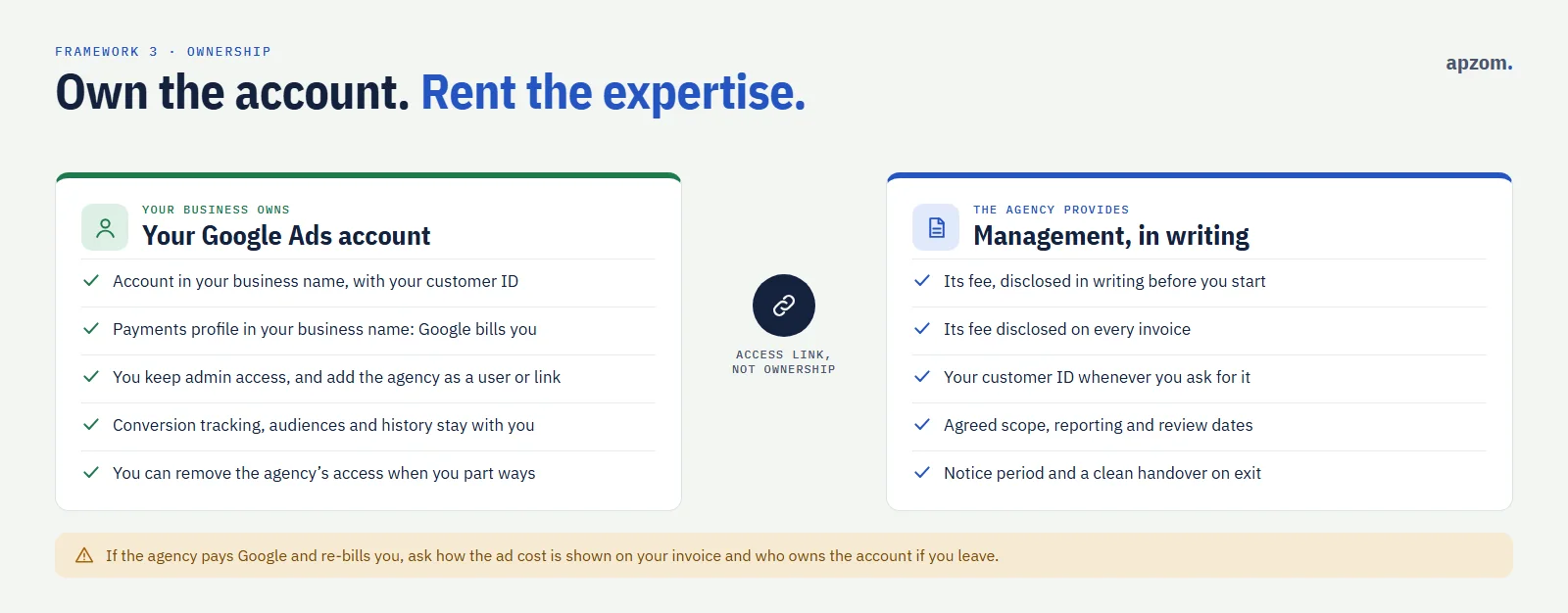
A sound set-up looks like this:
- The account is in your business’s name, and you hold Admin access.
- The agency gets access, not ownership. Google Ads has five access levels: Admin, Standard, Read-only, Billing and Email-only. Agencies usually link your account to their own manager account, or are added as users.
- You can remove the agency at any time. A user with Admin access on your account can remove a manager account under Admin, then Access and security, then Managers. Google’s help on manager accounts says a manager’s ownership link does not take data ownership away from the client account, which can remove that access by unlinking.
- Your data stays with you. Conversion tracking, audiences and history live in your account, so a new agency can pick up where the last one stopped.
Who pays Google
The payments profile records the person or company legally responsible for paying Google. The cleanest arrangement is a payments profile in your business’s name, so Google bills you directly and you can see every charge.
Some agencies pay Google themselves and re-bill clients, for example through Google’s consolidated billing, which gives an agency one invoice for many client accounts. Google says consolidated billing is not available to media agencies or to advertisers in France. If an agency pays Google for you, ask how the Google cost appears on your invoice, whether anything is added to it, and who owns the account and its history if you leave.
Extra charges on the Google side, by country
Even a clear agency quote does not show everything you will pay, because some charges come from Google and depend on where your ads run and where your business is registered. Check these with your accountant.
Google surcharges on ad costs. Google adds a regulatory operating cost or digital services tax fee to ads served in some countries. It depends on where the ad is shown, not where your business is based. According to Google Ads Help’s page on jurisdiction-specific surcharges, checked 26 October 2026:
| Where the ad is served | Until 31 December 2026 | From 1 January 2027 |
|---|---|---|
| United Kingdom | 2% | 2% |
| Austria | 5% | 5% |
| Spain | 3% | 3% |
| France | 2% | 3% |
| Italy | 2.5% | 3% |
| Turkey | 4.5% | 2.5% |
| Canada | None (removed) | None |
| India | None (removed September 2024) | None |
Tax on the ad spend itself:
- US: we did not find a US-wide statement on Google Ads Help, and state rules differ, so ask your accountant.
- EU: for business accounts billed by Google Ireland, Google does not add VAT; you self-assess VAT at your own country’s rate under the reverse charge (Google Ads Help).
- UK: Google Ads Help does not publish a UK-specific statement. Under HMRC’s general rule, a VAT-registered UK business buying business services from a supplier outside the UK usually accounts for the VAT itself under the reverse charge.
- India: Google Ads is billed with 18% GST (IGST, or CGST and SGST for bill-to addresses in Haryana); advertisers in special economic zones pay 0%. For services received from Google Asia Pacific, Google says 18% GST is charged unless you provide a valid GSTIN (Google Ads Help).
- Australia: 10% GST applies to accounts with Australian business addresses (Google Ads Help).
- Canada: GST/HST applies to Canadian billing addresses that have not added a GST/HST registration number, and Québec adds QST at 9.975% (Google Ads Help).
- UAE: under Federal Tax Authority rules, a VAT-registered business receiving services from a supplier outside the UAE usually accounts for 5% VAT itself under the reverse charge.
The agency’s own fee is a separate service, and it may carry its own sales tax: for example, the UK standard VAT rate is 20%, most business services in India usually carry 18% GST, Australia’s GST is 10% and the UAE’s VAT is 5%. Whether it applies depends on where the agency and your business are registered, so ask for every quote with and without tax.
What a management fee should pay for
Ask every agency for a written scope. A Google Ads management fee would normally cover most of the following, at a stated frequency:
- Search-term reviews and exclusions. Regularly reading the searches that triggered your ads and excluding irrelevant ones.
- Conversion tracking checks. Making sure what Google counts as a conversion matches the enquiries and sales you actually receive.
- Bidding and budgets. Choosing and monitoring bid strategies, and pacing spend across the month.
- Ads and assets. Writing and testing ads, sitelinks and other assets, and fixing policy disapprovals.
- Automation oversight. Reviewing what automated features and Google’s recommendations change in your account, rather than accepting them blindly.
- Landing-page feedback. Pointing out where the page people land on loses them. Building new pages is often extra.
- Reporting. A regular report in plain language: spend, conversions, cost per conversion, what changed and what is next.
Automation changes what you pay a manager for rather than removing the need for one. Google Ads can apply some of its recommendations automatically (“auto-apply”); this is set at account level and can be switched on or off at any time on the Recommendations page. Optimization score, which agencies sometimes quote, is Google’s estimate of how well an account is set up to perform, based on its recommendations; it is not a report of results, and Google says it is not used in Quality Score.
Google is also moving Search campaigns towards AI Max, a set of features inside Search campaigns rather than a new campaign type. Google said campaigns using automatically created assets or campaign-level broad match would be auto-upgraded starting in September 2026, and that the Dynamic Search Ads upgrade would begin in February 2027 (Google Ads blog, updated 11 June 2026). In our view, management time moves from building keyword lists towards supplying good assets, landing pages and conversion data, and reading search terms.
If you want the agency to run other platforms too, such as Microsoft Advertising or Meta, ask whether that is in the same fee.
Red flags in a Google Ads quote
- Guaranteed positions or results.
- The agency owns the account, or will not say who does.
- A long minimum term with no exit route, especially combined with a large set-up fee.
- Reports full of clicks and impressions, with no conversions or cost per lead.
- Read-only access for you when you asked for admin.
- Vague scope: “full management” with no list of tasks, review frequency or estimated hours.
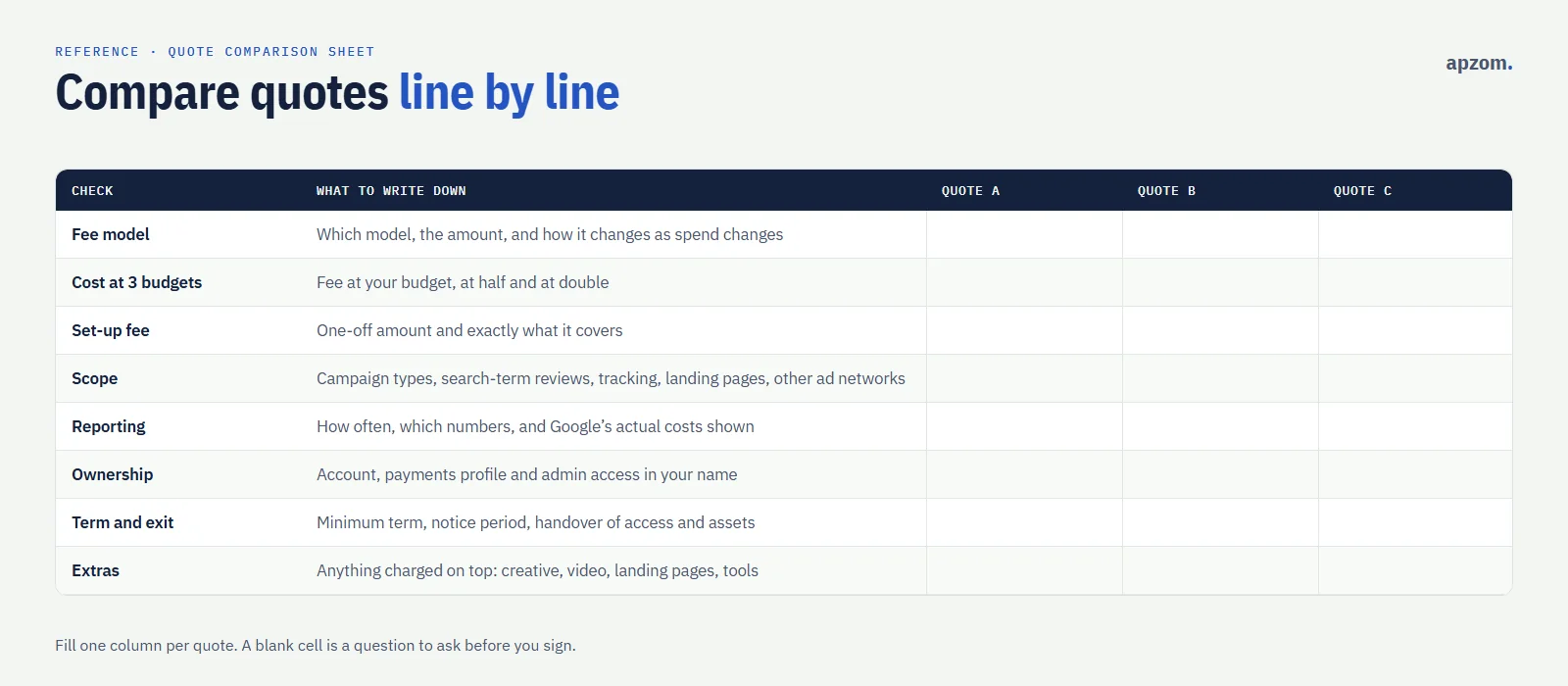
Compare quotes line by line
Use the sheet below for every quote you receive. A blank cell is a question to ask before you sign.
Ten questions worth asking every agency:
- Which fee model do you use, and what would the fee be at my budget, half of it and double?
- How many hours a month do you expect to spend on my account, and on what?
- Is there a set-up fee, and what exactly does it cover?
- Will the Google Ads account and the payments profile be in my business’s name, with admin access for me from day one?
- Will your fee be disclosed on every invoice, and will reports show Google’s cost without your fee mixed in?
- Who will actually manage my account, and how often will they look at it?
- How do you check that conversions in Google Ads match the enquiries I really receive?
- Which automated features and recommendations do you turn on, and how do you review them?
- What is the minimum term and the notice period, and what do I keep if I leave?
- What will you report each month, and what decisions will you ask me to make?
How to tell whether the fee is worth it
A management fee is worth paying when the campaigns earn more, after the fee, than they would without it. You can check that with three numbers:
- Fee as a share of total cost, month by month. If it stays high while the account is stable, the arrangement may need to change.
- Cost per qualified lead or sale, using your own records, not only Google’s conversion count. Mark each enquiry as good, poor or spam.
- Profit from the leads or sales, when you can track them through to revenue. Our guide on how to measure marketing ROI shows how.
Agree a review point, for example after three months, when both sides look at these numbers and decide what to change. If you are still deciding whether paid search is right for you at all, read SEO vs Google Ads. If you want to understand the set-up yourself first, our Google Ads guide for small businesses walks through it, and our guide to choosing a digital marketing agency covers agency selection across all channels. For the SEO side of the budget, see how much SEO costs.
Doing it yourself, a freelancer or an agency
| Option | Usually suits | Main trade-off |
|---|---|---|
| Doing it yourself | Small budgets, simple Search campaigns, owners with time to learn | Your time, and mistakes that cost money while you learn |
| A freelancer | Single-market accounts that need hands-on attention | Holidays, illness and limited capacity; check who covers |
| An agency | Several campaign types, markets or channels, or tracking work | Higher fees; check who actually does the work |
Whichever you choose, the rules are the same: your account, your payments profile, written scope and fees, and numbers you can check.
How Apzom can help
Apzom Digital manages Google Ads as part of our performance marketing service. Our work starts with an account audit, assessing structure, waste and missed opportunity before any spend changes, and the account, its history and its data remain yours whether or not you continue working with us. Like any agency that charges a management fee, we are required by Google to disclose it to you in writing.
We have not published Google Ads client results yet, so we will not show you any. Our published paid-media results are from Meta ads: HillTown Group, with 600+ leads every month from Meta ads, for 12 months running, and Kingston Flats, with 560+ Meta leads every month since June 2025. You can read both on our case studies page. If you also want to improve the pages your ads send people to, see our conversion rate optimization service and our guide on what conversion rate optimization is.
We work with clients worldwide, remotely, from our base in Ahmedabad, India.
Request a Google Ads Fee and Account Review. We check account ownership and access, whether your conversion tracking matches the enquiries you really receive, how much of your spend goes on searches that never convert, and what your current or proposed fee covers. You get a written list of findings and, if you want us to manage the account, a scoped quote.
No obligation and no guaranteed results. Prefer to talk first? Contact us or see all our services.
Frequently asked questions
How much does Google Ads management cost?
It depends on the fee model, the scope and the size of your account. We found no reliable published survey of typical fees, so compare quotes by total cost at your own budget and by implied hourly rate, using the two tests in this guide.
Is the management fee included in my ad budget?
It should not be. Your ad budget is what Google charges for ads; the management fee is what the agency charges for the work. Google requires an agency that charges a fee to disclose it in writing, and any monthly report it provides must show Google’s cost without the agency’s fees.
Is a percentage of ad spend or a flat fee better?
Neither in every case. A flat fee is predictable but heavy on a small budget; a percentage scales but rewards higher spend. Run the three-budget test on your own quotes.
What is a reasonable set-up fee for Google Ads?
There is no standard figure. A set-up fee is reasonable when it pays for clearly listed work, such as an account audit, tracking fixes and a campaign rebuild, and when everything it creates stays in your account if you leave.
Does a Google Partner badge mean an agency is good?
It means the agency meets Google’s thresholds, which include an optimization score of at least 70% across its manager account, US$10,000 in ad spend across managed accounts over a rolling 90 days, and at least half of its account strategists certified in Google Ads. Premier Partners are the top 3% of participating companies in each country, decided each year. The badge shows activity and training, not results for businesses like yours. You can look an agency up in the Google Partners directory; agencies that opt out are not listed, so if one is missing, ask to see its badge status.
Can I change agencies without losing my Google Ads data?
Yes, if the account is yours: remove the old agency’s access and give the new one access. If the old agency owns the account, ask for ownership to be transferred before you leave.
Is there a minimum ad budget for Google Ads?
No. Google says there is no minimum spending commitment and you set your own budget. A budget can still be too small to learn from: if it buys only a handful of clicks a month, you will not have enough data to tell what works. Some agencies set their own minimum budget before they take on an account.