
The short answer: Keyword research for a small business is finding the words your customers actually use when they look for what you sell, then deciding which page on your site should answer each one. You do not need expensive tools to start. Begin with your customers’ own words, check demand and wording with free tools, sort the searches by what the searcher wants, map each group to one page, and prioritise the ones most likely to bring paying customers. Volume matters less than intent: a small number of searches from people ready to buy is worth more than a large number from people who are just curious.
This guide is for owners and marketers of small businesses in any country, whether you serve a local area or sell online. It walks through a step-by-step process, the free tools that help, how to match searches to pages, how to prioritise, and the mistakes to avoid.
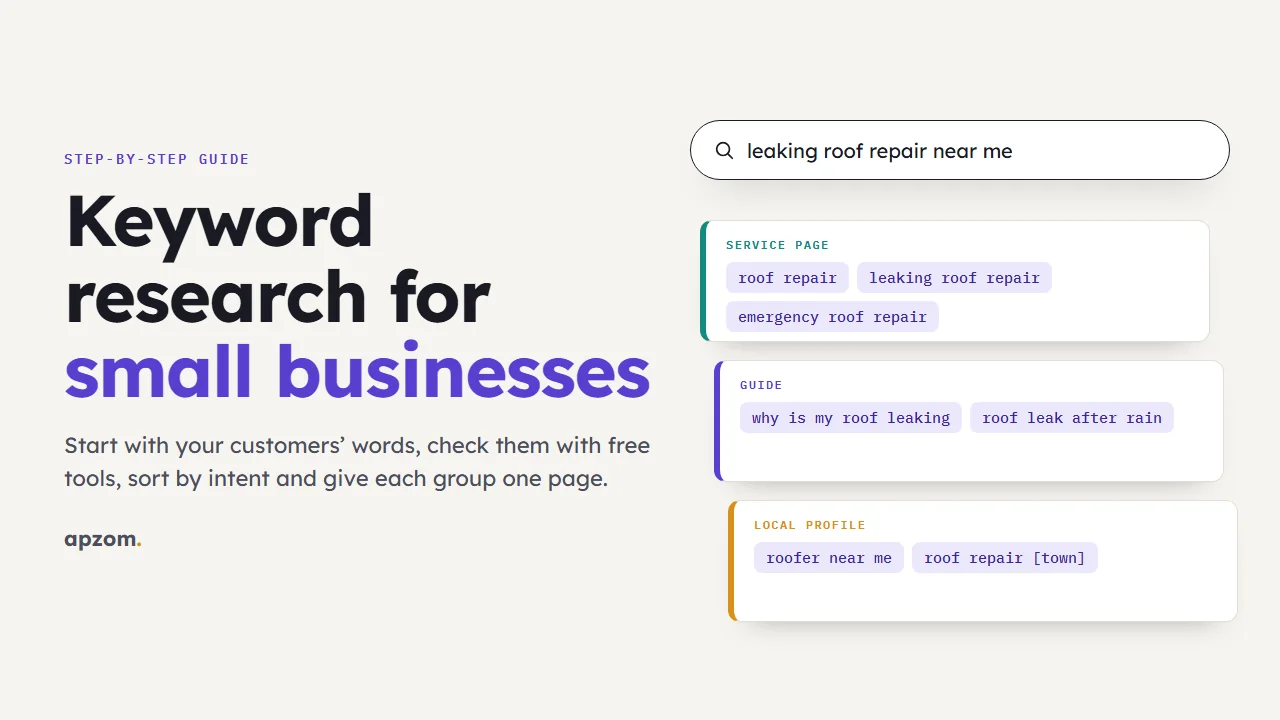
Step 1: start with your customers’ words
The first framework is customer-language mining. The best keyword ideas are already in your business.
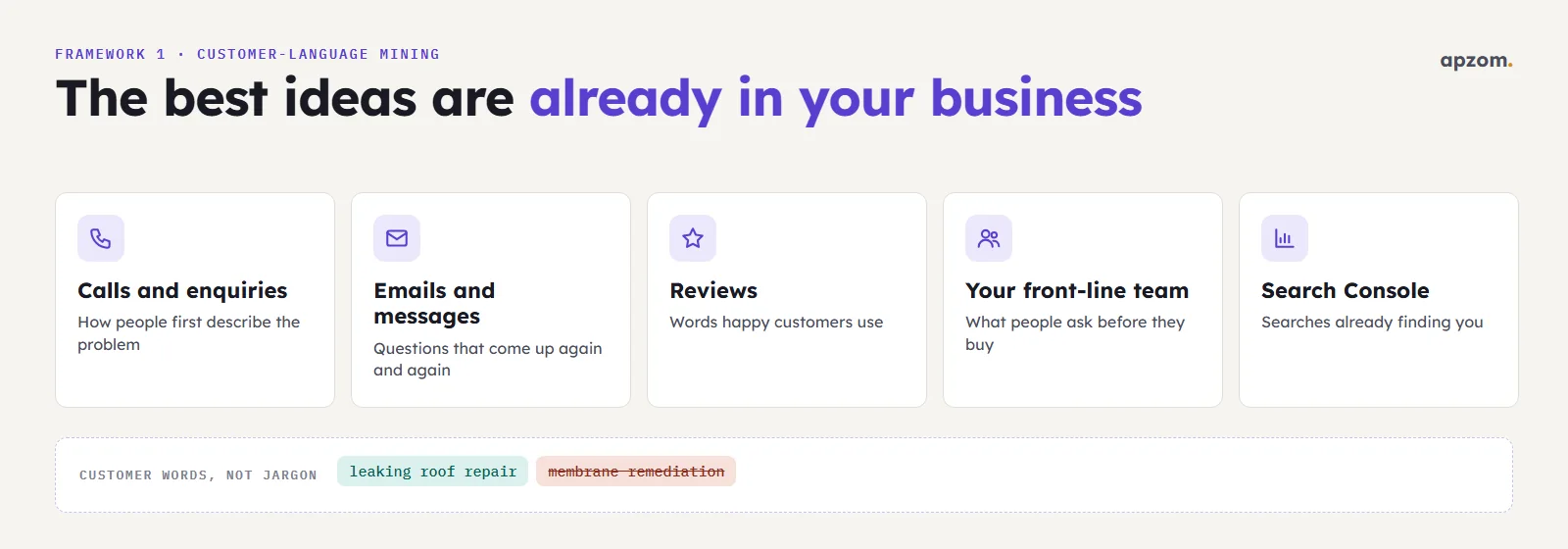
- Phone calls and enquiries: how do people describe their problem when they first get in touch?
- Emails and messages: what questions come up again and again?
- Reviews: which words do happy customers use about what you did for them?
- Your sales or front-desk team: what do people ask before they buy?
- Your own search data: if your site already exists, Google Search Console shows the searches people used to find you.
Write down everything, in the customers’ words, not your industry’s jargon. Customers search for “leaking roof repair”, not “membrane remediation”.
Step 2: check demand and wording with free tools
| Free tool | What it tells you | Watch out for |
|---|---|---|
| Google Keyword Planner | Google calls it a free resource for building keyword lists. Its “Discover new keywords” and “Get search volume and forecasts” features suggest related searches and show average monthly searches for the locations and languages you choose. | It sits inside Google Ads and needs your account set up, including billing details. Google says its search volume statistics are rounded, and many advertisers find accounts with little or no ad spend see wide ranges rather than precise figures. |
| Google Search Console | The searches people already use to find your site, with clicks, impressions, click-through rate and average position. Google keeps this data for the last 16 months. | Very rare searches are hidden for privacy: Google anonymises queries that aren’t issued by more than a few dozen users over a two-to-three month period. |
| Google Trends | Whether interest in a search is rising, falling or seasonal, and how it differs by place. | It shows relative interest on a scale of 0 to 100, not the number of searches. |
| Bing Webmaster Tools Keyword Research | Related keywords, question keywords and newly discovered searches, filtered by country, language and device. | Based on Bing data, which can differ from Google. |
| Google search suggestions | How people phrase searches as they type. Google says predictions reflect real searches. | Google also says autocomplete doesn’t simply display the most common queries, so it is not a measure of volume. |
You do not need exact numbers. You need to know which wording is more common, whether anyone is searching at all, and whether demand is seasonal.
Step 3: sort searches by what the searcher wants
The second framework is the intent sorter. The same topic can hide very different needs, and each need suits a different kind of page.
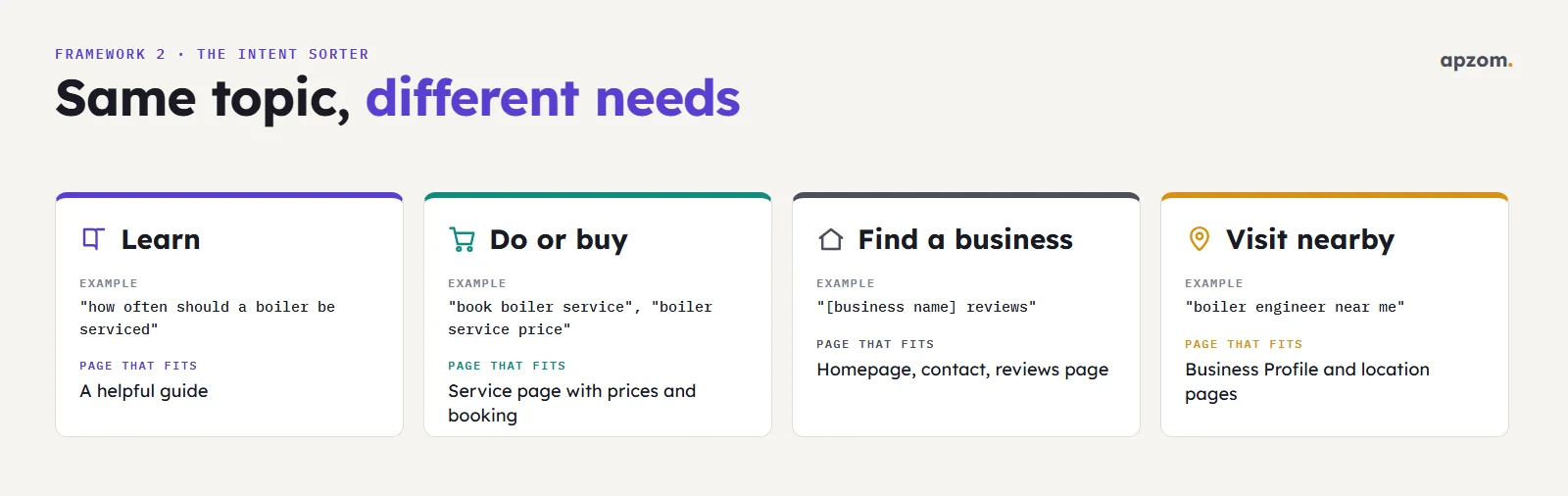
Google’s Search Quality Rater Guidelines, the instructions Google gives the people who evaluate its results (latest version dated September 2025), describe four kinds of need: Know, Do, Website and Visit-in-person. These are guidelines for raters, not a list of ranking factors, but they are a useful way to think about what a searcher wants.
| What the searcher wants | Example searches | The page that fits |
|---|---|---|
| To learn something | “how often should a boiler be serviced” | A helpful guide or answer page |
| To do or buy something | “book boiler service”, “boiler service price” | A service or product page with prices and booking |
| To find a specific business | “[your business name] reviews” | Your homepage, contact or reviews page |
| To visit somewhere nearby | “boiler engineer near me” | Your Google Business Profile and location pages |
For local searches, Google says local results are based mainly on relevance, distance and prominence (which it also describes as popularity), so your Business Profile matters as much as your website. Our local SEO checklist and Google Business Profile optimization checklist cover that side.
Step 4: map each group of searches to one page
The third framework is the keyword-to-page map. Group searches that mean the same thing, and give each group one page.
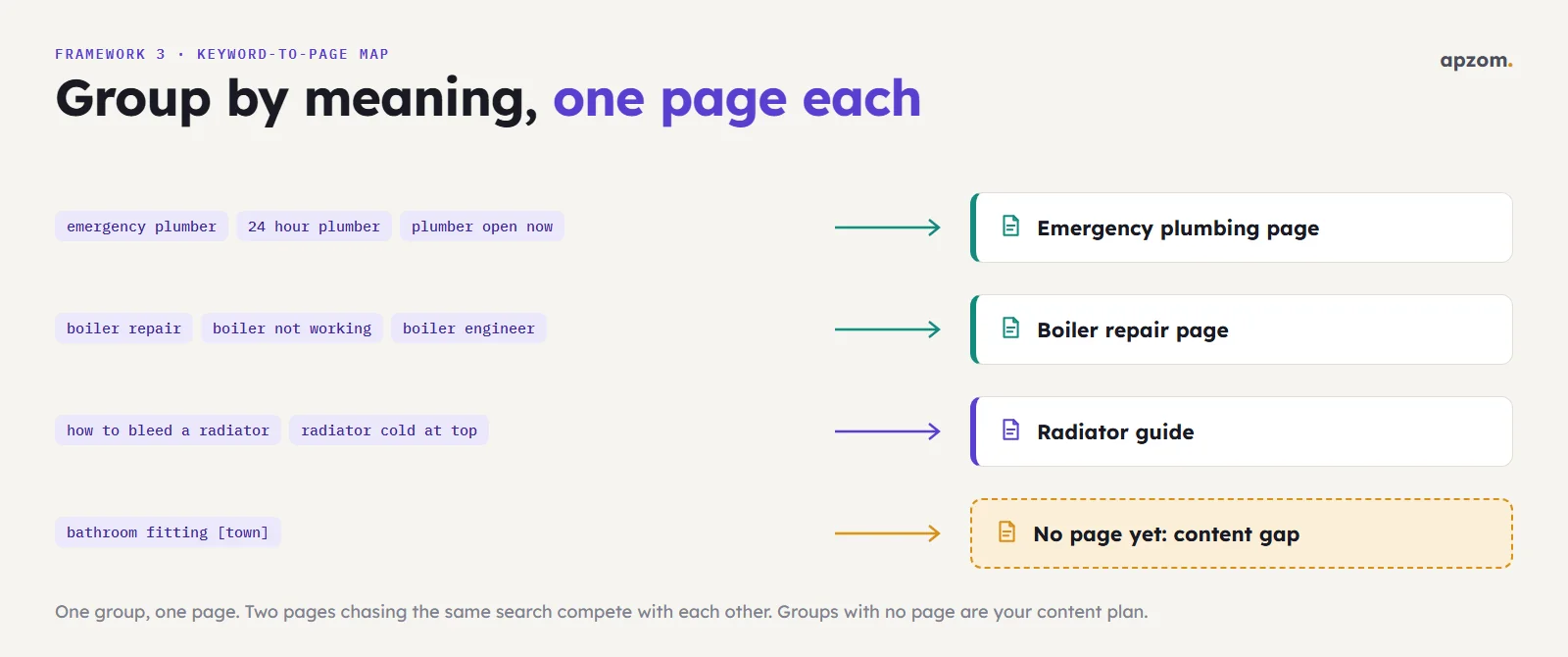
- Group by meaning, not by exact words. “Emergency plumber”, “24 hour plumber” and “plumber open now” are probably one group.
- Give each group one main page. Two pages chasing the same search compete with each other.
- Use the main wording naturally in the page title, the main heading and the opening paragraph, and answer the search fully.
- Link related pages to each other, for example from a guide to the matching service page.
- Find the gaps: groups with no page are your content plan.
Do not stuff keywords into pages. Google’s spam policies describe keyword stuffing as filling a web page with keywords or numbers in an attempt to manipulate rankings. One of Google’s own examples will be familiar to many local businesses: blocks of text that list cities and regions a page is trying to rank for. Write for people first; Google asks for content created primarily for people, not to manipulate search rankings.
Want a keyword plan built around your customers? A Keyword and Content Review maps the searches your customers use to the pages you have, and shows the gaps worth filling first.
Step 5: prioritise what to work on first
The fourth framework is a simple priority score. For each group of searches, score three things from 1 to 3 and multiply them.
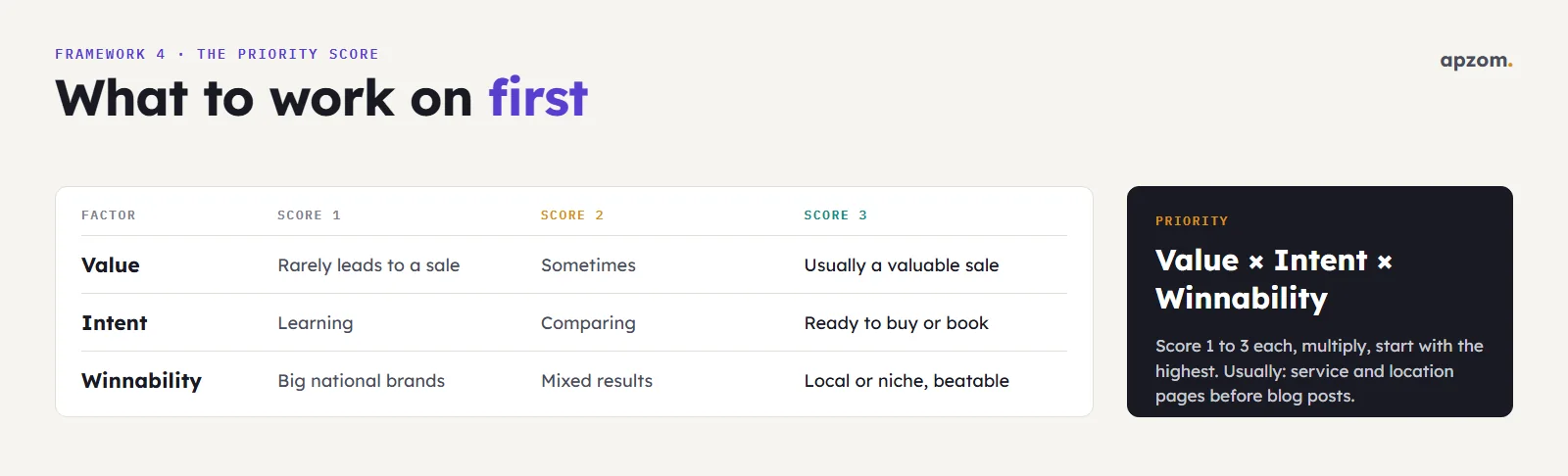
| Factor | 1 | 2 | 3 |
|---|---|---|---|
| Value | Rarely leads to a sale | Sometimes leads to a sale | Usually leads to a valuable sale |
| Intent | Learning | Comparing | Ready to buy or book |
| Winnability | Dominated by big national brands | Mixed results | Local or niche results you can realistically beat |
Start with the highest scores. For most small businesses, that means service pages for your main services and locations before blog posts. Search the term yourself and look at what ranks: if every result is a huge national brand or marketplace, pick a narrower version you can win.
Keyword research for different kinds of business
| Business type | Focus first |
|---|---|
| Local service businesses | Service plus place searches, “near me” searches, and the problems customers describe |
| Online shops | Product and category searches, including brand, size, colour and material |
| B2B and professional services | Problem and solution searches, industry terms buyers use, comparison searches |
| Businesses selling in several countries | Local wording and spelling in each market, and local search tools set to each country and language |
If you sell in several countries or languages, research each market separately. Keyword Planner lets you choose countries, territories, regions and cities, and a language. Spelling and wording often differ: “car insurance” and “motor insurance”, “apartment” and “flat”. If you build separate pages for each country or language, Google’s hreflang guidance helps point users to the most appropriate version of your page by language or region.
Common mistakes
- Choosing keywords by volume alone and ignoring intent.
- Targeting the same search with several pages.
- Using industry jargon customers never type.
- Stuffing keywords into pages instead of answering the question.
- Treating keyword research as a one-off. Customers’ language and your services change, so review it every few months.
- Ignoring the searches you already get in Search Console.
How Apzom can help
Our SEO services start with keyword research grounded in your customers’ language and your profit, not just search volume. We map searches to pages, find gaps, prioritise what will bring customers soonest and write or improve the pages, as part of our content marketing and local SEO work. Our SEO methodology explains the process. We work with clients worldwide, remotely, from our base in Ahmedabad, India. If you are budgeting, our guide on how much SEO costs may help.
Request a Keyword and Content Review. We gather your customers’ language, check demand with search tools, sort searches by intent, map them to your existing pages, and list the gaps and conflicts to fix first, for each market you sell into.
No obligation and no guaranteed rankings. Prefer to talk first? Contact us or see all our services.
Frequently asked questions
How do I do keyword research for free?
Start with your customers’ own words from calls, emails and reviews. Then check wording and demand with free tools: Google Keyword Planner (inside a Google Ads account), Google Search Console, Google Trends, the Keyword Research tool in Bing Webmaster Tools and Google’s search suggestions.
How many keywords should a small business target?
There is no fixed number. Group searches by meaning and aim for one strong page per group. Most small businesses start with their main services and locations, then add guides.
Should I target high-volume keywords?
Not by default. A search with lower volume but clear buying intent often brings more customers than a popular search from people who are only curious.
What is search intent?
Search intent is what the person searching wants: to learn something, to do or buy something, to find a specific website, or to visit somewhere nearby. Matching your page to the intent matters as much as matching the words.
How do I find keywords my competitors rank for?
Search your main topics and see which pages rank, and what they cover that you do not. Paid tools can show more, but looking at the results yourself is a good start.
How often should I redo keyword research?
Review it every few months, and whenever you add services or enter new markets. Check Search Console regularly for new searches people use to find you.
Do keywords still matter with AI search?
Yes, in a different way. Clear pages that answer specific questions in your customers’ words help both search engines and AI tools understand you. Our guide on what GEO is explains more.
Can Apzom do keyword research for businesses outside India?
Yes. We work with clients worldwide, remotely, from our base in Ahmedabad, India, and research the language, spelling and search habits of each market you sell into.