
The short answer: Good digital marketing for wedding businesses wins bookings from couples who are planning months, sometimes years, ahead. It shows your real work where couples look for ideas, makes it easy to check your availability and prices, answers enquiries fast, and keeps you in front of couples through a long decision. A good agency will build a portfolio of real weddings, a clear enquiry process and a steady flow of reviews, and measure results in viewings, consultations and booked dates, not likes.
This guide is for wedding venues, planners, photographers and videographers, caterers, florists and decorators, bridal wear shops and other wedding suppliers, in any country. It covers how couples choose suppliers, which channels suit which kind of business, how to turn enquiries into booked dates, how to use real weddings as marketing, reviews, the rules on pricing, photos and reviews, and what to measure.
Weddings are a large and seasonal market. The US National Center for Health Statistics counted 2,041,926 marriages in 2023 (provisional figures). The Australian Bureau of Statistics recorded 118,804 marriages registered in 2025, with 25 October the single most popular date. In England and Wales, the Office for National Statistics found that August was the most popular month for marriages in 2023 and Saturday the most popular day. And couples start early: Pinterest’s Wedding Trends Report 2026 says people have made over 7 billion wedding-related searches and saved more than 16.7 billion wedding ideas on the platform.
How couples choose wedding suppliers
A wedding is one of the biggest purchases most couples make, and they rarely book on the first visit. The first framework we use with wedding clients is the booking timeline: the stages a couple goes through, and what your marketing needs to do at each one.
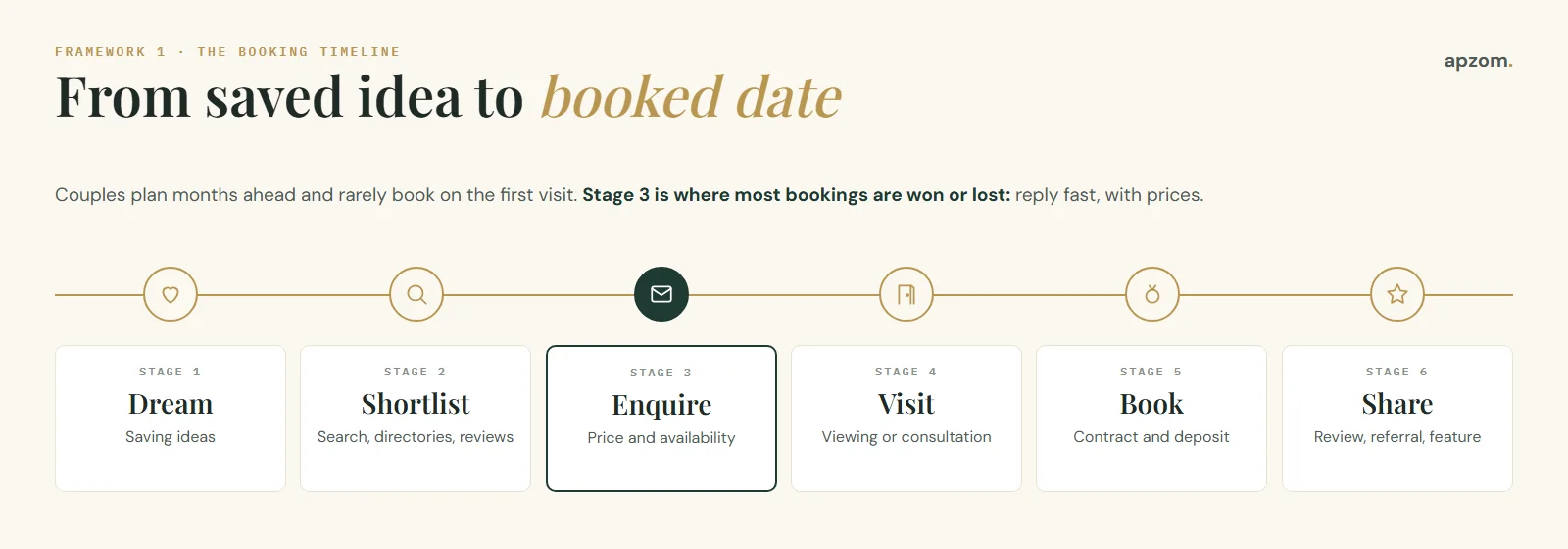
| Stage | What the couple is doing | What helps |
|---|---|---|
| 1. Dream | Saving ideas, often before they have a date or budget | Pinterest, Instagram, real wedding features, styled shoots |
| 2. Shortlist | Searching for suppliers in their area, style and budget | Google search and Maps, wedding directories, reviews, recommendations |
| 3. Enquire | Asking about availability and price | A clear contact form, a pricing guide, a fast and personal reply |
| 4. Visit or consult | Viewing a venue or meeting a supplier | A well-run viewing or call, a clear proposal, honest answers |
| 5. Book | Signing a contract and paying a deposit | Simple contracts, clear terms, easy payment |
| 6. Celebrate and share | The wedding, and afterwards | Great service, then a review request and permission to feature their wedding |
Most suppliers put their effort into stages 1 and 2. The ones that book more dates are also very good at stage 3: answering every enquiry quickly, with the information couples need.
Which channels suit which wedding business
The second framework: choose channels by business type. A venue and a photographer are found and judged in different ways.
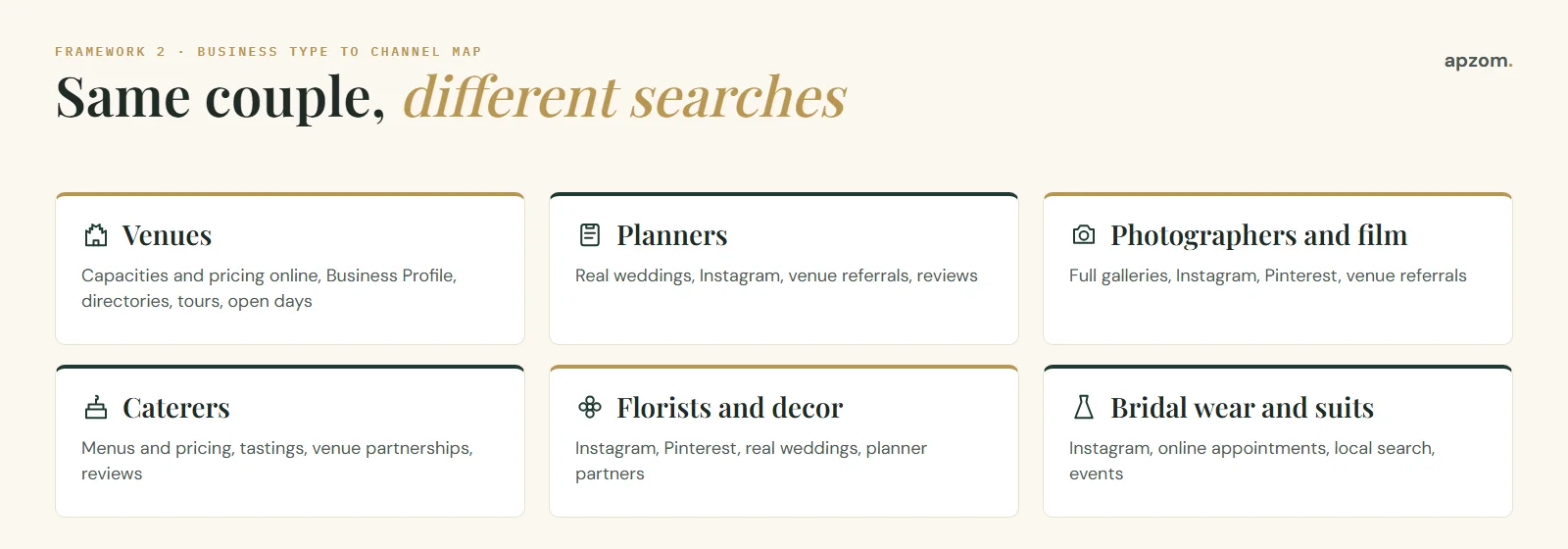
| Business type | What couples care about | Channels to start with |
|---|---|---|
| Venues | Capacity, setting, price, availability, location | Website with capacities and pricing, Google Business Profile, directories, virtual tours, open days |
| Planners | Trust, style, organisation, budget management | Portfolio of real weddings, Instagram, referrals from venues, reviews |
| Photographers and videographers | Style, personality, full galleries | Portfolio site with full weddings, Instagram, Pinterest, reviews, venue referrals |
| Caterers | Menus, tastings, dietary needs, price per head | Menu and pricing pages, tasting events, venue partnerships, reviews |
| Florists and decorators | Style, seasonality, budget | Instagram, Pinterest, real weddings, venue and planner partnerships |
| Bridal wear and suits | Styles, appointments, fittings | Instagram, appointment booking online, local search, try-on events |
Show real weddings, not just pretty pictures
Your best marketing is proof that you have done this before, beautifully and reliably. The third framework is the real-wedding page.
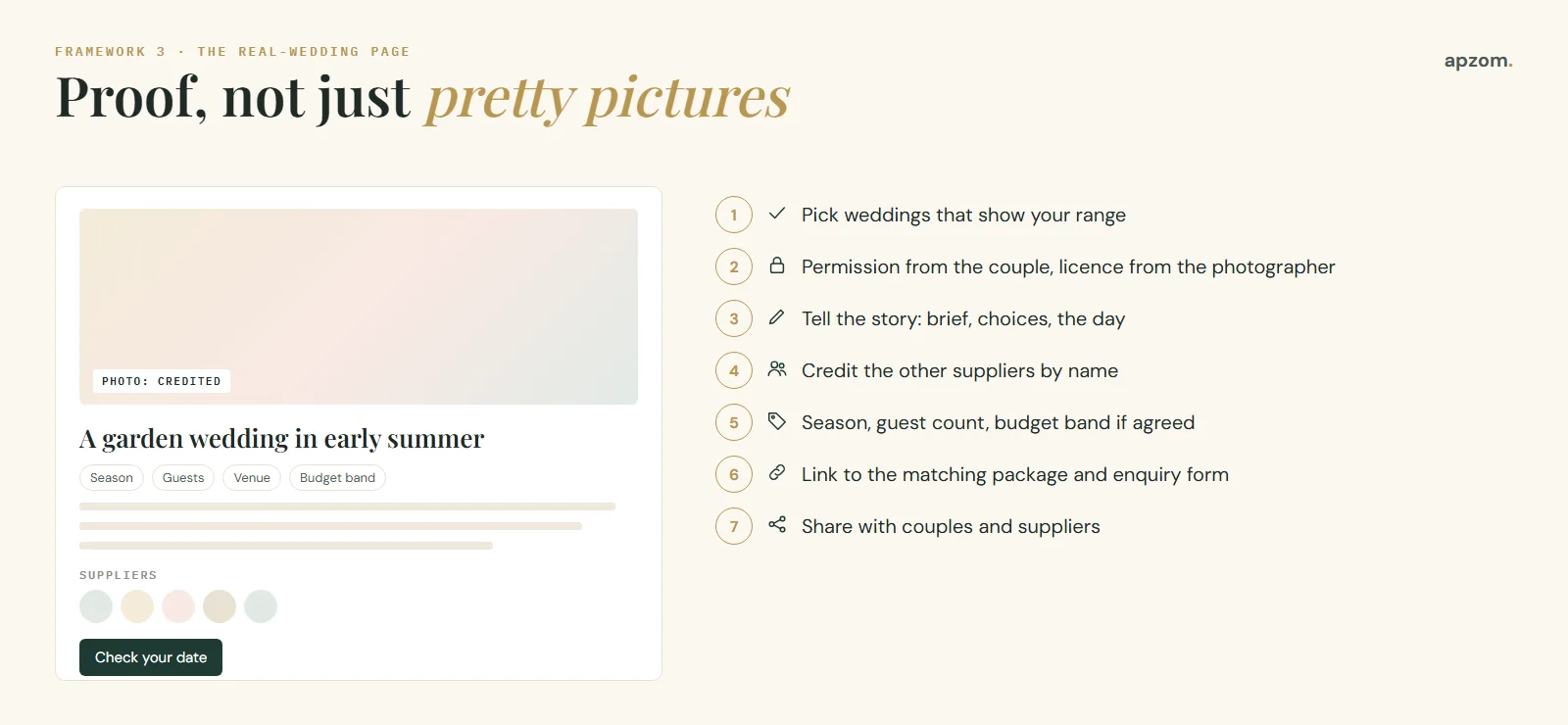
- Pick weddings that show your range: different seasons, sizes, styles and budgets.
- Get permission from the couple to feature their wedding, and a written licence from the photographer for the images.
- Tell the story: who they were, what they wanted, what you did, and what made the day special.
- Credit the other suppliers by name, with their permission. They often share the feature, which brings you new visitors.
- Add useful details couples want: the season, guest count, budget band if the couple agrees, and the venue.
- Link to the matching service or package page, and to your enquiry form.
- Share it on Instagram, Pinterest and with the suppliers involved.
Photo rights matter more than many suppliers realise. In the UK, the Intellectual Property Office says that with commissioned photos the copyright will usually remain with the photographer, and couples may also have a right to stop private photos being made public. In the US, the Copyright Office explains that a commissioned work only counts as a “work made for hire” in limited categories and with a signed written agreement, so a wedding photographer usually keeps the copyright. Venues, planners and other suppliers therefore need the photographer’s permission to use their images, and should credit them.
Make enquiries easy, and answer them fast
Couples often contact several suppliers at once. The ones who reply first, with clear information, are often the ones who get the viewing or the call. The fourth framework is the enquiry-to-booking system.
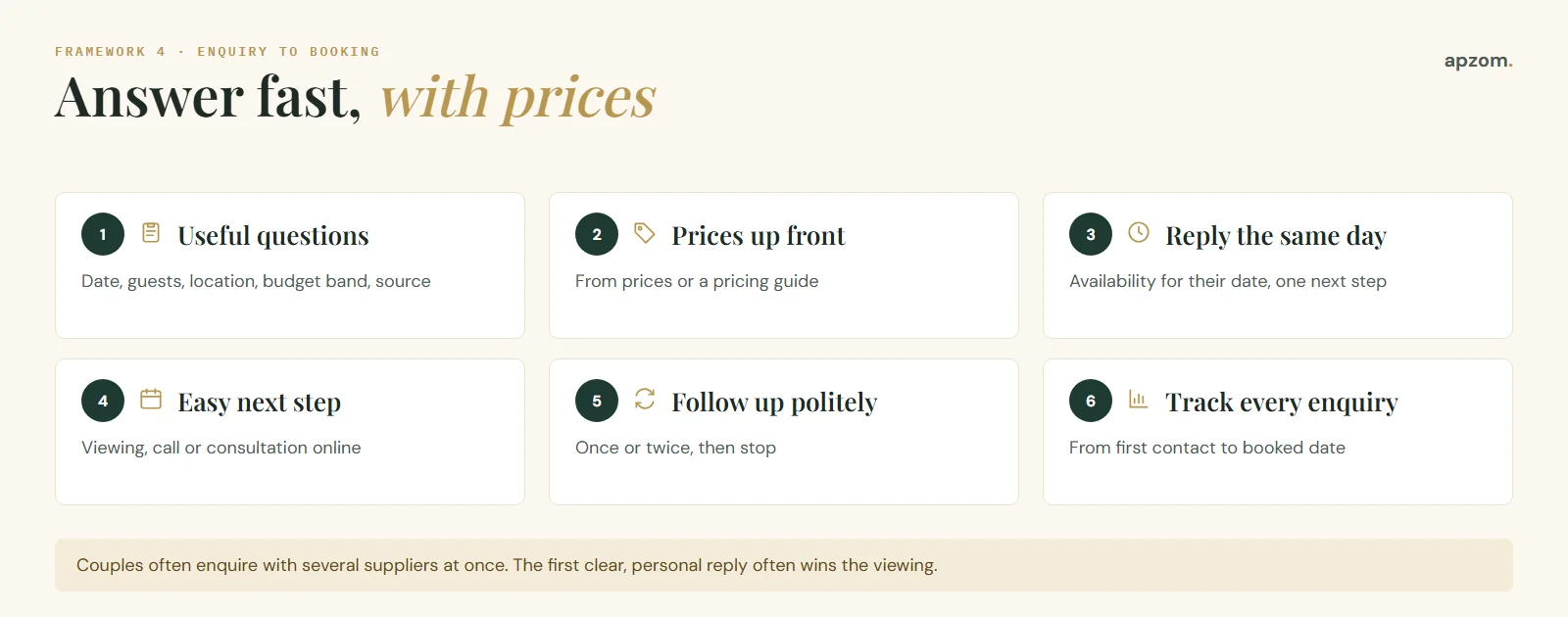
- Ask a few useful questions on your form: the wedding date, rough guest numbers, location, budget band and how they found you.
- Share pricing up front, or at least a pricing guide or “from” prices. Couples who never see prices often assume you are too expensive.
- Reply quickly and personally, ideally the same day, with availability for their date and a clear next step.
- Offer an easy next step: a viewing, a call or a consultation, bookable online.
- Follow up once or twice, politely, if you do not hear back.
- Track every enquiry from first contact to booked date, so you know where couples drop off.
Plenty of enquiries, not enough booked dates? A Wedding Business Marketing Audit follows couples from first search to booked date and shows where they drop off.
Local search, directories and marketplaces
- Google Business Profile: keep it complete, with real photos, your services and up-to-date opening hours for viewings. If you travel to couples, such as a photographer or mobile caterer, set it up as a service-area business.
- Wedding directories and marketplaces: many couples browse these. List where your couples actually look, keep the listing as good as your website, and track which ones bring bookings, not just enquiries.
- Your own website: directories can change their rules and prices. A strong website with your own portfolio, prices and enquiry form is the asset you control.
Our Google Business Profile optimization checklist and local SEO checklist go into detail.
Social media, Pinterest and video
- Instagram: show finished weddings and behind-the-scenes. Short videos of a venue set-up, a first look or a table design help couples imagine their own day.
- Pinterest: works like a visual search engine for wedding ideas. Pin your real wedding images to clear boards, linking back to the feature on your site.
- Video: venue tours and supplier introductions build trust before a couple ever visits.
- Partner content: feature suppliers you work with, and ask them to do the same.
Reviews and referrals
Couples read reviews carefully because they get one chance to get it right.
Ask every couple after the wedding, in the same way, with a direct link. The rules are strict:
- Google bans offering anything in exchange for reviews, bans selectively asking only couples you think were happy, and bans reviews from people with a conflict of interest, such as staff or family.
- In the US, the Federal Trade Commission’s rule on reviews, in force since 21 October 2024, bans fake reviews and incentives that depend on a review being positive.
- In the UK, fake reviews are banned under the Digital Markets, Competition and Consumers Act 2024, from 6 April 2025.
Our guide on how to get more Google reviews explains how to ask without breaking these rules.
Reply to every review, especially critical ones, calmly and helpfully. Referrals from venues, planners and past couples matter just as much: make it easy for them to recommend you, and thank them when they do.
Paid ads that work for wedding businesses
- Google Ads suit searches for your service in your area, such as a venue type or a photographer in a city. Send each ad to the matching page with prices or a pricing guide. Our guide to Google Ads for small businesses explains the set-up.
- Meta ads suit showing real weddings to people who are newly engaged or planning, in your area. See our guide to Facebook and Instagram ads for local businesses.
- Retargeting keeps you in front of couples who viewed your pricing or portfolio during a long decision.
Judge ads by viewings, consultations and booked dates, not clicks.
Rules to know: pricing, photos and reviews
This is a starting point, not legal advice.
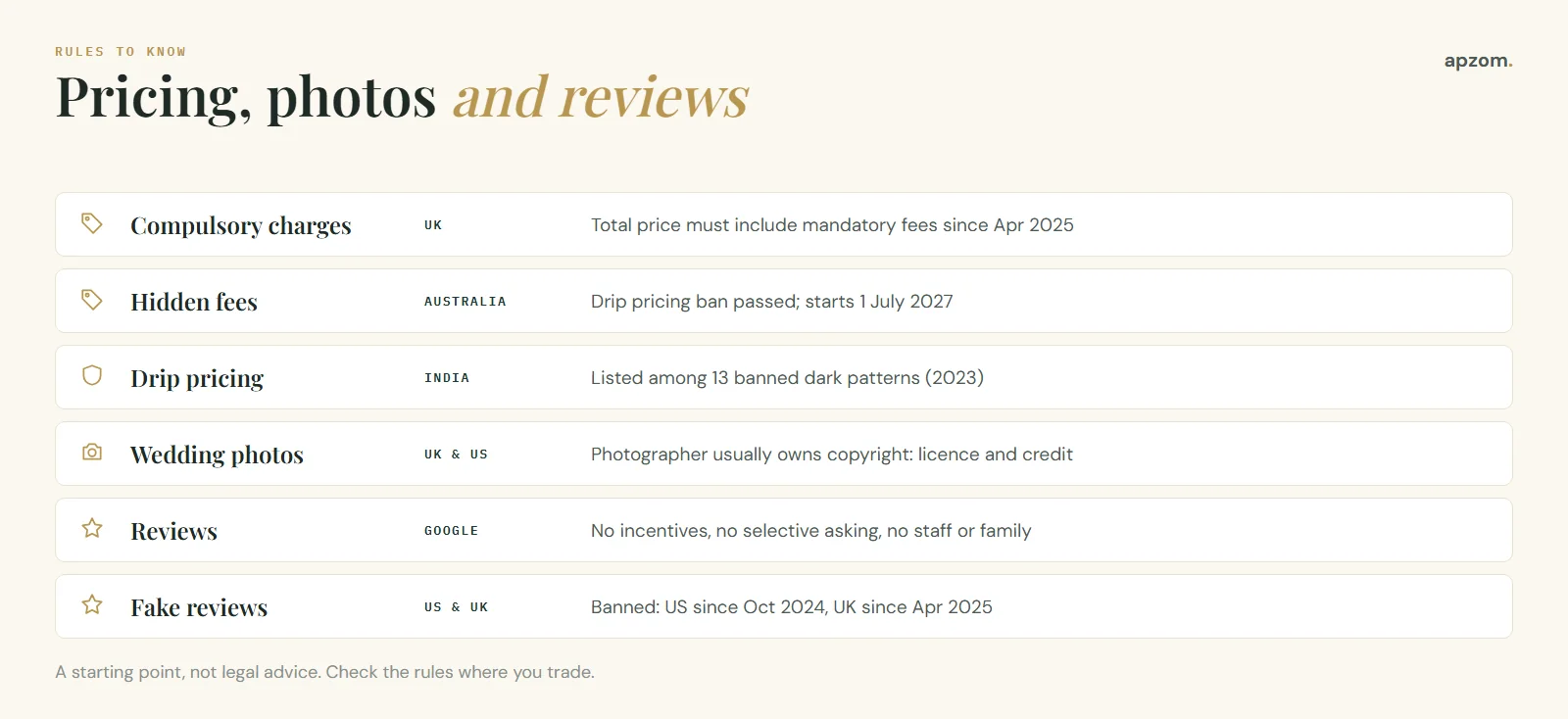
| Area | What to know |
|---|---|
| Prices and compulsory charges (UK) | Since 6 April 2025, the Digital Markets, Competition and Consumers Act 2024 requires the total price, including mandatory fees and charges, to be shown. The CMA says the total price should normally include unavoidable charges, so a compulsory service charge or venue fee should be in the headline price. |
| Hidden fees (Australia) | Australia has passed a ban on drip pricing, which the government says starts on 1 July 2027. |
| Drip pricing (India) | The Central Consumer Protection Authority’s 2023 dark patterns guidelines list drip pricing as one of 13 banned dark patterns. |
| Wedding photos (UK and US) | Photographers usually keep the copyright in wedding photos. Get a written licence before reusing images, and credit the photographer. |
| Reviews (Google) | No incentives, no asking only happy couples, and no reviews from staff, family or others with a conflict of interest. |
| Reviews (US and UK) | The FTC’s rule against fake reviews and sentiment-based incentives has applied since 21 October 2024; the UK’s fake reviews ban since 6 April 2025. |
Deposits and cancellation terms should be clear and fair before a couple pays. Rules differ by country, so take local advice on your contracts.
How to measure what matters
Track these every month, and compare across the year, because wedding demand is seasonal:
- Enquiries by source: website, Google, directories, Instagram, referrals.
- Reply time: how quickly you answer new enquiries.
- Viewings or consultations booked from enquiries.
- Bookings and booked revenue by source.
- Booked dates by season, so you can see which dates need more marketing.
- Reviews and referrals from each season’s couples.
How Apzom can help
Apzom Digital helps service businesses get found, trusted and booked. For wedding businesses, that means local SEO, website development with portfolio and pricing pages, social media marketing, Meta ads and Google Ads, email marketing to follow up enquiries, and reputation management. We work with clients worldwide, remotely, from our base in Ahmedabad, India.
We have not published a wedding industry case study yet, so we will not show you one. Our case studies page shows the lead generation and search work we have done for other businesses. We will not promise a number of bookings. We will show you where couples drop off and what to fix first. If you also host events, our guide to digital marketing for hotels covers weddings from a hotel’s point of view.
Request a Wedding Business Marketing Audit. We review your website, portfolio and pricing pages, Business Profile, directory listings, Instagram and Pinterest, enquiry form and reply process, reviews and ads. You get a prioritised list of what to fix first, for your market and season.
No obligation and no guaranteed booking numbers. Prefer to talk first? Contact us or see all our services.
Frequently asked questions
What is the best marketing for wedding businesses?
A portfolio of real weddings, a complete Google Business Profile, a strong website with prices or a pricing guide, steady reviews and fast replies to enquiries. Add Instagram, Pinterest and the directories your couples use, then ads to fill quiet dates.
How do wedding venues get more bookings?
By showing capacity, pricing and availability clearly, answering enquiries the same day, making viewings easy to book, and following up politely. Real weddings and reviews help couples picture their own day and trust you.
Should wedding suppliers show prices online?
Yes, at least “from” prices or a downloadable pricing guide. Couples are budgeting carefully, and many will not enquire if they cannot see any prices. In some countries, compulsory fees must also be included in the price you show.
Are wedding directories worth paying for?
Some are, for some businesses. Track enquiries and, more importantly, bookings from each directory. Keep your own website strong, because you control it and directories can change their terms.
Can I use photographers’ wedding photos on my website?
Only with permission. Photographers usually keep the copyright in their images, so get a written licence and credit them. Ask the couple too before featuring their wedding.
How do wedding businesses get more reviews?
Ask every couple after the wedding, in the same way, with a simple link. Google bans offering gifts or discounts for reviews and bans asking only the couples you think were happiest.
When is the busiest time for wedding marketing?
It depends on your country and market. Many couples plan many months ahead, so marketing for next year’s peak season often needs to start well before it. Use your own enquiry and booking data to see when your couples start looking.
Can Apzom work with wedding businesses outside India?
Yes. We work with clients worldwide, remotely, from our base in Ahmedabad, India, and plan marketing around your market, season and the platforms your couples use.