
The short answer: Good digital marketing for interior designers turns your best projects into enquiries from the right clients. People hire a designer after weeks or months of looking at pictures, so your work has to be easy to find where they look: Google, Instagram, Pinterest and Houzz. Your website then has to prove you can deliver their kind of project. And your enquiry form has to filter out people whose budget, scope or timing do not fit. A good agency builds all three and reports on qualified enquiries and signed projects, not likes.
This guide is for interior design studios, freelance designers and design-and-build firms in any country. It covers how clients choose a designer, which channels suit which kinds of project, how to turn a portfolio into pages that win work, how to filter enquiries, what the rules say about reviews, photos and the title “interior designer”, and how to measure results. Where rules differ by country, we say which country.
How clients choose an interior designer
Hiring a designer is a big, personal decision. Few people search “interior designer near me” and hire the first result. Most go through four stages, and your marketing needs to be present at each one. This is the first framework we use with design clients: the inspiration-to-hire journey.
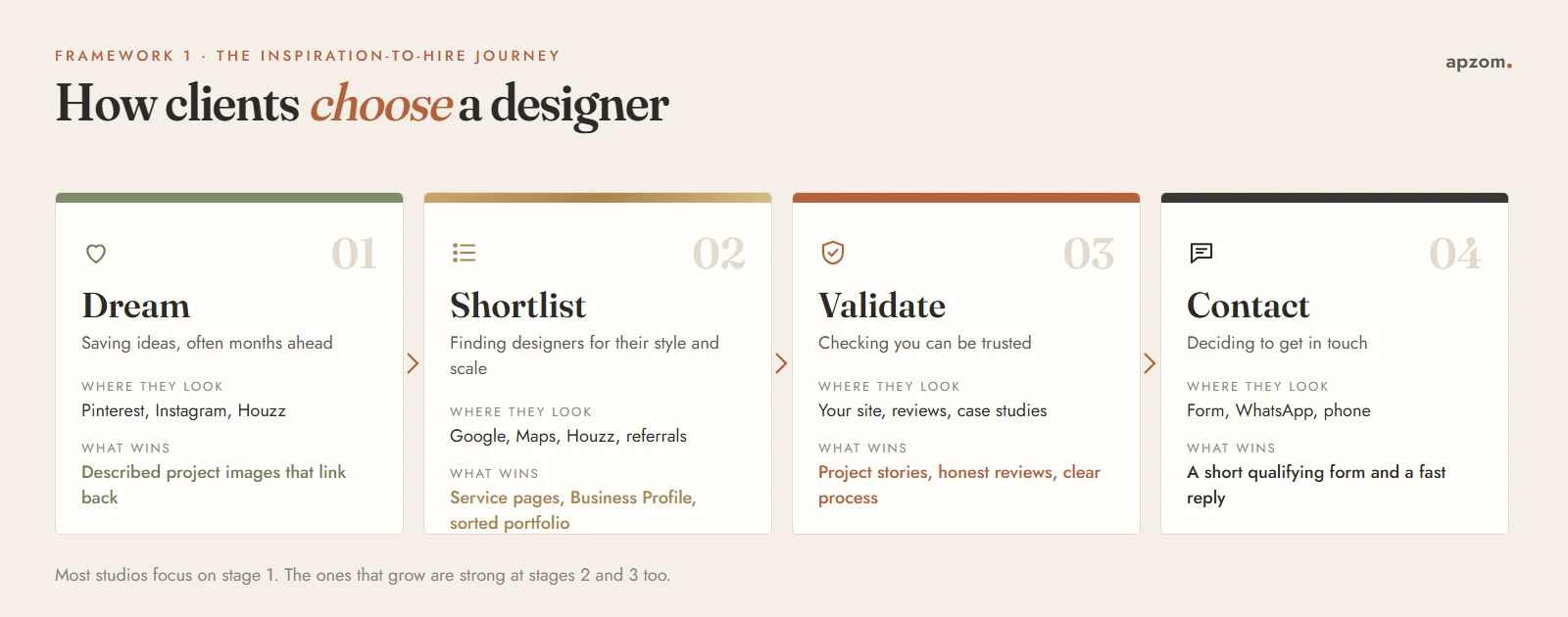
| Stage | What the client is doing | Where they look | What wins this stage |
|---|---|---|---|
| 1. Dream | Saving ideas, often months before hiring | Pinterest, Instagram, Houzz, magazines | Beautiful, well-described project images that link back to you |
| 2. Shortlist | Looking for designers who do their style and scale | Google search and Maps, Houzz, Instagram, referrals | Clear service and location pages, a complete Business Profile, a portfolio sorted by project type |
| 3. Validate | Checking you can be trusted with their home or budget | Your website, reviews, case studies, your process page | Real project stories, honest reviews, a clear process and fee structure |
| 4. Contact | Deciding whether to get in touch | Your contact page, WhatsApp, phone | An easy form that asks the right questions and a quick, personal reply |
Most designers put all their effort into stage 1, because Instagram feels like marketing. The studios that grow tend to be strong at stages 2 and 3 too.
Which channels suit which kind of design work
The second framework: choose channels by project type, not by what is popular. A studio doing full-home renovations needs different marketing from an e-design service selling single-room plans online.
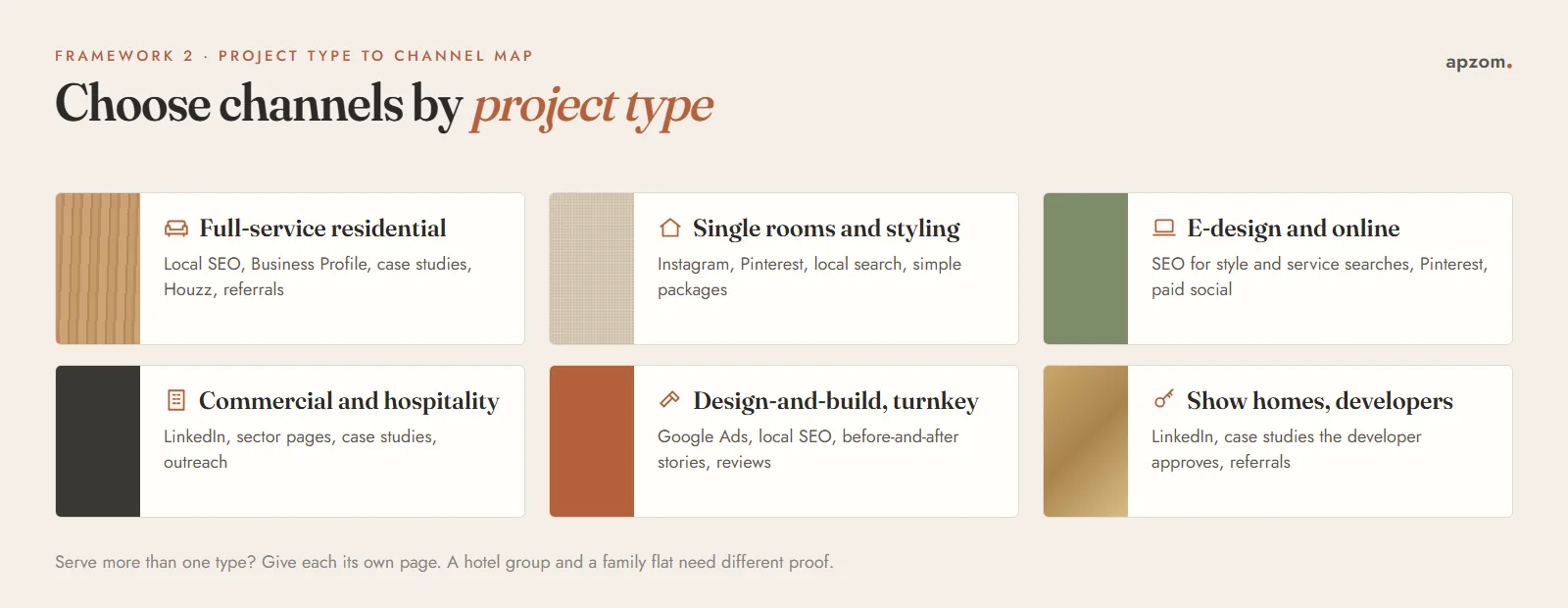
| Project type | Typical client | Channels to start with |
|---|---|---|
| Full-service residential (whole homes, renovations) | Homeowners with larger budgets, often referred | Local SEO, Google Business Profile, project case studies, Houzz, Instagram, referral programme |
| Single rooms and styling | Homeowners and renters with smaller budgets | Instagram, Pinterest, local search, simple packages on the website |
| E-design and online consultations | Clients anywhere, price-aware | SEO for service and style searches, Pinterest, paid social, clear online packages |
| Commercial, hospitality and retail interiors | Business owners, developers, hotel groups | LinkedIn, SEO for sector pages, case studies, direct outreach, industry events |
| Design-and-build or turnkey firms | Homeowners and businesses wanting one contract | Google Ads on high-intent searches, local SEO, before-and-after case studies, reviews |
| Show homes and developer projects | Property developers and builders | LinkedIn, case studies with results the developer agrees to share, referrals |
If you serve more than one type, give each its own page. A hotel group and a family doing up a flat are not convinced by the same words or pictures.
Turn your portfolio into pages that win work
A gallery of pretty photos is not enough. Search engines cannot judge a photo’s quality, and clients cannot tell from a photo alone whether you can handle their budget, timeline or building. The third framework is a project page structure we use for design studios.
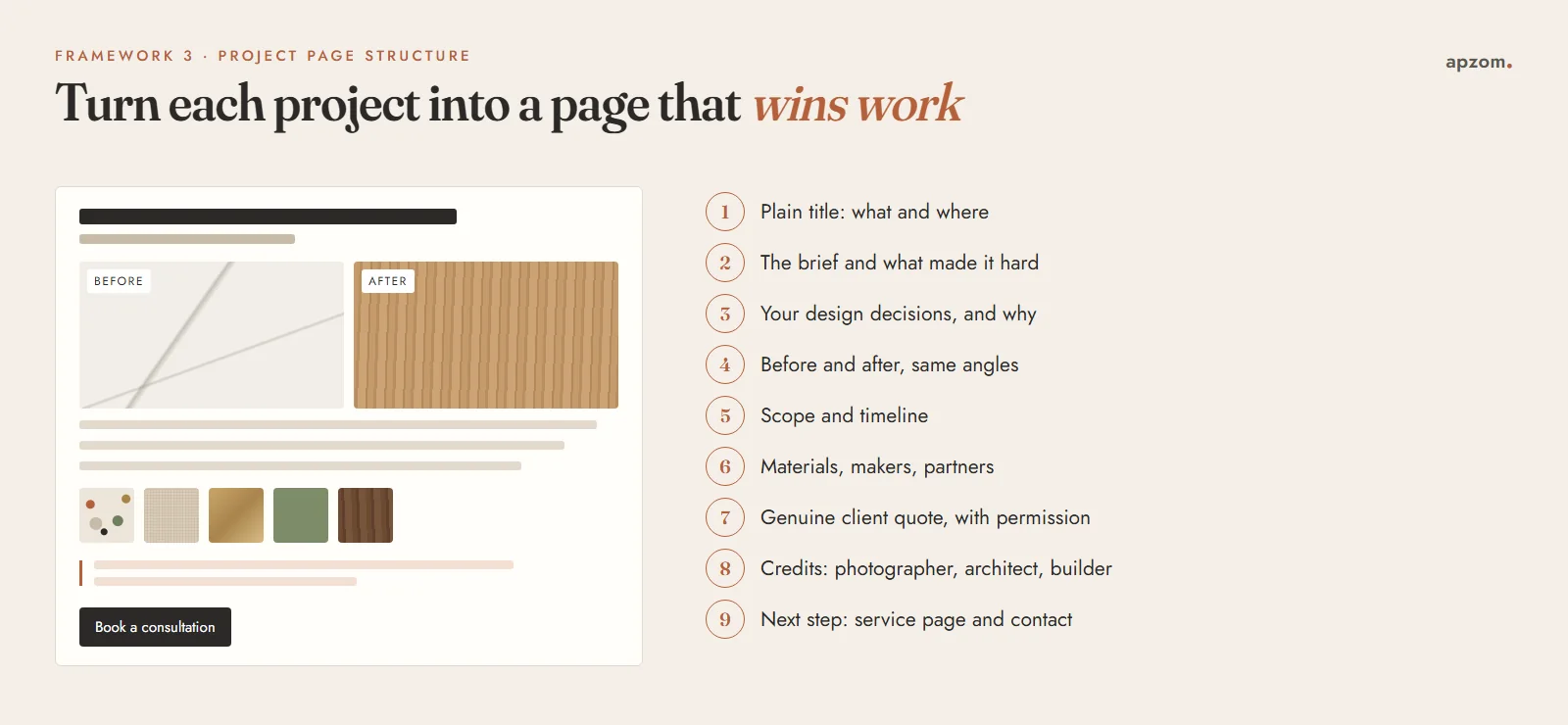
Each important project gets its own page with:
- A plain title that says what and where, such as “Three-bedroom apartment renovation in [area]”, not just a project nickname.
- The brief: who the client was, what they needed and what made it hard (a tight budget band, a listed building, a short deadline, a family with young children).
- Your solution: the main design decisions and why you made them.
- Before and after images, taken from the same angles, with real captions.
- Scope and timeline: what you did (design only, design and procurement, or full project management) and roughly how long it took.
- Materials, makers and partners you used, where the client agrees.
- A client quote, only if it is genuine and you have permission.
- Credits: the photographer, and any architect or contractor you worked with.
- A next step: a link to the relevant service page and your contact page.
Write image alt text that describes what is in the photo, for example “Open-plan kitchen with oak cabinets and terrazzo floor”, not “interior design company best”. Use a sensible file name, compress images, and keep the original high-quality files for Houzz, Pinterest and press.
Do you own your project photos?
Often you do not. If you hire a freelance photographer, they usually keep the copyright unless a written agreement says otherwise. In the US, the Copyright Office explains that a commissioned work only counts as a “work made for hire” if it falls into certain categories and both sides sign a written agreement saying so. In the UK, the Intellectual Property Office says that with commissioned photos the copyright will usually remain with the photographer. In practice: agree a written licence that covers your website, social media, Houzz, ads and award entries before the shoot, and credit the photographer.
Local search: the stage most designers neglect
When someone is ready to shortlist, many search Google or Google Maps. Three things matter most:
- A complete Google Business Profile. Choose the category that best describes your core business, add real project photos, list your services, and keep your hours and contact details right. Google’s guidance says photos should represent reality, so use your own work. If you work from home and do not receive clients there, set the profile up as a service-area business: Google says service-area businesses should hide their address from customers. Virtual offices are not eligible.
- Service and location pages on your website. One page per main service, and pages for the areas you genuinely serve, each with real projects from that area. Avoid near-identical pages that only swap the town name.
- Reviews. Ask every happy client for a review, soon after handover. Reply to reviews, including the critical ones, calmly and briefly.
For a deeper checklist, see our Google Business Profile optimization checklist and our local SEO checklist.
Getting likes but not the right projects? A Design Studio Marketing Audit looks at your portfolio pages, Business Profile, reviews, social channels and enquiry form, and shows where good clients drop off.
Social media and visual platforms
- Instagram: show work in progress as well as finished rooms. Short videos of a room coming together, material choices and site visits show your process, which photos alone cannot. Put your location and a clear contact route in your profile.
- Pinterest: works more like a visual search engine than a social network. Pinterest said in December 2025 that 600 million people come to it each month to search and shop. Pin your best project images to your own boards with clear titles and descriptions, linking to the matching project page on your site.
- Houzz: a platform built for home design and renovation, where homeowners browse projects and professionals. A complete profile with projects and reviews can help you get shortlisted. Check the terms of any paid plan carefully before signing up.
- LinkedIn: for commercial, hospitality and workplace interiors, where your buyers are business owners, facilities managers and developers.
Do not try to be everywhere. Pick the two or three places your clients actually use and do them well.
Paid advertising: when it makes sense
Paid ads can bring enquiries quickly, but design is a considered purchase, so ads work best when they send people to a strong page.
- Google Ads suit high-intent searches such as a specific service and city. Send each ad group to the matching service page, not your homepage. In the US, Google also offers Local Services Ads for interior designers, but at the time of writing only in California and Florida, with screening and licence checks. Elsewhere, use standard Search ads. Our guide to SEO vs Google Ads explains when each makes more sense.
- Meta ads (Facebook and Instagram) suit showing finished projects to people in the right area and life stage, such as new homeowners. Use ads that link to a project or a consultation offer, and send leads to a form that asks qualifying questions.
- Retargeting reminds people who looked at your portfolio but did not get in touch. Keep it light and stop showing ads after a sensible period.
Set a monthly budget you are comfortable testing for at least two to three months, and judge ads by qualified enquiries, not clicks.
Filter enquiries before they reach your inbox
Many designers lose hours to enquiries that were never going to become projects. The fourth framework is an enquiry filter: ask a few questions up front, then reply faster to the ones that fit.
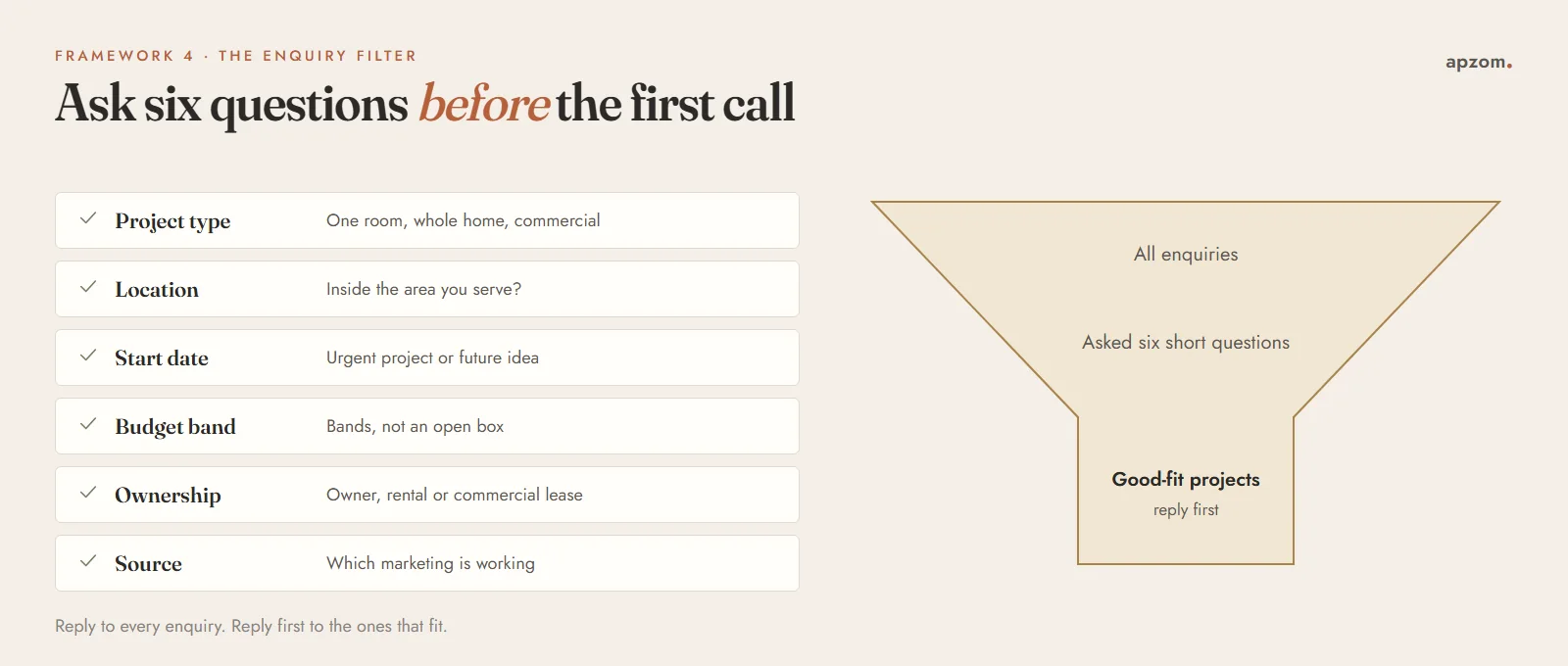
| Question on your form | Why it helps |
|---|---|
| What kind of project is it? (one room, whole home, commercial) | Sends the enquiry to the right person or package |
| Where is the property? | Confirms it is within the area you serve |
| When would you like to start? | Separates urgent projects from future ideas |
| What budget band are you planning for? | Avoids long calls about projects outside your range |
| Do you own the property, or is it a rental or a commercial lease? | Changes what is possible and who approves it |
| How did you find us? | Shows which marketing is working |
Offer budget bands rather than an open box, and explain that it helps you suggest the right service. Some clients will not answer, and that is fine. Reply to every enquiry, but reply first to the ones that fit.
Rules to know: reviews, claims and the title “interior designer”
Marketing rules differ by country. This is a starting point, not legal advice.
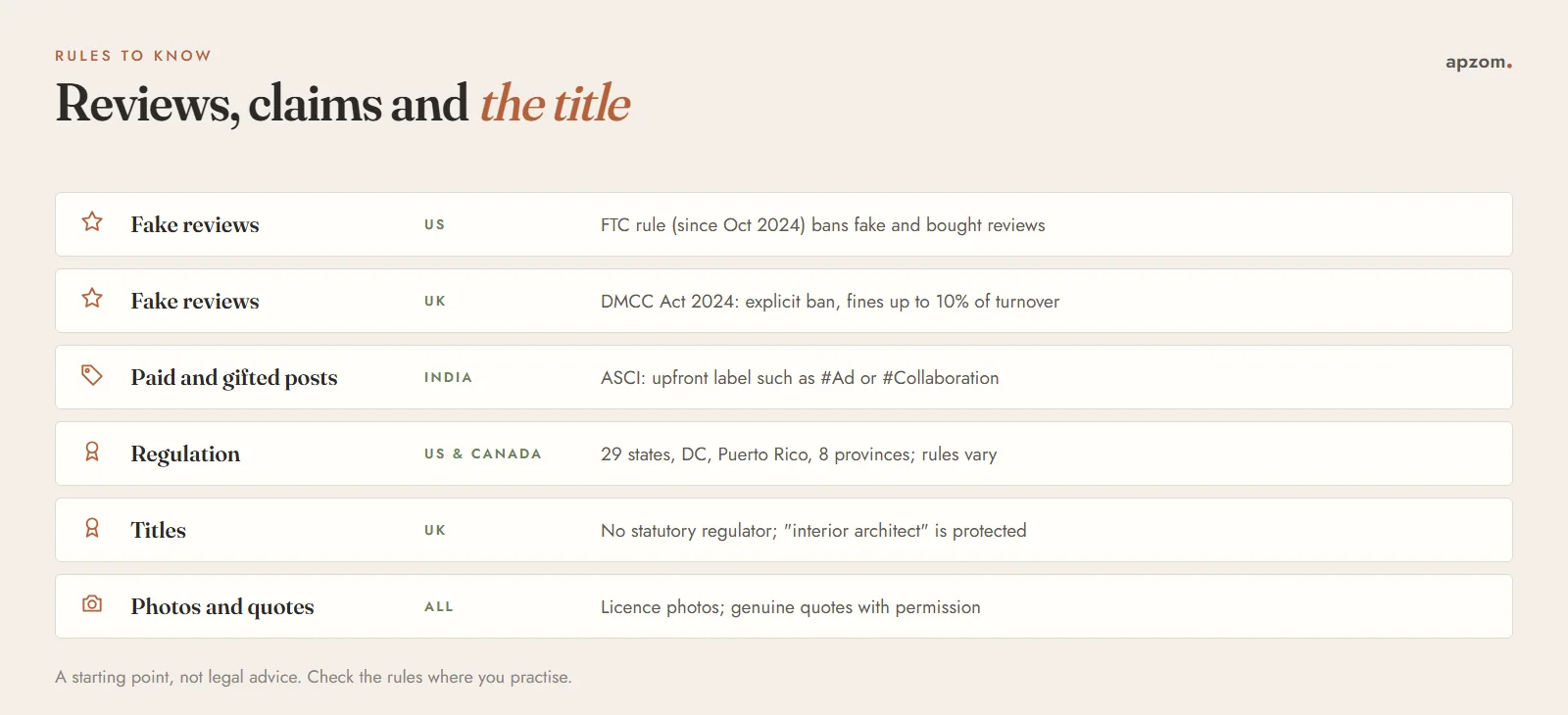
| Area | What to know |
|---|---|
| Fake reviews (US) | The Federal Trade Commission’s rule on consumer reviews and testimonials, in force since 21 October 2024, bans fake reviews and buying reviews. |
| Fake reviews (UK) | The Competition and Markets Authority says the Digital Markets, Competition and Consumers Act 2024 includes an explicit ban on posting and commissioning fake reviews, with fines of up to 10% of global turnover. |
| Testimonials (UK) | The UK advertising code requires advertisers to hold evidence that testimonials are genuine, and to be able to back up objective claims. |
| Influencer and paid posts (India) | ASCI’s influencer guidelines require an upfront label from its approved list, such as #Ad, #Sponsored, #Collaboration or #Partnership, on paid or gifted posts. |
| Regulation (US and Canada) | The Council for Interior Design Qualification says 29 US states, Washington DC, Puerto Rico and eight Canadian provinces have laws regulating the profession. Rules vary: Florida, for example, protects the title “registered interior designer” but not “interior designer”, and exempts residential work. |
| Titles (UK) | The British Institute of Interior Design says there is no statutory regulator of interior designers in the UK. But calling yourself an “interior architect” is illegal unless you are a registered architect. |
| Photos and testimonials (all countries) | Use only photos you have the right to use, and only genuine testimonials with the client’s permission. Do not show other designers’ work as your own. |
If you use influencers or gifted collaborations with brands or homeowners, label them clearly. If you claim awards or press features, make sure they are real and current, and keep the evidence. In the US, the FTC expects a reasonable basis for objective advertising claims.
How to measure what matters
Likes and followers are easy to count but do not pay the bills. Track these instead:
- Enquiries by source: website form, phone, WhatsApp, Houzz, Instagram messages and referrals.
- Qualified enquiries: the ones that match your project type, area and budget band.
- Consultations booked and projects signed, by source.
- Average project value by source, so you can see which channels bring the best clients.
- Search Console and Business Profile insights: which searches and pages bring people in.
Review these monthly. Most design studios find that a handful of channels bring most of their good projects, and that is where to spend more.
How Apzom can help
Apzom Digital helps service businesses get found, trusted and chosen. For interior designers, that means local SEO, SEO for service and project pages, website development with portfolio and project pages built to rank and convert, social media marketing, Meta ads and Google Ads, and enquiry forms that filter for fit. We work with clients worldwide, remotely, from our base in Ahmedabad, India.
We have not yet published an interior design case study, so we will not show you one. You can see the kind of work we do for other businesses on our case studies page. We will not promise rankings or a number of enquiries. We will show you where your current marketing loses good clients and what to fix first. If you are comparing agencies, our guide on how to choose a digital marketing agency may help.
Request a Design Studio Marketing Audit. We review how clients find you at each stage, from inspiration to shortlist to contact: your website and project pages, local search, Houzz, Instagram and Pinterest, ads, and how enquiries are filtered and answered. You get a prioritised list of what to fix first, for your country and the kinds of project you want more of.
No obligation and no guaranteed rankings. Prefer to talk first? Contact us or see all our services.
Frequently asked questions
What is the best marketing for interior designers?
There is no single best channel. Most studios do well with a strong portfolio website, local SEO and a complete Google Business Profile, plus one or two visual platforms such as Instagram, Pinterest or Houzz. Commercial designers usually add LinkedIn and case studies.
How do interior designers get clients online?
By being visible where clients look at each stage: visual platforms for ideas, Google and Houzz for shortlisting, and a website with detailed project pages for checking you can be trusted. A simple enquiry form that asks about project type, location, timing and budget band helps turn visitors into the right clients.
Is Instagram enough for an interior design business?
Usually not on its own. Instagram is good for showing your style and process, but many clients shortlist designers through Google search, Maps, Houzz and referrals. A website with project pages and a Business Profile gives you visibility you control.
Should interior designers use Google Ads?
Google Ads can work for high-intent searches, such as a specific service in your area, especially for design-and-build and renovation firms. Send each ad to a matching service page and judge results by qualified enquiries, not clicks.
Do I own the photos of my interior design projects?
Not always. A professional photographer often owns the copyright unless your contract says otherwise. Agree a written licence that covers your website, social media, ads and platforms such as Houzz before the shoot.
Can I call myself an interior designer?
It depends on where you work. Twenty-nine US states, Washington DC, Puerto Rico and eight Canadian provinces have some form of interior design regulation, and the details vary by state. In the UK there is no statutory regulator of interior designers, but “interior architect” may only be used by registered architects. Professional bodies such as ASID, BIID, IDC, DIA and the Indian Institute of Interior Designers have their own membership criteria. Check the rules where you practise.
How long does SEO take for an interior designer?
It varies with competition and how much work your site needs. Local results from a complete Business Profile and reviews can come sooner than rankings for broader searches. Treat SEO as a long-term investment and review progress monthly.
Can Apzom work with interior designers outside India?
Yes. We work with clients worldwide, remotely, from our base in Ahmedabad, India, and plan marketing around the search habits and rules of your market.