The short answer: Performance marketing is advertising you judge, and often pay for, by measurable results such as leads, sales or sign-ups rather than by how many people saw it. It usually runs on channels where results can be tracked: search ads, social ads, shopping ads, remarketing, email and affiliate partners. What matters most is how you pay for it, because each payment model rewards something different: a retainer rewards ongoing work, pay-per-lead rewards lead volume, cost-per-sale rewards conversions and revenue share rewards revenue. Choose the model that rewards the result you actually want, agree in writing what counts as a result, and keep the ad accounts and tracking in your own name.
This guide is for business owners and marketers anywhere in the world who are hearing the term from agencies, or weighing a “pay only for results” offer, and want to understand what it means in practice. It explains how performance marketing works, the four common ways to pay and the incentives each creates, how the channels fit together, and how to measure results you can trust. It is written by an agency that offers performance marketing, so read it knowing we have an interest; the questions here are worth asking whoever you hire. It does not quote typical fees or percentages, because we have not found reliable public figures.
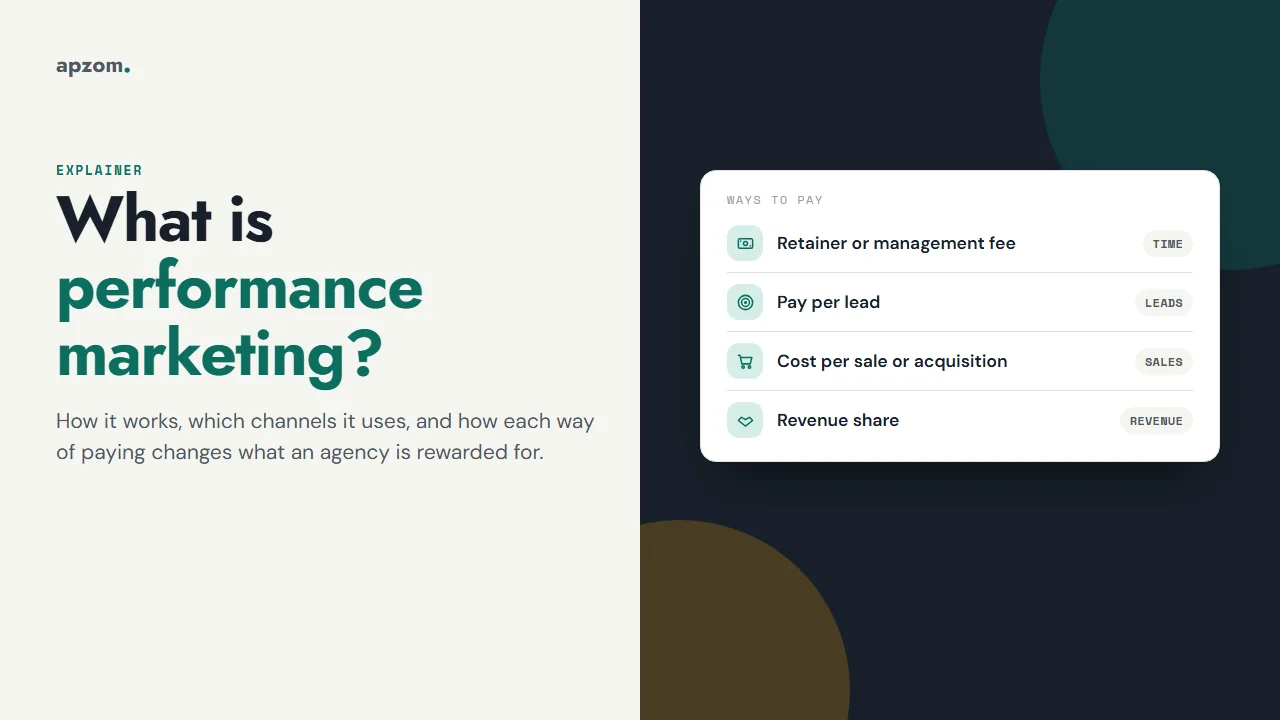
What performance marketing means
There is no single legal or universal definition. The Interactive Advertising Bureau (IAB) described it in 2015 as advertising aimed at a specific action, with measurable cause and effect and optimisation in close to real time, and said that paying per action is common “in many cases” but “not necessarily required”. In practice the term describes marketing that is planned, bought and judged by measurable actions, not by reach or awareness alone. Three ideas sit underneath it:
- Results are tracked. Every channel records the actions that matter, such as a form sent, a call or a purchase, so you can see what each campaign produces.
- Spend follows results. Budget moves towards the campaigns, audiences and ads that produce results at an acceptable cost, and away from those that do not.
- Payment can be tied to results. Sometimes the agency or partner is paid per lead, per sale or as a share of revenue, rather than only for time.
It is not a different kind of advertising so much as a way of running it. The same Google or Meta campaign can be “performance marketing” or not, depending on whether it is measured and managed against real business results.
How the ad platforms charge
It helps to separate two things that are often confused: how the ad platform charges you, and how an agency or partner charges you.
Ad platforms mostly charge for attention, not for outcomes:
- Google Ads usually charges per click, per thousand impressions or per view. Target CPA and Target ROAS are bidding targets, not billing per result. Google does offer paying for conversions, but only in Display campaigns and only for accounts with a strong conversion history (more than 100 conversions in the last 30 days, 90% of them within 7 days of the click), and Google says eligibility can change daily.
- Meta charges for impressions by default; some objectives let you pay for link clicks or video plays instead. Lead and sales goals are still billed on impressions, so Meta does not charge per lead.
- Microsoft Advertising has a cost-per-sale option, but only for Shopping campaigns, and it charges only for sales within 24 hours of a click on a product ad.
So even “performance” campaigns usually carry the risk that you pay for clicks or impressions that never turn into customers.
That is why the agency’s payment model matters so much: it decides who carries that risk.
Framework 1: the four payment models
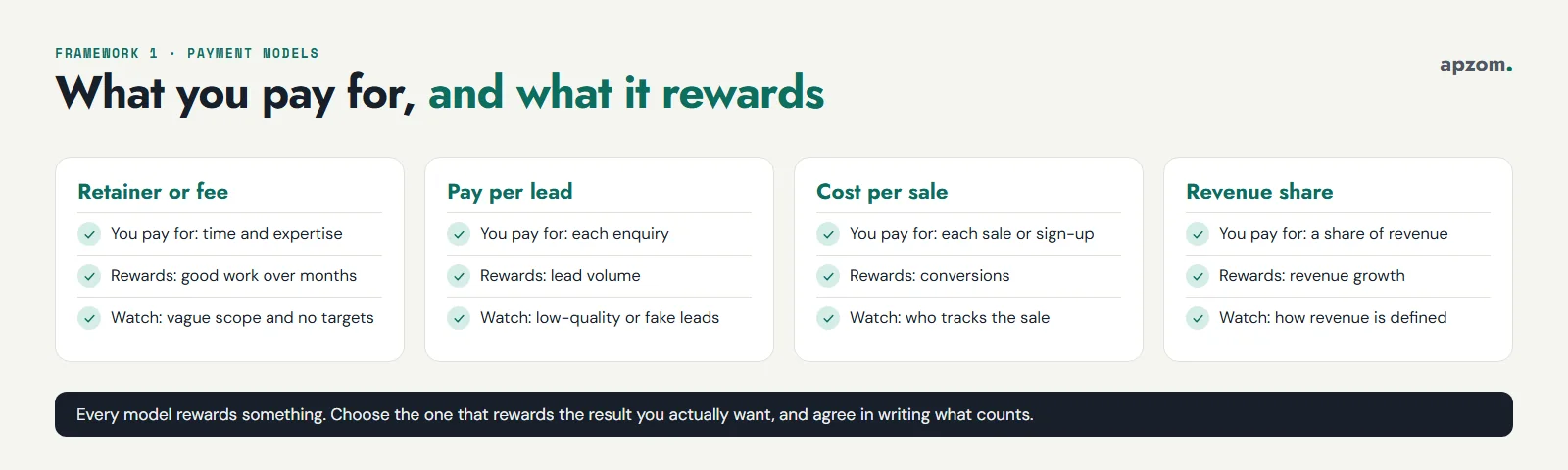
| Model | You pay for | What it rewards | Watch out for |
|---|---|---|---|
| Retainer or management fee | The agency’s time and expertise, usually monthly | Steady work and improvement over months | Vague scope and no agreed targets |
| Pay per lead | Each enquiry the agency delivers | Lead volume | Low-quality, duplicate or fake leads; disputes over what counts |
| Cost per sale or acquisition | Each sale, sign-up or customer | Conversions | Who tracks the sale, and how returns or cancellations are handled |
| Revenue share or commission | A share of the revenue the work brings in | Revenue growth | How revenue is defined, measured and audited |
No model is right for everyone. Pay-per-lead can suit a business with a clear lead definition and a fast way to check quality. A retainer can suit a business that wants an agency to improve the whole funnel, including landing pages and tracking. Revenue share needs very reliable tracking that both sides trust. In regulated sectors such as financial services or insurance, check whether your regulator restricts or requires disclosure of commission paid to marketers.
Whatever you choose, write down exactly what counts as a result. For leads, that means which fields must be filled, how duplicates and spam are treated, how quickly you will report a bad lead, and what happens if you dispute it.
Framework 2: the channel mix
Performance marketing usually combines channels that do four different jobs.
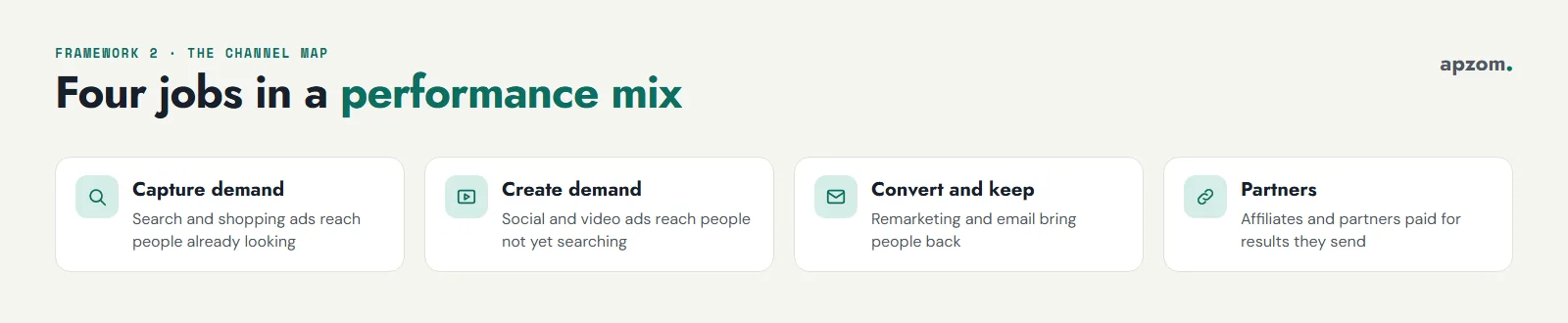
- Capture demand. Search ads and shopping ads reach people who are already looking for what you sell. Our comparison of Google Ads vs Facebook ads explains when each works best.
- Create demand. Social and video ads reach people who are not searching yet, which is often where new customers start.
- Convert and keep. Remarketing and email bring back people who visited but did not act, and existing customers.
- Partners. Affiliates and other partners promote you and are paid when they send results.
Small budgets rarely need every channel at once. A simple start: define one result (for example a qualified enquiry), set up tracking for it, run one channel where your customers already are, review lead quality weekly, then add the next channel once the first works.
Affiliates and disclosure
If you pay affiliates or creators for results, they generally have to disclose that relationship, and you can be responsible for what they publish about you. In the US, the Federal Trade Commission’s guidance says a label such as “affiliate link” on its own may not be understood, while “paid link” next to the link is an example of adequate disclosure. In the UK, CAP advice says affiliate content is advertising and should carry an up-front identifier such as “Ad” or “#Ad”, and that brands stay responsible for their affiliates’ content; the Advertising Standards Authority has ruled that “affiliate” on its own was not enough. In the EU, the Unfair Commercial Practices Directive treats hiding the commercial intent of content as misleading, and bans paid editorial promotion that is not clearly identified. Elsewhere, check your national advertising regulator’s rules. Make disclosure part of every partner agreement.
Weighing a pay-per-lead or performance offer? Ask for a Free Growth Audit. We check your tracking, what counts as a result and who owns your ad accounts, and tell you which payment model fits your goals.
Framework 3: measure results you can trust
Performance marketing is only as good as its measurement. Four layers build on each other:
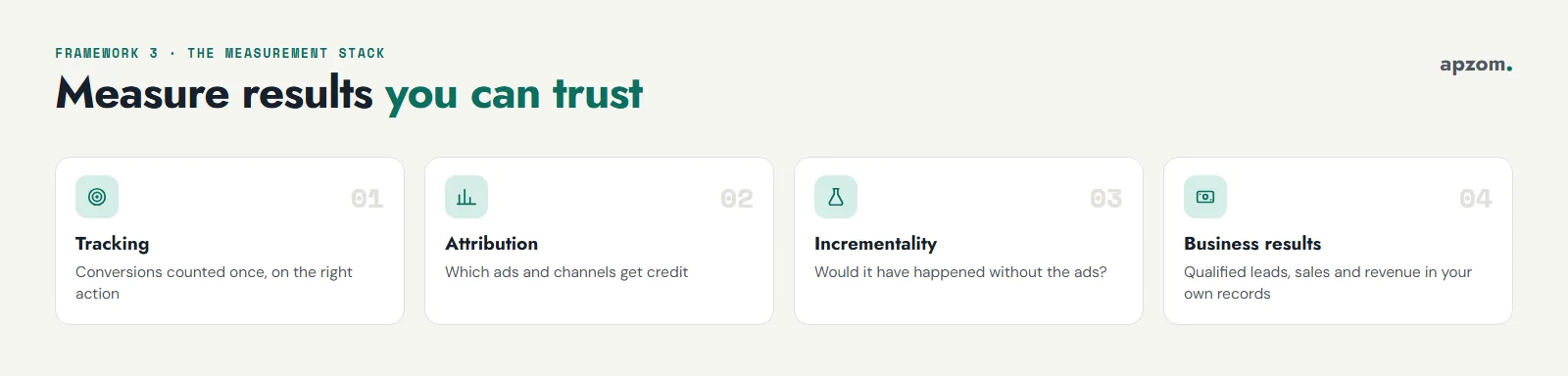
- Tracking. Each platform records the right action once: a successful form submission, a qualified call or a purchase. Our guides to setting up Google Analytics 4, the Meta Pixel and Conversions API and UTM links cover the set-up.
- Attribution. Each platform gives itself credit for results in its own way, so their totals can count the same customer more than once and often do not match your real number. Google Ads uses data-driven attribution by default for most conversion actions. Look at results in one place, such as Google Analytics 4 or your CRM, as well as in each platform.
- Incrementality. Some results would have happened anyway, for example people searching for your brand name. Lift tests help show what the ads actually added: Google says its Conversion Lift studies can give directional results with budgets above US$5,000 and 1,000 conversions, though they are not available to every account. Smaller advertisers can use simple on-off tests in comparable areas or time periods.
- Business results. In the end, judge performance by qualified leads, sales and revenue in your own records. Our guide to measuring marketing ROI explains how to connect them.
Lead quality is part of performance
Paying per lead, or optimising for lead volume, can attract low-quality or even fake leads, and lead generation has a compliance problem regulators take seriously: in August 2025 the US Federal Trade Commission announced $145 million in settlements with two health-insurance lead businesses, Assurance IQ and MediaAlpha, over what it alleged were misleading practices, and called unlawful lead generation a priority. If you buy leads, ask where each one came from and how consent was recorded. In the US, calling or texting leads with automated systems still needs prior express written consent under the TCPA. In the UK, PECR generally requires specific consent before marketing emails or texts to bought-in leads. Check a sample of leads every week, feed back which ones became customers, and use the platforms’ quality options: Meta’s “higher intent” instant forms add a review step before people submit, and Google’s lead forms offer one-time-passcode verification. Google’s lead form requirements say affiliate networks and lead-generation businesses will not be allowed to use them, at Google’s discretion. A cheaper lead that never becomes a customer is not cheaper.
Questions to ask a performance marketing agency
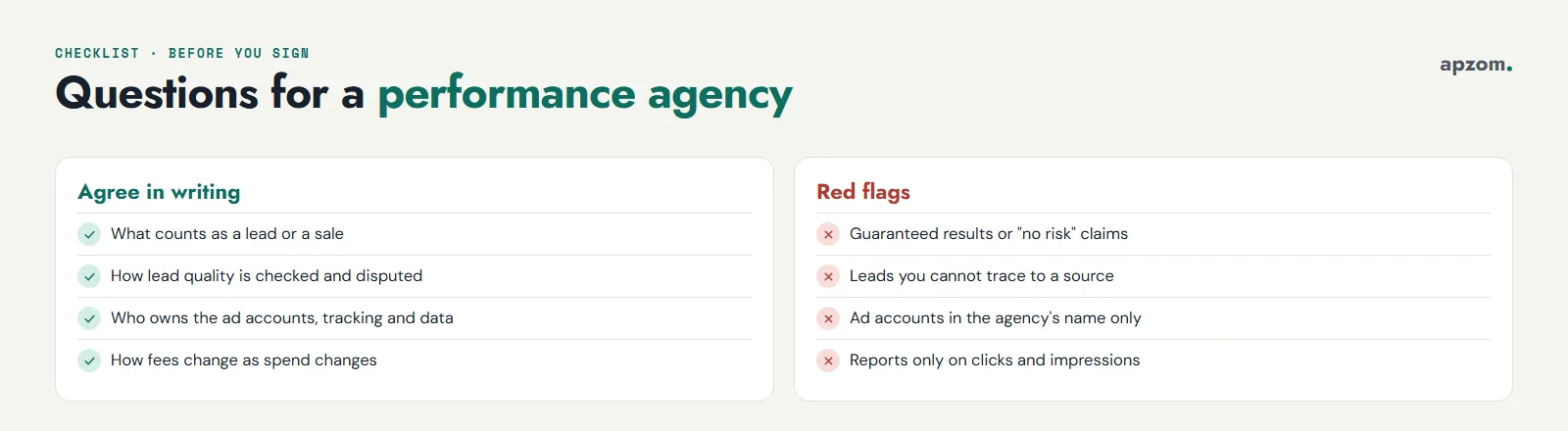
Agree in writing:
- What counts as a lead or a sale, and how lead quality is checked and disputed.
- Who owns the ad accounts, tracking, data and creative. They should be in your name; see our Google Ads audit checklist for the ownership checks.
- How fees change if your ad spend goes up or down.
- How and how often results are reported, and against which numbers.
Red flags:
- Guaranteed results, or offers with “no risk” that do not explain who pays for the clicks.
- Leads you cannot trace back to a source, campaign or ad.
- Ad accounts or tracking in the agency’s name only.
- Reports that only show clicks, impressions and “engagement”.
If you are comparing management fees, our guide to Google Ads management costs explains the common ways agencies charge.
How Apzom can help
Apzom Digital’s performance marketing work covers Google Ads, Meta ads and the tracking behind them, in ad accounts your business owns. We start by agreeing what counts as a result, set up tracking so you can see qualified leads and sales, and report against your own numbers, not just platform figures. Our published Meta results are on our case studies page; for example, HillTown Group has had 600+ leads every month from Meta ads, for 12 months running.
We work with clients worldwide, remotely, from our base in Ahmedabad, India.
Frequently asked questions
Is performance marketing the same as digital marketing?
No. Digital marketing covers everything online, including brand building, content and SEO. Performance marketing is the part that is planned and judged by measurable actions such as leads and sales.
Is SEO performance marketing?
SEO results can be measured, but you do not usually pay for SEO per lead or per click, and results build over months. Many businesses run SEO alongside performance channels rather than as part of them.
Is pay-per-lead better than a retainer?
It depends on how clear and checkable your leads are. Remember that the ad platforms themselves still charge for clicks or impressions, so in some pay-per-lead deals the agency pays the ad cost and prices that risk into its fee, while in others you pay the ad spend plus a fee per lead. Ask which one you are being offered. Pay-per-lead moves some risk to the agency but rewards volume; a retainer rewards ongoing work but needs clear targets. Whichever you choose, define what counts as a result in writing.
Do I pay the agency’s fee on top of ad spend?
Usually, yes. Ad spend goes to the platform, such as Google or Meta, and the agency charges separately, whether as a fee, per lead, per sale or as a share of revenue. Ask for both to be shown separately.
How quickly does performance marketing work?
Paid ads can start producing clicks quickly, but campaigns usually need time and data to improve. Judge them over months, not days, against qualified leads and sales.
Who should own the ad accounts?
Your business. Give the agency access to your accounts rather than letting it run ads from its own, so you keep your data, history and audiences if you change agency.
Get your Free Growth Audit and Quote. We review your ad accounts, conversion tracking, lead quality process and reporting, and set out a plain-English plan, including which payment model rewards the result you want.
No obligation and no guaranteed results. Prefer to talk first? Contact us or see our performance marketing service.