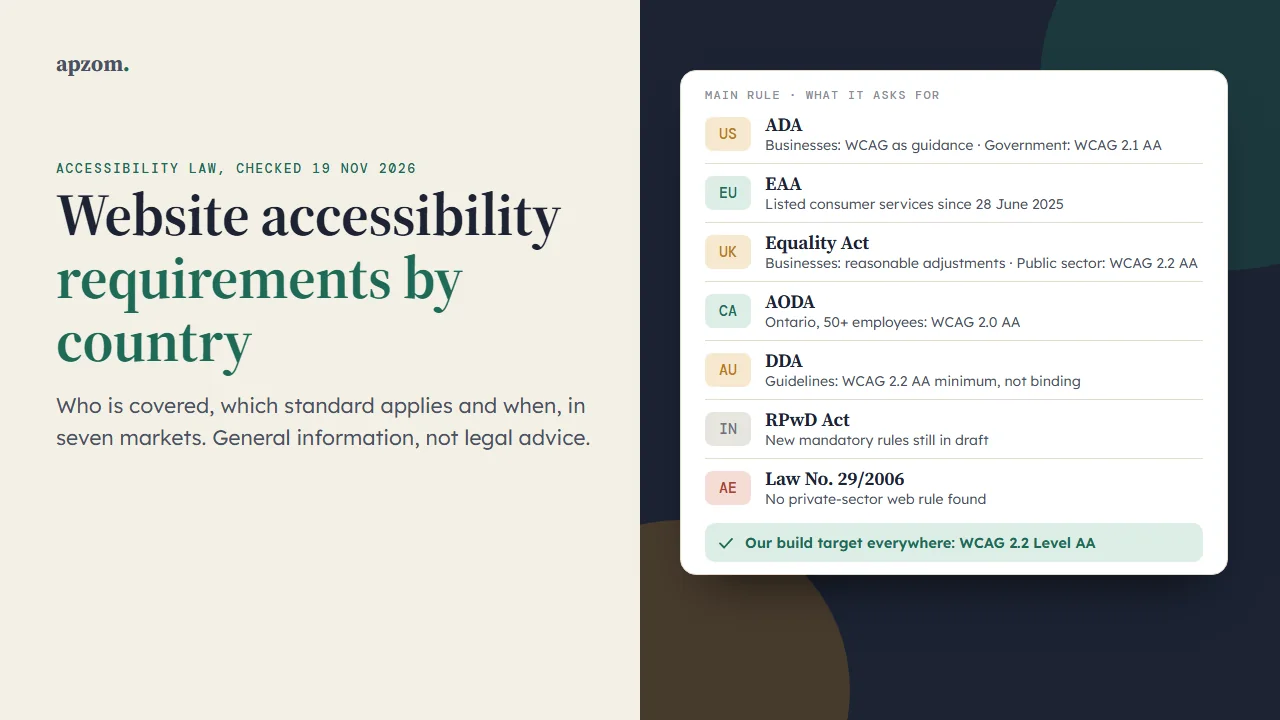
The short answer: There is no single worldwide website accessibility law. In most countries a private business has a general duty not to exclude disabled customers, and its website is part of that duty, but the law does not name a technical standard (the US ADA for businesses, the UK Equality Act, Australia’s Disability Discrimination Act). Specific web rules with a named standard and deadlines apply to public bodies, to listed consumer services sold in the EU under the European Accessibility Act (since 28 June 2025), to Ontario organisations with 50 or more employees, and to some regulated sectors. Almost every rule points back to the Web Content Accessibility Guidelines (WCAG), so building to WCAG 2.2 Level AA is the safest target wherever you sell, and official sources do not treat an overlay widget as a fix.
This guide is for business owners, marketing leads and web managers anywhere in the world who need to know which accessibility rules apply to their website, which standard to build to and by when. It gives you one table for the US, EU, UK, Canada, Australia, India and the UAE (who is covered, the standard, key dates, enforcement), what official sources say about overlays, a five-question decision path and the first steps to take. We checked every law, date and standard against official sources on 19 November 2026. This is general information, not legal advice; ask a qualified lawyer in each market where your obligations matter.
The standard behind almost every rule: WCAG
The Web Content Accessibility Guidelines (WCAG) are published by the World Wide Web Consortium (W3C). They set testable success criteria, such as text alternatives for images, enough colour contrast, full keyboard use and clear form labels, at three levels: A, AA and AAA. Laws and guidance almost always ask for Level AA.
Four versions matter, and the one a law names matters too:
| Version | Status on 19 November 2026 | Who still names it |
|---|---|---|
| WCAG 2.0 | W3C Recommendation, not withdrawn | Ontario’s AODA rules |
| WCAG 2.1 | W3C Recommendation (June 2018) | US ADA Title II rule and the US health department’s Section 504 rule; the current EU standard EN 301 549 v3.2.1 is based on it |
| WCAG 2.2 | W3C Recommendation (October 2023, updated December 2024); also ISO/IEC 40500:2025 | UK public sector guidance and Australia’s 2025 guidelines |
| WCAG 3.0 | Working Draft only (10 September 2026) | No law we found; W3C says it “still has several years of work” |
W3C says WCAG 2.2 is backwards compatible with WCAG 2.1, so a site that meets 2.2 AA generally meets 2.1 AA too. It removed one old criterion, 4.1.1 Parsing, which a law or contract naming 2.0 or 2.1 may still expect you to report on.
In the EU, the technical reference is the European standard EN 301 549. The European Commission’s AccessibleEU centre says a new version, v4.1.1, was published in September 2026 and adopts WCAG 2.2, but it has not yet been cited in the EU’s Official Journal. Until it is, the reference remains EN 301 549 v3.2.1 (2021), which is based on WCAG 2.1 Level AA.
Website accessibility requirements by country
Read the table as a map, not a final answer: scope often turns on sector, size and whether you sell to consumers.
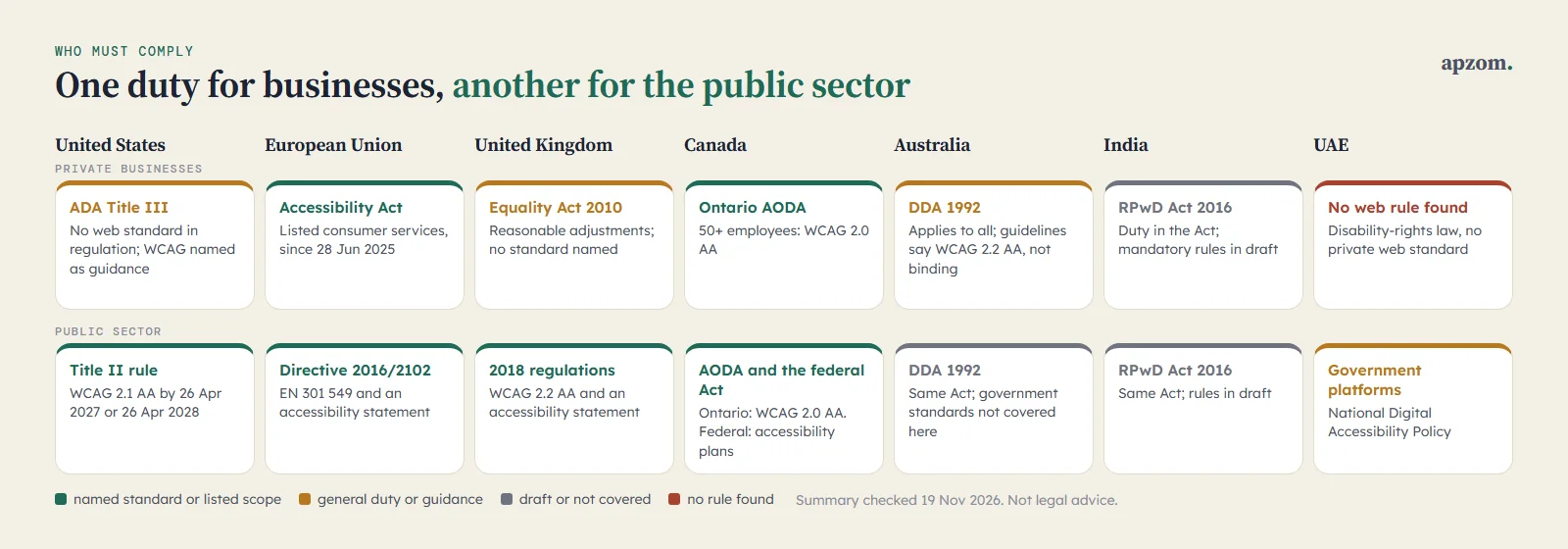
| Market | Main law or rule | Who must comply on the web | Standard named | Key dates | Who enforces |
|---|---|---|---|---|---|
| US, businesses | ADA Title III | Businesses open to the public | None in regulation; the Justice Department points to WCAG as helpful guidance | Applies now | US Department of Justice |
| US, government | ADA Title II web rule (2024, dates moved in 2026) | State and local governments | WCAG 2.1 AA | 26 April 2027 (population 50,000+); 26 April 2028 (smaller entities and special districts) | US Department of Justice |
| US, health funding | Section 504 rule of the Department of Health and Human Services (HHS) | Organisations that receive HHS funding | WCAG 2.1 AA | 11 May 2027 (15+ employees); 10 May 2028 (fewer than 15) | HHS |
| EU, private | European Accessibility Act (Directive (EU) 2019/882) | Listed products and consumer services such as e-commerce and consumer banking; microenterprises providing services are exempt | EN 301 549; the current reference is v3.2.1 (based on WCAG 2.1 AA), and v4.1.1 (WCAG 2.2) awaits citation | Since 28 June 2025 (some transition to 2030) | National authorities; penalties set nationally |
| EU, public sector | Web Accessibility Directive (Directive (EU) 2016/2102) | Public sector bodies | EN 301 549 | Websites since 23 September 2019 or 2020; mobile apps since 23 June 2021 | National monitoring bodies |
| UK, all providers | Equality Act 2010 (Disability Discrimination Act 1995 in Northern Ireland) | All service providers must make reasonable adjustments | None named | Applies now | Claims under the Act; equality regulators |
| UK, public sector | Public Sector Bodies Accessibility Regulations 2018 | Public sector bodies, with some exemptions | WCAG 2.2 AA plus an accessibility statement | In force since 23 September 2018; the website and app deadlines have passed | GDS monitors; EHRC (Great Britain) and ECNI (Northern Ireland) enforce |
| Canada, Ontario | AODA, Integrated Accessibility Standards, section 14 | Public sector, and businesses and non-profits with 50+ employees | WCAG 2.0 AA, except live captions (1.2.4) and pre-recorded audio description (1.2.5) | Since 1 January 2021, for content posted after 1 January 2012 | Ontario government, including compliance audits |
| Canada, federal | Accessible Canada Act | Federal government and federally regulated sectors such as banks and telecoms | Accessibility plans, no single web standard named | Plans updated at least every three years | Penalties up to CAD 250,000 per violation |
| Australia | Disability Discrimination Act 1992 | Anyone providing goods or services | None in the Act; non-binding 2025 guidelines say WCAG 2.2 AA at a minimum | Applies now; guidelines published April 2025 | Complaints to the Commission, then the courts |
| India | Rights of Persons with Disabilities Act 2016 | Government and private service providers | Being reset: the old rule was struck down in 2024 and new rules are still in draft | Supreme Court judgment 8 November 2024 | Fines under section 89 once rules apply |
| UAE | Federal Law No. 29 of 2006 | No web rule for private businesses found | Government platforms follow a National Digital Accessibility Policy | Not applicable | Not found |
United States
Businesses (Title III). The Justice Department’s guidance says the ADA applies to all the goods and services of businesses open to the public, and that inaccessible website features can limit access to them. The Department “does not have a regulation setting out detailed standards”, so businesses have flexibility, with WCAG named as helpful guidance. The guidance lists common barriers (poor colour contrast, missing alt text, videos without captions, inaccessible forms, mouse-only navigation) and describes settlements with businesses, including Rite Aid.
State and local government (Title II). A 2024 rule set WCAG 2.1 Level AA for the web content and mobile apps of state and local governments, including content they provide through contractors. An interim final rule that took effect on 20 April 2026 moved the compliance dates by a year: 26 April 2027 for entities serving a population of 50,000 or more, and 26 April 2028 for smaller entities and special district governments. The rule has exceptions, such as archived content. The Justice Department also wrote that it “plans to engage in future rulemaking” on the rule’s substance, so check ADA.gov before relying on the details.
Health and social care funding (Section 504). Organisations that receive funding from the US Department of Health and Human Services, such as many hospitals and clinics, have a separate rule that also uses WCAG 2.1 AA. An HHS interim final rule published on 11 May 2026 moved its dates to 11 May 2027 for recipients with 15 or more employees and 10 May 2028 for smaller ones.
Some US states have their own disability laws. We have not covered them here.
European Union
The European Accessibility Act (EAA). Directive (EU) 2019/882 applies to listed products and to listed services provided to consumers after 28 June 2025. The European Commission’s list includes e-commerce, banking services, e-books, telephony and audiovisual media services, and services for air, bus, rail and waterborne passenger transport. Each member state wrote the Act into its own law, so penalties and the authority you deal with differ by country. In Ireland, for example, the Competition and Consumer Protection Commission enforces the rules for e-commerce services.
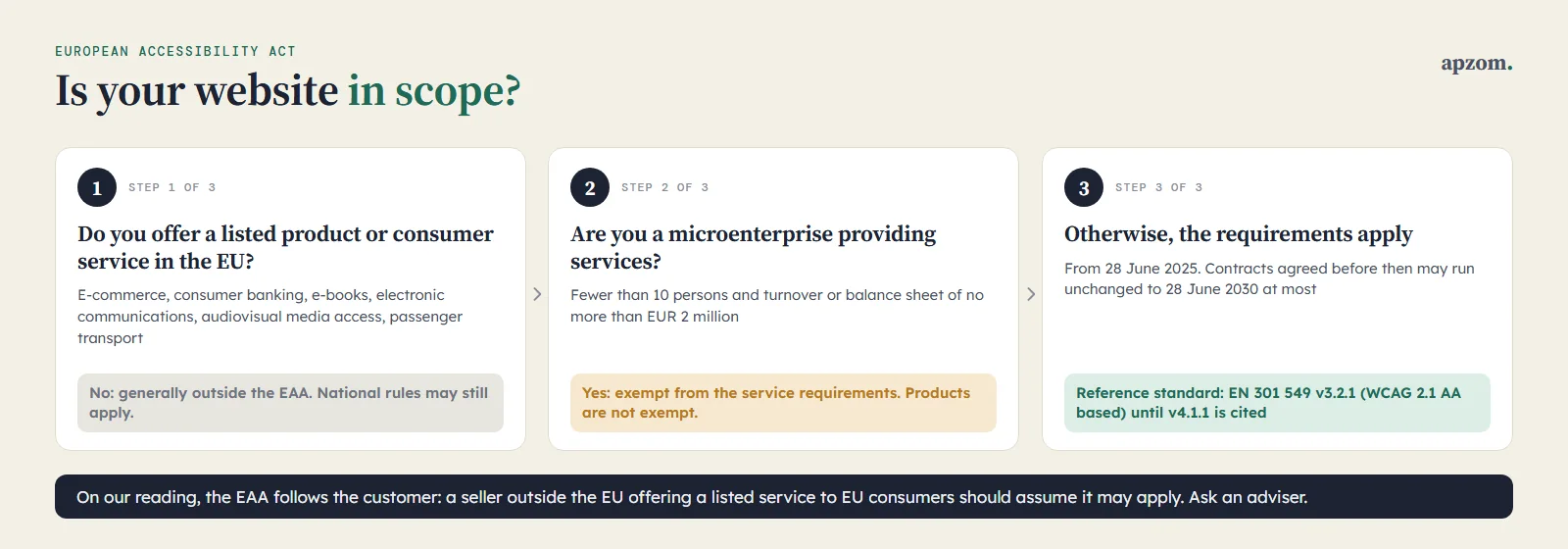
Three limits matter for a small business:
- Microenterprises providing services are exempt from the service requirements. Your Europe, the EU’s official business portal, describes this as a service business with fewer than 10 employees and under EUR 2 million in turnover. The Directive’s own test uses annual turnover or balance sheet total. The exemption does not cover products.
- Only listed services are covered. A company brochure site that sells none of the listed services is generally outside the EAA, though national rules can still apply. A business-to-business portal is also outside a consumer-services rule, on our reading; ask an adviser if your customers are a mix.
- Some transition rules apply. Service contracts agreed before 28 June 2025 can continue unchanged until they end, for no longer than until 28 June 2030, and archived content that is not updated after that date is excluded.
On our reading, the EAA follows the customer, not your office: if you sell a listed service to EU consumers from the US, UK, India or the UAE, assume it may apply and take advice.
Public sector bodies. The Web Accessibility Directive (Directive (EU) 2016/2102) has required public sector websites in every member state to be accessible, and to publish an accessibility statement, since 23 September 2019 for newer sites and 23 September 2020 for all others, and since 23 June 2021 for mobile apps.
United Kingdom
GOV.UK guidance says “all UK service providers have a legal obligation to make reasonable adjustments under the Equality Act 2010” (the Disability Discrimination Act 1995 in Northern Ireland). That includes private businesses and their websites, but the Act does not name a web standard. On our reading, WCAG AA is the most practical way to show you have taken reasonable steps.
Public sector bodies have a specific rule: the Public Sector Bodies (Websites and Mobile Applications) (No. 2) Accessibility Regulations 2018. The government guidance expects WCAG 2.2 Level AA and a published accessibility statement. The Government Digital Service monitors a sample of sites, and the Equality and Human Rights Commission (Great Britain) and the Equality Commission for Northern Ireland enforce. Some bodies, such as public service broadcasters and some charities, are exempt. The UK left the EU, so the European Accessibility Act does not apply in the UK itself, but it can apply to a UK business selling listed services to consumers in the EU.
Not sure which of these rules reach your website? Ask for a Free Growth Audit with an accessibility review. Tell us where your customers are and what the site sells; we test your main templates by hand against WCAG 2.2 AA and send back a short list of what fails, where it sits and which rules appear to apply. It is not legal advice, and we will say when you need a lawyer.
Canada
Ontario (AODA). The Ontario government says that, since 1 January 2021, public websites must be accessible if you are a designated public sector organisation or a business or non-profit with 50 or more employees. Public websites and web content posted after 1 January 2012 must meet WCAG 2.0 Level AA, except success criteria 1.2.4 (live captions) and 1.2.5 (pre-recorded audio descriptions). The organisation that controls the website, directly or through a contract, is responsible. Organisations with fewer than 50 employees are not required to meet these website rules but are encouraged to.
Federal (Accessible Canada Act). The Act covers the federal government and federally regulated organisations, such as banks, telecoms, broadcasters and transport that crosses provincial or national borders. Covered organisations must publish accessibility plans, update them at least every three years and consult people with disabilities. Section 91 sets a maximum penalty of CAD 250,000 per violation. We have not covered other provinces’ laws.
Australia
Australia’s Disability Discrimination Act 1992 makes it unlawful to discriminate when providing goods and services, and the Australian Human Rights Commission treats websites and digital services as services. It reached that view in an early complaint against the Sydney 2000 Olympics organising committee, whose website a blind user could not use. The Commission’s “Guidelines on equal access to digital goods and services” (April 2025) replaced its 2014 advisory note. They say organisations should conform with WCAG 2.2 at a minimum Level AA, and they state that the guidelines are not legally binding. A person can complain to the Commission, and a business may argue that a change would cause unjustifiable hardship, but it has to make that case.
India
Section 46 of the Rights of Persons with Disabilities Act 2016 requires service providers, government and private, to provide services in line with the accessibility rules made under the Act. In Rajive Raturi v Union of India (8 November 2024), the Supreme Court held that Rule 15(1) of the 2017 rules was “ultra vires” because it relied on guidelines rather than mandatory rules. The Court directed the Union Government to set mandatory rules within three months, in consultation with stakeholders and NALSAR’s Centre for Disability Studies, and said the fines in section 89 must be applied once those rules exist.
The rules are still not final. The Department of Empowerment of Persons with Disabilities consulted on draft accessibility standards for the ICT sector on 25 June 2025. Legal summaries also report a draft amendment to the rules published in the Gazette in July 2026, based on IS 17802, the Indian standard for ICT accessibility. We could not open the Gazette copy, so treat any deadlines in that draft as proposals. If you serve Indian users, plan for a binding standard and build to WCAG 2.2 AA while the final rules are awaited.
United Arab Emirates
We could not find a federal law or regulation that sets a website accessibility standard for private businesses in the UAE. Federal Law No. 29 of 2006 protects the rights of people of determination (the UAE’s term for people with disabilities). Government platforms work under a National Digital Accessibility Policy, and the official u.ae portal says it follows WCAG 2.1 and 2.2 Level AA. We did not check every emirate’s or free zone’s rules. For a private site, treat WCAG 2.2 AA as good practice rather than a legal requirement we can point to.
The accessibility overlay myth
An accessibility overlay is a third-party script or widget added to a site that claims to detect and fix accessibility problems automatically. Official sources do not support the claim that an overlay makes a website compliant.
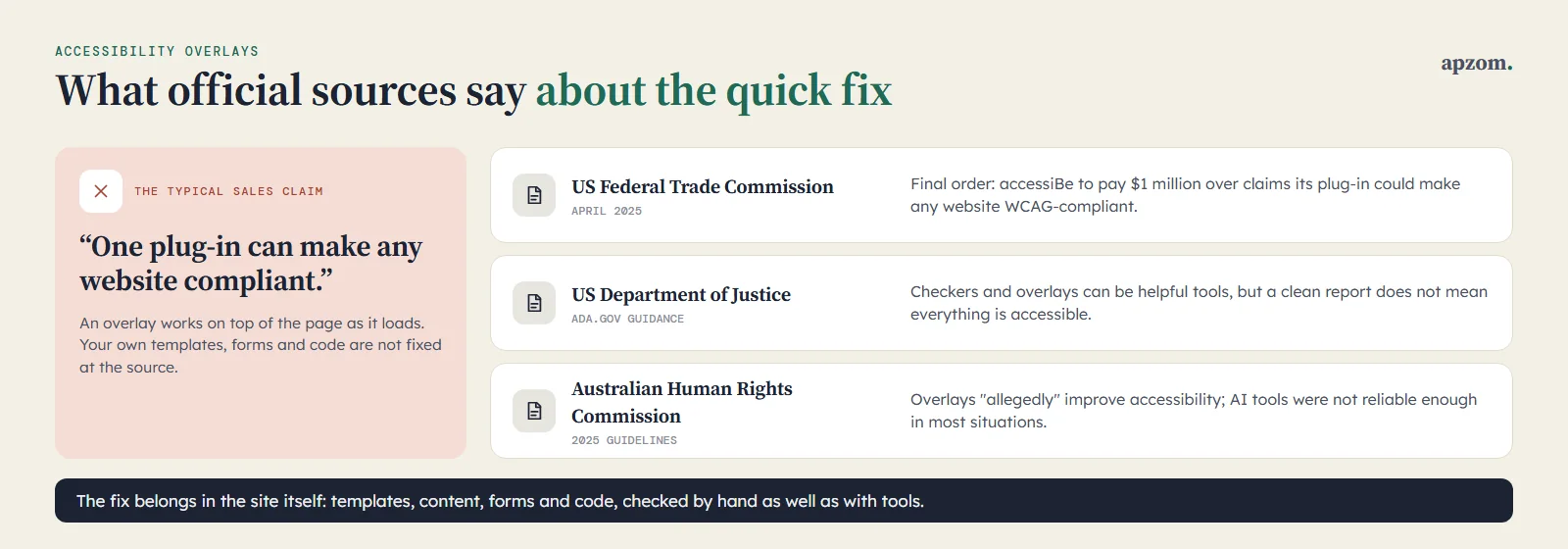
- US Federal Trade Commission. In April 2025 the FTC approved a final order requiring the overlay vendor accessiBe to pay $1 million. The FTC said the company had claimed its accessWidget plug-in “can make any website compliant” with WCAG. The order bars it from saying its automated products can make any website WCAG-compliant unless it has evidence, and the FTC also alleged that the company formatted third-party articles and reviews to look like independent opinions.
- US Justice Department. ADA.gov says automated checkers and overlays “can be helpful tools”, but that a clean report does not necessarily mean everything is accessible, and it recommends manual checks as well.
- Australian Human Rights Commission. Its 2025 guidelines mention plug-in overlays that “allegedly” improve accessibility, and say that in 2025 AI applications were not reliable enough in most situations.
The honest position: an automated tool can help you find some problems, but accessibility lives in your templates, content, forms and code. If the menu cannot be reached by keyboard or a form field has no label, the fix belongs in the site itself. Be wary of any vendor, agencies included, that promises “full compliance” or “protection from lawsuits”.
What applies to my business? A five-question decision path
Answer in order and note every “yes”; many businesses have more than one.
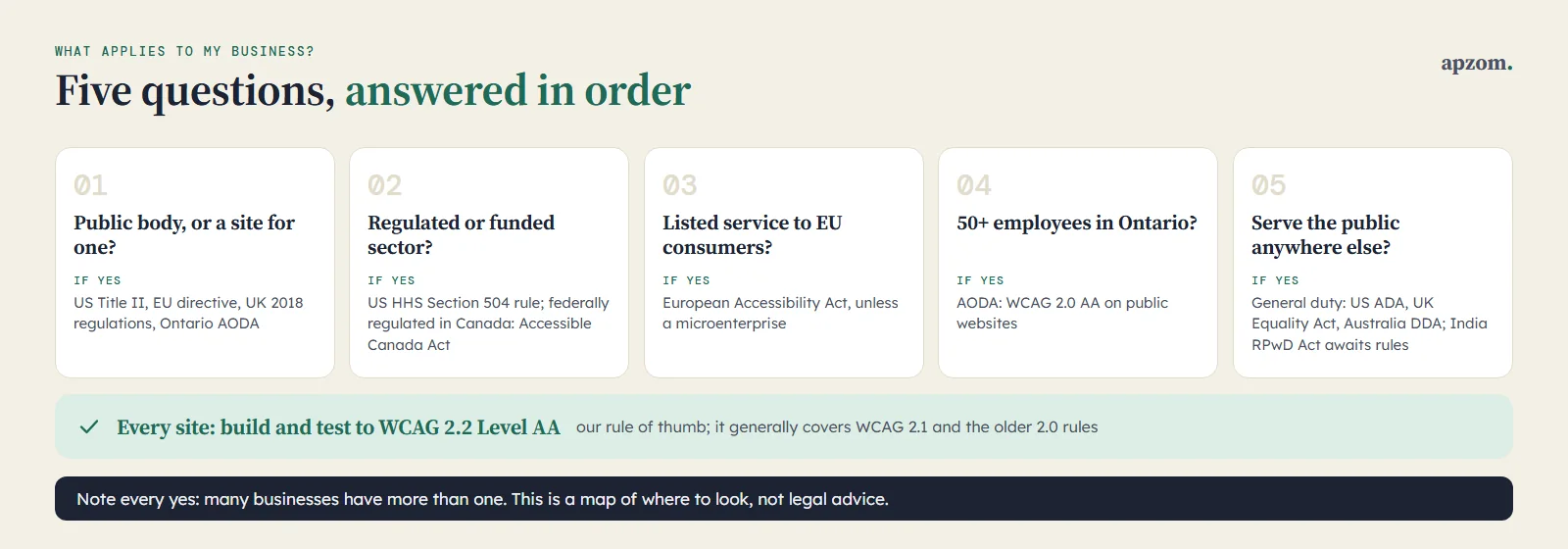
- Are you a public body, or do you build or run a website for one? If yes, the public sector rules apply to that site: US Title II (WCAG 2.1 AA by 2027 or 2028), the EU Web Accessibility Directive, the UK 2018 regulations (WCAG 2.2 AA and a statement) or Ontario’s AODA rules.
- Are you in a regulated or funded sector? If you receive US health department funding, the Section 504 rule applies. If you are a federally regulated organisation in Canada, such as a bank or telecom, the Accessible Canada Act applies.
- Do you sell a listed service to consumers in the EU? E-commerce, consumer banking, e-books, communications or passenger transport. If yes and you are not a microenterprise, the EAA applies.
- Do you have 50 or more employees in Ontario? If yes, your public website must meet WCAG 2.0 Level AA.
- Do you serve the public anywhere else? In the US, UK and Australia, a general duty not to discriminate applies to your website even though no web standard is written into the law for most private businesses; in India, the RPwD Act’s duty on service providers is waiting for final rules.
If you answered “no” to all five, you may have no specific web rule today, but disabled people are still your customers, and several of the rules above changed in 2025 and 2026 alone. Our rule of thumb for every business website: build and test to WCAG 2.2 Level AA. It is the newest finished version, it generally covers WCAG 2.1, and it is the minimum Australia’s guidance recommends.
What a business website should do next
- Record which rules apply. Note your markets, the rules from the decision path, the standard each names and the date you checked.
- Test your main templates against WCAG 2.2 AA. Run an automated checker, then test by hand: complete your main form and checkout with only the keyboard, zoom to 200% and try a screen reader on key pages. Our guide to writing alt text covers one of the most common failures.
- Fix templates before pages. If contrast, focus or headings fail across the whole site, the problem sits in the theme. Our guide to the signs your website needs a redesign explains how to tell a fixable theme from one that needs replacing, and our WordPress vs website builders comparison covers what each platform lets you change.
- Publish an accessibility statement and a contact route. Public sector bodies in the UK and EU must publish one. For everyone else it is good practice: say what standard you aim for, what you know does not yet work, and how to ask for help or another format.
- Put accessibility into contracts. Ontario holds the organisation that controls the site responsible, including through a contract, and the US Title II rule covers content provided through contractors. Ask developers, plugin vendors and booking or payment providers which WCAG level they meet, and get it in writing.
- Re-test after every major change. A new theme, page builder or checkout can undo earlier work. If a redesign is coming, include accessibility in the brief alongside the redesign SEO checklist.
Common mistakes
- Assuming “no law names a standard” means “no duty”. In the US, UK and Australia the general duty already applies to websites.
- Quoting old dates. The US Title II dates of April 2026 and April 2027 were replaced in April 2026, and the HHS Section 504 dates moved in May 2026.
- Thinking the EAA covers every EU website, or none outside the EU. It covers listed consumer services provided to EU consumers, which on our reading can include sellers based outside the EU, and it exempts microenterprises providing services.
- Building to WCAG 2.0 or 2.1 only because one law names it. Building to 2.2 AA generally satisfies the older versions and the newer rules together.
- Buying an overlay instead of fixing the site. No official source we checked treats an overlay as a route to compliance.
- Forgetting third-party parts. Booking widgets, chat tools and payment pages are part of the journey too.
How Apzom can help
Apzom Digital builds and rebuilds business websites on WordPress and custom code, and reviews existing sites for accessibility problems in templates, forms and content (keyboard use, focus, contrast, headings, labels, alt text), tested by hand as well as with automated tools. We tell you which rules from this guide appear to apply to your markets and which WCAG level we would build to, and we recommend a lawyer where the legal answer matters. We have not published an accessibility case study yet, so we will not show you results we cannot prove; you can see the projects we have published on our case studies page. See our website development service for how we build. We work with clients worldwide, remotely, from our base in Ahmedabad, India.
Get a Free Growth Audit and Quote for an accessible website. Send us your site and the markets you sell in. We check keyboard use, focus, contrast, headings, forms and alt text on your key pages, tell you whether the problems sit in a few pages or in the theme, and quote for fixing or rebuilding if you want us to do the work.
No obligation, no promise of “full compliance” and no overlay. Prefer to talk first? Contact us or see our website development service.
Frequently asked questions
Does the ADA apply to my business website?
If your business is open to the public in the US, the Justice Department’s guidance treats your website as part of the goods and services the ADA covers. There is no regulation with a detailed web standard for businesses, so WCAG is the usual benchmark. The 2026 date changes apply to state and local governments and to organisations that receive US health department (HHS) funding, not to businesses in general.
Does the European Accessibility Act apply to businesses outside the EU?
It can. The Act covers listed services provided to consumers in the EU, such as e-commerce and consumer banking, so a seller outside the EU offering them to EU consumers should assume it may apply and take advice. Microenterprises providing services are exempt.
Which WCAG version should my website meet?
Build to WCAG 2.2 Level AA. It is the version UK public sector guidance and Australia’s 2025 guidelines name, it is backwards compatible with WCAG 2.1, which the US Title II rule and the current EU standard use, and it generally covers Ontario’s WCAG 2.0 AA rule too. WCAG 3.0 is still a draft and no law we found requires it.
Will an accessibility overlay make my website compliant?
No official source we checked says so. The FTC required one overlay vendor to pay $1 million over claims that its tool could make any website WCAG-compliant, and the Justice Department says a clean automated report does not prove a site is accessible. Fix the site itself.
Is there a website accessibility law in India or the UAE?
India’s Rights of Persons with Disabilities Act 2016 already requires service providers to follow its accessibility rules, but the Supreme Court struck down the old rule in November 2024 and the replacement rules are still in draft. In the UAE we found disability-rights law and a digital accessibility policy for government platforms, but no federal web standard for private businesses.