The short answer: Search campaigns show text ads for the keywords you choose, on Google Search, with detailed control over keywords, ads and search terms. Performance Max is a goal-based campaign that, in Google’s words, gives access to all Google Ads inventory from one campaign, including YouTube, Display, Search, Discover, Gmail and Maps. Google describes Performance Max as a complement to keyword-based Search, not a replacement. When a search is identical to an exact match keyword in a Search campaign, Google says the Search campaign is prioritised. For most service businesses generating leads, in our judgement, start with Search on high-intent searches, then add Performance Max once your conversion tracking counts qualified leads reliably.
This guide is for business owners and marketers deciding how to structure Google Ads for enquiries, quotes and bookings. Online stores have extra considerations around product feeds that are not covered in depth here. Features follow Google Ads Help as checked in November 2026, and Performance Max changes more often than most campaign types. Apzom Digital manages Google Ads, so read this knowing we have an interest.

What to take from this guide
- They are built for different jobs. Search captures people already searching for what you sell. Performance Max reaches people across Google’s channels and lets Google decide where.
- They can run together. Google has rules for which campaign serves when both could.
- Performance Max depends on your data. If your conversion tracking counts the wrong thing, it will find more of the wrong thing.
- Control has improved, but differs. Performance Max now has a search terms report and negative keywords for its Search and Shopping traffic.
How they compare
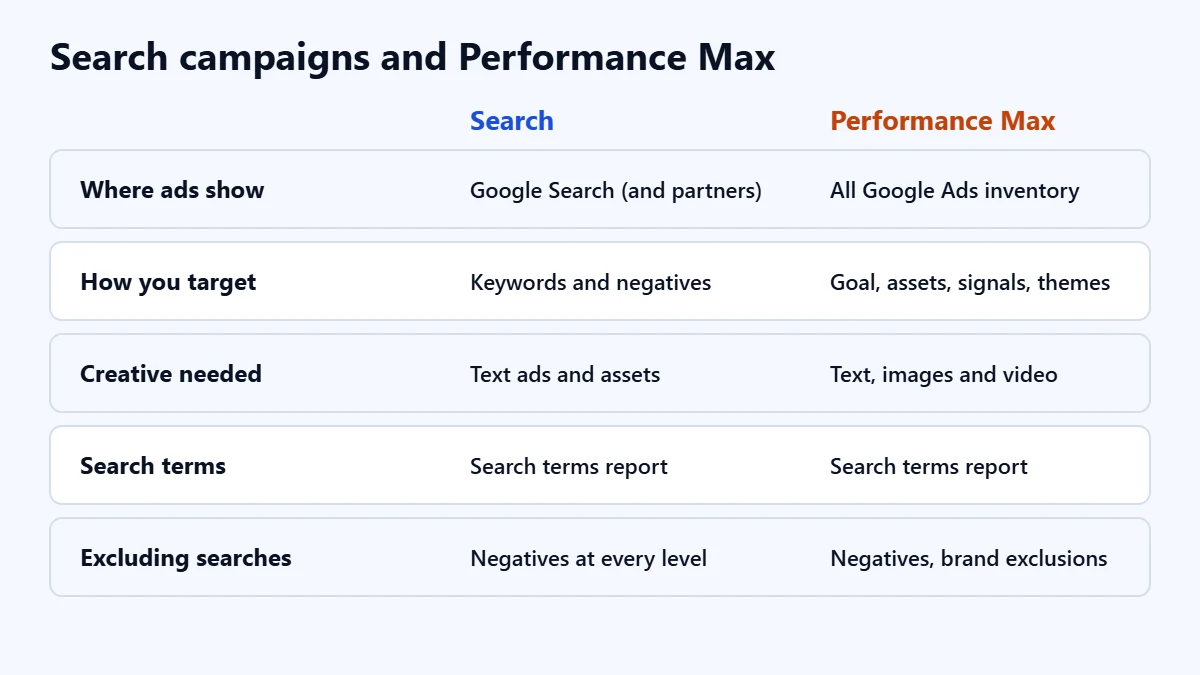
| Search campaigns | Performance Max | |
|---|---|---|
| Where ads show | Google Search and, if chosen, search partners | All Google Ads inventory, including YouTube, Display, Search, Discover, Gmail and Maps |
| How you target | Keywords with match types, plus negatives | Your goal, assets, audience signals and optional search themes |
| Creative needed | Text ads and assets | Asset groups with text, images and ideally video |
| Search terms | Search terms report | A Performance Max search terms report, with data from March 2023 |
| Excluding searches | Negative keywords at ad group, campaign or account level | Negative keywords for Search and Shopping inventory, plus brand exclusions |
| Best suited to | Capturing clear demand with tight control | Reaching more people across channels once your conversion data is strong |
How they work together
If you run both, they can be eligible for the same search. Google’s help pages explain what happens:
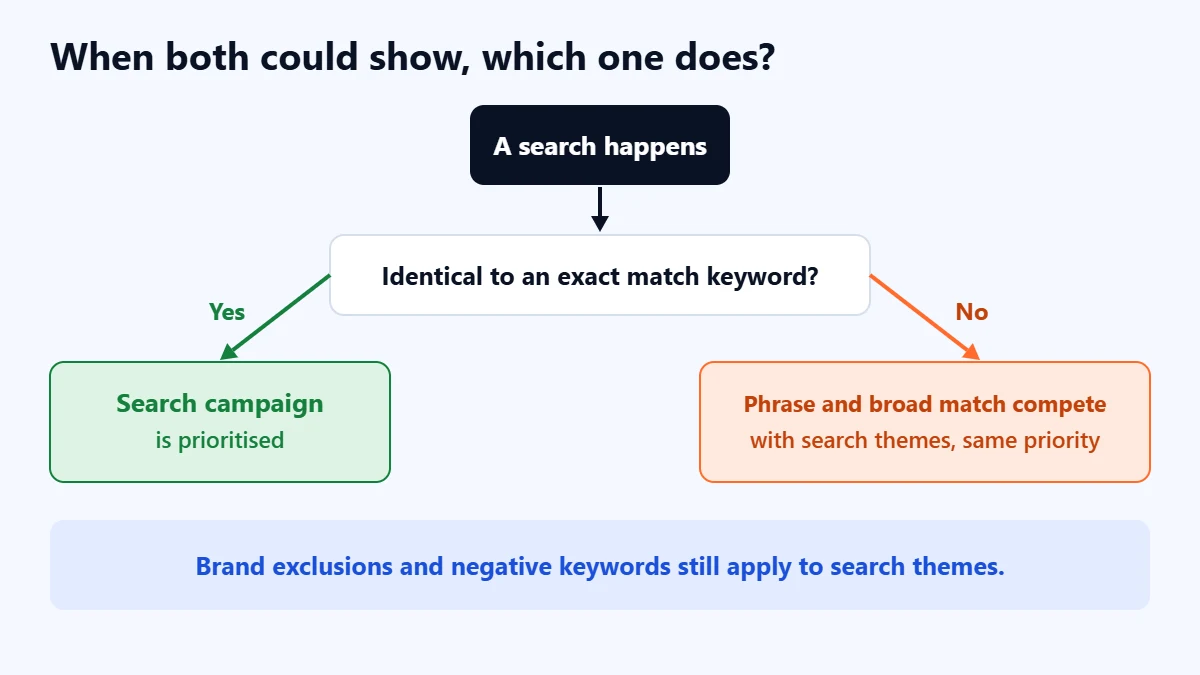
- Exact match wins when it is identical. Google says Search campaigns with an exact match keyword are prioritised over Performance Max when the query matches that keyword exactly.
- Search themes compete like broad and phrase match. Google says search themes have the same priority as phrase and broad match keywords in your Search campaigns.
- Your exclusions still apply. Google says search themes respect brand exclusions and negative keywords.
In practice, this means your most important, highest-intent searches can stay in a Search campaign you control, as exact match keywords, while Performance Max looks for demand elsewhere.
When Search should come first
In our judgement, Search is the better starting point when:
- People already search for your service in clear terms, such as “emergency plumber near me” or “commercial roofing contractor”.
- Your conversion tracking is new or still counts every form fill, including spam.
- You get only a handful of conversions a month. Google’s lead generation guidance suggests at least 15 conversions in the last 30 days for a goal used in bidding.
- You have no strong images or video to supply.
- Budget is tight and you need to see exactly where every click came from.
When Performance Max is worth adding
- Your conversion tracking counts real, preferably qualified leads, and you have steady volume.
- Search campaigns are already capturing most of the clear demand, and you want to reach people earlier.
- You can supply good images, video and messaging for each service or audience.
- You sell products with a Merchant Center feed, where Performance Max can use the feed across channels.
Not sure how your account should be structured? Ask for a Free Growth Audit. We review your campaigns, tracking and search terms, and tell you whether Search, Performance Max or both make sense for you.
Which should you use? A quick decision path
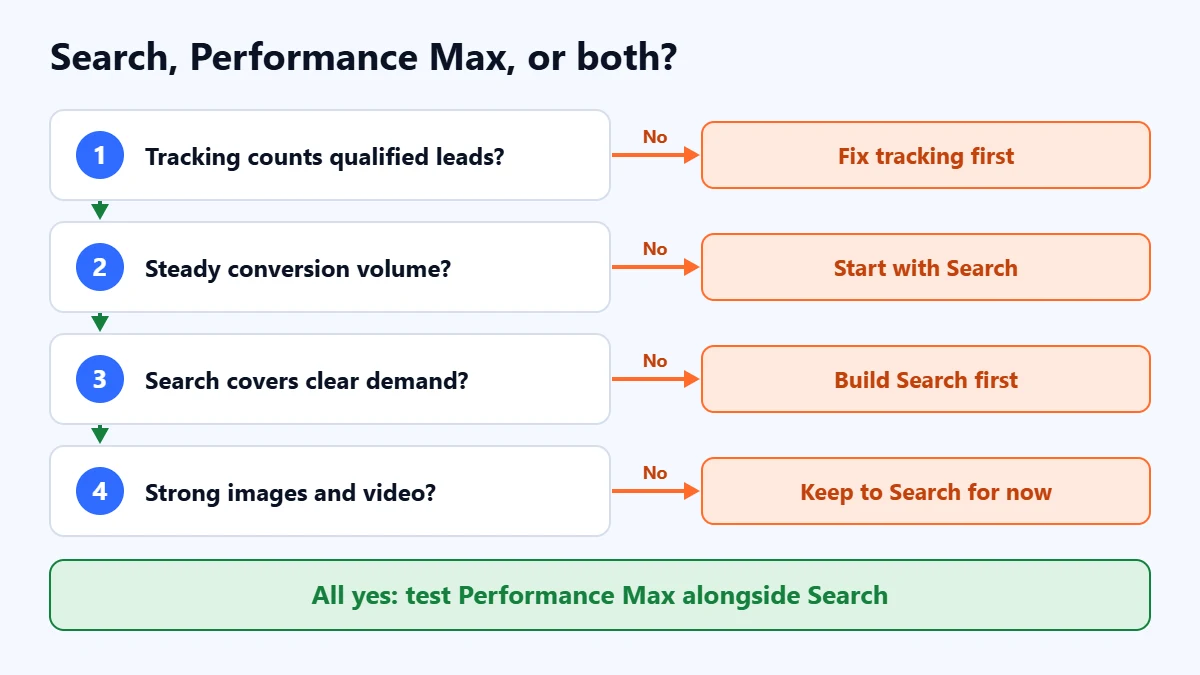
- Does your tracking count qualified leads, not every form fill? If not, fix that first. Our guide to improving Google Ads lead quality explains how.
- Do you have steady conversion volume? If not, start with Search.
- Is Search already covering the clear, high-intent searches? If not, build that first.
- Can you supply strong images and video? If so, test Performance Max alongside Search.
If you run Performance Max for leads
- Bid to the deepest conversion with enough volume. Google’s guidance recommends lead-specific goals such as qualified or converted leads, and picking one stage of the funnel to bid to.
- Add brand exclusions if you do not want it bidding on your own name. Google says brand exclusions also catch clear misspellings, which negative keywords do not. In our judgement, this stops brand searches you would have won anyway from flattering the campaign’s results.
- Use negative keywords for searches you never want. They apply to Performance Max’s Search and Shopping inventory. Account-level negatives also apply across other campaigns.
- Read the search terms report. Google advises prioritising conversion data over clicks and impressions when judging Performance Max.
- Give it time before major changes. Google suggests allowing one to two weeks, or up to six for complex setups or low conversion volume.
A setup checklist
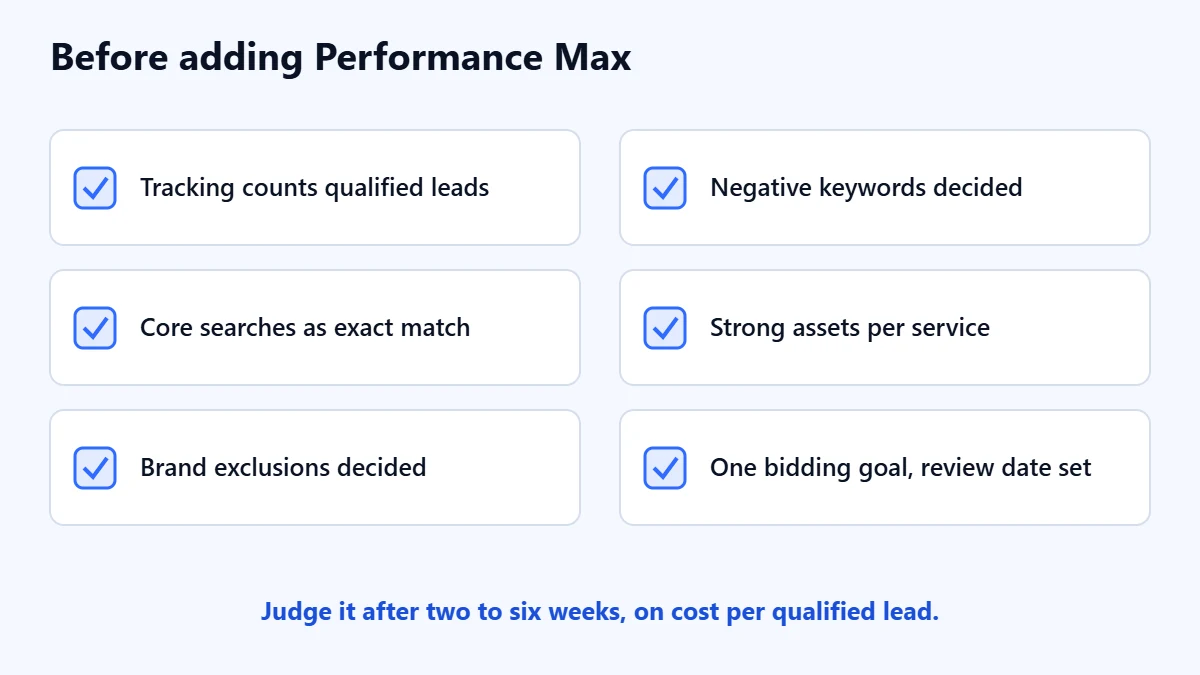
- Conversion tracking counts qualified leads, checked against your own records.
- Your core, high-intent searches sit in a Search campaign as exact match keywords.
- Brand exclusions and negative keywords are decided before launch, not after.
- Asset groups have specific text, images and video for each service or audience.
- One conversion goal is used for bidding, with other stages for observation.
- A review date is set, two to six weeks out, and you judge by cost per qualified lead.
Common mistakes
- Launching Performance Max on unreliable tracking. It will optimise towards whatever is being counted.
- Replacing Search entirely. Google itself positions Performance Max as a complement to Search.
- Judging it on brand searches. Results that come mainly from your own name can make it look better than it is.
- Changing it every few days. It needs time to learn, and constant changes reset that.
- Comparing the two on clicks. Compare them on qualified leads and their cost.
Frequently asked questions
Is Performance Max better than Search?
Neither is better in general. Search gives control and captures clear demand, while Performance Max gives reach across Google’s channels and relies on your data and assets. Many accounts use both, with Search for core searches and Performance Max for wider reach.
Will Performance Max take traffic from my Search campaigns?
It can compete with phrase and broad match keywords, because Google gives search themes the same priority as those. Searches identical to your exact match keywords go to the Search campaign. Keeping your most important searches as exact match keywords protects them.
Can I see what searches Performance Max showed my ads for?
Yes. Google provides a search terms report for Performance Max, with data available from March 2023. You can also add negative keywords to it for Search and Shopping traffic.
Is Performance Max good for a small local business?
Sometimes, but in our judgement it is rarely the best first campaign. With few conversions and a small budget, Search usually gives clearer results and more control. Our guide to Google Ads for small businesses covers where to start.
Get your Free Growth Audit and Quote. We review your Google Ads structure, tracking and results, then send a plain-English plan for what to run and what to fix first. We will ask for read-only or standard access; you stay the owner.
No obligation and no guaranteed results. Prefer to talk first? Contact us or see our Google Ads management service.