
The short answer: Marketing ROI is the profit your marketing brings in, compared with what it costs. To measure it honestly, you need to track every enquiry and sale back to where it came from, count profit rather than revenue, include every cost (ad spend, agency fees, tools and your team’s time), and judge each channel over the right length of time. Most small businesses do not need complex software to start. They need consistent tracking links, a few well-defined conversions, a simple source field in their customer records and a monthly review.
This guide is for owners and marketers at small and mid-sized businesses anywhere in the world. It explains the numbers that matter, how to set up tracking, why ad platforms and analytics never agree, how long to give each channel, and a simple monthly routine. If you sell online, our guide to ecommerce marketing covers store-specific measures in more depth.
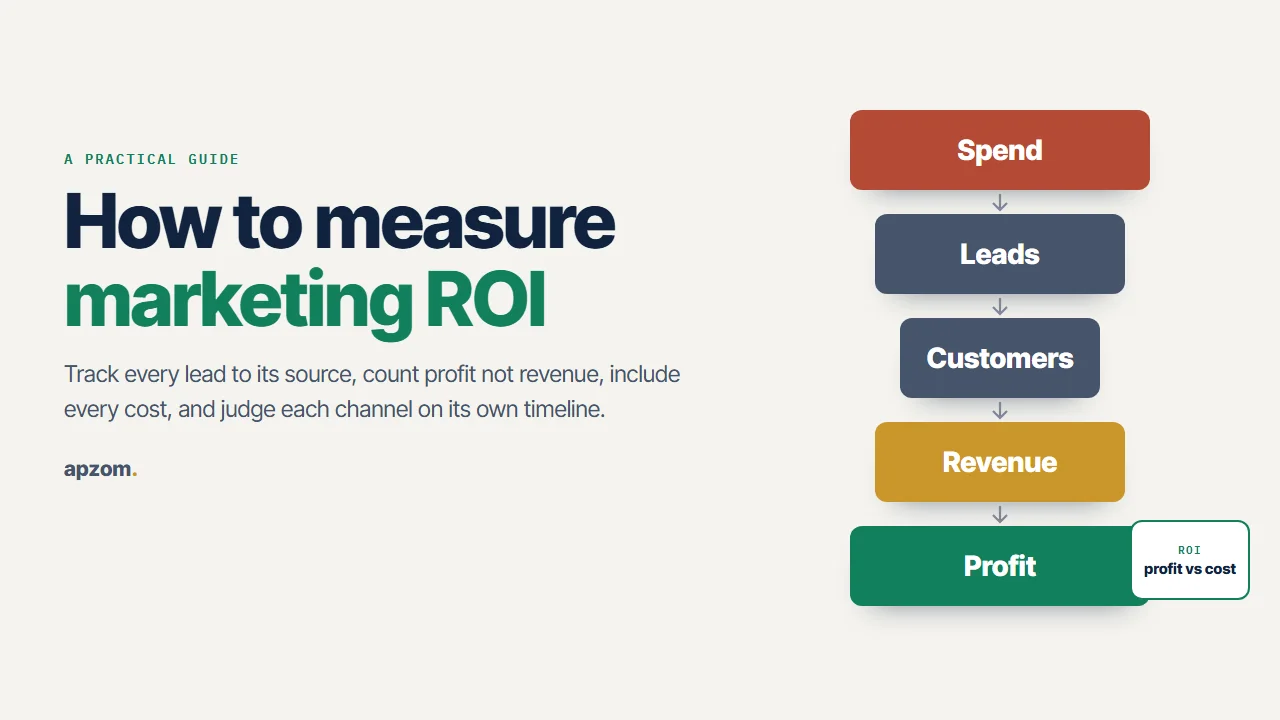
The numbers that matter
Many reports are full of numbers that do not tell you whether marketing is paying for itself. The first framework is the ROI ladder: each step gets closer to profit.
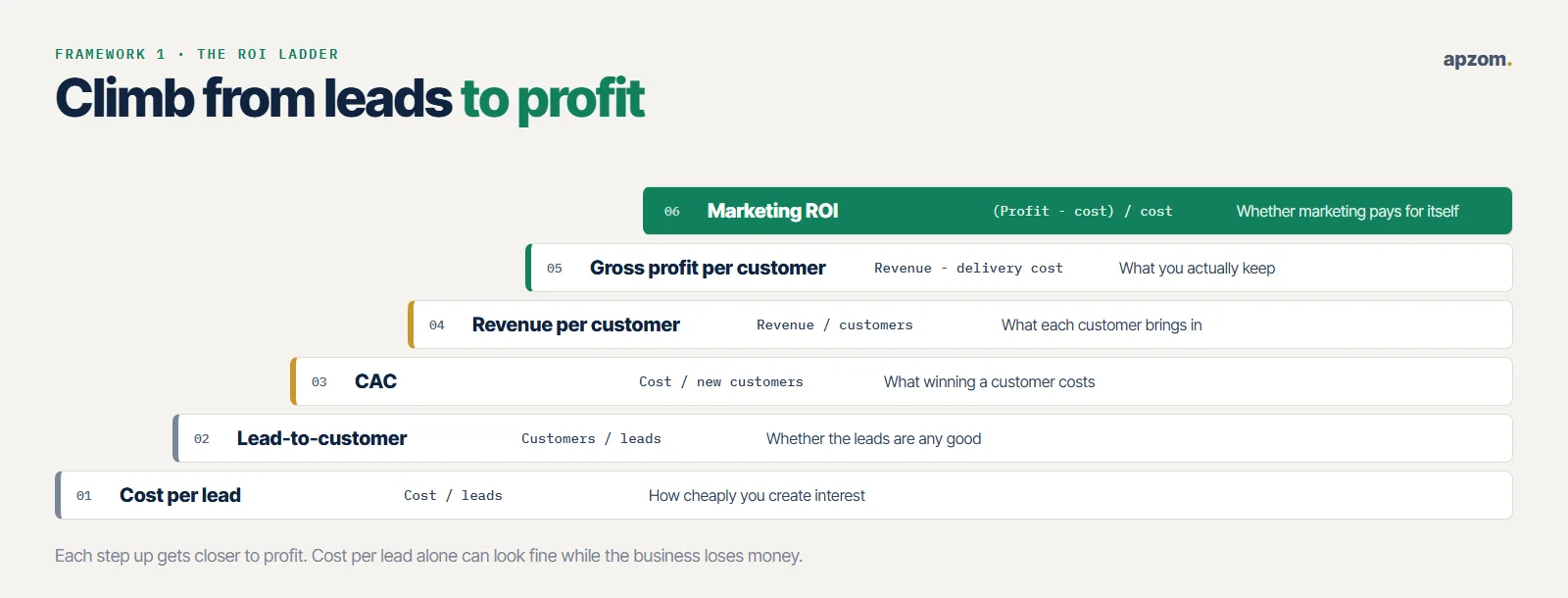
| Step | The number | How to work it out | What it tells you |
|---|---|---|---|
| 1 | Cost per lead | Marketing cost divided by leads | How cheaply you generate interest |
| 2 | Lead-to-customer rate | Customers divided by leads | Whether the leads are any good |
| 3 | Customer acquisition cost (CAC) | Marketing cost divided by new customers | What it really costs to win a customer |
| 4 | Revenue per customer | Revenue from new customers divided by new customers | What each customer brings in |
| 5 | Gross profit per customer | Revenue minus the direct cost of delivering it | What you actually keep |
| 6 | Marketing ROI | (Gross profit minus marketing cost) divided by marketing cost | Whether marketing pays for itself |
Two more numbers help:
- Payback period: how long it takes for a new customer’s profit to cover what it cost to win them. Important for subscriptions and repeat businesses.
- Customer lifetime value: the profit a customer brings over the whole relationship, not just the first sale. A channel that looks expensive on the first sale can be the best one over a year.
You will also see return on ad spend (ROAS) in ad platforms. Google Ads describes target ROAS as the average conversion value, such as revenue, you’d like to get for each dollar you spend on ads; its own example is 5 in sales from 1 in ad spend, a ROAS of 500%. ROAS is useful for steering campaigns, but it uses revenue and ad spend only. A campaign can show a healthy ROAS and still lose money once product costs, fees and other marketing costs are included. Different tools also define ROI in different ways; the formula in this guide is our own working definition, built around profit and the full marketing cost.
A simple worked example
Made-up numbers, to show the method. A business spends 5,000 (in any currency) on marketing in a month, including ad spend, agency fees and tools. It gets 100 leads, so cost per lead is 50. Ten become customers, so customer acquisition cost is 500. Each customer brings 1,500 in revenue and 600 in gross profit, so the month’s gross profit is 6,000. Marketing ROI is (6,000 minus 5,000) divided by 5,000, which is 20%. If those customers come back and buy again, the real return is higher.
Notice that the cost per lead looked fine at every step. The question that matters is whether the profit from customers covers the full cost.
Set up tracking you can trust
The second framework is the measurement stack: five layers that, together, show where customers come from.
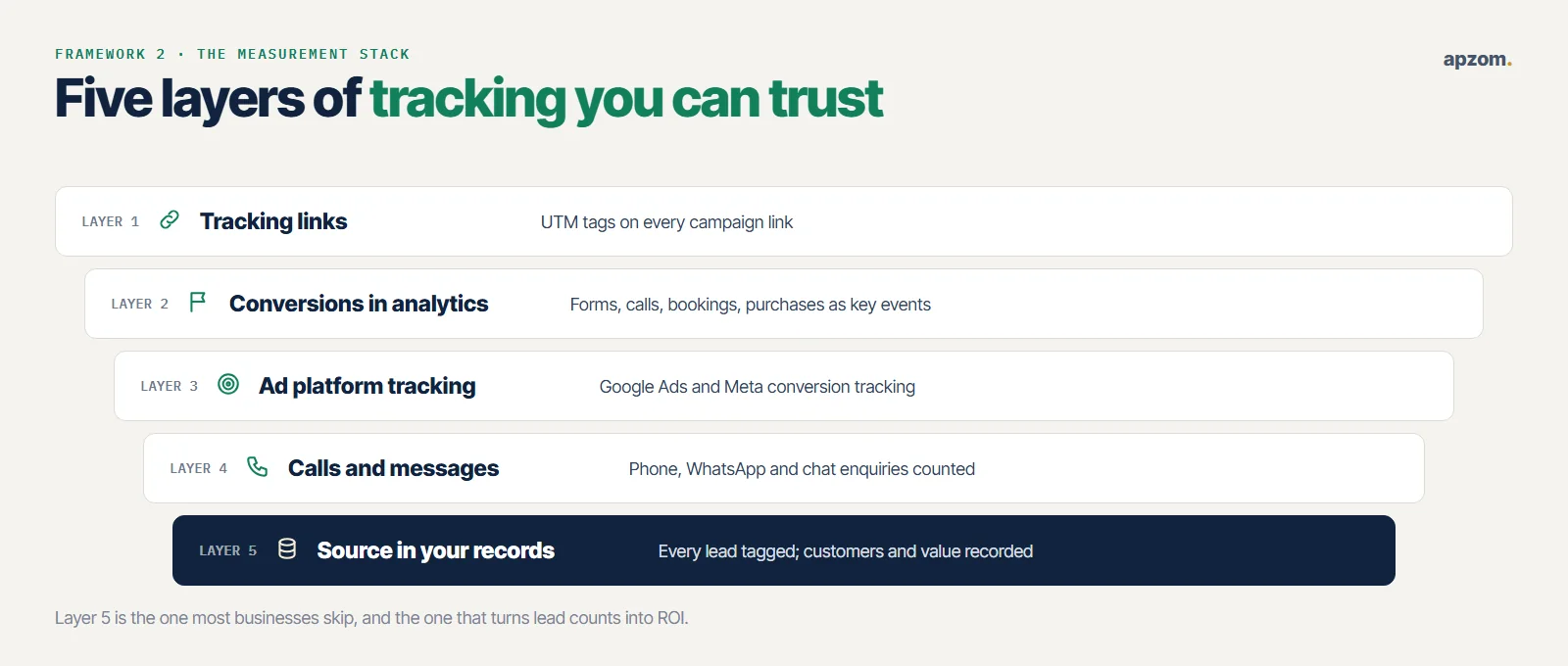
- Tracking links. Add UTM parameters to the links in your emails, social posts, ads and QR codes, so analytics knows where each visit came from: utm_source (which site or platform sent the traffic), utm_medium (such as email, cpc or social) and utm_campaign (the campaign name), plus utm_content, utm_term and utm_id where useful. Agree a naming rule and use it every time; “Facebook”, “facebook” and “fb” will show up as three different sources.
- Defined conversions in analytics. In Google Analytics 4, mark your most important actions, such as enquiry form submissions, calls from the website, bookings and purchases, as key events. Google renamed “conversions” in Analytics to “key events” in 2024, and describes a key event as an action that’s particularly important to the success of your business. Keep the list short: five meaningful key events beat thirty minor ones.
- Ad platform conversion tracking. Set up conversion tracking in Google Ads and Meta, so each platform can learn which ads lead to enquiries and sales. If sales happen later by phone or in person, send them back: Google’s enhanced conversions for leads (an upgraded version of offline conversion import that uses data your customers provide) and Meta’s Conversions API, which creates a direct connection between your marketing data and Meta’s ad systems, are built for this.
- Calls and messages. Track phone calls from ads and your website, and enquiries from WhatsApp or chat, so they are not invisible.
- A source field in your customer records. Every lead in your CRM or spreadsheet gets a source, and you record which leads became customers and what they were worth. This is the layer most businesses skip, and it is the one that turns lead counts into ROI.
Tracking is never complete, and it is getting less complete. Since iOS 14.5, Apple has required apps to ask permission before tracking people across other companies’ apps and websites. In Europe, Google’s consent mode carries consent signals for advertising data and personalisation, which affect what can be measured. Chrome is keeping third-party cookies for now: in April 2025 Google said it would maintain its current approach. Expect a gap between what really happened and what any tool reports, and use your own customer records to close it.
Not sure which marketing actually pays? A Marketing Measurement Review checks your tracking links, analytics conversions, ad platform tracking, call tracking and lead records, and shows what you can and cannot trust.
Why the numbers never match
Every ad platform, your analytics tool and your own records will report different numbers for the same month. That is normal, not a mistake. The third framework is to compare three views, and trust the trend.
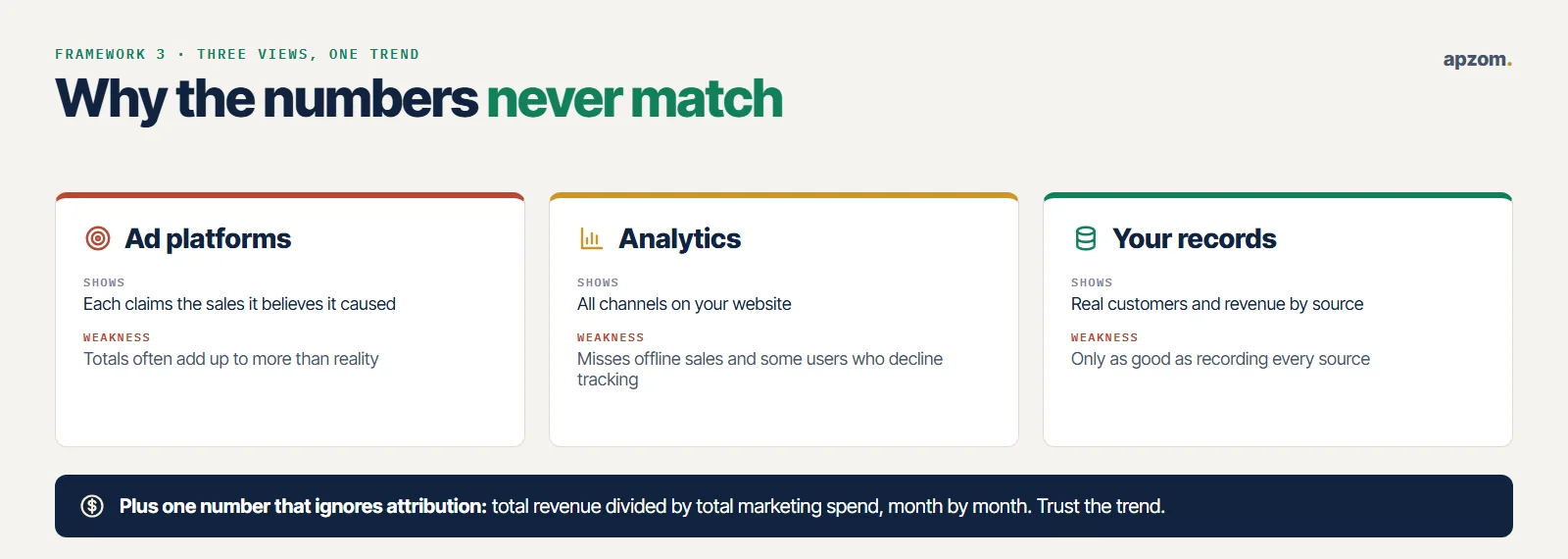
| View | What it shows | Its weakness |
|---|---|---|
| Ad platform reports | Conversions each platform believes it caused | Each platform tends to take credit for sales other channels helped with, so totals often add up to more than reality |
| Analytics | Visits and conversions across all channels on your website | Misses some offline sales and some users blocked by consent choices or privacy features |
| Your own records | Real customers and revenue by source | Depends on recording the source accurately for every lead |
The platforms also count over different time windows. In Google Analytics 4, attribution looks back 90 days by default for most key events. Google removed GA4’s rule-based attribution models, such as first click and linear, in November 2023. Meta Ads Manager now offers attribution of 1 or 7 days after a click, 1 day after a view and 1 day after an engagement, after Meta removed its 7-day and 28-day view windows in January 2026. Google Ads conversions can also take time to arrive, and Google suggests judging reports that end at least 30 days ago.
Add one more number that ignores attribution altogether: total revenue divided by total marketing spend, month by month. If it rises when you increase spend in a channel, that channel is probably working.
Judge each channel over the right time
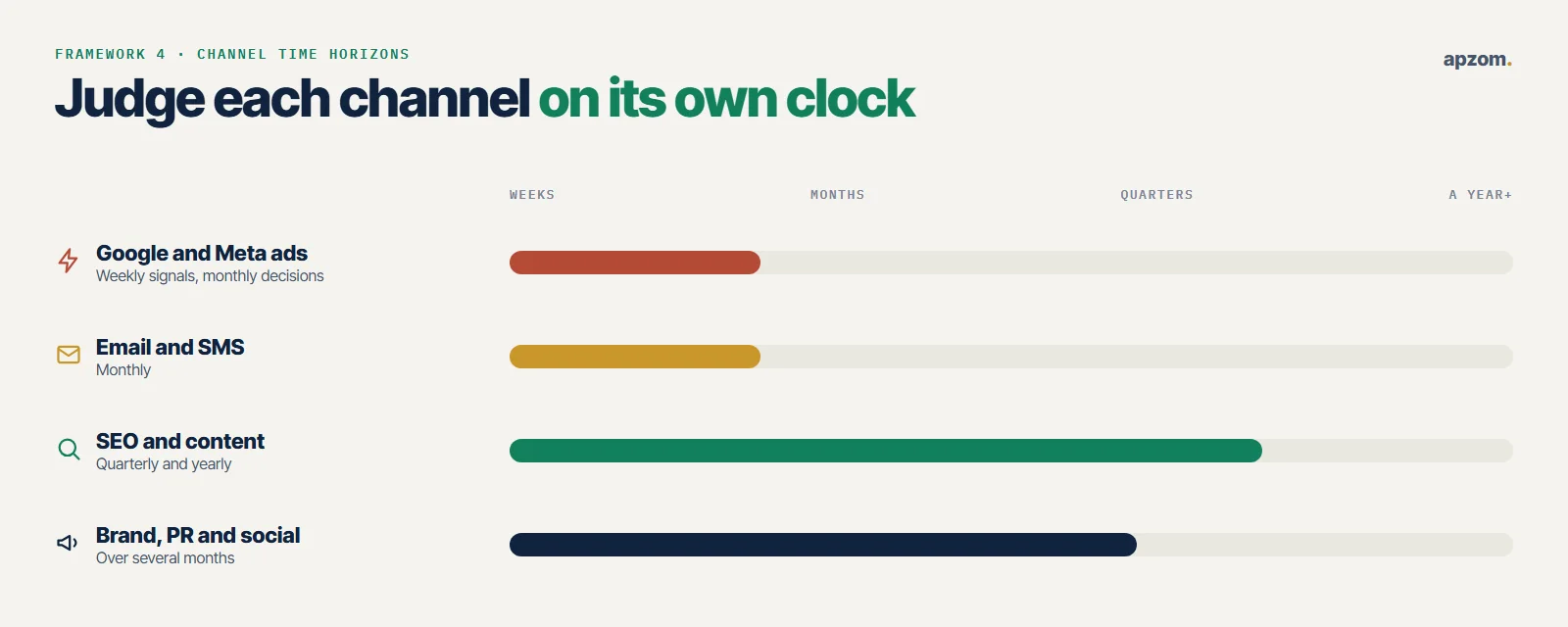
The fourth framework: different channels pay back on different timelines, so do not judge them all after one month.
| Channel | When to judge it | Why |
|---|---|---|
| Google Ads and Meta ads | Weekly signals, monthly decisions | Results start fast, but campaigns need time to learn and enough data |
| Email and SMS to existing customers | Monthly | Cheap to run; measure revenue per message and unsubscribes |
| SEO and content | Quarterly and yearly | Takes months to build, then keeps working without paying per click |
| Brand, PR and social | Over several months | Often shows up as more direct and branded searches, not last-click sales |
Our guide to SEO vs Google Ads explains how to compare search channels fairly, and how much SEO costs covers what you are paying for in SEO.
Testing what really works
The most reliable way to know whether a channel works is a test with a control group. Meta’s lift tests measure incremental conversions, which Meta defines as conversions that would not have occurred without the ads being tested. Google offers Conversion Lift, which it calls an incrementality tool, though it is not available for all Google Ads accounts. Larger advertisers also use marketing mix modelling, which estimates each channel’s contribution from historical data; Google has released Meridian, an open-source marketing mix model.
For most small businesses, a simpler version works: change one thing at a time, such as pausing a channel in one area or one month, and watch what happens to total enquiries and sales.
A monthly ROI review
The fifth framework is a one-page monthly review. Thirty minutes each month is enough.
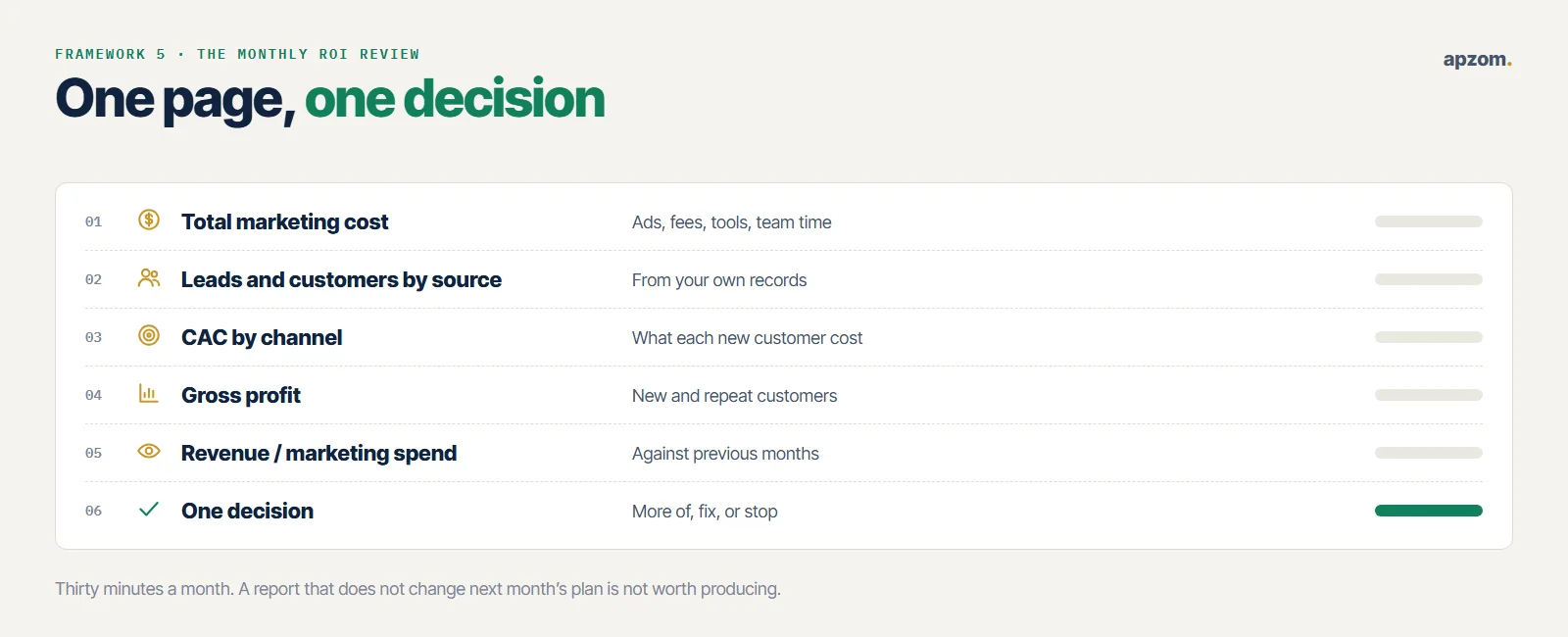
- Total marketing cost: ad spend, agency fees, tools and an estimate of your team’s time.
- Leads and customers by source, from your own records.
- Customer acquisition cost by channel.
- Gross profit from new customers, and from repeat customers.
- Revenue divided by total marketing spend, compared with previous months.
- One decision: what to do more of, what to fix and what to stop.
Keep the review short and the decision clear. A report that does not change what you do next month is not worth producing.
Common mistakes
- Judging marketing by clicks, followers or cost per lead alone.
- Counting revenue instead of profit.
- Leaving out agency fees, tools or staff time.
- Believing every platform’s own conversion numbers and adding them up.
- Not recording the source of every lead and customer.
- Cutting SEO or brand work after a month because ads look cheaper in the short term.
How Apzom can help
Apzom Digital sets up measurement that connects marketing to customers and profit, not just clicks. That includes tracking links, analytics conversions, ad platform tracking, call and message tracking, and a simple source field in your customer records, then a monthly report built around decisions. It sits alongside our Google Ads management, Meta ads management, SEO, email marketing and conversion rate optimisation. We work with clients worldwide, remotely, from our base in Ahmedabad, India.
We are careful with our own numbers too. Our published Meta ads results are lead counts: for HillTown Group, 600+ leads every month from Meta ads, for 12 months running, and for Kingston Flats, 560+ Meta leads every month since June 2025. Neither case study claims sales, bookings or return on ad spend, because those figures belong to the client. We will not promise you a return. We will show you what your current numbers can and cannot tell you.
Request a Marketing Measurement Review. We check how each channel is tracked from first click to customer, where enquiries and sales go missing, which numbers in your reports you can rely on, and what a simple monthly ROI review should look like for your business. You get a prioritised list of fixes.
No obligation and no guaranteed returns. Prefer to talk first? Contact us or see all our services.
Frequently asked questions
How do you calculate marketing ROI?
Take the gross profit your marketing generated, subtract the total marketing cost, and divide by the marketing cost. Use profit, not revenue, and include ad spend, agency fees, tools and staff time in the cost.
What is a good marketing ROI?
It depends on your margins, how long customers stay and how fast you need returns. A channel that loses money on the first sale can be very profitable over a customer’s lifetime. Set targets from your own numbers rather than from a generic benchmark.
What is the difference between ROI and ROAS?
ROAS compares revenue with ad spend only. ROI compares profit with the full marketing cost. A campaign can have a high ROAS and still lose money once product costs, fees and other costs are included.
Why do Google Ads, Meta and Google Analytics show different numbers?
Each uses different data, attribution rules and time windows, and each platform tends to credit itself. Compare them with your own customer records and look at the trend over time.
How long should I wait before judging a marketing channel?
Ads can be judged monthly once they have enough data. SEO and content usually need several months, and brand work longer. Judge each channel on the timeline it needs.
Do I need expensive software to measure marketing ROI?
No. Most small businesses can start with tracking links, analytics conversions, ad platform tracking and a source field in a CRM or spreadsheet. More advanced tools help later.
What costs should be included in marketing ROI?
Ad spend, agency or freelancer fees, software and tools, content and design costs, and a fair estimate of your own team’s time spent on marketing.
Can Apzom set up marketing measurement for businesses outside India?
Yes. We work with clients worldwide, remotely, from our base in Ahmedabad, India, and set up tracking around the platforms, privacy rules and customer systems you use.