
The short answer: Good digital marketing for an ecommerce brand grows profit, not just traffic or revenue. It works on four levers: how many of the right people visit, how many of them buy, how much they spend, and how often they come back. A good agency will fix your product feed, product pages and checkout before spending more on ads. It will build email and SMS flows that bring customers back, and measure results after product costs, shipping, returns and ad spend. If an agency reports only return on ad spend or revenue, ask what is left after costs.
This guide is for founders and marketing leads at online shops and direct-to-consumer brands, whether you sell through your own website, marketplaces or both, in any country. It covers the four growth levers, which channels suit each stage of a buyer’s journey, how to build product pages and feeds that sell, email and SMS, the rules on pricing, reviews and marketing consent, what to measure, and what to prioritise at each stage of your store’s growth.
Online shopping keeps growing. The US Census Bureau estimates that ecommerce made up 17.1% of US retail sales in the second quarter of 2026 (seasonally adjusted). In the UK, the Office for National Statistics put online sales at 28.8% of all retail sales in August 2026. More competition online makes profitable marketing harder, not easier.
The four levers of ecommerce growth
This is the first framework we use with ecommerce clients. Revenue comes from four things multiplied together, so a small improvement in each adds up.
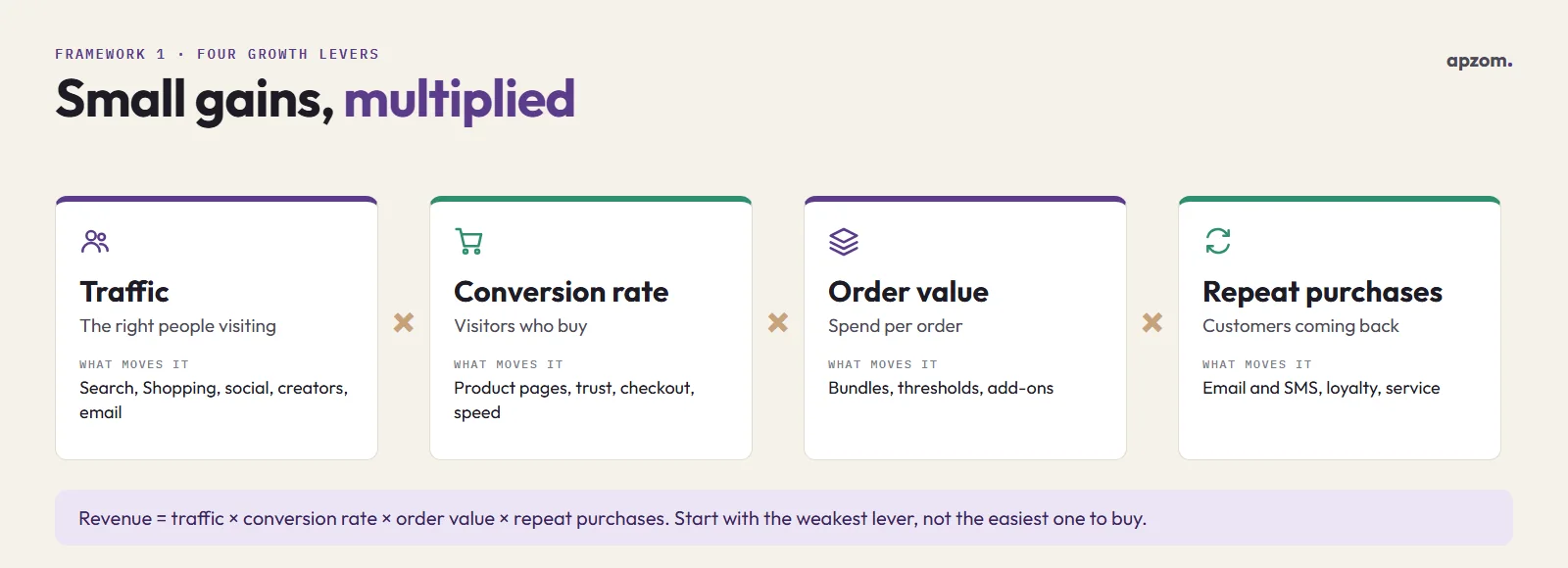
| Lever | What it means | What usually moves it |
|---|---|---|
| Traffic | How many of the right people visit | Search, Shopping and product listings, social, creators, email, referrals |
| Conversion rate | How many visitors buy | Product pages, trust, delivery and returns information, checkout, site speed |
| Average order value | How much each order is worth | Bundles, sensible free-delivery thresholds, relevant add-ons |
| Repeat purchases | How often customers come back | Email and SMS flows, loyalty, good service, product quality |
Most brands only push traffic, because it is the easiest lever to buy. But paying for more visitors to a store that converts poorly is expensive. Start with the lever that is weakest.
Which channels work at each stage
The second framework maps channels to where the buyer is. Different channels do different jobs, so judge each by its own job.
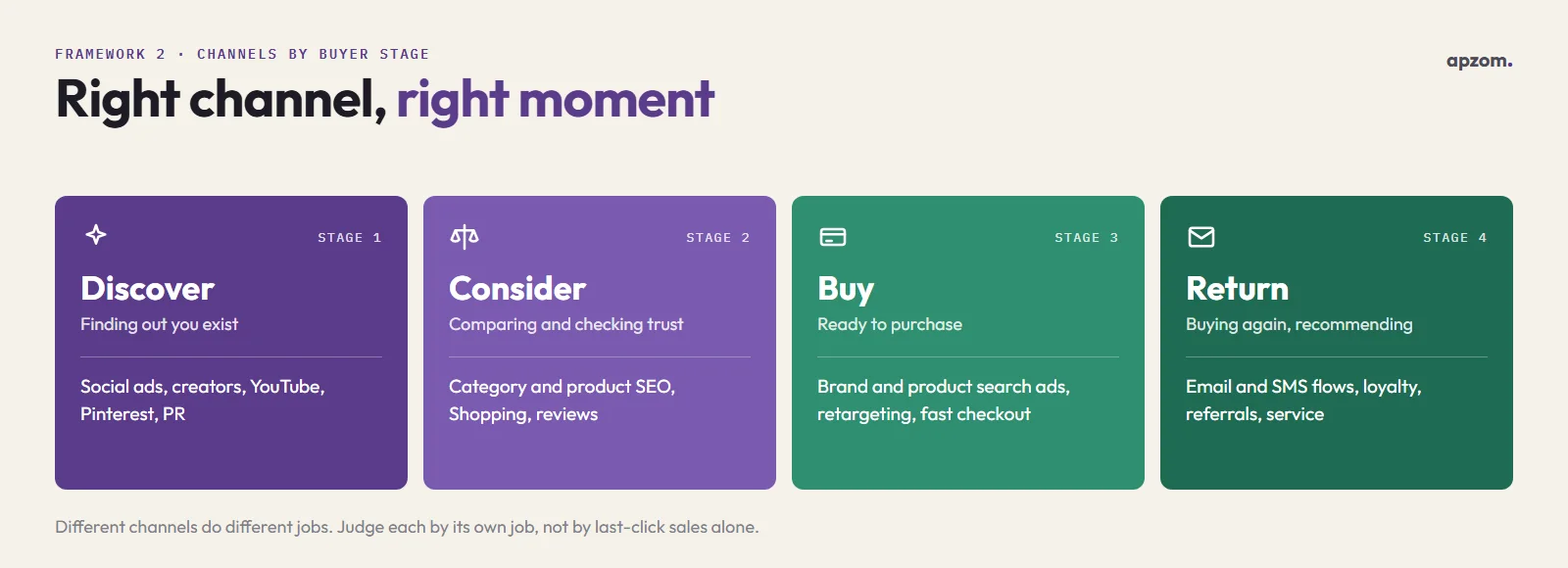
| Stage | What the buyer is doing | Channels that help |
|---|---|---|
| Discover | Finding out your brand or product exists | Meta and TikTok-style social ads, creators, YouTube, Pinterest, PR |
| Consider | Comparing products and checking you are trustworthy | Product and category SEO, Google Shopping and product listings, reviews, comparison content |
| Buy | Ready to purchase | Search ads on brand and product terms, retargeting, a fast, simple checkout |
| Return | Buying again or recommending you | Email and SMS flows, loyalty and referral programmes, good customer service |
Product feeds, Shopping and marketplaces
Google Merchant Center is where you upload your product data for Google. Google lets you show products at no cost in free listings across Search, the Shopping tab, Images and Lens, YouTube and Maps, though it says these listings are not guaranteed. Paid Shopping campaigns are still available alongside Performance Max, and Google says Shopping ads use your product data, not keywords, to decide where to appear. On Facebook and Instagram, Meta’s Advantage+ sales campaigns, the updated version of what were called Advantage+ shopping campaigns, can promote products from your catalogue.
Marketplaces such as Amazon or regional marketplaces can add reach, but you have less control over pricing, branding and the customer relationship. Many brands use them for discovery and their own site for repeat customers.
Whatever channels you use, your product data is the foundation. Use clear product titles with the brand, product type and key attributes such as size, colour or material. Keep prices, stock and shipping information accurate and in sync with your website, and use your own high-quality images.
Product pages that sell
The third framework is a product page checklist. Your product page does the job a shop assistant would do in a store.
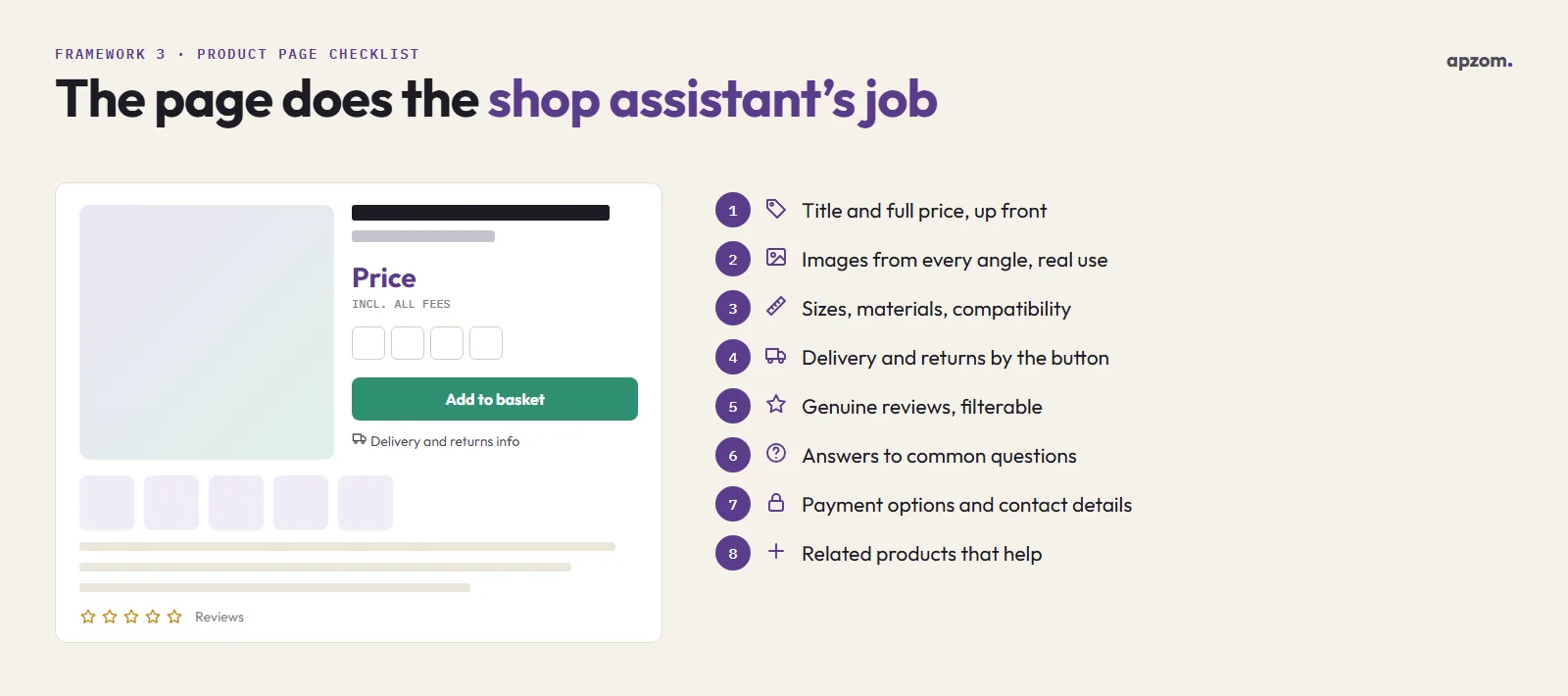
- A clear title and the price, including any extra costs the buyer must pay, shown up front.
- Good images and, where useful, video, from several angles, showing scale and real use.
- The details people need to decide: size guides, materials, compatibility, care instructions, dimensions.
- Delivery and returns information near the buy button: costs, times and how returns work.
- Genuine reviews, including critical ones, with a way to sort or filter them.
- Answers to common questions on the page, so people do not have to email you.
- Trust signals: secure payment options you actually accept, contact details and your returns policy.
- Related products that genuinely help, such as accessories or refills.
Checkout: where sales are lost
The Baymard Institute puts the average documented online cart abandonment rate at 70.22%, based on 50 studies (updated September 2025). In its research on why shoppers abandon during checkout, the most common reason was extra costs such as shipping, taxes and fees being too high (40%). Next came delivery being too slow (20%), not trusting the site with card details (19%) and being forced to create an account (18%).
Simple fixes that help most stores:
- Show the full price, including delivery and any fees, as early as possible.
- Allow guest checkout, and do not force account creation before payment.
- Offer the payment methods your customers expect in each market, such as cards, wallets, UPI in India or buy-now-pay-later where it fits.
- Keep forms short and make them work well on phones.
- Say clearly when the order will arrive.
Revenue growing but profit not? An Ecommerce Growth Audit looks at your four levers, product pages, feed, checkout, email flows and how results are measured, and shows where margin is leaking.
SEO for ecommerce
Ecommerce SEO is mostly about category and product pages, not blog posts.
- Category pages often target the biggest searches, such as a product type plus a feature. Give each category a short, useful introduction and clear filters.
- Product pages need unique descriptions, not copied manufacturer text, and product structured data that matches what is on the page. Google’s merchant listing markup requires at least the product name, an image, and an offer with a price above zero and its currency.
- Filters and duplicate URLs can create thousands of near-identical pages. Control which ones search engines crawl and index.
- Out-of-stock products: keep the page live if the product is coming back, with a way to get notified. If it is gone for good, point people to the closest alternative.
- Helpful guides such as size guides, comparisons and how-to articles can bring in people earlier in their search, and link to the products they need.
If you are changing platforms or redesigning, use our website redesign SEO checklist so you do not lose rankings.
Email and SMS: the profit channels
For many stores, email and SMS bring in a large share of repeat revenue, because you are not paying for each click. The flows that matter most:
- Welcome series for new subscribers.
- Abandoned browse and abandoned cart reminders.
- Post-purchase messages: delivery updates, how to use the product, and a request for a review.
- Win-back messages for customers who have not bought in a while.
- Replenishment reminders for products that run out.
Email and SMS are regulated almost everywhere. A few rules to check:
- Bulk email senders: Google requires senders to authenticate their email (SPF, DKIM and DMARC), offer one-click unsubscribe and keep spam rates below 0.10%, never reaching 0.30%. Yahoo asks senders to honour unsubscribes within 2 days.
- US: the CAN-SPAM Act requires a valid postal address in marketing emails and honouring opt-outs within 10 business days.
- UK: under the “soft opt-in”, you may email existing customers about similar products if they had a chance to opt out when they bought and in every message. The ICO says its guidance is under review following the Data (Use and Access) Act.
- EU: under the GDPR, consent must be freely given, specific, informed and unambiguous. Pre-ticked boxes do not count.
- India: promotional SMS must come from registered headers, which carry a “-P” suffix under TRAI’s 2025 changes. The Digital Personal Data Protection Rules, notified in November 2025, phase in over 18 months.
Rules to know: prices, reviews and checkout
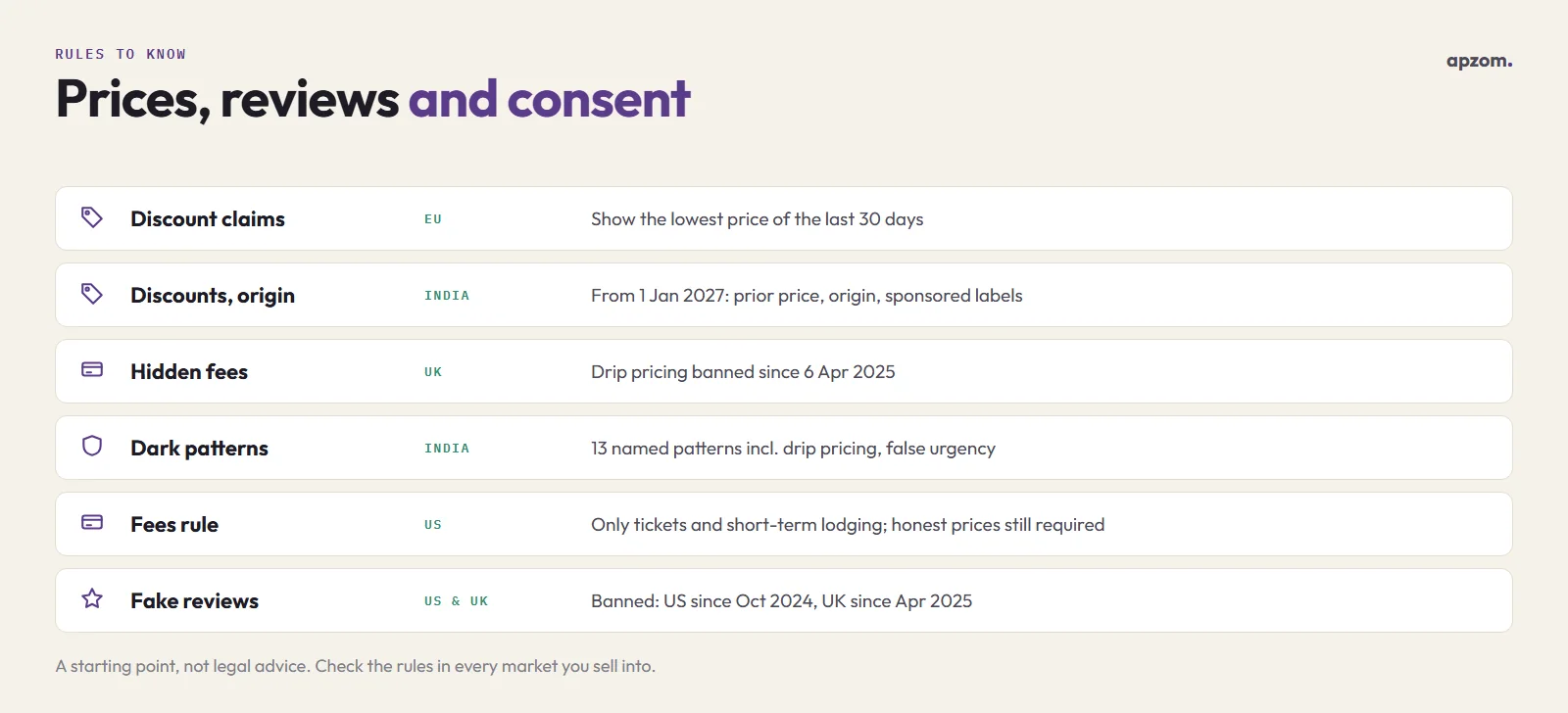
Ecommerce marketing is closely regulated in most markets. This is a starting point, not legal advice.
| Area | What to know |
|---|---|
| Discount claims (EU) | Under the EU’s Omnibus rules, a price reduction must show the prior price, meaning the lowest price in the 30 days before the reduction. |
| Discount claims and product details (India, from 1 January 2027) | India’s amended Consumer Protection (E-Commerce) Rules, announced in September 2026, require the reduced price to be shown with a prior price (the lowest price in the previous 30 days), importer details and country of origin for imported goods, and clear disclosure of sponsored listings. |
| Hidden fees (UK) | Under the Digital Markets, Competition and Consumers Act 2024, enforced by the CMA from 6 April 2025, drip pricing is banned: unavoidable fees must be included in the headline price. |
| Dark patterns (India) | The Central Consumer Protection Authority’s 2023 guidelines list 13 dark patterns, including drip pricing, false urgency and basket sneaking. |
| Fees (US) | The FTC’s fees rule, in force since May 2025, applies only to live-event ticketing and short-term lodging, not to online shops in general. Misleading prices can still break consumer protection law. |
| Fake reviews (US and UK) | The FTC’s rule banning fake reviews, including AI-generated ones, has been in force since 21 October 2024. The UK’s ban on fake reviews applies from 6 April 2025. |
Selling across borders? The rules of your customer’s country usually apply, not just your own.
What to measure
Revenue and return on ad spend are easy to report but can hide losses. The fourth framework is a profit-first scorecard:
- Contribution margin: revenue minus product costs, shipping, payment fees, returns and marketing. This is what actually pays your business.
- Customer acquisition cost by channel: what it costs to win a new customer, not just an order.
- Repeat purchase rate and customer lifetime value: how much a customer is worth over time.
- Conversion rate and average order value by device and channel.
- Blended marketing efficiency: total revenue divided by total marketing spend, alongside platform-reported results, because ad platforms each tend to claim credit for the same sale.
Review these monthly, and decide on budget by margin, not by revenue alone.
Priorities by store stage
| Store stage | Focus first |
|---|---|
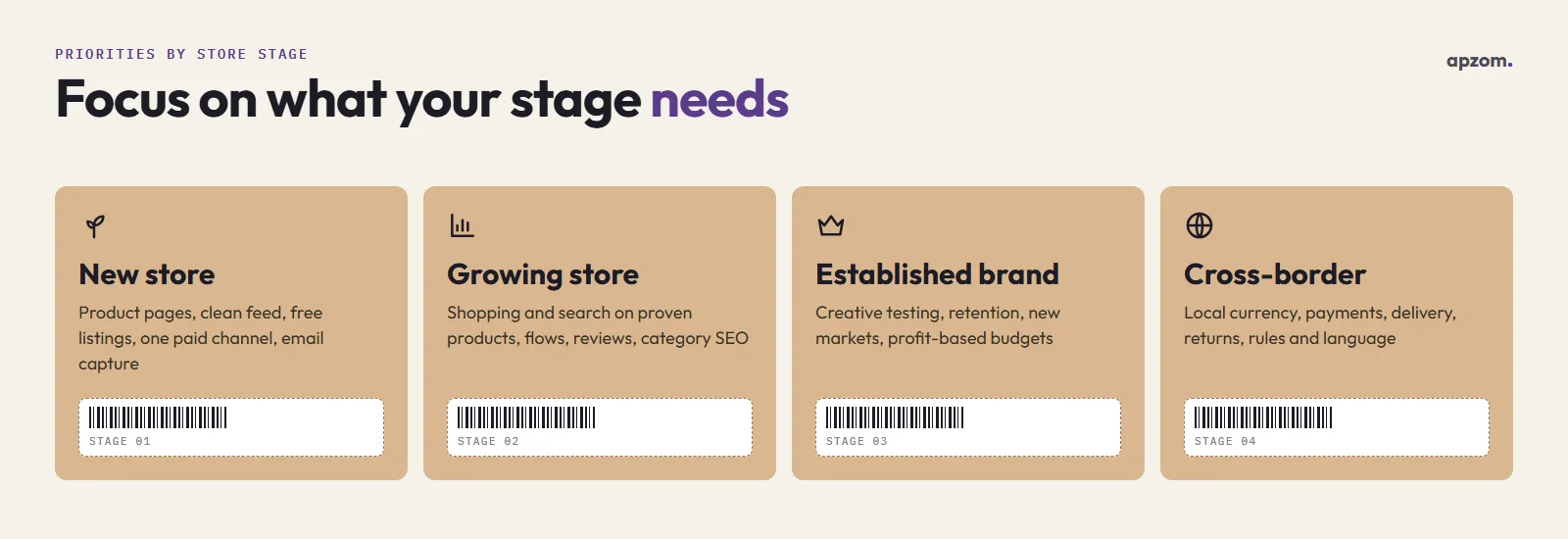
| New store, few sales | Product pages, a clean feed, free product listings where available, one paid channel tested carefully, email capture |
| Growing store | Shopping and search ads on proven products, email and SMS flows, reviews, category SEO |
| Established brand | Creative testing at scale, retention and loyalty, new markets or marketplaces, profit-based budgeting |
| Selling across borders | Local currencies, payment methods, delivery and returns information, local rules and language for each market |
How Apzom can help
Through our ecommerce development service we build online stores on WordPress with WooCommerce, and a typical build takes 6 to 12 weeks.
We work with clients worldwide, remotely, from our base in Ahmedabad, India. We offer SEO, Google Ads management, Meta ads management, email marketing, conversion rate optimisation and content marketing, and we report on margin and customers, not just revenue. We have not published an ecommerce case study yet, so we will not show you one; our case studies page shows the lead generation and search work we have done for other businesses. If you are comparing agencies, our guide on how to choose a digital marketing agency may help.
Request an Ecommerce Growth Audit. We review your traffic sources, product feed and Shopping set-up, product and category pages, checkout, email and SMS flows, pricing and consent compliance for your markets, and how you measure profit. You get a prioritised list of what to fix first.
No obligation and no guaranteed revenue figures. Prefer to talk first? Contact us or see all our services.
Frequently asked questions
What does an ecommerce marketing agency do?
It helps an online store grow profitably by improving traffic, conversion rate, average order value and repeat purchases. That usually covers product feeds and Shopping ads, SEO for category and product pages, paid social, email and SMS, conversion rate optimisation and profit-focused reporting.
Which marketing channel is best for ecommerce?
It depends on your product, price and margin. Shopping and search ads catch people ready to buy, paid social and creators help people discover new brands, and email and SMS bring customers back at low cost. Most stores need a mix, judged on profit.
How do I increase my online store’s conversion rate?
Show the full price and delivery costs early, make product pages answer people’s questions, add genuine reviews, allow guest checkout, offer the payment methods your customers expect and make everything work well on phones.
Is ROAS a good way to measure ecommerce marketing?
It is useful but incomplete. Return on ad spend ignores product costs, shipping, returns and fees, and ad platforms often each claim credit for the same sale. Track contribution margin and customer acquisition cost as well.
Do I need SEO if I run Shopping ads?
Usually yes. Ads stop when you stop paying, while category and product pages that rank organically keep bringing visitors. Good product data also helps both.
Should I sell on marketplaces as well as my own website?
Marketplaces can bring reach, but you have less control over the customer relationship, pricing and data. Many brands use both, with their own website for repeat customers and brand building.
How long does it take to see results from ecommerce marketing?
Paid ads can bring sales within days, while SEO and email lists build over months. Fixing product pages and checkout often helps quickly because it improves results from every channel.
Can Apzom work with ecommerce brands outside India?
Yes. We work with clients worldwide, remotely, from our base in Ahmedabad, India, and plan marketing around the currency, payment methods, rules and search habits of each market you sell into.