
The short answer: Good digital marketing for a gym or fitness studio does two jobs. It brings the right people through the door for a first visit, and it helps them stay long enough to see results. Most gym marketing only does the first job. A good agency will set up local search, a clear trial offer, fast follow-up and honest ads that follow platform health rules. It will also look at your retention data, because keeping a member is usually easier than finding a new one. Results should be judged in trials booked, members joined and members kept, not likes.
This guide is for gym owners, boutique studios (yoga, pilates, cycling, boxing, martial arts and functional training), personal trainers and multi-site fitness brands in any country. It covers how people choose a gym, which channels suit which kind of fitness business, how to build a first-visit system, how to keep members, the advertising rules on health and body image, and what to measure. Where rules differ by country, we say which country.
How people choose a gym or studio
Fitness is a growing market. The Health & Fitness Association’s 2026 Global Report found that the operators it surveyed grew median revenue by 10.7% and median net membership by 6.1% in 2025. But joining a gym is a habit decision, not just a purchase. People worry about cost, about feeling out of place, and about whether they will keep going. The first framework we use with fitness clients is the member lifecycle: five stages, and marketing has a job at each one.
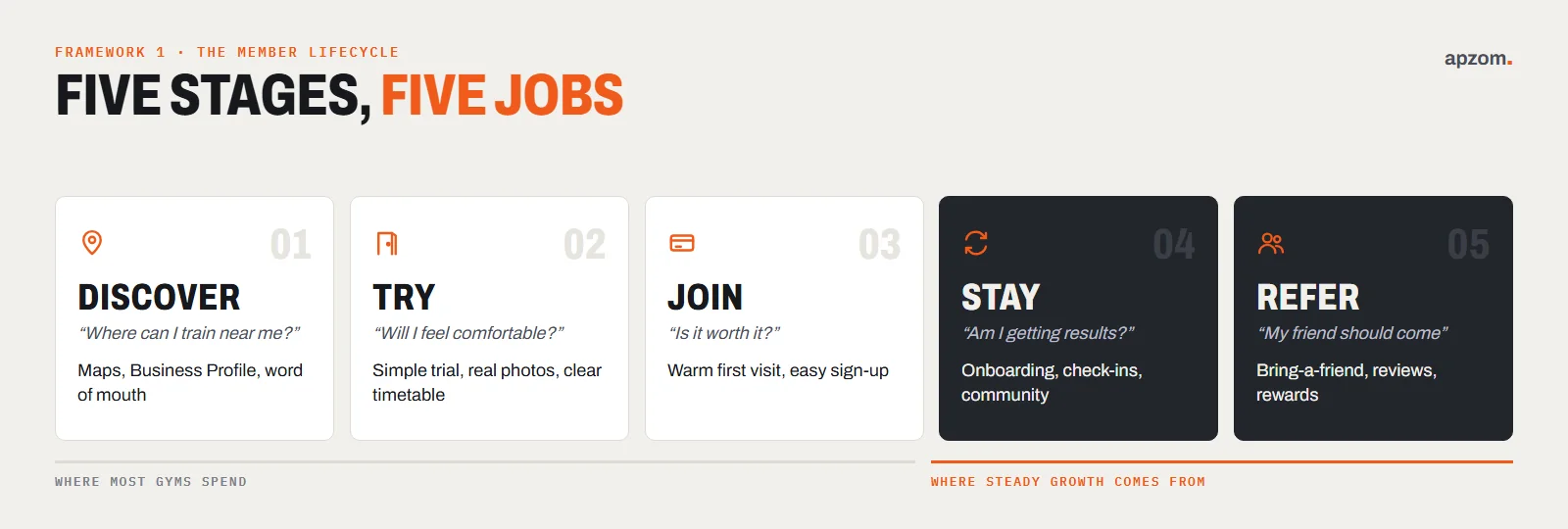
| Stage | What the person is thinking | What helps |
|---|---|---|
| 1. Discover | “Where can I train near home or work?” | Google Maps, a complete Business Profile, local search, word of mouth, social media |
| 2. Try | “Will I feel comfortable there?” | A simple trial or first-class offer, real photos of the space and the people, clear timetable and prices |
| 3. Join | “Is it worth the money and can I stick with it?” | A friendly first visit, a clear membership choice, an easy sign-up |
| 4. Stay | “Am I getting results? Do I belong?” | Onboarding in the first weeks, progress check-ins, community, class variety |
| 5. Refer | “My friend should come too.” | Referral rewards, bring-a-friend sessions, reviews |
Most gyms spend almost everything on stage 1. The ones that grow steadily also invest in stages 4 and 5, because a member who stays a year and brings a friend is worth far more than a member who leaves after a month.
Which channels suit which kind of fitness business
The second framework: choose channels by business model. A large, low-cost gym and a small reformer pilates studio sell very different things to very different people.
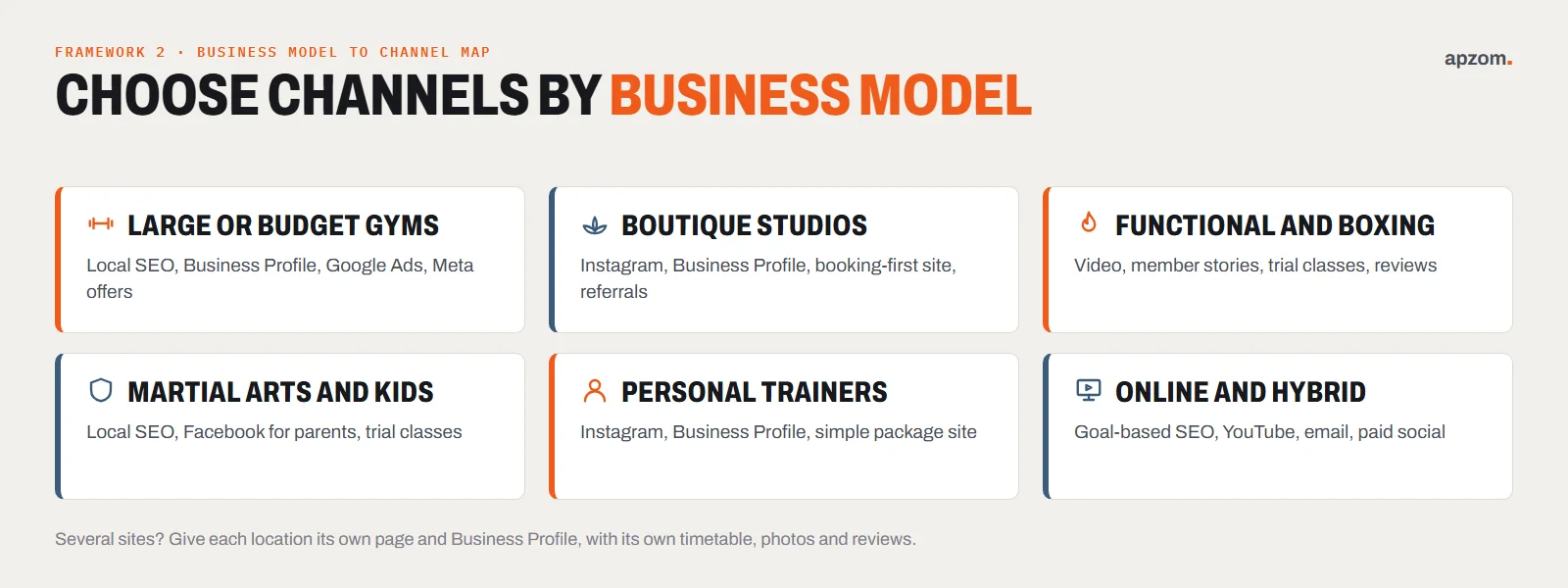
| Business model | What members care about | Channels to start with |
|---|---|---|
| Large or budget gyms | Price, location, opening hours, equipment | Local SEO, Google Business Profile, Google Ads on “gym near me” style searches, offers in Meta ads |
| Boutique studios (yoga, pilates, cycling, barre) | Atmosphere, instructors, class times, community | Instagram, Google Business Profile, a booking-first website, referral offers |
| Functional, CrossFit-style and boxing gyms | Coaching, community, results | Instagram and video, member stories, trial classes, Meta ads, reviews |
| Martial arts and kids’ programmes | Safety, instructors, discipline, schedules | Local SEO, Facebook for parents, trial classes, school and community partnerships |
| Personal trainers | Trust, expertise, results, fit with the trainer | Instagram, Google Business Profile, a simple website with packages, referrals |
| Online coaching and hybrid programmes | Results, structure, price | SEO for specific goals, YouTube, email, paid social, a clear sales page |
If you run several sites, give each location its own page and its own Business Profile, with that site’s timetable, photos and reviews.
Local search: where most new members start
Many people find a gym by searching on their phone and choosing from the map. Three things matter most:
- A complete Google Business Profile for each location: the category that matches your business (Google’s own guidelines use “Health club” as the right category for a 24-hour fitness business), accurate opening hours (including holidays), real photos of the space, your class types, and a booking or contact link. Update it whenever your timetable or hours change.
- Location and class pages on your website: one page per site, and pages for your main programmes, each with prices or price ranges, the timetable and what a first visit is like.
- Reviews: ask members for an honest review after a good first month, not on their first day. Reply to every review, including the critical ones.
Our Google Business Profile optimization checklist and local SEO checklist go through this step by step.
Build a first-visit system
The third framework is the first-visit system. Most gyms lose more people between “interested” and “joined” than anywhere else. A simple system fixes much of that.
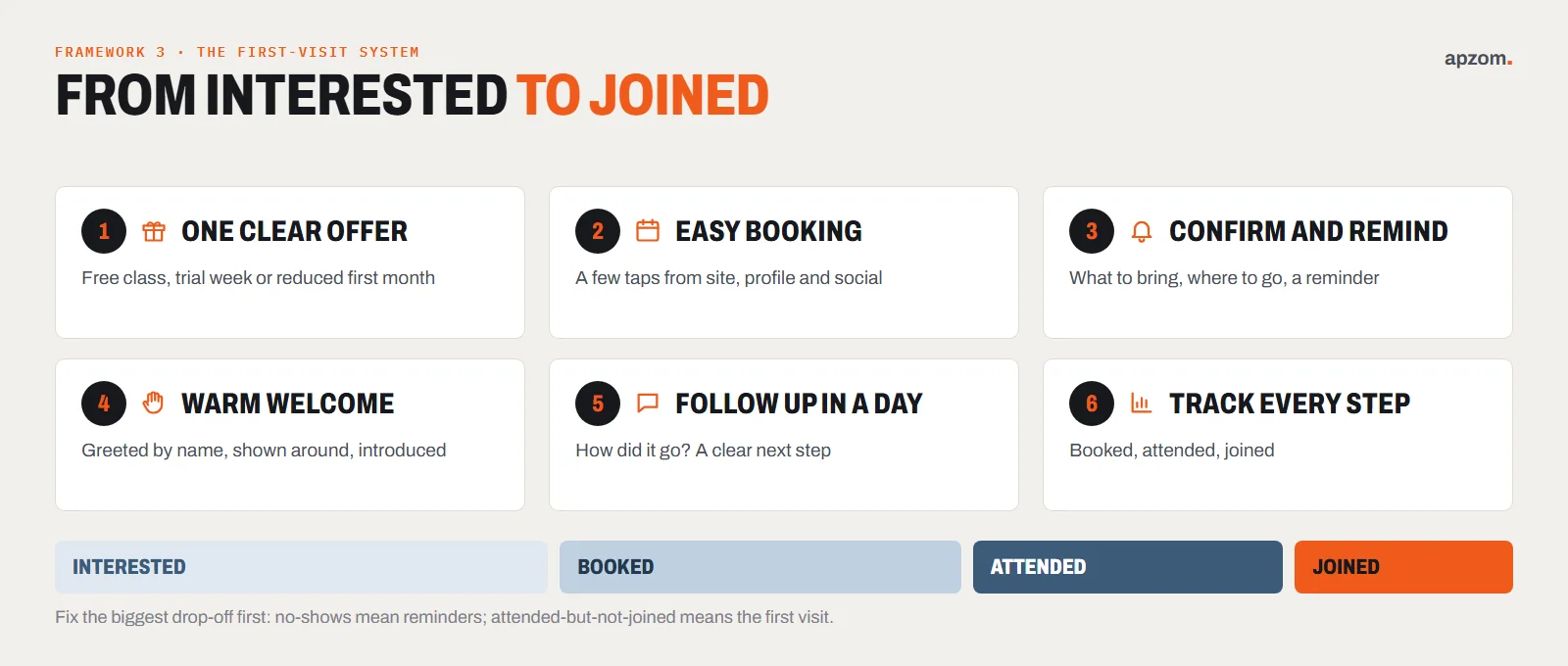
- One clear offer. For example, a free first class, a short trial week or a reduced first month. Make the terms simple and easy to find.
- Easy booking. Let people book online in a few taps, from your website, Business Profile and social profiles.
- Fast confirmation and a reminder. Send what to bring, where to park, where to go when they arrive, and a reminder the day before.
- A warm welcome. Someone greets them by name, shows them around and introduces them to a coach or other members.
- Follow-up within a day. Ask how it went and offer a clear next step, without pressure.
- Track every step. Count how many people book, attend and join, so you know where people drop off.
Fix the biggest drop-off first. If many people book but do not turn up, work on reminders. If many attend but do not join, work on the first visit itself.
Plenty of enquiries, not enough members? A Gym Growth Audit follows your marketing from first search to first visit to membership, and shows where people drop off.
Social media and video
Fitness is visual and personal, so social media matters more than for most local businesses. What works:
- Show real people and the real space. Members (with their permission), coaches and classes in progress. Prospective members want to see people like them.
- Teach something. Short videos on technique, mobility or how a class works build trust and show your coaching.
- Tell member stories carefully. Focus on habits, strength, energy and confidence. Avoid shaming language, and follow the platform and advertising rules below on body image and before-and-after content.
- Post your timetable and changes where members actually look, such as Instagram Stories, WhatsApp groups or an app.
Paid ads that work for gyms
- Google Ads suit people already searching for a gym, a class type or a trainer in your area. Send each ad to the matching location or class page.
- Meta ads (Facebook and Instagram) suit trial offers shown to people near your location. Lead forms can work well if you call or message leads quickly. See our guide to Facebook and Instagram ads for local businesses for setting them up.
- Retargeting can remind people who looked at your timetable or prices but did not book.
Judge paid ads by trials attended and members joined, not by clicks or form fills. If you are deciding where to start, our SEO vs Google Ads guide explains the trade-offs.
Keep the members you have
The fourth framework is a retention checklist. Retention is marketing too, and it is usually the cheapest growth you can find.
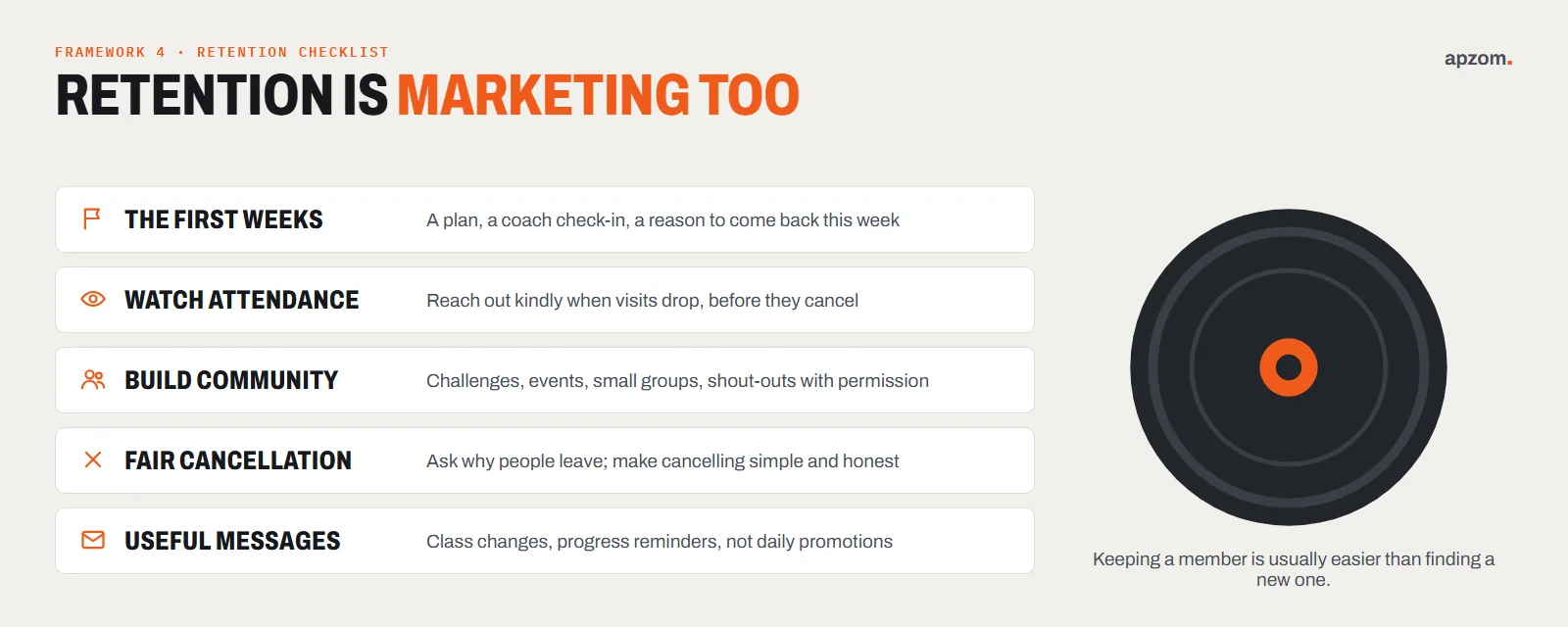
- The first weeks matter most. Give new members a plan, a check-in with a coach and a reason to come back that week.
- Watch attendance. Members who stop coming often leave soon after. Contact them kindly before they cancel.
- Build community. Challenges, events, member shout-outs (with permission) and small-group classes help people feel they belong.
- Ask why people leave, and make cancellation simple and honest. A clear, fair process protects your reputation and, in many countries, is required by law.
- Use email and messages well. Useful updates, class changes and progress reminders, not daily promotions. Our email marketing service can help set this up.
Rules to know: health claims, body image and memberships
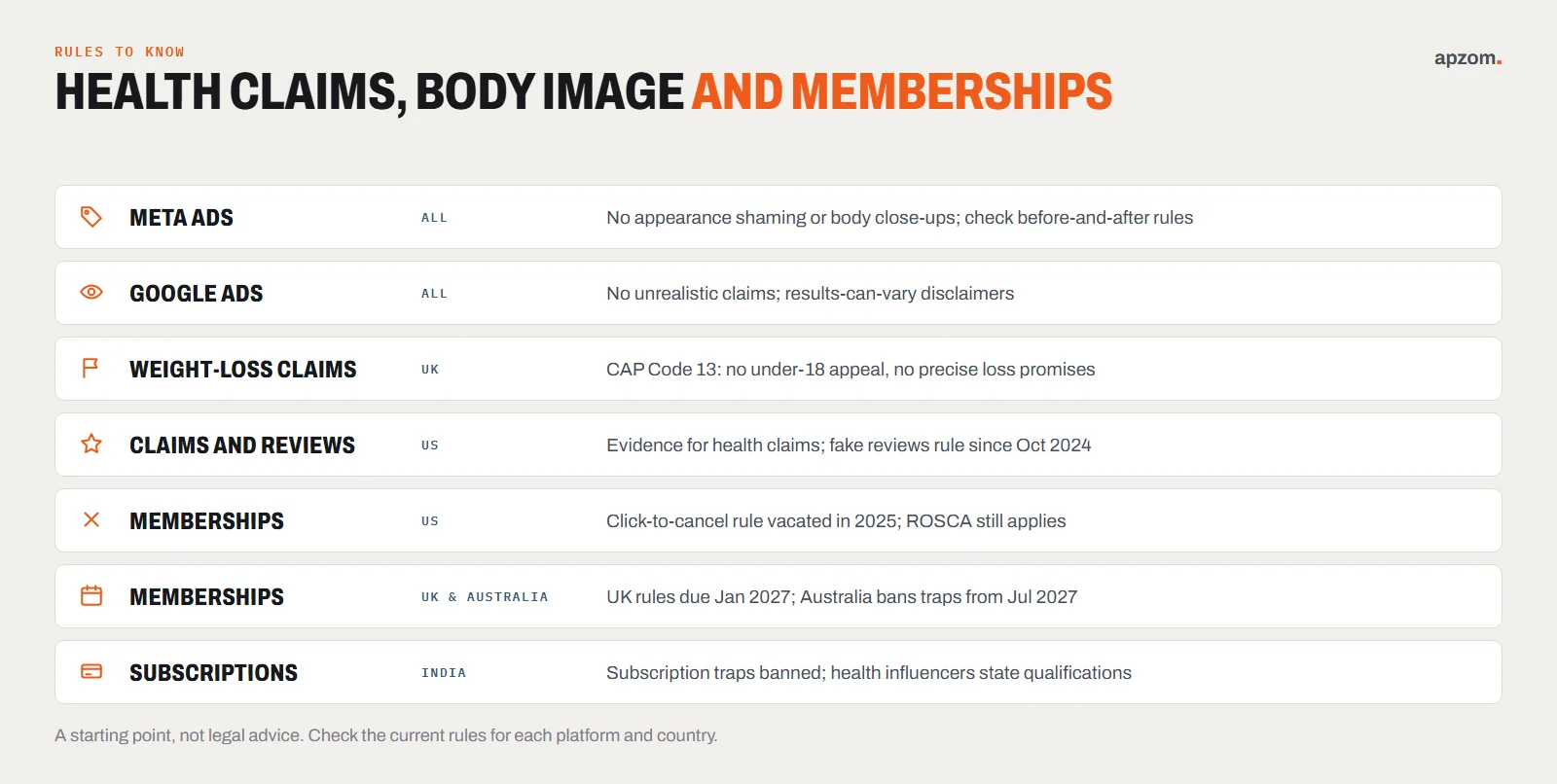
Fitness marketing is closely watched by platforms and regulators. This is a starting point, not legal advice.
| Area | What to know |
|---|---|
| Meta ads (all countries) | Meta’s health and wellness ad policy treats fitness services and health clubs as general wellbeing, so gym ads are not limited to adults by default. But ads must not contain statements of inferiority about physical appearance or close-ups of body areas, such as pinching fat. Weight-loss products must target people aged 18 or over, and before-and-after images face extra restrictions, so check the current policy before using them. |
| Google Ads (all countries) | Google’s unreliable claims policy uses “lose 10 pounds in a month” as an example of an unrealistic claim. Testimonials that claim specific results need a visible “results can vary” style disclaimer. |
| Weight-loss claims (UK) | Section 13 of the UK advertising code (CAP Code) says weight-control ads must not be targeted at, or particularly appeal to, under-18s, and must not claim people will lose a precise amount of weight in a stated period. It says losing more than 2 lbs (just under 1 kg) a week is unlikely to be compatible with good medical and nutritional practice, and exercise claims must be backed by evidence. |
| Health claims and reviews (US) | The FTC expects health claims to be backed by competent and reliable scientific evidence, and treats testimonials showing unusually dramatic results as likely deceptive. Its rule banning fake reviews has been in force since 21 October 2024. |
| Memberships (US) | The FTC’s “click-to-cancel” rule was struck down by a federal appeals court in July 2025 and is not in force. The FTC began new rulemaking in March 2026. The Restore Online Shoppers’ Confidence Act still requires clear terms and express informed consent before charging people on a recurring basis online. |
| Memberships (UK and Australia) | The UK government says new subscription contract rules under the Digital Markets, Competition and Consumers Act 2024 will come into force in January 2027. The Australian government says subscription traps will be banned from 1 July 2027, and has named gym memberships as an example of a subscription. |
| Memberships and influencers (India) | The Central Consumer Protection Authority’s dark patterns guidelines ban “subscription traps”, including making cancellation hard or hidden. ASCI requires health and nutrition influencers who make prevention, treatment or cure claims to state their qualifications. |
The safest approach everywhere: make membership terms, prices and cancellation easy to find and understand, never shame people about their bodies, and only make claims you can prove.
How to measure what matters
Track these each month, by location and by channel:
- Leads and trial bookings, by source.
- Trial attendance rate: how many who booked actually came.
- Join rate: how many who attended became members.
- Cost per new member for each paid channel.
- Retention: how many new members are still active after one, three and six months.
- Referrals and reviews: how many new members came from existing members.
Likes and followers can be useful signs, but members joined and members kept are what pay the rent.
How Apzom can help
Apzom Digital helps local businesses get found and chosen. For gyms and fitness studios, that means local SEO, Google Ads, Meta ads, social media marketing, website development with booking-first pages, email marketing for onboarding and retention, and tracking that follows a lead from first click to membership. We work with clients worldwide, remotely, from our base in Ahmedabad, India.
We have not published a fitness case study yet, so we will not show you one. Our case studies page shows the kind of lead generation and search work we do for other businesses. We will not promise a number of members or rankings. We will show you where your current marketing loses people and what to fix first.
Request a Gym Growth Audit. We review your Business Profile and local search, website and booking flow, trial offer, follow-up, ads, social channels and retention signals. You get a prioritised list of what to fix first, for each location and for the rules in your country.
No obligation and no guaranteed member numbers. Prefer to talk first? Contact us or see all our services.
Frequently asked questions
What is the best way to market a gym?
Start with local search: a complete Google Business Profile, a page for each location, and steady reviews. Add one clear trial offer, easy online booking and fast follow-up. Then use paid ads to fill gaps, and invest in keeping the members you already have.
How do gyms get more members?
By making the first visit easy and pleasant, and following up quickly. Many gyms get plenty of interest but lose people between enquiry, trial and joining. Tracking each step shows where to improve.
Are Facebook and Instagram ads good for gyms?
They can be, especially for trial offers shown to people near your location. Follow Meta’s health and wellness ad policy, avoid any language that shames people about their bodies, respond to leads quickly, and judge ads by trials attended and members joined.
Can gyms use before-and-after photos in ads?
Be careful. Meta’s policies restrict some before-and-after content and ban ads that shame people about their appearance. Advertising codes such as the UK’s CAP Code restrict weight-loss claims, and US law expects results claims to be typical and backed by evidence. Check the current rules for each platform and country, and focus on strength, habits and confidence instead.
How important is member retention in gym marketing?
Very. A member who stays for a year and refers a friend is worth much more than one who leaves after a month. Good onboarding, attendance tracking and community are part of marketing.
Should a gym list prices on its website?
Many people want to know the cost before they visit. Showing prices or price ranges, plus what is included, can reduce wasted enquiries and build trust. If you prefer not to, at least explain the membership options clearly.
How much should a gym spend on marketing?
It depends on your size, location, competition and how many members you need. Set the budget from the value of a member over the time they usually stay, then track cost per new member by channel.
Can Apzom work with gyms outside India?
Yes. We work with clients worldwide, remotely, from our base in Ahmedabad, India, and plan marketing around the search habits and rules of your market.