
The short answer: a digital marketing agency for manufacturers helps the right engineers, buyers and sourcing teams find your capabilities, trust them enough to send a drawing, and turn that request for quote (RFQ) into purchase orders and repeat business. For a manufacturer, good marketing is less about traffic and more about getting a usable RFQ from a buyer whose part, material, volume and quality requirements fit your shop.
This guide is for owners, sales heads and marketing managers at contract manufacturers, machine shops, fabricators, component makers, OEMs and industrial product companies. It explains how industrial buyers actually choose suppliers, what your website has to prove, which channels suit which kind of manufacturer, how to handle distributors and marketplaces, and how to measure marketing in quotes won rather than clicks.
Why manufacturing marketing is different
Most marketing advice assumes one buyer, a short decision and a price on the page. Industrial buying works almost the opposite way.
- The buyer is a group. A design engineer, a quality engineer, a sourcing or purchasing manager and often a plant or operations head all have a say. Each one checks different things.
- The product is often a drawing, not a catalogue item. A job shop or contract manufacturer sells capability: what it can make, to what tolerance, in what material, at what volume.
- The price is a quote. You cannot show a price for a part you have not seen. The conversion is a request for quote, not a checkout.
- Switching suppliers is risky. A new supplier means new approvals, first-article inspection and the chance of a line stoppage if things go wrong. Buyers move carefully.
- The first order is the start, not the goal. The real value is the repeat part numbers, annual schedules and new programmes that follow a good first job.
Gartner’s research on B2B buying puts numbers on part of this. Its current guidance says B2B buyers dedicate only 24% of their buying time to engaging with potential suppliers, and that time is shared across every supplier they are considering. In a separate 2025 survey, Gartner found that 61% of B2B buyers prefer an overall buying experience without a sales rep. Neither figure is specific to manufacturing, but the direction is clear: most of the evaluation happens when nobody from your sales team is in the room. Your website, documents and public footprint do the talking.
First, which kind of manufacturer are you?
“Manufacturing marketing” covers businesses that sell in very different ways. Before choosing channels, be clear about your model, because it changes almost everything that follows.
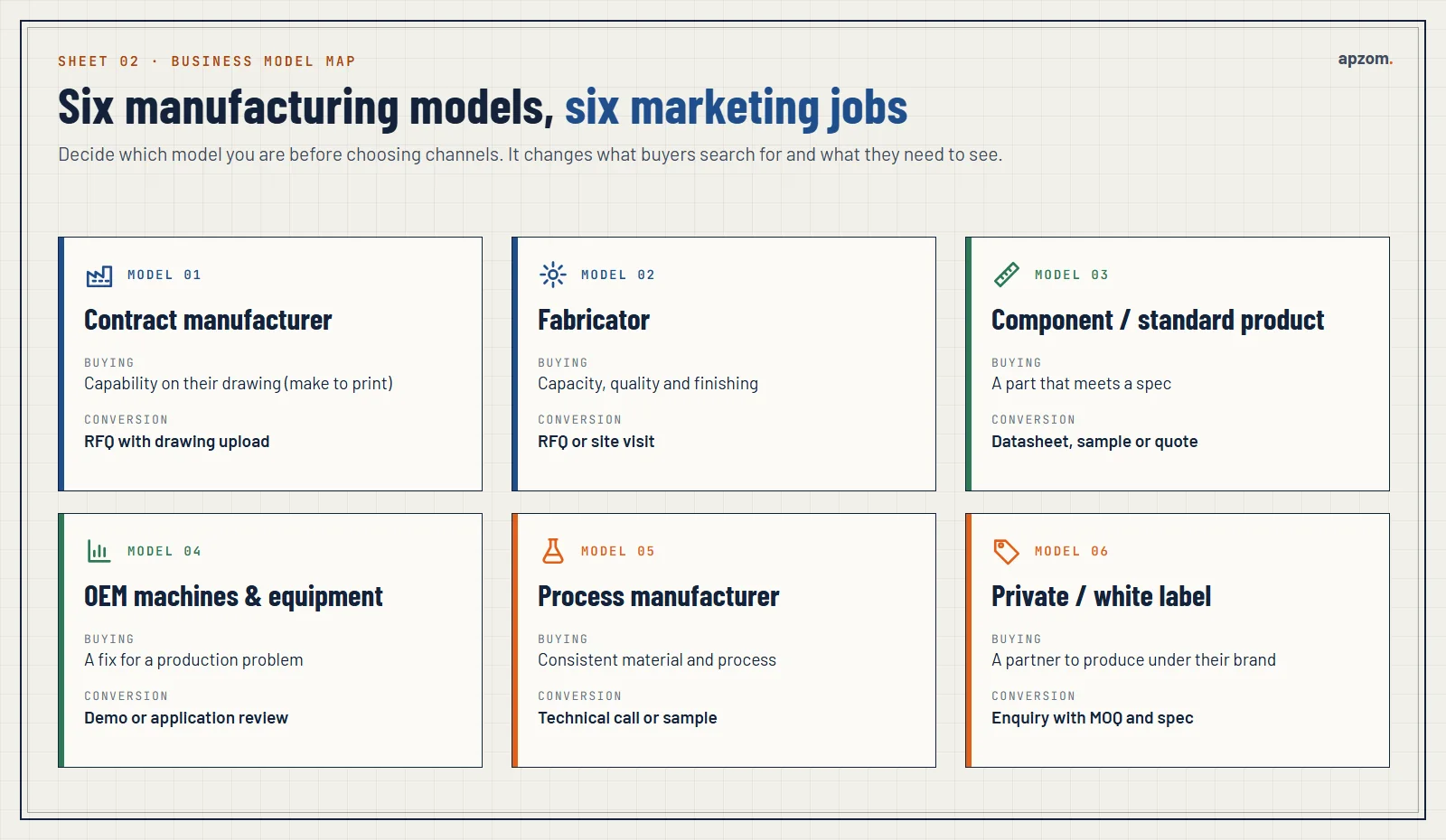
| Business model | What the buyer is really buying | What they search for | Main conversion |
|---|---|---|---|
| Contract manufacturer or job shop (make to print) | Capability and reliability on their part | Process + material + capability, e.g. “5-axis CNC machining titanium” | RFQ with drawing upload |
| Fabricator (sheet metal, structural, welding) | Capacity, quality and finishing on their design | Process + product type + location, e.g. “sheet metal enclosures fabrication” | RFQ or site visit |
| Component or standard product maker | A product that meets a specification | Product type + spec + standard, part numbers | Datasheet download, sample or quote |
| OEM with its own equipment or machines | A machine that solves a production problem | The problem, the application, the machine type | Demo, application study or consultation |
| Process manufacturer (plastics, castings, chemicals, packaging) | Consistent material and process quality | Material + process + application | Technical call or sample request |
| Private label or white label supplier | A partner who can produce under their brand | Product + “manufacturer” + private label | Enquiry with MOQ and specification |
A machine shop that writes like an OEM, or an OEM that writes like a job shop, attracts the wrong enquiries. Decide which rows describe you, then build the website and campaigns around those buyers.
The spec-to-PO journey
Here is the path most industrial purchases follow, from a need appearing to a purchase order and then repeat orders. Each stage needs something different from marketing.
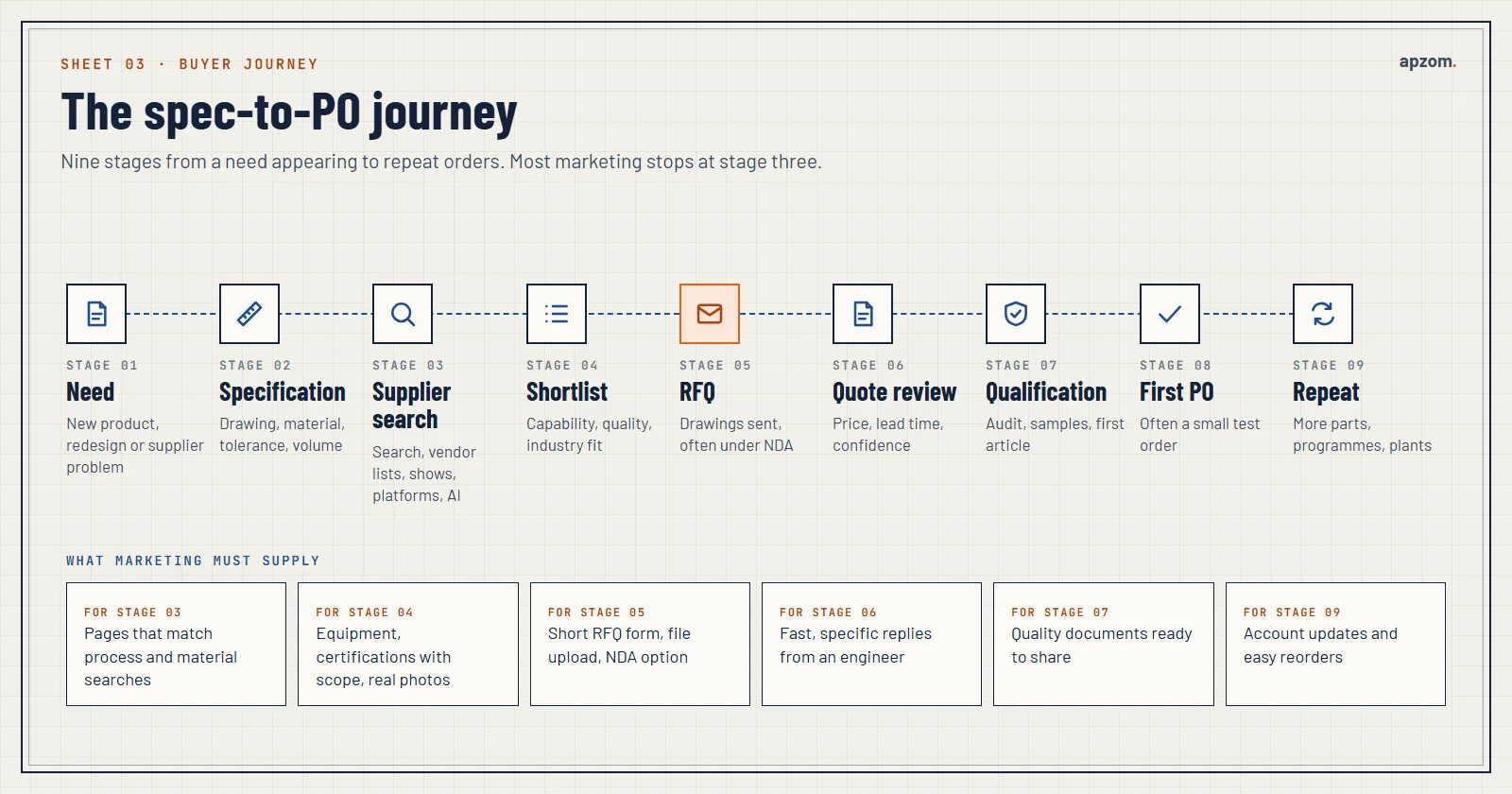
- Need: a new product, a redesign, a supplier problem, a capacity gap or a cost-down target.
- Specification: the engineer defines the part or product: drawing, material, tolerance, finish, standard, volume.
- Supplier search: the team looks for suppliers who can do this. Search, existing approved vendor lists, colleagues, trade shows, sourcing platforms and, increasingly, AI tools.
- Shortlist: a handful of suppliers are checked for capability, quality systems, industry experience and location.
- RFQ: drawings and requirements go out to the shortlist, often under a non-disclosure agreement.
- Quote evaluation: price matters, but so do lead time, technical questions asked, and confidence in the supplier.
- Qualification: for regulated or critical parts, there may be a supplier audit, sample parts, first-article inspection or a formal approval process.
- Purchase order: the first order, often small, as a test.
- Repeat and expansion: more part numbers, annual schedules, new programmes and referrals to other plants or divisions.
Marketing’s job changes along that path:
| Stage | What the buyer needs | What marketing must supply |
|---|---|---|
| Supplier search | To find suppliers who can make this | Pages that match process, material, product and industry searches |
| Shortlist | Evidence you are a serious, capable supplier | Equipment, capacity, certifications, industries served, real photos |
| RFQ | An easy, secure way to send a drawing | A short RFQ form with file upload and NDA option |
| Quote evaluation | Confidence you understood the job | Fast, specific replies; engineers available for questions |
| Qualification | Documents and proof of process control | Quality documents, inspection capability, certificates ready to share |
| Repeat | A reason to send the next part | Account communication, new capability news, easy reorder routes |
Most manufacturers only invest in the first row. The deals are usually won or lost in the rows below it.
The buying committee: who checks what
Different people visit your website for different reasons. If your pages only speak to one of them, the others quietly drop you from the shortlist.
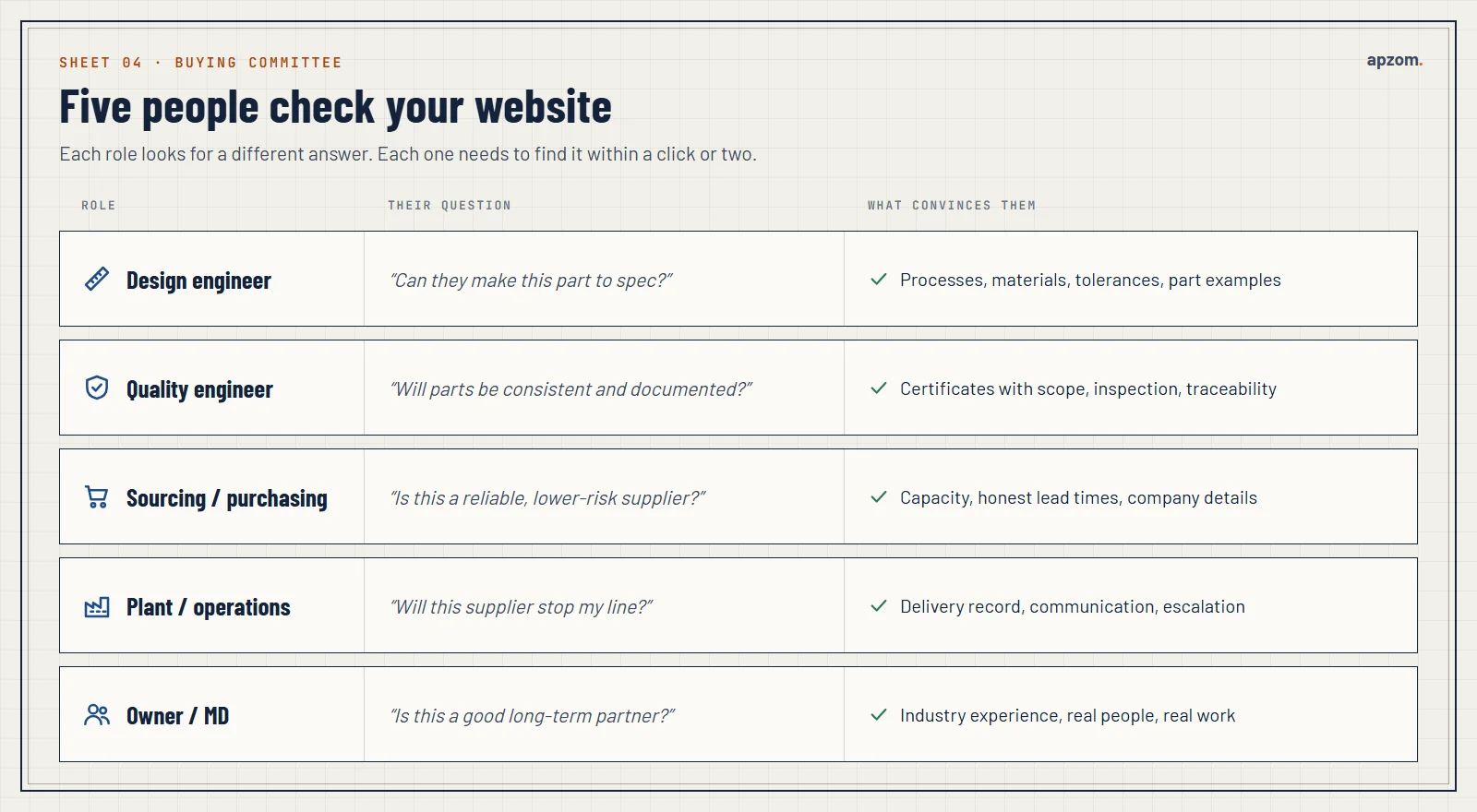
| Role | Main question | What convinces them | What puts them off |
|---|---|---|---|
| Design or project engineer | Can they make this part to spec? | Processes, materials, tolerances, part examples, technical answers | Vague claims like “precision quality” with no detail |
| Quality engineer | Will the parts be consistent and documented? | Certifications with scope, inspection equipment, process control, traceability | Certificates with no scope, expired or unverifiable |
| Sourcing or purchasing | Is this a reliable, lower-risk supplier? | Capacity, lead times explained honestly, location, logistics, financial stability signals | Missing company details, no clear contact, slow replies |
| Plant or operations head | Will this supplier cause line problems? | Delivery track record, communication process, contingency capacity | No evidence of on-time delivery or escalation routes |
| Owner or managing director | Is this a good long-term partner? | Industry experience, customer types, who runs the company | Generic stock photos and copied text |
You do not need a separate website for each role. You need each role to find its answer within a click or two. A capabilities page for the engineer, a quality page for the quality team, a “working with us” page for purchasing, and real photos and people for everyone.
What your website has to prove
An industrial buyer looking at a supplier website is doing due diligence. The useful question is not “does the site look modern?” but “does it answer what a buyer needs to shortlist us?”
The capability proof stack
Buyers tend to check proof in roughly this order, from the first five seconds on your homepage to the final shortlist meeting. A gap early in the list usually means they never reach the rest.
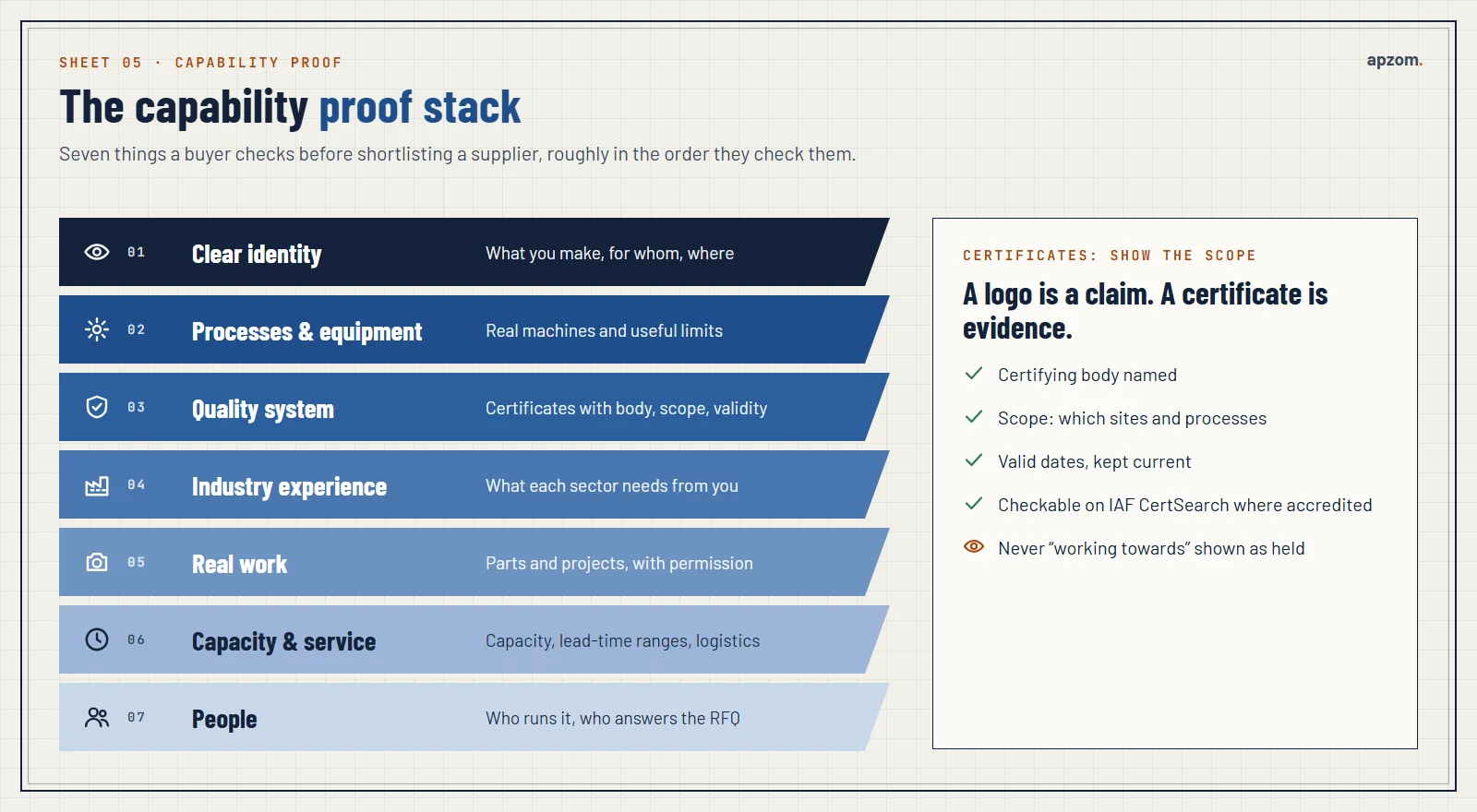
- Clear identity: what you make, for which industries, and where you are. A buyer should know in five seconds whether to keep reading.
- Processes and equipment: the actual machines and processes, with useful limits: maximum part size, materials handled, typical tolerances you hold, secondary operations and finishes.
- Quality system: certifications with their scope and certifying body, plus inspection equipment and how you control quality.
- Industry experience: the sectors you serve and what that means in practice, such as documentation for automotive or traceability for medical.
- Real work: photos and short write-ups of parts or projects you have made, with customer permission and without exposing customer drawings.
- Capacity and service: shifts, capacity for new work, typical lead time ranges with conditions, logistics and export capability.
- People: who runs the business, who the engineers are, and who answers an RFQ.
Certifications: show the scope, not just the logo
Certification logos are some of the most-read elements on a manufacturing site, and some of the most misused. ISO 9001 is the general quality management standard. Sector standards build on it: IATF 16949 for automotive, AS9100 (published by the IAQG as the 9100 series) for aviation, space and defence, and ISO 13485 for medical devices. ISO published a new edition of ISO 9001 in September 2026, so check which edition your certificate and your customers refer to.
Show each certificate with the certifying body, the scope (which sites and processes it covers) and its validity, and keep it current. Accredited certifications can often be checked on IAF CertSearch, the International Accreditation Forum’s database of accredited certificates, and quality engineers do check. It only covers certificates whose certification bodies supply data, so a missing entry is a reason to ask, not proof of a problem. Never display a certificate logo for a standard you are “working towards”, and never imply a certificate covers a site or process it does not.
Real photos beat polished stock
A buyer can tell a stock photo of a gleaming machine from your shop floor. Real, well-lit photos of your equipment, inspection room, finished parts (with permission) and team do more for trust than any design trend. They also help in image and visual search, where people increasingly search with a photo of a part. Give each image a descriptive file name and alt text that says what it shows.
Protect your customers’ drawings
Never publish customer drawings, part numbers or anything covered by an NDA. Show the type of work instead: “machined aluminium housing for an industrial pump, 5-axis, anodised”, with the customer’s agreement.
If you make defence or controlled items, check with your export compliance adviser before publishing technical detail. In the US, for example, the Export Administration Regulations (EAR) treat posting on a publicly available website as publishing, and the International Traffic in Arms Regulations (ITAR) only treat controlled technical data as public domain once its release has been approved by the relevant US government agency. Putting it on your website first is not a shortcut.
The RFQ engine: turn interest into a quote you can price
For most manufacturers the RFQ form is the most important page on the site. A bad one loses good buyers; a careless one floods sales with requests you cannot quote.
What a good manufacturing RFQ form collects
| Field | Why it matters | Required? |
|---|---|---|
| Name, company, email, phone | Basic contact and company check | Yes |
| Drawing or file upload (PDF, STEP, DXF and similar) | You cannot quote without it | Yes for make-to-print, optional otherwise |
| Material and finish | Changes cost and process route | Yes, or “as per drawing” |
| Quantity and annual volume | Separates prototypes from production programmes | Yes |
| Target date | Tells you if you can realistically meet it | Optional |
| Industry or application | Helps route to the right engineer | Optional |
| Certification or documentation needs | Flags PPAP, first-article, material certificates and similar early | Optional |
| NDA required? | Many buyers will not send drawings without one | Optional checkbox |
Keep the first step short. A form with 25 required fields protects sales time but loses good buyers who want a quick answer. If you need more detail, ask for it in the reply.
Make the reply part of the marketing
Buyers judge you by your first response. A fast, specific reply that asks a sensible technical question (“Is the 0.02 mm tolerance needed on all faces, or only the bore?”) often wins against a cheaper quote that arrives late and generic. Set a target response time, decide who owns RFQs, and track it.
Match the call to action to the page
- Capability pages: “Send your drawing for a quote”
- Product and datasheet pages: “Request a sample” or “Ask about this specification”
- OEM machine pages: “Book an application review”
- Industry pages: “Talk to an engineer about your project”
- Guides and resources: a quiet next step, not a hard sell
Not sure what your website is missing? A Manufacturing Digital Growth Audit checks how buyers find you, what your capability pages prove, and where RFQs get lost. Free, with no obligation.
Channels: what fits which manufacturer
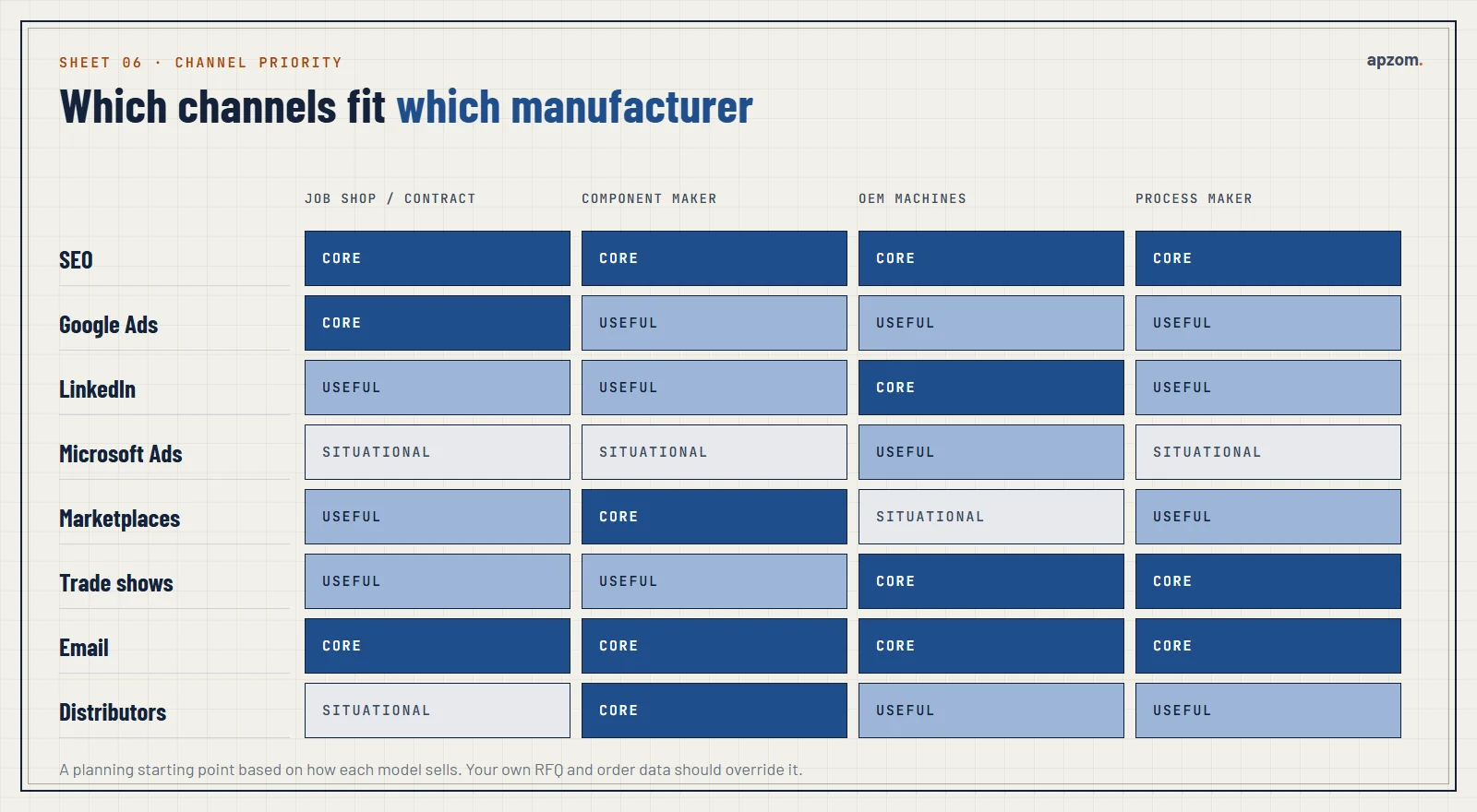
There is no single best channel for manufacturers. The right mix depends on your model, your buyers and how they already find suppliers.
| Channel | Best job | Fits best | Watch out for |
|---|---|---|---|
| SEO | Being found for process, material, product and industry searches | Contract manufacturers, component makers, OEMs | Slow to build; generic blog posts rarely bring RFQs |
| Google Ads | Capturing active searches for a process or product | Specific capabilities with clear demand | Broad terms waste money on jobs, students and DIY |
| Reaching named companies, engineers and sourcing teams | High-value accounts, OEMs, new market entry | Costly per click; needs real content, not just ads | |
| Microsoft Advertising | Search ads with LinkedIn profile targeting | B2B searches where job function matters | Lower volume than Google in most markets |
| Industrial marketplaces and directories | Being present where buyers already compare suppliers | Standard products, India and North American sourcing | Price pressure and low-quality enquiries |
| Trade shows | Meeting buyers and partners in person | Most manufacturers, especially new markets | Expensive unless followed up properly |
| Staying in touch with customers and past RFQs | Every manufacturer | Must follow the email law in each market | |
| Distributors and reps | Reach you cannot build alone | Standard products and international markets | Channel conflict and duplicate content |
SEO for manufacturers: build around capability, not keywords
Search for manufacturers works best when the site structure mirrors real capability. Instead of one “Services” page and a blog, build page families:
- Process pages: CNC machining, laser cutting, press brake forming, injection moulding, die casting, powder coating. Only processes you run in-house, or clearly marked as through partners.
- Material pages: where materials change the job, such as stainless steel, aluminium, titanium or engineering plastics.
- Industry pages: automotive, medical, agricultural equipment, energy. Only industries where you have real experience and something specific to say.
- Product pages: for component makers and OEMs, with specifications, standards, downloads and applications.
- Location pages: only for genuine plants or offices.
Engineers search in specifics. A page that says “we machine 316L stainless steel valve bodies up to 400 mm with ±0.01 mm on critical bores” matches more real searches than one that says “high-quality precision engineering solutions”. Apzom’s SEO services are built around that kind of structure. For the page-by-page detail, including catalogues, datasheets and export markets, see our guide to SEO for manufacturers.
Two technical points matter more for manufacturers than for most businesses:
- Datasheets and PDFs: Google can index PDF files, so technical PDFs can be found in search. But a PDF is a weak landing page with poor navigation. Put the key specification content on an HTML page and offer the PDF as a download from it.
- Product structured data: Google’s product snippets are meant for product pages where people cannot buy directly, and need at least one of offers, a review or an aggregate rating. Merchant listings need a purchasable page with a price. Many industrial products have no public price and no reviews, so product rich results may not be available. That is fine. Use structured data to describe what is true on the page, such as the product name, part number and certifications, and never invent prices or ratings to trigger a rich result.
Avoid doorway and copy-paste pages
It is tempting to create a page for every city, every industry and every material combination with the same text and a swapped word. Google’s spam policies describe this as doorway abuse and scaled content abuse. A page earns its place when it says something that is genuinely different and useful for that process, material, industry or location.
Google Ads: narrow and specific
Google Ads works for manufacturers when the targeting is tight. Bid on specific process and product searches, add strong negative keywords (jobs, training, course, DIY, free, used machines), send each ad group to its matching capability page, and track RFQs rather than clicks.
For long sales cycles, the real signal arrives weeks later when a quote is won. Google Ads’ enhanced conversions for leads lets you send that outcome back from your CRM using the hashed details the buyer gave in the form. That teaches the campaign which searches produce real business, not just form fills.
LinkedIn and account-based marketing
LinkedIn is where many engineers, sourcing managers and plant leaders build professional profiles and follow industry news. For manufacturers with a defined list of target accounts, its company list targeting lets you show ads to people at named companies, and its lead gen forms can pre-fill details from the member’s profile. It works best alongside real content from your engineers and leadership, not as a standalone ad channel. Microsoft Advertising also offers LinkedIn profile targeting, such as company, industry and job function, on its search ads in a number of markets, including the US, UK and India.
Industrial marketplaces, directories and public procurement
Many industrial buyers compare suppliers on sourcing platforms before visiting individual websites. Examples include IndiaMART in India and Thomasnet in North America, along with sector-specific directories. In India, many government buyers use the Government e-Marketplace (GeM), the national public procurement portal.
These platforms can bring volume, but enquiries are often price-led and less qualified. Treat them as a channel to manage: keep listings accurate, respond fast, track which enquiries become orders, and make sure your listings point back to the detailed capability pages on your own site.
Trade shows: make them a digital campaign
A trade show is expensive for a few days of conversations. Digital work makes it pay: tell target accounts in advance where to find you, book meetings before the event, publish what you will show, capture every conversation in the CRM, and follow up within days with something specific to each contact.
Email is still one of the best ways to stay in touch with customers and past RFQs: new capabilities, new equipment, capacity openings, useful technical notes. Follow the law in each market. In the US, the Federal Trade Commission is clear that the CAN-SPAM Act has no exception for business-to-business email. In the UK, the ICO’s guidance lets you email corporate bodies without prior consent if you identify yourself and offer an easy opt-out, but sole traders and some partnerships are treated as individuals. The ICO notes that this guidance is under review following the Data (Use and Access) Act 2025.
Distributors, reps and channel conflict
Many component and product manufacturers sell through distributors and representatives. That creates two marketing problems.
Channel conflict. If your website sells or quotes directly in territories where distributors operate, you may compete with your own partners. Decide clearly which enquiries go to which channel, and show buyers the right route: “Buy through our authorised distributors in these regions”, “Request a quote directly for custom work”.
Duplicate content. Distributors often copy your product descriptions word for word. Search engines then have several pages with the same text, and the distributor’s bigger site may outrank yours for your own product. Practical fixes:
- Keep your own product pages richer than any copy: full specifications, application notes, downloads, drawings you choose to publish and genuine FAQs.
- Give distributors a shorter, different description rather than your full page text.
- Where a partner republishes your full content, Google’s current advice for syndicated copies is to ask the partner to keep their copy out of the index with a noindex tag. It no longer recommends relying on a cross-domain canonical tag for this.
- Provide a dealer or distributor locator so buyers who land on your site can still buy locally.
AEO, GEO and AI search for manufacturers
Engineers and buyers are starting to ask AI tools questions such as “which processes suit low-volume aluminium enclosures?” or “what should I ask a contract manufacturer before sending drawings?”. You cannot control what those tools say, and nobody can honestly promise placement or citations in them.
What you can do is make accurate information about your capabilities easy to find, understand and quote. Google’s guidance on its AI features is clear that normal SEO best practice applies and that no special files, markup or tags are needed to appear in them. In practice that means:
- Clear capability facts: processes, materials, size limits, tolerances, certifications with scope, industries and locations, stated plainly and consistently on your website, LinkedIn and directory listings.
- Answer-first technical content: for questions buyers really ask, give the direct answer first, then the explanation, then the caveats.
- Original knowledge: things only your engineers know, such as design-for-manufacturing advice for a process you run every day.
- A consistent entity: the same company name, address and description everywhere, so systems can connect the facts to you.
Google Search Console now reports how often a site appears in Google’s generative AI features. Google announced these reports in June 2026 and said they would reach all sites by 31 August 2026. It also added reporting for visual and multimodal searches, such as searches made with Google Lens, in September 2026. Both show visibility, not enquiries, so read them alongside your RFQ data.
The manufacturing entity map
A simple way to plan your site is to map the facts a buyer, and a search system, needs to connect:
Company → plant and location → process → material → capability limits → certification → industry → product or part type → buyer problem → RFQ
When those relationships show up clearly in your pages, navigation and internal links, both people and machines understand what you do. Write naturally; do not stuff these words into every sentence.
Measure marketing in quotes won, not clicks
Manufacturing sales cycles are long, so marketing that is only measured on clicks and form fills always looks either brilliant or useless. Measure what the business cares about.
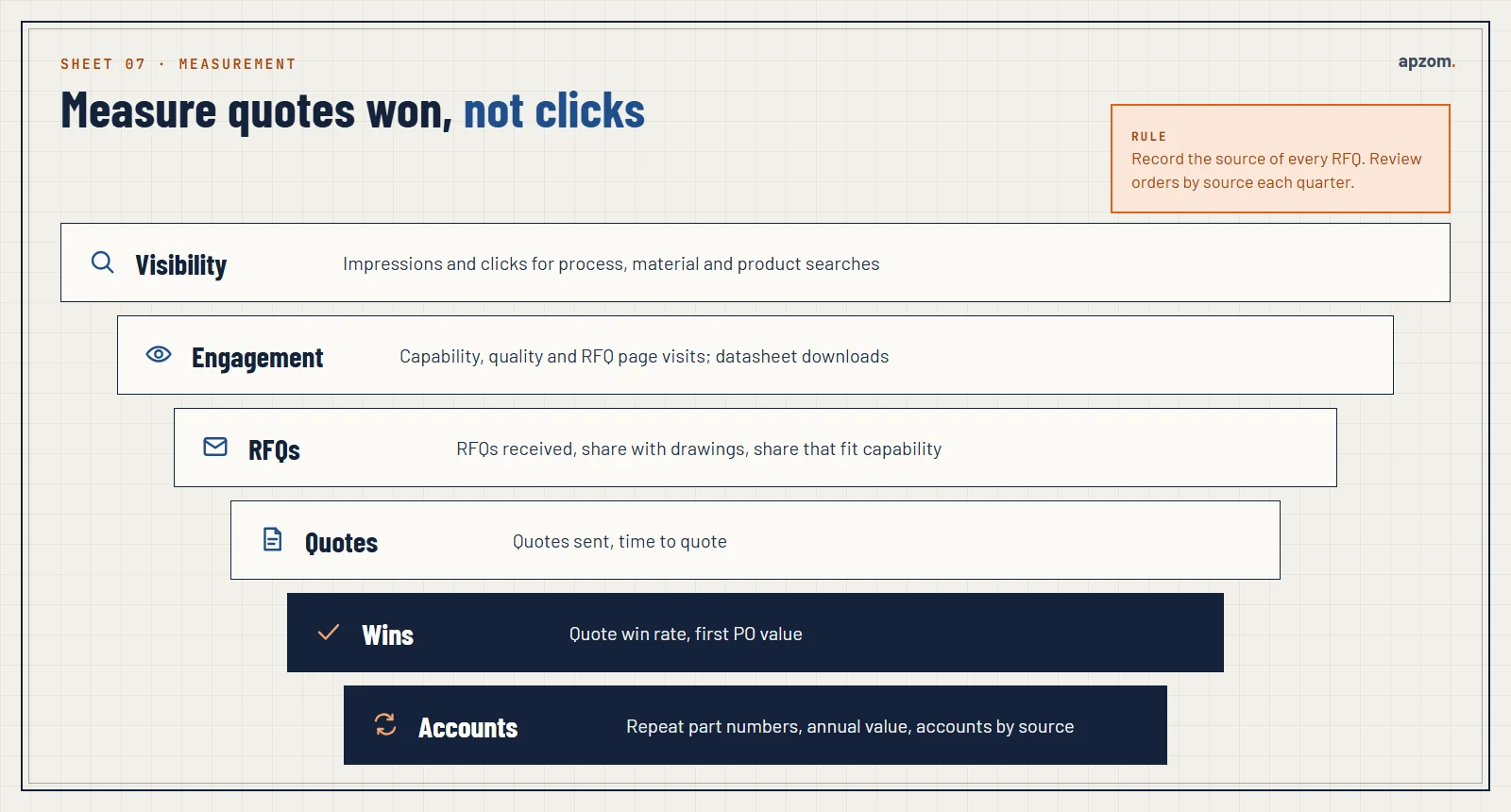
| Stage | What to measure | Why it matters |
|---|---|---|
| Visibility | Impressions and clicks for process, material and product searches; directory and LinkedIn reach | Are the right buyers finding you? |
| Engagement | Visits to capability, quality and RFQ pages; datasheet downloads | Are they checking you as a supplier? |
| RFQs | Number of RFQs, share with drawings attached, share that fit your capability | Is marketing producing quotable work? |
| Quotes | Quotes sent, time to quote | Can sales keep up with good demand? |
| Wins | Quote win rate, first PO value | Is the work you attract work you can win? |
| Accounts | Repeat part numbers, annual value per account, accounts by source | Is marketing building long-term revenue? |
Record the source of every RFQ in your CRM, even a simple one, and look back each quarter at which sources produced orders. The answer usually changes your budget more than any dashboard.
Be careful with industry benchmarks. Conversion rates, cost per RFQ and win rates vary hugely by process, region, order size and competition. Your own numbers, tracked over a few quarters, are the only benchmark that matters.
A 90-day starting plan
If your marketing is mostly referrals and a basic website today, this is a sensible order of work.
Days 1 to 30: foundations
- Decide your priority business model, industries and processes.
- Rewrite the homepage and main capability pages so a buyer knows in seconds what you make and for whom.
- Add real photos, an equipment list, certifications with scope, and a proper RFQ form with file upload.
- Set up conversion tracking and record RFQ source in the CRM.
Days 31 to 60: capture existing demand
- Build or improve pages for your most profitable processes, materials and industries.
- Launch a tightly targeted Google Ads campaign on two or three capabilities with clear demand.
- Clean up marketplace and directory listings so they match your website.
Days 61 to 90: build authority and accounts
- Publish two or three genuinely useful technical pieces from your engineers.
- Start a target account list and a LinkedIn plan for it.
- Review RFQs by source, quote win rate and first orders, then move budget accordingly.
What a manufacturing marketing agency should actually do
A good agency for manufacturers should spend its first weeks understanding your shop, not producing content. Expect questions about your machines, materials, tolerances, certifications, best customers, worst customers, capacity and what a good order looks like.
Questions to ask an agency
- Which of our processes and industries would you prioritise, and why?
- How will you learn enough about our capabilities to write accurately?
- Who reviews technical content before it is published?
- How will you track RFQs through to quotes and orders?
- What will you do about distributor duplicate content and channel conflict?
- Which channels would you not use for us?
Red flags
- Guaranteed rankings, guaranteed leads or a fixed cost per RFQ before they understand your market.
- Hundreds of near-identical city or industry pages.
- Content written without talking to anyone on your shop floor.
- Reporting that stops at clicks and form fills.
- Stock photos of factories that are not yours.
How Apzom can help
Apzom Digital works with businesses that sell complex, considered services, where the job is to earn trust before the first conversation. For manufacturers, that usually means SEO built around real capabilities, tightly managed Google Ads, website development that makes RFQs easy, and conversion rate optimisation on the pages that matter most.
We have designed and built the website for Vishwakarma Engineers, an engineering and fabrication business, and you can see our client work on our case studies page. We do not publish results we cannot verify, and we will not promise rankings or a set number of RFQs. If your buyers are B2B and your sales cycle is long, our guide to digital marketing for logistics companies covers a similar RFQ-led approach in another industrial sector.
Request a Manufacturing Digital Growth Audit. We review your positioning by business model, capability and quality pages, RFQ form and response process, SEO and paid search, marketplace and distributor presence, tracking from RFQ to order, and AI search readiness. You get a prioritised list of what to fix first and why.
The audit is free, with no obligation and no guaranteed rankings. Prefer to talk it through? Contact us or see all our services.
Frequently asked questions
What does a digital marketing agency for manufacturers do?
It helps manufacturers get found by the engineers and buyers who need their capabilities, shows enough proof for those buyers to shortlist the company, and makes it easy to send a quotable RFQ. A good one also tracks which marketing produces quotes, orders and repeat accounts, not just website visits.
Is SEO worth it for manufacturing companies?
Usually, yes, when it is built around real processes, materials, products and industries. Engineers search in specific terms, and pages that answer those searches with real detail can bring steady, qualified RFQs. It takes months to build, so many manufacturers pair it with targeted paid search at the start.
How can a manufacturer get more qualified RFQs?
Be specific about what you make, for whom and to what limits; show proof such as equipment, certifications with scope and real work; and use a short RFQ form with drawing upload and an NDA option. Then reply quickly with useful technical questions and track which sources produce orders.
Should manufacturers use Google Ads?
Google Ads can work well for specific capabilities with active demand, such as a particular process, material or product type. It wastes money on broad terms. Use tight keywords, strong negative keywords, matching landing pages and offline conversion tracking so the campaign learns from won quotes.
Does LinkedIn work for B2B manufacturing marketing?
It works best for manufacturers with high-value target accounts, where reaching specific companies and roles matters. Combine company list targeting with real content from engineers and leadership. It is rarely the cheapest channel per click, so judge it on account conversations and opportunities.
Should we list our company on IndiaMART, Thomasnet or similar platforms?
If your buyers use them, yes, but manage them as a channel. Keep listings accurate and consistent with your website, respond quickly, and track which enquiries become orders. Expect more price-led enquiries than from your own site.
Can we show our certifications and customer logos on our website?
Show certifications you actually hold, with the certifying body, scope and validity. Only show customer names or logos with permission, and never publish customer drawings or confidential details.
How long does manufacturing marketing take to show results?
Paid search and marketplace changes can bring RFQs within weeks. SEO and authority building usually take several months. Because quotes take time to convert, judge results over quarters, not weeks.
What is AEO and GEO for manufacturers?
AEO (answer engine optimisation) means writing clear, direct answers to the questions buyers ask so search and answer systems can use them. GEO (generative engine optimisation) means making accurate facts about your company easy for AI tools to find and understand. Both rely on the same foundations as good SEO, and neither can be guaranteed.