
Most dental practices that struggle to grow do not have a visibility problem alone. They have a chain problem. A patient has to find the practice, decide it is trustworthy, manage to book, actually turn up, have a good experience, and then tell someone about it. Marketing that only works on the first link of that chain produces clicks, not patients.
This guide is written for practice owners, dentists, practice managers and dental groups who want to grow responsibly. It explains what good dental marketing involves, stage by stage, and where it differs from marketing a restaurant or a law firm: healthcare advertising rules, patient privacy, review responses, clinical accuracy and the gap between an enquiry and an attended appointment.
The short answer
What does a digital marketing agency for dentists do? It helps a dental practice get found by nearby patients and by people researching specific treatments, makes the practice look as trustworthy online as it is in person, removes friction from calling and booking, and measures which activity leads to booked and attended appointments rather than just traffic. A good one does this within the advertising, review and privacy rules that apply to healthcare in the practice’s country.
What it should not do is promise a fixed number of new patients, write clinical content without dental review, or install tracking tools without asking what patient data they receive.
The Dental Patient Growth Operating System
Think of a practice’s growth as six connected stages rather than a list of channels.
- Get found. Search, Google Maps, ads, social and AI answers put the practice in front of people who need a dentist.
- Earn trust. The dentists, reviews, photos, treatment information and website persuade someone this is a practice they would be comfortable visiting.
- Get booked. A call is answered, a form is simple, online booking works on a phone.
- Get the patient to show up. Confirmation, clear directions and sensible reminders turn a booking into an attended appointment.
- Build the relationship. Good care, follow-up and recall turn a first visit into an ongoing patient.
- Build reputation and measure growth. Genuine reviews and referrals feed back into stage one, and measurement shows which stages are working.
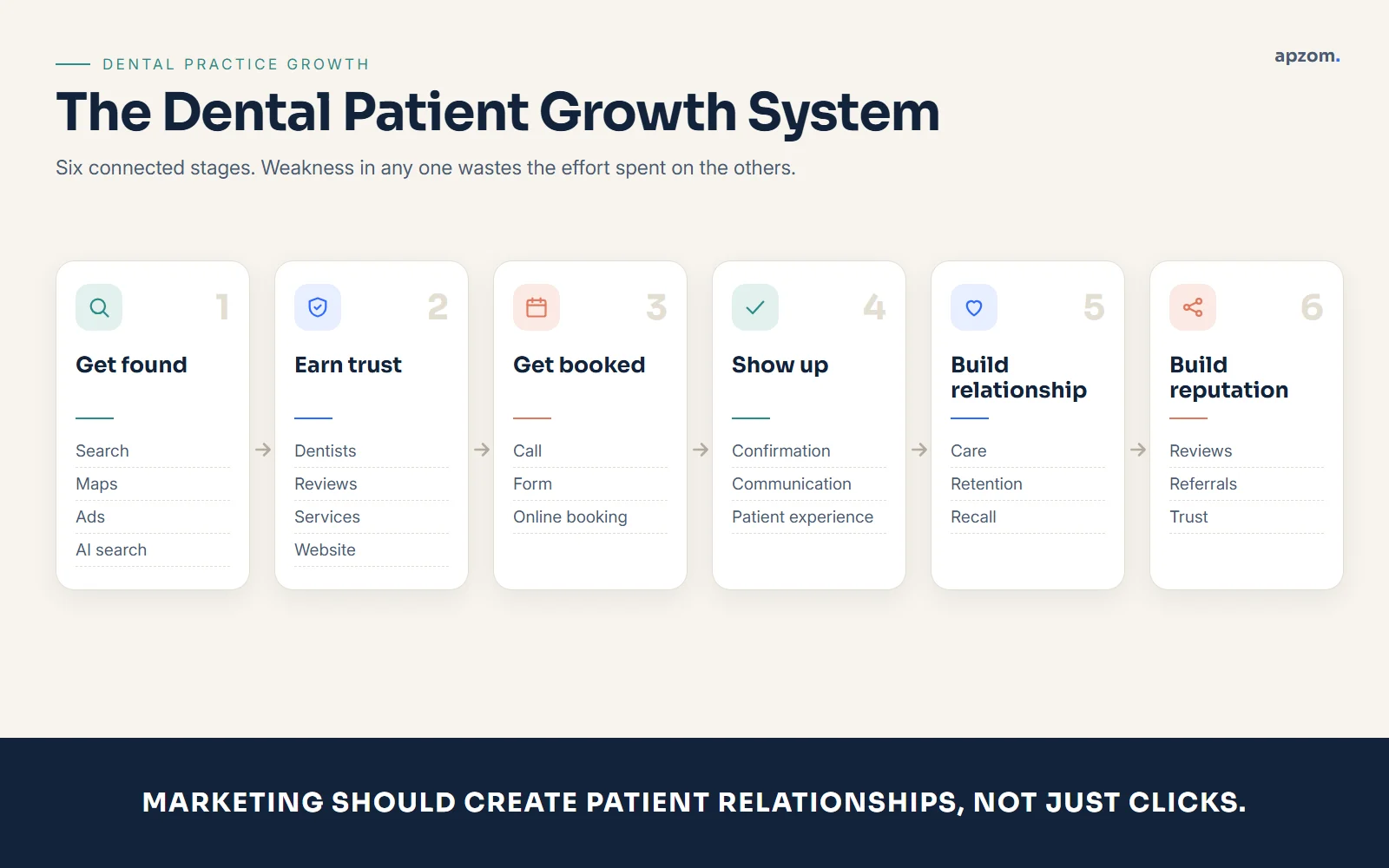
The value of seeing it this way is diagnostic. If the phone rings but bookings stay flat, more advertising will not help. If the diary is full of first appointments that never become ongoing patients, the problem is not search rankings. Each stage has its own fixes, and a good agency should be able to tell you which stage is actually limiting your growth before recommending anything.
First, a note on rules
Dental marketing is healthcare marketing, and the rules depend on where the practice is. This guide uses examples from several countries, labelled as such. None of it is legal advice, and a practice should check with its own regulator, professional body or adviser.
| Where | Who sets the rules | What it means for marketing |
|---|---|---|
| United States | State dental boards, the FTC, HHS (HIPAA), plus the ADA Code of Ethics for ADA members | Advertising must not be false or misleading; the FTC’s Consumer Reviews and Testimonials Rule (in force since 21 October 2024) bans fake reviews and review suppression; HIPAA applies to practices that are covered entities |
| United Kingdom | General Dental Council and the advertising codes | GDC guidance expects accurate, evidence-backed claims and display of registration details on websites; titles must not imply specialist status the dentist does not hold |
| Australia | Ahpra, the Dental Board of Australia and the National Law | Section 133 of the National Law prohibits testimonials about clinical aspects of a regulated health service and claims that create unreasonable expectations of treatment |
| India | Dental Council of India and the Dentists (Code of Ethics) Regulations, 2014 | Dentists may advertise with decorum; factual websites, including fees, are acceptable, but claims of superiority or being “the best” are treated as unethical |
The common thread is simple: marketing can make a practice more visible. It cannot make a misleading claim acceptable.
Stage 1: Get found
How patients actually search for a dentist
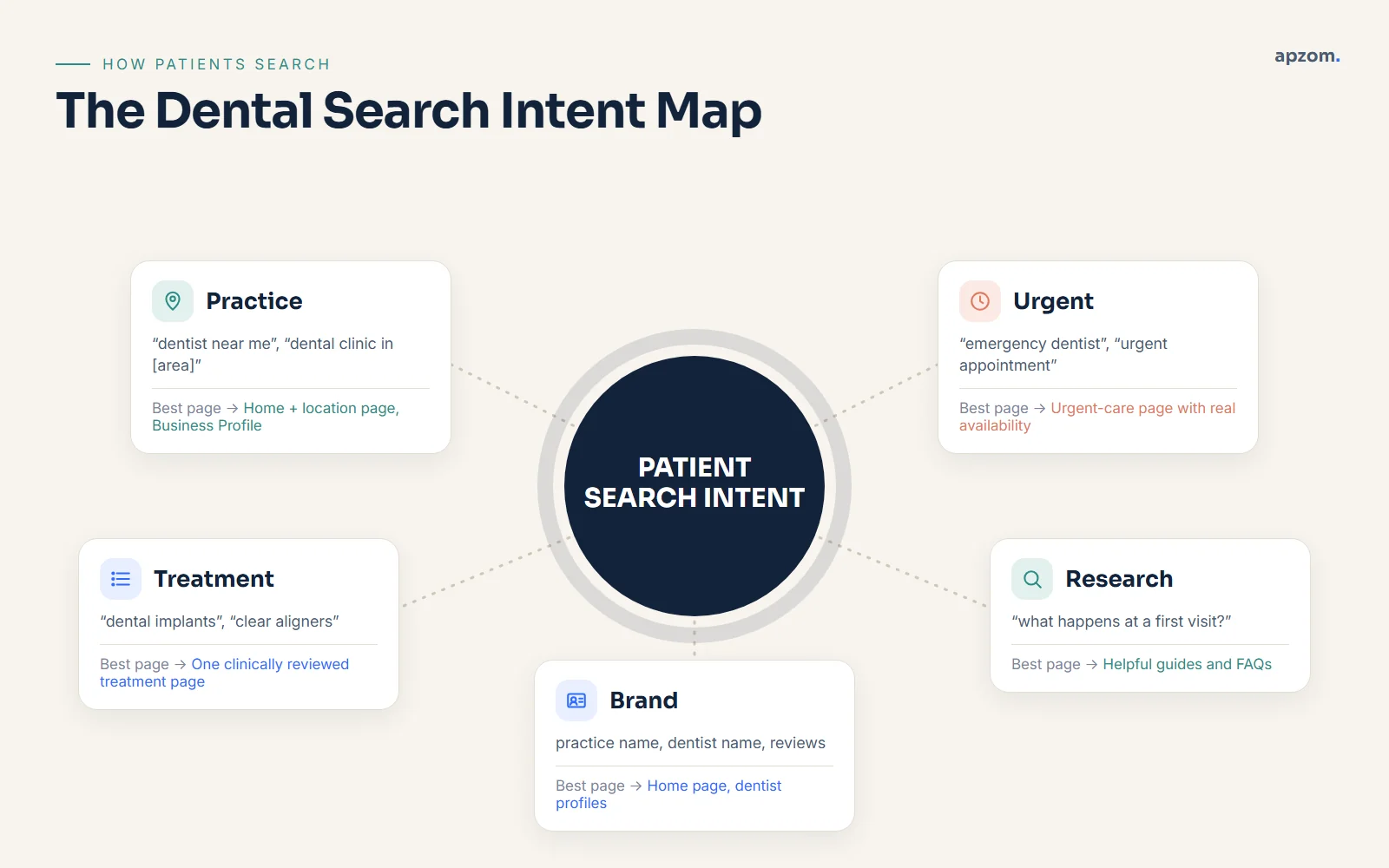
People do not search for “dental marketing”. They search with a need, and the need changes what they type, what they expect to see, and what page should answer them.
| Search intent | What it looks like | Page that should answer it | What the visitor wants to do |
|---|---|---|---|
| Practice | dentist near me, dentist in [area], dental clinic [area] | Home page and location page, plus the Google Business Profile | Check location, hours, reviews; call or book |
| Urgent | emergency dentist, urgent dental appointment | A page on what to do and how to reach the practice today, with real availability | Call now |
| Treatment | dental implants, clear aligners, veneers, crowns, dentures | One strong, clinically reviewed treatment page | Understand the treatment and request a consultation |
| Research | what happens at a first visit, how a treatment works, payment options | Helpful guides and FAQs | Learn, then often return later by brand name |
| Brand | the practice name, a dentist’s name, “[practice] reviews” | Home page, dentist profiles, the Business Profile | Confirm the decision and book |
A common mistake is sending every one of these searches to the home page. Someone searching for an emergency appointment wants a phone number and an honest answer about availability, not a welcome message. Someone researching implants wants to understand the process and meet the dentist who does them. Matching the page to the intent is most of what dental SEO is.
Local search is the core channel
For most practices, the searches that produce appointments are local. That makes the Google Business Profile, Google Maps and location pages the centre of local SEO for a dental practice, not a side task.
The basics matter more than any trick:
- The practice name exactly as it appears on the sign. Google’s guidelines do not allow keywords, taglines or locations to be added to the business name.
- An accurate address that patients actually visit. A virtual office or mailbox address is not eligible for a Business Profile.
- The fewest categories that describe the practice, chosen as specifically as possible.
- Correct hours, including holidays, and the services the practice genuinely offers.
- Real photos of the building, entrance, reception and team, so a nervous patient knows what to expect.
- A clear website link, appointment link and phone number.
Consistency matters too. The name, address, phone number, hours and dentists listed on the website, the Business Profile and the main directories should match. Accuracy on the listings that patients actually use is worth more than appearing on hundreds of low-quality directories.
Practice profiles and practitioner profiles
Google treats dentists as “individual practitioners”: public-facing professionals who may be eligible for their own Business Profile, separate from the practice. The rules are specific, and getting them wrong creates duplicate listings that compete with each other.
According to Google’s current guidelines, a solo dentist who practises under a practice brand should usually share one profile with the practice, named in the format “[Practice]: [Dentist name]”. Where several dentists work at one location, the practice can have its own profile and eligible practitioners can have separate profiles that use only their own name. A practitioner should not have multiple profiles to cover different specialities, and support staff should not create profiles.
So “one profile per dentist” is not an automatic recommendation. It depends on how the practice is set up, whether the dentist is genuinely public-facing and available at that location, and whether separate profiles would help patients or just split the reviews. Check the rules before creating anything.
Treatment pages that help, not just rank
A treatment page should exist because a patient has questions, not because a keyword exists. A good one usually explains:
- What the treatment is, in plain language.
- Who it may suit, in careful wording that a dentist has reviewed, without diagnosing the reader.
- What the first consultation involves and what happens after it.
- What the process generally looks like, including the number of visits where that is predictable.
- Common questions, including cost and payment options where the practice is able and allowed to publish them.
- Limitations or risks where appropriate, written and reviewed by a dentist.
- Which dentist at the practice provides it, and their relevant experience.
- How to book a consultation.
What it should avoid is just as important: promised results, fear-based copy, before-and-after images used without consent or context, and urgency that does not exist.
There is also a structural mistake to avoid. Practices sometimes publish several pages for the same treatment, such as “dental implants”, “implant dentist”, “best dental implants” and “dental implant clinic”, each with slightly different wording. These pages compete with each other, dilute the practice’s authority and read as thin to patients. One strong page per treatment, kept accurate and up to date, almost always does better.
Dental groups and multiple locations
A group with several practices needs a page for each real location. What it does not need is a set of near-identical pages where only the town name changes. Search engines treat those as doorway pages, and patients find them unhelpful.
A useful location page includes the things that genuinely differ between practices: the address and how to get there, parking and step-free access, the dentists and team who work there, opening hours, the services actually offered at that site, real photos, and how to book that location specifically. Each location should also have its own accurate Business Profile.
Google Ads: capture the search that is happening now
Paid search makes sense when people are already searching and the practice wants to appear immediately: emergency appointments, a new practice without an organic presence yet, a treatment the practice wants to grow, or a new location.
Like any well-run Google Ads account, it works when it is built around intent:
- Campaigns or ad groups organised by intent, such as general practice searches, urgent searches and specific treatments, each sending visitors to the matching page.
- Tight geographic targeting around the area patients actually travel from.
- Negative keywords to block searches the practice cannot serve, such as jobs, courses or free treatment.
- Ad copy that is accurate about what the practice offers and when.
- Conversion tracking that counts calls and appointment requests, then booked appointments where the practice can measure them.
Healthcare advertising also has platform rules. Google classes health as a sensitive interest category for personalised advertising. Under its current personalised advertising policy, advertisers promoting health-related services cannot use their own audience lists, such as Customer Match or data segments built from their website visitors, to target people, though Google’s predefined audiences remain available. Some treatments, particularly surgical or injectable cosmetic procedures, can face extra restrictions depending on the country. The right approach is to check the specific service, country and targeting method against current policy rather than assume, and never to look for ways around the rules.
SEO or Google Ads?
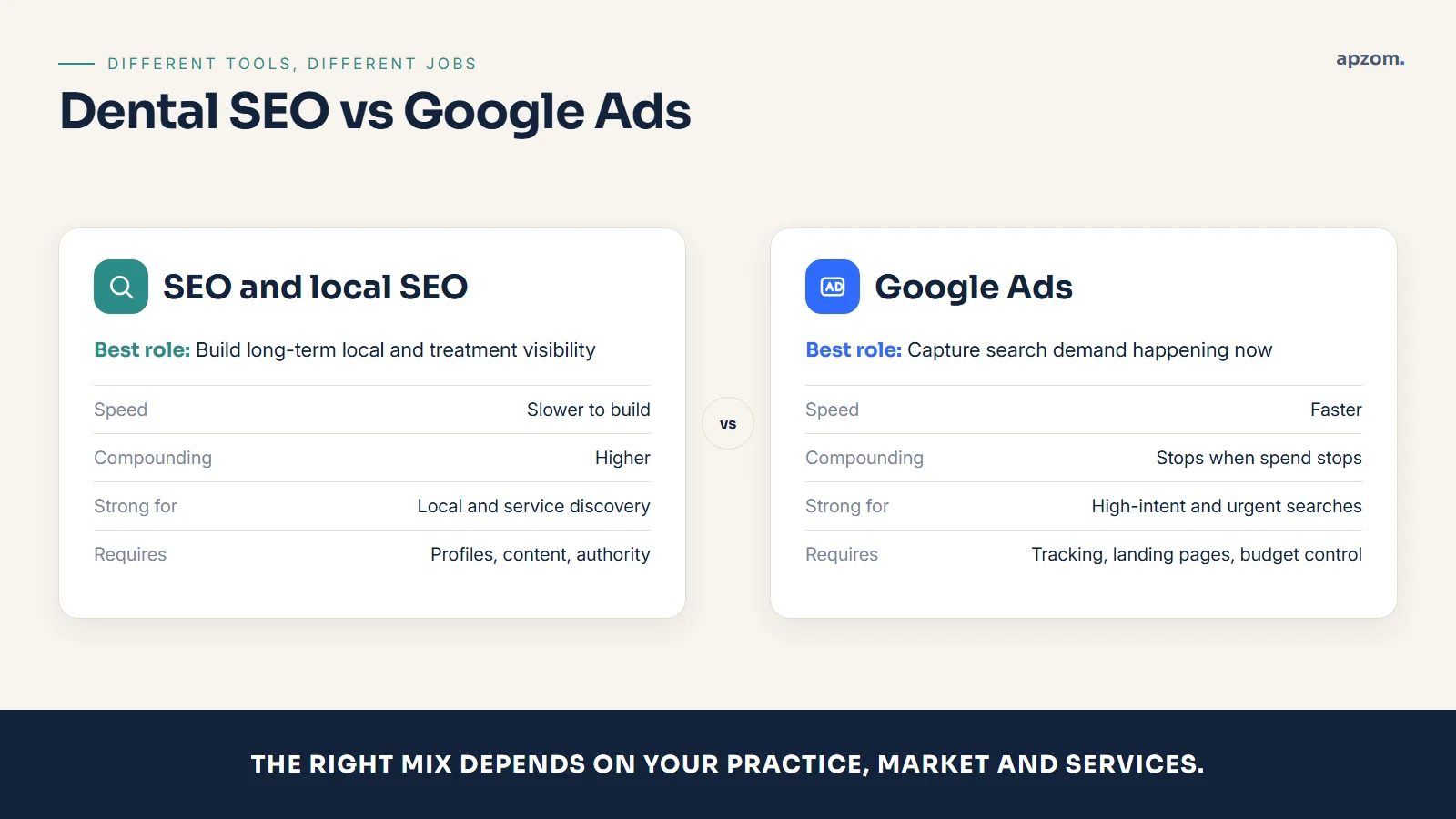
Neither is universally better. They do different jobs.
| Factor | Dental SEO and local SEO | Google Ads |
|---|---|---|
| Speed | Slower to build | Visible as soon as campaigns are approved |
| Compounding | Builds over time | Stops when spending stops |
| Cost model | Ongoing investment in content, pages and profiles | Paying for each click |
| Best use | Long-term local and treatment visibility | Immediate demand, launches, urgent care |
| Main risk | Slow or poor execution | Paying for clicks that never become patients |
| What it needs | Accurate profiles, strong pages, reviews, authority | Tracking, matching landing pages, budget control |
Many practices run both: ads to fill gaps while local and treatment visibility builds, then adjust spending as organic visibility grows. The mix depends on the practice, its market and the services it wants to grow.
Social media and Meta ads: familiarity, not pressure
Social media rarely produces a booking on its own, but it does something search cannot: it lets people see the practice and the team before they ever visit. For an anxious patient, that matters.
A healthier content mix than an endless stream of promotions and before-and-after photos:
- Meet the practice: dentists and team introductions, the building, what a first visit feels like.
- Education: non-diagnostic answers to common questions, reviewed by a dentist.
- Trust: qualifications, sterilisation and safety processes where the practice is comfortable showing them, the technology the practice actually uses.
- Community: local involvement and practice news.
- Short FAQ videos: a dentist answering the questions patients ask at the front desk.
Paid social needs the same care as paid search. Meta’s advertising standards do not allow ads that assert or imply knowledge of a person’s personal attributes, including their health, so copy such as “Embarrassed by your crooked teeth?” is both off-putting and likely to be rejected. Meta has also restricted the data that many health-related advertisers can share and the conversion events they can optimise for, so check what your own account allows in Events Manager before planning campaigns around detailed tracking.
Stage 2: Earn trust
Choosing a dentist is a decision about trust. Patients cannot judge clinical skill directly, so they look for signals that stand in for it.
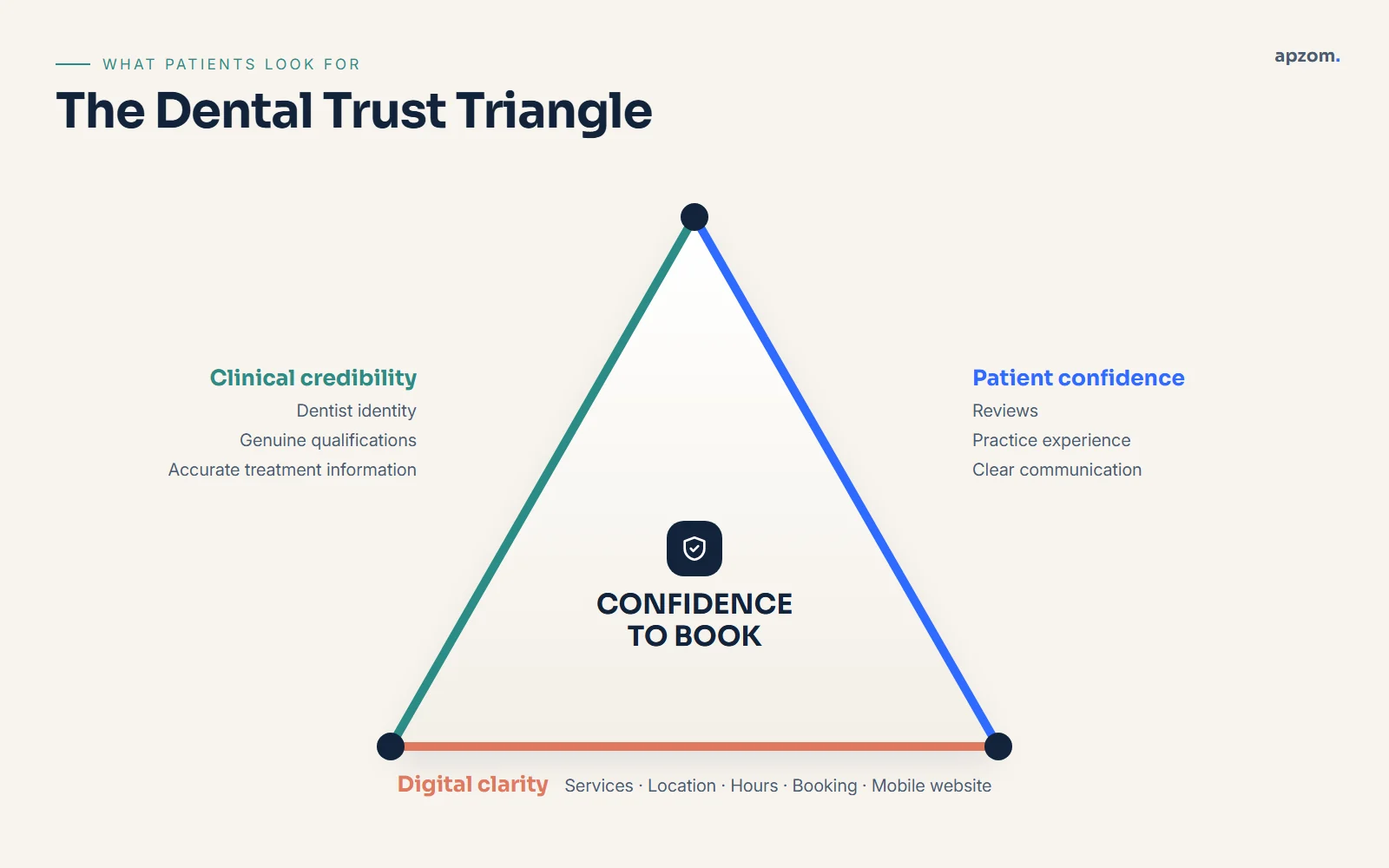
The Dental Trust Triangle
Three things work together to give someone the confidence to contact the practice.
Clinical credibility. Who the dentists are, their genuine qualifications and registration, the treatments each one provides, and treatment information that is accurate. In some countries this is a requirement as well as a trust signal: the GDC, for example, expects dental professionals’ qualifications and registration numbers to be shown on practice websites.
Patient confidence. Reviews, real photos of the practice and team, clear explanations of what happens at an appointment, and a tone that is calm rather than salesy. Nervous patients in particular look for reassurance that they will be treated kindly.
Digital clarity. The basics, easy to find on a phone: services, location, parking, hours, how to book, and payment or insurance information where the practice can publish it.
A practice with excellent dentists but an unclear website loses patients at the clarity stage. A beautiful website with no information about the dentists loses them at the credibility stage. The work is to strengthen whichever side is weakest.
Who writes and reviews dental content
Dental content falls under what search engines call “Your Money or Your Life” topics: information that can affect someone’s health. It deserves a higher standard than ordinary marketing copy.
A sensible model is to let marketers write the marketing and business content, and have a qualified dentist review anything clinical. Show the author and the clinical reviewer, with their genuine credentials and the date the content was last reviewed. Use reliable clinical sources. Update pages when the information or the practice’s approach changes, not just to change the date. Never let an SEO writer invent clinical claims to fill a page.
Patient photos, testimonials and before-and-after images
These are some of the most persuasive marketing assets a practice has, and some of the most regulated.
- Consent first. In the United States, the ADA advises that dentists should not post patient testimonials, photographs, radiographs or even names without written authorisation signed by the patient or guardian, and a full-face photo can be identifying even without a name. Other countries have their own consent and privacy rules.
- Testimonials may be restricted. In Australia, Ahpra’s interpretation of the National Law means testimonials that mention clinical aspects, such as symptoms, the treatment received or the outcome, cannot be used in advertising a regulated health service. A comment about friendly staff is treated differently from a comment about a treatment result.
- Results must not mislead. Before-and-after images should not imply that every patient will get the same result, and should be genuine, unedited and representative. The ADA Code describes statements likely to create unjustified expectations about results as misleading.
- Endorsements must be disclosed. If a reviewer, patient or influencer receives anything of value, disclosure may be required. In the US, the FTC’s rules and the ADA’s 2025 guidance on social media influencers both address this.
Make consent part of the content workflow: a written record of what each patient agreed to, for which uses, and when.
Stage 3: Get booked
What the website has to do in the first few seconds
A dental website is mostly visited on a phone, often by someone deciding between a few practices. Within seconds they should be able to see:
- Who the practice is and where it is.
- Which services it offers.
- When it is open.
- How to call, and a button that dials on a mobile.
- How to request or book an appointment.
- Who the dentists are.
Supporting information then answers the next questions: dentist profiles, reviews where the rules allow them, payment and insurance information, what to expect at a first visit, accessibility details and directions.
A clean structure helps both patients and search engines: Home, Dentists and team, Services or treatments, New patients, About, Reviews or patient stories where compliant, Location and contact, and Book an appointment. Groups add a genuine page for each location.
Booking forms: ask for less
A marketing contact form exists to start a conversation. It usually needs a name, a way to contact the person, a preferred time and perhaps the reason for the visit in broad terms. It does not need medical history.
A clinical intake form is different. If the practice needs health information before an appointment, that belongs in a secure intake workflow chosen for the job, not in a marketing form that may pass data to analytics or advertising tools. Keeping the two separate is one of the simplest ways to reduce privacy risk.
Speed, accessibility and honest design
Heavy video backgrounds, sliders, uncompressed images and a long list of tracking scripts all slow a site down on a phone, and slow sites lose impatient visitors. Prioritise a fast mobile experience, a stable layout that does not jump while loading, and calls to action that are easy to tap. Most conversion work on a dental site is removing small frictions like these rather than redesigning everything.
Accessibility is part of the same job. Readable text, enough contrast, proper headings, descriptive image text, forms that work with a keyboard and with screen readers: these help patients with disabilities, older patients and anyone using a phone outdoors. Treat it as patient experience, not an SEO tactic.
Avoid the dark patterns some agencies still use: fake countdown timers, “only one slot left” when it is not true, pop-ups that block the page, and fear-based messages about what happens if someone delays treatment. They may lift a number briefly, and they cost trust.
Stage 4: Turn enquiries into attended appointments
Marketing does not end when a form is submitted. This is where many practices lose the patients their marketing has already paid for, and where agencies that stop measuring at “leads” cannot see the problem.
The phone is still central
Many patients still prefer to call, especially for urgent problems or first visits. A campaign can be working perfectly and still fail if:
- Calls go unanswered at busy times or after hours.
- Callers wait too long or are put on hold repeatedly.
- The person answering is not sure which services or dentists the practice offers.
- A web enquiry waits a day for a reply.
- Booking requires several calls back and forth.
This is not a criticism of front-desk teams, who are usually juggling patients in the room and calls at the same time. It is a reason to align marketing with operations: campaigns timed to when calls can be answered, a clear process for web enquiries, call handling notes for each service being promoted, and a review of missed calls.
From booked to attended
Distinguish three numbers where the practice can measure them: requested, booked and attended. A gap between booked and attended is a no-show problem, and it is worth looking at before buying more traffic.
Appointment confirmations, directions, what to bring, and a reminder before the visit can help, as long as they follow the consent and communication rules that apply in the practice’s country. No system eliminates no-shows, and no honest agency should promise to.
Treatment conversations belong to the dentist and the patient
Some marketing talks about “case acceptance” as if it were a sales target. It is not. Treatment decisions should rest on clinical need and informed consent. Marketing can help by attracting patients who are a good fit for the practice, explaining treatments clearly and making it easy to ask questions. It should never pressure patients into treatment, create artificial urgency or use financing offers to rush a decision.
Stage 5: Build reputation and retention
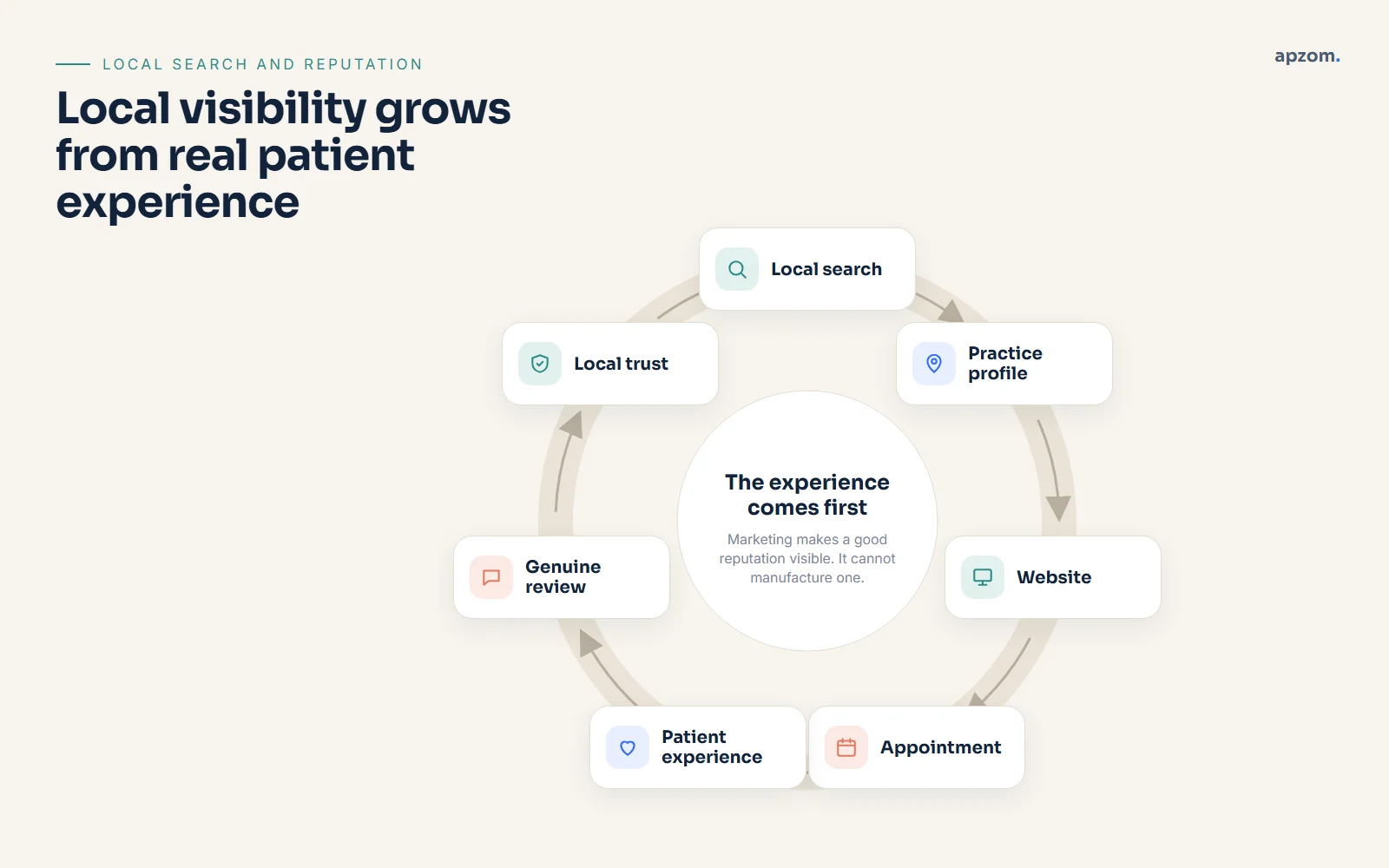
Experience, review, response, trust
A practice’s online reputation follows a simple sequence.
- Experience. What actually happens to the patient, from the first call to the follow-up.
- Review. Some patients choose to describe that experience publicly.
- Response. The practice replies, professionally and without revealing anything private.
- Trust. Future patients read both, and decide.
Marketing can make a good reputation more visible. It cannot sustainably manufacture one that the patient experience does not support.
Asking for reviews the right way
Google’s policies prohibit offering anything in exchange for reviews, including discounts or free services, and prohibit discouraging negative reviews or selectively asking only satisfied patients. In the United States, the FTC’s Consumer Reviews and Testimonials Rule also bans fake reviews, incentives that require a positive review, undisclosed reviews by staff or insiders, and threats or other tactics to suppress negative reviews.
A neutral system works better anyway: ask every patient in the same way, at a natural moment, with a simple link, and accept whatever they choose to write. Never offer “10% off whitening for a five-star review”, never ask staff to post reviews, and never filter requests so that only happy patients receive them.
Where testimonials are restricted, as in Australia, the practice should also consider how reviews are reused in its own advertising.
Responding without revealing anything
This is where dental practices differ most from other businesses, and where good intentions cause real problems.
In the United States, HHS has settled cases with dental practices over replies to online reviews. Elite Dental Associates in Dallas paid $10,000 in 2019 after responses on Yelp disclosed patients’ information, and New Vision Dental in California paid $23,000 after replies included patient names and details of their visits and insurance. The ADA’s guidance is direct: do not confirm that a reviewer is a patient, even if they say so themselves, and even when the review is positive.
So instead of “Thank you for trusting us with your root canal last Tuesday”, a safer reply looks like:
- For a positive review: “Thank you for taking the time to share this.”
- For a negative review: “We take all feedback seriously and want everyone to have a good experience with us. Please call the practice on [number] so we can talk this through.”
Write the reply for future patients reading it, not as a conversation with the reviewer. Take any detail offline. If a review is false or breaks the platform’s rules, use the platform’s reporting process rather than arguing in public.
Retention and recall
A new patient is valuable because of the relationship that can follow. Recall reminders, check-up scheduling, useful follow-up and a good experience at every visit keep patients coming back and give them reasons to recommend the practice. Recall and marketing messages need to follow consent and communication rules, which differ between countries and between appointment reminders and promotional messages.
Stage 6: Measure what actually grows the practice
From search to patient
Most dental marketing reports stop at traffic, clicks or leads. The useful question is what happened next.
Search, referral or ad → practice evaluation → call or appointment request → booked appointment → attended appointment → new patient → ongoing patient relationship
Not every patient should go on to a particular treatment, and a report should never treat treatment as the goal of marketing. Clinical decisions belong to the dentist and patient.
The Patient Acquisition Scorecard
Group measurement into five layers, so a report shows where the chain is strong and where it breaks.
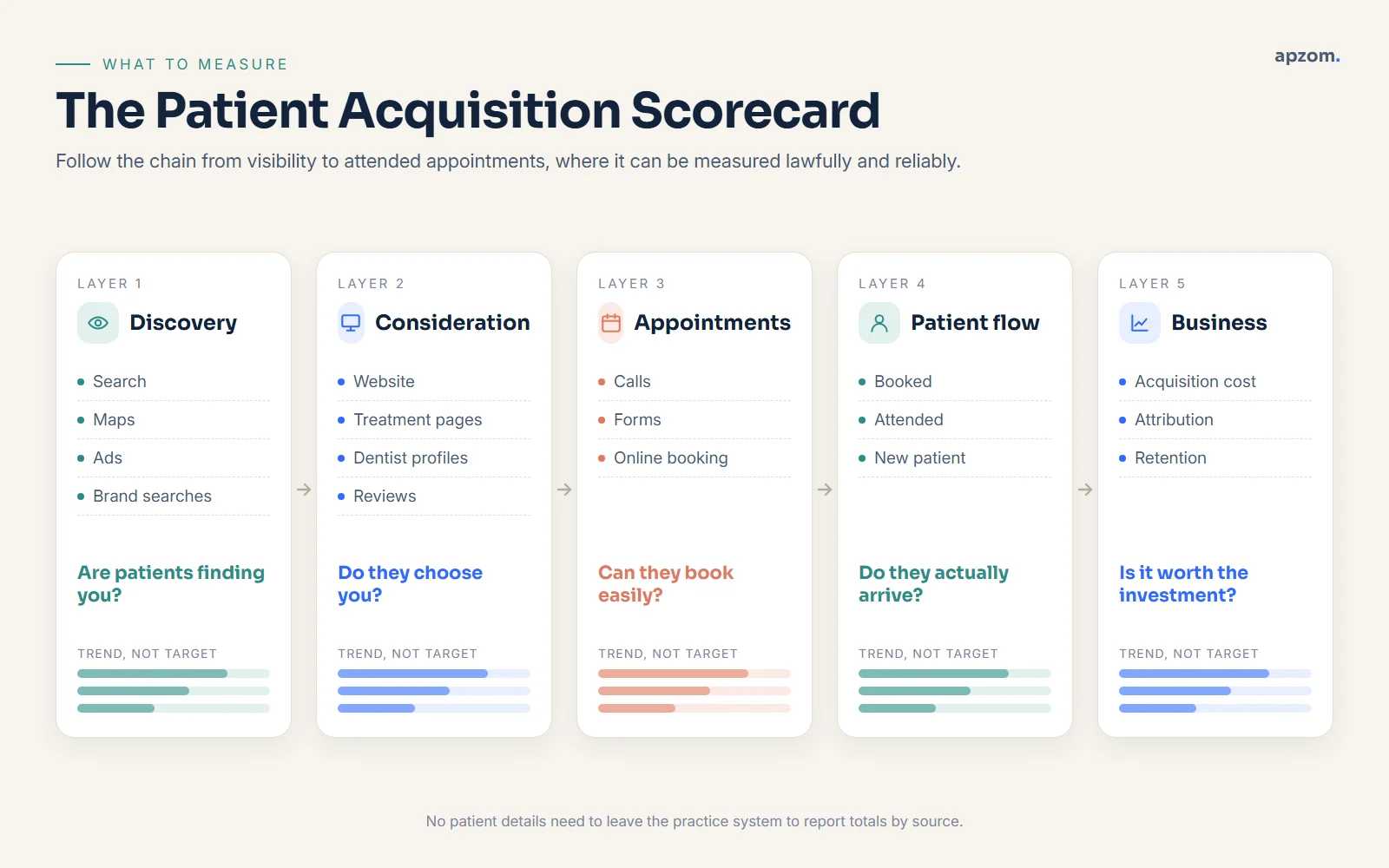
| Layer | What to look at |
|---|---|
| Discovery | Organic visibility, Maps visibility, paid search visibility, searches for the practice name |
| Consideration | Treatment page and dentist profile engagement, clicks for directions, visits to the booking page |
| Appointments | Phone enquiries, appointment requests, booked appointments |
| Patient flow | Attended appointments and new patients by source, where they can be lawfully and reliably measured |
| Business | Acquisition cost, revenue that can reasonably be attributed to marketing, retention trends, where privacy-safe |
Attribution does not require sending patient data to advertising platforms. Many practices can count booked and attended appointments by source inside their practice management system, and report totals, without any individual’s details leaving it.
Privacy-first tracking
This is the part most dental marketing advice leaves out.
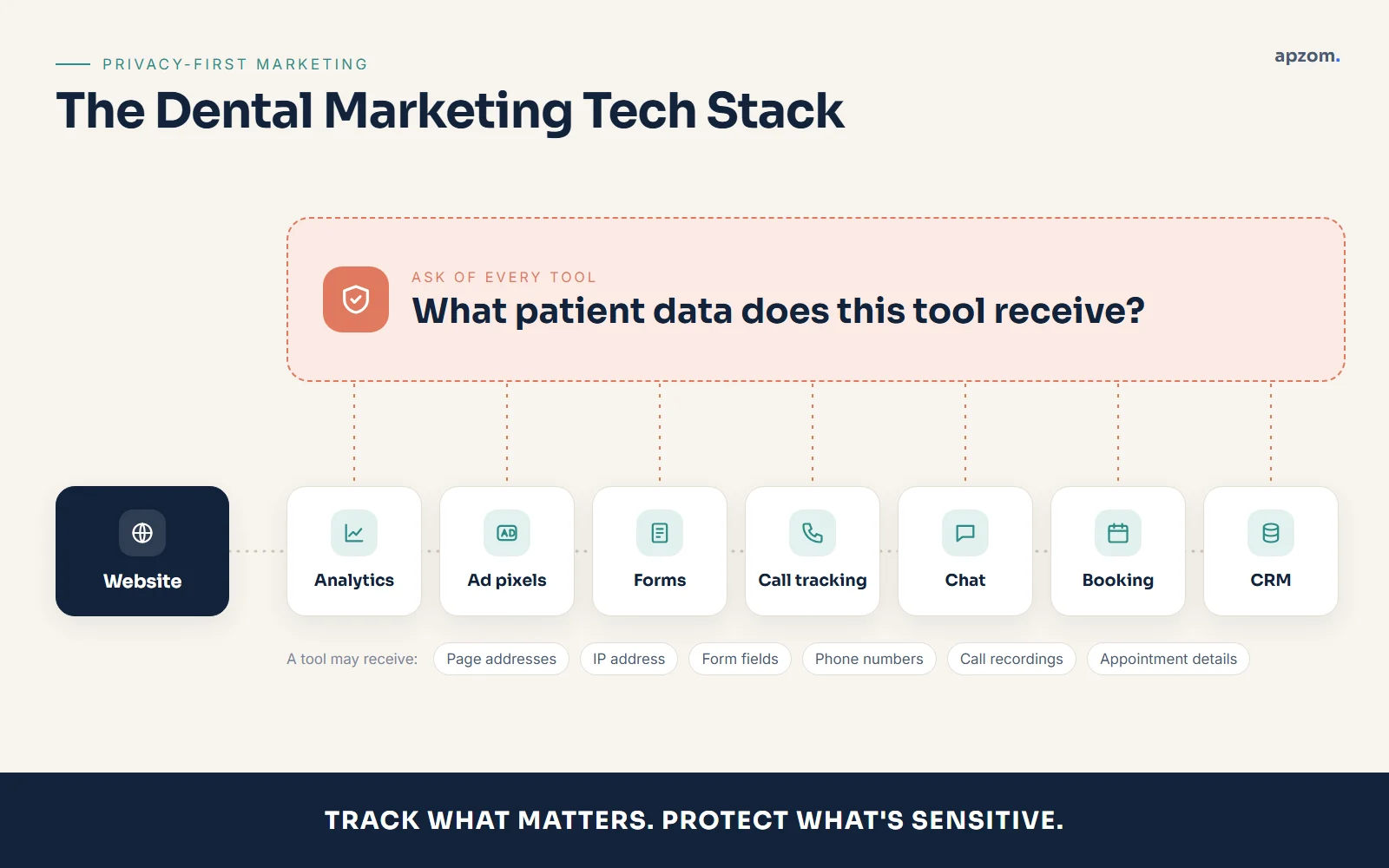
Analytics, ad pixels, session recording, call tracking, chat widgets, booking tools, forms, CRMs and email or SMS platforms each receive data from the website. Before adding or keeping any of them, ask one question: what patient data does this tool receive? A pixel on a blog post is a different risk from a pixel on an appointment confirmation page.
In the United States, it helps to be precise about HIPAA. HHS lists dentists as health care providers who are covered entities, but only if they transmit health information electronically in connection with certain standard transactions, such as electronic insurance claims. Many practices meet that test; not every one does. State privacy laws can apply regardless.
For practices that are covered, the HHS Office for Civil Rights has published guidance on online tracking technologies. In June 2024, a federal court in *American Hospital Association v. Becerra* vacated part of that guidance: the part saying HIPAA is triggered when a tracking tool connects someone’s IP address with a visit to an unauthenticated public webpage about health conditions or providers. The rest of the bulletin remains, including its position that where tracking tools receive protected health information, for example through appointment booking or patient portals, the practice must ensure the disclosure is permitted and have a business associate agreement with the vendor.
So “Google Analytics breaks HIPAA” is too simple, and so is “public website tracking is fine”. A sensible review covers:
- Which pages each tool runs on, and whether any of them involve logins, booking or health information.
- What each tool collects and where it sends it.
- Whether a vendor would be a business associate, and whether it will sign an agreement.
- Consent requirements, including state privacy laws and cookie rules outside the US.
- Whether a simpler, privacy-safe setup would answer the same business question.
Qualified privacy or legal advice is worth having for anything uncertain. A marketing agency can map the tools and the data flows, and should say so when a question needs a lawyer.
Call tracking without surprises
Call tracking shows which campaigns produce calls, which is valuable for dental marketing because so many bookings start with a phone call. If calls are recorded, though, recording consent laws apply, and those laws vary between countries and between US states. Recordings can also contain health information. Review the vendor’s contract and data handling, tell callers when calls are recorded, and limit who can listen. Never record calls secretly.
AEO and AI search for dental practices
AEO, answer engine optimisation, means writing useful answers clearly enough that search engines and answer systems can understand and use them. Questions such as “how do I book an emergency appointment here?”, “what happens at my first visit?”, “which dentists here provide implants?” or “do you accept my insurance?” deserve a short, direct answer on the right page, followed by detail and a clear next step. Clinical questions need answers a dentist has reviewed.
GEO, generative engine optimisation, applies the same thinking to AI assistants and AI-generated search answers. Nobody can guarantee that ChatGPT, Gemini or Google’s AI Overviews will mention a practice. What a practice can do is make its information easy to understand and consistent everywhere:
- One clear identity for the practice, its locations and its dentists.
- Each dentist’s genuine qualifications and the services they provide.
- Accurate services, hours, location and contact details, matching the Business Profile.
- Genuine reviews and a good reputation across the places patients look.
- Original first-party information: dentist-written explanations, the practice’s actual appointment process, real photos and videos, the technology actually used, genuine patient questions, accessibility details and payment information.
That last point is the real advantage. Generic dental articles are everywhere. A practice explaining its own process, in its own dentists’ words, is something no competitor can copy.
Structured data for a dental practice website
Structured data can help search engines connect a practice’s information: the practice, each location, its dentists, its services and its contact details. Which types fit depends on the actual business, and every detail must be accurate. Never mark up ratings or reviews that do not meet the platform’s rules, and never invent a credential, speciality or address.
Marketing differs by type of practice
| Practice type | Typical search behaviour | Content that helps | Usual conversion |
|---|---|---|---|
| General dentistry | Local, routine care | Practice information, services, what to expect | Appointment |
| Cosmetic dentistry | Treatment research over time | Clear treatment explanations, realistic expectations, consented images | Consultation |
| Implant dentistry | High-consideration decision | Dentist expertise, process, costs and payment where publishable | Consultation |
| Orthodontics | Comparing options and providers | Treatment options, process, FAQs, parent information | Consultation |
| Paediatric dentistry | Parents searching locally | Child-friendly approach, first visit, team | Appointment |
| Emergency dentistry | Urgent, local, now | Availability, location, how to get seen | Phone call |
| Specialist practices | Often referral plus research | Referral information, specialist credentials, process | Referral or consultation |
Only market a dentist as a specialist where they are legitimately entitled to use that title in the relevant jurisdiction. In the UK, for example, the GDC warns against titles that imply specialist status a professional does not hold.
Build content around patient journeys
Instead of publishing a stream of generic dental blogs, organise content into a few clusters patients actually use: choosing a dentist and practice information; treatment education, written or reviewed by a dentist; local questions such as parking and access; preventive education based on reputable clinical sources; and appointment questions such as what to bring and how payment works. A small number of excellent pages beats hundreds of thin articles written only for search.
The jobs each channel does
| Channel | Its job |
|---|---|
| Local SEO | Be found by people near the practice |
| Organic SEO | Answer treatment and service research |
| Google Ads | Capture search demand happening now |
| Reviews | Reduce doubt before someone contacts you |
| Website and conversion | Turn visits into calls and appointment requests |
| Content and video | Explain and reassure |
| Social media | Build familiarity with the team and practice |
| Follow-up and CRM | Make sure genuine enquiries are not lost |
| Analytics | Show which activity produces attended appointments |
How to choose a dental marketing agency
Questions worth asking any agency, including us:
- How will you find out which stage of our patient journey is limiting growth before you recommend services?
- What will you report: clicks and leads, or booked and attended appointments where we can measure them?
- Who writes clinical content, and who reviews it?
- How do you handle Google reviews, testimonials and patient images under the rules that apply to us?
- Which tracking tools will you add, what data will each receive, and how do you approach healthcare privacy?
- Will we own our website, Business Profile, ad accounts and data?
- What happens to our accounts if we stop working together?
Be cautious of guarantees of a fixed number of new patients, guaranteed rankings, paid or “managed” review schemes, long contracts before any results are visible, and reports that never go beyond traffic.
How Apzom can help
Apzom Digital is a digital marketing agency covering SEO, local SEO, Google Ads, Meta and social media, content, website development, conversion rate optimisation, and answer engine and generative engine optimisation. We are not a dental practice and we do not give clinical, legal or HIPAA compliance advice. What we do is look at the whole patient journey and tell you honestly where the gaps are.
Request a dental digital growth audit
A dental growth audit from Apzom reviews:
- Your visibility in Google Search and Maps, and the accuracy of your Business Profile.
- Your treatment and service pages, and whether any compete with each other.
- How you compare with the practices patients see alongside you.
- Your reviews and how you respond to them.
- Your Google Ads setup and tracking, if you advertise.
- How easily a visitor on a phone can call or book.
- Your appointment funnel, from enquiry to booked appointment.
- Your tracking tools, including the areas that should be checked by a qualified privacy or legal professional.
- Your readiness for answer engines and AI search, and the content gaps worth filling.
You will get a clear view of what to fix first, and a realistic view of what it would take. Request your free growth audit, or see how we approach search in our SEO methodology.
Frequently asked questions
What does a digital marketing agency for dentists do?
It helps a practice get found, look trustworthy, make booking easy and measure which activity produces booked and attended appointments. That usually involves local SEO, the Google Business Profile, treatment pages, paid search, social media, reviews, website conversion and tracking, all within the healthcare advertising and privacy rules that apply.
Is SEO worth it for dentists?
For most practices, yes, because many new patients start with a local search. SEO takes longer than advertising to build, but accurate profiles, strong treatment pages and genuine reviews keep working after the effort has been made. It is weakest when it is generic, inaccurate or disconnected from how the practice takes bookings.
Should dentists use Google Ads?
Often, for specific jobs: emergency appointments, new practices, new locations or treatments the practice wants to grow. Ads work best with tight local targeting, matching landing pages and tracking that goes beyond clicks. Health-related advertising has targeting restrictions, so check current policy for the service and country.
How can a dental practice get more genuine Google reviews?
Ask every patient in the same neutral way, at a natural moment, with a simple link. Do not offer discounts or gifts for reviews, do not ask only patients you think are happy, and never post reviews yourself or ask staff to. These practices break Google’s policies, and in the US the FTC’s rules prohibit several of them.
How should a dental practice respond to online reviews?
Briefly, politely and without confirming that the reviewer is a patient. Do not mention treatment, visits or any personal detail, even in reply to a positive review. Invite the person to contact the practice privately. In the US, HHS has fined dental practices for disclosing patient information in review replies.
Can dentists use patient photos and testimonials in marketing?
Sometimes, depending on the country and the consent obtained. In the US, written authorisation is advised before posting identifiable patient information, photos or testimonials. In Australia, testimonials about clinical aspects of treatment cannot be used in advertising. Images should never imply that every patient will get the same result.
What should a dental marketing agency measure?
More than traffic and leads. Useful reporting follows the chain from visibility to calls and appointment requests, then to booked and attended appointments and new patients by source, where the practice can measure these lawfully. Acquisition cost and retention trends complete the picture.
What are AEO and GEO for dentists?
AEO means making useful answers clear enough for search engines and answer systems to understand. GEO applies the same idea to AI assistants and AI search. For a practice, both come down to accurate, consistent information about the practice, its dentists and services, plus original first-party content. No one can guarantee AI recommendations.
How do I choose a dental digital marketing agency?
Look for an agency that diagnoses before it sells, reports on appointments rather than clicks, has clinical content reviewed by dentists, understands review and privacy rules, and leaves you owning your accounts and data. Avoid guarantees of patient numbers or rankings.
Sources
Rules and policies change. These are the primary sources behind the regulatory and platform statements in this guide, checked in October 2026.
- Google Business Profile Help: Guidelines for representing your business on Google (business names, virtual offices, categories, individual practitioners).
- Google Maps user-contributed content policy: Fake engagement (incentivised reviews, selective solicitation).
- Google Ads policy: Personalized advertising, health as a sensitive interest category.
- Meta Advertising Standards: Personal attributes; Meta Business Help Centre and Events Manager for health-related data restrictions.
- US Federal Trade Commission: Consumer Reviews and Testimonials Rule, 16 CFR Part 465, effective 21 October 2024.
- US Department of Health and Human Services: Covered Entities and Business Associates; Use of Online Tracking Technologies by HIPAA Covered Entities and Business Associates, with the notice on American Hospital Association v. Becerra (N.D. Tex., 20 June 2024).
- HHS Office for Civil Rights resolution agreements: Elite Dental Associates (2019) and New Vision Dental (2022).
- American Dental Association: Principles of Ethics and Code of Professional Conduct, section 5.F (Advertising) and advisory opinions; ADA guidance on managing online reviews and on patient privacy and social media; ADA News, February 2025, on social media influencers.
- General Dental Council (UK): Guidance on advertising.
- Ahpra and the National Boards (Australia): Guidelines for advertising a regulated health service; testimonial guidance under section 133 of the National Law.
- Dental Council of India: Revised Dentists (Code of Ethics) Regulations, 2014, clause 8.