
Most real estate businesses in India do not have a lead problem. They have a leads-that-go-nowhere problem. Campaigns produce names and phone numbers, the sales team calls, some numbers never pick up, others were “just checking”, and at the end of the month nobody can say which rupee of marketing spend produced the three bookings that actually happened.
This guide is written for the people who live with that problem: developers and builders, marketing heads running project launches, brokers, channel partners and independent property consultants. It covers search, Google Business Profile, the property portals, Google Ads, Meta, YouTube, WhatsApp, CRM and measurement, along with the rules that shape property marketing here: RERA and its state authorities, consumer advertising guidelines, TRAI’s commercial communication rules and the Digital Personal Data Protection framework.
The thread running through all of it is simple. Marketing for Indian real estate should be judged by qualified conversations, site visits and bookings, not by impressions or raw form fills.
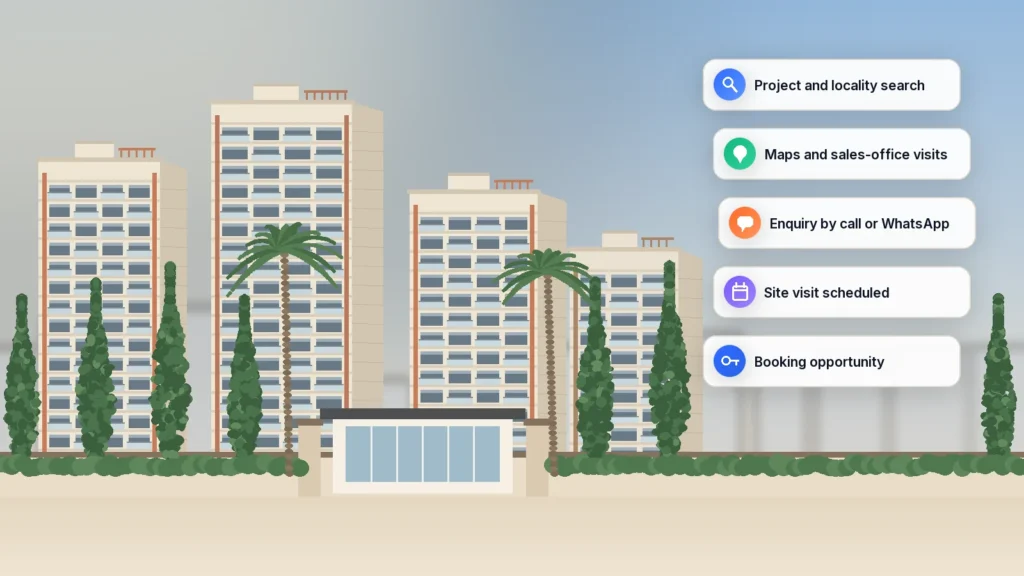
The short answer
What does a real estate digital marketing agency in India actually do? A good one builds and runs the system that takes a buyer from first search to site visit: visibility on Google, Maps and the portals, paid campaigns on Google and Meta, project and locality pages that convert, fast handoff to calls and WhatsApp, CRM tracking, and reporting that follows each lead as far down the funnel as the data allows. It works inside RERA’s advertising requirements rather than around them.
What it should not do is sell you a lead count. A lead count with no link to site visits and bookings tells you very little about whether the money was well spent.
More leads is the wrong brief
Ask most property businesses what they want from marketing and the answer is “more leads”. It is an understandable answer and usually the wrong target, because a lead in Indian real estate is only the start of a long, human process.
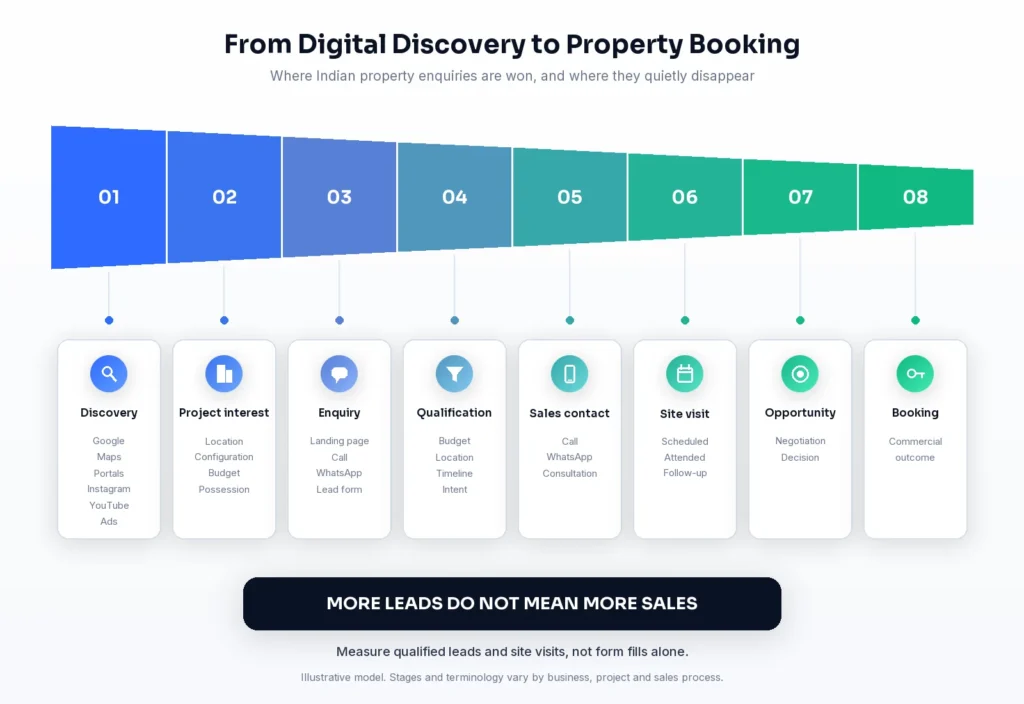
A useful way to look at the whole journey:
Visibility → Project interest → Enquiry → Qualification → Call or WhatsApp → Site visit → Sales opportunity → Booking → Transaction
For a developer selling one or more projects, the working version is shorter:
Awareness → Lead → Qualification → Site visit → Follow-up → Booking
Every stage loses people, and that is normal. What matters is where you lose them and why. If most leads never answer the first call, the issue may be targeting, lead-form design, or simply that nobody called for six hours. If plenty of people are qualified but few visit the site, the problem may be the offer, the location, the follow-up, or that the sales team books visits without confirming them. If visits are healthy but bookings are not, marketing may be doing its job and the gap is elsewhere: pricing, inventory, the site experience, or the closing conversation.
None of this is visible if the only number anyone reports is cost per lead. A cheap lead that never becomes a conversation is not cheap. That is why this guide keeps coming back to three measures: qualified leads, site visits and bookings.
Four businesses, four different marketing problems
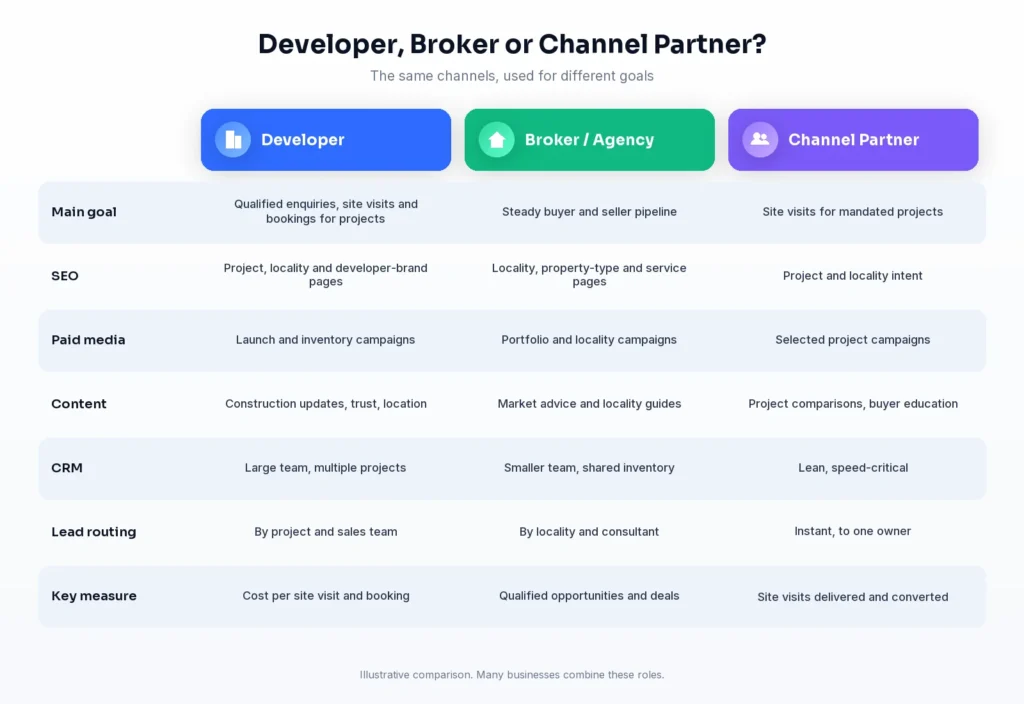
“Real estate marketing” covers very different businesses in India, and a plan that suits a large developer can be wrong for a two-person brokerage in the same city.
Developers and builders are selling specific projects with fixed inventory, timelines and sales targets. Marketing has to create awareness around a launch, produce qualified enquiries, fill site-visit slots, and keep inventory moving across configurations. Brand trust matters a great deal, because a buyer is often committing to something that is still under construction.
Brokers and property consultancies usually sell across many projects and resale properties. Their assets are local knowledge, inventory access, a reputation in specific micro-markets and a database of past buyers. Their marketing is closer to a local service business than a product launch.
Channel partners sit between the two. They sell registered projects on behalf of developers, often competing with the developer’s own marketing and with other channel partners for the same buyers. Speed of response and the quality of the conversation decide who gets the site visit.
Individual property consultants live on personal brand, referrals and repeat business. For them, a strong Google Business Profile, a clear personal presence and a looked-after contact list often matter more than an ad budget.
| Area | Developer / builder | Broker / consultancy | Channel partner | Individual consultant |
|---|---|---|---|---|
| Main goal | Qualified enquiries, site visits and bookings for specific projects | Steady buyer and seller pipeline across inventory | Qualified leads and site visits for mandated projects | Direct enquiries, referrals and repeat clients |
| Brand to build | Developer name plus each project | Agency name and its consultants | Personal or firm name, alongside the projects | Personal name and local reputation |
| SEO focus | Corporate site, project pages, locality and property-type pages | Locality, property-type and service pages | Project and locality intent, within what the developer allows | Local and personal-brand searches |
| Paid media | Project campaigns around launches and inventory | Portfolio and locality campaigns | Selected project campaigns, often competing with the developer | Small, tightly local campaigns, if any |
| CRM need | Large sales team, routing across projects, site-visit scheduling | Smaller team, lead assignment by locality | Fast assignment and follow-up | Simple, disciplined contact list |
| Key measure | Cost per qualified lead, per site visit, per booking | Qualified opportunities and closed deals | Site visits delivered and converted | Enquiries, referrals and closures |
| Content | Project detail, construction progress, trust and location | Market advice, locality guides, inventory | Project comparisons and buyer education | Local expertise and personal credibility |
Commercial property is a different sale
Office, retail and warehouse space involve different decision-makers, longer cycles and far fewer transactions. A company leasing an office floor is not searching like a family looking for a 3 BHK. Searches are more specific, enquiries come through relationships and consultants as much as through Google, and a single qualified conversation can be worth more than a month of residential leads. Commercial campaigns should be judged on meetings and proposals, not on form volume.
RERA comes before the first advertisement
No agency should treat this as an afterthought, and it is where a lot of generic advice goes wrong.
Section 3 of the Real Estate (Regulation and Development) Act, 2016 says that a promoter shall not “advertise, market, book, sell or offer for sale, or invite persons to purchase in any manner” any plot, apartment or building in a real estate project that needs registration, without first registering that project with the Real Estate Regulatory Authority. The Act defines “advertisement” broadly, as any document or publicity “through any medium” that informs people about a project or invites them to buy. Digital campaigns, landing pages, social posts and WhatsApp creatives are not a loophole.
There are exemptions. Under Section 3(2), registration is not required where the land does not exceed 500 square metres or the project has no more than eight apartments across all phases, though the appropriate Government can lower those thresholds. Projects that received a completion certificate before the Act commenced, and renovation or redevelopment that involves no marketing or new allotment, are also exempt. The Act treats each phase of a phased project as a separate project needing its own registration, which matters when a developer wants to advertise “Phase 2” on the back of Phase 1’s registration.
Once a project is registered, Section 11(2) applies. It requires that an advertisement or prospectus issued by the promoter “shall mention prominently the website address of the Authority” where the project’s details are entered, and include the registration number obtained from the Authority.
Two further points in the Act matter to marketers. Real estate agents, which in practice includes brokers and channel partners, must themselves register with the authority under Section 9, and Section 10 says a registered agent must not facilitate the sale of a project that is not registered. The same section prohibits agents from false or misleading representations about their services, or claiming an approval or affiliation they do not have. And Section 12 gives buyers a right to compensation from the promoter if they make an advance or deposit relying on an incorrect or false statement in an advertisement, prospectus or model apartment.
The penalties are not small. A promoter who breaches Section 3 can face a penalty of up to 10% of the estimated cost of the project; other contraventions by a promoter carry up to 5%; and agents who breach Sections 9 or 10 face ₹10,000 a day, up to 5% of the cost of the property involved. (Source: the Real Estate (Regulation and Development) Act, 2016, Sections 2, 3, 9, 10, 11, 12, 59, 61 and 62.)
One Act, many authorities
RERA is central legislation, but each state and union territory runs its own authority, with its own rules, orders, portals and formats. Some have gone well beyond the Act on advertising.
Maharashtra is the best-known example. MahaRERA has required a project QR code in advertisements since 2023, and its Order No. 46C/2025, dated 8 April 2025, set norms for the QR code and for the font size of the MahaRERA registration number and website address in advertisements. Summaries of that order describe the registration details and QR code being placed in the top-right area of the advertisement, in a font at least as large as the project’s contact details, across print, digital and social media. Gujarat’s authority issued its own order in 2025 (reported as Order No. 108, effective from 15 June 2025) requiring the registration number, the GujRERA website and a QR code in project advertisements, with its own placement rules.
The mistake to avoid is treating one state’s order as a national rule. A QR code requirement from MahaRERA does not automatically apply to a project in Karnataka, and a creative template built for a Pune project may not satisfy Gujarat’s format. Before a campaign goes live, someone should check the current orders of the authority where the project is registered: MahaRERA, GujRERA, UP RERA, K-RERA, HRERA, TNRERA, TG RERA or whichever applies. Authorities issue new orders, so a check made last year is not enough.
A pre-flight check for every property creative
This is not legal advice, and a developer with any doubt should take advice from a qualified professional or the relevant authority. But in practice, every advertisement, landing page, brochure and social creative for a registered project should be checked for:
- The correct registration number for that project, and that phase, shown as the state authority requires
- The authority’s website address, and a QR code where the state requires one
- Claims about price, possession date, carpet area and configuration that match the registered details and the actual offer
- Amenities, approvals and connectivity described as they are, not as they might one day be
- Images and renders that are clearly representative where they are not photographs of the actual project
- Offers and discounts that are real, with the conditions stated clearly
- Testimonials and influencer content that are genuine and disclosed as promotion
The operational fix is dull but effective: a sign-off step, owned by someone who knows the project’s registration details, that every creative passes before it is published. Agencies should build that step into the workflow rather than leaving it to whoever is uploading the ad at 11 pm before launch.
Misleading advertising is a separate rulebook
RERA is not the only framework. The Central Consumer Protection Authority’s Guidelines for Prevention of Misleading Advertisements and Endorsements for Misleading Advertisements, 2022, apply to advertising generally, including property. They were announced by the Department of Consumer Affairs in June 2022.
In plain terms, an advertisement should be accurate, should not exaggerate, should be backed by evidence, and should not use a disclaimer to contradict the main claim. Endorsements should reflect the endorser’s genuine and current opinion. The penalty for a misleading advertisement can reach ₹10 lakh, and up to ₹50 lakh for later contraventions. (Source: Department of Consumer Affairs press release on the 2022 guidelines.)
For property marketing, that rules out a familiar set of tactics:
- “Only 3 units left” when there are thirty
- “Sold out” messaging used to create pressure on a phase that is not sold out
- “Guaranteed returns” or rental-yield promises that cannot be backed up
- “5 minutes from the airport” when that is true only at 3 am
- A “limited-period” price that never changes
- Influencer posts or testimonials that are paid for and not disclosed
None of these helps a serious developer anyway. Buyers compare notes, visit the site and talk to people who already booked. An advertisement that overpromises tends to produce visits that end badly, and complaints that last longer than the campaign.
How Indian buyers actually find a project
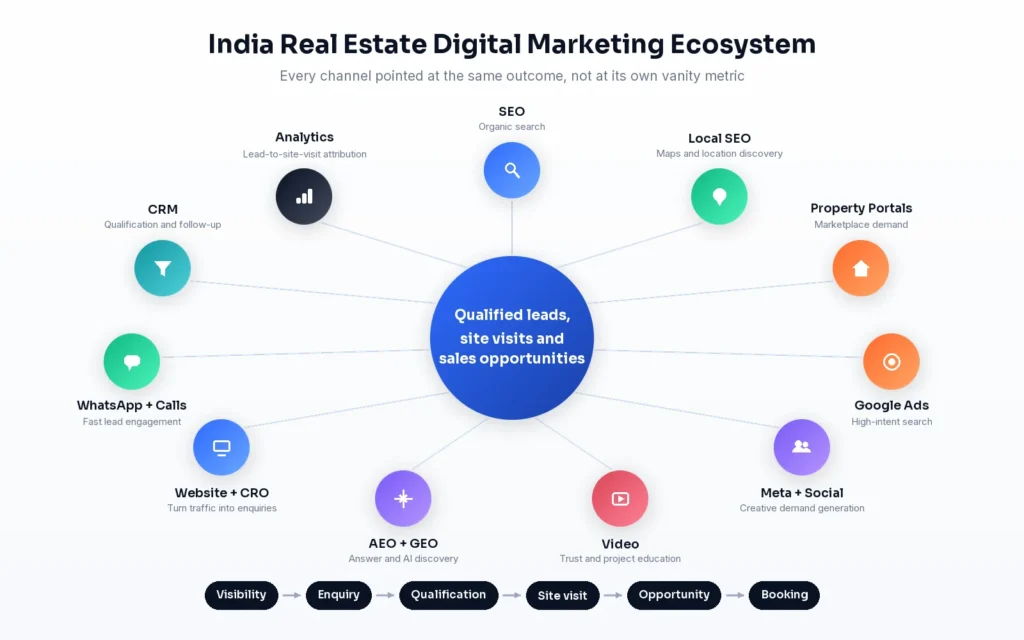
Nobody finds a flat through one channel. A typical buyer might see a Reel about a new launch, search the project name on Google, check it on a portal, look up the developer’s past projects, open the location on Maps, watch a walkthrough on YouTube, ask a relative, and only then leave a number. Each touchpoint does a different job, and a weak one can undo the rest.
We call this the India property discovery stack:
| Layer | Its job | What goes wrong |
|---|---|---|
| Google Search | Captures people actively looking for a project, locality or property type | Project pages that are thin, slow or missing key facts |
| Google Maps | Shows location, connectivity and the sales office | Unverified or duplicate listings, wrong pins, no reviews |
| Property portals | Puts inventory in front of active buyers comparing options | Outdated listings, inconsistent prices, no follow-up process |
| YouTube | Walkthroughs, site progress, location tours, buyer questions | Glossy videos that answer nothing buyers actually ask |
| Instagram and Facebook | Creates awareness and familiarity, especially around launches | Chasing reach and cheap leads with no quality check |
| Paid media | Adds speed and control around specific projects and localities | Broad targeting sent to a generic homepage |
| Website and landing pages | The owned place where interest becomes an enquiry | Forms that ask too much or too little, no RERA details |
| WhatsApp and calls | The first human conversation | Slow response, no context, nobody owns the lead |
| CRM | Holds every lead, its source and its outcome | Leads kept in personal phones and spreadsheets |
| Sales team | Qualifies, books and runs the site visit | No feedback to marketing on lead quality |
The last three rows are where many campaigns fail, and they are rarely what a marketing agency is asked about. They should be.
Portal demand, paid demand and owned demand
Property portals such as 99acres, Magicbricks, Housing.com and NoBroker (the last built largely around owner listings and rentals) are part of how Indians search for property. Telling a developer to stop using them and “just do SEO” is poor advice. The better question is how much of your pipeline depends on each type of demand.
Portal demand comes from marketplaces. The advantage is an existing audience of people already comparing properties. The limitation is that you share that audience with every competing project on the same page, and the relationship with the buyer starts on someone else’s platform, under someone else’s rules.
Paid demand comes from Google Ads, Meta and similar platforms. It is fast, controllable and can be switched on around a launch or a specific locality. It stops the day the budget stops, and poor targeting or weak landing pages can waste a great deal of money quickly.
Owned demand is what you build yourself: the website, search visibility, your Google Business Profile, branded search, content, organic social, reviews, your database and first-party audiences. It is slower. It also compounds, and it is the only one of the three that is still there when a campaign ends or a portal changes its pricing.
The three work best together. A launch might use portals and paid media for immediate reach, while the project pages, locality content and reviews built at the same time keep producing enquiries long after the launch budget is spent. The risk to watch is dependence: if nearly all qualified leads come from one portal or one ad platform, the business is renting its pipeline.
SEO, Google Ads, Meta and the portals compared
There is no single best channel. Each does something different.
| What to compare | SEO | Google Ads | Meta and social | Property portals |
|---|---|---|---|---|
| Main role | Build owned search visibility | Capture people searching now | Create and nurture demand with creative | Reach active marketplace buyers |
| Speed | Slow to build | Fast | Fast | Immediate |
| Buyer intent | Varies, often high on project and locality searches | High, if keywords are chosen well | Lower at first, built through creative | High, but spread across competitors |
| Compounding value | High | None once spend stops | Low, though brand familiarity lasts | Low |
| Control | Moderate | High | High | Limited to the portal’s options |
| Best use | Project, developer, locality and property-type searches | Launches, projects, localities, ready-to-move searches | Launches, video, location story, retargeting where allowed | Inventory exposure and comparison shoppers |
| Main limitation | Takes months; needs real content | Costs rise with competition; stops when budget stops | Cheap leads can be low intent | Competing listings on the same page |
| Useful measure | Qualified enquiries from organic search | Cost per qualified lead and per site visit | Qualified rate and site visits, not cost per lead | Response rate and site visits per listing |
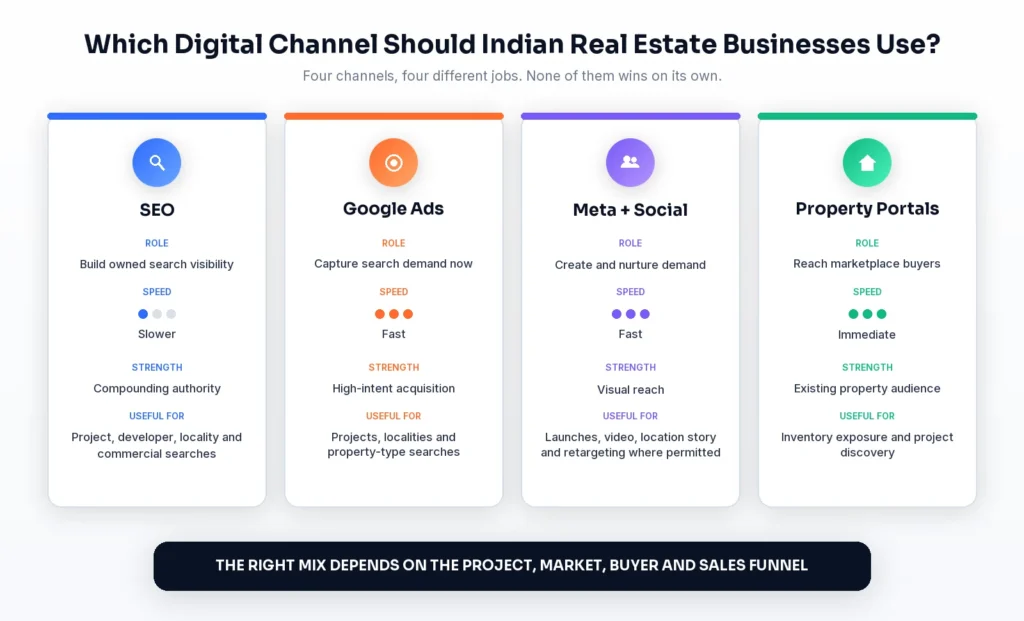
In practice, a developer launching a project in a competitive metro might lean on Google Ads, Meta and portals for the first weeks while project and locality pages start to rank. A broker in a smaller city with limited ad competition might get further from local search, reviews and a well-kept WhatsApp list than from any paid campaign. The right mix depends on the project, the market, the buyer and how good the sales process is at the other end.
Search in India runs from city to configuration
Property searches in India tend to narrow in a recognisable order:
Country → City → Micro-market → Locality → Project or developer → Property type → Configuration → Budget or intent
A buyer in Ahmedabad might move from “flats in Ahmedabad” to SG Highway, to a named project, to 3 BHK, to a budget. In Bengaluru, it might be Whitefield, apartments, ready-to-move. Each step is a different search, and a site that only has a homepage and a “Projects” page is invisible for most of them.
This is not an argument for publishing hundreds of pages with city names swapped in. Google’s spam policies treat doorway pages and scaled content that adds nothing as manipulation, and buyers can spot a template page in seconds. A locality page earns its place when it contains something genuinely local: what the area is like, how people commute, which projects are there and at what stage, what buyers in that micro-market tend to ask.
Project pages that do their job
For a developer, the project page is usually the most important page on the site, and it is often the weakest. A buyer arriving from an ad or a search wants the basics without hunting: location on a map, configurations, carpet areas, price basis, construction status, the possession date as registered, the RERA registration number and authority website, amenities, the developer’s track record, and an obvious way to book a site visit or start a WhatsApp conversation.
Those same facts should match everywhere the project appears: the website, the portals, Google Business Profile, brochures and ads. Inconsistent details confuse buyers, and they also confuse search engines and AI systems trying to work out what is true.
The technical layer
Most real estate sites in India are built for launch day and then left alone. Common problems include heavy image-and-video sliders that load slowly on mobile data, project pages blocked from indexing by accident, old projects that 404, duplicate pages for the same project, and missing canonical tags (a canonical tag tells Google which version of a page is the main one). None of this is glamorous, and all of it limits how far good content can travel. Our SEO services and SEO methodology pages explain how we approach it.
Google Ads for Indian property
Google Ads is usually where high-intent buyers are cheapest to reach, provided the account is built around intent rather than volume.
Useful search themes tend to fall into groups: project and developer names, property type plus locality (the “3 BHK in Gota” or “apartments in Whitefield” kind of search), ready-to-move searches, villa and plot searches, and commercial property where relevant. Each group deserves its own campaign or ad group, its own ads and, ideally, its own landing page. Sending a “villas in Hyderabad” search to a page about a 2 BHK tower wastes the click.
Negative keywords matter as much as keywords. Rental searches, jobs, “PG”, home loans, interiors and “floor plan pdf download” can quietly eat a budget. Location targeting should reflect where buyers actually come from, which is not always the city where the project sits. Many projects draw buyers from other cities, and some from NRIs abroad, each of which may need separate campaigns and messaging.
Tracking is where most accounts fall short. Calls, WhatsApp clicks and form fills should all be tracked as conversions. Better still, the CRM outcome (qualified, site visit booked, site visit done, booking) should flow back into Google Ads through offline conversion imports, so the system can learn which searches produce visits rather than just form fills.
A policy note that trips up advice copied from abroad. Google’s restricted targeting rules for housing ads, which block targeting by age, gender, parental or marital status and by postcode, apply in the United States and Canada. Google’s policy does not extend them to India. Indian campaigns still have to follow Google’s standard advertising policies, including those on misrepresentation and on landing-page destinations, and advertiser verification requirements, and they still have to follow Indian law, including RERA. The practical point: an agency quoting North American housing rules as if they apply here is working from someone else’s playbook. (Source: Google Ads policy on housing in personalised advertising, checked September 2026.)
Our Google Ads management and wider performance marketing services cover this work in detail.
Meta, Instagram and YouTube
Meta is where many Indian real estate campaigns spend most of their money, and where the gap between cheap leads and good leads is widest.
The reason is structural. Meta’s instant forms make it very easy to submit details without leaving the app, often with details pre-filled from the person’s profile. That produces volume. It also produces people who do not recognise your name when your sales team calls. A lead form set to favour higher intent, a question or two that makes the person think (budget range, preferred configuration, timeline), or sending traffic to a fast landing page instead of an instant form can reduce volume and improve the share of leads who actually take the call.
Cheap lead is not the same as good lead. A campaign reporting a low cost per lead can easily be the most expensive campaign in the account if almost none of those leads ever reach a site visit. That comparison is only possible if lead source is recorded in the CRM and sales outcomes are recorded against it.
Where Meta and Instagram are strong is in creating familiarity and interest: a new project launch, a location story, amenities, the view from a sample flat, construction progress, the developer’s people. Reels suit short, specific content like a 30-second walk from the gate to the clubhouse, or a quick answer to “what is carpet area?”. Regional-language creative can outperform English in many markets, though that is worth testing rather than assuming.
Meta treats housing as a special ad category with limited targeting options in the markets where that category applies. Check Meta’s own current documentation and Ads Manager’s prompts for India, rather than relying on blog summaries.
YouTube does a different job. Buyers researching a large purchase will watch a ten-minute walkthrough that they would scroll past on Instagram. Useful formats include sample flat tours, site visits filmed from the buyer’s point of view, construction updates, location and connectivity videos, and a developer or founder answering real buyer questions. Video does not automatically improve Google rankings; treat it as trust, education and discovery that makes the eventual site visit more likely.
For the organic side of social, see our social media marketing service, and for paid Meta campaigns, Meta ads management.
WhatsApp is where the sale actually starts
In most Indian property sales, the first meaningful conversation does not happen on a landing page. It happens on a phone call or on WhatsApp, often within minutes of an enquiry, and that handoff decides a surprising amount.
A typical journey looks like this:
Ad or search → Landing page → Enquiry → WhatsApp or call → Qualification → Site visit → Follow-up → Booking
The operational details matter more than the channel itself:
- Speed. A lead that sits untouched for hours has usually talked to two other projects by the time you call.
- Ownership. Every lead should be assigned to a named person immediately, not left in a shared inbox.
- Context. The first message should know which project, configuration and campaign the person came from. “Hi, how can I help?” wastes the moment.
- Qualification. A few natural questions about budget, preferred location, configuration and timeline, asked as a conversation rather than a form.
- Follow-up. Site visits need confirmation and reminders. Missed visits need a polite second attempt.
- CRM sync. Conversations and outcomes should be recorded against the lead, not lost in a salesperson’s personal phone.
- Source attribution. The CRM record should carry the original campaign source, so marketing can see which campaigns produce visits.
WhatsApp Business messaging depends on the person having agreed to hear from you, and Meta’s WhatsApp Business policies require that opt-in. Mass-messaging bought lists or random numbers is not a strategy; it is how numbers get reported and blocked, and it runs into the telecom rules below.
We are not going to quote a statistic about how much faster response improves conversion. Numbers like “calling within five minutes multiplies conversions” circulate widely without a verifiable source for Indian real estate. The principle holds on its own: the business that responds quickly, with context, and follows up properly will convert more of the same leads.
Calls, SMS and TRAI’s rules
Real estate businesses make a lot of calls and send a lot of messages, which puts them squarely inside the Telecom Regulatory Authority of India’s commercial communication framework, the Telecom Commercial Communications Customer Preference Regulations, 2018, as amended.
Under this framework, people can block promotional communication by category, and real estate is one of those categories in the preference list. Businesses sending commercial communication are expected to register as senders (called principal entities) on the telecom operators’ distributed ledger (DLT) platforms, with approved headers and message templates. TRAI’s second amendment, notified in February 2025, tightened the system further. It covers consent, including a Digital Consent Acquisition process run through operators, and number series: promotional voice calls through auto-dialers go through the 140 series, and service and transactional calls through the 1600 series. It also makes clear that bulk commercial calls from ordinary 10-digit numbers by unregistered senders are a target for enforcement. (Source: TRAI, Telecom Commercial Communications Customer Preference (Second Amendment) Regulations, 2025.)
For a marketing team, the practical implications are:
- Do not buy phone databases of “HNI buyers” or “property investors”. Beyond the ethics, they are exactly what the framework is designed to stop.
- Do not run promotional calling or bulk SMS from personal mobile numbers.
- Make sure your SMS and calling vendor operates through registered headers and templates.
- Keep a record of how and when each person gave consent.
- Separate service messages (site-visit confirmations, payment reminders to existing customers) from promotional ones.
The detail changes, and TRAI amends these regulations periodically. Check the current position with your telecom and messaging providers before a campaign rather than relying on a summary written months ago.
Lead data and the DPDP framework
Every enquiry form collects personal data: names, phone numbers, email addresses, budgets, preferred locations, sometimes income or employment details. The Digital Personal Data Protection Act, 2023 is the law that will govern how that data is handled, and the timing matters.
The DPDP Rules, 2025 were notified on 14 November 2025, and the government set an eighteen-month phased implementation. As published, the timeline looks like this:
| Stage | When | What it covers |
|---|---|---|
| Already in force | From notification, November 2025 | Setting up the Data Protection Board of India |
| Consent Manager framework | November 2026 | Registration and duties of Consent Managers |
| Main obligations | May 2027 | Consent notices, lawful processing, security safeguards, breach notification, data principals’ rights and penalties |
(Source: Press Information Bureau, “DPDP Rules, 2025 Notified”, 17 November 2025. The government consulted in early 2026 on compressing the timeline; check the current position before relying on these dates.)
So as of September 2026, most day-to-day obligations for businesses are upcoming rather than current. That is a reason to prepare, not to wait. Penalties under the Act go up to ₹250 crore for failing to maintain reasonable security safeguards, and changing how leads are collected across a website, several ad platforms, portals, a CRM and a sales team takes months.
The practical preparation for a real estate business:
- A clear notice on every lead form, explaining what data is collected and why
- Consent for marketing messages kept separate from the enquiry itself, and recorded
- A list of every system that holds lead data: ad platforms, portals, CRM, WhatsApp tools, call-tracking, spreadsheets
- Contracts with vendors that process lead data on your behalf
- A decision on how long leads are kept, and a way to honour requests to access, correct or erase data
- Limited access, so leads do not leave with a salesperson who resigns
None of this is legal advice. A developer with a large database should take proper advice on its obligations.
From enquiry to site visit
A lead is a starting point, not a result. A simple ladder helps everyone agree what they are counting:
- Raw lead: someone submitted details.
- Marketing-qualified lead: basic fit exists. The number is real, the person remembers enquiring, and the location or budget is not wildly off.
- Sales-qualified lead: budget, location, configuration, timeline and intent all look plausible.
- Site-visit opportunity: the person is willing and able to visit, or to take the next meaningful step if they are buying remotely.
- Active sales opportunity: there is continuing, genuine buying intent after the visit.
- Booking: the commercial outcome.
Agencies should measure as far down this ladder as the data allows. An agency that stops at step one can make its results look good while the business sees no improvement.
Getting there depends on things marketing does not directly control: how leads are routed, how many call attempts are made and when, what the first WhatsApp message says, how visits are confirmed, and whether the sales team records outcomes honestly. That is why lead quality cannot be judged in isolation from sales handling. The best arrangement we know of is a weekly conversation between marketing and sales, looking at the same CRM data, about which sources produced visits and which produced nothing.
The numbers worth tracking
Not every business can track all of these, and none of them has a universal benchmark. They are a measurement framework, not targets.
| Measure | What it tells you | Watch out for |
|---|---|---|
| Lead-to-contact rate | Whether leads are real and reachable | Slow first calls making good leads look bad |
| Contact-to-qualified rate | Whether targeting and messaging attract the right people | Salespeople qualifying loosely to hit numbers |
| Qualified-to-site-visit rate | Whether the offer and follow-up are working | Visits booked but never confirmed |
| Site-visit attendance | Whether booked visits actually happen | Counting scheduled visits as completed ones |
| Site-visit-to-opportunity rate | Whether the project and the visit experience convince | Blaming marketing for sales or product issues |
| Opportunity-to-booking rate | Whether negotiations close | Very small numbers that swing wildly month to month |
| Cost per qualified lead | Real cost of a useful conversation | Inconsistent qualification rules |
| Cost per site visit | The most useful single efficiency measure for many developers | Visits from channel partners or walk-ins credited to ads |
| Cost per booking | The closest link between spend and revenue | Attribution is often unreliable; treat it carefully |
Site visits deserve particular attention. For many developers and brokers, the site visit is the point where interest becomes something real, and it is measurable with reasonable accuracy if the sales team records it. Cost per site visit, broken down by source, is often the number that changes how a budget is split.
Attribution, meaning which marketing touchpoint gets credit for a result, will never be perfect in real estate. Buyers see many touchpoints over weeks or months, and some bookings come from walk-ins who saw a hoarding. The aim is not perfect attribution. It is attribution good enough to stop funding campaigns that never produce visits.
Launching a registered project
Project launches are where the most money is spent in the shortest time, and where mistakes are most expensive.
A word on “pre-launch”. The term is common in Indian real estate, but Section 3 of RERA prohibits advertising, marketing, booking or inviting purchases for a project that needs registration before it is registered. Whatever it is called, promotion of an unregistered project that requires registration is not something a responsible agency should run. The preparation work below can and should happen before launch; the advertising should not.
Before launch, the work is mostly invisible: conversion tracking and CRM integration tested end to end, project and locality pages built and checked against the registration details, creative and landing pages approved, search demand for the locality and project type researched, sales scripts and WhatsApp templates ready, lead routing rules agreed, and site-visit capacity planned so a successful campaign does not overwhelm the sales team.
At launch, search campaigns capture people looking for the project and locality, Meta and video campaigns build awareness, portal listings go live, and content, PR or influencer activity runs only where it is compliant and properly disclosed. Everything should point to pages that carry the right registration details.
In the weeks after, the useful work is optimisation based on outcomes: which search queries produce qualified leads, which creatives produce visits rather than just clicks, which configurations are drawing demand, what the sales team is hearing, and which sources should get more or less budget.
The inventory changes the plan
Buyers of different property types behave differently, and campaigns should reflect that.
Apartments are usually bought on configuration, budget, location, possession timeline, amenities and the developer’s reputation. Searches are specific, and project pages need detail.
Villas tend to sell on lifestyle, community and privacy as much as specification. Visual storytelling and a strong site-visit experience carry more weight.
Plots and plotted developments raise questions about location, connectivity, approvals and what can be built. Buyers are often more cautious, and marketing should be careful not to drift into investment promises it cannot support.
Commercial property, as covered earlier, involves different decision-makers and much longer cycles.
The stage of construction matters too. Buyers looking at ready-to-move homes want to see the actual home, visit soon and understand the paperwork. Buyers considering under-construction projects want to know about construction progress, the payment schedule, the registered possession date and the developer’s track record of delivering. Regular, honest construction updates on the website and YouTube are one of the most persuasive things an under-construction project can publish.
Tier-1 and tier-2 markets
Digital marketing does not work the same way in Mumbai and in a smaller, fast-growing city, although the differences should be tested rather than assumed.
In the large metros such as Mumbai and the wider MMR, Delhi NCR, Bengaluru, Hyderabad, Pune and Chennai, search competition is usually heavier, more projects advertise on the portals, paid campaigns are more sophisticated and costs per click tend to be higher. Differentiation has to come from specificity: particular micro-markets, particular buyer types, better project pages, faster follow-up.
In tier-2 and emerging markets, search volumes may be smaller, but a local developer’s brand often carries more weight, Google Maps and local reputation can matter more, and regional-language content may reach buyers that English-only campaigns miss. Buyers may also need more education about the buying process or about living in a newly developing area. The opportunity is often that fewer competitors are doing the basics well.
English, regional languages and the way people really search
English works for a large share of property searches in India, but not all of them, and it is worth checking rather than assuming.
Translation converts words. Localisation adapts the content to how people in that market think, search and speak about property. A Gujarati page for an Ahmedabad project, written by someone fluent, using the terms buyers actually use, is localisation. Machine-translated copies of every page are not, and Google’s spam policies treat mass-produced content that adds no value as a problem.
A sensible regional-language approach usually means:
- Researching whether your buyers actually search in the language, using Search Console, keyword tools and your sales team’s experience
- Writing natively for the pages that matter, rather than translating everything
- Using separate URLs for each language version, with correct internal links and hreflang tags where there are genuine equivalents
- Treating each language as its own search-intent analysis, not a copy of the English one
Search behaviour in India also mixes languages. People type Hindi words in Roman script, blend English property terms with local ones, and speak searches in ways they would never type. The main content of a site should be clear, standard writing. But keyword research, ad copy and social creative should reflect how people actually search in each market, which often means testing transliterated and mixed-language variations. Your own Search Console data is the best evidence of what your buyers use.
Local search and Google Business Profile
For brokers, consultants and developers with genuine offices, Google Business Profile is often the most valuable free marketing asset available. It is what appears when someone searches your name, looks for property consultants nearby, or opens Maps to find your office.
Useful work includes accurate and consistent name, address and phone details; the right categories; real photos; regular posts; a steady flow of genuine reviews with replies; and tracking of calls and direction requests. Local landing pages on your website should support the profile with real, local information.
Google’s own guidelines draw some clear lines. Properties for sale and model homes are not eligible for their own profiles, although a staffed sales or leasing office can be. Virtual offices and addresses where you do not actually meet customers are not eligible. Keyword-stuffed business names, duplicate listings and fake reviews break the rules and can get profiles suspended. We would never recommend creating listings for offices that do not exist, and we do not claim offices of our own that we do not have.
Our local SEO services and online reputation management work covers this in more depth.
AEO, GEO and AI search
Two newer terms come up often in agency proposals, and both are simpler than they sound.
Answer Engine Optimisation (AEO) means making your important information clear enough that search engines and answer tools can understand it and present it accurately. In practice: direct answers to real buyer questions, clear headings, specific facts, and pages that say plainly what the project is, where it is, what it offers and how it is registered.
Generative Engine Optimisation (GEO) is about how AI assistants such as ChatGPT, Gemini, Perplexity and Google’s AI features describe and recommend businesses. Nobody can guarantee that an AI tool will mention your project or cite your page, and anyone who promises it should be treated with caution. What does help is being a clear, consistent and credible source: the same developer name, project names, RERA numbers, locations and facts across your website, portals, Google Business Profile and press coverage; original local information that is not available elsewhere; and genuine mentions in reputable places.
Google’s own guidance on AI features in Search is clear that there is no special optimisation or special markup needed to appear in AI Overviews or AI Mode. The same fundamentals apply: crawlable pages, helpful original content, good page experience and accurate structured data. That should be the basis for any AEO or GEO plan.
For more on this, see our guide to answer engine optimisation for real estate, and our AEO services and GEO services.
Content that buyers actually use
Useful real estate content answers questions buyers are already asking. It tends to fall into four groups.
Location: what it is like to live in a locality, how people commute, what infrastructure is planned or under way (with sources), and micro-market guides that compare areas honestly.
Project: configurations, carpet areas, amenities, construction progress, site plans and clear answers to common questions. Only claims the developer can support belong here.
Buyer education: RERA basics and how to check a project’s registration, the buying process, what to look for on a site visit, the questions to ask a developer, and the practical differences between ready-to-move and under-construction purchases. This content should stay educational; it is not the place for financial or legal advice.
Developer trust: completed projects, delivery history where it can be verified, leadership, construction updates and approvals where they are real.
A developer who publishes honest construction updates every month is building something a competitor cannot copy quickly. That is worth more than a blog calendar full of generic “top 10 tips” posts. Our content marketing service is built around this kind of work.
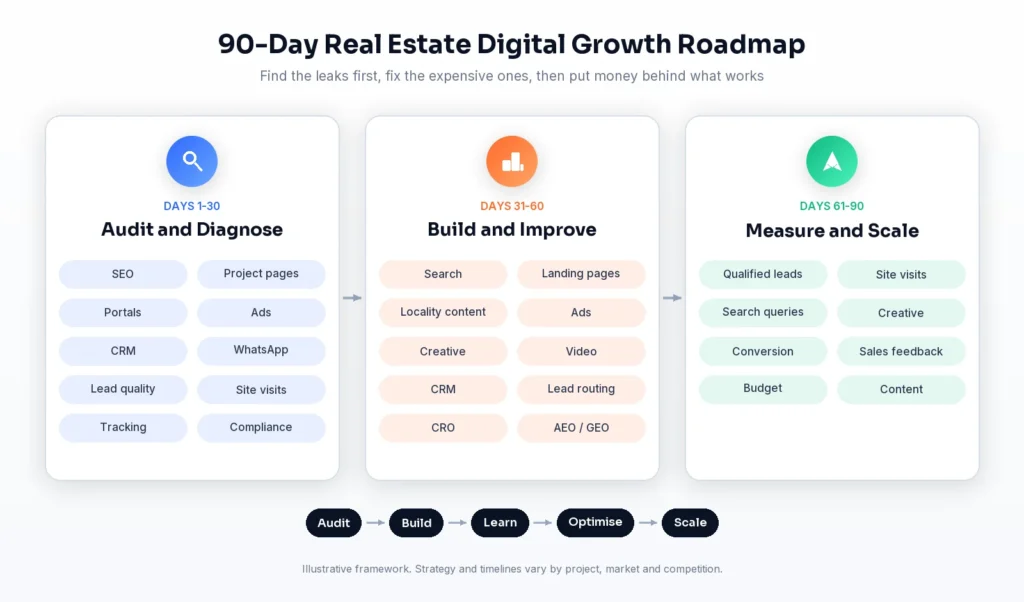
A 90-day plan
Treat this as an illustrative framework, not a fixed programme. Priorities and timings vary with the business, the projects, the location and the competition.
Days 1 to 30: find where leads and site visits are being lost
Review analytics and Search Console, technical SEO and indexing, current search visibility against competitors, Google Business Profile, project pages, portal listings, Google Ads and Meta accounts, creative, landing pages, the CRM, the WhatsApp and call handoff, lead routing, lead quality and site-visit records. Check the advertising workflow against RERA and the state authority’s current requirements, the calling and messaging set-up against TRAI’s rules, and how consent is collected ahead of the DPDP obligations.
The question for the month: where are qualified leads, site visits and budget being lost?
Days 31 to 60: fix the biggest gaps first
Depending on what the audit finds, this might mean rebuilding project and locality pages, fixing local search, restructuring Google Ads around intent, refreshing Meta creative, adding site-visit calls to action, setting up a proper WhatsApp handoff, connecting the CRM to the ad platforms, agreeing lead-scoring rules with sales, starting a video series, testing regional-language content, or tightening entity consistency for search and AI discovery. The discipline is to fix the highest-impact problems first, not everything at once.
Days 61 to 90: measure, then move budget
Look at search queries, qualified leads, lead-to-contact rates, site visits and their sources, demand by project, configuration and locality, creative performance, landing-page conversion and sales feedback. Where attribution is reliable, look at bookings. Then learn, improve, reallocate and expand what works.
Choosing a real estate marketing agency
A few questions separate agencies that understand Indian property from those that do not.
Ask how they will measure success. If the answer is leads and cost per lead only, keep asking. Ask whether they will work inside your CRM and report on site visits. Ask how they handle RERA details in creative, and whether they know your state authority’s current advertising orders. Ask how they approach calling and messaging under TRAI’s rules. Ask what they will do in the first thirty days, and what they will not do.
Some red flags:
- Guaranteed lead volumes, or “300 leads a month” promised before they have seen your project
- Guaranteed rankings, AI citations or bookings
- Offers to promote a project before it is registered, if it needs registration
- Purchased databases or bulk SMS offered as a lead source
- Reports that stop at impressions, clicks and cost per lead
- Reluctance to give you ownership of your ad accounts, data and website
How Apzom Digital works with property businesses
Apzom Digital is a digital marketing agency based in Ahmedabad. We work with clients across India and internationally, and we do not have offices in other Indian cities. Our property work includes website builds, social media marketing and performance marketing for two property developers, HillTown and KingSton. We do not publish their numbers here because verified results have not yet been signed off by those clients.
For real estate businesses, our work typically covers SEO, local SEO, AEO and GEO, Google Ads, Meta ads, social media, content, website development, conversion rate optimisation, tracking and lead-funnel strategy. We do not provide legal advice on RERA, consumer protection, TRAI or DPDP matters, and we will ask your team to confirm compliance-sensitive details before anything goes live.
Request a Real Estate Digital Growth Audit
If you want a clear view of where enquiries and site visits are being lost, start with a diagnostic rather than a proposal. A useful audit looks at your search visibility and competitors, project landing pages, Google Ads and Meta campaigns, lead quality, the site-visit funnel, CRM and WhatsApp workflow, conversion tracking, dependence on portals, AEO and GEO readiness, content gaps and technical SEO.
Request a Real Estate Digital Growth Audit and tell us about your projects, markets and current results. If you would rather talk first, you can contact us directly.
Frequently asked questions
What does a real estate digital marketing agency in India do?
It plans and runs the digital channels that bring property buyers to a developer, broker or consultant: search, Google Business Profile, property portals, Google Ads, Meta, YouTube, content and the website. A good one also connects those channels to calls, WhatsApp and the CRM, and measures results in qualified leads, site visits and bookings rather than clicks or raw leads.
How can builders generate more qualified property leads?
Target intent rather than volume: project, locality and configuration searches; creative that shows real details; landing pages with complete project information and RERA details; lead forms that filter lightly; fast, contextual follow-up; and CRM data that tells marketing which sources produce site visits.
How can real estate brokers generate leads online?
Brokers usually benefit most from local visibility, a strong Google Business Profile with genuine reviews, well-kept portal listings, locality content that shows real knowledge, a looked-after contact list and focused local campaigns. Personal and agency reputation carries a lot of weight.
Google Ads or Meta Ads: which is better for property leads?
Neither is better in general. Google Ads captures people already searching, so intent is usually higher. Meta creates awareness and demand, especially for launches and visual projects, but its leads need tighter qualification. Most developers need both, judged on site visits rather than cost per lead.
Is SEO worth it for real estate companies in India?
Usually, yes, especially for developers with several projects and brokers who work particular localities. SEO takes months and requires genuinely useful pages, but it builds visibility you own and reduces dependence on portals and ad budgets over time.
What should real estate businesses know about RERA and advertising?
A project that requires registration cannot be advertised or marketed before it is registered, under Section 3 of the RERA Act. Once registered, advertisements must prominently show the authority’s website address and the project registration number, under Section 11(2). State authorities can add their own requirements, such as QR codes in Maharashtra and Gujarat, so check the current orders of the authority where your project is registered.
Do Google’s housing ad restrictions apply in India?
Google’s restricted targeting policy for housing ads applies to the United States and Canada. Indian property campaigns still have to follow Google’s general advertising policies and Indian law, including RERA and consumer protection rules.
What are AEO and GEO for real estate?
AEO makes your information clear enough for search and answer tools to present accurately. GEO is about how AI assistants describe and recommend businesses. For real estate, both rely on consistent, accurate project and developer information, useful original content and search fundamentals. No one can guarantee AI visibility.
How should real estate companies measure digital marketing?
Track leads through to outcomes: contact rate, qualification rate, site visits booked and attended, opportunities and bookings, and the cost of each by source. Cost per site visit is often the most useful single measure for developers.
If you market beyond India
Many Indian developers and brokers also sell to buyers overseas or work in other markets, and the rules change as soon as you cross a border. We have written separate guides to real estate marketing in the United States, Canada, Dubai and Australia, each built around that market’s own regulators and platforms.